 JAZZPROFILES lives in the music 1,572 Jazz Artists fully Profiled!
 David Amram
Last updated September 5, 2026
Listen on Spotify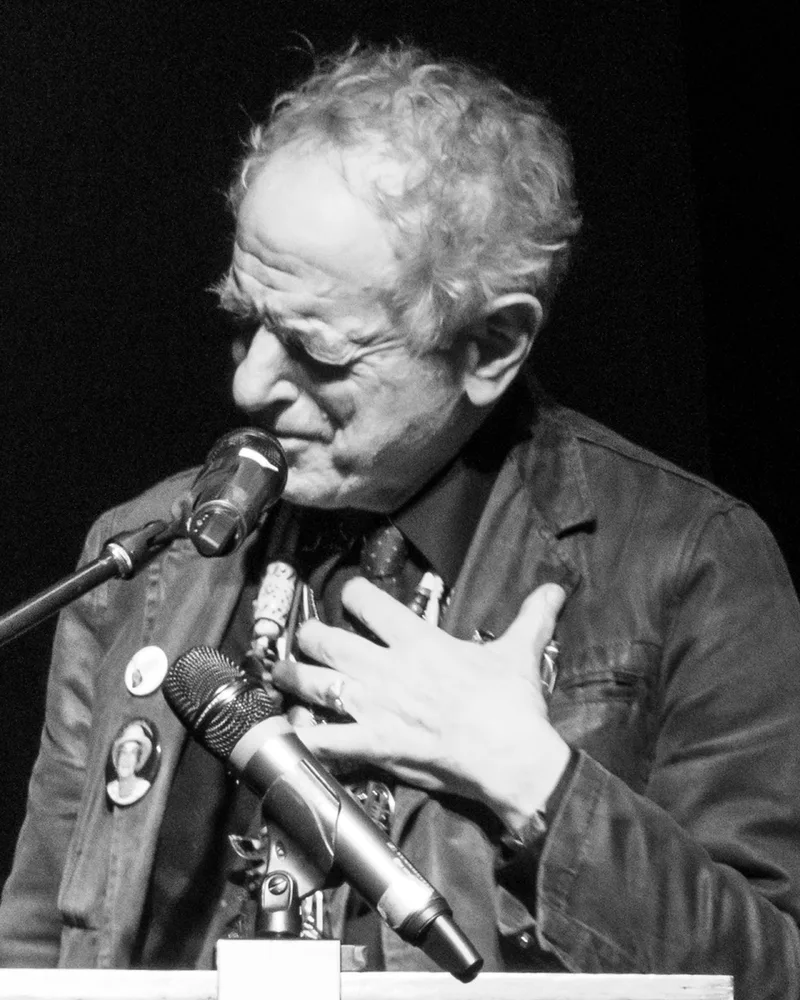
David Amram speaking at the public tribute to Robert Knight, March 28, 2015, at The Riverside Church, New York, New York. Photo by Jennifer.hasegawa. CC BY-SA 4.0 (Creative Commons Attribution-ShareAlike 4.0 International) — Wikimedia Commons — https://commons.wikimedia.org/wiki/File:David_Amram_at_The_Riverside_Church.jpg

David Werner Amram III was born November 17, 1930, in Philadelphia, the son of the legal scholar Philip Werner Amram and grandson of another David Werner Amram, also a lawyer and legal scholar. He spent much of his childhood on the family farm in Bucks County, Pennsylvania, learning Hebrew and cantorial melodies from his grandfather while working through classical piano, which he started at seven. He tried trumpet before settling on the French horn, an instrument with almost no jazz precedent at the time. He studied at Oberlin Conservatory in 1948 and 1949, then took a bachelor's degree in European history from George Washington University in 1952, playing horn with the National Symphony Orchestra in Washington from 1951 while he finished the degree.
Drafted in 1952, Amram spent his service in Europe, playing French horn in Army bands and in the Seventh Army Symphony Orchestra, which had been founded that same year and was based in Stuttgart. Off duty he found the European jazz scene instead. In the autumn of 1954 he recorded six sides at the American Forces Network studios in Frankfurt with a group built around trombonist Albert Mangelsdorff and guitarist Attila Zoller, issued as a 7-inch EP on the tiny Presto label. In Paris on March 17 and 18, 1955 he cut three separate dates in two days: Don Rendell and Bobby Jaspar's Rencontre à Paris for Swing, Jaspar's own Plays... Gone With The Winds, and two sessions with Lionel Hampton's pickup French band alongside Sacha Distel, René Urtreger, and Nat Adderley, released as Crazy Rhythm on EmArcy and Lionel Hampton And His French New Sound on Barclay.
He moved to New York later in 1955 and enrolled at the Manhattan School of Music, studying composition with Vittorio Giannini and Gunther Schuller and conducting with Dimitri Mitropoulos, while paying rent on the bandstand. He played French horn in Charles Mingus's Jazz Workshop at the Café Bohemia and in Oscar Pettiford's orchestra at Birdland, and he was in Pettiford's horn section for both Oscar Pettiford Orchestra In Hi-Fi (ABC-Paramount ABC-135, 1956) and its February 1958 sequel, sharing the chairs with Julius Watkins, the only other horn player then working regularly in jazz. The rest of the decade brought a steady run of unusual dates: accordionist Mat Mathews's Gentle Art Of Love (Dawn, 1956) with Herbie Mann and Art Farmer, Mathews's 4 French Horns Plus Rhythm (Elektra EKL-134, 1957), a Teddy Charles-supervised session for Rudy Van Gelder on May 18, 1957 that turned up years later under three different titles, the Sal Salvador Quartet's Colors In Sound (Decca DL 9210, 1958), and Kenny Dorham's Blue Spring (Riverside RLP 12-297), recorded January 20 and February 18, 1959 with Cannonball Adderley, Paul Chambers, and Jimmy Cobb. His own first leader date came in between: The Eastern Scene, a quartet co-billed with tenor saxophonist George Barrow, recorded January 16, 21, and 30, 1957 and released by Decca.
The same years put Amram at the center of the downtown literary scene. In 1957 he staged what is generally counted as New York's first jazz and poetry reading, at the Brata Art Gallery on East 10th Street, with Jack Kerouac, Howard Hart, and Philip Lamantia. Two years later he wrote the score for Pull My Daisy, the 28-minute short directed by Robert Frank and Alfred Leslie from a Kerouac text that Kerouac then narrated live over the finished picture; Amram also appears on screen as the horn-playing character Mez McGillicuddy, and Anita Ellis sang the title song. He and Kerouac kept working together for more than a decade, and Amram published an account of it in 2002 as Offbeat: Collaborating with Kerouac.
While the jazz work continued, Amram was building a parallel career in theater, film, and concert music. Joseph Papp commissioned incidental music from him for a 1956 Titus Andronicus, the start of an association that produced scores for 25 New York Shakespeare Festival productions through 1967. He was composer and music director at the Lincoln Center Repertory Theater from 1964 to 1966, writing for Arthur Miller's After the Fall and Incident at Vichy. His film work arrived in a concentrated burst: The Young Savages and Elia Kazan's Splendor in the Grass, both released in 1961, then John Frankenheimer's The Manchurian Candidate in 1962 and Kazan's The Arrangement in 1969. A score he wrote for Frankenheimer's Seven Days in May was rejected and replaced with one by Jerry Goldsmith. His one-act opera The Final Ingredient, set in a concentration camp, was televised by ABC in 1965, and the comic opera Twelfth Night, to a libretto by Papp, followed in 1968. In 1966 Leonard Bernstein picked Amram out of roughly 100 candidates to be the New York Philharmonic's first composer-in-residence, a one-year post created for him.
From the late 1960s onward Amram treated the whole world as source material, traveling for the U.S. Information Agency and other sponsors to Brazil in 1969, Kenya in 1975, Cuba in 1977, and the Middle East in 1978, and eventually working in more than 35 countries. The Cuban trip was the consequential one. In May 1977 he sailed from New Orleans aboard the Daphne with Dizzy Gillespie, Stan Getz, and Earl Hines in the first group of American musicians permitted to visit Cuba since 1961; a live Havana performance of his "En Memoria de Chano Pozo" with members of Irakere, including Arturo Sandoval and Paquito D'Rivera, anchors the resulting album Havana/New York. His own records from this period gathered whatever he had picked up: No More Walls (RCA Red Seal, 1971), Subway Night (RCA Victor, 1973), At Home / Around The World (Flying Fish, 1980), and Latin-Jazz Celebration (Elektra Musician, 1983) all mix jazz horns with oud, dumbek, shanai, Andean flutes, and Cuban percussion. He ran young people's and family concerts for the Brooklyn Philharmonic for more than 25 years and became director of the International Jewish Arts Festival on Long Island in 1982.
Amram has written more than 100 orchestral and chamber works and four books, including the memoir Vibrations (1968) and Amram@90: Notes from a Promising Young Composer (2022). He remains active in his mid-nineties: in April 2026 he traveled to Ohio State University for the Wind Symphony's premiere of a wind-band version of his This Land: Symphonic Variations on a Song by Woody Guthrie, and he was billed to open the Hudson River Music Festival at Croton Point Park on June 14, 2026.
Amram's central claim on jazz history is simple and hard to overstate: with Julius Watkins, he made the French horn an improvising voice rather than a section color, and he did it in the two hardest rooms available, Charles Mingus's Jazz Workshop and Oscar Pettiford's big band. The horn has no keys, a treacherous overtone series, and a tone built for blending rather than cutting, which is why the discography of jazz horn soloists before 1955 is essentially empty. Amram's answer was to play it lyrically instead of trying to make it bark like a saxophone, which is audible on the six French-horn tracks from the May 18, 1957 Van Gelder session, where he and Watkins trade lines over Hampton Hawes and Curtis Fuller. He refused the standard mid-century separation of jazz from concert music, studying with Gunther Schuller while gigging at the Café Bohemia, and his Triple Concerto (1974) makes the argument literally by writing a jazz quintet, a woodwind quintet, and a brass quintet into the same orchestral score. The later records widen the frame further, absorbing Cuban, Middle Eastern, Native American, and Appalachian material well before "world music" was a marketing category. BMI has listed him among the 20 most-performed composers of concert music in the United States since 1974, which is a fair measure of where his weight actually sits: the jazz playing is a real and continuous thread, but the composing is the larger body of work.
- The Eastern Scene (1957, Decca) - Amram's first leader date, co-billed to the Amram-Barrow Quartet with tenor saxophonist George Barrow, and a rare full album of jazz French horn as the lead voice. Spotify - The Eastern Scene Listen
- Oscar Pettiford Orchestra In Hi-Fi (1956, ABC-Paramount) - As a sideman: Pettiford's big band with Amram and Julius Watkins paired in the horn chairs, alongside Art Farmer, Gigi Gryce, and Tommy Flanagan. Spotify - Oscar Pettiford Orchestra in Hi-Fi
- Curtis Fuller And Hampton Hawes With French Horns (rec. 1957, rel. 1965, Status) - The six-track Amram/Watkins half of the May 18, 1957 Van Gelder date, first issued in 1958 as the B-side of Prestige's Modern Jazz Survey 2: Baritones & French Horns opposite Pepper Adams and Cecil Payne. Includes Amram's own "Five Spot." Spotify - Curtis Fuller & Hampton Hawes With French Horns
- Blue Spring (1959, Riverside) - As a sideman: Kenny Dorham's septet date with Cannonball Adderley and Cecil Payne, one of the few hard bop records of its era to carry a French horn in the front line. Spotify - Blue Spring
- No More Walls (1971, RCA Red Seal) - A double LP that puts Amram's Shakespearean Concerto and King Lear Variations on the first record and jazz, Middle Eastern, and Brazilian pieces on the second, closing with a setting of "Pull My Daisy" featuring the recorded voices of Kerouac and Allen Ginsberg. Pepper Adams plays baritone. Spotify - No More Walls Listen
- Triple Concerto For Woodwind, Brass, Jazz Quintets And Orchestra (1974, RCA Red Seal) - Amram's Third Stream statement of purpose, with his own jazz quintet (Pepper Adams, Jerry Dodgion, Herb Bushler, Al Harewood) set against the Rochester Philharmonic under David Zinman. Spotify - Triple Concerto & Elegy for Violin and Orchestra Listen
- Havana/New York (1978, Flying Fish) - The document of the 1977 U.S.-Cuban musical exchange, including "En Memoria de Chano Pozo" recorded live in Havana on May 18, 1977 with Arturo Sandoval, Paquito D'Rivera, Candido, and Ray Mantilla. Spotify - Havana/New York Listen
- Latin-Jazz Celebration (1983, Elektra Musician) - A Joel Dorn-produced big-band Latin date with Machito on claves, Jimmy Knepper on trombone, Joe Wilder on trumpet, and Pepper Adams and George Barrow in the reeds. Not found on Spotify.
David Amram: Full Discography
Identity confirmed via the live Discogs API, artist ID 145286 ("David Amram," realname David Werner Amram III, born November 17, 1930 in Philadelphia, listed as father of Alana, Adam, and Adira Amram). Amram's catalog runs across three largely separate bodies of work: jazz playing dates, concert music and opera issued under his name as composer, and film and theater scores. This file scopes the leader table to his own commercially issued albums across all three, curated rather than exhaustive, and follows it with a selected set of his most significant sideman credits as a player. Private and archival pressings of single concert works are represented only where a commercial release or reissue exists.
Discogs credits Amram on 225 releases under his personal artist ID: 57 in a "Main" role, 142 "Appearance" credits, 23 track-level credits, 2 production credits, and 1 unofficial release. The "Appearance" figure is not a count of playing dates. A large share of it is composer credit on other people's recordings of his film themes, including Stan Kenton's "Theme From Splendor In The Grass," Les Baxter's "Theme From The Manchurian Candidate," Hugo Montenegro's "Theme From The Young Savages," Percy Faith's Hollywood's Great Themes, Martin Denny's Another Taste Of Honey!, and the LeRoy Holmes Orchestra's Themes From The New Provocative Films. Amram plays on far fewer sessions than the raw number suggests. Five additional group-billing entities carry work that does not appear under the personal ID at all: David Amram Quintet (635343), David Amram Quartet (2504326), David Amram And Friends (1511526), The David Amram Ensemble (1021961), and The Amram-Barrow Quartet, all checked for this file.
As Leader / Co-Leader
| Album Title | Recording Date(s) | Release Date | Label | Catalog Number | Format(s) | Personnel | Role | Reissue History | Spotify | Buy | Notes |
|---|---|---|---|---|---|---|---|---|---|---|---|
| David Amram / Albert Mangelsdorff Group | Recorded autumn 1954, AFN Studios, Frankfurt | 1954 | Presto | No catalog number listed | Vinyl, 7", EP | David Amram (French horn), Albert Mangelsdorff (trombone), Attila Zoller (guitar, piano), Harry Schell (bass), Karl Sanner (drums) | Co-leader | The six 1954 tracks form side A of Live In Germany 1954-2013 (After The Fall Records, 2022) | Spotify - Live in Germany (1954-2013) | — | Cut while Amram was still in the Army in Europe; his earliest known recording |
| The Eastern Scene | Recorded January 16, 21, and 30, 1957, New York | 1957 | Decca | DL 8558 | Vinyl, LP, Mono | David Amram (French horn, piano, Wagner tuba), George Barrow (tenor saxophone), Art Phipps (double bass), Al Harewood (drums) | Co-leader (The Amram-Barrow Quartet) | None found on Discogs | Spotify - The Eastern Scene | — | Session dates per Tom Lord's Jazz Discography as cited in the Discogs release notes; includes three Amram originals ("City Talk," "Lobo Nocho," "Shenandoah") |
| Modern Jazz Survey 2 / Baritones & French Horns | French Horns side recorded May 18, 1957, Van Gelder Studio, Hackensack NJ; Baritones side date not specified | August 1958 | Prestige | PRESTIGE 6 | Vinyl, LP, 16⅔ RPM, Mono | French Horns side: David Amram, Julius Watkins (French horn), Curtis Fuller (trombone), Sahib Shihab (alto saxophone), Hampton Hawes and Teddy Charles (piano), Addison Farmer (bass), Jerry Segal (drums). Baritones side: Pepper Adams and Cecil Payne (baritone saxophone), John Coltrane (tenor saxophone), Mal Waldron (piano), Doug Watkins (bass). Supervised by Teddy Charles, recorded by Rudy Van Gelder | Co-leader (billing shared among four leaders) | The six French Horns tracks were reissued complete and at standard speed in 1965 as Curtis Fuller And Hampton Hawes With French Horns (Status ST 8305), then on Original Jazz Classics CD in 2001; the Baritones side was later folded into Coltrane compilations issued as Dakar | Spotify - Curtis Fuller & Hampton Hawes With French Horns | — | A four-way survey disc, not a solo Amram date. The 16⅔ RPM original is not on Spotify; the linked Status reissue carries Amram's half of it, tracklist verified identical (Ronnie's Tune / Roc And Troll / A-Drift / Lyriste / Five Spot / No Crooks). This is the release through which Amram appears in Pepper Adams's profile |
| The Young Savages (An Original Sound Track Recording) | Recorded 1961 | 1961 | Columbia | CS 8472 | Vinyl, LP, Album, Stereo | David Amram (composed by, conducted, orchestrated) | Leader (composer/conductor) | Reissued digitally in 2011 billed to "David Amram & His Orchestra" | Spotify - The Young Savages | — | Score for John Frankenheimer's 1961 Burt Lancaster picture; 13 tracks on both the LP and the digital reissue |
| The Final Ingredient | Recorded 1965 | 1965 | Not On Label (private pressing) | None listed | Vinyl, 2xLP | David Amram (composer) | Leader (composer) | Commercially issued on CD in 1996 by Premier Recordings; the work also appears on the 2004 Naxos program below | Not found as this pressing; the work is on Spotify - AMRAM: Songs of the Soul / Shir L'erev Shabbat / The Final Ingredient | — | One-act opera set in a concentration camp, commissioned and televised by ABC in 1965 |
| A Year In Our Land | Not specified in Discogs data | 1965 (Interracial Chorale pressing); 1968 (Houston Symphony pressing) | Not On Label | None listed | Vinyl, LP | David Amram (composer), Harold Aks conducting the Interracial Chorale & Orchestra (1965); Houston Symphony Orchestra with the Texas Southern University Choir (1968) | Leader (composer) | Two separate private pressings of different performances | Not found on Spotify | — | Cantata on American texts; both pressings are documentary rather than commercial |
| Let Us Remember | Not specified in Discogs data | 1965 | Not On Label | None listed | Vinyl, 10" | David Amram (composer), Oakland Symphony Orchestra and Oakland Symphony Chamber Chorus, Gerhard Samuel (conductor) | Leader (composer) | None found | Not found on Spotify | — | Cantata premiered at a Union of American Hebrew Congregations convention, on Jewish and African American freedom struggles |
| The Arrangement (Original Motion Picture Sound Track) | Recorded July 1969, Fine Studios, New York | 1969 | Warner Bros. - Seven Arts | WS 1824 | Vinyl, LP, Album | David Amram (composed by, conductor); liner notes by Elia Kazan | Leader (composer/conductor) | None found | Not found on Spotify | — | Amram's second Kazan score after Splendor in the Grass |
| No More Walls | Not specified in Discogs data | 1971 | RCA Red Seal | VCS-7089 | Vinyl, 2xLP (Dynaflex) | David Amram (piano, French horn, guitar, Clarke/Bombay/Pakistani flutes, bouzouki, kazoo, percussion), Pepper Adams (baritone saxophone), Jerry Dodgion (alto saxophone), Herb Bushler and Lisle Atkinson (bass), Al Harewood (drums), Candido, Arthur Edgehill, L. J. Calderon (percussion), Moulay "Ali" Hafid (dumbek, vocals), George Mgrdichian (oud), Ramblin' Jack Elliott and Sam Brown (guitar), Midhat Serbagi (viola) | Leader | Reissued on CD in 1997 by Flying Fish (FF 752) with a reduced 7-track selection | Spotify - No More Walls | — | Four sides, twelve pieces: the Shakespearean Concerto and King Lear Variations on record one, jazz and world pieces on record two, closing with "Pull My Daisy" featuring the recorded voices of Jack Kerouac and Allen Ginsberg. The Spotify edition is the 7-track CD reissue, not the full double LP |
| Subway Night | Not specified in Discogs data | 1973 | RCA Victor | LSP-4820 | Vinyl, LP, Album, Stereo | David Amram (lead vocals, piano, guitar, flutes, bouzouki, composer, arranger, conductor, producer), Joe Henderson (tenor saxophone), Pepper Adams (baritone saxophone), Thad Jones (on "Mean Dean"), Joe Wilder (on "Ballad For Red Allen"), Bill Watrous (trombone), Herb Bushler (bass), Al Harewood (drums), Candido (congas, bongos), David Bromberg and Joe Beck (guitar), Collin Walcott (tabla), George Mgrdichian and Charles Ganimian (oud), Andy Statman (mandolin), Kenny Kosek (violin) | Leader | None found | Not found on Spotify | — | Amram singing his own songs over a very large mixed band; with a two-sided lyric insert |
| Triple Concerto For Woodwind, Brass, Jazz Quintets And Orchestra | Not specified in Discogs data | 1974 | RCA Red Seal | ARL1-0459 | Vinyl, LP, Stereo | The David Amram Quintet: David Amram (French horn, piano, flute), Pepper Adams (baritone saxophone), Jerry Dodgion (alto saxophone), Herb Bushler (bass), Al Harewood (drums); Rochester Philharmonic Orchestra, David Zinman (conductor); Howard Weiss (violin soloist on "Elegy") | Leader (composer/performer) | Reissued on CD in 1998 by Flying Fish (FF 751) | Spotify - Triple Concerto & Elegy for Violin and Orchestra | — | Three movements plus the "Elegy For Violin And Orchestra." Discogs dates the RCA LP 1974; Spotify's metadata for the linked digital edition says 1977, and the discrepancy is unresolved |
| Summer Nights, Winter Rain | Some selections recorded in concert, Toronto, March 1976 | 1976 | RCA Victor | KPL1-0169 | Vinyl, LP, Stereo | David Amram (lead vocals, acoustic and electric guitar, flute, whistle, kazoo, French horn, piano, percussion, words and music, producer), Charlie Chin (guitars, banjo), Tony Markellis (fretless bass), Beaver Harris (drums), Ray Mantilla (congas, percussion), Herbie Spanier (trumpet), Shingoose (rattle, percussion), Shirley Eikhard (backing vocals); one lyric by Jack Kerouac | Leader | None found | Not found on Spotify | — | Canadian release only |
| Havana/New York | Recorded live in Havana, Cuba, May 18, 1977 and at Broadway and 44th Street, New York, June 1977 | 1978 | Flying Fish | FF-057 | Vinyl, LP, Album | David Amram (Spanish guitar, piano, wooden flute, pennywhistle, French horn, claves, percussion, composer, arranger, producer), Arturo Sandoval (trumpet), Paquito D'Rivera (alto saxophone), Oscar Valdés (congas), Los Papines (congas, percussion), Candido (congas), Ray Mantilla (congas, percussion), Nicky Marrero (timbales), Johnny Rodriguez (bongos), Alfredo de la Fé (electric violin) | Leader | Later CD reissue | Spotify - Havana/New York | — | Subtitled "The Historic US-Cuban Musical Exchange of 1977"; liner notes by Arnold Jay Smith of DownBeat. Four long tracks, one of them "En Memoria de Chano Pozo" |
| At Home / Around The World | Not specified in Discogs data | 1980 | Flying Fish | FF-094 | Vinyl, LP, Album | David Amram (French horn, piano, Pakistani and shepherd flutes, pennywhistles, shanai, percussion, producer, arranger), Pepper Adams (baritone saxophone), Jerry Dodgion (alto saxophone), George Barrow (saxophone), Wilmer Wise (trumpet), Victor Venegas (bass), Steve Berrios (drums, percussion), Candido (congas), Ray Mantilla, Nicky Marrero, Johnny Rodriguez (percussion), George Mgrdichian (oud), Mohammed El Akkad (kanoon), Hakki Obadia (violin), Floyd Westerman (Sioux frame drum, chant), Odetta (vocals), Ramblin' Jack Elliott (guitar, yodeling), Patty Smyth and Angela Bofill (backing vocals) | Leader (David Amram And Friends) | CD reissue on Flying Fish | Spotify - At Home / Around The World | — | Side one American material (including "Splendor In The Grass"), side two pieces from Kenya, Panama, Guatemala, Pakistan, Afghanistan, and Egypt |
| Autobiography | Not specified in Discogs data | 1982 | Flying Fish | FC 27753 | Vinyl, LP, Album | David Amram (composer, conductor), The New York Chamber Orchestra: David Nadien (violin), Midhat Serbagi (viola), Lorne Munroe (cello), James Politis (flute), Alfred Genovese (oboe), Andrew Crisanti (clarinet), Kenneth Pasmanick (bassoon), Howard Howard and Tony Miranda (French horn), Raymond Crisara (trumpet) | Leader (composer/conductor) | None found | Not found on Spotify | — | Two extended concert works, "Autobiography For Strings" among them |
| Latin-Jazz Celebration | Not specified in Discogs data | 1983 | Elektra Musician | 60195-1 | Vinyl, LP | David Amram (acoustic guitar, French horn, pennywhistle, piano, ocarina, Andean flute and percussion, composer, arranger), Paquito D'Rivera (alto and soprano saxophone), Pepper Adams (baritone saxophone), Jerry Dodgion (alto and soprano saxophone), George Barrow (tenor saxophone), Jimmy Knepper (trombone), Joe Wilder (trumpet), Victor Venegas (bass), Candido (congas, bongos), Mayra Casales (congas), Steve Berrios (timbales, drums), Duduka Da Fonseca (Brazilian percussion), Machito (claves), Mario Grillo (guiro); produced by Joel Dorn | Leader (David Amram And Friends) | None found | Not found on Spotify | — | Includes "En Memoria De Chano Pozo," "Take The A Train," and a closing spoken interview track |
| Live At Musikfest! / Pull My Daisy ... And Other Jazz Classics / Pull My Daisy (Live) | Recorded live at Musikfest, Bethlehem PA, August 22, 1988 and August 21, 1989 | 1990 (Live At Musikfest!); 1995 (Pull My Daisy ... And Other Jazz Classics); 2017 (digital, as Pull My Daisy (Live)) | New Chamber Music, Inc. (1990); Premier Recordings (1995) | NCM901C (1990); PRCD 1046 (1995) | CD, Album; also cassette (1990) | David Amram Quartet: David Amram (piano, vocals, congas, flute, French horn, guitar, cowbell, claves, percussion), Victor Venegas (bass), Akira Tana (drums), Vic Juris (guitar, 1988 selections), Paquito D'Rivera (alto saxophone, clarinet, 1989 selections) | Leader | One recording, three titles: the 1995 Premier CD and the 2017 digital edition carry the same nine tracks as the 1990 original | Spotify - Pull My Daisy (Live) | — | Verified as a single set rather than three albums: identical nine-track running order and identical personnel across all three issues. Programme runs "Musikfest Montuno," "Lover Man," "Take The A Train," "Pull My Daisy," "Saint Thomas," "Summertime," "Tennessee Waltz," "Red River Valley," "Blue Monk" |
| An American Original | Not specified in Discogs data | 1993 | Newport Classic | NPD 85546 | CD, Album | David Amram (composer), The Manhattan Chamber Orchestra, Richard Auldon Clark (conductor), Julius Baker (flute), Chris Gekker (trumpet), James Courtney (bass voice) | Leader (composer) | None found | Not found on Spotify | — | Concert works only |
| Three Concertos | Not specified in Discogs data | 1995 | Newport Classic | NPD 85562 series | CD, Album | David Amram (composer), Charles Castleman (violin), Nathaniel Rosen (cello), Kenneth Pasmanick (bassoon), Manhattan Chamber Orchestra, Richard Auldon Clark (conductor) | Leader (composer) | None found | Not found on Spotify | — | Catalog number not confirmed in the Discogs data returned; label and year are |
| On The Waterfront On Broadway (Original Broadway Soundtrack) | Recorded at The Hit Factory, New York | 1995 | Varèse Sarabande | VSD-5638 | CD, Album | David Amram (composer, orchestrator, conductor, piano, pennywhistle, French horn, Irish flute, percussion), Jerry Dodgion (alto saxophone), Slide Hampton (trombone), Jimmy Owens and Chris Gekker (trumpet), Gene Bertoncini and Vic Juris (guitar), Victor Venegas (bass), Akira Tana (drums), Candido (percussion) | Leader (composer/conductor) | None found | Spotify - On The Waterfront: On Broadway | — | Amram's score for the 1995 stage adaptation, not the 1954 Bernstein film score |
| The Manchurian Candidate (Complete Soundtrack Recording) | 1962 score, re-recorded for this release | 1997 | Premier Recordings | PRCD 1059 | CD, Album | David Amram (composed by, conductor) | Leader (composer/conductor) | None found | Only single-track digital versions of the main theme found on Spotify; the complete recording is not there | — | 13 tracks, 66 minutes, with booklet notes by Neil Hickey and by Amram |
| Southern Stories | Not specified in Discogs data | 1999 | Chrome Records | CC4202 | CD, Album | David Amram (vocals, piano, Lakota courting flute, shanai, dumbek, whistle, words and music), Vassar Clements (fiddle), Mickey Raphael (harmonica), Reggie Young and Rick Gordon (acoustic guitar), Butch Baldassari (mandolin), Michael Rhodes (bass), Fred Bogert (producer, bass, guitar); liner notes by Douglas Brinkley | Leader | None found | Not found on Spotify | — | Nashville-recorded songwriter record, 13 tracks |
| Symphony: Songs Of The Soul | Not specified in Discogs data | 2004 | Naxos | 8.559420 series (Milken Archive) | CD, Album | David Amram (composer); performances of Symphony: Songs of the Soul, Shir L'Erev Shabbat, and excerpts from The Final Ingredient | Leader (composer) | Reissued/repackaged within the Milken Archive of Jewish Music series | Spotify - AMRAM: Songs of the Soul / Shir L'erev Shabbat / The Final Ingredient | — | Gathers Amram's Jewish liturgical and Holocaust-related works in one program. Naxos catalog number inferred from the Milken Archive series and not confirmed in the Discogs data returned |
| David Amram's Classic American Film Scores 1956-2016 | Various, 1956-2016 | 2016 | Moochin' About | Not listed | 5xCD, Compilation, Remastered, Box set | David Amram (composer, conductor) | Leader (composer) | None found | Not found on Spotify | — | Five-disc survey of the film work, from the 1956 documentary Echo of an Era forward |
| So In America: Selected Chamber Music Compositions 1958-2017 | Various, 1958-2017 | 2018 | Affetto Recordings | Not listed | CD, Album | David Amram (composer), various chamber performers | Leader (composer) | None found | Not found on Spotify | — | Sixty years of chamber writing in one program |
| Live In Germany 1954-2013 | Recorded autumn 1954, AFN Studios Frankfurt (side A) and summer 2013, KZM Museum, Karlsruhe (side B) | March 16, 2022 | After The Fall Records | ATF-002 | Vinyl, LP, Compilation, Limited Edition (200 copies) | Side A: David Amram (French horn), Albert Mangelsdorff (trombone), Attila Zoller (guitar), Jutta Hipp (piano), Harry Schell (bass), Karl Sanner (drums). Side B: David Amram (piano, pennywhistle), Emil Mangelsdorff (alto saxophone), Thomas Siffling (trumpet), Matthias Ockert (guitar), Judith Goldbach (bass), Erwin Ditzner (drums) | Leader | First issue of the 1954 AFN broadcast material in album form | Spotify - Live in Germany (1954-2013) | — | Fifty-nine years apart on one record, with a Mangelsdorff brother on each side. Signed limited pressing |
| Voyages / Piano Sonata / Violin Sonata | Not specified in Discogs data | 2025 | Naxos | Not listed | CDr, Album | David Amram (composer), Elmira Darvarova (violin), Thomas Weaver (piano) | Leader (composer) | None found | Not found on Spotify | — | The most recent release under Amram's name in the Discogs data |
As Sideman (selected major credits)
| Year | Project (Leader) | Title | Label | Catalog | Role | Notes |
|---|---|---|---|---|---|---|
| 1955 | Don Rendell and Bobby Jaspar | Rencontre à Paris | Swing | M. 33.344 | French horn | Recorded March 17, 1955, Paris; with Sacha Distel, Maurice Vander, Guy Pedersen |
| 1955 | Bobby Jaspar | Plays... Gone With The Winds | Swing | M. 33.351 | Horn | 10-inch LP; chamber-jazz instrumentation including oboe, bassoon, and flute |
| 1955 | Lionel Hampton And His French New Sound | Crazy Rhythm; French New Sound Vols. 1 and 2 | EmArcy; Barclay | MG-36034; 84004 | French horn (credited as "Dave Amram") | Recorded live in Paris, March 18, 1955; band included Nat Adderley, Benny Bailey, Sacha Distel, and René Urtreger |
| 1956 | Mat Mathews | Gentle Art Of Love | Dawn | DLP 1111 | French horn | With Oscar Pettiford (bass), Herbie Mann (flute), Art Farmer (trumpet) |
| 1956 | Oscar Pettiford Orchestra | Oscar Pettiford Orchestra In Hi-Fi | ABC-Paramount | ABC-135 | French horn | Horn chairs shared with Julius Watkins; also Art Farmer, Gigi Gryce, Lucky Thompson, Jimmy Cleveland, Tommy Flanagan; produced by Creed Taylor |
| 1957 | Mat Mathews | 4 French Horns Plus Rhythm | Elektra | EKL-134 | French horn | Four-horn front line with Julius Watkins, Tony Miranda, and Fred Klein; Milt Hinton and Osie Johnson in the rhythm section. Also issued on Savoy (MG 12173) |
| 1958 | The Oscar Pettiford Orchestra | Oscar Pettiford Orchestra In Hi-Fi, Volume Two | ABC-Paramount | ABC-227 | Horn | Released February 1958; arrangements by Gigi Gryce and Benny Golson, with Kenny Dorham, Art Farmer, Ray Copeland, and Al Grey |
| 1958 | Sal Salvador Quartet | Colors In Sound | Decca | DL 9210 | French horn | Large-ensemble date despite the "Quartet" billing; brass included Doc Severinsen, Ernie Royal, Jimmy Maxwell, and Bill Barber on tuba |
| 1959 | Kenny Dorham Septet | Blue Spring | Riverside | RLP 12-297 | French horn | Recorded January 20 and February 18, 1959, New York; with Cannonball Adderley, Cecil Payne, Cedar Walton, Paul Chambers, Philly Joe Jones and Jimmy Cobb; produced by Orrin Keepnews |
| 1959 | Archibald MacLeish (cast recording) | J.B. | RCA Victor Red Seal | 2xLP boxed | Incidental music | Amram wrote the score for MacLeish's Pulitzer Prize-winning play |
| 1965 | Curtis Fuller and Hampton Hawes | Curtis Fuller And Hampton Hawes With French Horns | Status | ST 8305 | French horn | Recorded May 18, 1957 at Van Gelder Studio, Hackensack; the same six tracks that made up the French Horns side of Prestige 6 in 1958, reissued at standard speed |
| 1970 | Mary Lou Williams | Music For Peace | Mary Records | MG-7-202.488 | French horn, flute | Credited on tracks A1, A4 to B1, B3, and B4 |
| 1972 | Loudon Wainwright III | Album III | Columbia | KC 31462 | French horn, additional instruments | One of several jazz and folk session players on the record |
| 1974 | Hannibal Marvin Peterson and The Sunrise Orchestra | Children Of The Fire | Sunrise Records | 1944 | Conductor | Amram conducted the private-press original, dedicated to the children of Vietnam; Richard Davis, Billy Hart, and Gil Evans (remix) also credited |
Amram's remaining Discogs credits, not itemized here, include the Shakespearean Concerto and other concert-work private pressings, several RCA promotional singles from the 1973-1976 period ("The Fabulous Fifties," "Greasy Spoon," "What Is An Amram?"), poetry and spoken-word collections (Disconnected: The Dial-A-Poem Poets, 1974; Poetry Jam, 2011; Langston Hughes: The Dream Keeper, 2017), chamber-music anthologies alongside Copland, Rorem, and Harbison, the Wanderlust: The Flute Music Of David Amram recital (Blue Griffin, 2020), and the large body of composer-only credits described in the opening section. A well-known 1971 sideman appearance on David Bromberg's self-titled Columbia debut is frequently cited but is not supported by the credits on the Discogs main release, so it is left out rather than asserted.
- Charles Mingus - Amram played French horn in the Jazz Workshop at the Café Bohemia after arriving in New York in 1955; the association was a working-band one and left no commercially issued studio recording under Mingus's name.
- Oscar Pettiford - horn chair in Pettiford's orchestra at Birdland and on both volumes of Oscar Pettiford Orchestra In Hi-Fi (ABC-Paramount, 1956 and 1958).
- Julius Watkins - the other pioneering jazz French hornist of the era and Amram's section partner on the Pettiford orchestra dates, Mat Mathews's 4 French Horns Plus Rhythm (1957), and the May 18, 1957 Van Gelder session.
- George Barrow - tenor saxophonist and co-leader of the Amram-Barrow Quartet, which recorded The Eastern Scene for Decca in January 1957 and worked at the Five Spot in the mid-1960s; Barrow was still on Amram's records 26 years later, playing tenor on Latin-Jazz Celebration (1983).
- Pepper Adams - the two shared billing on Prestige's Modern Jazz Survey 2: Baritones & French Horns (1958), and Adams then played baritone on five Amram leader dates across twelve years: No More Walls (1971), Subway Night (1973), Triple Concerto (1974), At Home / Around The World (1980), and Latin-Jazz Celebration (1983).
- Jack Kerouac - collaborator for more than a decade, beginning with the 1957 Brata Art Gallery jazz and poetry readings and continuing through Pull My Daisy (1959) and the recorded "Pull My Daisy" on No More Walls.
- Jerry Dodgion, Al Harewood, Herb Bushler - the core of Amram's working jazz quintet through the RCA years, heard on No More Walls, Subway Night, and the Triple Concerto.
- Paquito D'Rivera and Arturo Sandoval - met on the 1977 Havana exchange as members of Irakere; D'Rivera later became a regular in Amram's groups, appearing on Latin-Jazz Celebration (1983) and the 1988-1989 Musikfest live recordings.
- Victor Venegas, Candido, Ray Mantilla, Steve Berrios, Duduka Da Fonseca - the Latin rhythm players who defined the sound of Amram's late-1970s and 1980s bands.
- Joseph Papp and Leonard Bernstein - Papp commissioned 25 Shakespeare Festival scores from Amram between 1956 and 1967 and wrote the libretto for his 1968 opera Twelfth Night; Bernstein named him the New York Philharmonic's first composer-in-residence in 1966.
- Thelonious Monk, Lionel Hampton, Joe Henderson, Thad Jones, Mary Lou Williams - among the leaders Amram played alongside or recorded with, from the 1955 Paris Hampton sessions to Williams's Music For Peace (1970) and the guest horns on Subway Night (1973).
More Third Stream Artists
See all 114 Third Stream artists →More American Jazz Artists
See all 567 American artists →- Wikipedia: David Amram
- Discogs: David Amram (artist 145286)
- Milken Archive of Jewish Music: David Amram
- David Amram biography (davidamram.com text, mirrored)
- David Amram jazz biography (mirrored)
- Wikipedia: Pull My Daisy
- Wikipedia: Baritones and French Horns
- Wikipedia: Seventh Army Symphony Orchestra
- Wikipedia: Splendor in the Grass
- BMI: The Extraordinary Career of David Amram
- The Lantern (Ohio State), April 2026: Amram visits Ohio State for the Wind Symphony premiere
- Moochin' About: David Amram's Jazz Bio
- NYPL Archives: David Amram papers