 JAZZPROFILES lives in the music 1,572 Jazz Artists fully Profiled!
 Oscar Pettiford
Last updated September 7, 2026
Listen on Spotify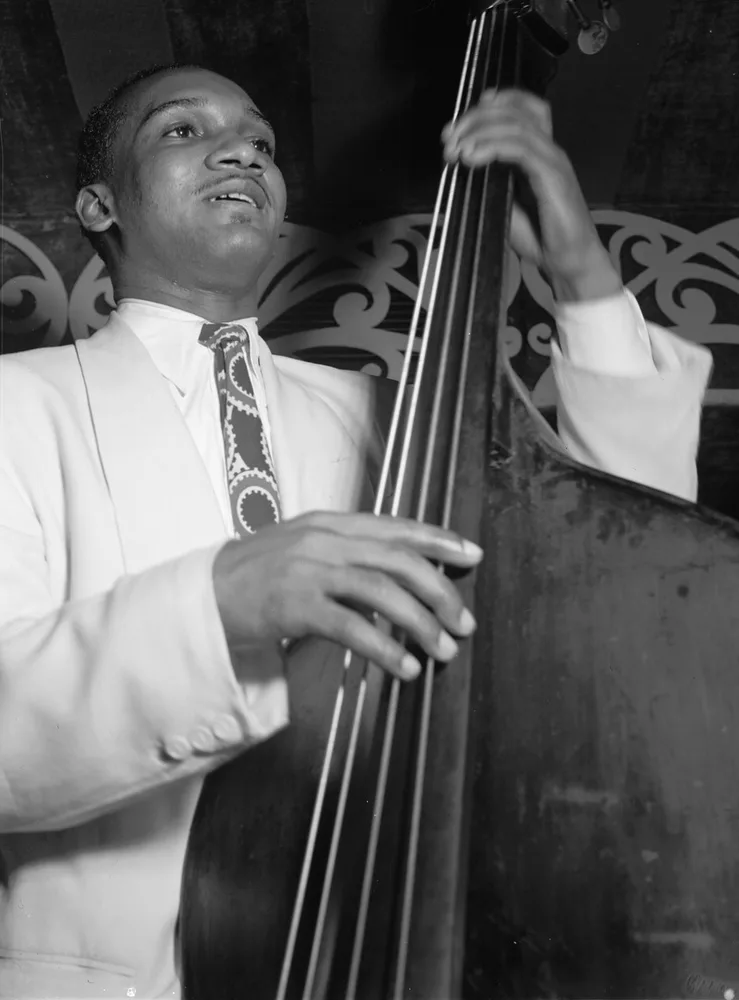
Oscar Pettiford at the Aquarium, New York, N.Y., circa November 1946, photographed by William P. Gottlieb Public Domain (William P. Gottlieb dedicated the rights in his photographs to the public domain effective February 16, 2010; no known copyright restrictions on the Library of Congress print) — Wikimedia Commons — https://commons.wikimedia.org/wiki/File:Oscar_Pettiford_(Gottlieb_07051).jpg (Library of Congress, William P. Gottlieb Collection, digital ID gottlieb.07051)
.jpg)
Oscar Pettiford was born September 30, 1922, in Okmulgee, Oklahoma, to a musical family: his mother was of Choctaw descent, his father Harry "Doc" Pettiford half Cherokee and half African-American. The family traveled as itinerant musicians before settling in north Minneapolis, where Oscar was one of eleven children who all performed together in the Pettiford family band, singing and dancing before he moved to piano at twelve and then double bass at fourteen. He briefly gave up the instrument in 1941, doubting he could make a living on it, but resumed five months later after encouragement from bassist Milt Hinton, developing an unusually personal style because, in his own words, he "did not like the way people were playing the bass."
Pettiford left Minneapolis in 1942 when Charlie Barnet hired him for the unusual job of playing bass duets alongside Barnet's own bassist, Chubby Jackson, and he broke into wider notice on December 23, 1943, playing on Coleman Hawkins's Signature Records session "The Man I Love"/"Sweet Lorraine," recorded with Hawkins, pianist Eddie Heywood, and drummer Shelly Manne at WOR Studios in New York, one of the earliest recordings to carry bebop's harmonic language onto record. Around the same time Pettiford was a regular at the after-hours jam sessions at Minton's Playhouse alongside Dizzy Gillespie, Thelonious Monk, and Kenny Clarke, and from late 1943 into early 1944 he co-led a quintet with Gillespie at the Onyx Club on 52nd Street, a group jazz historians count among the first working bebop bands to hold a regular engagement. He worked in Duke Ellington's orchestra from 1945 to 1948 and joined Woody Herman's band in 1949; it was during his time with Herman that a broken arm, suffered playing baseball with the band, sidelined him from the bass. Borrowing a cello from a friend and tuning it in fourths an octave above the bass, he taught himself to solo on it during his recovery, made his first cello recordings in 1950, and became jazz's first significant cello soloist, an achievement that stands alongside his bass playing as his most lasting innovation.
Through the 1950s Pettiford worked primarily as a leader, recording a run of albums for Debut, Bethlehem, and ABC-Paramount that showcased both his bass and cello playing: The New Oscar Pettiford Sextet (recorded December 1953, Debut), featuring Charles Mingus on bass while Pettiford played cello; Oscar Pettiford Sextet (1954, French Vogue); Oscar Pettiford (1954, Bethlehem, also billed as the Oscar Pettiford Modern Quintet); Basically Duke (1954, Bethlehem), a tribute to Duke Ellington's book; and Another One (1955, Bethlehem), praised by AllMusic for a "full, lyrical band sound" that folded in Ellington and calypso influences. In 1956 and 1957-58 he led larger ensembles on The Oscar Pettiford Orchestra in Hi-Fi and its sequel, The Oscar Pettiford Orchestra in Hi-Fi Volume Two (the latter produced by Creed Taylor), both for ABC-Paramount, unusual for their use of French horns and harp alongside a conventional big-band brass and reed section and featuring pianist Tommy Flanagan on the first volume. It was also at a 1955 gig with his group at Café Bohemia that Pettiford unknowingly helped launch another career: he let an unknown Florida schoolteacher named Cannonball Adderley sit in on alto saxophone, and Adderley's playing that night made him the talk of the New York jazz scene within weeks.
Pettiford was equally in demand as a sideman across the decade. He played bass on Miles Davis's The Musings of Miles (1955, Prestige) alongside Red Garland and Philly Joe Jones, and on Thelonious Monk's first two Riverside albums, Thelonious Monk Plays Duke Ellington and The Unique Thelonious Monk (1955-56), plus most of Brilliant Corners (1956); a professional falling-out with Monk during that period ended their collaboration, and the two never recorded together again. He also recommended baritone saxophonist Pepper Adams to bandleader Stan Kenton in May 1956, a connection documented in Adams's own JazzProfiles.com profile that put Adams in front of a national audience for the first time.
In 1958 Pettiford relocated to Copenhagen, Denmark, where he recorded for European labels and performed regularly with Scandinavian musicians including guitarist Attila Zoller and with fellow American expatriates Bud Powell and Kenny Clarke. His final studio recordings, made in Copenhagen between August 1959 and July 1960, were released as My Little Cello on Debut. Pettiford died September 8, 1960, at Frederiksberg Hospital in Copenhagen, three weeks short of his 38th birthday; accounts describe the cause as a polio-like viral illness that led to paralysis, a tracheotomy, and fatal complicating pneumonia.
Pettiford is widely regarded as the most important bassist to emerge between Jimmy Blanton and Charles Mingus, translating bebop's harmonic vocabulary and rhythmic drive into horn-like, rapid-fire bass lines and giving the instrument a new solo voice; bassist Christian McBride has called him "probably the most important bass player of that bebop generation in terms of creating new language for the bass." His parallel invention, playing pizzicato and arco cello as a genuine solo instrument rather than a novelty, opened a role in jazz that later bassist-cellists such as Ron Carter would continue. As a composer he left a small but durable body of original tunes, most notably "Tricotism," recorded over the decades by Ray Brown, Milt Hinton, and others, along with "Bohemia After Dark" and "Laverne Walk." His large-ensemble writing for the two ABC-Paramount Hi-Fi albums, built around French horns and harp rather than a standard big-band reed and brass blend, reflected the same restless, orchestrally curious sensibility that ran through his composing and bandleading.
- The New Oscar Pettiford Sextet (1953/54, Debut) - A cello-led date notable for pairing Pettiford with bassist Charles Mingus, recorded for the label Mingus co-founded. Spotify - The New Oscar Pettiford Sextet Listen
- Another One (1955, Bethlehem) - A quintet-plus-horns session AllMusic rated four stars for its "full, lyrical band sound," folding Ellington and calypso influences into a bebop framework. Spotify - Another One (digital reissue titled "Oscar Pettiford") Listen
- The Oscar Pettiford Orchestra in Hi-Fi (1956, ABC-Paramount) - Ten Pettiford originals for an unconventional big band voiced with French horns and harp, featuring pianist Tommy Flanagan.
- The Oscar Pettiford Orchestra in Hi-Fi Volume Two (1958, ABC-Paramount) - The sequel session, produced by Creed Taylor, with arrangements by Gigi Gryce, Lucky Thompson, and Benny Golson.
- My Little Cello (1960, Debut) - Pettiford's final studio recordings, made in Copenhagen in the year of his death.
- As a sideman: "The Man I Love" (1943, Signature) - Coleman Hawkins's landmark single, one of the earliest commercial recordings to carry bebop's harmonic language.
- As a sideman: The Musings of Miles (1955, Prestige) - Miles Davis's quartet date with Red Garland and Philly Joe Jones, cut at Rudy Van Gelder's home studio.
- As a sideman: Thelonious Monk Plays Duke Ellington (1955, Riverside) - The first of two consecutive Monk trio albums featuring Pettiford, before a rift ended their collaboration.
Oscar Pettiford: Full Discography
Identity confirmed via the live Discogs API: artist ID 255767 ("Oscar Pettiford," profile giving born September 30, 1922, Okmulgee, Oklahoma, died September 8, 1960, Copenhagen, both matching). Discogs credits Pettiford on 1,969 releases in total: 81 in a "Main"/leader role, 1,761 sideman "Appearance" credits, 99 track-level credits, and 28 unofficial pressings. Most of the 81 "Main" entries are 78 rpm singles, EPs, compilations, and posthumous reissues rather than distinct album sessions. The table below itemizes Pettiford's original leader/co-leader album catalog plus a representative set of his most significant sideman dates; it does not attempt to itemize the full 1,969-release credit log.
As Leader / Co-Leader
| Album Title | Recording Date(s) | Release Date | Label | Catalog Number | Format(s) | Personnel | Role | Reissue History | Spotify | Buy | Notes |
|---|---|---|---|---|---|---|---|---|---|---|---|
| The New Oscar Pettiford Sextet | Recorded December 29, 1953, New York City | 1954 | Debut Records | DLP 8 | Vinyl, 10", LP, Mono | Oscar Pettiford (cello, tracks 1,3-5; bass, track 2), Julius Watkins (French horn), Phil Urso (tenor sax), Walter Bishop Jr. (piano), Charles Mingus (bass, tracks 1,3-5), Percy Brice (drums) | Leader | Reissued on Fantasy in 1964 combined with extra material as My Little Cello; also drawn on for the 1963 Prestige compilation The Oscar Pettiford Memorial Album | Spotify - The New Oscar Pettiford Sextet | — | Cello-led date pairing Pettiford with bassist Charles Mingus, cut for the Debut label Mingus co-founded with Max Roach |
| Oscar Pettiford Sextet | Recorded March 21, 1954, New York City | 1954 | Disques Vogue (France) | Swing M 33.326 | Vinyl, 10", LP, Mono | Oscar Pettiford (cello, bass), Kai Winding (trombone), Al Cohn (tenor sax), Henri Renaud (piano), Tal Farlow (guitar), Max Roach (drums) | Leader | Reissued 1963 on Prestige as part of The Oscar Pettiford Memorial Album | Not confirmed | — | Recorded in New York for the French Vogue label; Henri Renaud composed "Burt's Pad" |
| Oscar Pettiford (aka Oscar Pettiford Modern Quintet) | Recorded September 1954, New York City | 1954 | Bethlehem Records | BCP 1003 | Vinyl, 10", LP | Oscar Pettiford (bass, cello), Julius Watkins (French horn), Charlie Rouse (tenor sax), Duke Jordan (piano), Ron Jefferson (drums); arranged by Quincy Jones | Leader | Reissued on CD, 2013 | Not confirmed | — | Includes an early recording of Pettiford's own composition "Tricotism" (listed on some pressings as "Trictatism") |
| Basically Duke | Recorded December 17, 1954, New York City | 1954 | Bethlehem Records | BCP 1019 | Vinyl, 10", LP | Oscar Pettiford (bass, cello), Clark Terry, Joe Wilder (trumpet), Jimmy Cleveland (trombone), Jimmy Hamilton (clarinet, tenor sax), Dave Schildkraut (alto sax), Danny Bank (baritone sax), Earl Knight (piano), Osie Johnson (drums) | Leader | None found | Not confirmed | — | A tribute session built from Duke Ellington's book, including "Jack the Bear" and "Mood Indigo" |
| Another One (aka Oscar Pettiford Volume 2) | Recorded August 12, 1955, New York City | 1955 | Bethlehem Records | BCP 33 | Vinyl, 10"/12", LP | Oscar Pettiford (bass, cello), Donald Byrd, Ernie Royal (trumpet), Bob Brookmeyer (valve trombone), Gigi Gryce (alto sax, clarinet), Jerome Richardson (tenor sax, clarinet, flute), Don Abney (piano), Osie Johnson (drums) | Leader | Reissued on CD, 2000 | Spotify - Another One (digital reissue titled "Oscar Pettiford") | — | AllMusic: 4/5 stars; includes "Bohemia After Dark," named for the club where Pettiford's group discovered Cannonball Adderley |
| The Oscar Pettiford Orchestra in Hi-Fi | Recorded June 11, 12 & 19, 1956, New York City | 1956 | ABC-Paramount | ABC 135 | Vinyl, LP | Oscar Pettiford (bass, cello), Art Farmer, Ernie Royal (trumpet), Jimmy Cleveland (trombone), David Amram, Julius Watkins (French horn), Gigi Gryce (alto sax), Lucky Thompson, Jerome Richardson (tenor sax), Danny Bank (baritone sax), Tommy Flanagan (piano), Osie Johnson (drums), Janet Putnam (harp, tracks 1-5), Whitey Mitchell (additional bass, track 5) | Leader | Reissued on CD by Impulse! in 1994 combined with Volume Two as Deep Passion | Not confirmed as a standalone album; "Deep Passion" reissue has individual tracks on Spotify | — | AllMusic: 3 stars; ten tracks, mostly Pettiford originals, voiced with French horns and harp rather than a standard big-band section |
| The Oscar Pettiford Orchestra in Hi-Fi Volume Two (aka O.P.'s Jazz Men) | Recorded August 23 & 30 and September 6, 1957, New York City | 1958 | ABC-Paramount | ABC 227 | Vinyl, LP | Oscar Pettiford (bass, cello), Ray Copeland, Art Farmer (trumpet, tracks 1-5), Kenny Dorham (trumpet, tracks 6-7), Benny Golson (tenor sax), Gigi Gryce (alto sax), Julius Watkins, David Amram (French horn), Dick Katz (piano), Gus Johnson (drums), Betty Glamann (harp, select tracks) | Leader | Reissued on CD by Impulse! in 1994 combined with Volume One as Deep Passion | Not confirmed as a standalone album; "Deep Passion" reissue has individual tracks on Spotify | — | AllMusic: 4.5 stars; produced by Creed Taylor; arrangements by Gigi Gryce, Lucky Thompson, and Benny Golson |
| My Little Cello | Recorded August 22, 1959, and July 5-6, 1960, Copenhagen, Denmark | 1960 | Debut Records | DEB 132 | Vinyl, LP | Oscar Pettiford (cello, bass), Allan Botschinsky (trumpet), Erik Nordström (tenor sax), Louis Hjulmand (vibraphone), Jan Johansson (piano), Jorn Elniff (drums) | Leader | Reissued under alternate titles including Last Recordings by the Late, Great Bassist and Montmartre Blues | Not confirmed | — | Pettiford's final studio recordings, made in Copenhagen weeks before his death |
As Sideman (selected major credits)
| Year | Project (Leader) | Title | Label | Catalog | Role | Notes |
|---|---|---|---|---|---|---|
| 1943 | Coleman Hawkins Swing Four | "The Man I Love" / "Sweet Lorraine" | Signature (90001) | Bass | Recorded December 23, 1943, WOR Studios, NYC; among the earliest commercial recordings to carry bebop's harmonic language | |
| 1945-1948 | Duke Ellington and His Orchestra | Various sides | Various (Musicraft, Columbia, others) | Bass | Regular orchestra member; not itemized session-by-session here | |
| 1949 | Woody Herman and His Orchestra | Various sides | Capitol | Bass | Band membership during which a broken arm led Pettiford to take up the cello | |
| 1955 | Miles Davis | The Musings of Miles | Prestige (PRLP 7007) | Bass | Recorded June 7, 1955, at Rudy Van Gelder's home studio, with Red Garland and Philly Joe Jones | |
| 1955 | Thelonious Monk | Thelonious Monk Plays Duke Ellington | Riverside (RLP 12-201) | Bass | First of two consecutive Monk trio albums featuring Pettiford | |
| 1956 | Thelonious Monk | The Unique Thelonious Monk | Riverside (RLP 12-209) | Bass | Second Monk trio album with Pettiford | |
| 1956 | Thelonious Monk | Brilliant Corners | Riverside (RLP 12-226) | Bass | Appears on most tracks; a professional falling-out with Monk during this period ended their collaboration | |
| 1955-1956 | Herbie Mann | Salute to the Flute | Bethlehem | Bass | Exact recording date not confirmed; alongside Hank Jones and Joe Puma |
Pettiford's broader sideman work in the 1940s and 1950s also included dates with Earl Hines, Ben Webster, Sonny Rollins, Max Roach as a leader, Kenny Dorham, John Coltrane, and, in Europe after 1958, Attila Zoller, Bud Powell, and Kenny Clarke, among others; these are not itemized exhaustively here.
- Duke Ellington - orchestra member, 1945-1948.
- Charles Mingus - played bass alongside Pettiford's cello on The New Oscar Pettiford Sextet (1953), for the Debut label Mingus co-founded; full catalog covered in his JazzProfiles.com profile.
- Tommy Flanagan - pianist on The Oscar Pettiford Orchestra in Hi-Fi (1956).
- Creed Taylor - produced The Oscar Pettiford Orchestra in Hi-Fi Volume Two (1958).
- Cannonball Adderley - Pettiford unknowingly launched his career by letting him sit in at a 1955 Café Bohemia gig; profiled separately on JazzProfiles.com.
- Pepper Adams - recommended the baritone saxophonist to Stan Kenton in May 1956; profiled separately on JazzProfiles.com.
- Donald Byrd - trumpet on Another One (1955).
- Miles Davis - sideman date on The Musings of Miles (1955) alongside further early-1950s sessions.
- Thelonious Monk - bass on Monk's first two Riverside trio albums and most of Brilliant Corners (1955-56), a collaboration that ended after a professional falling-out.
- Dizzy Gillespie - co-led a bebop quintet at New York's Onyx Club, late 1943 into early 1944.
- Ray Brown - among several bassists who kept Pettiford's composition "Tricotism" in the standard repertoire.
- Max Roach - drummer on multiple Pettiford leader dates and reissue sessions during the 1950s.
- Herbie Mann - sideman appearance on Mann's Bethlehem session Salute to the Flute, alongside Hank Jones and Joe Puma.
More Bebop Artists
See all 166 Bebop artists →More American Jazz Artists
See all 567 American artists →- Wikipedia: Oscar Pettiford
- Discogs: Oscar Pettiford (artist 255767)
- AllMusic: Oscar Pettiford
- Wikipedia: The New Oscar Pettiford Sextet
- Wikipedia: Oscar Pettiford Sextet
- Wikipedia: Oscar Pettiford (album)
- Wikipedia: Basically Duke
- Wikipedia: Another One (Oscar Pettiford album)
- Wikipedia: The Oscar Pettiford Orchestra in Hi-Fi
- Wikipedia: The Oscar Pettiford Orchestra in Hi-Fi Volume Two
- Wikipedia: My Little Cello
- Wikipedia: The Musings of Miles
- NoTreble: A Look at Oscar Pettiford's "Tricotism"
- Twin Cities Music Highlights: The Pettiford Family (family band of eleven children, Doc and Leontine Pettiford, the 1942 Charlie Barnet hire)
- Minnesota Public Radio Archive: Born 100 years ago and raised in Minnesota, Oscar Pettiford changed the sound of American music (September 30, 2022)
- NPR Jazz Profiles: Oscar Pettiford, Bass Beyond Bop
- Wikimedia Commons: File:Oscar Pettiford (Gottlieb 07051).jpg (portrait, public domain, William P. Gottlieb Collection, Library of Congress)