 JAZZPROFILES lives in the music 1,572 Jazz Artists fully Profiled!
 Eddie Sauter
Last updated September 5, 2026
Listen on Spotify
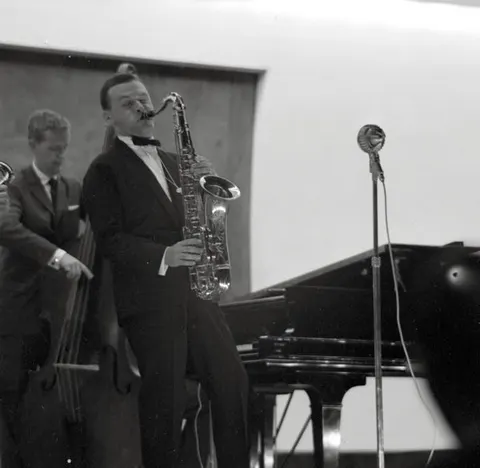
Eddie Sauter at the Donaueschinger Musiktage festival, Stadthalle, Donaueschingen, West Germany, October 19, 1957 — around the time he was leading the SWF radio orchestra in nearby Baden-Baden. CC BY 3.0 DE (Creative Commons Attribution 3.0 Germany) — Wikimedia Commons — https://commons.wikimedia.org/wiki/File:Donaueschingen_Donaueschinger_Musiktage;_Stadthalle;_Eddie_Sauter,_Portr%C3%A4t_mit_Pfeife_-_W134Nr.050024b_-_Willy_Pragher.jpg (photo by Willy Pragher, Landesarchiv Baden-Württemberg / Staatsarchiv Freiburg, ref. W 134 Nr. 050024b)

Edward Ernest Sauter was born December 2, 1914, in Brooklyn, and grew up in Nyack, New York, in Rockland County, where a schoolteacher named Gertrude Goldstein spotted his musical talent at age nine and arranged for him to play trumpet with the high school band and take advanced lessons; she also drove him into the city to perform with the Columbia Teachers College symphonic orchestra. Before graduating in 1932 he was already leading his own dance band, "Eddie Sauter and His Eight Aces," broadcasting locally on WCOH, and later that year he co-formed the Dale-Sauter Orchestra with pianist Jack Dailey, which played Manhattan's Empire Room. He went on to study at Columbia University and Juilliard, working with composers Stefan Wolpe, Bernard Wagenaar, and Louis Gruenberg, a classical grounding that would set him apart from most of his big-band arranging peers.
Sauter broke into the profession as a trumpeter with the Charlie Barnet Orchestra before joining Red Norvo's band in the mid-1930s, where he shifted from playing to writing full-time. His arrangements for Norvo's xylophone and vocalist Mildred Bailey, Norvo's wife, drew notice throughout 1935-1939; a 1938 piece in The New Republic called him "a young genius," and two of the Norvo/Bailey sides he arranged reached No. 1 on the Hit Parade that year. He carried that reputation into freelance work for Artie Shaw, Tommy Dorsey, and Woody Herman, and above all for Benny Goodman's orchestra through the first half of the 1940s, where his harmonically adventurous charts ("Benny Rides Again," "Clarinet à la King," "Moonlight on the Ganges" among them) pushed dance-band writing further than almost anyone else was attempting.
Tuberculosis interrupted his career on January 1, 1942, when he was admitted to Nyack Hospital and then spent an extended recovery at Summit Park Sanatorium in nearby Pomona under Dr. Robert Yeager's care. It was during this period, at Camp Shanks in Orangeburg, New York, that he met Army bandleader Bill Finegan, the partnership that would define the next phase of his career. After the war he wrote briefly again for Shaw and Herman, then for Ray McKinley's band, before the two arrangers reconnected: in 1952 Sauter and Finegan formed the Sauter-Finegan Orchestra, signing to RCA Victor. The band became known for pushing orchestration well past standard dance-band instrumentation (by 1957 its twenty members were credited with playing some ninety different instruments between them, including oboe, harp, and kazoo), and Time magazine in 1953 called it "the most original band heard in the U.S. in years." Its biggest hit, "Doodletown Fifers" (an adaptation of the Civil War-era tune "Kingdom Coming"), took its name from Doodletown, a hamlet near Bear Mountain not far from Sauter's own Rockland County home; "Nina Never Knew," sung by Joe Mooney, and "The Moon Is Blue," sung by Sally Sweetland, were further chart entries. The band's own size worked against it financially (Sauter later said that "being popular and famous didn't always mean that you could meet your weekly payroll for such a large band"), and after ending regular touring in 1955, the orchestra disbanded in March 1957. Sauter then moved to West Germany, succeeding Kurt Edelhagen as leader of the SWF radio orchestra in Baden-Baden from 1957 to 1959, before he and Finegan reunited in the studio for further recordings, including 1962's Stereo Fantasy.
The commission that produced Sauter's most celebrated work came from tenor saxophonist Stan Getz, whom he had known since Getz's own brief stint with Goodman's band in 1945. By 1960 Getz, based in Denmark and under commercial pressure from Verve, wanted an artistic statement rather than another set of standards; he told Sauter, who was then supporting himself largely on jingles and television scoring, "I don't want any arrangements on standards, pop songs, jazz classics, or anything. I want it to be all your own original music." Sauter responded with a seven-movement suite for strings, harp, piano, and bass with no fixed rhythm section, built so Getz could improvise with and against the orchestration rather than simply solo over it. The sessions, held at Webster Hall in New York on July 14 and 28, 1961, were complicated when Getz missed the first date after his mother's death on July 13; he later overdubbed his saxophone parts onto the pre-recorded orchestral tracks by ear, relying on perfect pitch to match Sauter's charts. Verve released the album, Focus, in January 1962 with Hershy Kay conducting and Creed Taylor producing; it earned a nomination for the 1963 Grammy Award for Best Original Jazz Composition, which went instead to Vince Guaraldi's "Cast Your Fate to the Wind." Getz called it his own favorite among all his recordings.
Sauter spent his later years working across film, television, and Broadway. He wrote the score for Arthur Penn's 1965 film Mickey One, performed on record by Getz; composed the third-season theme for Rod Serling's Night Gallery and the "World Without Time" theme for the public-affairs series The Open Mind; and orchestrated roughly ten Broadway shows beginning with Milk and Honey (1961) and including The Apple Tree (1966), It's a Bird...It's a Plane...It's Superman (1966), and 1776 (1969); theater orchestrator Jonathan Tunick later recalled that "Eddie did these marvelous things, always theatrical, always effective." His 1955 Concerto for Jazz Band and Symphony Orchestra, recorded with Fritz Reiner and the Chicago Symphony Orchestra, was revived decades later by the Boston Pops under Arthur Fiedler. Sauter died of a heart attack on April 21, 1981, at Nyack Hospital, not far from the childhood home where his musical career had begun; he was posthumously inducted into the Big Band and Jazz Hall of Fame in 2003, and his manuscripts and parts are now held in an Eddie Sauter Archive at Yale University.
Sauter's classical training under Wolpe, Wagenaar, and Gruenberg, and his stated admiration for Bartók, Prokofiev, and Stravinsky, gave his big-band writing a harmonic and textural range that set him apart from most swing-era arrangers; his son Gregory has recalled Sauter's own compositional rule of thumb, that "you should always try to have three things going at once." Bandleader Glenn Miller reportedly said Sauter's writing was a decade ahead of its time, and critic George Simon suggested the music world needed twenty years to catch up with it. That reach showed up first in dissonant, structurally complex charts for Red Norvo and Benny Goodman, then in the Sauter-Finegan Orchestra's deliberately uncommercial embrace of orchestral color and novelty instrumentation, and finally in Focus, which the Penguin Guide to Jazz singled out for its "superlative" arranging and which biographer Donald L. Maggin called "the most fully realized third stream record ever made," a suite built for a soloist to work against rather than simply over. On the strength of that body of work, Sauter is usually placed in a small company of composer-arrangers who built a big band's identity around specific musicians' voices rather than interchangeable sections, alongside Duke Ellington and Gil Evans, a lineage critics have since extended to Toshiko Akiyoshi's big band writing as well.
- Focus (rec. 1961, rel. 1962, Verve) - A seven-movement string suite Sauter composed and arranged for Stan Getz at Getz's own request for wholly original music; Getz called it his favorite of his own recordings, and it remains Sauter's best-known and most acclaimed work. Spotify - Focus Listen
- New Directions in Music (1952, RCA Victor) - The Sauter-Finegan Orchestra's debut LP, introducing the unconventional orchestration and instrumentation that would define the band. Spotify - New Directions in Music Listen
- Concerto for Jazz Band and Symphony Orchestra / Don Juan (1955, RCA Victor Red Seal) - Sauter's big band recorded alongside Fritz Reiner and the Chicago Symphony Orchestra, an early and unusually prominent jazz/classical crossover billing.
- Concert Jazz (1955, RCA Victor) - A Sauter-Finegan studio set showcasing the band's more straightforwardly swinging side alongside its novelty arrangements. Spotify - Concert Jazz Listen
- Adventure in Time (1956, RCA Victor) - One of the Sauter-Finegan Orchestra's most exploratory studio albums, leaning into the space-age, percussion-driven textures the band was known for; not found on Spotify.
- Doodletown Fifers (single, 1952-53, RCA Victor) - The band's breakout hit, adapting the Civil War tune "Kingdom Coming" and named for a hamlet near Sauter's Rockland County home.
- Stan Getz Plays Music From the Soundtrack of "Mickey One" (1965, MGM) - Sauter's film score for Arthur Penn's Mickey One, performed by Getz; their second and final full-length collaboration after Focus. Spotify - Mickey One Listen
Eddie Sauter: Full Discography
Identity confirmed via the live Discogs API: personal artist ID 259472 ("Eddie Sauter," realname Edward Ernest Sauter, born/died dates matching, linked directly to the Wikipedia article). As with several other arrangers/bandleaders in this sweep, most of Sauter's actual leader/co-leader catalog is filed under separate Discogs group-billing entities rather than his personal artist page: "Sauter-Finegan Orchestra" (artist 432779, 159 credited releases) and "Orchester Eddie Sauter" (artist 411598, 17 credited releases, covering his 1957-59 SWF Baden-Baden radio-orchestra period). His personal artist page carries 439 credits, but the overwhelming majority (over 400) are "Appearance" credits: decades of reissues and box sets crediting him as composer/arranger on tracks he wrote for Red Norvo, Benny Goodman, Artie Shaw, and others in the 1930s-40s, not sessions where he personally performed or was newly recorded. That distinction is noted throughout the tables below rather than implying several hundred recording dates.
The table below covers his confirmed leader/co-leader studio and live albums (the Sauter-Finegan Orchestra catalog plus his own-name and co-billed releases), followed by a curated set of his most significant work as an arranger/composer for other leaders. It is not an exhaustive listing of every 78/45rpm single or reissue compilation Discogs tracks against his name.
As Leader / Co-Leader
| Album Title | Recording Date(s) | Release Date | Label | Catalog Number | Format(s) | Personnel | Role | Reissue History | Spotify | Buy | Notes |
|---|---|---|---|---|---|---|---|---|---|---|---|
| New Directions in Music | 1952 | November 29, 1952 | RCA Victor | LPM-3115 / LJM-3115 | Vinyl, 10", LP, Album, Mono | Sauter-Finegan Orchestra (full personnel not individually itemized by Discogs for this release) | Co-leader (with Bill Finegan) | Various later compilation reissues | Spotify - New Directions in Music | — | Debut studio LP, introducing the band's unconventional orchestration |
| Inside Sauter-Finegan | 1954 | 1954 | RCA Victor | LJM-1003 | Vinyl, LP, Album, Mono, Gatefold | Sauter-Finegan Orchestra (full personnel not individually itemized by Discogs) | Co-leader (with Bill Finegan) | None found | Not confirmed on Spotify under this exact title | — | |
| The Sound of the Sauter-Finegan Orchestra | 1954 | 1954 | RCA Victor | LPM-1009 | Vinyl, LP, Album | Sauter-Finegan Orchestra (full personnel not individually itemized by Discogs) | Co-leader (with Bill Finegan) | None found | Spotify - The Sound of the Sauter-Finegan Orchestra | — | |
| Concert Jazz | 1955 | 1955 | RCA Victor | LPM-1051 | Vinyl, LP | Sauter-Finegan Orchestra (full personnel not individually itemized by Discogs) | Co-leader (with Bill Finegan) | None found | Spotify - Concert Jazz | — | |
| Concerto for Jazz Band and Symphony Orchestra / Don Juan | 1955 | January 21, 1955 | RCA Victor Red Seal | LM-1888 | Vinyl, LP, Album, Mono | Sauter-Finegan Orchestra with Fritz Reiner conducting the Chicago Symphony Orchestra | Composer / Co-leader | Later revived in concert by the Boston Pops under Arthur Fiedler (not a Discogs-documented reissue of this specific LP) | Not found on Spotify | — | An early, unusually prominent jazz/classical crossover billing |
| Adventure in Time | 1956 | 1956 | RCA Victor | LPM-1240 | Vinyl, LP, Album, Mono | Sauter-Finegan Orchestra (full personnel not individually itemized by Discogs) | Co-leader (with Bill Finegan) | None found | Not found on Spotify | — | Space-age, percussion-driven material; one of the band's most exploratory studio sets |
| Under Analysis | 1957 | 1957 | RCA Victor | LPM-1341 | Vinyl, LP, Mono | Sauter-Finegan Orchestra (full personnel not individually itemized by Discogs) | Co-leader (with Bill Finegan) | None found | Not found on Spotify | — | |
| The Historic Donaueschingen Jazz Concert 1957 | October 19, 1957, Donaueschingen, West Germany | 1977 | (various reissue labels) | Vinyl, LP | The Eddie Sauter Big Band (SWF Baden-Baden radio orchestra), shared billing with André Hodeir et son Jazz Group de Paris and the Modern Jazz Quartet | Leader (SWF/Baden-Baden orchestra) | Reissued 1977 as an archival document | Not found on Spotify | — | Recorded the same day as this profile's portrait photo, at the Donaueschinger Musiktage new-music festival | |
| The Return of the Doodletown Fifers | 1960 | 1960 | United Artists Ultra Audio | WWS 8511 | Vinyl, LP, Album, Stereo, Gatefold | Sauter-Finegan Orchestra (full personnel not individually itemized by Discogs) | Co-leader (with Bill Finegan) | None found | Not found on Spotify | — | |
| Inside Sauter-Finegan Revisited | 1961 (compiled) | 1961 | RCA Victor | LPM-2473 | Vinyl, LP, Compilation, Mono | Sauter-Finegan Orchestra | Co-leader (with Bill Finegan) | Compilation of previously released RCA Victor performances | Not found on Spotify | — | Compiles earlier 1950s recordings; not new material |
| Focus | July 14 & 28, plus Sept./Oct. 1961, Webster Hall, New York City | January 1962 | Verve Records | V6-8412 | Vinyl, LP, Album, Stereo, Gatefold | Stan Getz (tenor sax), Steve Kuhn (piano), John Neves (bass), Roy Haynes (drums), Hershy Kay (conductor), plus a 16-piece string section and harp | Composer / Arranger (co-billed with Stan Getz) | Reissued/remastered repeatedly, incl. "All That Jazz, Vol. 61" (2016) and "Focus + Cool Velvet" (2012) | Spotify - Focus | — | Grammy nominee, Best Original Jazz Composition, 1963 (lost to Vince Guaraldi's "Cast Your Fate to the Wind"); Getz called it his favorite of his own recordings |
| Pop Concert | 1962 | 1962 | United Artists Records | WWS 8516 | Vinyl, LP, Album, Reissue, Stereo, Gatefold | Sauter-Finegan Orchestra (full personnel not individually itemized by Discogs) | Co-leader (with Bill Finegan) | Reissue compilation (per Discogs format tag) | Not found on Spotify | — | |
| Stereo Fantasy | 1962 | 1962 | United Artists Ultra Audio | 139 007 | Vinyl, LP, Album, Compilation, Stereo | Eddie Sauter, Bill Finegan | Co-leader | Compilation of Sauter/Finegan material | Not found on Spotify | — | Studio reunion recordings after the orchestra's 1957 disbandment |
| Eddie Sauter In Germany 1957-59 | 1957-1959, Baden-Baden, West Germany | (archival reissue) | Big Band Landmarks | (not confirmed) | Vinyl, LP, Album, Mono, Promo | Orchester Eddie Sauter (SWF radio orchestra) | Leader | Archival release documenting his SWF tenure | Not found on Spotify | — |
As Composer / Arranger for Other Leaders (selected significant credits)
Sauter was, for most of his career, a non-performing composer/arranger rather than a playing sideman; the entries below are his most significant and well-documented contributions to other artists' recorded work, not an attempt to catalog the hundreds of reissue compilations that credit him decades after the fact for 1930s-40s arranging work.
| Year | Project (Leader) | Title | Label | Catalog | Role | Notes |
|---|---|---|---|---|---|---|
| 1935-1939 | Red Norvo Orchestra, featuring Mildred Bailey | (various sides) | Brunswick / Vocalion | Arranger | Chief staff arranger for Norvo's orchestra; two sides reached No. 1 on the Hit Parade in 1938 | |
| 1940-1945 | Benny Goodman Orchestra / Sextet | "Benny Rides Again," "Clarinet à la King," "Moonlight on the Ganges" | Columbia | Composer / Arranger | His most celebrated big-band client; charts still reissued regularly on Goodman compilations | |
| Mid-1940s | Artie Shaw and His Orchestra | (various sides) | Victor | Arranger | ||
| Mid-1940s | Tommy Dorsey Orchestra | (various sides) | Victor | Arranger | ||
| Mid-1940s | Woody Herman Orchestra | (various sides) | Columbia | Arranger | ||
| 1945 | Ray McKinley and His Orchestra | Borderline | (reissued on various labels) | Arranger | Later reissued individually as Discogs master 624235 | |
| 1955 | Fritz Reiner / Chicago Symphony Orchestra | Concerto for Jazz Band and Symphony Orchestra | RCA Victor Red Seal (LM-1888) | Composer | Co-billed; also listed in the Leader table above | |
| 1957 | Harry Arnold Orchestra (Swedish Radio) | "The Moon Walks," on The Big Band in Concert 1957/58 | (Swedish radio archival reissue) | Composer / Arranger | One track contributed to this Swedish radio big band's book; Quincy Jones separately contributed other charts to the same orchestra on this release, but the two did not otherwise collaborate on it | |
| 1965 | Stan Getz | Stan Getz Plays Music From the Soundtrack of "Mickey One" | MGM Records | SE-4312 | Composer / Arranger (billed solely to Getz as performer) | Film score for Arthur Penn's Mickey One; Sauter and Getz's second and final full-length collaboration after Focus |
| 1966-1969 | Broadway orchestrations | Milk and Honey (1961), The Apple Tree (1966), It's a Bird...It's a Plane...It's Superman (1966), 1776 (1969) | (original cast recording labels) | Orchestrator | Roughly ten Broadway shows in total; not exhaustively itemized here |
Discogs' remaining several hundred "Appearance" and "TrackAppearance" credits on Sauter's personal artist page are almost entirely later reissue compilations of the Goodman, Norvo, Mildred Bailey, Artie Shaw, Charlie Barnet, and Roy Eldridge material listed above, repackaged repeatedly from the 1970s through the 2020s; they are not itemized individually here.
- Bill Finegan - co-leader of the Sauter-Finegan Orchestra, 1952-1957 (studio reunions 1959 and 1962); the two met during World War II at Camp Shanks, Orangeburg, New York.
- Stan Getz - composed and arranged Focus (1961) and Plays Music From the Soundtrack of "Mickey One" (1965); the two had known each other since Getz's brief 1945 stint with Benny Goodman's band.
- Red Norvo and Mildred Bailey - staff arranger for Norvo's orchestra, 1935-1939, writing extensively for Norvo's xylophone and for vocalist Bailey (Norvo's wife); two of these sides reached No. 1 on the Hit Parade in 1938.
- Benny Goodman - his most celebrated big-band client of the 1940s, contributing signature charts including "Benny Rides Again," "Clarinet à la King," and "Moonlight on the Ganges."
- Artie Shaw, Tommy Dorsey, Woody Herman, Ray McKinley - other swing-era leaders Sauter arranged for, before and after his wartime illness.
- Fritz Reiner and the Chicago Symphony Orchestra - performed and recorded Sauter's Concerto for Jazz Band and Symphony Orchestra in 1955.
- Roy Haynes, Steve Kuhn, John Neves, Hershy Kay, Creed Taylor - drummer, pianist, bassist, conductor, and producer respectively on the Focus sessions.
- Jonathan Tunick - fellow Broadway orchestrator who praised Sauter's theatrical instincts on shows including 1776 and The Apple Tree.
More Big Band Artists
See all 202 Big Band artists →More American Jazz Artists
See all 567 American artists →- Spotify artist page (Sauter-Finegan Orchestra)
- Discogs
- Eddie Sauter Archive (family/estate site, research by Alex Chilowicz)
- Wikipedia: Eddie Sauter
- Wikipedia: Sauter-Finegan Orchestra
- Wikipedia: Focus (Stan Getz album)
- Wikipedia: Stan Getz Plays Music from the Soundtrack of Mickey One
- Discogs: Eddie Sauter (artist 259472)
- Discogs: Sauter-Finegan Orchestra (artist 432779)
- AllMusic: Eddie Sauter biography
- AllMusic: Focus
- The Rockland County Times: "Our Forgotten but Notable Neighbors: Eddie Sauter, Musical Genius" (2025)
- Eddie Sauter Archive (eddiesauter.org)
- jazzfuel.com: "Stan Getz's Focus (1961): The Album He Called His Greatest Recording"