 JAZZPROFILES lives in the music 1,572 Jazz Artists fully Profiled!
 Doug Watkins
Last updated September 7, 2026
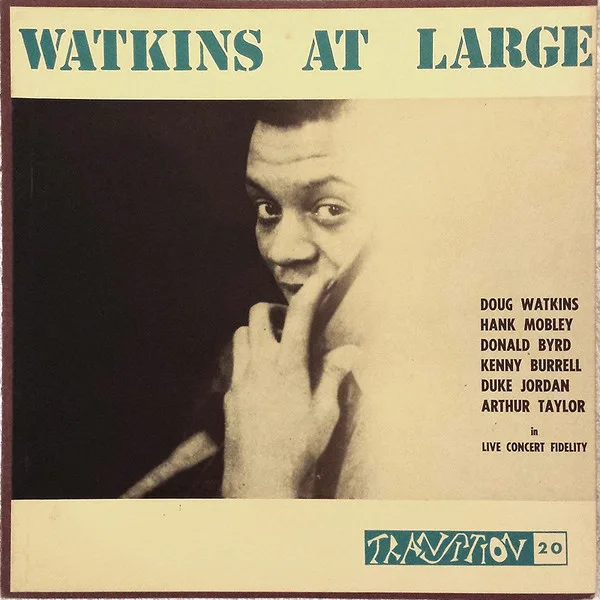
Doug Watkins pictured on the front cover of his debut album as a leader, *Watkins at Large* (Transition Records, TRLP 20), recorded December 8, 1956 and released 1957. Album cover art (not a CC-licensed artist photo) - used as the only available image showing the artist — Discogs - https://www.discogs.com/release/3495143-Doug-Watkins-Watkins-At-Large
Douglas Watkins was born March 2, 1934, in Detroit, Michigan, and took up the double bass at Cass Technical High School, the same public school music program that was producing much of the next decade's hard-bop rhythm section talent. A year behind him at Cass Tech was a bassist recently arrived from Pittsburgh, Paul Chambers; the two studied harmony together in after-hours sessions at pianist Barry Harris's house and became close friends, so alike in height and dress that they started a joking rumor around the Detroit clubs that they were cousins. They were not related. The friendship was real enough that in 1952 Watkins introduced Chambers to Ann Williams, the woman Chambers married that year. (Watkins is sometimes described elsewhere as a relative of Motown bassist James Jamerson; no source turned up in researching this profile supports that claim, and it does not appear in Watkins's Wikipedia entry, AllMusic biography, or any other account consulted.)
Watkins moved to New York in 1954, part of the same wave of young Detroit players that included Chambers, Kenny Burrell, and Tommy Flanagan. He was an original member of the quintet that became Art Blakey's Jazz Messengers, joining pianist Horace Silver, trumpeter Kenny Dorham, and tenor saxophonist Hank Mobley for a Blue Note session on November 13, 1954, with Blakey on drums; a second session on February 6, 1955 completed the material Blue Note issued as Horace Silver and the Jazz Messengers. The same band, by then billed as the Jazz Messengers with Blakey and Silver as co-leaders, recorded live at Café Bohemia in Greenwich Village on November 23, 1955, released the following spring as At the Café Bohemia. In 1956 Watkins left the group alongside Silver to form the new Horace Silver Quintet; according to Silver's autobiography Let's Get to the Nitty Gritty, both men were tired of being harassed and searched by police at gigs because of the drug problems of other members of Blakey's band.
Watkins was already one of the most in-demand bassists in New York by the time he appeared, at 22, on Sonny Rollins's June 22, 1956 session for Saxophone Colossus (Prestige), a quartet date with Flanagan and Max Roach that became one of the defining tenor-saxophone records of the decade. That December 8 he led his own recording debut, Watkins at Large (Transition Records), a sextet with Donald Byrd, Mobley, Duke Jordan, Burrell, and Art Taylor. Through the rest of the 1950s he worked as a first-call session player across the Blue Note, Prestige, and Riverside rosters: Donald Byrd's early Transition and Blue Note dates, Lee Morgan's first sideman sessions, Jackie McLean's mid-1950s Prestige albums, Burrell's Blue Note leader debut and his January 1957 All Day Long (with Byrd, Frank Foster, and Flanagan), and two Prestige all-star sessions billed to no single leader, Wheelin' & Dealin' (September 1957, with John Coltrane, Frank Wess, Paul Quinichette, and Mal Waldron) and Olio (1957, with Thad Jones, Wess, Teddy Charles, Waldron, and Elvin Jones).
It was in this same stretch that Watkins crossed paths repeatedly with baritone saxophonist Pepper Adams, also newly settled in New York. He played bass on three of Adams's late-1950s dates: Critics' Choice (recorded August 23, 1957, World Pacific), with Lee Katzman, Jimmy Rowles, and Mel Lewis; The Pepper-Knepper Quintet (recorded March 25, 1958, MetroJazz), co-led by Adams and trombonist Jimmy Knepper with Wynton Kelly and Elvin Jones; and 10 to 4 at the 5-Spot (recorded April 15, 1958, Riverside), the live document of Adams's 1958-1961 co-led quintet with Byrd, Bobby Timmons, and Elvin Jones.
Watkins made his second and final album as a leader on May 17, 1960, at Van Gelder Studio: Soulnik (New Jazz), credited to the Doug Watkins Quintet featuring Yusef Lateef on flute and oboe. On the date Watkins himself switched to cello, an instrument he had reportedly taken up only days before the session, while Herman Wright covered the bass chair; Hugh Lawson played piano and Lex Humphries drums. He also spent time in Charles Mingus's Jazz Workshop in this period, one more stop in a freelance career that by 1962 had put him on well over 500 recording dates in under a decade. On February 5, 1962, Watkins was killed in a car accident near Holbrook, Arizona, while driving to San Francisco for a gig with drummer Philly Joe Jones. He was 27.
Watkins played in the same Detroit lineage as Paul Chambers and Ray Brown: a big, centered tone, a walking line built for forward motion rather than mere timekeeping, and enough facility to move between the riff-driven Jazz Messengers sound and more exploratory small-group settings without strain. That range shows plainly across his own two leader dates, from the straight-ahead hard bop of Watkins at Large to Soulnik, where his decision to play cello rather than bass, alongside Yusef Lateef's oboe, gave the record a texture AllMusic's Scott Yanow singled out as unusual for a hard-bop session. His reputation, though, rests overwhelmingly on the sideman ledger: in a recording career of barely seven years he became one of the most heavily used bassists on the New York hard-bop scene, anchoring dates for Blue Note, Prestige, and Riverside alike before his death at 27 cut the career short.
- Saxophone Colossus (1956, Prestige) - As a sideman: Sonny Rollins's landmark quartet date, recorded June 22, 1956 with Tommy Flanagan and Max Roach, and among the most acclaimed tenor saxophone albums of the era.
- Watkins at Large (rec. Dec. 1956, rel. 1957, Transition) - His debut as a leader, a sextet with Donald Byrd, Hank Mobley, Duke Jordan, Kenny Burrell, and Art Taylor.
- 10 to 4 at the 5-Spot (1958, Riverside) - As a sideman: the Pepper Adams-Donald Byrd Quintet's live document from New York's Five Spot Café, with Bobby Timmons and Elvin Jones.
- The Pepper-Knepper Quintet (rec. 1958, rel. 1959, MetroJazz) - As a sideman: Pepper Adams and Jimmy Knepper's co-led date, with Wynton Kelly and Elvin Jones.
- Wheelin' & Dealin' (rec. 1957, rel. 1958, Prestige) - A leaderless Prestige all-star session with John Coltrane, Frank Wess, Paul Quinichette, and Mal Waldron.
- Soulnik (1960, New Jazz) - His second and last leader date, the Doug Watkins Quintet featuring Yusef Lateef, notable for Watkins switching from bass to cello.
- Horace Silver and the Jazz Messengers / At the Café Bohemia (1954-1956, Blue Note) - As a sideman: the founding recordings of the group that became Art Blakey's Jazz Messengers, with Watkins as the original bassist.
Doug Watkins: Full Discography
Identity confirmed via the live Discogs API: artist ID 254176 ("Doug Watkins," realname Douglas Watkins, birth/death details matching March 2, 1934 - February 5, 1962). Discogs credits Watkins on 562 releases total: 17 in a "Main" role, 517 sideman "Appearance" credits, 9 track-level "TrackAppearance" credits, and 19 unofficial releases (the components sum to the total). Of the 17 "Main" credits, only two are genuine leader dates in his own name (Watkins at Large and Soulnik); the rest are various-artist samplers, leaderless "all-star" jam sessions credited to several musicians equally, and later compilations/reissues repackaging his sideman work (for example, The Transition Sessions, a 2000s compilation bundling Watkins at Large with two unrelated Donald Byrd Transition albums, and Imagination!, a 1970s retitled reissue of Soulnik credited to "Yusef Lateef And Doug Watkins"). The table below lists the two true leader albums plus three notable sessions billed to no single leader, followed by a curated set of his most significant sideman credits; it does not attempt to itemize all ~540 sideman/compilation credits in a recording career that ran from 1954 until his death in 1962.
Correction to a claim commonly repeated about Watkins: he is sometimes described as a cousin of Motown bassist James Jamerson. No source consulted while building this profile (Wikipedia, AllMusic, Discogs, or jazz-history sites) supports that claim. The well-documented family-adjacent relationship is with fellow Detroit bassist Paul Chambers: the two were close friends and Cass Technical High School classmates who joked about being cousins because they looked and dressed alike, and Watkins introduced Chambers to his future wife in 1952.
As Leader / Co-Leader
| Album Title | Recording Date(s) | Release Date | Label | Catalog Number | Format(s) | Personnel | Role | Reissue History | Spotify | Buy | Notes |
|---|---|---|---|---|---|---|---|---|---|---|---|
| Watkins at Large | Recorded December 8, 1956, probably NYC | 1957 | Transition | TRLP 20 | Vinyl, LP, Album, Mono | Doug Watkins (bass), Donald Byrd (trumpet), Hank Mobley (tenor sax), Duke Jordan (piano), Kenny Burrell (guitar), Art Taylor (drums) | Leader | Reissued in Japan as Transition (J) LNJ-70088 (1976) and GXF-3122 (1979); later bundled into the compilation The Transition Sessions | Not confirmed - Spotify search unavailable during this build (API quota exhausted) | — | His recorded debut as a leader, made at 22 |
| Olio | 1957, exact date not confirmed | 1957 | Prestige | PRLP 7084 | Vinyl, LP, Mono | Thad Jones (trumpet), Frank Wess (flute, tenor sax), Teddy Charles (vibes), Mal Waldron (piano), Doug Watkins (bass), Elvin Jones (drums) | Co-billed (six-way equal billing, no designated leader) | Reissued with bonus material as After Hours (Prestige, 1982) | Not confirmed - Spotify search unavailable during this build | — | A various-artists Prestige jam session; Watkins receives equal cover billing with the other five |
| Wheelin' & Dealin' | Recorded September 20, 1957, Van Gelder Studio, Hackensack NJ | April 1958 | Prestige | PRLP 7131 | Vinyl, LP, Album, Mono | Frank Wess (flute, tenor sax), John Coltrane (tenor sax), Paul Quinichette (tenor sax), Mal Waldron (piano), Doug Watkins (bass), Art Taylor (drums) | Co-billed (on some reissues, "The Prestige All Stars") | Reissued on Original Jazz Classics | Not confirmed - Spotify search unavailable during this build | — | A three-tenor leaderless session; Watkins is credited as a full co-billed artist, not a sideman, on the original release |
| All Day Long | Recorded January 4, 1957, Hackensack NJ | 1957 | Prestige | PRLP 7081 | Vinyl, LP, Album, Mono | Kenny Burrell (guitar), Donald Byrd (trumpet), Frank Foster (tenor sax), Tommy Flanagan (piano), Doug Watkins (bass), Art Taylor (drums) | Co-billed (billed to Kenny Burrell on most pressings; some reissues credit "The Prestige All Stars") | Later reissued/compiled as part of Prestige's Kenny Burrell reissue series | Not confirmed - Spotify search unavailable during this build | — | Listed here for completeness since Discogs lists Watkins under a "Main" credit on this release; treat as a Burrell-led sideman date if a stricter leader/sideman line is wanted |
| Soulnik | Recorded May 17, 1960, Van Gelder Studio, Englewood Cliffs NJ | 1960 | New Jazz | NJLP 8238 | Vinyl, LP, Album, Mono | Doug Watkins (cello), Yusef Lateef (flute, oboe), Hugh Lawson (piano), Herman Wright (bass), Lex Humphries (drums) | Leader (Doug Watkins Quintet featuring Yusef Lateef) | Reissued as Original Jazz Classics OJCCD-1848-2 (1994); also retitled Imagination! on a 1970s reissue credited to "Yusef Lateef And Doug Watkins" | Not confirmed - Spotify search unavailable during this build | — | His second and final leader date; Watkins plays cello throughout, an instrument he had reportedly taken up only days before the session, while Herman Wright covers the bass chair |
As Sideman (selected major credits)
| Year | Project (Leader) | Title | Label | Catalog | Role | Notes |
|---|---|---|---|---|---|---|
| 1954/1955 | Horace Silver Quintet (with Art Blakey) | Horace Silver and the Jazz Messengers | Blue Note (BLP 1518) | Bass | Recorded November 13, 1954 and February 6, 1955; the quintet that became Art Blakey's Jazz Messengers, with Kenny Dorham and Hank Mobley | |
| 1955 | Jackie McLean | Presenting... Jackie McLean: The New Tradition | Not confirmed in Discogs data | Bass | ||
| 1955 | Art Blakey and Horace Silver | At the Cafe Bohemia | Blue Note (BLP 1524/1525) | Bass | Recorded live at Cafe Bohemia, NYC, November 23, 1955; released 1956 | |
| 1956 | Sonny Rollins | Saxophone Colossus | Prestige (PRLP 7079) | Bass | Recorded June 22, 1956, Van Gelder Studio, with Tommy Flanagan and Max Roach; one of the most acclaimed tenor saxophone albums of the era | |
| 1956 | Donald Byrd | Byrd's Eye View | Transition (TRLP 5) | Bass | ||
| 1956 | Lee Morgan | Introducing Lee Morgan | Not confirmed in Discogs data (compiled later from Blue Note sideman sessions) | Bass | ||
| 1957 | Kenny Burrell | Introducing Kenny Burrell | Blue Note (BLP 1523) | Bass | Burrell's debut as a Blue Note leader | |
| 1957 | Pepper Adams | Critics' Choice | World Pacific (PJM-407) | Bass | Recorded August 23, 1957; with Jimmy Rowles and Mel Lewis | |
| 1958 | Pepper Adams / Jimmy Knepper | The Pepper-Knepper Quintet | MetroJazz (E1004) | Bass | Recorded March 25, 1958; issued 1959; with Wynton Kelly and Elvin Jones | |
| 1958 | Pepper Adams | 10 to 4 at the 5-Spot | Riverside (RLP 12-265) | Bass | Recorded live April 15, 1958, at the Five Spot Cafe, NYC; with Donald Byrd, Bobby Timmons, and Elvin Jones | |
| 1958 | Donald Byrd | Byrd in Paris | Not confirmed in Discogs data | Bass | ||
| 1957 | Hank Mobley | Mobley's Message / Mobley's 2nd Message | Prestige | Bass | ||
| 1960 | Charles Mingus Jazz Workshop | Not confirmed - specific album not identified in this build | Not confirmed | Bass | Discogs lists "Charles Mingus Jazz Workshop" among Watkins's group-billing entities, but a specific issued album could not be confirmed in the time available for this build |
Discogs's sideman log (517 "Appearance" credits, plus 9 track-level credits, spanning 1954-1962) also includes further Donald Byrd Transition and Blue Note dates, further Hank Mobley Blue Note sessions, Jackie McLean's mid-1950s Prestige albums, Gene Ammons, Art Farmer, and Phil Woods sessions, and numerous later compilations reassembling this material - not itemized exhaustively here.
Discography notes and corrections
- The task brief for this profile listed "The Cool Sound of Pepper Adams" (Regent, 1957) as a fourth shared Watkins/Adams session. This is incorrect and has been dropped. Pepper Adams's own verified discography (
76-pepper-adams-profile/discography-full.md) lists the bassist on that session as George Duvivier, not Doug Watkins, and no "Cool Sound of Pepper Adams" credit appears anywhere in Watkins's 562-release Discogs feed. The three genuine shared sessions are Critics' Choice, The Pepper-Knepper Quintet, and 10 to 4 at the 5-Spot, all listed above. - Several "Main"-role credits on Watkins's Discogs artist page are compilations or reissue packagings rather than original sessions (The Jazz Message Of, Mainstream 1958, Hank's Shout, Jazz Message #2, Hank Mobley Quintet Plus 2, The Best Of Charlie Mingus, Four Classic Albums, 2 Guitars, and a 2022 reissue credit on Saxophone Colossus); these are not listed as separate rows above to avoid double-counting sessions already covered.
- Spotify search could not be run for this build: the vault's Spotify API credentials returned a quota-exceeded (429) error on every attempt. Titles above are marked "not confirmed" rather than guessed; a later pass with working Spotify credentials should fill these in.
- Art Blakey and Horace Silver - original bassist in the quintet that became the Jazz Messengers, 1954-1956, before leaving with Silver to form the new Horace Silver Quintet.
- Paul Chambers - close friend and fellow Cass Technical High School bass student; introduced Chambers to his future wife in 1952.
- Pepper Adams - bassist on three of Adams's late-1950s dates, Critics' Choice (1957), The Pepper-Knepper Quintet (1958/59), and 10 to 4 at the 5-Spot (1958).
- Sonny Rollins - bassist on the June 1956 Saxophone Colossus session.
- Donald Byrd - frequent collaborator across Byrd's Transition and Blue Note dates and on Watkins's own Watkins at Large.
- Kenny Burrell - Detroit contemporary and session partner on Burrell's Blue Note debut and All Day Long (1957).
- Yusef Lateef - co-billed on Watkins's 1960 leader date Soulnik.
- Charles Mingus - brief stint in Mingus's Jazz Workshop.
- Elvin Jones, John Coltrane, and Mal Waldron - bandmates on the leaderless Prestige all-star sessions Olio and Wheelin' & Dealin' (1957).
More Hard Bop Artists
See all 304 Hard Bop artists →More American Jazz Artists
See all 567 American artists →- Wikipedia: Doug Watkins
- Discogs: Doug Watkins (artist 254176)
- AllMusic: Doug Watkins
- Wikipedia: Soulnik
- Wikipedia: Wheelin' & Dealin' (Prestige Records album)
- Wikipedia: Horace Silver and the Jazz Messengers
- Wikipedia: At the Cafe Bohemia
- jazzdisco.org: Doug Watkins discography
- Everything Jazz: Doug Watkins, The Forgotten Detroit Bassist & Original Jazz Messenger