 JAZZPROFILES lives in the music 1,572 Jazz Artists fully Profiled!
 Philly Joe Jones
Last updated September 7, 2026
Listen on Spotify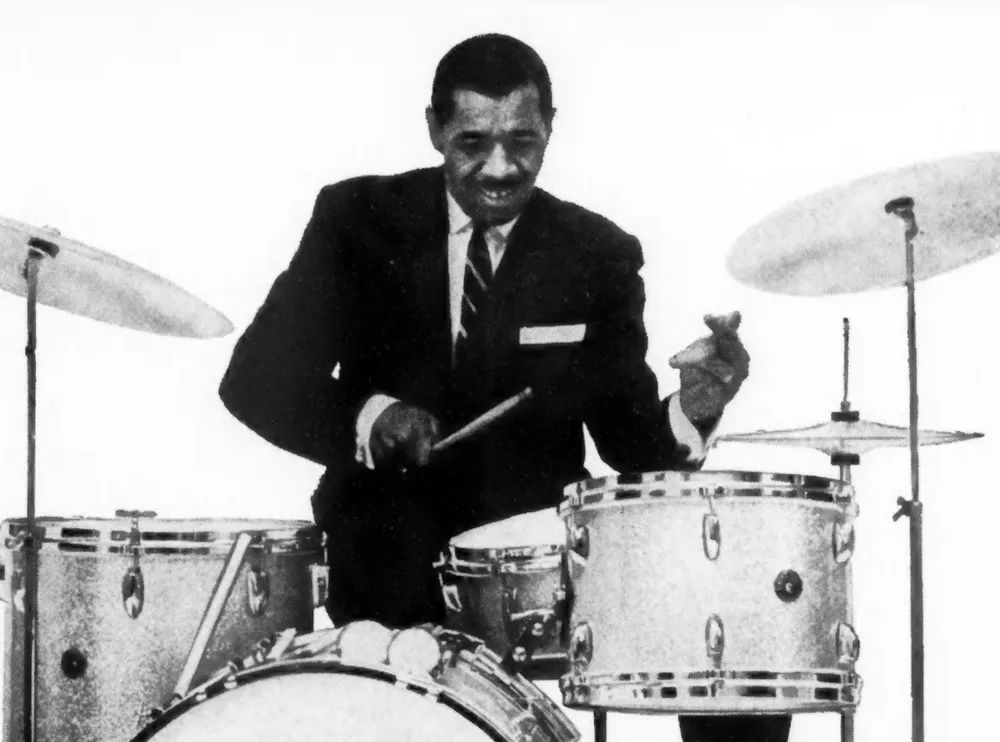
Philly Joe Jones at the drum kit in a Gretsch Drums advertisement, published in DownBeat magazine, October 12, 1961 Public Domain (PD-US-no notice: published in a collective work in the United States between 1931 and 1977 without a copyright notice specific to the advertisement) — Wikimedia Commons — https://commons.wikimedia.org/wiki/File:Philly_Joe_Jones_Advertisement.jpg

Joseph Rudolph Jones was born July 15, 1923, in Philadelphia, into a family where music was a household requirement: his maternal grandmother insisted that all of her daughters study an instrument, and Jones later credited that rule with putting him on the path he took. As a boy he worked as a featured tap dancer on The Kiddie Show, broadcast on the Philadelphia radio station WIP. He served in the U.S. Army during the Second World War (several biographical accounts put the stretch at 1941 to 1947), and after his discharge he took a job as a Philadelphia trolley car driver, one of the first African American men hired to do it. The wages bought his first drum kit, and the route put him in the way of drummers passing through the city, including Max Roach and Art Blakey.
The "Philly" in front of his name was a piece of practical bookkeeping, and it is worth stating plainly because listeners still confuse the two men. Jo Jones, the drummer who powered the Count Basie Orchestra rhythm section from 1934 to 1948 and was widely called "Papa Jo," was already famous when the younger Joe Jones reached New York. Clarinetist Tony Scott took to introducing his new drummer from the bandstand as the Joe Jones from Philly, and the shortened version stuck hard enough that Jones used it professionally for the rest of his life. They were not related, not from the same generation, and not remotely alike behind a kit.
Jones moved to New York in 1947 and became the house drummer at Café Society, where he worked alongside the leading bebop players of the day, Tadd Dameron among them. He also spent time in Joe Morris's rhythm-and-blues band, a group that at various points carried Johnny Griffin, Elmo Hope, and Percy Heath. His first documented recording sessions date to 1948 and 1949 with the Morris orchestra; by 1953 he was in studios with Miles Davis (January 30), with Clifford Brown and Lou Donaldson for Blue Note (June 9), with Tadd Dameron's orchestra (June 11), and with Elmo Hope (June 18). Some accounts have him with Duke Ellington's orchestra briefly in 1952, a job he gave up because he preferred staying in New York and taking studio calls. To sharpen his reading for that work he studied with Cozy Cole, having earlier picked up brush technique directly from Sidney Catlett.
In the summer of 1955, after his Newport Jazz Festival appearance won him a Columbia contract, Miles Davis assembled a working band for an engagement at the Café Bohemia: Sonny Rollins on tenor, Red Garland on piano, Paul Chambers on bass, and Jones on drums. Rollins left that autumn, and on Jones's recommendation Davis brought in John Coltrane. What followed is the most documented rhythm section of the decade. The quintet cut the two 1956 marathon dates for Prestige that produced Cookin', Relaxin', Workin' and Steamin', then 'Round About Midnight for Columbia in 1957, and in February and March 1958 the sextet session (with Cannonball Adderley added on alto) that became Milestones. Davis called Jones his favorite drummer and wrote in his autobiography that he listened for Jones in every drummer he heard afterward, describing him as the fire that made things happen and noting that Jones anticipated what he was about to play. The relationship was not frictionless. Davis let Jones and Coltrane go in 1957 over the unreliability that came with heroin, and by mid-1958 Jimmy Cobb had taken the drum chair for good. Jones eventually got clean, and he was blunt in later interviews about the cost, saying he did not think he had played badly while using but believed he would have played better without it.
Across the same stretch Jones became one of the busiest studio drummers in jazz, working constantly for Prestige, Riverside and Blue Note. The short list of what he played on in three years includes Coltrane's Blue Train (September 15, 1957), Sonny Clark's Cool Struttin' (January 5, 1958), Sonny Rollins's Tenor Madness (May 24, 1956) and Newk's Time (September 22, 1957), Tadd Dameron's Mating Call with Coltrane (November 30, 1956), Art Pepper's Art Pepper Meets the Rhythm Section (January 19, 1957), Bill Evans's Everybody Digs Bill Evans (December 15, 1958), and Cannonball Adderley's Portrait of Cannonball (July 1, 1958). His own leader career began on September 17, 1958, with Blues for Dracula for Riverside, a sextet date with cornetist Nat Adderley, trombonist Julian Priester, Johnny Griffin, pianist Tommy Flanagan and bassist Jimmy Garrison. The title track opens with Jones delivering a deadpan vampire monologue, not an impression of Bela Lugosi so much as an impression of Lenny Bruce's impression of Bela Lugosi, a routine Bruce reportedly enjoyed enough to fold back into his own act. Two more Riverside albums followed quickly: Drums Around the World, cut across three May 1959 dates with a small orchestra billed as Philly Joe Jones' Big Band Sounds and including Cannonball Adderley, Lee Morgan, Curtis Fuller, Benny Golson, Herbie Mann and Wynton Kelly; and Showcase, recorded November 17 and 18, 1959, with Pepper Adams on baritone and Jones himself sitting down at the piano for part of the session. He moved to Atlantic for Philly Joe's Beat (May 20, 1960) and for a two-drummer summit with Elvin Jones, Together!, taped February 2, 1961 but held back until 1964.
Between late 1967 and 1972 Jones lived in London and Paris. For two years, 1967 to 1969, he taught at a school organized specifically around him in Hampstead, north London, while the British Musicians' Union blocked him from taking paid performing work in the country. One of the drummers who sought him out in England was Rashied Ali, a fellow Philadelphian a decade his junior who had just come off John Coltrane's last band and was spending time in Europe. Jones did record in London: Mo' Joe, also issued as Trailways Express, was cut on October 1 and 31, 1968 with a British and Canadian cast including Peter King, Harold McNair, Chris Pyne and Kenny Wheeler. In Paris he made an album with the Jef Gilson Ensemble (Vogue, 1969) and, that November and December, a live co-billed date with Archie Shepp for the America label whose band also held Anthony Braxton and violinist Leroy Jenkins, about as far from the Miles Davis Quintet as he ever travelled.
Back in Philadelphia from 1972, Jones led a fusion group called Le Grand Prix for roughly three years, then returned to the acoustic mainstream. He toured with Bill Evans in 1976 and 1978 and appears on Evans's Quintessence (Fantasy, 1976); he reunited with Red Garland for Keystones! (Xanadu) and Crossings (Galaxy) in 1977 and 1978. Galaxy also gave him the most substantial run of leader dates of his later career: Philly Mignon, recorded November 29 and 30 and December 1, 1977 with Dexter Gordon, Ira Sullivan, Nat Adderley, George Cables and Ron Carter; and a three-day session at Fantasy Studios in Berkeley, October 10 to 12, 1978, that yielded two albums, Advance! (issued 1979) and Drum Song (held until 1985), both with Blue Mitchell, Slide Hampton, Harold Land, Cedar Walton and Marc Johnson.
The last chapter was a repertory project he had wanted for years. In 1981 Jones and trumpeter-arranger Don Sickler founded Dameronia, a nonet built to play Tadd Dameron's compositions and arrangements as Dameron actually wrote them, and staffed in part with musicians who had worked for him: Johnny Coles, Britt Woodman, Cecil Payne, Frank Wess, Charles Davis, Walter Davis Jr. and bassist Larry Ridley. The band recorded To Tadd with Love at Nola Recording Studios on June 28, 1982, and Look Stop Listen, with Johnny Griffin added out front, at Rudy Van Gelder's Englewood Cliffs studio on July 11, 1983. Jones led it until the end of his life, still recording in 1985 with Clifford Jordan (The Rotterdam Session), on Bobby Hutcherson's Good Bait, and on the Manhattan Transfer's Vocalese. He suffered a fatal heart attack in Philadelphia on August 30, 1985, six weeks after his sixty-second birthday. Dameronia carried on without him, with Kenny Washington in the drum chair. The Philadelphia Music Alliance added Jones to its Walk of Fame in 1996, and DownBeat's Veterans Committee elected him to the magazine's Hall of Fame in 2010.
Jones is the drummer who defined what hard bop time felt like, and his signature is identifiable inside two bars: a hard, forward-leaning ride cymbal, an unusually loud and conversational snare, and the cross-stick rimshot accent on the fourth beat that drummers still call the "Philly lick," heard most famously threaded through Miles Davis's Milestones. Art Blakey used the figure first, but Jones made it structural. He came up out of the swing drummers rather than around them, taking brush technique from Sidney Catlett in person and citing Baby Dodds, Chick Webb, Jo Jones, Denzil Best and Dave Tough, then turning rudimental snare vocabulary into melodic solo lines in a way that the bebop generation had not quite managed. That combination made him the pivot between the swing masters and the Elvin Jones and Tony Williams school that displaced him, and it made him a first-call studio player: he appeared on a figure commonly given as 500 or more albums, and his Discogs credit log runs to over 1,200 releases. Both of the bandleaders who used him most were unusually direct about it. Davis named him his favorite drummer outright, and Bill Evans, whose trios were built on the opposite of Jones's volume, is reported to have said the same.
- Blues for Dracula (1958, Riverside) - His debut as a leader, cut September 17, 1958 with Johnny Griffin, Nat Adderley, Julian Priester, Tommy Flanagan and Jimmy Garrison, opening with the comic vampire monologue that gave the record its afterlife. Spotify - Blues For Dracula Listen
- Relaxin' with the Miles Davis Quintet (rec. 1956, rel. 1958, Miles Davis, Prestige) - One of the four albums drawn from the two 1956 marathon sessions that document the first great quintet at working-band tempo. Spotify - Relaxin'
- Milestones (1958, Miles Davis, Columbia) - The sextet date with Cannonball Adderley added, and the clearest recorded example of the fourth-beat accent that carries Jones's name. Spotify - Milestones
- Blue Train (rec. Sept. 15, 1957; rel. 1958, John Coltrane, Blue Note) - Coltrane's only Blue Note leader date, with Jones and Paul Chambers importing the Davis quintet rhythm section wholesale. Spotify - Blue Train
- Cool Struttin' (1958, Sonny Clark, Blue Note) - Recorded January 5, 1958 with Art Farmer and Jackie McLean over the Chambers/Jones tandem, and the record most often held up as the definition of the hard bop groove. Spotify - Cool Struttin'
- Drums Around the World (1959, Riverside) - Subtitled Philly Joe Jones' Big Band Sounds, a three-session May 1959 project scored for a ten-piece band including Lee Morgan, Curtis Fuller, Benny Golson and Herbie Mann, and closing with Tadd Dameron's "Philly J.J." Spotify - Drums Around The World
- Everybody Digs Bill Evans (rec. Dec. 15, 1958; rel. 1959, Bill Evans, Riverside) - Evans's second trio album, with Jones and Sam Jones, recorded weeks after Evans left the Davis band. Spotify - Everybody Digs Bill Evans
- To Tadd with Love (rec. June 28, 1982, Uptown) - The first Dameronia album, a nonet reading of Tadd Dameron's book with Cecil Payne, Frank Wess, Britt Woodman and Larry Ridley. Not confirmed on Spotify.
Philly Joe Jones: Full Discography
Identity confirmed via the live Discogs API: artist ID 257251 ('"Philly" Joe Jones'), which Discogs credits on 1,303 releases in total (60 in a "Main" leader role, 1,109 sideman "Appearance" credits, 52 track-level credits and 82 unofficial pressings). Discogs also maintains five separate group-billing entities for him, checked individually so their releases are not missed here: Philly Joe Jones Sextet (2442379), Philly Joe Jones' Big Band Sounds (2992615), Philly Joe Jones Quintet (6884059), Philly Joe Jones Octet (4819934) and Dameronia (6479708). He is not the same drummer as Jo Jones of the Count Basie Orchestra (Discogs artist 258702), and is unrelated to Elvin Jones and Thad Jones.
The first table below covers his leader and co-leader catalog reasonably fully. The second table is an explicitly labelled representative selection of his most significant sideman dates, not a complete list: his sideman work runs to more than a thousand credited releases and cannot be itemized here.
Spotify's API was returning HTTP 429 (quota exceeded, Retry-After roughly seven hours) throughout this build, so Spotify links below were confirmed by loading the album pages on open.spotify.com directly. Where no album page could be confirmed, the row says so rather than guessing at a link. The Buy column is always a dash: no affiliate program is set up for this site yet.
As Leader / Co-Leader
| Album Title | Recording Date(s) | Release Date | Label | Catalog Number | Format(s) | Personnel | Role | Reissue History | Spotify | Buy | Notes |
|---|---|---|---|---|---|---|---|---|---|---|---|
| Blues for Dracula | September 17, 1958, New York City | 1958 | Riverside Records | RLP 12-282 | Vinyl, LP, Album, Mono | Philly Joe Jones (drums, spoken monologue), Nat Adderley (cornet), Julian Priester (trombone), Johnny Griffin (tenor sax), Tommy Flanagan (piano), Jimmy Garrison (bass) | Leader (Philly Joe Jones Sextet) | Widely reissued on Original Jazz Classics; Riverside also pulled a 7-inch single (R-45-419) from the LP | Spotify - Blues For Dracula | — | His debut as a leader. Produced by Orrin Keepnews. The title track, composed by Johnny Griffin, opens with Jones's spoken vampire routine, a copy of Lenny Bruce's Bela Lugosi bit rather than of Lugosi himself |
| Drums Around the World (subtitled Philly Joe Jones' Big Band Sounds) | May 4, 11 and 28, 1959, New York City | 1959 | Riverside Records | RLP 12-302 | Vinyl, LP, Album, Mono | Philly Joe Jones (drums), Lee Morgan and Blue Mitchell (trumpet), Curtis Fuller (trombone), Cannonball Adderley (alto sax), Benny Golson (tenor sax), Sahib Shihab (baritone sax), Herbie Mann (flute, piccolo), Wynton Kelly (piano), Jimmy Garrison and Sam Jones (bass) | Leader | CD reissue adds an alternate take of "Stablemates" | Spotify - Drums Around The World | — | Ten-piece date, produced by Orrin Keepnews; closes with Tadd Dameron's "Philly J.J." Discogs files it under the separate "Philly Joe Jones' Big Band Sounds" billing |
| Showcase | November 17-18, 1959, New York City | 1959 (Discogs release stamped 1960) | Riverside Records | RLP 12-313 | Vinyl, LP, Album, Mono | Philly Joe Jones (drums, piano), Blue Mitchell (trumpet), Julian Priester (trombone), Bill Barron (tenor sax), Pepper Adams (baritone sax), Sonny Clark and Dolo Coker (piano), Jimmy Garrison (bass) | Leader | Later paired with Drums Around the World on a single CD | Spotify - Showcase | — | Jones takes the piano chair himself on part of the session, alongside Sonny Clark and Dolo Coker |
| Philly Joe's Beat | May 20, 1960, New York City | 1960 | Atlantic | 1340 | Vinyl, LP, Album, Mono | Philly Joe Jones (drums), Michael Downs (cornet), Bill Barron (tenor sax), Walter Davis Jr. (piano), Paul Chambers (bass) | Leader | Atlantic also issued a 7-inch EP; later paired on CD with Together! (Collectables, 1999) | Spotify - Philly Joe's Beat | — | Engineered by Tom Dowd and Phil Iehle; cover photograph by Lee Friedlander |
| Together! (with Elvin Jones) | February 2, 1961, New York City | 1964 (recorded 1961) | Atlantic | 1428 | Vinyl, LP, Album, Mono | Philly Joe Jones and Elvin Jones (drums), Blue Mitchell (trumpet), Curtis Fuller (trombone), Hank Mobley (tenor sax), Wynton Kelly (piano), Paul Chambers (bass) | Co-leader (with Elvin Jones) | Reissued 1999 on CD paired with Philly Joe's Beat (Collectables) | Spotify - Together! | — | Two-drummer date supervised by Nesuhi Ertegun, engineered by Phil Ramone; held in the vault three years before Atlantic issued it |
| Gretsch Drum Night at Birdland (Vols. 1 and 2) | Recorded live at Birdland, New York, 1960 | 1960 and 1961 | Roulette | R 52049 / R 52086 | Vinyl, LP, Album | Art Blakey, Charlie Persip, Elvin Jones and Philly Joe Jones (drums), with accompanying groups | Co-billed (four-drummer bill) | Repackaged repeatedly, including as Drum Night at Birdland (1974), Soulful Drum Battles (1964), The Big Beat (1973) and Five Greatest Drummers (1968) | Not confirmed on Spotify | — | Not a Jones leader date, but he shares top billing; listed here because Discogs files it under his "Main" role |
| Trailways Express (also issued as Mo' Joe and Gone, Gone, Gone) | October 1 and 31, 1968, London | 1971 (US reissue July 1975) | Black Lion Records | BL-142 | Vinyl, LP, Album, Stereo | Philly Joe Jones (drums), Kenny Wheeler and Les Condon (trumpet, flugelhorn), Chris Pyne (trombone), Peter King (alto sax), Harold McNair (tenor sax, flute), Mick Pyne (piano), Ron Mathewson and John Hart (bass) | Leader | Reissued repeatedly under all three titles | Not confirmed on Spotify | — | Cut in London during the years the British Musicians' Union barred him from paid performing work in the UK; produced by Alan Bates, liner notes by Brian Priestley |
| Philly Joe Jones Avec Jef Gilson Et Son Ensemble | January 31 and March 1, 1969, Paris | 1969 | Disques Vogue | (Vogue LP, catalog not confirmed) | Vinyl, LP, Album | Philly Joe Jones (drums) with the Jef Gilson Ensemble | Co-leader | None found | Not confirmed on Spotify | — | One of two French leader-billed sessions from his Paris period |
| Archie Shepp & Philly Joe Jones | November 29-30 and December 1, 1969, Paris (recorded live) | 1969 (Discogs release stamped 1970) | America Records | 30 AM 6102 / 6102 | Vinyl, LP, Album | Philly Joe Jones (drums), Archie Shepp (tenor sax, piano), Anthony Braxton (alto and soprano sax), Leroy Jenkins (violin), Earl Freeman (bass), Chicago Beau (vocals, soprano sax, harmonica), Julio Finn (harmonica) | Co-leader (with Archie Shepp) | Reissued on the BYG/America catalog | Not confirmed on Spotify | — | The furthest into the free-jazz avant-garde Jones ever recorded |
| Round Midnight | July 18, 1969 (recorded live) | 1980 (also issued 1977 in Japan on Joker) | Lotus | (Lotus LP; Japanese Joker pressing UPS-2065-KR) | Vinyl, LP, Album | Philly Joe Jones (drums), Dizzy Reece (trumpet), Bent Jaedig (tenor sax), Larry Vuckovich (piano), Isla Eckinger (bass) | Leader | Multiple grey-area European and Japanese pressings; release year varies by pressing | Not confirmed on Spotify | — | Live European date held back for over a decade; Discogs shows conflicting issue years across pressings |
| Mean What You Say | April 6-7, 1977 | 1977 | Sonet Records | SNTF 735 | Vinyl, LP, Album | Philly Joe Jones (drums), Tommy Turrentine (trumpet), Charles Bowen (soprano and tenor sax), Mickey Tucker (piano), Mickey Bass (bass) | Leader | None found | Not confirmed on Spotify | — | Issued in Sonet's "Giants of Jazz" series, produced by Samuel B. Charters. Not to be confused with the 1966 Thad Jones/Pepper Adams album of the same title |
| Philly Mignon | November 29-30 and December 1, 1977 | 1978 | Galaxy | GXY-5112 | Vinyl, LP, Album, Stereo | Philly Joe Jones (drums), Nat Adderley (cornet), Dexter Gordon and Ira Sullivan (tenor sax), George Cables (piano), Ron Carter (bass) | Leader | Reissued on CD by Fantasy/OJC | Not confirmed on Spotify | — | Produced by Ed Michel; the first of three Galaxy leader albums |
| Advance! | October 10-12, 1978, Fantasy Studios, Berkeley, CA | 1979 | Galaxy | GXY-5122 | Vinyl, LP, Album | Philly Joe Jones (drums), Blue Mitchell (trumpet, flugelhorn), Slide Hampton (trombone, arranger), Harold Land and Charles Bowen (tenor and soprano sax), Cedar Walton (piano), Marc Johnson (bass) | Leader | Reissued on CD | Not confirmed on Spotify | — | Same three-day session as Drum Song. "Midnight Waltz" is a trio track for Walton, Johnson and Jones only |
| Drum Song | October 10-12, 1978, Fantasy Studios, Berkeley, CA | 1985 (recorded 1978) | Galaxy | GXY-5153 | Vinyl, LP, Album | Same personnel as Advance!: Jones, Blue Mitchell, Slide Hampton, Harold Land, Charles Bowen, Cedar Walton, Marc Johnson | Leader | Collected on the Drum Songs CD compilation (Milestone, 2002) | Not confirmed on Spotify | — | Second album drawn from the Advance! sessions, shelved seven years. Opens with Tadd Dameron's "Our Delight," four of the six charts arranged by Slide Hampton |
| Filet de Sole (Philly of Soul) | June 19, 1981, Paris | 1992 (recorded 1981) | Marge Productions / FD Music | MARGE 18 / 151972 | CD, Album | Philly Joe Jones Octet: Jones (drums), Roger Guerin (trumpet), Glenn Ferris (trombone), Hirshel McGinnis (alto sax), Charles Davis and Hal Singer (tenor sax), Gene Adler (piano), Wilbur Little (bass) | Leader (Philly Joe Jones Octet) | None found | Not confirmed on Spotify | — | Filed on Discogs under the separate "Philly Joe Jones Octet" entity; copyright 1981, issued 1992, seven years after his death |
| To Tadd with Love | June 28, 1982, Nola Recording Studios, New York City | 1982 (Discogs pressing stamped 1983) | Uptown Records | UP 27.11 | Vinyl, LP, Album | Philly Joe Jones Dameronia: Jones (drums), Don Sickler (trumpet, music director), Johnny Coles (trumpet), Britt Woodman (trombone), Frank Wess (alto sax), Charles Davis (tenor sax), Cecil Payne (baritone sax), Walter Davis Jr. (piano), Larry Ridley (bass) | Leader (Dameronia) | Reissued on CD by Uptown | Not confirmed on Spotify | — | First album by the Tadd Dameron repertory nonet Jones co-founded with Don Sickler in 1981. Liner notes by Ira Gitler |
| Look Stop Listen (labelled Look Stop and Listen) | July 11, 1983, Van Gelder Studio, Englewood Cliffs, NJ | 1983 | Uptown Records | UP 27.15 | Vinyl, LP, Album | Philly Joe Jones Dameronia featuring Johnny Griffin: Jones (drums), Griffin and Charles Davis (tenor sax), Don Sickler and Virgil Jones (trumpet), Benny Powell (trombone), Frank Wess (alto sax, flute), Cecil Payne (baritone sax), Walter Davis Jr. (piano), Larry Ridley (bass) | Leader (Dameronia) | Reissued on CD by Uptown | Not confirmed on Spotify | — | Recorded and mastered by Rudy Van Gelder; co-produced by Helen Keane. Jones's last studio album as a leader |
| The Rotterdam Session | 1985 | 1985 | Audio Daddio | (LP, catalog not confirmed) | Vinyl, LP, Album | "Philly" Joe Jones, Clifford Jordan (tenor sax), James Long | Co-billed | None found | Not confirmed on Spotify | — | A late co-billed European date; sourced from Discogs and Wikipedia, session details thin |
| Live at Birdland (Historic Unreleased 1962 Recordings) | 1962, Birdland, New York City | 2023 | Fresh Sound Records | (Fresh Sound CD) | CD, Mono, Remastered | Philly Joe Jones Sextet and Quintet | Leader (posthumous archival release) | First issue | Not confirmed on Spotify | — | Previously unissued 1962 club tapes, released 38 years after his passing |
| Philly Joe's Beat: 1960-1961 Studio & Live Recordings | 1960-1961 | 2023 | Fresh Sound Records | (Fresh Sound CD) | CD, Remastered | Philly Joe Jones Quintet | Leader (compilation/archival) | First issue in this configuration | Not confirmed on Spotify | — | Couples the Atlantic album with a previously unreleased 1961 Birdland performance |
Dameronia after Jones. The band continued under Don Sickler with Kenny Washington on drums and recorded Live at the Theatre Boulogne-Billancourt Paris for Soul Note, issued 1994. It is Dameronia's third album but is not a Philly Joe Jones recording and is listed here only to close the group's discography.
As Sideman (selected major credits)
This table is a representative selection, not a complete list. Discogs credits Jones on 1,109 sideman "Appearance" releases plus 52 track-level credits, spanning 1948 to posthumous compilations; the sessions below are the ones most often cited as historically significant.
| Year | Project (Leader) | Title | Label | Catalog | Role | Notes |
|---|---|---|---|---|---|---|
| 1953 | Clifford Brown / Lou Donaldson | Memorial Album | Blue Note (BLP 1526) | Drums | Recorded June 9, 1953; among his earliest bebop studio dates | |
| 1953 | Tadd Dameron | (Tadd Dameron Orchestra session) | Prestige | Drums | Recorded June 11, 1953; the start of a working relationship that ended with Dameronia thirty years later | |
| 1953 | Elmo Hope | The Elmo Hope Trio | Blue Note (BLP 5029) | Drums | Recorded June 18, 1953; Jones recorded with Hope on and off until 1966 | |
| 1956 | Sonny Rollins | Tenor Madness | Prestige (PRLP 7047) | Drums | Recorded May 24, 1956; Rollins hired the whole Miles Davis rhythm section, and the title track is the only known Rollins/John Coltrane meeting. Spotify - Tenor Madness | |
| 1956 | Miles Davis Quintet | Cookin' / Relaxin' / Workin' / Steamin' | Prestige (PRLP 7094, 7129, 7166, 7200) | Drums | The two marathon sessions of May 11 and October 26, 1956, split across four albums. Spotify - Relaxin' | |
| 1956 | Tadd Dameron with John Coltrane | Mating Call | Prestige (PRLP 7070) | Drums | Recorded November 30, 1956 at Van Gelder's Hackensack studio, quartet with John Simmons on bass. Spotify - Mating Call | |
| 1957 | Art Pepper | Art Pepper Meets the Rhythm Section | Contemporary (C 3532) | Drums | Recorded January 19, 1957 in Los Angeles; the Garland/Paul Chambers/Jones trio hired as a unit. Spotify - Art Pepper Meets The Rhythm Section | |
| 1957 | Miles Davis | 'Round About Midnight | Columbia (CL 949) | Drums | The quintet's Columbia debut. Spotify - 'Round About Midnight | |
| 1957 | John Coltrane | Blue Train | Blue Note (BLP 1577) | Drums | Recorded September 15, 1957; Coltrane's only Blue Note leader session, with Lee Morgan, Curtis Fuller, Kenny Drew and Paul Chambers. Spotify - Blue Train | |
| 1957 | Sonny Rollins | Newk's Time | Blue Note (BLP 4001) | Drums | Recorded September 22, 1957, released 1959; "The Surrey with the Fringe on Top" is a Rollins/Jones duo | |
| 1957 | Clark Terry | Serenade to a Bus Seat | Riverside (RLP 12-237) | Drums | With Coltrane, Wynton Kelly and Paul Chambers | |
| 1958 | Sonny Clark | Cool Struttin' | Blue Note (BLP 1588) | Drums | Recorded January 5, 1958, with Art Farmer and Jackie McLean. Spotify - Cool Struttin' | |
| 1958 | Miles Davis | Milestones | Columbia (CL 1193) | Drums | Recorded February 4 and March 4, 1958, with Cannonball Adderley added to make a sextet. Spotify - Milestones | |
| 1958 | Cannonball Adderley | Portrait of Cannonball | Riverside (RLP 12-269) | Drums | Recorded July 1, 1958, with Blue Mitchell, Bill Evans and Sam Jones | |
| 1958 | Bill Evans | Everybody Digs Bill Evans | Riverside (RLP 12-291) | Drums | Recorded December 15, 1958, trio with Sam Jones. Spotify - Everybody Digs Bill Evans | |
| 1958 | Miles Davis | Porgy and Bess | Columbia (CL 1274) | Drums (part) | Gil Evans orchestral collaboration; drum chair split with Jimmy Cobb | |
| 1958 | Bud Powell | Time Waits: The Amazing Bud Powell (Vol. 4) | Blue Note (BLP 1598) | Drums | Trio with Sam Jones | |
| 1958 | Chet Baker | Chet Baker in New York | Riverside (RLP 12-281) | Drums | Recorded 1958, released 1959; also on the companion Chet Baker Introduces Johnny Pace. Chet Baker profiled separately | |
| 1958 | Benny Golson | The Other Side of Benny Golson / Benny Golson and the Philadelphians | Riverside / United Artists | Drums | The United Artists date is an all-Philadelphia band with Lee Morgan, Percy Heath and Ray Bryant | |
| 1961 | Hank Mobley | Workout | Blue Note (BLP 4080) | Drums | Recorded March 26, 1961, with Grant Green, Wynton Kelly and Paul Chambers; named by Scott Yanow among the essential hard bop recordings | |
| 1961 | Dexter Gordon | Dexter Calling... | Blue Note (BLP 4083) | Drums | Gordon's second Blue Note return date; further material from 1961-62 issued as Landslide (1980) | |
| 1961 | Freddie Hubbard | Goin' Up / Hub Cap | Blue Note (BLP 4056, 4073) | Drums | Two of three Hubbard Blue Notes Jones played on, with Here to Stay following in 1962. Freddie Hubbard profiled separately | |
| 1962 | Bill Evans | Interplay | Riverside (RLP 445) | Drums | Quintet with Freddie Hubbard, Jim Hall and Percy Heath; the same August 1962 sessions produced Loose Blues | |
| 1962 | Milt Jackson and Wes Montgomery | Bags Meets Wes! | Riverside (RLP 407) | Drums | With Wynton Kelly and Sam Jones | |
| 1962 | Red Garland | Red's Good Groove | Jazzland (JLP 76) | Drums | Reunion with the Davis quintet pianist, with Blue Mitchell and Pepper Adams | |
| 1963 | Ben Webster with Joe Zawinul | Soulmates | Riverside (RLP 476) | Drums | Webster's meeting with the young Joe Zawinul | |
| 1967 | Bill Evans | California Here I Come | Verve (issued 1982) | Drums | Live at the Village Vanguard with Eddie Gomez, unreleased for fifteen years | |
| 1976 | Bill Evans | Quintessence | Fantasy (F-9529) | Drums | With Harold Land, Kenny Burrell and Ray Brown, from the years Jones toured with Evans | |
| 1977 | Red Garland | Keystones! | Xanadu (XAN 183) | Drums | Live San Francisco date; the studio album Crossings (Galaxy) followed in 1978 with Ron Carter | |
| 1983-84 | Bobby Hutcherson | Four Seasons / Good Bait | Timeless / Landmark | Drums | Recorded 1983 and 1984, both issued 1985; among his last sideman sessions | |
| 1985 | The Manhattan Transfer | Vocalese | Atlantic (81266) | Drums | Released the year he died; a Grammy-winning vocalese project drawing on the hard bop repertoire he helped create |
Jones's Discogs log also carries substantial runs with Elmo Hope (six albums, 1953 to 1966), Kenny Drew, Ernie Henry, Art Farmer, Duke Jordan, Abbey Lincoln, Howard McGhee, Blue Mitchell, Phineas Newborn Jr., Archie Shepp, Clark Terry, Jimmy Smith, Kenny Burrell, Serge Chaloff, Warne Marsh, J. R. Monterose, Phil Woods, Sonny Stitt, Jack Wilson and Sun Ra, none of them itemized here.
- Miles Davis - bandleader, summer 1955 to mid-1958, across the two 1956 Prestige marathon sessions, 'Round About Midnight, Milestones and part of Porgy and Bess. Davis named Jones his favorite drummer and also fired him, in 1957, over the unreliability that came with heroin.
- John Coltrane - quintet bandmate 1955 to 1958, hired on Jones's own recommendation after Sonny Rollins left; Jones then played on Blue Train (1957) and on Tadd Dameron's Mating Call (1956) with him.
- Paul Chambers - bass partner in the Davis quintet and on dozens of outside dates; the Garland/Chambers/Jones trio was hired as a unit for Art Pepper Meets the Rhythm Section and Tenor Madness.
- Red Garland - pianist in the same rhythm section, and a partner again twenty years later on Red's Good Groove (1962), Keystones! (1977) and Crossings (1978).
- Tadd Dameron - employer at Café Society in the late 1940s, leader on Mating Call (1956), composer of "Philly J.J.," and the subject of the repertory band Jones spent his last four years leading.
- Bill Evans - recorded together from Everybody Digs Bill Evans (1958) through Interplay (1962), the 1967 Village Vanguard tapes issued as California Here I Come, and Quintessence (1976); Jones toured with Evans in 1976 and 1978.
- Don Sickler - trumpeter, arranger and music director; co-founded Dameronia with Jones in 1981 and transcribed Dameron's charts for it.
- Elvin Jones - co-leader on the two-drummer album Together! (recorded 1961, released 1964) and a fellow participant in the Gretsch Drum Night sessions at Birdland.
- Johnny Griffin - tenor saxophonist on Blues for Dracula (1958), composer of its title track, and the featured soloist on Dameronia's Look Stop Listen (1983).
- Cannonball Adderley, Lee Morgan, Curtis Fuller, Benny Golson, Herbie Mann, Wynton Kelly, Pepper Adams - among the players Jones hired for his own Riverside leader dates in 1958 and 1959.
- Sonny Clark, Hank Mobley, Freddie Hubbard, Dexter Gordon, Kenny Drew, Elmo Hope, Blue Mitchell, Milt Jackson and Wes Montgomery, Jimmy Smith, Chet Baker - a small sample of the leaders who used him on Blue Note, Riverside and Prestige dates between 1953 and 1963.
- Rashied Ali - fellow Philadelphian and John Coltrane's last drummer, who studied with Jones in England during Jones's London years.
- Archie Shepp, Anthony Braxton, Leroy Jenkins - his Paris company on the co-billed Archie Shepp & Philly Joe Jones (America, recorded late 1969).
More Bebop Artists
See all 166 Bebop artists →More American Jazz Artists
See all 567 American artists →- Wikipedia: Philly Joe Jones
- Discogs: "Philly" Joe Jones (artist 257251)
- Encyclopedia.com: Jones, Philly Joe
- Musician Guide: Philly Joe Jones Biography
- Modern Drummer: Philly Joe Jones, One Of The Greatest Hard Boppers
- Philadelphia Music Alliance Walk of Fame: Philly Joe Jones
- DownBeat Hall of Fame inductee list
- WRTI: How "Blues for Dracula" made Philly Joe Jones a Halloween hero
- Jazzfuel: Philly Joe Jones, essential albums
- Jazzdisco.org: Philly Joe Jones session index
- Wikipedia: Miles Davis Quintet
- Wikipedia: Dameronia
- Wikipedia: Blues for Dracula
- Wikipedia: Drums Around the World
- Wikipedia: Showcase (Philly Joe Jones album)
- Wikipedia: Together! (Elvin Jones and Philly Joe Jones album)
- Wikipedia: Advance!
- Wikipedia: Drum Song
- Wikipedia: To Tadd with Love
- Wikipedia: Look Stop Listen