 JAZZPROFILES lives in the music 1,572 Jazz Artists fully Profiled!
 Eric Dolphy
Last updated September 26, 2026
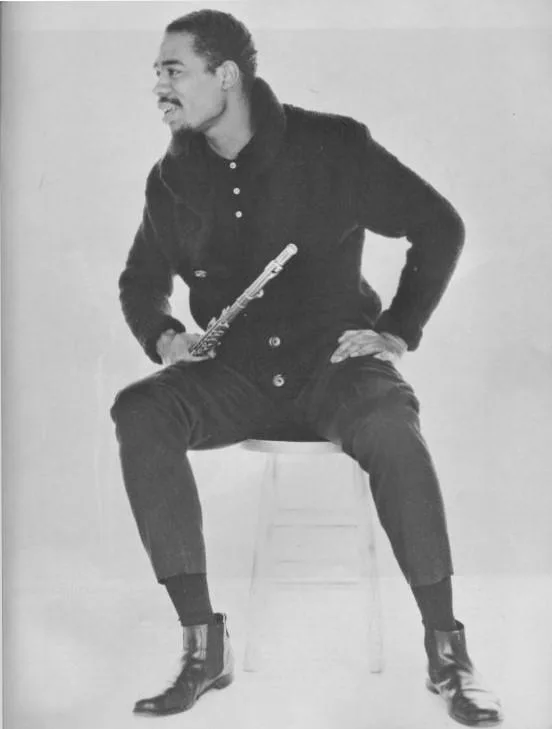
Eric Dolphy, uncredited photograph published in *The Jazz Review*, June 1960 issue, taken during the peak years of his New York career. Public domain (per Wikimedia Commons file page; uploader documented no known copyright holder for this 1960 magazine photo). — Wikimedia Commons - https://commons.wikimedia.org/wiki/File:Eric_Dolphy_-_uncredited_photo_in_The_Jazz_Review_-_June_1960_issue.jpg

Eric Allan Dolphy Jr. was born June 20, 1928, in Los Angeles, California, to Sadie and Eric Dolphy Sr., immigrants from Panama. He began private lessons on clarinet and saxophone at age six and added oboe in junior high school, attended Susan Miller Dorsey High School, and won a two-year scholarship to the University of Southern California's music school before enrolling at Los Angeles City College. By 1948 and 1949 he was recording with trumpeter Roy Porter's big band, the 17 Beboppers, doubling on baritone and alto saxophone, flute, and soprano clarinet. Drafted into the U.S. Army in 1950, he served at Fort Lewis, Washington, and attended the Navy School of Music starting in 1952; discharged in 1953, he returned to Los Angeles and worked through the decade with reedman Buddy Collette, pianist Eddie Beal, trumpeter Clifford Brown, and bandleader Gerald Wilson.
Dolphy's breakthrough came in 1958, when he joined drummer Chico Hamilton's quintet, touring nationally and appearing in the concert film Jazz on a Summer's Day, shot at the 1958 Newport Jazz Festival. He left Hamilton's band in 1959 and moved to New York, where bassist and composer Charles Mingus, who had known him from the Los Angeles scene, brought him into his Jazz Workshop in 1960. Dolphy appeared that October on the sessions later issued as Charles Mingus Presents Charles Mingus and Mingus (Candid), his first recorded showcase alongside Mingus's most volatile writing.
Between April and December 1960, Dolphy cut his first three albums as a leader for Prestige's New Jazz subsidiary: Outward Bound (recorded April 1, 1960), with trumpeter Freddie Hubbard, pianist Jaki Byard, bassist George Tucker, and drummer Roy Haynes; Out There (recorded August 15, 1960), an unusual quartet built around Ron Carter's cello; and Far Cry (recorded December 21, 1960), which introduced his partnership with 22-year-old trumpeter Booker Little, again with Byard and Carter. That same December he also recorded as a sideman on two Third Stream-adjacent Atlantic dates: Ornette Coleman's Free Jazz: A Collective Improvisation, playing bass clarinet in Coleman's double quartet, and composer Gunther Schuller and pianist John Lewis's Jazz Abstractions, which paired him with guitarist Jim Hall on Hall's "Piece for Guitar and Orchestra." In early 1961 Dolphy joined John Coltrane's band, appearing on the Africa/Brass sessions (May 23 and June 7, 1961, Impulse!) and the Village Vanguard residency that November; Down Beat writer John Tynan branded their exploratory duets "anti-jazz," a charge Coltrane later rejected, crediting Dolphy with a "broadening effect" on his own playing. Dolphy also appeared, billed under the pseudonym "George Lane" to sidestep his exclusive Prestige contract, on Coltrane's Atlantic session Olé Coltrane (May 1961).
In July 1961, Dolphy and Little co-led a two-week engagement at the Five Spot in Greenwich Village; the surviving tape, from July 16, the residency's final night, produced three volumes released between 1961 and 1965 (At the Five Spot, Volume 1 and Volume 2, and the posthumous Memorial Album), with pianist Mal Waldron, bassist Richard Davis, and drummer Ed Blackwell. Little died of kidney failure that October 5, at age 23. Weeks earlier, in September 1961, Dolphy had toured Scandinavia, recording in Copenhagen with a Danish rhythm section (pianist Bent Axen, bassist Erik Moseholm, drummer Jorn Elniff) and in Stockholm with trumpeter Idrees Sulieman, material later issued across several "In Europe" volumes. On March 10, 1963, he taped a broadcast concert at the University of Illinois with a 22-year-old Herbie Hancock on piano, bassist Eddie Khan, and drummer J.C. Moses; shelved for 36 years, it surfaced in 1999 as The Illinois Concert. That July 1 and 3, he recorded an ambitious two-session date in New York with trumpeter Woody Shaw, multi-reedists Prince Lasha and Sonny Simmons, saxophonist Clifford Jordan, bassoonist Garvin Bushell, vibraphonist Bobby Hutcherson, and a rotating rhythm section, issued in pieces as Conversations (1963) and, after his death, Iron Man (1968).
Dolphy's final American studio album, Out to Lunch! (recorded February 25, 1964, for Blue Note), paired his alto saxophone, bass clarinet, and flute with Freddie Hubbard's trumpet, Bobby Hutcherson's vibraphone, Richard Davis's bass, and 18-year-old Tony Williams's drums on five originals built from angular, asymmetrical structures; it is now widely regarded as his masterpiece. That spring he rejoined Mingus for a European tour with pianist Jaki Byard, tenor saxophonist Clifford Jordan, trumpeter Johnny Coles, and drummer Dannie Richmond, documented on the February 4, 1964 Town Hall Concert and a run of European concert tapes. Before a concert in Oslo, Dolphy told Mingus he intended to leave the band and stay in Europe, disillusioned with the American reception of his music and planning to settle in Paris with his fiancee, dancer Joyce Mordecai; he went on to work with expatriate trumpeter Donald Byrd and saxophonist Nathan Davis. On June 2, 1964, at a VARA radio studio in Hilversum, Netherlands, he recorded what became Last Date with pianist Misha Mengelberg, bassist Jacques Schols, and drummer Han Bennink.
Dolphy fell ill after traveling to West Berlin to perform with vibraphonist Karl Berger's trio; he was hospitalized following his first concert there and passed away on June 29, 1964, five days short of turning 36, after slipping into a diabetic coma that hospital physicians reportedly misread as a drug overdose. He was buried at Angelus-Rosedale Cemetery in Los Angeles under the epitaph "He Lives In His Music," and was inducted into Down Beat's Hall of Fame later that year. His influence reached directly into the next generation of reed players, including Anthony Braxton, members of the Art Ensemble of Chicago, and Oliver Lake, and Frank Zappa later paid tribute with "The Eric Dolphy Memorial Barbecue" on Weasels Ripped My Flesh (1970).
Dolphy was one of jazz's rare true multi-instrumentalist innovators, developing an original vocabulary on alto saxophone, bass clarinet, and flute at once rather than treating any of them as a secondary horn; his lines moved in wide, angular intervals that critics and fellow musicians likened to speech patterns and birdsong, a fascination he pursued directly (he was known to study and imitate the calls of finches and other birds). He bridged camps that rarely spoke to each other in 1960 and 1961: a hard-bop-trained sideman who could also hold his own inside Ornette Coleman's free-jazz double quartet and Gunther Schuller's Third Stream chamber writing, and a member of John Coltrane's working band during the stretch when Coltrane's own harmonic and rhythmic freedom expanded most dramatically. Down Beat's 1961 dismissal of the two men's playing as "anti-jazz" marked the low point of his contemporary critical reception; historical judgment reversed it almost entirely. Out to Lunch! is now routinely ranked among Blue Note's most important albums, and Dolphy is recognized as a direct forerunner of the 1960s "New Thing" avant-garde and of later reed stylists including Anthony Braxton and Oliver Lake.
- Out to Lunch! (rec. Feb. 25, 1964; rel. 1964, Blue Note) - Dolphy's magnum opus, a quartet date with Freddie Hubbard, Bobby Hutcherson, Richard Davis, and Tony Williams. Spotify - Out To Lunch (The Rudy Van Gelder Edition) Listen
- Last Date (rec. June 2, 1964; rel. 1964, Limelight) - His last studio session, a Hilversum radio recording with pianist Misha Mengelberg's trio, released months after his death; a further Paris session on June 11, 1964, with Donald Byrd and drummer Franco Manzecchi, was issued much later. Spotify - Last Date Listen
- Outward Bound (rec. April 1, 1960; rel. 1960, New Jazz) - His debut as a leader, with Freddie Hubbard and Jaki Byard. Not confirmed on Spotify (search quota-limited during this build).
- Far Cry (rec. Dec. 21, 1960; rel. 1962, New Jazz) - Introduced his short but pivotal partnership with trumpeter Booker Little. Not confirmed on Spotify.
- At the Five Spot, Volume 1 (rec. July 16, 1961; rel. 1961, New Jazz) - The only recorded night of the Dolphy/Little Five Spot residency, with pianist Mal Waldron. Not confirmed on Spotify.
- Free Jazz: A Collective Improvisation (rec. Dec. 21, 1960; rel. 1961, Atlantic, Ornette Coleman) - As a sideman: Dolphy on bass clarinet inside Coleman's landmark double quartet. Not confirmed on Spotify.
- The Blues and the Abstract Truth (rec. Feb. 23, 1961; rel. 1961, Impulse!, Oliver Nelson) - As a sideman: alto sax and flute alongside Freddie Hubbard on one of the era's most influential sextet dates. Not confirmed on Spotify.
- Africa/Brass (rec. May-June 1961; rel. 1961, Impulse!, John Coltrane) - As a sideman and arranger: part of the stretch of Coltrane recordings Down Beat branded "anti-jazz." Not confirmed on Spotify.
Eric Dolphy: Full Discography
Identity confirmed via the live Discogs API, artist ID 145272 ("Eric Dolphy," born/died dates matching). Discogs credits Dolphy across 971 release/master entries in total (158 in a "Main" role, 563 sideman "Appearance" credits, 173 track-level "TrackAppearance" credits, plus 77 unofficial releases), but Dolphy died at 36 with a compact original recorded output, so the great majority of that total is reissues, compilations, and posthumous repackagings of the same handful of sessions (the "In Europe" and "At the Five Spot" material alone accounts for dozens of overlapping volume/reissue titles). The table below itemizes his confirmed leader/co-leader sessions plus a representative set of his most significant sideman dates; it does not attempt to list every reissue or compilation. Group-billing entities were checked separately (Discogs IDs 943319 "Eric Dolphy Quintet" and 1239436 "Eric Dolphy Quartet") and surfaced no leader sessions beyond what is already listed here.
As Leader / Co-Leader
| Album Title | Recording Date(s) | Release Date | Label | Catalog Number | Format(s) | Personnel | Role | Reissue History | Spotify | Buy | Notes |
|---|---|---|---|---|---|---|---|---|---|---|---|
| Outward Bound | Recorded April 1, 1960, Van Gelder Studio, Hackensack NJ | 1960 | New Jazz | NJLP 8236 | Vinyl, LP, Album, Mono | Eric Dolphy (alto sax, bass clarinet, flute), Freddie Hubbard (trumpet), Jaki Byard (piano), George Tucker (bass), Roy Haynes (drums) | Leader | Reissued on Original Jazz Classics (OJC) | Not confirmed on Spotify (search quota-limited during this build) | — | Dolphy's recorded debut as a leader |
| Out There | Recorded August 15, 1960, Van Gelder Studio, Hackensack NJ | 1960 | New Jazz | NJLP 8252 | Vinyl, LP, Album, Mono | Eric Dolphy (alto sax, bass clarinet, flute), Ron Carter (cello), George Duvivier (bass), Roy Haynes (drums) | Leader | Reissued on OJC | Not confirmed on Spotify | — | Unusual pianoless, cello-anchored quartet instrumentation |
| Far Cry | Recorded December 21, 1960, Van Gelder Studio, Hackensack NJ | 1962 | New Jazz | NJLP 8270 | Vinyl, LP, Album, Mono | Eric Dolphy (alto sax, bass clarinet, flute), Booker Little (trumpet), Jaki Byard (piano), Ron Carter (bass), Roy Haynes (drums) | Leader | Reissued on OJC | Not confirmed on Spotify | — | Introduced Dolphy's partnership with 22-year-old Booker Little |
| At the Five Spot, Volume 1 | Recorded live July 16, 1961, Five Spot Cafe, New York City | 1961 | New Jazz | NJLP 8260 | Vinyl, LP, Album | Eric Dolphy (alto sax, bass clarinet, flute), Booker Little (trumpet), Mal Waldron (piano), Richard Davis (bass), Ed Blackwell (drums) | Co-leader (with Booker Little) | Reissued on OJC and, expanded, as The Complete Eric Dolphy box sets | Not confirmed on Spotify | — | The residency's only recorded night |
| At the Five Spot, Volume 2 | Same July 16, 1961 session | 1963 | Prestige | PRLP 7350 | Vinyl, LP, Album | Same personnel as Volume 1 | Co-leader (with Booker Little) | Reissued on OJC | Not confirmed on Spotify | — | Second volume drawn from the same night's tape |
| Memorial Album: Recorded Live at the Five Spot | Same July 16, 1961 session | 1965 (posthumous) | Prestige | PRLP 7382 | Vinyl, LP, Album | Same personnel as Volume 1 | Co-leader (with Booker Little) | Reissued on OJC | Not confirmed on Spotify | — | Released after both Dolphy's and Little's deaths |
| Eric Dolphy in Europe, Vol. 1-3 | Recorded September 6, 8, 25 and November 19, 1961, in Copenhagen and Stockholm | 1961-1965 | Prestige | Various (NJLP 8286 and successors) | Vinyl, LP, Album | Eric Dolphy (alto sax, bass clarinet, flute) with, in Copenhagen: Bent Axen (piano), Erik Moseholm (bass), Jorn Elniff (drums), Chuck Israels (bass, one track); in Stockholm: Idrees Sulieman (trumpet) and a local rhythm section | Leader | Repeatedly reissued and recompiled (e.g. In Copenhagen 1961, Stockholm Sessions, "Live" 1961) | Not confirmed on Spotify | — | Recorded during a September-November 1961 solo European tour, separate from his 1964 tour with Mingus |
| The Illinois Concert | Recorded live March 10, 1963, University of Illinois, Champaign-Urbana | 1999 (posthumous) | Blue Note | 7243 4 99826 2 3 | CD, Album | Eric Dolphy (alto sax, bass clarinet, flute), Herbie Hancock (piano), Eddie Khan (bass), J.C. Moses (drums), with University of Illinois Brass Ensemble and Big Band on select tracks | Leader | None found | Not confirmed on Spotify | — | Unreleased for 36 years; surfaced after being mentioned in an online Dolphy discussion group and relayed to producer Michael Cuscuna |
| Conversations | Recorded July 1 and 3, 1963, Music Makers Studio, New York City | 1963 | FM Records (Alan Douglas) | FM 33-121 | Vinyl, LP, Album | Eric Dolphy (alto sax, flute, bass clarinet), Prince Lasha (flute), Sonny Simmons (alto sax), Clifford Jordan (soprano sax), Woody Shaw (trumpet), Garvin Bushell (bassoon), Bobby Hutcherson (vibraphone), Richard Davis / Eddie Khan (bass), J.C. Moses / Charles Moffett (drums) | Leader | Reissued 1986 | Not confirmed on Spotify | — | Same two-day sessions as Iron Man, split across the two releases |
| Iron Man | Same July 1 and 3, 1963 sessions | 1968 (posthumous) | Douglas International | SD 785 | Vinyl, LP, Album | Same personnel pool as Conversations | Leader | Reissued; expanded material later issued by Resonance Records as Musical Prophet: The Expanded N.Y. Studio Sessions (1962-1963) | Not confirmed on Spotify | — | Held back for five years, released after Dolphy's death |
| Out to Lunch! | Recorded February 25, 1964, Van Gelder Studio, Englewood Cliffs NJ | 1964 | Blue Note | BLP 4163 / BST 84163 | Vinyl, LP, Album, Stereo | Eric Dolphy (alto sax, bass clarinet, flute), Freddie Hubbard (trumpet), Bobby Hutcherson (vibraphone), Richard Davis (bass), Tony Williams (drums) | Leader | Reissued as part of Blue Note's Rudy Van Gelder Edition series and multiple audiophile pressings | Spotify - Out To Lunch (The Rudy Van Gelder Edition) | — | Widely regarded as Dolphy's masterpiece; his last American studio session |
| Last Date | Recorded live for radio, June 2, 1964, VARA Studio, Hilversum, Netherlands | 1964 | Limelight | LM 82013 | Vinyl, LP, Album | Eric Dolphy (alto sax, bass clarinet, flute), Misha Mengelberg (piano), Jacques Schols (bass), Han Bennink (drums) | Leader | Reissued on Fontana, Verve, and CD | Spotify - Last Date | — | Dolphy's final recording, made 27 days before his death |
As Sideman (selected major credits)
| Year | Project (Leader) | Title | Label | Catalog | Role | Notes |
|---|---|---|---|---|---|---|
| 1958 | Chico Hamilton | Gongs East! | Warner Bros. | W 1271 | Alto sax, flute, bass clarinet | Recorded during Dolphy's 1958-1959 tenure in Hamilton's quintet |
| 1960 | Charles Mingus | Charles Mingus Presents Charles Mingus | Candid | CJM 8005 | Alto sax, bass clarinet | Recorded October 20, 1960 |
| 1960 | Ornette Coleman | Free Jazz: A Collective Improvisation | Atlantic | SD 1364 | Bass clarinet | Recorded December 21, 1960; double-quartet format |
| 1961 | Gunther Schuller / John Lewis | Jazz Abstractions | Atlantic | 1365 | Alto sax, bass clarinet | Recorded December 1960; featured on Jim Hall's "Piece for Guitar and Orchestra" |
| 1961 | John Coltrane | Olé Coltrane | Atlantic | SD 1373 | Alto sax, flute (credited as "George Lane") | Recorded May 25, 1961, two days after the Africa/Brass sessions; pseudonym used due to Dolphy's exclusive Prestige contract |
| 1961 | John Coltrane | Africa/Brass | Impulse! | A-6 | Alto sax, flute, bass clarinet, arranger | Recorded May 23 and June 7, 1961 |
| 1961 | John Coltrane | Coltrane "Live" at the Village Vanguard | Impulse! | A-10 | Alto sax, bass clarinet | Recorded November 1961; the material Down Beat's John Tynan branded "anti-jazz" |
| 1961 | Oliver Nelson | The Blues and the Abstract Truth | Impulse! | A-5 | Alto sax, flute | Recorded February 23, 1961, with Freddie Hubbard, Bill Evans, Paul Chambers, Roy Haynes |
| 1961 | Ron Carter | Where? | New Jazz | NJLP 8265 | Bass clarinet, alto sax, flute | Recorded June 20, 1961; Carter's debut as a leader, with Mal Waldron, George Duvivier, Charles Persip |
| 1961 | Mal Waldron | The Quest | New Jazz | NJLP 8269 | Alto sax, clarinet | Recorded June 27, 1961, with Booker Ervin, Ron Carter (cello), Joe Benjamin, Charles Persip |
| 1961 | George Russell | Ezz-thetics | Riverside | RLP 375 | Alto sax, bass clarinet | Recorded May 8, 1961, with Don Ellis, Dave Baker, Steve Swallow, Joe Hunt |
| 1961 | Max Roach | Percussion Bitter Sweet | Impulse! | A-8 | Alto sax, bass clarinet, flute | Recorded August 1961, with Booker Little, Julian Priester, Clifford Jordan, Mal Waldron, Art Davis, Abbey Lincoln |
| 1964 | Charles Mingus | The Great Concert of Charles Mingus (Town Hall Concert) | America / Prestige | 30 AM 6009/10/11 | Alto sax, bass clarinet, flute | Recorded live February 4, 1964, Town Hall, New York; Dolphy's last recorded date with Mingus before staying in Europe |
Notes on discography scope
The 1961 "In Europe" material and the 1963 Iron Man/Conversations sessions were retitled and recompiled repeatedly over subsequent decades (new labels, new track sequencing, new bonus material); the table above lists the earliest or most commonly cited issue of each and flags known reissue relationships rather than treating every retitled edition as a separate session. Where a Spotify link could not be confirmed, that is a function of this build's Spotify API access being rate-limited (HTTP 429 on repeated attempts), not a claim that the album is unavailable there; two titles (Out to Lunch! and Last Date) were confirmed via direct WebFetch verification of the actual open.spotify.com album page against personnel and track listing.
- Charles Mingus - bandleader, 1960-1964, including the October 1960 Candid sessions, the February 4, 1964 Town Hall Concert, and Dolphy's final Mingus tour of Europe that spring, which he left to stay behind.
- John Coltrane - bandmate, early 1961 through the November 1961 Village Vanguard residency, including the Africa/Brass sessions and (credited as "George Lane") Olé Coltrane.
- Booker Little - trumpet partner on Far Cry (1960) and the July 1961 Five Spot residency; died October 5, 1961, at 23, only months after their last recordings together.
- Jaki Byard - pianist on Dolphy's own Outward Bound (1960) and Far Cry (1960), and a bandmate in Mingus's 1964 touring sextet, Dolphy's last tour before his death.
- Mal Waldron - pianist on the July 1961 Five Spot residency and leader of The Quest (recorded June 1961, New Jazz), on which Dolphy was a sideman.
- Ron Carter - bassist/cellist on Out There and Far Cry (1960), and leader of his own debut Where? (recorded June 20, 1961), on which Dolphy appeared as a sideman.
- Freddie Hubbard - trumpeter on Outward Bound (1960), Oliver Nelson's The Blues and the Abstract Truth (1961), and Out to Lunch! (1964).
- Bobby Hutcherson - vibraphonist on the 1963 Iron Man/Conversations sessions and Out to Lunch! (1964).
- Tony Williams - 18-year-old drummer on Out to Lunch! (1964), his first major recording.
- Elvin Jones - Coltrane's regular drummer during Dolphy's 1961 tenure in the band, including the Africa/Brass sessions and the Village Vanguard residency.
- Herbie Hancock - 22-year-old pianist on the March 1963 University of Illinois concert, released in 1999 as The Illinois Concert.
- Jim Hall - guitarist featured alongside Dolphy on Gunther Schuller and John Lewis's Jazz Abstractions (1960-61, Atlantic).
- Chico Hamilton - bandleader who gave Dolphy his breakthrough, 1958-1959.
- Donald Byrd - fellow American expatriate in Europe during Dolphy's final months, 1964.
- Misha Mengelberg, Jacques Schols, and Han Bennink - the Dutch trio behind Dolphy's last studio session, Last Date (June 2, 1964).
- Franco Manzecchi (drums) - drummer, with Donald Byrd, Nathan Davis, Jack Diéval and Jacques Hess, on Dolphy's Paris session of June 11, 1964, issued as Unrealized Tapes (1988), Naima (1987) and, in full, The Complete Last Recordings: In Hilversum & Paris 1964 (2010); Discogs-credited. Profiled on JazzProfiles.com.
More Hard Bop Artists
See all 304 Hard Bop artists →More American Jazz Artists
See all 567 American artists →- Wikipedia: Eric Dolphy
- Wikipedia: Out to Lunch!
- Wikipedia: Last Date (Eric Dolphy album)
- Wikipedia: The Illinois Concert
- Wikipedia: At the Five Spot
- Wikipedia: Conversations (Eric Dolphy album)
- Wikipedia: Iron Man (Eric Dolphy album)
- Wikipedia: Out There (Eric Dolphy album)
- Wikipedia: Where? (album)
- Wikipedia: The Quest (Mal Waldron album)
- Wikipedia: Percussion Bitter Sweet
- Wikipedia: Ezz-thetics
- Wikipedia: The Blues and the Abstract Truth
- Discogs: Eric Dolphy (artist 145272)
- Wikimedia Commons: Category:Eric Dolphy