JAZZPROFILES lives in the music 1,006 Artists Catalogued, 1,002 fully Profiled!
This Day in Jazz

This Day in Jazz

One overlooked, odd, or otherwise obscure jazz-history event a day — not birthdays, the stranger corners of the story.

Portrait of Miles Davis, photographed by Tom Palumbo around 1956
September 9, 1958

Columbia Taped Its Own Office Party, Then Paid the Band Fifteen Years Late

On September 9, 1958, Columbia Records threw itself a party in the Persian Room of the Plaza Hotel to toast the health of its jazz division, and booked the entertainment off its own roster: Duke Ellington's orchestra, the Buck Clayton Quartet, Jimmy Rushing, Billie Holiday — ten months from her death — and the Miles Davis Sextet, with John Coltrane, Cannonball Adderley, Bill Evans, Paul Chambers and Jimmy Cobb, six months before they made Kind of Blue. A remote crew taped all of it anyway; producer Irving Townsend's liner note later explained they did so “in case it never happened again.” Most of the musicians had no idea. Columbia then sat on the tapes for fifteen years, issued them in 1973 as Jazz at the Plaza Vols. I and II, and, by Bill Evans's account, paid the surviving players at 1958 scale. Townsend's notes put the party in the wrong room and credited the wrong drummer.

Miles Davis, photographed by Tom Palumbo around 1956, two years before his sextet played Columbia's party at the Plaza. (Photo: Tom Palumbo, CC BY-SA 2.0, via Wikimedia Commons)

Sources: Jazz at the Plaza Vol. I — Wikipedia , Jazz at the Plaza Vol. II — Wikipedia (Ellington, Rushing, Holiday) , “A Great Night in Manhattan: Jazz at the Plaza 1958” — JazzBuffalo , The Miles Davis Sextet — Jazz At The Plaza Vol. 1, Discogs (1973 Columbia release)

Portrait of bassist Oscar Pettiford at the Aquarium jazz club, New York, circa November 1946
September 8, 1960

How a Practical Joke and a Broken Arm Gave Jazz the Cello

On September 8, 1960, Oscar Pettiford died at Frederiksberg Hospital in Copenhagen, aged 37, of what doctors called a virus closely related to polio — though at least one account instead blames complications from a car crash two years earlier. He had moved to Denmark in 1958 and never came back. Pettiford's stranger bequest to jazz was the cello, and he arrived at it twice by accident. The first time was a gag on Woody Herman in the late 1940s: he walked offstage in the middle of his bass solo and returned to the bandstand carrying the wrong instrument. The second time he meant it. In 1949 he broke his arm, found the bass unplayable, borrowed a friend's cello, tuned it in fourths an octave above the bass, and worked through his convalescence with his arm in a sling. He was recording on it by 1950. His final studio date, cut in Copenhagen two months before he died, was titled My Little Cello.

Oscar Pettiford at the Aquarium, New York, ca. November 1946 — three years before the broken arm that put a cello in his hands. (Photo: William P. Gottlieb, Library of Congress Gottlieb Collection, Public Domain, via Wikimedia Commons)

Sources: Oscar Pettiford — Wikipedia , My Little Cello — Wikipedia (Copenhagen 1959–60 sessions, his final studio recordings) , Jazz Cellists: Essential Listening and Iconic Jazz Cello Players — Jazzfuel , "Oscar Pettiford born 30 September 1922" — From The Vaults (Frederiksberg Hospital; the competing car-accident account)

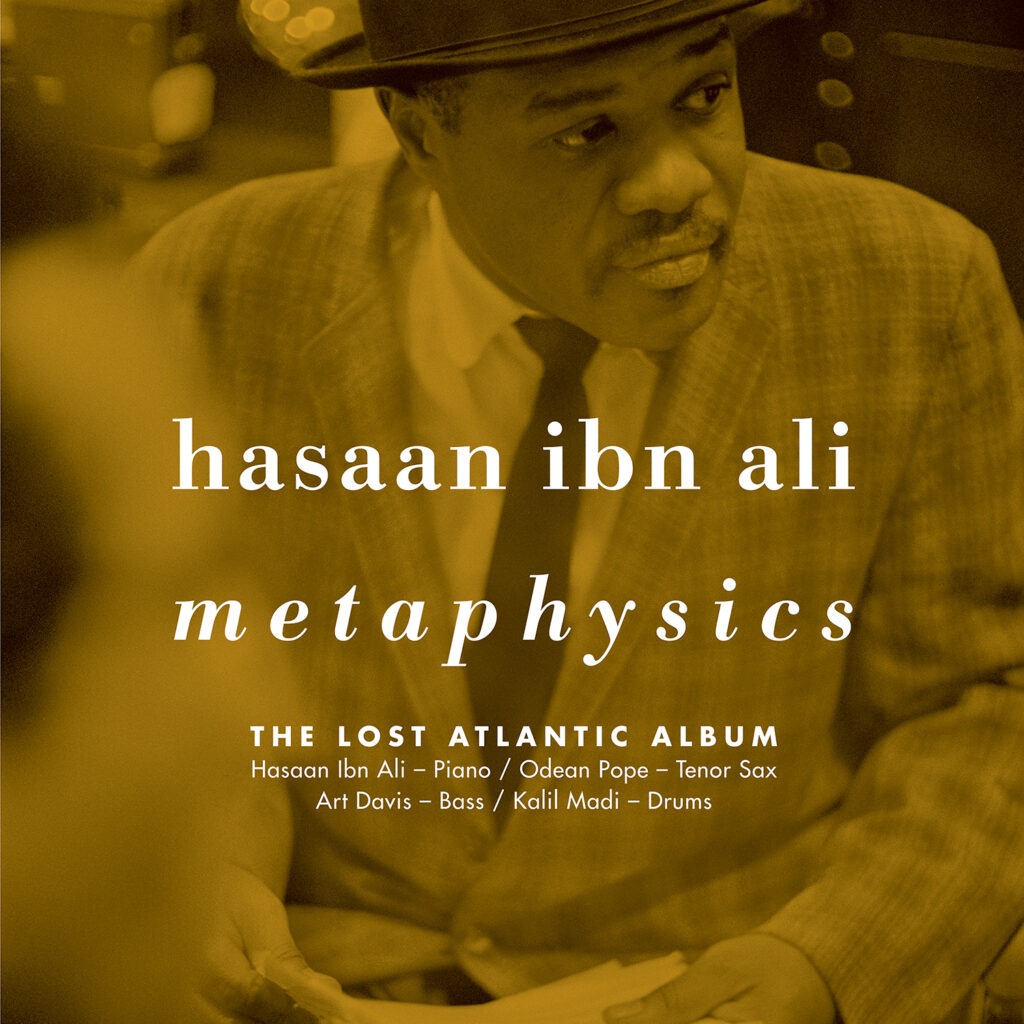
Cover of Hasaan Ibn Ali's album Metaphysics: The Lost Atlantic Album, a gold-toned photograph of the pianist in a hat and checked jacket
September 7, 1965

Shelved, Then Burned: The Album That Took Fifty-Six Years to Arrive

On September 7, 1965, Hasaan Ibn Ali went back into Atlantic Studios in New York to finish a quartet session begun two weeks earlier — Odean Pope on tenor, Art Davis on bass, Kalil Madi on drums. It should have been the Philadelphia pianist's second record. Instead he was imprisoned on a drug charge not long after, Atlantic shelved the tapes, and in 1978 the masters burned in the label's warehouse fire at Long Branch, New Jersey. Ibn Ali died in 1980 having released exactly one album in his lifetime. That was the end of it until 2017, when a tape copy of the session's reference acetates surfaced. Seven of the eight titles were intact, and Omnivore issued them in 2021 as Metaphysics: The Lost Atlantic Album — fifty-six years late and one track short, by a man Pope credited with teaching nearly every important musician Philadelphia produced in that era, McCoy Tyner included.

Cover art for Hasaan Ibn Ali's "Metaphysics: The Lost Atlantic Album" (Omnivore Recordings, 2021), the belated release of the 1965 sessions. Used as a stand-in because no free-licensed photograph of Ibn Ali could be found on Wikimedia Commons or elsewhere. Album cover art, copyright Omnivore Recordings, all rights reserved — this is not a Creative Commons or public-domain image.

Sources: Metaphysics: The Lost Atlantic Album — Wikipedia , Hasaan Ibn Ali — Wikipedia , "Long lost, Philly jazz great Hasaan Ibn Ali's album 'Metaphysics' has finally been found" — The Philadelphia Inquirer, May 8, 2021 , Metaphysics: The Lost Atlantic Album — Omnivore Recordings

Carmen McRae, 1960 publicity portrait
September 6, 1961

The Night Carmen McRae Sang Everything Except “Take Five”

On September 6, 1961, Carmen McRae stood in front of the Dave Brubeck Trio at Basin Street East in New York and sang a set of Brubeck tunes fitted with words by Iola Brubeck — Dave's wife, and the household lyricist. Ten of those performances became Columbia's Take Five: Recorded Live at Basin Street East. The title track was not one of them. “Take Five” — the first known vocal recording of Paul Desmond's tune, and the reason most people bought the record — was cut in a New York studio on December 15, with Desmond, who had not been at the club at all; “Easy as You Go” followed on the 19th. Discographies note both were issued with echo and applause dubbed on to match the room. The instrumental, meanwhile, was still on its way up: it reached No. 25 on the Hot 100 about a month after the Basin Street night.

Carmen McRae in a 1960 publicity photo distributed by Associated Booking Corp., a year before the Basin Street East date. (Public Domain, via Wikimedia Commons)

Sources: Take Five Live — Wikipedia , Dave Brubeck Discography, 1961 sessions — JazzDisco.org , “Take Five” — Wikipedia (Iola Brubeck lyrics; 1961 chart run) , Carmen McRae / Dave Brubeck — Take Five (Recorded Live At Basin Street East), Discogs

Police line tape at an unrelated scene
September 5, 1950

The Day Duke Ellington's Screaming Trumpeter Was Shot by His Own Landlord

On September 5, 1950, Al Killian — the trumpeter Gunther Schuller called the greatest high-note lead man of the late swing era — was shot dead in his Los Angeles apartment by his landlord, in a dispute over money that had nothing to do with music. Killian was 33. He'd spent fifteen years anchoring brass sections for Count Basie, Lionel Hampton, and Norman Granz's Jazz at the Philharmonic before joining Duke Ellington's orchestra in 1947, where his stratospheric range was distinctive enough that Ellington wrote a piece named directly after him: "Killian's Lick." A journeyman who never led his own record date, he left behind a tune still credited to Ellington's book — and a death stranger and more senseless than almost anything else in the jazz history books.

Police tape at an unrelated scene, used here only as a generic illustration — this photograph has no connection to Killian's case. (Photo: Tony Webster, CC BY-SA 4.0, via Wikimedia Commons)

Sources: Al Killian — Wikipedia , "Killian's Lick" — Duke Ellington, on Spotify