 JAZZPROFILES lives in the music 1,572 Jazz Artists fully Profiled!
 Thelonious Monk
Last updated September 7, 2026
Listen on Spotify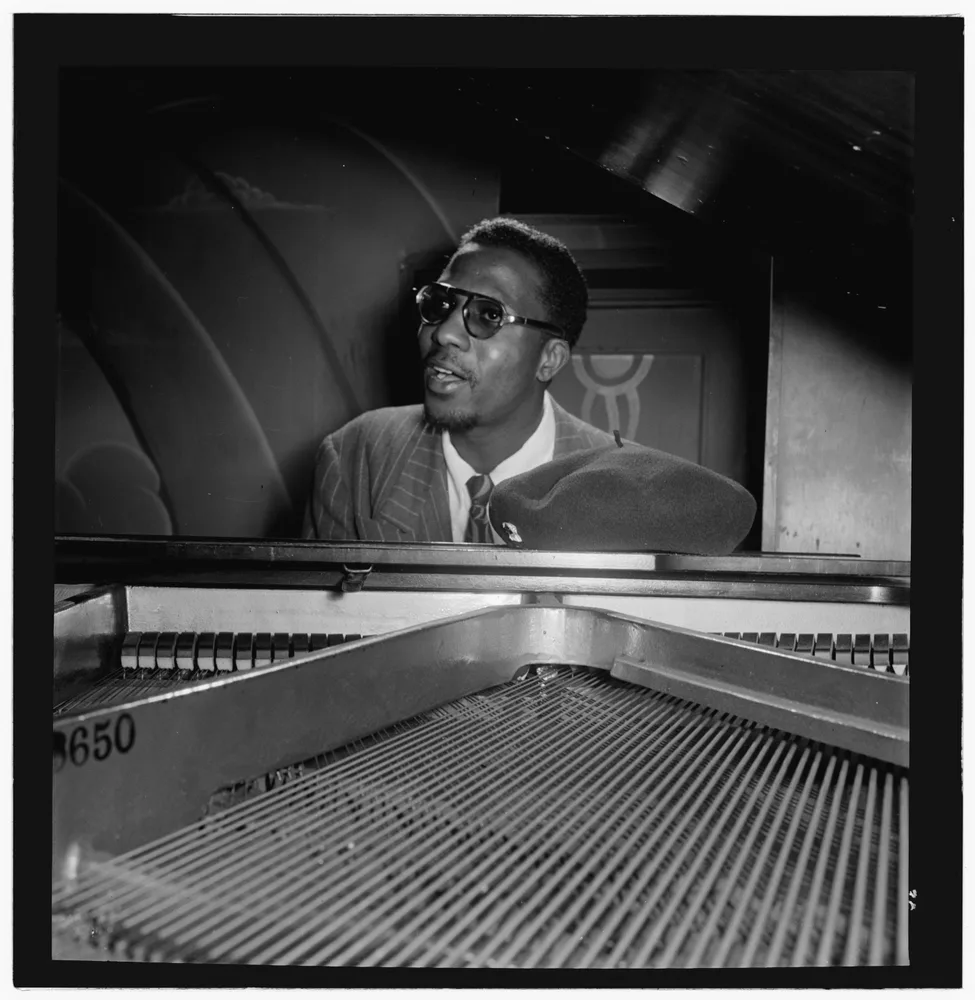
Thelonious Monk at Minton's Playhouse, New York, N.Y., circa September 1947, where Monk worked as house pianist during bebop's formative years. Public Domain (William P. Gottlieb collection, released per the photographer's wishes; part of the Library of Congress's Gottlieb collection) — Wikimedia Commons — https://commons.wikimedia.org/wiki/File:Thelonious_Monk,_Minton's_Playhouse,_New_York,_N.Y.,_ca._Sept._1947_(William_P._Gottlieb_06231).jpg
.jpg)
Thelonious Sphere Monk was born October 10, 1917, in Rocky Mount, North Carolina, to Thelonious and Barbara Monk. The family moved to New York City around 1922, settling in the San Juan Hill neighborhood of Manhattan. Monk briefly tried trumpet before switching to piano around age nine, learning stride technique from a neighbor, Alberta Simmons, while his mother had him accompany hymns at church. He later studied classical piano for two years under an Austrian-born teacher, Simon Wolf, working through Bach, Mozart, Beethoven, and Chopin, and attended Stuyvesant High School in Manhattan without graduating. By sixteen he had toured briefly as an accompanist for a traveling evangelist, and in the late 1930s he found steady work as house pianist at Minton's Playhouse in Harlem.
At Minton's, Monk took part nightly in the after-hours cutting sessions that, alongside Dizzy Gillespie, Charlie Christian, Kenny Clarke, Charlie Parker, and a young Miles Davis, forged the harmonic and rhythmic vocabulary of bebop. He failed his 1943 Army induction physical, classified psychiatrically unfit, and stayed in New York. His first commercial recordings came in 1944 as a sideman with the Coleman Hawkins Quartet. Through saxophonist Ike Quebec he met Blue Note Records co-founder Alfred Lion, and beginning in 1947 Monk cut a series of leader sessions for the label with a rotating cast that included Milt Jackson, Art Blakey, Sahib Shihab, and Idrees Sulieman; these were later gathered as Genius of Modern Music, Vol. 1 and Vol. 2. In August 1951, New York police searched a parked car occupied by Monk and pianist Bud Powell and found narcotics; Monk refused to identify the drugs as Powell's, and the resulting conviction cost him his New York City cabaret card, barring him for roughly six years from performing in any venue serving liquor. He kept working through low-profile Brooklyn club dates and a 1952-54 contract with Prestige Records, and on Christmas Eve 1954 he was the pianist on Miles Davis's session for Bags' Groove at Rudy Van Gelder's Hackensack studio, an encounter later mythologized (not entirely accurately) as a heated clash over Monk's dense comping behind Davis's solos. That same year he traveled to Paris, recording solo piano for French radio and meeting Baroness Pannonica "Nica" de Koenigswarter, a Rothschild-family patron who became his lifelong friend and financial supporter.
Orrin Keepnews signed Monk to Riverside Records in 1955, pairing him first with safer commercial ground, an album of Duke Ellington compositions, before Brilliant Corners (recorded October-December 1956) became his first widely praised original statement, built around the title track's famously difficult, tempo-shifting theme with Max Roach on drums and timpani and Sonny Rollins and Ernie Henry on saxophones. His cabaret card restored in 1957, Monk opened a celebrated six-month residency at the Five Spot Café that June with a quartet featuring John Coltrane on tenor, Wilbur Ware on bass, and Shadow Wilson on drums, a pairing documented commercially only on the septet album Monk's Music (recorded June 1957 with Coltrane, Coleman Hawkins, Art Blakey, and Gigi Gryce) and later, more fully, on tapes issued posthumously as Thelonious Monk with John Coltrane. A second Five Spot residency in 1958 introduced tenor saxophonist Johnny Griffin, captured on Thelonious in Action and Misterioso. On February 28, 1959, Monk fronted a ten-piece orchestra at New York's Town Hall, playing arrangements of his own tunes that pianist and arranger Hall Overton built out with Monk's direct involvement; the band included trumpeter Donald Byrd, altoist Phil Woods, tenor saxophonist Charlie Rouse, and baritone saxophonist Pepper Adams, released as The Thelonious Monk Orchestra at Town Hall.
Rouse joined Monk's working quartet permanently that same year and stayed through 1970, the longest tenure of any Monk sideman, anchoring records including 5 by Monk by 5 (1959, with Thad Jones) and Monk's solo recital Thelonious Alone in San Francisco (1959). Monk signed with Columbia Records in 1962, and his label debut Monk's Dream (recorded and released 1963, with bassist John Ore and drummer Frankie Dunlop alongside Rouse) became the best-selling album of his lifetime. Columbia's publicity push culminated in a February 1964 Time magazine cover story, "The Loneliest Monk," making him one of only a handful of jazz musicians ever to receive that honor. He expanded the working quartet back into a Hall Overton-arranged big band for Big Band and Quartet in Concert, recorded live at Philharmonic Hall on December 30, 1963, with soprano saxophonist Steve Lacy in the section. A 1964 rhythm-section change brought in bassist Larry Gales and drummer Ben Riley, who stayed with Monk more than four years through albums including Criss-Cross (1963), It's Monk's Time (1964), the solo album Solo Monk (1965), Straight, No Chaser (1966-67), and Underground (1967-68), his final quartet studio album for the label.
Monk's public activity thinned steadily after 1968; his last quartet performance with Rouse, Gales, and Riley came at an October 1968 concert arranged by a Palo Alto, California teenager, unreleased until the 2020 album Palo Alto. In November 1971 he undertook a farewell world tour with the all-star Giants of Jazz, alongside Dizzy Gillespie, Art Blakey, Sonny Stitt, Kai Winding, and Al McKibbon, and made his final studio recordings that same month in London for producer Alan Bates's Black Lion label, issued as Something in Blue and The Man I Love. He performed only sporadically for the rest of the decade and stopped playing piano altogether around 1976, spending his last six years largely in seclusion at Nica de Koenigswarter's home in Weehawken, New Jersey. Thelonious Monk passed away there of a stroke on February 17, 1982, at age 64. He received a Grammy Lifetime Achievement Award in 1993 and a posthumous special Pulitzer Prize citation in 2006 for a body of work that transformed the harmonic and structural language of jazz.
Monk built his music from dissonance treated as consonance: flatted ninths and fifths, unresolved whole-tone runs, deliberately "wrong" clashing intervals, and a percussive, often halting attack punctuated by silence, all set against a left hand still rooted in the stride tradition of James P. Johnson and Duke Ellington, whom Monk cited as his deepest influence. He rarely played fast for its own sake, preferring space, repetition, and abrupt hesitations that made his soloing sound structurally inevitable rather than merely virtuosic; he was known to stand up mid-performance to dance beside the piano before returning to the keyboard. Critical reception ran from bewildered dismissal in the early 1950s (poet Philip Larkin memorably derided him as "the elephant on the keyboard") to, by the Riverside and Columbia years, recognition as one of jazz's essential composers; by some counts he is the second-most-recorded jazz composer in history after Ellington, and "'Round Midnight" is the single most-recorded jazz standard by one composer. Disciples ranging from Bud Powell's generation of boppers to dedicated later interpreters like soprano saxophonist Steve Lacy, who devoted much of a five-decade career to Monk's book, carried his compositional logic into new contexts long after his death.
- Brilliant Corners (1957, Riverside) - Monk's first widely acclaimed leader album, built around the title track's notoriously difficult tempo shifts, with Sonny Rollins, Ernie Henry, and Max Roach. Spotify - Brilliant Corners Listen
- Monk's Music (1957, Riverside) - A septet session from the year of Monk's Five Spot residency, pairing John Coltrane and Coleman Hawkins on tenor with Art Blakey on drums. Spotify - Monk's Music Listen
- Genius of Modern Music, Vol. 1 (1951, Blue Note) - Monk's earliest leader sessions (1947-48), introducing "'Round Midnight," "Ruby, My Dear," and "Well, You Needn't" to record. Spotify - Genius Of Modern Music, Vol. 1 Listen
- The Thelonious Monk Orchestra at Town Hall (1959, Riverside) - Hall Overton's big-band arrangements of Monk's tunes, with Pepper Adams on baritone sax; the first large-ensemble showcase for his compositions.
- Monk's Dream (1963, Columbia) - Monk's major-label debut and, commercially, the best-selling album of his lifetime, with the long-running quartet of Charlie Rouse, John Ore, and Frankie Dunlop. Spotify - Monk's Dream Listen
- Underground (1968, Columbia) - The final studio album by Monk's longest-standing quartet (Rouse, Larry Gales, Ben Riley), closing out his Columbia studio run. Spotify - Underground Listen
- Bags' Groove (1954, Prestige) - As a sideman: Miles Davis's session, with Monk's comping behind Davis's solo on the title track a famous point of jazz lore.
Thelonious Monk: Full Discography
Identity confirmed against Discogs artist ID 145256 ("Thelonious Monk," pianist/composer, born/died dates matching) and cross-checked with Wikidata (Q109612). Monk's own leader catalog is moderate in size compared to the giant big-band leaders (Ellington, Basie, Kenton) covered elsewhere on this site, so the table below aims for comprehensive coverage of his studio and major live leader/co-leader releases rather than a curated subset. It does not itemize the full run of posthumous compilations, alternate-take reissue box sets, or every live tape issued after his death; those are noted in the text below the table where relevant. A short "As Sideman" table follows for his handful of significant non-leader sessions. The Buy column is always "-" (no affiliate program set up yet).
As Leader / Co-Leader
| Album Title | Recording Date(s) | Release Date | Label | Catalog Number | Format(s) | Personnel | Role | Reissue History | Spotify | Buy | Notes |
|---|---|---|---|---|---|---|---|---|---|---|---|
| Genius of Modern Music, Vol. 1 | October 15 & 24 and November 21, 1947; July 2, 1948 (Blue Note 10" sessions) | 1951 (10"); reissued as 12" LP 1956 | Blue Note | BLP 5002 (10"); BLP 1510 (12") | Vinyl, LP | Thelonious Monk (piano), Art Blakey (drums), Milt Jackson (vibraphone, select tracks), Sahib Shihab, Idrees Sulieman, Danny Quebec West, Gene Ramey, and others across sessions | Leader | Reissued on CD 1989/2001 | Spotify - Genius Of Modern Music, Vol. 1 | - | Debut leader sessions; introduced "'Round Midnight," "Ruby, My Dear," "Well, You Needn't," "Epistrophy," and "Thelonious" to record |
| Genius of Modern Music, Vol. 2 | July 23, 1951 and May 30, 1952 (plus earlier 1948 material) | 1952 (10"); reissued as 12" LP 1956 | Blue Note | BLP 5009 (10"); BLP 1511 (12") | Vinyl, LP | Thelonious Monk (piano), Art Blakey and Max Roach (drums, separate sessions), Milt Jackson (vibraphone), Sahib Shihab, Lou Donaldson, others | Leader | Reissued on CD 1989/2001 | Not confirmed as a standalone Spotify listing (usually bundled with Vol. 1 reissues) | - | Continuation of the Blue Note sessions |
| Thelonious Monk Trio | Recorded 1952 | 1954 | Prestige | PRLP 189 | Vinyl, LP | Thelonious Monk (piano), Gary Mapp / Percy Heath (bass), Art Blakey / Max Roach (drums) | Leader | Reissued on Original Jazz Classics CD | Not confirmed | - | First Prestige session |
| Thelonious Monk and Sonny Rollins | Recorded November 1953 & October 1954 | 1956 | Prestige | PRLP 7053 | Vinyl, LP | Thelonious Monk (piano), Sonny Rollins (tenor sax), Julius Watkins (French horn, select tracks), Percy Heath / Tommy Potter (bass), Willie Jones / Art Blakey (drums) | Co-leader (with Sonny Rollins) | Reissued on Original Jazz Classics CD | Not confirmed | - | |
| Monk (Thelonious Monk Quintet) | Recorded May 11 & June 4, 1954 | 1954 | Prestige | PRLP 180 | Vinyl, LP | Thelonious Monk (piano), Ray Copeland (trumpet), Frank Foster (tenor sax), Curly Russell (bass), Art Blakey (drums) | Leader | Reissued on Original Jazz Classics CD | Not confirmed | - | Also released/reissued under the title Thelonious Monk Quintet Blows for LP |
| Thelonious Monk Plays | Recorded September 22, 1954 | 1957 | Prestige | PRLP 189 (shared with Trio material on some pressings) | Vinyl, LP | Thelonious Monk (piano), solo and trio formats across sessions | Leader | Reissued on Original Jazz Classics CD | Not confirmed | - | Catalog history is tangled across several Prestige repackagings of the 1952-54 sessions; not all catalog numbers independently confirmed |
| Thelonious Monk Plays Duke Ellington | Recorded July 21 & 27, 1955 | 1956 | Riverside | RLP 12-201 | Vinyl, LP | Thelonious Monk (piano), Oscar Pettiford (bass), Kenny Clarke (drums) | Leader | Reissued on Original Jazz Classics CD | Spotify - Plays Duke Ellington | - | Monk's Riverside debut, a covers album chosen by producer Orrin Keepnews to broaden his commercial appeal |
| The Unique Thelonious Monk | Recorded March 17 & April 3, 1956 | August 1956 | Riverside | RLP 12-209 | Vinyl, LP | Thelonious Monk (piano), Oscar Pettiford (bass), Art Blakey (drums) | Leader | Reissued on Original Jazz Classics CD | Spotify - The Unique Thelonious Monk | - | A trio album of jazz standards, part of the same broadened-appeal strategy |
| Brilliant Corners | Recorded October 9, October 15, and December 7, 1956 | April 4, 1957 | Riverside | RLP 12-226 | Vinyl, LP | Thelonious Monk (piano, celesta), Sonny Rollins (tenor sax), Ernie Henry (alto sax), Clark Terry (trumpet), Oscar Pettiford / Paul Chambers (bass), Max Roach (drums, timpani) | Leader | Reissued on Original Jazz Classics CD | Spotify - Brilliant Corners | - | Widely regarded as Monk's first fully realized artistic and critical breakthrough |
| Thelonious Himself | Recorded April 5 & 16, 1957 | 1957 | Riverside | RLP 12-235 | Vinyl, LP | Thelonious Monk (piano, solo), with John Coltrane (tenor sax) and Wilbur Ware (bass) on "Monk's Mood" only | Leader | Reissued on Original Jazz Classics CD | Spotify - Thelonious Himself | - | Mostly solo piano; the sole quartet track anticipates the Five Spot pairing with Coltrane |
| Monk's Music | Recorded June 25-26, 1957 | November 1957 | Riverside | RLP 12-242 (mono) / RLP 1102 (stereo) | Vinyl, LP | Thelonious Monk (piano), Ray Copeland (trumpet), Gigi Gryce (alto sax, arrangements), Coleman Hawkins and John Coltrane (tenor sax), Wilbur Ware (bass), Art Blakey (drums) | Leader | Reissued on Original Jazz Classics CD | Spotify - Monk's Music | - | Recorded during Monk's celebrated Five Spot residency with Coltrane |
| Mulligan Meets Monk | Recorded August 12-13, 1957 | 1957 | Riverside | RLP 12-247 | Vinyl, LP | Thelonious Monk (piano), Gerry Mulligan (baritone sax), Wilbur Ware (bass), Shadow Wilson (drums) | Co-leader (with Gerry Mulligan) | Reissued on Original Jazz Classics CD | Not confirmed | - | |
| Thelonious in Action | Recorded live August 7, 1958, Five Spot Café, NYC | 1958 | Riverside | RLP 12-262 | Vinyl, LP | Thelonious Monk (piano), Johnny Griffin (tenor sax), Ahmed Abdul-Malik (bass), Roy Haynes (drums) | Leader | Reissued on Original Jazz Classics CD; expanded on 2-CD Complete Live at the Five Spot 1958 | Not confirmed | - | Second Five Spot residency |
| Misterioso | Recorded live August 7, 1958, Five Spot Café, NYC | 1959 | Riverside | RLP 12-279 | Vinyl, LP | Thelonious Monk (piano), Johnny Griffin (tenor sax), Ahmed Abdul-Malik (bass), Roy Haynes (drums) | Leader | Reissued on Original Jazz Classics CD; expanded on 2-CD Complete Live at the Five Spot 1958 | Spotify - Misterioso | - | Same engagement as Thelonious in Action, different track selection |
| 5 by Monk by 5 | Recorded June 1959 | 1959 | Riverside | RLP 12-305 | Vinyl, LP | Thelonious Monk (piano), Thad Jones (cornet), Charlie Rouse (tenor sax), Sam Jones (bass), Art Taylor (drums) | Leader | Reissued on Original Jazz Classics CD | Not confirmed | - | Rouse's first studio session with Monk, ahead of joining full-time |
| Thelonious Alone in San Francisco | Recorded October 21-22, 1959, Fugazi Hall, San Francisco | 1959 | Riverside | RLP 12-312 | Vinyl, LP | Thelonious Monk (piano, solo) | Leader | Reissued on Original Jazz Classics CD | Spotify - Thelonious Alone In San Francisco | - | Solo studio recital, cut in an empty concert hall |
| The Thelonious Monk Orchestra at Town Hall | Recorded live February 28, 1959, Town Hall, NYC | 1959 | Riverside | RLP 12-300 | Vinyl, LP | Thelonious Monk (piano), Donald Byrd (trumpet), Phil Woods (alto sax), Charlie Rouse (tenor sax), Pepper Adams (baritone sax), Eddie Bert (trombone), Robert Northern (French horn), Jay McAllister (tuba), Sam Jones (bass), Art Taylor (drums); arranged by Hall Overton | Leader | Reissued on Original Jazz Classics CD | Not confirmed | - | First large-ensemble showcase of Monk's compositions; arrangements built out with Monk directly |
| Thelonious Monk with John Coltrane | Recorded 1957 (Riverside sessions, some tracks from the Five Spot-era studio dates) | 1961 | Riverside/Jazzland | JLP 946 | Vinyl, LP | Thelonious Monk (piano), John Coltrane (tenor sax), with Wilbur Ware, Shadow Wilson, and (on some tracks) Coleman Hawkins, Ray Copeland, Gigi Gryce | Leader | Reissued/expanded multiple times, including as part of Coltrane's The Complete 1957 Riverside Recordings | Not confirmed | - | Held back from release for several years after recording |
| Monk's Dream | Recorded October 31-November 6, 1962 | January 1963 | Columbia | CL 1965 (mono) / CS 8765 (stereo) | Vinyl, LP | Thelonious Monk (piano), Charlie Rouse (tenor sax), John Ore (bass), Frankie Dunlop (drums) | Leader | Reissued on CD; part of Columbia box sets | Spotify - Monk's Dream | - | Monk's Columbia debut; best-selling album of his lifetime |
| Criss-Cross | Recorded November 6, 1962-March 29, 1963 | August 1963 | Columbia | CL 2038 (mono) / CS 8838 (stereo) | Vinyl, LP | Thelonious Monk (piano), Charlie Rouse (tenor sax), John Ore (bass), Frankie Dunlop (drums) | Leader | Reissued on CD | Not confirmed | - | |
| Big Band and Quartet in Concert | Recorded live December 30, 1963, Philharmonic Hall, Lincoln Center, NYC | March 1964 | Columbia | CL 2164 (mono) / CS 8964 (stereo) | Vinyl, LP | Thelonious Monk (piano), Nick Travis (trumpet), Thad Jones (cornet), Eddie Bert (trombone), Steve Lacy (soprano sax), Phil Woods (alto sax, clarinet), Charlie Rouse (tenor sax), Gene Allen (baritone sax, bass clarinet), Butch Warren (bass), Frankie Dunlop (drums); arranged by Hall Overton | Leader | Reissued on CD | Not confirmed | - | |
| It's Monk's Time | Recorded January 29-March 9, 1964 | July 1964 | Columbia | CL 2184 (mono) / CS 8984 (stereo) | Vinyl, LP | Thelonious Monk (piano), Charlie Rouse (tenor sax), Butch Warren (bass), Ben Riley (drums) | Leader | Reissued on CD | Not confirmed | - | |
| Solo Monk | Recorded October 31, 1964-March 2, 1965 | June 1965 | Columbia | CL 2349 (mono) / CS 9149 (stereo) | Vinyl, LP | Thelonious Monk (piano, solo) | Leader | Reissued on CD; SACD reissue catalog SRGS 4520 | Not confirmed | - | |
| Straight, No Chaser | Recorded 1966-67 | 1967 | Columbia | CL 2651 (mono) / CS 9451 (stereo) | Vinyl, LP | Thelonious Monk (piano), Charlie Rouse (tenor sax), Larry Gales (bass), Ben Riley (drums) | Leader | Reissued on CD 1996 with restored full-length tracks and 3 bonus cuts | Not confirmed | - | |
| Underground | Recorded December 14 & 21, 1967; February 14 & December 14, 1968 | May 1968 | Columbia | CS 9632 | Vinyl, LP | Thelonious Monk (piano), Charlie Rouse (tenor sax), Larry Gales (bass), Ben Riley (drums), Jon Hendricks (vocal, "In Walked Bud") | Leader | Reissued on CD | Not confirmed | - | Final studio album by Monk's longest-tenured quartet |
| Monk's Blues | Recorded November 19-20, 1968, Los Angeles | 1969 | Columbia | CS 9806 | Vinyl, LP | Thelonious Monk (piano), Charlie Rouse (tenor sax), Larry Gales (bass), Ben Riley (drums), plus a big band arranged and conducted by Oliver Nelson (Buddy Collette, Tom Scott, Conte Candoli, Bobby Bryant, Howard Roberts, and other Los Angeles studio players) | Leader | Reissued on CD | Not confirmed | - | Monk's final studio album for Columbia |
| Palo Alto | Recorded live October 27, 1968, Palo Alto High School, Palo Alto, CA | September 2020 | Impulse! | B0031838-01 | Vinyl, LP; CD; digital | Thelonious Monk (piano), Charlie Rouse (tenor sax), Larry Gales (bass), Ben Riley (drums) | Leader | First release, 2020 | Spotify - Palo Alto | - | Unreleased for 52 years; recorded by a school janitor at a concert arranged by a 16-year-old student |
| Something in Blue | Recorded November 15, 1971, Chappell Studios, London | 1972 | Black Lion | BLP 30129 | Vinyl, LP | Thelonious Monk (piano), Al McKibbon (bass), Art Blakey (drums) | Leader | Reissued on CD, sometimes combined with The Man I Love | Not confirmed | - | Monk's last studio recordings as a leader |
| The Man I Love | Recorded November 15, 1971, Chappell Studios, London | 1973 | Black Lion | BLP 30141 | Vinyl, LP | Thelonious Monk (piano), Al McKibbon (bass), Art Blakey (drums) | Leader | Reissued on CD | Not confirmed | - | Same London session as Something in Blue |
As Sideman (selected major credits)
| Year | Project (Leader) | Title | Label | Catalog | Role | Notes |
|---|---|---|---|---|---|---|
| 1944 | Coleman Hawkins Quartet | Various 78 rpm sides | Joe Davis / Signature | Piano | Monk's first commercial recordings | |
| 1954 | Miles Davis | Bags' Groove | Prestige (PRLP 7109) | Piano (side one only) | Recorded December 24, 1954, Van Gelder Studio, Hackensack NJ; Monk's comping behind Davis's solo on the title track is a widely cited episode in jazz lore | |
| 1954 | Miles Davis | Miles Davis and the Modern Jazz Giants | Prestige (PRLP 7150) | Piano | Same December 24, 1954 session, different track compilation |
Beyond these, Monk's Discogs sideman credits are relatively few compared to the hundreds logged by career freelancers like Pepper Adams, reflecting how quickly he moved from bebop-era sideman work into leading his own bands; not itemized exhaustively here.
- Charlie Rouse - Monk's tenor saxophonist from 1959 to 1970, the longest-serving member of any Monk band, on records from 5 by Monk by 5 through Underground.
- John Coltrane - member of Monk's 1957 Five Spot quartet and Monk's Music septet; the pairing is one of the most studied partnerships in jazz history.
- Art Blakey - drummer across Monk's career from the 1947-52 Blue Note sessions through The Unique Thelonious Monk (1956), Monk's Music (1957), and the 1971 London sessions with the Black Lion label.
- Max Roach - drums and timpani on Brilliant Corners (1956), a key early Riverside collaborator.
- Miles Davis - sideman pianist on Davis's Bags' Groove session, December 24, 1954.
- Steve Lacy - soprano saxophonist in the 1963 Big Band and Quartet in Concert band; went on to become widely regarded as Monk's most dedicated interpreter over a five-decade solo career built substantially around Monk's compositions.
- Pepper Adams - baritone saxophonist in the ten-piece band Monk led at Town Hall on February 28, 1959, arranged by Hall Overton.
- Hall Overton - pianist, composer, and arranger who orchestrated Monk's tunes for the 1959 Town Hall concert and the 1963 Philharmonic Hall big-band concert.
- Baroness Pannonica de Koenigswarter - patron and close friend from their 1954 Paris meeting until Monk's death; he spent his final years at her New Jersey home.
More Bebop Artists
See all 166 Bebop artists →More American Jazz Artists
See all 567 American artists →- Wikipedia: Thelonious Monk
- Wikipedia: Thelonious Monk discography
- Wikipedia: Brilliant Corners
- Wikipedia: Monk's Music
- Wikipedia: The Thelonious Monk Orchestra at Town Hall
- Wikipedia: Monk's Dream (Thelonious Monk album)
- Wikipedia: Underground (Thelonious Monk album)
- Wikipedia: Bags' Groove
- Wikipedia: Big Band and Quartet in Concert
- AllMusic: Thelonious Monk biography
- Discogs: Thelonious Monk (artist 145256)
- Wikidata: Thelonious Monk (Q109612)