 JAZZPROFILES lives in the music 1,572 Jazz Artists fully Profiled!
 Creed Taylor
Last updated September 7, 2026
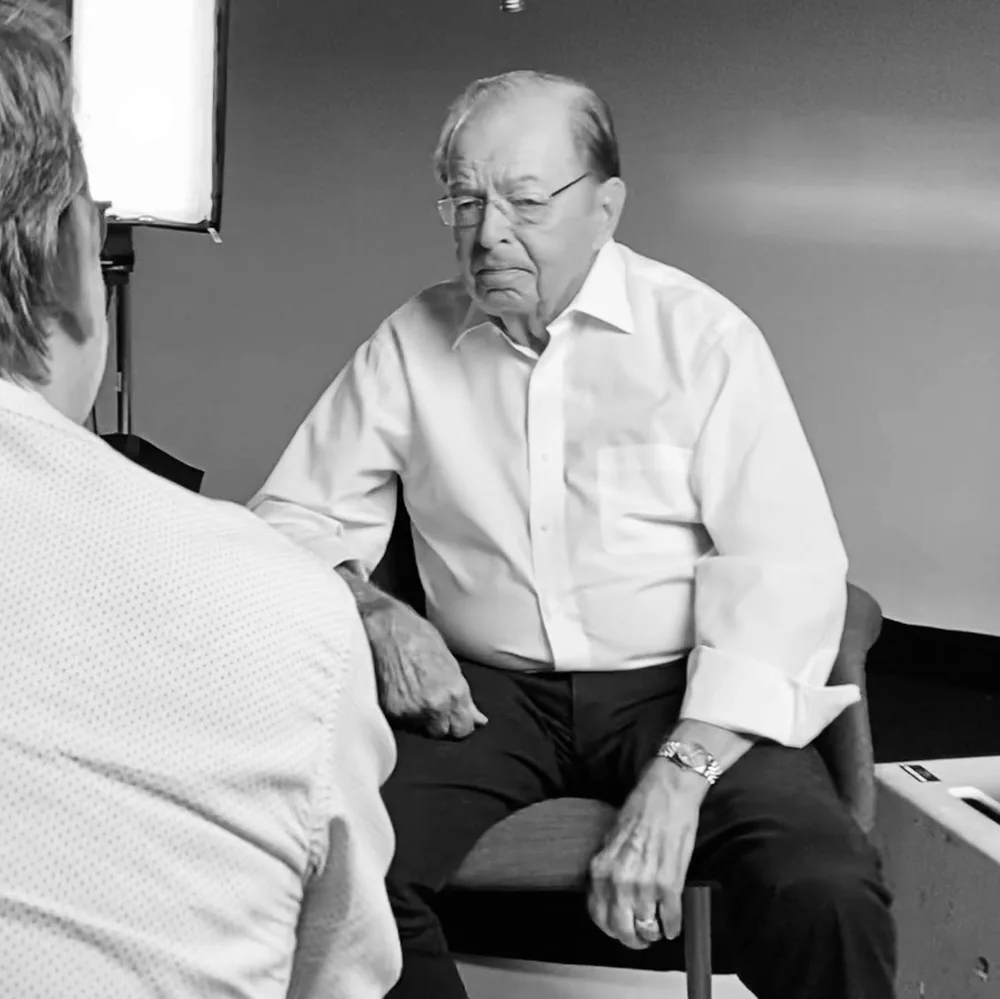
Creed Taylor during a 2021 interview. CC BY 4.0 — Wikimedia Commons — photographer Blake Taylor — https://commons.wikimedia.org/wiki/File:Creed_Taylor_-_2021_Interview.jpg

Creed Bane Taylor V was born May 13, 1929, in Lynchburg, Virginia, and grew up in Pearisburg, playing trumpet in high school jazz ensembles and citing Dizzy Gillespie as an early inspiration. He earned a psychology degree from Duke University in 1951, where he played in student jazz groups, then served two years in the Marines before returning to Duke for graduate study. He moved to New York with no formal production training. A Duke alumnus introduced him to Gus Wildi at Bethlehem Records, and Taylor's first real break came from convincing Wildi to record vocalist Chris Connor in a straight jazz setting with pianist Ellis Larkins rather than the pop material she'd been assigned. It worked well enough that Bethlehem made him head of A&R, and over the label's two strongest years he recorded Oscar Pettiford, Ruby Braff, Carmen McRae, and Charles Mingus.
In December 1955, ABC-Paramount hired Taylor to build a jazz department from scratch. In 1960 he went further, founding Impulse! Records, marketed as "The New Wave in Jazz." It was Taylor, not the better-known Bob Thiele, who signed John Coltrane to the label. He prioritized album design as much as the music, regularly hiring photographers Pete Turner and Arnold Newman for gatefold covers on albums by Ray Charles, Gil Evans, and Oliver Nelson.
Taylor left for Verve Records in 1961, where he introduced bossa nova to American audiences after traveling to Brazil and visiting Antônio Carlos Jobim's home, beginning a long friendship and a run of albums together. That relationship produced "The Girl from Ipanema," recorded with Jobim and Stan Getz for the 1964 album Getz/Gilberto. Taylor and engineer Phil Ramone cut a 2:44 radio edit from the album's 5:15 track; the single sold more than five million copies, and the album won the 1965 Grammy for Album of the Year. At Verve, Taylor also produced Wes Montgomery, Jimmy Smith, Bill Evans, and Cal Tjader.
Creed Taylor, Inc. (CTI) was incorporated in October 1966, and by mid-1967 Taylor was producing records for A&M Records' New York operation under his own imprint. The first CTI titles, Wes Montgomery's A Day in the Life and Jobim's Wave, both released in 1967, set the template before CTI was its own independent company: contemporary material, elite New York session musicians, and meticulous studio craft. Engineer Rudy Van Gelder recorded nearly every session at his Englewood Cliffs, New Jersey studio, and photographer Pete Turner shot the covers that became CTI's visual signature.
CTI went fully independent around 1970, switching to the stark black album covers that marked the label's commercial and creative peak. With A&M's backing gone, the sound turned leaner and funkier rather than softer: Freddie Hubbard's Red Clay (1970), Stanley Turrentine's Sugar (1970), George Benson's Beyond the Blue Horizon (1971) and White Rabbit (1972), Hubert Laws' The Rite of Spring (1971) and Morning Star (1972), and Bob James' One (1974), whose closing track "Nautilus" became one of the most sampled recordings in hip-hop. In January 1973, Eumir Deodato's funk arrangement of "Also Sprach Zarathustra" on Prelude reached No. 2 on the Billboard Hot 100, CTI's highest chart placement ever, and won the 1974 Grammy for Best Pop Instrumental Performance. Taylor launched Kudu Records as a CTI subsidiary the same era, home to Grover Washington Jr.'s breakout Mister Magic (1975).
The label began unraveling when an October 1974 distribution deal with Motown Records, meant to solve a cash-flow crisis, instead produced years of litigation; Motown stopped paying CTI in December 1975. George Benson left for Warner Bros. in 1976 and went platinum immediately with "Breezin'." Between the Motown dispute, a lawsuit from Grover Washington Jr., and a $600,000 loan from Columbia Records secured against the master catalog, Creed Taylor, Inc. filed for Chapter 11 bankruptcy on December 8, 1978, listing $2.3 million in liabilities against $1.4 million in assets; Columbia took ownership of roughly 130 album masters. Taylor kept CTI running in reduced form into the mid-1980s, revived it again in 1989 with Van Gelder back at the board, and in 2009 assembled a CTI All Stars lineup, including Hubert Laws, Airto Moreira, Flora Purim, Randy Brecker, John McLaughlin, and George Duke, for a European tour recorded at the Montreux Jazz Festival and released in 2010, his final production. CTI Records was formally dissolved as a corporate entity in January 2012.
Albums and tracks Taylor produced won 12 Grammy Awards, and eight were later inducted into the Grammy Hall of Fame, though Taylor himself never won one personally; the Recording Academy did not create a formal Producer of the Year category until 1974, and his last Grammy-winning production came two years after that, George Benson's "Theme From Good King Bad" (1976). DownBeat gave him its Lifetime Achievement Award in 2005. Creed Taylor passed away on August 22, 2022, at age 93, after suffering a stroke while visiting family in Winkelhaid, Germany.
Taylor's identity as a producer was defined less by a sound he personally played than by a production system he built and controlled: a fixed circle of collaborators (engineer Rudy Van Gelder, arranger Don Sebesky, photographer Pete Turner, a rotating pool of top New York session players) applied consistently across a wide range of artists and genres, from Brazilian bossa nova to hard bop to classical-jazz crossover. That consistency is what gave CTI Records a recognizable "sound" and look even though the artists under it varied widely, from a saxophonist like Stanley Turrentine to a classically trained flutist like Hubert Laws to a Brazilian arranger like Eumir Deodato.
His guiding instinct, evident from the Chris Connor sessions at Bethlehem through the CTI years, was pairing serious jazz musicianship with contemporary, commercially accessible material and polished studio production, without treating the two as being in conflict. Taylor's influence on later producers is explicit: Discogs' own artist profile for him names Tommy LiPuma, Dave Grusin, Esmond Edwards, Arnaldo DeSouteiro, and Dave Matthews as producers who worked in his shadow or under his direct influence.
- Getz/Gilberto (1964, Verve, with Stan Getz and João Gilberto) - Winner of the 1965 Grammy for Album of the Year; its single "The Girl from Ipanema" introduced bossa nova to American mainstream audiences and sold more than five million copies. Spotify - Getz/Gilberto
- Red Clay (1970, CTI, Freddie Hubbard) - The sound of CTI going independent: its 12-minute title track fused hard bop with electric funk and became a jazz standard. Spotify - Red Clay Listen · Buy
- Sugar (1970, CTI, Stanley Turrentine) - Turrentine's first CTI album after his long Blue Note run, and a foundational text of the CTI soul-jazz sound. Spotify - Sugar Listen · Buy
- White Rabbit (1972, CTI, George Benson) - A Jefferson Airplane cover turned into a CTI signature; features a young Earl Klugh on acoustic guitar alongside Benson. Spotify - White Rabbit Listen · Buy
- Prelude (1972, CTI, Eumir Deodato) - CTI's biggest commercial hit: its "Also Sprach Zarathustra" arrangement reached No. 2 on the Billboard Hot 100 and won the 1974 Grammy for Best Pop Instrumental Performance. Spotify - Prelude Listen · Buy
- One (1974, CTI, Bob James) - James' CTI debut as a leader; closing track "Nautilus" became one of the most sampled recordings in hip-hop history. Spotify - One Listen · Buy
- Mister Magic (1975, Kudu, Grover Washington Jr.) - Topped both the Billboard soul and jazz album charts on the CTI subsidiary label Taylor built specifically for Washington's breakout run. Spotify - Mister Magic Listen · Buy
Creed Taylor: Full Discography (Discogs-Verified)
Discogs profile summary
- Real name: Creed Bane Taylor V
- Discogs artist ID: 97480
- Born: May 13, 1929, Lynchburg, Virginia · Died: August 22, 2022, Winkelhaid, Bavaria, Germany
- Discogs bio: "Jazz producer and the founder of two legendary labels: Impulse! (as a subsidiary of ABC-Paramount) and CTI Records.. Creed Taylor has been a huge influence in many producers such as Esmond Edwards, Tommy LiPuma, Dave Grusin, Arnaldo DeSouteiro and Dave Matthews. He started his career as a trumpet player influenced by Ernie Royal, and became a record producer when working in the '50s for Bethlehem Records and, later, ABC-Paramount."
- Name variations on file: C. Taylor, C.T., Chud Taylor, Greed Taylor, クリード・テイラー (Japanese katakana)
- Total credits on this artist ID across all roles: 1,468, spanning 1954 to 2025 (as a producer, not a performer, since Taylor did not play on the records he made)
- Role breakdown: Producer 1,340 (1,278 distinct titles after removing exact year+title duplicates), UnofficialRelease 69 (bootlegs, excluded from all tables below), Appearance 56, Main 1, Remix 1, Co-producer 1
Scope of this discography
Creed Taylor's Discogs-credited catalog runs to 1,278 distinct titles across a 70-year span, the large majority of which are reissues, "Best Of" compilations, foreign pressings, and radio/retail samplers of a comparatively small number of original studio productions. This file gives full session-level personnel detail, pulled from each release's Discogs extraartists credits, for 13 landmark productions spanning every era of his career: the record that introduced bossa nova to America, CTI's own founding titles, and the core run of early-1970s CTI albums that defined commercial jazz-funk. Every other era is covered as a chronological account with the Discogs-sourced title count for that era and a curated selection of its most historically notable additional productions, not an exhaustive reproduction of all 1,278 titles.
LANDMARK PRODUCTIONS: full detail
Verve Years (1961-1966)
| Album | Year | Artist | Label / Catalog | Personnel (selected) | Notes | Listen | Buy |
|---|---|---|---|---|---|---|---|
| Getz/Gilberto | 1964 | Stan Getz & João Gilberto | Verve Records, V-8545 | Stan Getz (tenor saxophone); João Gilberto (guitar, vocals); Antônio Carlos Jobim (piano, featuring); Milton Banana (drums); Phil Ramone (recording engineer); Val Valentin (director of engineering); Olga Albizu (cover painting); Creed Taylor (producer) | Won the 1965 Grammy for Album of the Year; the single "The Girl from Ipanema" (a 2:44 radio edit cut by Taylor and Phil Ramone from the album's 5:15 version) sold more than five million copies and introduced bossa nova to American mainstream audiences | Spotify | Amazon search |
CTI Years — A&M-Distributed (1967-1969)
CTI's first two releases, both cut in 1967, before CTI Records existed as an independent company.
| Album | Year | Artist | Label / Catalog | Personnel (selected) | Notes | Listen | Buy |
|---|---|---|---|---|---|---|---|
| A Day in the Life | 1967 | Wes Montgomery | A&M Records, SP-3001 | Wes Montgomery (guitar); Don Sebesky (arranger, conductor); Ron Carter (bass); Grady Tate (drums); Rudy Van Gelder (engineer); Sam Antupit (album design); Creed Taylor (producer) | Reached No. 1 on Billboard's Jazz Album chart and No. 13 on the Billboard 200; the single "Windy" hit No. 44 on the Hot 100 | Spotify | Amazon search |
| Wave | 1967 | Antônio Carlos Jobim | A&M Records / CTI Records, SP-3002 | Antônio Carlos Jobim (composer, piano); Claus Ogerman (arranger, conductor); Ron Carter (bass); Rudy Van Gelder (engineer); Sam Antupit (album design); Creed Taylor (producer) | Jobim's first release after signing with Taylor's newly formed production company; carries both the A&M and CTI catalog imprint | Spotify | Amazon search |
CTI Independent (1970-1975)
The run that defined "the CTI sound" after Taylor took the label fully independent: black-cover era, Rudy Van Gelder engineering every session, Pete Turner's cover photography.
| Album | Year | Artist | Label / Catalog | Personnel (selected) | Notes | Listen | Buy |
|---|---|---|---|---|---|---|---|
| Red Clay | 1970 | Freddie Hubbard | CTI Records, CTI 6001 | Freddie Hubbard (trumpet, written by); Herbie Hancock (piano); Ron Carter (bass); Lenny White (drums); Joe Henderson (saxophone); Rudy Van Gelder (engineer); Creed Taylor (producer) | Hubbard's first CTI album; the 12-minute title track fused hard bop with electric funk and became a jazz standard and Hubbard's signature tune | Spotify | Amazon search |
| Sugar | 1970 (released Feb. 1971) | Stanley Turrentine | CTI Records, CTI 6005 | Stanley Turrentine (tenor saxophone); George Benson (guitar); Freddie Hubbard (trumpet); Ron Carter (bass); Lonnie Liston Smith (electric piano); Butch Cornell (organ); Billy Kaye (drums); Pete Turner (cover photography); Rudy Van Gelder (engineer, mastering); Creed Taylor (producer) | Turrentine's first CTI album after his long run at Blue Note | Spotify | Amazon search |
| Beyond the Blue Horizon | 1971 | George Benson | CTI Records, CTI 6009 | George Benson (guitar); Clarence Palmer (organ); Ron Carter (double bass); Jack DeJohnette (drums); Pete Turner (cover photography); Chuck Stewart (liner photography); Rudy Van Gelder (engineer); Creed Taylor (producer) | Benson's first CTI album, recorded on a tight post-A&M budget; Benson later said Taylor "didn't have no money to put any sweetening on it," pushing the record toward a leaner, edgier sound | Spotify | Amazon search |
| First Light | 1971 | Freddie Hubbard | CTI Records, CTI 6013 | Freddie Hubbard (trumpet, flugelhorn); Richard Wyands (piano); Hubert Laws (flute); George Benson (guitar); Ron Carter (bass); Jack DeJohnette (drums); Airto Moreira (percussion); Don Sebesky (arranger); Rudy Van Gelder (engineer, mastering); Creed Taylor (producer) | Won the 1972 Grammy for Best Jazz Performance by a Group; a more string-and-flute-heavy production than Red Clay, arranged by Don Sebesky | Spotify | Amazon search |
| The Rite of Spring | 1971 | Hubert Laws | CTI Records, CTI 6012 | Hubert Laws (flute); Bob James (piano, electric piano, harpsichord); Ron Carter (bass); Jack DeJohnette (drums); Airto Moreira (percussion); Don Sebesky (arranger); Pete Turner (cover photography); Rudy Van Gelder (engineer); Creed Taylor (producer) | Jazz arrangement of Stravinsky's "Rite of Spring" and Debussy's "Syrinx," part of CTI's classical-jazz crossover strand alongside Laws' own conservatory training | Spotify | Amazon search |
| White Rabbit | 1972 | George Benson | CTI Records, CTI 6015 | George Benson (guitar); Herbie Hancock (electric piano); Earl Klugh (acoustic guitar); Billy Cobham (drums); Hubert Laws (flute, piccolo); Don Sebesky (arranger); Rudy Van Gelder (engineer); Creed Taylor (producer) | Title track is a cover of Jefferson Airplane's "White Rabbit"; guitarist Earl Klugh's session credit here predates his own CTI/Kudu-adjacent career | Spotify | Amazon search |
| Morning Star | 1972 | Hubert Laws | CTI Records, CTI 6022 | Hubert Laws (flute, alto flute, piccolo); Bob James (electric piano); John Tropea (guitar); Ron Carter (bass); Billy Cobham (drums); Don Sebesky (arranger, conductor); Rudy Van Gelder (engineer); Creed Taylor (producer) | One of Laws' two defining CTI-era classical/jazz crossover records, alongside The Rite of Spring above | Spotify (CTI 40th Anniversary Edition) | Amazon search |
| Prelude | 1972 (released Jan. 1973) | Eumir Deodato | CTI Records, CTI 6021 | Eumir Deodato (arranger, conductor); Ron Carter, Stanley Clarke (electric bass); John Tropea (electric guitar); Billy Cobham (drums); Hubert Laws (flute); Rudy Van Gelder (engineer); Creed Taylor (producer) | Its funk arrangement of Richard Strauss's "Also Sprach Zarathustra" reached No. 2 on the Billboard Hot 100, CTI's highest chart placement ever, and won the 1974 Grammy for Best Pop Instrumental Performance | Spotify | Amazon search |
| One | 1974 | Bob James | CTI Records, CTI 6043 | Bob James (arranger, conductor, electric piano); Gary King (bass); Idris Muhammad (drums); Rudy Van Gelder (engineer); Bob Ciano (album design); Creed Taylor (producer) | James' first CTI leader album; closing track "Nautilus" became one of the most sampled recordings in hip-hop history | Spotify | Amazon search |
| Mister Magic | 1975 | Grover Washington Jr. | Kudu Records, KU 20 | Grover Washington Jr. (alto, soprano, tenor saxophone); Bob James (arranger, conductor, electric piano); Harvey Mason (drums); Eric Gale (guitar); Rudy Van Gelder (engineer); Bob Ciano (album design); Creed Taylor (producer) | Released on Kudu, the CTI subsidiary Taylor launched for Washington's breakout run; topped both the Billboard soul and jazz album charts and reached No. 10 on the Billboard 200 | Spotify | Amazon search |
CHRONOLOGICAL ACCOUNT BY LABEL ERA (scoped, not exhaustive)
Counts below are distinct-title counts (year+title deduplicated) from the Discogs Producer-role credit list for artist ID 97480. Titles are overwhelmingly re-pressings, reissues, "Best Of" compilations, and radio/retail samplers built from the same handful of original recordings, not new productions each time.
Bethlehem Records (1954-1956) — 37 titles
Taylor's start as a producer, recording bebop and cool-jazz sessions in New York. Notable originals: Sings Lullabys of Birdland; the East Coast Jazz series (multiple volumes, various leaders); Ruby Braff's Holiday in Braff; Oscar Pettiford sessions; the Chris Connor sessions that got Taylor promoted to head of A&R (not separately titled in this credit list; folded into Bethlehem's broader catalog).
ABC-Paramount / Impulse! (1956-1961) — 101 titles
Taylor built ABC-Paramount's jazz department starting December 1955, then founded Impulse! Records in 1960, where he (not the better-known Bob Thiele) signed John Coltrane. Notable originals: Oscar Pettiford Orchestra sessions; Gil Evans and Oliver Nelson gatefold albums; Ray Charles-era ABC-Paramount jazz sides; the Creed Taylor Presents Know Your Jazz instructional series (multiple volumes).
Verve (1961-1966) — 227 titles, including Getz/Gilberto above
Taylor's bossa nova period, introducing the genre to American audiences after visiting Antônio Carlos Jobim in Brazil. Notable originals beyond Getz/Gilberto: Stan Getz's Jazz Samba (1962, with Charlie Byrd) and Big Band Bossa Nova; further Getz/Gilberto-adjacent sides (Desafinado, Getz/Gilberto #2); Wes Montgomery, Jimmy Smith, Bill Evans, and Cal Tjader leader albums produced during this period at Verve.
CTI Years — A&M-Distributed (1967-1969) — 96 titles, including A Day in the Life and Wave above
The founding run of Creed Taylor, Inc., incorporated October 1966 and producing for A&M's New York operation from mid-1967. Notable originals beyond the two detailed above: Wes Montgomery's continued A&M run; further Jobim and Brazilian-jazz titles (Beach Samba, Batucada); Astrud Gilberto sessions.
CTI Independent (1970-1978) — 302 titles, including the nine detailed above
CTI's full-independence, black-cover era and commercial peak, through the label's December 1978 Chapter 11 bankruptcy filing. Beyond the nine landmark titles detailed above, other historically notable originals from this run: Freddie Hubbard's Straight Life (1970); Joe Farrell's self-titled Joe Farrell Quartet (1970); Airto Moreira's Free (1972); Stanley Turrentine's Don't Mess with Mister T. (1973); Esther Phillips' Kudu sides; Grover Washington Jr.'s Soul Box and Feels So Good (following Mister Magic); Patti Austin's early Kudu/CTI singles.
Post-Bankruptcy / Later CTI (1979-1988) — 92 titles
CTI survived its 1978 reorganization in reduced form, releasing new material into the mid-1980s alongside a growing stream of "Best Of" and anthology repackagings (Encore: The Best of George Benson, The George Benson Collection, Anthology) as the label's original 1970s artists moved to other labels. Notable originals: Grover Washington Jr.'s continued Kudu-era work; George Benson and Stanley Turrentine reissue-era material still carrying a Taylor producer credit; Fuse One, a CTI-era fusion supergroup project (1980).
CTI Revival (1989-2012) — 315 titles
Taylor revived CTI in 1989 with Rudy Van Gelder back at the studio; the largest era by raw title count, driven mainly by an extensive reissue and remaster campaign (including a Japanese SHM-CD "CTI + RVG" series) rather than new recordings. Genuinely new productions from this era: Rhythmstick (1990, the comeback album, featuring Dizzy Gillespie and Art Farmer); In Concert (1989); the 2009 CTI All Stars European tour (Hubert Laws, Airto Moreira, Flora Purim, Randy Brecker, John McLaughlin, George Duke, Jamie Cullum), recorded live at the Montreux Jazz Festival and released in 2010, Taylor's final new production and his last collaboration with Van Gelder. CTI Records was formally dissolved as a corporate entity in January 2012.
Post-2012 reissues and undated — 108 titles
Continued reissue activity after CTI's formal dissolution, plus 48 titles with no year recorded in Discogs metadata (mostly foreign-pressing singles and unlisted-date samplers).
APPEARANCE credits (56, curated)
Discogs lists 56 "Appearance" credits for artist ID 97480, distinct from the Producer role above, typically liner-note or spoken-word contributions and various-artists compilation appearances rather than production work.
Full raw data
The complete, unfiltered release list (1,468 raw credits, 1,278 distinct Producer-role titles after deduplication) is available via https://api.discogs.com/artists/97480/releases for anyone who wants it. It was not reproduced here in full for the reason stated in "Scope of this discography" above.
- Rudy Van Gelder - engineer on nearly every CTI session at his Englewood Cliffs, New Jersey studio, and on Taylor's earlier Verve productions; their partnership continued through the 2009-10 CTI All Stars project, Taylor's final production.
- Pete Turner - photographer whose saturated, surreal cover images became CTI's visual signature across the label's independent-era catalog.
- Don Sebesky - the primary arranger/conductor across CTI's core early-1970s run (A Day in the Life, First Light, The Rite of Spring, Morning Star, White Rabbit).
- George Benson - signed to CTI for Beyond the Blue Horizon (1971) and White Rabbit (1972) before leaving for Warner Bros. in 1976.
- Stanley Turrentine - CTI's Sugar (1970) launched his post-Blue Note career.
- Grover Washington Jr. - Taylor built the Kudu subsidiary around his breakout album Mister Magic (1975).
- Hubert Laws - CTI's classical-jazz crossover catalog (The Rite of Spring, Morning Star) centered on him.
- Bob James - CTI leader debut on One (1974), also arranger/conductor on Washington's Mister Magic.
- Earl Klugh - session guitarist on Benson's White Rabbit (1972), years before his own recording career.
- Eumir Deodato - Brazilian arranger/keyboardist whose Prelude (1972) was CTI's single biggest commercial hit.
- Antônio Carlos Jobim - Taylor's Verve-era bossa nova collaborator on Getz/Gilberto (1964) and CTI's own first release, Wave (1967).
- Freddie Hubbard - CTI's opening leader album (Red Clay, 1970) and one of its Grammy-winning records (First Light, 1971).