 JAZZPROFILES lives in the music 1,572 Jazz Artists fully Profiled!
 Julius Watkins
Last updated September 7, 2026
Listen on Spotify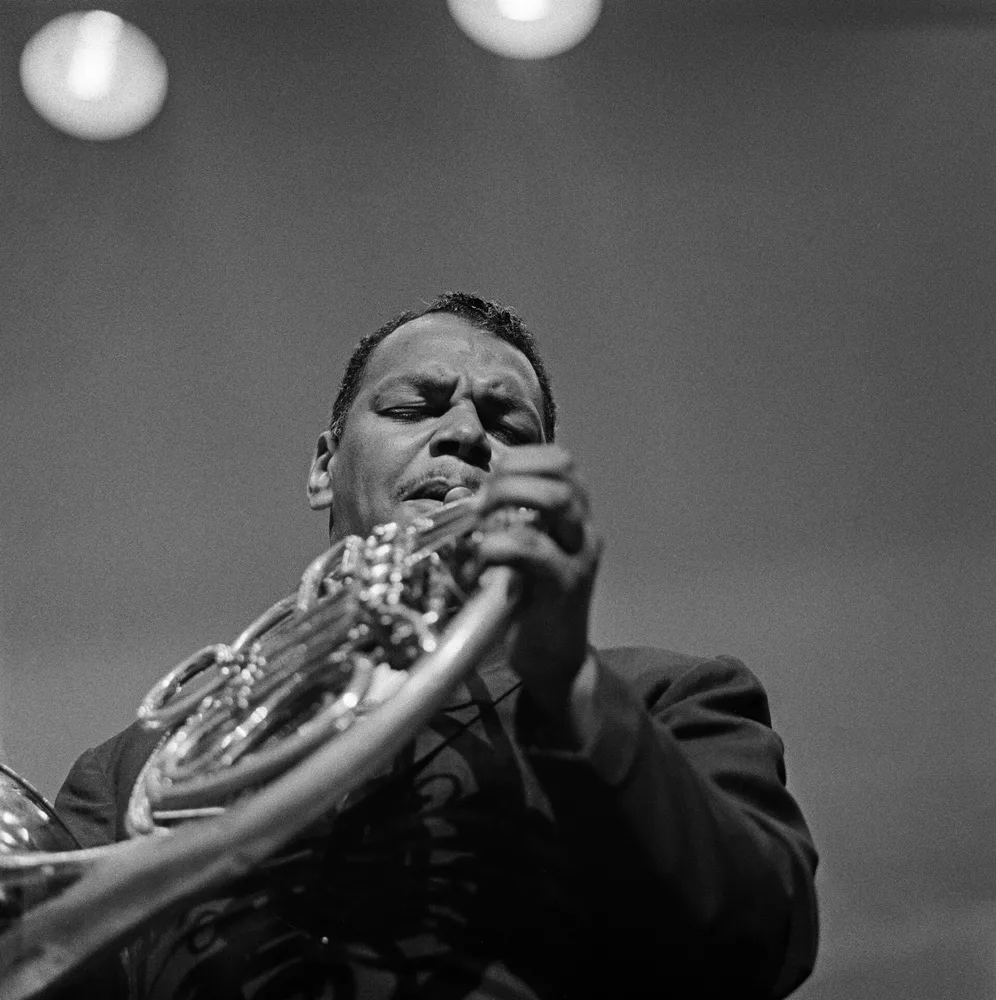
Julius Watkins performing on French horn with the Quincy Jones Orchestra at Kulttuuritalo (Culture House), Helsinki, Finland, August 29, 1960. CC BY 4.0 (Creative Commons Attribution 4.0 International) — Wikimedia Commons - File:Quincy Jones Orchestra 1960 (JOKAHBL3E A05-3).tif - https://commons.wikimedia.org/wiki/File:Quincy_Jones_Orchestra_1960_(JOKAHBL3E_A05-3).tif (JOKA Press Photo Archive / Hufvudstadsbladet collection, Finnish Heritage Agency, digitized 2023)
Julius Brian Watkins was born October 10, 1921, in Detroit, Michigan, and started on French horn at age nine, an unusual choice of first instrument that would define his entire career. He came up playing trumpet rather than horn professionally at first, touring with the Ernie Fields Orchestra from 1943 to 1946 and with pianist Milt Buckner's band from 1949 to 1950. Somewhere in that stretch he also studied for three years at the Manhattan School of Music after settling in New York, and by the late 1940s he was already turning up on record dates led by Kenny Clarke and Babs Gonzales, taking occasional French horn solos on sessions including Three Bips and a Bop's 1949 Blue Note single "Capitolizing" and "Professor Bop." From 1950 on he played French horn exclusively, effectively inventing a role in jazz that had not existed before him: no one had built a career as an improvising soloist on an instrument designed for orchestral blending, with no keys, a treacherous overtone series, and none of the jazz vocabulary that had accumulated on trumpet or saxophone.
Bassist Oscar Pettiford became Watkins's most important early patron, using him in the New Oscar Pettiford Sextet in the early 1950s and then in the two-volume big band album Oscar Pettiford Orchestra In Hi-Fi (ABC-Paramount, 1956 and 1958), where Watkins shared the horn chairs with fellow pioneer David Amram. Watkins led his own record dates for the first time on August 8, 1954, and March 20, 1955, at Rudy Van Gelder's Hackensack studio, cutting two 10-inch Blue Note LPs, New Faces - New Sounds (BLP 5053) and Volume Two (BLP 5064), as the Julius Watkins Sextet with Frank Foster and then Hank Mobley on tenor, Oscar Pettiford on bass, and Kenny Clarke or Art Blakey on drums. Around the same period he was a first-call horn on other bandleaders' dates, including Gigi Gryce's October 1955 Savoy session later issued as Nica's Tempo (where he appears alongside Thelonious Monk and Cecil Payne) and a 1954 Prestige date credited to Monk and Sonny Rollins.
In 1956 Watkins formed a working co-led group with tenor saxophonist Charlie Rouse, first billed as the Rouse-Watkins Jazz Modes and then simply Les Jazz Modes, built around Watkins's horn and Gildo Mahones's piano trio with harpist Janet Putnam and, on several tracks, vocalist Eileen Gilbert. The group recorded four albums for Dawn between 1956 and 1957, Les Jazz Modes (Dawn DLP 1108) and Mood in Scarlet (Dawn DLP 1117) among them, then moved to Atlantic for The Jazz Modes Play Excerpts from the Frank Loesser Musical "The Most Happy Fella" (1958) and the group's self-titled Atlantic album (recorded October 1957 and November 1958, released 1959), which added baritone saxophonist Sahib Shihab to the front line. Watkins and David Amram remained the only two jazz musicians working regularly on French horn through the decade, and on May 18, 1957, at Van Gelder's studio, the two of them co-led a session with pianist Hampton Hawes, trombonist Curtis Fuller, bassist Addison Farmer, and drummer Jerry Segal, supervised by Teddy Charles. Prestige paired those six tracks with a baritone-saxophone session cut by Pepper Adams and Cecil Payne one month earlier, on April 20, 1957, with John Coltrane on tenor and Mal Waldron on piano, and released the combined program in August 1958 as the 16 2/3 rpm sampler Modern Jazz Survey 2: Baritones and French Horns (Prestige 6). The baritone side was reissued in November 1963 under Coltrane's name as Dakar; the French horn side, with Watkins and Amram, was reissued in 1965 as Curtis Fuller and Hampton Hawes with French Horns (Status ST 8305).
The Jazz Modes dissolved around 1959, and Watkins spent the following years absorbed into the busiest rooms in New York studio jazz. Gil Evans put him in the French horn section, alongside Gunther Schuller and Willie Ruff, for Miles Davis's Porgy and Bess (recorded across four sessions from July to August 1958). He toured and recorded with Quincy Jones's big band from 1959 to 1961, including the album The Great Wide World of Quincy Jones and European dates that survive on later live releases, and in January 1962 he led his own final studio date, French Horns for My Lady (Philips), produced by Jones and pairing his horn with three others (John Barrows, Jim Buffington, Bob Northern) plus Gunther Schuller, tuba, and a rhythm section including George Duvivier and Ray Barretto. He was one of four French hornists, alongside Bob Northern, Robert Swisshelm, and Donald Corrado, that Eric Dolphy assembled for Coltrane's Impulse! debut Africa/Brass (May 23 and June 4, 1961), and he appears on Randy Weston's Uhuru Afrika (1961) and Oliver Nelson's Afro/American Sketches (1962). He also documented Charles Mingus's September 1965 UCLA concert and, later, the two-LP Let My Children Hear Music (1972), and he joined the free-jazz collective billed as The Jazz Composer's Orchestra for its 1968 self-titled JCOA album. In the 1970s he became a regular presence in Thad Jones and Mel Lewis's orchestra on record, heard on Consummation (1970), Suite for Pops (1972), and Suite for Pops follow-up New Life (1976), and he played on Mary Lou Williams's Mary Lou's Mass (1975).
Watkins's health declined through the 1970s under the weight of diabetes, liver and kidney problems, and chronic alcoholism. He died of a heart attack on April 4, 1977, in Short Hills, New Jersey, at age 55. Discogs credits him on 444 releases under his own name (7 as leader or co-leader, 411 sideman "Appearance" credits, 5 track-level credits, and 21 later unofficial/bootleg pressings), a tally that understates his actual leader catalog: seven more of his own albums, the two Blue Note 10-inches and all five Rouse-Watkins/Jazz Modes LPs, are filed on Discogs only under group names ("Julius Watkins Sextet," "The Jazz Modes," "Rouse-Watkins Jazz Modes") rather than his personal artist page.
AllMusic calls Watkins "virtually the father of the jazz French horn," and the claim is not much of an exaggeration: before him, the instrument had essentially no improvising vocabulary in jazz, and the two players who built one, Watkins and David Amram, did it in the same handful of New York rooms within a few years of each other. Watkins's solution was to play the horn with the warmth of a trombone and something close to the fluidity of a trumpet, running bebop lines through an instrument with no keys and a notoriously unforgiving overtone series. He was flexible enough to lead a plush, mood-driven co-op with Charlie Rouse's tenor one year and to hold down a chair in Eric Dolphy's dense Africa/Brass horn section or Thelonious Monk's hard-swinging quintet the next, which is largely why bandleaders as different as Oscar Pettiford, Gil Evans, and Quincy Jones all kept calling him for three decades. DownBeat's international critics gave him the Miscellaneous Instrument category two years running, 1960 and 1961, a recognition of the fact that he had no real competition; even after other hornists (Bob Northern, Jim Buffington) began doing studio work, none built the same identity as an improvising voice. His direct influence runs to every subsequent jazz French hornist, and later players such as Vincent Chancey have recorded explicit tributes to him.
- Julius Watkins Sextet, Vols. 1 & 2 (rec. 1954-55, Blue Note) - His recorded debut as a leader, two Van Gelder-cut 10-inch LPs (BLP 5053 and BLP 5064) combining Frank Foster and Hank Mobley on tenor with Oscar Pettiford and Kenny Clarke or Art Blakey. Spotify - Sextet Volumes 1 & 2
- Modern Jazz Survey 2: Baritones and French Horns (1958, Prestige) - A 16 2/3 rpm sampler pairing Watkins and David Amram's French horn side (with Hampton Hawes and Curtis Fuller) against a baritone-sax session led by Pepper Adams and Cecil Payne with John Coltrane; the baritone half was later reissued as Coltrane's Dakar, the horn half as Curtis Fuller and Hampton Hawes with French Horns. Spotify - Curtis Fuller & Hampton Hawes With French Horns
- Les Jazz Modes (1957, Dawn) - The first full album by Watkins's co-led group with Charlie Rouse, built around his horn, Rouse's tenor, and harpist Janet Putnam. Spotify - Les Jazz Modes Listen
- The Jazz Modes Play Excerpts from the Frank Loesser Musical "The Most Happy Fella" (1958, Atlantic) - The Rouse-Watkins group's take on Broadway, cut in two November 1957 sessions. Spotify - The Most Happy Fella Listen
- French Horns for My Lady (1962, Philips) - His last leader date, a Quincy Jones-produced four-French-horn showcase with George Duvivier and Ray Barretto in the rhythm section. Spotify - French Horns For My Lady Listen
- Porgy and Bess (1959, Columbia) - As a sideman: Miles Davis and Gil Evans's orchestral reimagining of the Gershwin opera, with Watkins in a three-man French horn section alongside Gunther Schuller and Willie Ruff.
- Africa/Brass (1961, Impulse!) - As a sideman: John Coltrane's label debut, with Watkins one of four French horns Eric Dolphy arranged into the brass choir on the title track.
Julius Watkins: Full Discography
Identity confirmed via the live Discogs API - personal artist ID 274971 ("Julius Watkins," realname Julius B. Watkins, born/died dates matching Wikipedia). Discogs credits 444 releases against that personal ID (7 "Main"/leader role, 411 sideman "Appearance" credits, 5 track-level "TrackAppearance" credits, and 21 later unofficial/bootleg pressings - the four counts sum exactly to 444). That personal-ID total understates his real leader catalog, however: as flagged in this sweep's standing field notes, Discogs files several of an artist's own albums under separate group-billing entities rather than the personal page. Two such entities hold seven more Watkins leader/co-leader albums invisible from ID 274971 alone: Julius Watkins Sextet (group ID 2702178, both 10-inch Blue Note LPs) and The Jazz Modes (group ID 1104337, five Dawn/Atlantic albums, one of which duplicates a personal-ID listing under a shared credit). A third group entity, The Rouse-Watkins Combo (3730458), holds only compilation track-appearances, nothing further. The table below lists every leader/co-leader release confirmed this way, plus a representative set of his most significant sideman credits drawn from a career that runs from 1949 to the mid-1970s; it does not attempt to itemize all 411 Appearance credits.
As Leader / Co-Leader
| Album Title | Recording Date(s) | Release Date | Label | Catalog Number | Format(s) | Personnel | Role | Reissue History | Spotify | Buy | Notes |
|---|---|---|---|---|---|---|---|---|---|---|---|
| New Faces - New Sounds | Recorded August 8, 1954, Van Gelder Studio, Hackensack NJ | 1954 | Blue Note | BLP 5053 | Vinyl, 10", LP, Mono | Julius Watkins (French horn), Frank Foster (tenor sax), George Butcher (piano), Perry Lopez (guitar), Oscar Pettiford (bass), Kenny Clarke (drums) | Leader (Julius Watkins Sextet) | Combined with Volume Two on the 1983 Japanese 12" reissue (King Records K18P-9273) and later CD compilations titled Sextet, Vols. 1 & 2 | Spotify - Sextet Volumes 1 & 2 | — | Watkins's recorded debut as a leader; filed on Discogs under the group entity "Julius Watkins Sextet" (2702178), not his personal artist page |
| Volume Two | Recorded March 20, 1955, Van Gelder Studio, Hackensack NJ | 1955 | Blue Note | BLP 5064 | Vinyl, 10", LP, Mono | Julius Watkins (French horn), Hank Mobley (tenor sax), Duke Jordan (piano), Perry Lopez (guitar), Oscar Pettiford (bass), Art Blakey (drums) | Leader (Julius Watkins Sextet) | Combined with New Faces - New Sounds on the 1983 Japanese 12" reissue and later CD compilations | Spotify - Sextet Volumes 1 & 2 | — | Also filed under the "Julius Watkins Sextet" group entity |
| Jazzville '56 (Vol. 1) | Recorded February 1956, Van Gelder Studio, Hackensack NJ | 1956 | Dawn | DLP 1101 | Vinyl, LP, Album | Julius Watkins (French horn), Charlie Rouse (tenor sax), Gildo Mahones (piano), Paul West (bass), Arthur Taylor (drums) | Co-leader (split LP, credited "Rouse-Watkins Jazz Modes" on one side and the Gene Quill-Dick Sherman Quintet on the other) | None found | Not found on Spotify under this title | — | The Watkins/Rouse duo's first record together, made before the group settled on the "Les Jazz Modes" name; filed under The Jazz Modes group entity (1104337) |
| Les Jazz Modes | Recorded June 12, 1956, NYC | 1957 | Dawn | DLP 1108 | Vinyl, LP, Album, Mono | Julius Watkins (French horn, arranger), Charlie Rouse (tenor sax), Janet Putnam (harp), Gildo Mahones (piano), Oscar Pettiford / Paul Chambers (bass), Ron Jefferson (drums), Eileen Gilbert (soprano voice) | Co-leader (Les Jazz Modes) | Later folded into 1998 and 2000s-era Jazz Modes reissue compilations | Spotify - Les Jazz Modes | — | The group's first full-length album under the Les Jazz Modes billing; filed under The Jazz Modes group entity |
| Mood in Scarlet | Recorded December 4, 1956, NYC | 1957 | Dawn | DLP 1117 | Vinyl, LP, Album | Julius Watkins (French horn), Charlie Rouse (tenor sax), Gildo Mahones (piano), Martin Rivera (bass), Ron Jefferson (drums), Chino Pozo (bongo), Eileen Gilbert (soprano voice) | Co-leader (billed "Les Modes") | None found | Not found on Spotify as a standalone album; several of its tracks appear on later compilations | — | Filed under The Jazz Modes group entity |
| The Jazz Modes Play Excerpts from the Frank Loesser Musical "The Most Happy Fella" | Recorded November 7 & 11, 1957, NYC | 1958 | Atlantic | LP 1280 | Vinyl, LP, Album | Julius Watkins (French horn), Charlie Rouse (tenor sax), Gildo Mahones (piano), Martin Rivera (bass), Ron Jefferson (drums), Chino Pozo (percussion), Eileen Gilbert (voice) | Co-leader (The Jazz Modes) | None found | Spotify - The Most Happy Fella | — | Filed under The Jazz Modes group entity |
| Modern Jazz Survey 2 / Baritones & French Horns | Two sessions: baritone side recorded April 20, 1957; French horn side recorded May 18, 1957, both at Van Gelder Studio, Hackensack NJ | August 1958 | Prestige | PRESTIGE 6 | Vinyl, LP, 16⅔ RPM, Mono | French horn side: Julius Watkins and David Amram (French horn), Curtis Fuller (trombone), Sahib Shihab (alto sax), Hampton Hawes (piano, most tracks) / Teddy Charles (piano, one track, also supervisor), Addison Farmer (bass), Jerry Segal (drums). Baritone side: Pepper Adams and Cecil Payne (baritone sax), John Coltrane (tenor sax), Mal Waldron (piano), Doug Watkins (bass) | Co-leader (shared billing, credited "Pepper Adams, Cecil Payne, Julius Watkins, Dave Amram") | The French horn side was reissued in 1965 as Curtis Fuller and Hampton Hawes with French Horns (Status ST 8305); the baritone side was reissued in November 1963 under John Coltrane's name as Dakar | Spotify - Curtis Fuller & Hampton Hawes With French Horns | — | A various-artists sampler disc combining two unrelated sessions on one LP, not a single recording date; verified against the full Discogs release credits (release 9861658), which list Watkins and Amram on tracks B1-B6 only |
| The Jazz Modes | Recorded October 28, 1957 and November 20, 1958, NYC | 1959 (Discogs master dates the pressing 1960) | Atlantic | LP 1306 | Vinyl, LP, Album, Mono | Julius Watkins (French horn), Charlie Rouse (tenor sax), Sahib Shihab (baritone sax, 1958 session only), Gildo Mahones (piano), Martin Rivera (bass), Ron Jefferson / Jimmy Wormworth (drums), Chino Pozo (percussion), Eileen Gilbert (voice) | Co-leader ("Julius Watkins & Charlie Rouse," billed as The Jazz Modes) | Reissued 2011 (Solar Records) as part of The Complete Jazz Modes Sessions | Not confirmed as a standalone Spotify listing; covered by "The Complete Jazz Modes Sessions" and "Essential Jazz Masters" compilations | — | Listed both on Watkins's personal Discogs page and under The Jazz Modes group entity; the two 1957/1958 sessions were combined onto one LP |
| French Horns for My Lady | Recorded January 1962, NYC | 1962 | Philips | PHM 200-001 | Vinyl, LP / 7" EP | Roger "King" Mozian (trumpet), John Barrows, Jim Buffington, Bob Northern, Gunther Schuller, Julius Watkins (French horns), Jay McAllister (tuba), Eddie Costa (piano, vibes), George Duvivier (bass), Ray Barretto (conga), Billy Byers (arranger, conductor); produced by Quincy Jones | Leader | None found | Spotify - French Horns For My Lady | — | Watkins's final studio leader date; a four-French-horn showcase, not a small-group blowing session |
As Sideman (selected major credits)
| Year | Project (Leader) | Title | Label | Catalog | Role | Notes |
|---|---|---|---|---|---|---|
| 1949 | Three Bips and a Bop featuring Babs Gonzales | "Capitolizing" / "Professor Bop" | Blue Note | — | French Horn | Among his earliest recorded French horn solos, per Wikipedia and AllMusic |
| 1953 | The New Oscar Pettiford Sextet | The New Oscar Pettiford Sextet | — | — | French Horn | Early Pettiford association that led to the 1956/58 orchestra albums |
| 1954 | Thelonious Monk / Sonny Rollins | Thelonious Monk / Sonny Rollins | Prestige | — | French Horn | Cited in Wikipedia's Watkins biography as a notable 1954 Monk session |
| 1955 | Gigi Gryce Orchestra | Nica's Tempo | Savoy | — | French Horn (tracks 3 & 5 only) | Recorded October 22, 1955, Van Gelder Studio; large personnel including Thelonious Monk, Oscar Pettiford, Cecil Payne, Art Blakey, Percy Heath, Art Farmer; Gunther Schuller played horn on the session's other tracks |
| 1956 | Oscar Pettiford Orchestra | Oscar Pettiford Orchestra In Hi-Fi | ABC-Paramount | ABC-135 | French Horn | Watkins and David Amram paired in the horn section |
| 1957 | Mat Mathews | 4 French Horns Plus Rhythm | Elektra | EKL-134 | French Horn | With David Amram among the other three horns |
| 1958 | Oscar Pettiford Orchestra | Oscar Pettiford Orchestra In Hi-Fi, Volume Two | ABC-Paramount | — | French Horn | Sequel to the 1956 volume, same horn pairing with Amram |
| 1958 | Gil Evans Orchestra featuring Cannonball Adderley | New Bottle Old Wine | World Pacific | — | French Horn | Gil Evans large-ensemble session |
| 1958 | Miles Davis / Orchestra under the direction of Gil Evans | Porgy and Bess | Columbia | — | French Horn | Recorded across four sessions, July 22-August 18, 1958, Columbia's 30th Street Studio; Watkins shared the horn chairs with Gunther Schuller and Willie Ruff |
| 1959 | Quincy Jones | The Great Wide World of Quincy Jones | Mercury | — | French Horn | Around the start of Watkins's 1959-1961 tenure in Jones's touring big band |
| 1961 | The John Coltrane Quartet (arr. Eric Dolphy) | Africa/Brass | Impulse! | A-6 | French Horn | Recorded May 23 & June 4, 1961; Watkins one of four French horns (with Bob Northern, Robert Swisshelm, Donald Corrado) on the title track |
| 1961 | Randy Weston / Langston Hughes | Uhuru Afrika | Roulette | — | French Horn | |
| 1961 | Dizzy Gillespie and His Orchestra | Gillespiana | Verve | — | French Horn | Lalo Schifrin-composed suite for Gillespie's orchestra |
| 1962 | Oliver Nelson Orchestra | Afro/American Sketches | Prestige | — | French Horn | |
| 1965/66 | Charles Mingus | Music Written for Monterey, 1965, Not Heard... Played in Its Entirety at UCLA | — | — | French Horn | Documents a September 1965 UCLA concert |
| 1968 | The Jazz Composer's Orchestra | The Jazz Composer's Orchestra | JCOA | — | French Horn | Free-jazz collective large-ensemble recording |
| 1970 | Thad Jones & Mel Lewis | Consummation | Solid State | — | French Horn (occasional guest chair) | |
| 1972 | Charles Mingus | Let My Children Hear Music | Columbia | — | French Horn | |
| 1975 | Thad Jones & Mel Lewis | Suite for Pops | Horizon | — | French Horn | |
| 1975 | Mary Lou Williams | Mary Lou's Mass | Mary Records | — | French Horn | |
| 1976 | Thad Jones / Mel Lewis | New Life (Dedicated to Max Gordon) | — | — | French Horn |
Watkins's Discogs sideman log (411 "Appearance" credits, 1949-2026 including posthumous compilation appearances) also includes further work with Milt Jackson (multiple 1949-1980 sessions), Kenny Clarke, Dizzy Gillespie's big band and orchestra, Tadd Dameron, Gil Evans (The Individualism of Gil Evans, 1964), John Coltrane compilations and reissues, Miles Davis reissue packages, Phil Woods, Jimmy Heath, Freddie Hubbard, Pharoah Sanders, Benny Golson, Blue Mitchell, and Michel Legrand, among many others - not itemized exhaustively here. A large share of the post-1980 "Appearance" entries are reissue compilations and box sets repackaging his 1950s-1970s sessions rather than new recording dates.
- Oscar Pettiford - Watkins's most important early patron, employing him on the New Oscar Pettiford Sextet in the early 1950s and both volumes of Oscar Pettiford Orchestra In Hi-Fi (1956, 1958).
- David Amram - the only other jazz French hornist working regularly in the 1950s; the two shared the horn chairs in Pettiford's orchestra and co-led the May 18, 1957 Van Gelder session issued as the French-horn half of Modern Jazz Survey 2: Baritones and French Horns.
- Charlie Rouse - co-leader of the Jazz Modes (later Les Jazz Modes), 1956 to roughly 1959, across five albums for Dawn and Atlantic; no JazzProfiles.com profile yet.
- Gil Evans - placed Watkins in the French horn section of Miles Davis's Porgy and Bess (1958) and New Bottle Old Wine (1958), featuring Cannonball Adderley.
- Quincy Jones - toured Europe and the U.S. with Jones's big band from 1959 to 1961 and produced Watkins's final leader date, French Horns for My Lady (1962).
- John Coltrane - fellow horn on the 1957 Prestige session later split into Dakar and Curtis Fuller and Hampton Hawes with French Horns, and one of four French hornists on Coltrane's Africa/Brass (1961).
- Curtis Fuller, Hampton Hawes, and Teddy Charles - trombonist, pianist, and session supervisor/producer on the May 18, 1957 French-horn date with Watkins and Amram, later reissued as Curtis Fuller and Hampton Hawes with French Horns.
- Thelonious Monk - sideman on a 1954 Prestige date credited to Monk and Sonny Rollins, and on Gigi Gryce's 1955 Savoy session Nica's Tempo, where both men appear.
- Charles Mingus - played French horn on Mingus's September 1965 UCLA concert recording and on the 1972 double album Let My Children Hear Music.
- Thad Jones and Mel Lewis - regular orchestra member through the 1970s, heard on Consummation (1970), Suite for Pops (1972), and New Life (1976).
More Bebop Artists
See all 166 Bebop artists →More American Jazz Artists
See all 567 American artists →- Wikipedia: Julius Watkins
- Wikipedia: Julius Watkins Sextet
- Wikipedia: The Jazz Modes
- Wikipedia: Les Jazz Modes
- Wikipedia: Mood in Scarlet
- Wikipedia: The Most Happy Fella (album)
- Wikipedia: Baritones and French Horns
- Wikipedia: Dakar (album)
- Wikipedia: French Horns for My Lady
- Wikipedia: Porgy and Bess (Miles Davis album)
- Wikipedia: Nica's Tempo
- Discogs: Julius Watkins (artist 274971)
- Discogs API release credits (labels, catalog numbers, formats, personnel) for the releases in
discography-full.md, including the group-billing entities Julius Watkins Sextet (2702178) and The Jazz Modes (1104337). - AllMusic: Julius Watkins biography
- Horn Matters: Julius Watkins, jazz French horn pioneer
- Spotify Web API / open.spotify.com pages, for artist and album link matching (Spotify's catalogue search was unavailable; links were confirmed manually against Discogs track counts and personnel instead).