 JAZZPROFILES lives in the music 1,572 Jazz Artists fully Profiled!
 Gil Evans
Last updated September 5, 2026
Listen on Spotify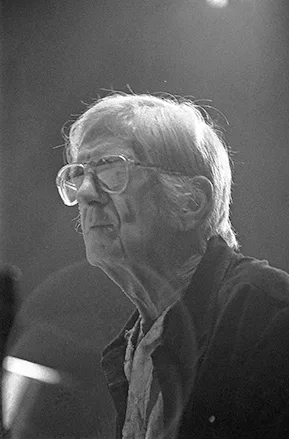
Gil Evans, 1978 CC BY-SA 4.0 — Wikimedia Commons — https://commons.wikimedia.org/wiki/File:Gil_Evans_1978_1.jpg

Gil Evans was born Gilmore Ian Ernest Green on May 13, 1912, in Toronto, Canada. His biological father, reportedly a doctor, died before he was born; his mother, Margaret Julia McConnachy, later remarried a miner named John Evans, whose surname the boy took. The family moved constantly through Evans's childhood, chasing his stepfather's work through Saskatchewan, British Columbia, Washington, Idaho, Montana, and Oregon before finally settling in California, where Evans graduated from Stockton High School in 1930. He discovered jazz through radio and records as a teenager, drawn especially to Duke Ellington, Louis Armstrong, and Fletcher Henderson — models whose orchestral thinking would shape his own arranging for the rest of his life.
Entirely self-taught as a musician, Evans enrolled at the College of the Pacific in Stockton and in 1933 founded his own band, Gil Evans & His Orchestra. By 1935 the group was the house band at the Rendezvous Ballroom in Balboa Beach, California; it toured the Pacific Northwest in 1937 before relocating to Hollywood, where it became a regular fixture on Bob Hope's radio program. Even in these early charts, Evans was already reaching past a standard dance-band palette toward the French horns, flutes, and tubas that would become his signature.
From 1941 to 1948, Evans arranged for the Claude Thornhill Orchestra, a band whose lush, almost classical sound became the single largest influence on his mature style. His charts were notoriously difficult — bassist Bill Crow recalled that Thornhill would pull out Evans's toughest arrangements "when he wanted to punish the band" — but they were also where Evans first built the augmented brass instrumentation, standard big-band lineup plus French horn and tuba, that defined his orchestral voice. His basement apartment behind a Manhattan Chinese laundry became an informal salon during these years, a gathering place for musicians looking for an alternative to bebop's harmonic language; Charlie Parker, Gerry Mulligan, and John Carisi were regulars, and it was in these conversations that the ideas behind Birth of the Cool first took shape.
That thinking became concrete in 1948, when Evans, Miles Davis, Gerry Mulligan, and others assembled a nine-piece band built around the unusual voicings Evans had developed under Thornhill. The Miles Davis Nonet recorded twelve sides across three sessions for Capitol in 1949 and 1950; compiled and released in 1957 as Birth of the Cool, that material became one of the foundational documents of cool and West Coast jazz, and cemented Evans and Davis as creative partners.
Nearly a decade later, producer George Avakian gave Davis his pick of arrangers for a new Columbia project, and Davis chose Evans without hesitation, opening the most celebrated collaboration of either man's career. Miles Ahead (1957) established the template: Davis's trumpet and flugelhorn floating over an orchestra Evans built and conducted, credited on the sleeve as "Miles Davis + 19" with Evans directing. Porgy and Bess (1958) followed with dense, demanding arrangements of Gershwin's opera, completed under such tight rehearsal time that some errors made it onto tape — yet the record is still regarded as among the finest jazz treatments of that score in any idiom. Sketches of Spain (1960), built around Evans's love of Manuel de Falla and Joaquín Rodrigo, won the pair a Grammy for Best Jazz Composition of More Than Five Minutes Duration and remains the high-water mark of orchestral jazz. A fourth and more contentious record, Quiet Nights (1963), was released by Columbia against both Davis's and Evans's wishes, using a partial batch of unfinished bossa nova sessions; it strained Davis's relationship with producer Teo Macero for two years afterward. Evans also contributed uncredited arranging work to Davis's Filles de Kilimanjaro (1968), a late, quiet coda to their partnership.
Evans built a leader career in parallel with the Davis records rather than after them. Gil Evans & Ten (Prestige, 1957) was his recording debut as a bandleader, a small-group session featuring Steve Lacy on soprano saxophone. New Bottle Old Wine (World Pacific, 1958) paired his orchestra with a young Cannonball Adderley on reinterpretations of classic jazz repertoire, and Great Jazz Standards (World Pacific, 1959) continued in that vein with trumpeter Johnny Coles as featured soloist. Out of the Cool (Impulse!, 1961) is widely considered his own masterpiece as a leader: a Grammy-nominated set built around slow tempos, spacious voicings, and a front line including Coles, Ron Carter, and Elvin Jones, it's frequently cited alongside the Davis records as proof of how far Evans could push an orchestra without losing intimacy. Into the Hot (Impulse!, 1962) split billing between charts by John Carisi and a quintet led by Cecil Taylor, with Evans credited as producer/leader of the overall project rather than composer of every track on it — a credit worth noting for anyone assembling his discography from the spine alone. The Individualism of Gil Evans (Verve, 1964) pushed furthest into his mature orchestral language: five French horns, multiple bassists playing simultaneously (some arco, some pizzicato — Richard Davis, Paul Chambers, Ron Carter, Gary Peacock, Milt Hinton, and Ben Tucker all appear across the sessions), alto and bass flutes, oboe, and harp, with Eric Dolphy, Wayne Shorter, and Steve Lacy among the reed soloists. Its orchestral arrangement of Willie Dixon's "Spoonful" foreshadowed the genre-crossing Evans would return to a decade later.
The mid-1960s were harder going. Evans arranged the big-band tracks on Kenny Burrell's Guitar Forms (1965) and recorded Look to the Rainbow (1966) with Astrud Gilberto, but grew discouraged with Verve's push toward more commercial material, and his output slowed through a period marked by depression and frustration with the logistics of scoring for the large, specialized ensembles his music required.
The turnaround came from an unlikely source: his wife encouraged him to listen to Jimi Hendrix, and the encounter reignited him. Evans built a new, electric-instrumentation band — guitars, electric bass, synthesizers, no more French-horn choir — and spent the 1970s reinventing his sound around it. Gil Evans (Ampex, 1970, later reissued as Blues in Orbit) and Svengali (Atlantic, 1973, a live recording and Grammy nominee whose title is an anagram of his own name) opened the decade; The Gil Evans Orchestra Plays the Music of Jimi Hendrix (RCA Victor, 1974), arranged with guitarists John Abercrombie and Ryo Kawasaki in the band, made the Hendrix debt explicit. There Comes a Time (RCA, 1976) and the belatedly released Where Flamingos Fly (recorded 1971, issued on Artists House in 1981) carried the same electric-orchestral language forward, and Priestess (recorded live in 1977, released on Antilles in 1983) earned Evans another Grammy nomination.
In April 1983, at the invitation of club owner and producer Horst Liepolt, Evans's orchestra began a regular Monday-night residency at Sweet Basil in Greenwich Village that ran for nearly five years. The Monday Night Orchestra drew heavily from New York's session-player pool — many of its members, including saxophonist David Sanborn, trombonist Tom Malone, and trumpeters Lew Soloff and Alan Rubin, also played in the Saturday Night Live band — and the shifting, rotating lineup gave Evans's late book a constant supply of new voices, including his own son Miles Evans on trumpet. Bud and Bird, recorded live at Sweet Basil in December 1986 and released in 1987, won Evans a Grammy for Best Jazz Instrumental Performance, Big Band, in 1988.
Evans's final years brought a wave of outside work: he produced and arranged the soundtrack to the film Absolute Beginners (1986), working with Sade, the Style Council, Jerry Dammers, and David Bowie, and arranged music for Martin Scorsese's The Color of Money (1986). In July 1987 he led the Monday Night Orchestra plus saxophonist Branford Marsalis through a live set of Police songs and Hendrix material with Sting at the Perugia Jazz Festival — the Last Session recording — a project notable for introducing a young apprentice arranger, Maria Schneider, to Evans's circle. His final project was a set of arrangements written for the Laurent Cugny Big Band in Paris, recorded in November 1987 and released posthumously as Golden Hair (EmArcy, 1989).
Evans married Lillian Grace not long after the Birth of the Cool sessions, and married his second wife, Anita Cooper, in 1963; the couple had two sons, Noah and Miles, with Miles Evans eventually playing trumpet in his father's own orchestra. Gil Evans died on March 20, 1988, in Cuernavaca, Mexico, of peritonitis following prostate surgery, at age 75. He was inducted into the DownBeat Jazz Hall of Fame in 1986 and the Canadian Music Hall of Fame in 1997, and Miles Davis & Gil Evans: The Complete Columbia Studio Recordings won a posthumous Grammy for Best Historical Album in 1997. Conductor Ryan Truesdell's Gil Evans Project, authorized by the Evans estate, released Centennial in 2012 — a collection of previously unrecorded Evans compositions and arrangements that earned its own Grammy nomination and prompted Miles Evans to lead a centennial tribute concert of his father's music at New York's Highline Ballroom.
Evans's orchestral language grew directly out of his years arranging for Claude Thornhill: unusual brass and reed colorations, especially French horn and tuba layered into a standard big-band frame, replacing the sharp attack of conventional swing writing with something closer to a wash of sustained, blended color. Where most big-band arrangers wrote for sections, Evans increasingly wrote for individual timbres — a single flute doubling a bass clarinet, two bassists playing the same line arco and pizzicato at once — building material specifically around the soloists in front of him (Steve Lacy, Johnny Coles, Eric Dolphy, Wayne Shorter, David Sanborn) rather than treating personnel as interchangeable. That instinct made him, alongside his Davis collaborations, one of the most consequential orchestrators jazz has produced: a player of harmonic and textural possibility as much as a conventional bandleader. The other defining thread of his career was restlessness. He moved from the classically tinged big-band writing of the 1940s and '50s, through the operatic scale of the Davis Columbia albums, into the free-leaning, soloist-driven records of the early-to-mid 1960s, and finally into an electric, rock- and funk-inflected idiom in the 1970s and '80s built around Jimi Hendrix's music — a reinvention few arrangers his age attempted, let alone pulled off with a working band of New York's best session players.
- Miles Ahead (1957, Columbia, with Miles Davis) - Evans's first Columbia collaboration with Davis, arranging and conducting a nineteen-piece orchestra credited to "Miles Davis + 19"; the template for everything that followed between them. Spotify - Miles Ahead Listen
- Porgy and Bess (1958, Columbia, with Miles Davis) - Dense, demanding orchestral arrangements of Gershwin's opera, completed under tight rehearsal time; still cited as among the finest jazz treatments of the score in any idiom. Spotify - Porgy And Bess Listen
- Sketches of Spain (1960, Columbia, with Miles Davis) - Grammy winner (Best Jazz Composition of More Than Five Minutes Duration); Spanish- and Latin-themed orchestral writing drawn from Evans's admiration for Manuel de Falla and Joaquín Rodrigo, and the high-water mark of the Davis-Evans partnership. Spotify - Sketches Of Spain Listen
- Out of the Cool (1961, Impulse!) - Widely considered his masterpiece as a leader in his own right: slow tempos, spacious voicings, and a front line including Johnny Coles, Ron Carter, and Elvin Jones; Grammy-nominated. Spotify - Out Of The Cool Listen
- The Individualism of Gil Evans (1964, Verve) - His most orchestrally ambitious leader date: five French horns, multiple simultaneous bassists (arco and pizzicato), harp, and reed soloists Eric Dolphy, Wayne Shorter, and Steve Lacy across the sessions. Spotify - The Individualism Of Gil Evans Listen
- Svengali (1973, Atlantic) - Grammy-nominated live recording opening his electric, Hendrix-influenced era; the title is an anagram of his own name. Spotify - Svengali Listen
- Bud and Bird (1987, Electric Bird, with the Monday Night Orchestra) - Recorded live at Sweet Basil in December 1986 during his nearly five-year residency there; won Evans a posthumously celebrated Grammy for Best Jazz Instrumental Performance, Big Band, in 1988. No confirmed Spotify listing for this specific release found in this research pass — flagged unconfirmed rather than guessed.
Gil Evans: Full Discography
Identity confirmed via Discogs artist ID 255137 ("Gil Evans," real name Ian Ernest Gilmore Evans, born Green). Extremely prolific catalog — 960 total Discogs credits across leader, arranger, sideman, and compilation appearances. This table covers his major studio/leader albums in full detail, plus the essential Miles Davis collaborations where Evans served as arranger/conductor. Dates, catalog numbers, and personnel below are pulled from Discogs release-level data (not master listings) wherever available; where Discogs' own release notes didn't itemize a detail, that's stated plainly rather than guessed. Buy links were not verified in this research pass — left blank rather than fabricated; a future pass should confirm and add them.
As Leader / Co-Leader
| Album Title | Recording Date(s) | Release Date | Label | Catalog Number | Format(s) | Personnel | Role | Reissue History | Spotify | Buy | Notes |
|---|---|---|---|---|---|---|---|---|---|---|---|
| Gil Evans & Ten | Sept 6, Sept 27 & Oct 10, 1957 | 1957 | Prestige | PRLP 7120 | Vinyl, LP, Album, Mono | Gil Evans (piano, arranger), Steve Lacy (soprano sax), Louis Mucci / Jake Koven / John Carisi (trumpet), Jimmy Cleveland (trombone), Bart Varsalona (bass trombone), Dave Kurtzer (bassoon), Willie Ruff (French horn), Paul Chambers (bass), Jo Jones / Nick Stabulas (drums), Zeke Tolin (alto sax) | Leader | 2013 CD reissue adds bonus tracks ("Original Album Plus Bonus Tracks 1957") | Spotify - Gil Evans &... | — | Evans's recording debut as a bandleader |
| New Bottle Old Wine | April 9 & May 26, 1958 (per Wikipedia; not itemized in this release's Discogs notes) | 1958 | World Pacific Records | STEREO-1011 | Vinyl, LP, Stereo, Album | Billed "Gil Evans Orchestra Featuring Cannonball Adderley." Cannonball Adderley (alto sax), Gil Evans (piano, arranger), Paul Chambers (bass), Art Blakey (drums), Julius Watkins (French horn), Chuck Wayne (guitar), Ernie Royal / Johnny Coles / Louis Mucci (trumpet), Frank Rehak / Joseph Bennett / Thomas Mitchell (trombone), Harvey Phillips (tuba) | Leader | None found | Not confirmed — no matching Spotify album page located this pass | — | Reinterpretations of classic jazz repertoire with a young Cannonball Adderley as featured soloist |
| Great Jazz Standards | Not specified in Discogs data | 1959 | World Pacific Records | WP-1270 | Vinyl, LP, Album, Mono | Billed "Gil Evans And His Orchestra" featuring Johnny Coles. Johnny Coles / Allen Smith / Danny Stiles / Louis Mucci (trumpet), Steve Lacy (soprano sax), Budd Johnson (tenor sax, clarinet), Elvin Jones / Denis Charles (drums), Curtis Fuller / Jimmy Cleveland / Rod Levitt / Dick Lieb / Bill Elton (trombone), Bill Barber (tuba), Earl Chapin / Robert Northern (French horn) | Leader | None found | Not confirmed — no matching Spotify album page located this pass | — | |
| Out of the Cool | Not itemized in this release's Discogs notes; commonly cited as recorded November 1960 | 1961-02 | Impulse! | A-4 | Vinyl, LP, Album, Mono (remastered/recut second-cut pressing; a first-cut pressing exists as a separate Discogs release) | Gil Evans (piano, arranger), Johnny Coles / Phil Sunkel (trumpet), Jimmy Knepper / Keg Johnson (trombone), Tony Studd (bass trombone), Bill Barber (tuba), Budd Johnson (tenor/soprano sax), Eddie Caine / Ray Beckenstein (alto sax, flute), Bob Tricarico (bassoon, flute), Ron Carter (bass), Elvin Jones / Charlie Persip (percussion), Ray Crawford (guitar) | Leader | Multiple CD remasters (2007, 2012 pressings confirmed via Spotify listings) | Spotify - Out Of The Cool | — | Grammy-nominated; widely considered his masterpiece as a leader |
| Into the Hot | September-October 1961, Van Gelder Studio, Englewood Cliffs NJ (per Wikipedia) | 1962 (Jan per secondary sources) | Impulse! | A-9 (cover/spine) / A-9-S (labels) | Vinyl, LP, Album, Stereo | Billed "Gil Evans And His Orchestra" but the album splits charts by John Carisi and a Cecil Taylor Unit quintet/septet: Cecil Taylor (piano), Archie Shepp / Gene Quill (tenor sax), Jimmy Lyons (2) / Phil Woods (alto sax), Henry Grimes (bass), Sunny Murray / Osie Johnson (drums), Eddie Costa (piano, vibraphone), Urbie Green (trombone), Harvey Phillips (tuba), Barry Galbraith (guitar) | Leader/producer credit — not composer of every track | None found | Spotify - Into The Hot | — | Evans is credited as the project's leader/producer, not as arranger of the Carisi or Cecil Taylor Unit material — worth flagging for anyone assembling a "Gil Evans as arranger" list from the spine alone |
| The Individualism of Gil Evans | Sept 1963 (A&R Studios), April 6 1964 (Webster Hall), July 9 1964 (Van Gelder's Recording Studio) — all NYC/NJ | 1964-09 | Verve Records | V6-8555 | Vinyl, LP, Album, Stereo, Gatefold | Gil Evans (piano, arranger, conductor), Eric Dolphy / Wayne Shorter / Steve Lacy / Jerome Richardson / Andy Fitzgerald / Al Block / George Marge / Garvin Bushell / Bob Tricarico (reeds/woodwinds across sessions), Kenny Burrell / Barry Galbraith (guitar), 5 French horns (Julius Watkins, Ray Alonge, Jim Buffington, Robert Northern, Donald Corrado, Gil Cohen — six credited across sessions), multiple bassists playing simultaneously — Ron Carter, Paul Chambers, Richard Davis, Gary Peacock, Milt Hinton, Ben Tucker, Elvin Jones / Osie Johnson (drums), Bob Maxwell / Margaret Ross (harp) | Leader | 1988 CD reissue added bonus tracks (per secondary sourcing) | Spotify - The Individualism... | — | His most orchestrally ambitious leader date; includes an orchestral arrangement of Willie Dixon's "Spoonful" |
| Gil Evans | Not specified in Discogs data | 1971 (Discogs master year; Wikipedia cites 1970) | Ampex Records | A10102 / A-10102 | Vinyl, LP, Album | Gil Evans (arranger, conductor), Herb Bushler (upright/Fender bass), Alphonse Mouzon / Donald MacDonald / Elvin Jones (drums), Joe Beck (electric guitar), Billy Harper (sax, flute), Jimmy Cleveland (trombone), Howard Johnson (tuba), Sue Evans (percussion) | Leader | Reissued as Blues in Orbit (Enja, 1980) | Not confirmed for this Ampex pressing; the Blues in Orbit reissue is confirmed: Spotify - Blues in Orbit | — | Small-label year discrepancy between Discogs (1971) and Wikipedia (1970) noted rather than resolved with a guess |
| Svengali | Live, May 30, 1973 (Trinity Church) & June 30, 1973 (Philharmonic Hall), NYC | 1973 | Atlantic | SD 1643 | Vinyl, LP, Album, Stereo | Gil Evans (piano, electric piano, arranger, conductor, producer), David Sanborn (alto sax), Billy Harper (tenor sax, flute), Ted Dunbar (guitar), Herb Bushler (electric bass), Bruce Ditmas (drums), Pete Levin / Sharon Freeman (French horn), David Horowitz (synthesizer), Hannibal Marvin Peterson / Richard Williams / Tex Allen (trumpet), Joe Daley (trombone, flute), Trevor Koehler (tuba, baritone sax, flugelhorn) | Leader | None found | Spotify - Svengali | — | Title is an anagram of "Gil Evans"; his only release for Atlantic; Grammy-nominated |
| The Gil Evans Orchestra Plays the Music of Jimi Hendrix | June 1974, RCA's Studio "B," New York City | 1974-09 | RCA Victor | CPL1-0667 | Vinyl, LP, Album | Gil Evans (piano, leader), John Abercrombie / Ryo Kawasaki (electric guitar), David Sanborn (alto flute, soprano sax), Howard Johnson (clarinet), Billy Harper (tenor sax, flute), David Horowitz (electric piano, synth), Pete Levin (horn, synth), Don Pate / Michael Moore (bass), Bruce Ditmas / Sue Evans (drums, congas), Lew Soloff / Hannibal Marvin Peterson (trumpet) | Leader | None found | Spotify - Plays The Music Of... | — | Explicit album-length Hendrix tribute; the clearest statement of Evans's 1970s electric reinvention |
| There Comes a Time | March-June 1975, RCA's Studio "B," New York City | 1976 | RCA | APL1-1057 | Vinyl, LP, Album | Billed "Gil Evans And His Orchestra." David Sanborn (alto/soprano sax, flute), Howard Johnson (baritone sax, bass clarinet, tuba), Ryo Kawasaki (electric guitar), Anthony (Tony) Williams / Bruce Ditmas (drums), Lew Soloff / Ernie Royal / Hannibal Marvin Peterson (trumpet), Tom Malone (trombone, synth, tuba), Bob Stewart / Joe Daley (tuba), Sue Evans (percussion) | Leader | None found | Not confirmed — no matching Spotify album page located this pass | — | |
| Where Flamingos Fly | Recorded NYC, 1971; mixed 1981 at Blank Tapes Recording Studio, NYC | 1981 | Artists House | AH 14 | Vinyl, LP, Album | Gil Evans (piano, electric piano), Richard Davis (acoustic bass), Johnny Coles / Stan Shafran (trumpet), Jimmy Knepper / Hannibal Marvin Peterson (trombone), Howard Johnson (baritone sax, tuba, flugelhorn), Trevor Koehler (baritone/soprano sax), Airto Moreira / Flora Purim (vocals, percussion), Don Preston / Phil Davis (synthesizer), Harry Lookofsky (violin), Lenny White / Bruce Ditmas (drums) | Leader | None found | Not confirmed — no matching Spotify album page located this pass | — | Recorded a full decade before its eventual release |
| Priestess | Live at St. George Church, NYC, May 13, 1977 | 1983 | Antilles | AN 1010 | Vinyl, LP, Album | Gil Evans (piano), David Sanborn / Arthur Blythe (alto sax), George Adams (tenor sax), Lew Soloff / Hannibal Marvin Peterson / Ernie Royal (trumpet), Jimmy Knepper (trombone), Bob Stewart / Howard Johnson (tuba), Pete Levin (synth, clavinet), John Clark (French horn), Sue Evans (drums), Keith Loving (guitar) | Leader | None found | Not confirmed — no matching Spotify album page located this pass | — | Grammy-nominated (Best Jazz Instrumental Performance, Group, 1984) |
| Bud and Bird (Live at Sweet Basil) | Live at Sweet Basil, NYC, December 1 & 22, 1986 (Discogs notes show a "33" typo for the second date; corrected against secondary sourcing) | 1987-06-21 | Electric Bird | K19P 6455-6 | Vinyl, 2×LP, Album | Billed to "Gil Evans" and "The Monday Night Orchestra." Lew Soloff / Miles Evans / Shunzo Ohno (trumpet), Dave Bargeron (trombone), Dave Tucker (bass trombone), John Clark (French horn), Chris Hunter (alto/soprano sax, flute), Bill Evans [unrelated] (tenor/soprano sax, flute), Hamiet Bluiett (baritone sax, clarinet), Hiram Bullock (guitar), Mark Egan (bass), Danny Gottlieb (drums), Pete Levin / Gil Goldstein (synthesizer), Johnny Coles (flugelhorn), Gil Evans (piano, arranger) | Leader | None found | Not confirmed — a Spotify track titled "Bud and Bird" exists but belongs to a different 1987/2000 live album (Live at Umbria Jazz), not this Sweet Basil release; flagged rather than misattributed | — | Grammy winner, Best Jazz Instrumental Performance, Big Band (1988); recorded during the Monday Night Orchestra's Sweet Basil residency, around Evans's 75th birthday |
| Golden Hair | Nov 3 & Nov 26, 1987, Studio Acousti, Paris | 1989 | EmArcy / Mercury | 838 773-1 | Vinyl, LP, Album | Billed "Gil Evans / Laurent Cugny / Big Band Lumière." Laurent Cugny (co-leader, keyboards), Gil Evans (leader, piano, electric piano, arranger), Stéphane Belmondo (trumpet), Andy Sheppard / Charles Schneider (tenor sax), Philippe Sellam / Pierre-Olivier Govin / Bobby Rangell (alto sax), Dominique Di Piazza (electric bass), Stéphane Huchard (drums), Marilyn Mazur / Xavier Desandre Navarre (percussion) | Leader (co-credited) | None found | Not confirmed — no matching Spotify album page located this pass | — | Evans's final recorded project, arrangements written for Laurent Cugny's Big Band Lumière; released posthumously |
With Miles Davis (Arranger / Conductor — Evans as co-credit, not leader)
These belong equally to a future dedicated Miles Davis discography; included here per this profile's remediation brief since they are the essential Evans/Davis collaborations.
| Album Title | Recording Date(s) | Release Date | Label | Catalog Number | Format(s) | Personnel | Role | Reissue History | Spotify | Buy | Notes |
|---|---|---|---|---|---|---|---|---|---|---|---|
| Miles Ahead | Not itemized in this release's Discogs notes; 1957 sessions per Wikipedia | 1957 | Columbia | CL 1041 | Vinyl, LP, Album, Mono | Billed "Miles Davis + 19." Miles Davis (trumpet, flugelhorn), Gil Evans (arranger, director), George Avakian (producer) | Arranger, Conductor | Multiple reissues confirmed, incl. "Miles Ahead (Expanded Edition)" and the "Miles Ahead, Miles +19" 2013 box | Spotify - Miles Ahead (Expanded...) | — | Evans's first Columbia collaboration with Davis; established the "orchestra under the direction of Gil Evans" template |
| Porgy and Bess | July 22, July 29, Aug 4 & Aug 18, 1958 | 1959-03 | Columbia | CL 1274 | Vinyl, LP, Album, Mono | Miles Davis (trumpet, flugelhorn), Gil Evans (director), Paul Chambers (bass), "Philly" Joe Jones / Jimmy Cobb (drums), Cannonball Adderley (sax), Julius Watkins / Gunther Schuller / Willie Ruff (French horn), Jerome Richardson / Phil Bodner / Romeo Penque (flute), Bill Barber (tuba) | Arranger ("Orchestra Under The Direction Of") | None itemized in this release's Discogs data beyond the base pressing | Spotify - Porgy And Bess | — | Completed under tight rehearsal time; still cited as among the finest jazz treatments of Gershwin's score |
| Sketches of Spain | Nov 20, 1959 & March 10-11, 1960, New York City | 1960-07-18 | Columbia | CL 1480 | Vinyl, LP, Album, Mono | Miles Davis (trumpet), Gil Evans (arranger, conductor), Teo Macero (producer) — full orchestra not itemized individually in this release's Discogs extraartists beyond these credits | Arranger, Conductor | Numerous CD/streaming remasters over the decades | Spotify - Sketches Of Spain | — | Grammy winner, Best Jazz Composition of More Than Five Minutes Duration; the peak of the Davis-Evans partnership |
| Quiet Nights | July 27 1962, Aug 13 1962, Nov 6 1962 & April 17 1963, CBS 30th Street Studio, New York City | 1963-12-16 | Columbia | CS 8906 | Vinyl, LP, Album, Stereo | Miles Davis (trumpet), Gil Evans (arranger, conductor), Ron Carter (bass), Frank Butler (drums), Victor Feldman (piano), George Coleman (tenor sax), Teo Macero (producer) | Arranger, Conductor | None found | Spotify - Quiet Nights | — | Released by Columbia against both Davis's and Evans's wishes from a partial batch of unfinished sessions; strained Davis's relationship with producer Teo Macero for roughly two years afterward |
Not itemized in full (out of scope for this pass)
Per Discogs, Evans has 960 total logged credits under artist ID 255137: 114 in a "Main" role (the albums above are the significant, non-duplicate titles among them — many of the remainder are reissues, compilations, or promo pressings of the same records), 567 "Appearance" credits, 228 track-level "TrackAppearance" credits, 41 unofficial releases, 9 producer credits, and 1 remix credit. Notable compilations not itemized as standalone rows above include The Complete Columbia Studio Recordings (Miles Davis & Gil Evans box, Legacy/Columbia, 1996 — posthumous Grammy winner, Best Historical Album, 1997) and Ryan Truesdell's Centennial (Gil Evans Project, 2012, Grammy-nominated, previously unrecorded Evans material). His extensive uncredited/arranging-only work for the Claude Thornhill Orchestra (1941-1948) predates his own leader catalog and is folded into the Biography above rather than itemized release-by-release, as it largely was not issued under Evans's own name at the time.
- Miles Davis - his most celebrated collaborator, from the Birth of the Cool nonet (1948-50) through five Columbia orchestral albums between 1957 and 1963 (Miles Ahead, Porgy and Bess, Sketches of Spain, Quiet Nights) and an uncredited arranging contribution to Filles de Kilimanjaro (1968).
- Claude Thornhill - the bandleader Evans arranged for from 1941 to 1948; the formative influence on Evans's brass-and-woodwind orchestral voicings.
- Steve Lacy and Wayne Shorter - featured soloists on his own 1950s-60s recordings (Gil Evans & Ten, Great Jazz Standards, The Individualism of Gil Evans); both profiled separately on this project.
- Eric Dolphy - reed soloist on The Individualism of Gil Evans (1964), one of several distinctive voices Evans built charts specifically around.
- David Sanborn - alto saxophonist across Evans's electric-era leader albums from Svengali (1973) through the Monday Night Orchestra years, one of the defining soloists of his 1970s-80s sound.
- Jimi Hendrix - not a direct collaborator (the two never recorded together), but the central influence on Evans's 1970s reinvention, arranged at album length on The Gil Evans Orchestra Plays the Music of Jimi Hendrix (1974).
- Horst Liepolt - Sweet Basil club owner/producer who booked and co-produced the Monday Night Orchestra's residency (1983-1988).
- Maria Schneider - apprentice arranger Evans brought into his circle during the 1987 Last Session recording with Sting; her own career as an arranger/composer began under his mentorship.
- Ryan Kisor - collaborator, Gil Evans Orchestra; profiled separately on JazzProfiles.com.
- Donny McCaslin - collaborator, Gil Evans Orchestra; profiled separately on JazzProfiles.com.
- Jeff Berlin - mid-1970s collaborator; profiled separately on JazzProfiles.com.