 JAZZPROFILES lives in the music 1,572 Jazz Artists fully Profiled!
 Tommy Flanagan
Last updated September 26, 2026
Listen on Spotify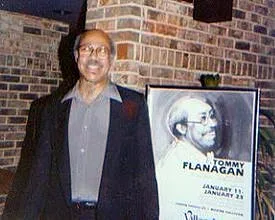
Jazz pianist Tommy Flanagan at the Village Jazz Lounge, Walt Disney World, Florida CC BY 2.0 — Wikimedia Commons (originally Flickr, photo by Laura Kolb): https://commons.wikimedia.org/wiki/File:Tommy_Flanagan.jpg

Thomas Lee Flanagan was born March 16, 1930, in Detroit's Conant Gardens neighborhood, the youngest of six children of Johnson Flanagan Sr., a postman, and Ida Mae Flanagan, a garment worker; both parents had come north from Georgia. He got a clarinet at six and switched to piano soon after, studying first with his older brother Johnson Jr. and then with the Detroit teacher Gladys Wade Dillard, who trained several of the city's future jazz pianists. Records by Art Tatum, Teddy Wilson, and Nat King Cole shaped his early ear, and once he heard Bud Powell he absorbed bebop's vocabulary directly into his playing. He graduated from Detroit's Northern High School already gigging around town.
Flanagan's professional life began around 1945, in a band led by trombonist Frank Rosolino, and by the late 1940s he was a fixture of Detroit's remarkably deep postwar scene, playing in tenor saxophonist Lucky Thompson's band alongside baritone saxophonist Pepper Adams and guitarist Kenny Burrell, and sitting in when Charlie Parker came through town. In 1949 he took his first regular chair at the Blue Bird Inn, the club that anchored the local scene alongside pianists Barry Harris and Hank Jones. The Army drafted him in 1951; he served through 1953, including a stretch in Korea as a motion-picture projectionist after auditioning successfully for an Army entertainment unit. Back in Detroit, he resumed at the Blue Bird until Barry Harris took over the house piano chair in 1954. In 1956, just before Flanagan and Burrell left for New York together, Savoy Records captured the scene's core players on Jazzmen: Detroit (Savoy MG-12083), a session pairing Flanagan and Burrell with Adams, bassist Paul Chambers, and drummer Kenny Clarke.
Flanagan and Burrell arrived in New York together in 1956 and roomed at Burrell's aunt's home in Harlem while they found their footing. The footing came fast: on March 16, 1956, his 26th birthday, Flanagan cut his only-ever studio session with Miles Davis, a Prestige date (later collected on Collectors' Items) that also featured Sonny Rollins; that June he was the pianist on Rollins's Saxophone Colossus, already regarded as a landmark; and that August he had his first stint accompanying Ella Fitzgerald, a booking of about a month that included the Newport Jazz Festival. From 1956 into 1958 he toured and recorded steadily with the J.J. Johnson Quintet, and it was on a European swing with that band that he cut his debut as a leader, Overseas (Prestige, recorded August 1957 in Stockholm with bassist Wilbur Little and drummer Elvin Jones).
The turn of the decade brought some of the most enduring sideman credits of his career. In May 1959 he played on John Coltrane's Giant Steps, memorably fumbling for a chorus on the harmonically brutal title track before recovering, a rare public stumble for a pianist critics otherwise called unflappable. In January 1960 he was the pianist on Wes Montgomery's The Incredible Jazz Guitar of Wes Montgomery. In 1961 he reunited with the Detroit crowd on Motor City Scene (Bethlehem), co-billed with Donald Byrd, Adams, Burrell, Chambers, and drummer Louis Hayes. He spent 1961 and 1962 touring and recording heavily with Coleman Hawkins, including a UK tour, and worked in a trio led by guitarist Jim Hall with bassist Percy Heath. A trio date from March 1959, cut for an unissued Blue Note session built entirely around West Side Story tunes, finally surfaced two decades later as Lonely Town (1979).
From 1962 to 1965, under an arrangement brokered by Norman Granz, Flanagan became Ella Fitzgerald's full-time accompanist, touring internationally including a 1964 trip to Japan. He stepped away in 1965 to work again briefly with Rollins and to join trumpeter Art Farmer's New York Jazz Sextet for the album Group Therapy, then spent part of 1966 accompanying Tony Bennett on the West Coast. In 1968 he returned to Fitzgerald, this time as pianist and musical director, a role he held for a decade, touring 40 to 45 weeks a year and playing his own trio sets within her concerts. He began recording as a leader again during this stretch, starting with Solo Piano (recorded 1974 in Zurich, later issued by Storyville) and The Tommy Flanagan Tokyo Recital (Pablo, recorded live in Tokyo February 15, 1975, with Keter Betts and Bobby Durham) - his first leader dates since the Overseas era.
A heart attack in 1978 prompted Flanagan to leave Fitzgerald's band and lead his own trio full-time for the rest of his career, and the recordings piled up: Eclypso and Montreux '77 (1977), Alone Too Long (1977), Our Delights (1978, a duo album with fellow Detroit pianist Hank Jones), Trinity (recorded 1976 with Ron Carter and Roy Haynes, issued 1980), and Tommy Flanagan Plays the Music of Harold Arlen (recorded 1978, released 1979). A single June 1983 session with Ron Carter and drummer Tony Williams - Flanagan's only recording with Williams - yielded two Japanese LPs, The Master Trio and Blues in the Closet. He paid tribute to his old Giant Steps colleague on Giant Steps (In Memory of John Coltrane) (Enja, 1982, with George Mraz and Al Foster) and to Thelonious Monk on Thelonica (Enja, 1983); both earned Grammy nominations, as did The Magnificent Tommy Flanagan (1981, with Mraz and Foster). His long-running trio anchored by Mraz gave way in the early 1990s to one with bassist Peter Washington, and in 1991 he closed the circle on Beyond the Blue Bird (Timeless), reuniting with Burrell to revisit the Detroit club where they'd both started. Later that year a collapse led to quadruple bypass heart surgery and, subsequently, treatment for an aneurysm; he kept touring and recording regardless, including Jazz Poet (1989, with Mraz and Kenny Washington) and, after his health scare, Sea Changes (1996) and the live Sunset and the Mockingbird (recorded at the Village Vanguard on his 67th birthday, March 16, 1997; released 1998 on Blue Note), both earning Grammy nominations for individual tracks. He won the Jazzpar Prize in 1993 and an NEA Jazz Masters fellowship in 1996, and toured Japan repeatedly with the all-star "100 Golden Fingers" piano troupe. In October 2001 he performed a Coltrane tribute at the San Francisco Jazz Festival; he was hospitalized soon after at Mount Sinai and died November 16, 2001, in New York, of complications from an aneurysm, at 71. A track from a posthumously released 2001 birthday concert, A Great Night in Harlem, earned him a further Grammy nomination in 2003.
Flanagan built his style on Art Tatum's harmonic richness, Teddy Wilson's clarity, and Bud Powell's bebop line, but his own voice was famously understated: swinging, harmonically sophisticated, melodically inventive, and laced with blues feeling and dry humor rather than pyrotechnics. "I like to play like a horn player, like I'm blowing into the piano," he said. "The sound of a piece - its overall tonality - is what concerns me." Critic Whitney Balliett noted his habit of stating a melody through "dissonant, levering chords played offbeat or staccato"; Leonard Feather praised his "subtle dynamic shadings" and "bursts of upsweeping chords"; and Stanley Crouch pointed to voice-like effects, "sighs, moans, swells, purrs," achieved through pedal control. He favored the songbooks of Duke Ellington, Thelonious Monk, Tadd Dameron, Benny Golson, and Thad Jones. Best known publicly as the most trusted accompanist of his generation, first to Ella Fitzgerald and briefly to Tony Bennett, he was equally in demand as a studio sideman on some of the era's defining records, and his rare on-record miscue on Coltrane's "Giant Steps" only underscored how reliable he otherwise was. Younger pianists including Kenny Barron (who called him his "hero"), Kirk Lightsey, Alan Broadbent, and Helen Sung cited him as a direct influence, and he remained a close contemporary and mutual influence of fellow Detroit pianists Barry Harris and Hank Jones throughout his career.
- Overseas (1957/1958, Prestige) - Flanagan's debut as a leader, a trio session cut in Stockholm with Wilbur Little and Elvin Jones while touring with the J.J. Johnson Quintet. Spotify - Overseas Listen
- Saxophone Colossus (1956, Prestige) - As a sideman: Sonny Rollins's landmark album, recorded within months of Flanagan's arrival in New York. Spotify - Saxophone Colossus
- Giant Steps (1960, Atlantic) - As a sideman: John Coltrane's harmonically forbidding classic, on which Flanagan's brief, well-documented struggle with the title track became jazz legend. Spotify - Giant Steps
- The Incredible Jazz Guitar of Wes Montgomery (1960, Riverside) - As a sideman: quartet date with Wes Montgomery, Percy Heath, and Albert Heath. Spotify - The Incredible Jazz Guitar
- Motor City Scene (1961, Bethlehem) - As a sideman/co-leader: a Detroit-scene reunion billed jointly to Donald Byrd, Pepper Adams, Kenny Burrell, Paul Chambers, and Louis Hayes.
- Giant Steps (In Memory of John Coltrane) (1982, Enja) - A trio tribute to his old colleague, with George Mraz and Al Foster, Grammy-nominated for Best Jazz Instrumental Performance, Soloist. Spotify - Giant Steps (In Memory Of John Coltrane) Listen
- Beyond the Blue Bird (1991, Timeless) - A trio reunion with Kenny Burrell named for the Detroit club where both men started out. Spotify - Beyond the Blue Bird Listen
- Sunset and the Mockingbird (1997/1998, Blue Note) - A live trio set recorded at the Village Vanguard on his 67th birthday, widely cited as a defining piano-trio recording. Spotify - Sunset and the Mockingbird Listen
Tommy Flanagan: Full Discography
Identity confirmed via the live Discogs API, artist ID 253443 ("Tommy Flanagan," realname Thomas Lee Flanagan, born/died dates and career profile matching). Discogs credits Flanagan on 1,317 total releases across a 45-year recording career. He is widely credited with more than three dozen albums as a leader and over 200 as a sideman, consistent with those figures once reissues, compilations, and duplicate pressings are accounted for. The table below itemizes the 18 leader/co-leader releases that could be most solidly confirmed (recording date, label, and where available personnel) and a representative set of his most historically significant sideman dates; it does not attempt to itemize either his full leader catalog or his 200+ sideman credits.
As Leader / Co-Leader
| Album Title | Recording Date(s) | Release Date | Label | Catalog Number | Format(s) | Personnel | Role | Reissue History | Spotify | Buy | Notes |
|---|---|---|---|---|---|---|---|---|---|---|---|
| Overseas | Recorded August 15-16, 1957, Metronome Studio, Stockholm | 1958 | Prestige | PRLP 7134 | Vinyl, LP, Album, Mono | Tommy Flanagan (piano), Wilbur Little (bass), Elvin Jones (drums) | Leader | Multiple CD reissues, including expanded "Complete Overseas Session" editions with bonus tracks | Spotify - Overseas | — | Recorded while Flanagan was touring Europe with the J.J. Johnson Quintet; his debut as a leader |
| The Cats | Recorded 1957, Van Gelder Studio, Hackensack, NJ (exact date not confirmed) | 1959 | New Jazz | NJLP 8217 | Vinyl, LP, Album, Mono | Idrees Sulieman (trumpet), John Coltrane (tenor sax), Kenny Burrell (guitar), Tommy Flanagan (piano), Doug Watkins (bass), Louis Hayes (drums) | Co-leader (shared billing) | Reissued on CD (Original Jazz Classics) | Not found on Spotify under this title | — | Shared-billing quintet date pairing Flanagan with Coltrane and Burrell |
| Lonely Town | Recorded March 10, 1959, NYC (unissued at the time) | 1979 | Blue Note (US); King Record Co. (Japan reissue, catalog GP 3186) | Not confirmed for original US pressing | Vinyl, LP, Album | Tommy Flanagan (piano), Joe Benjamin (bass), Elvin Jones (drums) | Leader | Japanese vinyl reissue (King/Blue Note, GP 3186) | Not found on Spotify under this title | — | All compositions drawn from Leonard Bernstein's West Side Story; shelved for two decades before release |
| Solo Piano | Recorded February 25-26, 1974, Zurich, Switzerland | Recording dated 1974; commercial release/reissue by Storyville sourced to the mid-2000s per the label's own catalog | Storyville | Not confirmed | CD, LP | Tommy Flanagan (solo piano) | Leader | None found | Not found on Spotify under this title | — | Recorded while Flanagan was Ella Fitzgerald's touring pianist; release-date sources conflict (some cite 1974, Storyville's product listing implies a later release), noted rather than guessed |
| The Tommy Flanagan Tokyo Recital | Recorded live February 15, 1975, Tokyo | 1975 | Pablo | 2310-724 | Vinyl, LP, Album, Stereo | Tommy Flanagan (piano), Keter Betts (bass), Bobby Durham (drums) | Leader | Reissued on CD as Original Jazz Classics OJCCD-737-2 (1992) | Not found on Spotify under this title | — | His first leader date since the Overseas era, cut during his years accompanying Ella Fitzgerald |
| Trinity | Recorded October 4 & 18 and November 10, 1976, CBS Studios, NYC | 1980 | Inner City | Not confirmed | Vinyl, LP, Album | Tommy Flanagan (piano), Ron Carter (bass), Roy Haynes (drums) | Leader | CD reissue exists; also circulated under the title Positive Intensity | Not found on Spotify under this title | — | Produced by Teo Macero; some sources give the recording year as 1975, but 1976 is the better-documented date |
| Tommy Flanagan Plays the Music of Harold Arlen | Recorded September 30 & October 2, 1978, SNS Productions, NYC | 1979 | Trio Records (Japan, original); reissued on DIW (Japan, CD) and Inner City (US, LP) | Not confirmed | Vinyl, LP; CD | Tommy Flanagan (piano), George Mraz (bass), Connie Kay (drums), Helen Merrill (vocals, one track) | Leader | Reissued on DIW (CD, Japan) and Inner City (LP, US) | Not found on Spotify under this title | — | Helen Merrill produced and guests on one track |
| Our Delights | Recording date not confirmed | 1978 | Galaxy | Not confirmed | Vinyl, LP | Tommy Flanagan and Hank Jones (piano duo) | Co-leader (duo with Hank Jones) | None found | Not found on Spotify under this title | — | Duo album pairing two Detroit-raised pianists |
| The Magnificent Tommy Flanagan | Recorded June 2-3, 1981 | 1981 | Progressive | Not confirmed | Vinyl, LP | Tommy Flanagan (piano), George Mraz (bass), Al Foster (drums) | Leader | None found | Spotify - The Magnificent Tommy Flanagan | — | Grammy-nominated, Best Jazz Instrumental Performance, Soloist (1983) |
| Giant Steps (In Memory of John Coltrane) | Recorded February 17-18, 1982, Eurosound, NYC | 1982 | Enja | 4022 | Vinyl, LP, Album, Stereo | Tommy Flanagan (piano), George Mraz (bass), Al Foster (drums) | Leader | None found | Spotify - Giant Steps (In Memory Of John Coltrane) | — | All-Coltrane-composition tribute program; Grammy-nominated, Best Jazz Performance, Group (1983) |
| Thelonica | Recording date not confirmed | 1983 | Enja | 4052 | Vinyl, LP, Album | Tommy Flanagan trio (personnel not fully confirmed) | Leader | None found | Not found on Spotify under this title | — | Program of Thelonious Monk compositions; Grammy-nominated, Best Jazz Instrumental Performance, Soloist (1985) |
| The Master Trio | Recorded June 16-17, 1983, A&R Recording Studio, NYC | 1983 | Baybridge (Japan) | KUX-183-B | Vinyl, LP, Album | Tommy Flanagan (piano), Ron Carter (bass), Tony Williams (drums) | Co-leader (trio) | Later combined with Blues in the Closet on a single CD reissue titled The Trio | Not found on Spotify under this title | — | Flanagan's only recording with Tony Williams |
| Blues in the Closet | Recorded June 16-17, 1983 (same session as The Master Trio), A&R Recording Studio, NYC | 1984 | Baybridge (Japan) | Not confirmed | Vinyl, LP, Album | Tommy Flanagan (piano), Ron Carter (bass), Tony Williams (drums) | Co-leader (trio) | Combined with The Master Trio on a later CD reissue titled The Trio | Not found on Spotify under this title | — | Second LP drawn from the same 1983 date as The Master Trio |
| Nights at the Vanguard | Recorded live October 18-19, 1986, Village Vanguard, NYC | 1987 | Uptown | Not confirmed | Vinyl, LP; CD | Tommy Flanagan (piano), George Mraz (bass), Al Foster (drums) | Leader | Reissued on CD | Not found on Spotify under this title | — | Engineered by Rudy Van Gelder |
| Jazz Poet | Recorded January 17 & 19, 1989, Van Gelder Studio, Englewood Cliffs, NJ | 1989 | Timeless | Not confirmed | Vinyl, LP; CD | Tommy Flanagan (piano), George Mraz (bass), Kenny Washington (drums) | Leader | None found | Not found on Spotify under this title | — | Produced by Wim Wigt, engineered by Rudy Van Gelder |
| Beyond the Blue Bird | Recorded April 29-30, 1990, Studio 44, Monster, Netherlands | 1991 | Timeless | CD SJP 350 | CD, Album | Tommy Flanagan (piano), Kenny Burrell (guitar), George Mraz (bass), Lewis Nash (drums) | Leader (Trio featuring Kenny Burrell) | None found | Spotify - Beyond the Blue Bird | — | Title refers to Detroit's Blue Bird Inn, where Flanagan and Burrell both started out in the late 1940s |
| Sea Changes | Recorded March 11-12, 1996, Clinton Recording Studios, NYC | 1996 (Japan, Alfa Jazz); 1997 (US, Evidence) | Alfa Jazz (Japan); Evidence (US) | Not confirmed | CD | Tommy Flanagan (piano), Peter Washington (bass), Lewis Nash (drums) | Leader | US reissue on Evidence Music (1997) | Not found on Spotify under this title | — | Includes five compositions revisited from Overseas (1957); Grammy-nominated for the track "Dear Old Stockholm," Best Jazz Instrumental Solo (1998) |
| Sunset and the Mockingbird: The Birthday Concert | Recorded live March 16, 1997, Village Vanguard, NYC (Flanagan's 67th birthday) | 1998 | Blue Note; Village Vanguard | CDP 7243 4 93155 2 5 | CD, Album | Tommy Flanagan (piano), Peter Washington (bass), Lewis Nash (drums) | Leader | None found | Spotify - Sunset and the Mockingbird | — | Widely cited as one of the defining piano-trio live recordings; a track from a separate 2001 birthday-concert release, A Great Night in Harlem, earned Flanagan a posthumous Grammy nomination in 2003 |
Additional leader/co-leader titles that are well documented in secondary sources but were not itemized above because recording dates, personnel, or catalog numbers could not be independently confirmed here: The Tommy Flanagan Trio (Moodsville, 1960), Eclypso (Enja, 1977), Montreux '77 (Pablo, 1977), Alone Too Long (Denon, 1977), Confirmation (1977-78), Something Borrowed, Something Blue (1978), Ballads & Blues (1978), The Super Jazz Trio (1978), Together (with Kenny Barron, 1978), The Standard (1980), and Flanagan's Shenanigans (Storyville, 1993).
As Sideman (selected major credits)
| Year | Project (Leader) | Title | Label | Catalog | Role | Notes |
|---|---|---|---|---|---|---|
| 1956 | Miles Davis | Collectors' Items | Prestige | 7108 | Piano | Recorded March 16, 1956 (Flanagan's 26th birthday) at Van Gelder Studio, with Sonny Rollins; Flanagan's only studio session with Davis |
| 1956 | Sonny Rollins | Saxophone Colossus | Prestige | 7079 | Piano | Recorded June 22, 1956 |
| 1956 | Kenny Burrell, Tommy Flanagan, Pepper Adams, Paul Chambers, Kenny Clarke | Jazzmen: Detroit | Savoy | MG-12083 | Piano | Detroit-scene document, cut just before Flanagan and Burrell left for New York |
| 1959 | John Coltrane | Giant Steps | Atlantic | 1311 | Piano | Recorded May 4-5, 1959; Flanagan's on-record difficulty with the title track's harmonic scheme is one of jazz's most-discussed recorded moments |
| 1960 | Wes Montgomery | The Incredible Jazz Guitar of Wes Montgomery | Riverside | RLP 12-320 | Piano | Recorded January 26 & 28, 1960 |
| 1961 | Donald Byrd / Pepper Adams / Kenny Burrell (co-billed) | Motor City Scene | Bethlehem | BCP 6056 | Piano | Co-billed Detroit-scene reunion; full session detail also appears in Pepper Adams's JazzProfiles.com discography |
| 1968 | Pepper Adams | Encounter! | Prestige | PR/PRST 7677 | Piano | Adams-Zoot Sims pairing, with Ron Carter and Elvin Jones completing the rhythm section |
| 1980 | Pepper Adams | The Master | Muse | MR 5213 | Piano | Adams quartet date, with George Mraz and Leroy Williams |
| 1983 | Ron Carter / Tony Williams (co-billed) | The Master Trio | Baybridge | KUX-183-B | Piano | Co-billed trio date; Flanagan's only recording with Tony Williams (also yielded Blues in the Closet from the same session) |
| 1985 | Pepper Adams / Frank Foster (co-billed) | The Adams Effect | Uptown | UP27.31 | Piano | Recorded the year before Adams's death, released posthumously in 1988 |
Flanagan's broader sideman work, spanning 1956 to 2001, also includes an extended run as Ella Fitzgerald's accompanist and musical director (1962-1965 and 1968-1978, across dozens of live and studio albums for Verve and Pablo among other labels), roughly ten albums with Coleman Hawkins including a UK tour (1961-1962), sessions with Harry "Sweets" Edison (1959-1960), a trio with guitarist Jim Hall and bassist Percy Heath, Art Farmer's New York Jazz Sextet album Group Therapy (1965), a brief period accompanying Tony Bennett (1966), and touring and recording with the J.J. Johnson Quintet (1956-1958), none of it itemized individually here.
- Ella Fitzgerald - full-time accompanist and musical director, 1962-1965 and 1968-1978, the role that made him jazz's most widely cited accompanist.
- Pepper Adams - Detroit contemporary from the late 1940s; together on Jazzmen: Detroit (1956) and Motor City Scene (1961), and Flanagan later appeared as a sideman on Adams's own leader dates Encounter! (1968), The Master (1980), and The Adams Effect (1985).
- Kenny Burrell - Detroit friend who moved to New York with Flanagan in 1956; reunited on Motor City Scene (1961) and Beyond the Blue Bird (1991).
- Barry Harris - Detroit contemporary who succeeded Flanagan as house pianist at the Blue Bird Inn in 1954 during Flanagan's Army service; the two remained lifelong peers in the same Detroit-piano lineage.
- Ron Carter - recorded together frequently from 1960 onward; co-starred on Trinity (1976) and, with Tony Williams, on The Master Trio and Blues in the Closet (both from a June 1983 session).
- George Mraz - Flanagan's primary trio bassist through most of the 1980s, on albums including The Magnificent Tommy Flanagan, Giant Steps (In Memory of John Coltrane), Nights at the Vanguard, and Jazz Poet.
- Wes Montgomery, Miles Davis, John Coltrane, Sonny Rollins, Coleman Hawkins, J.J. Johnson - among the many leaders Flanagan recorded with as an in-demand sideman across more than 200 sessions.
- Giancarlo Barigozzi (recording engineer) - credited as recording engineer on A Dream Comes True (Soul Note SN 1047, 1982), per Discogs.
More Bebop Artists
See all 166 Bebop artists →More American Jazz Artists
See all 567 American artists →- Wikipedia: Tommy Flanagan (musician)
- Discogs: Tommy Flanagan (artist 253443)
- AllMusic: Tommy Flanagan
- Wikipedia: Collectors' Items
- Wikipedia: Overseas (album)
- Wikipedia: Lonely Town (album)
- Wikipedia: Solo Piano (Tommy Flanagan album)
- Wikipedia: The Tommy Flanagan Tokyo Recital
- Wikipedia: Trinity (Tommy Flanagan album)
- Wikipedia: Tommy Flanagan Plays the Music of Harold Arlen
- Wikipedia: The Master Trio
- Wikipedia: Blues in the Closet (Tommy Flanagan album)
- Wikipedia: Giant Steps (Tommy Flanagan album)
- Wikipedia: Nights at the Vanguard
- Wikipedia: Beyond the Blue Bird
- Wikipedia: Sea Changes
- Wikipedia: Sunset and the Mockingbird