 JAZZPROFILES lives in the music 1,002 Jazz Artists fully Profiled!
 Benny Golson
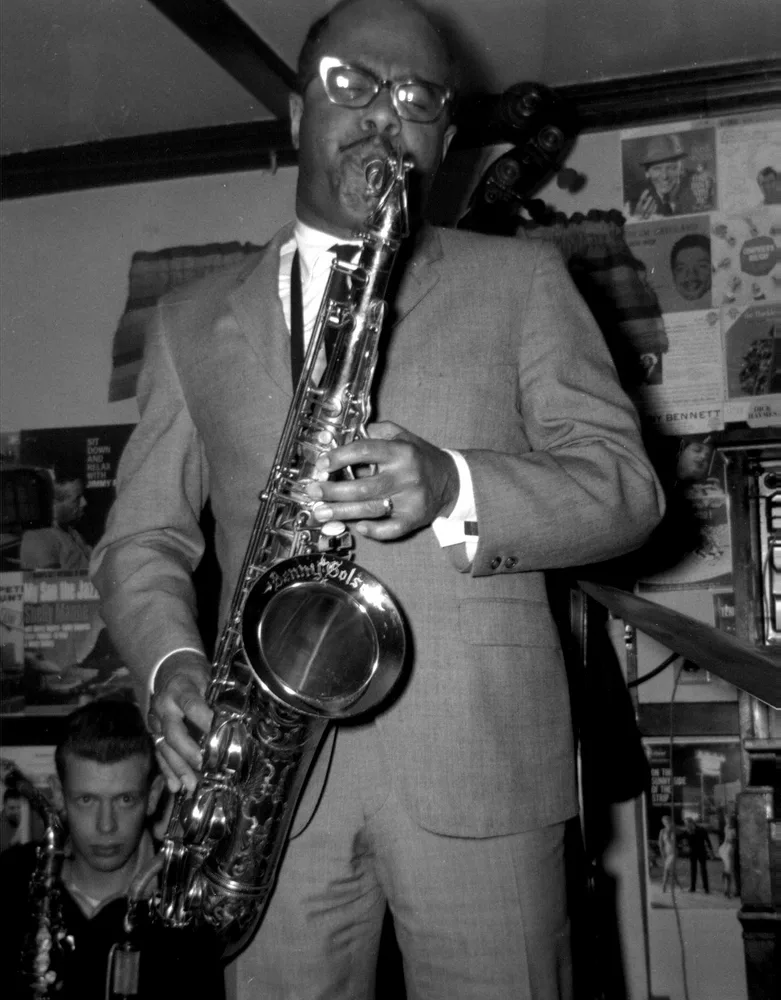
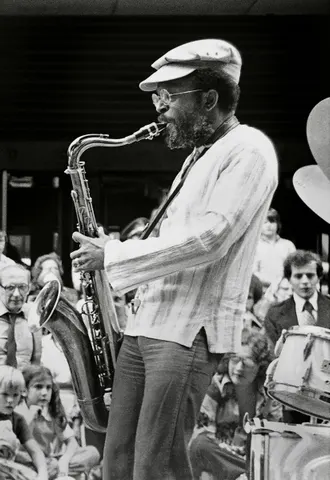
Benny Golson playing tenor saxophone with the Herb Pomeroy Big Band at Lennie's on the Turnpike, Peabody, Massachusetts, 1963. CC BY 4.0 — Wikimedia Commons, "File:Benny Golson, 1963.jpg" (https://commons.wikimedia.org/wiki/File:Benny_Golson,_1963.jpg), from the Lennie's on the Turnpike Collection, Salem State University Archives and Special Collections, via Flickr (https://www.flickr.com/photos/68317878@N04/6500252915/), reviewed and confirmed CC BY 4.0 by FlickreviewR 2.

Benny Golson was born in Philadelphia on January 25, 1929, the only child of Celadia Golson, who worked as a seamstress and a waitress, and Bennie Golson, who left the family before his son was old enough to know him. His mother started him on piano at nine and he first imagined a career as a classical concert pianist, drawn to Brahms and Chopin. An uncle who tended bar at Minton's Playhouse in Harlem took him to New York as a boy, where he heard the first generation of bebop players, Thelonious Monk among them. The decisive moment came at Philadelphia's Earle Theatre, where he watched Arnett Cobb take a tenor solo on "Flying Home" with Lionel Hampton's band; at fourteen he switched to saxophone. Benjamin Franklin High School put him in daily contact with an extraordinary group of contemporaries, including John Coltrane, Red Garland, Jimmy Heath, Percy Heath, Philly Joe Jones, Ray Bryant, and Red Rodney. He went on to Howard University, graduating in 1950.
His first professional work was with the singer and saxophonist Bull Moose Jackson's rhythm-and-blues band, whose pianist at the time was Tadd Dameron. Golson said for the rest of his life that Dameron was the single most important influence on his writing, and it was on Dameron's 1953 Prestige sessions, issued as A Study in Dameronia, that he made his recording debut, in a band that also carried the young trumpeter Clifford Brown. Over the next six years Golson passed through a remarkable sequence of employers: Dameron, Lionel Hampton, Johnny Hodges, and Earl Bostic, then Dizzy Gillespie's globe-trotting big band from 1956 to 1958, where his charts began to attract more notice than his playing. In 1958 he joined Art Blakey's Jazz Messengers as tenor saxophonist and, briefly, music director, recruiting Lee Morgan, Bobby Timmons, and Jymie Merritt into the band that recorded Moanin' for Blue Note on October 30, 1958. He stayed with Blakey barely a year, but the record he made there is one of the defining documents of hard bop, and two of its pieces, "Along Came Betty" and "Blues March," were his.
Composing is where his reach is widest. "Stablemates" reached record before Golson himself had led a session: Miles Davis's first great quintet cut it in November 1955 for the Prestige album Miles, with Coltrane, Red Garland, Paul Chambers, and Philly Joe Jones. In June 1956, while working with Hampton's band at the Apollo Theater in Harlem, Golson learned that Clifford Brown had been killed in a car crash on the Pennsylvania Turnpike at twenty-five. He wrote "I Remember Clifford" as a threnody for him, and it became one of the most recorded memorial pieces in jazz. "Whisper Not," "Along Came Betty," "Blues March," "Are You Real?" and "Killer Joe" all followed within a few years, and all became standards, played and recorded by musicians who never met him.
The leader dates began in October 1957 with Benny Golson's New York Scene for Contemporary, a quintet with Art Farmer, Wynton Kelly, Paul Chambers, and Charlie Persip, expanded to a nonet on three tracks. The Modern Touch followed that December for Riverside, with Kenny Dorham, J.J. Johnson, Kelly, Chambers, and Max Roach. Riverside's The Other Side of Benny Golson (November 1958) introduced the trombone-and-tenor front line with Curtis Fuller that Golson would return to for six decades, and a run of records for New Jazz followed: Groovin' with Golson, Gone with Golson, and Gettin' with It. In 1959 he and Art Farmer, who had been working together on and off since the early 1950s, formed the Jazztet, a sextet designed around three horns and closely written arrangements. Its debut, Meet the Jazztet, was recorded for Argo in February 1960 with Curtis Fuller on trombone, McCoy Tyner on piano, Addison Farmer on bass, and Lex Humphries on drums, and it carried the first recording of "Killer Joe." The band went through several lineups over the next two years, taking in Cedar Walton, Tom McIntosh, Albert Heath, Harold Mabern, and Grachan Moncur III, before Golson and Farmer wound it up in 1962 rather than keep paying for the rehearsal time the writing demanded.
What followed was the longest gap in his playing career. Golson moved into arranging and studio work, spent time in Europe, and recorded Stockholm Sojourn in 1964 with a Swedish and expatriate orchestra he conducted rather than played in. He then settled in Hollywood for roughly a decade of composing and arranging for television and film, supplying music for Mannix, Ironside, Room 222, The Partridge Family, M*A*S*H, and Mission: Impossible, and writing and conducting five arrangements for Eric Burdon's 1967 album Eric Is Here. He did not touch the saxophone seriously for years.
He came back in the mid-1970s, first with the Columbia album Killer Joe in 1977, a slick, funk-inflected production that reads now as a transitional record, and then with a run of acoustic dates for the Japanese Baystate label: California Message with Curtis Fuller in 1980, Time Speaks in 1982 with Freddie Hubbard and Woody Shaw, and This Is for You, John, a Coltrane tribute recorded in 1983 with Pharoah Sanders, Cedar Walton, Ron Carter, and Jack DeJohnette. He and Farmer revived the Jazztet in 1982, with Fuller back in the trombone chair, and recorded Moment to Moment for Soul Note in Milan in 1983 and the live Real Time at Sweet Basil in 1986. From there he worked steadily for another thirty years: I Remember Miles in 1992, That's Funky with Nat Adderley in 1995, Tenor Legacy in 1996, One Day, Forever in 2001, Terminal 1 in 2004, New Time, New 'Tet in 2008, and Horizon Ahead for HighNote in 2016, at eighty-seven. He was a subject of Art Kane's 1958 group photograph A Great Day in Harlem and the object of the plot of Steven Spielberg's 2004 film The Terminal, in which Tom Hanks's character has crossed the Atlantic for the one autograph from that photograph he lacks; Golson appears in the film as himself. He was named an NEA Jazz Master in 1996, received an honorary doctorate from Berklee College of Music in 1999, and was given the Grammy Trustees Award in 2021. He passed away at his home in Manhattan on September 21, 2024, following a short illness, at the age of 95.
Golson's early tenor sound was described as fibrous and slightly hoarse, built on the big-toned mainstream-modern line that ran through Coleman Hawkins, Don Byas, Lucky Thompson, and Arnett Cobb, the last of whom pushed him toward the instrument in the first place. During the 1960s he absorbed a good deal of John Coltrane's harmonic and rhythmic vocabulary, and when he resumed playing in the mid-1970s after more than a decade away, the change was audible enough that AllMusic's Scott Yanow heard less of the swing-era Don Byas in him and more of Archie Shepp: a rougher, more vocalized attack over the same architecture. But his largest claim is as a writer. He composed melodies that stand up without their harmony and harmony that rewards a soloist, and he built bridges (the release of "Along Came Betty," the descending line of "I Remember Clifford") that other players learned as set pieces. Six of his tunes entered the standard repertoire, which is more than almost any postwar jazz composer managed, and reference works routinely name him as one of the most significant contributors to the formation of hard bop. His arranging instincts, honed in Gillespie's big band and in the Jazztet's three-horn writing, are the other constant: even his small-group records are voiced, not just blown.
- Moanin' (1959, Blue Note), with Art Blakey and the Jazz Messengers - Recorded October 1958 with Golson as tenor saxophonist and music director; he assembled the band and contributed "Along Came Betty" and "Blues March" to what became one of hard bop's founding albums. Spotify - Album
- Meet the Jazztet (1960, Argo), co-led with Art Farmer - The sextet's debut and the first recording of "Killer Joe," with Curtis Fuller, McCoy Tyner, Addison Farmer, and Lex Humphries. Spotify - Album Listen
- Benny Golson's New York Scene (1958, Contemporary) - His first album as a leader, cut in October 1957, alternating a quintet with Art Farmer and a nonet carrying Gigi Gryce, Julius Watkins, and Jimmy Cleveland. Spotify - Album Listen
- The Modern Touch (1958, Riverside) - A December 1957 sextet date with Kenny Dorham, J.J. Johnson, Wynton Kelly, Paul Chambers, and Max Roach, and one of the earliest recordings of "Blues March." Spotify - Album Listen
- Gone with Golson (1959, New Jazz) - The quintet with Curtis Fuller and Ray Bryant, recorded in Hackensack in June 1959, and the most relaxed of his three New Jazz dates. Spotify - Album Listen
- Big City Sounds (1961, Argo) - The Jazztet's second Argo album, with Cedar Walton and Tom McIntosh in the band, recorded in September 1960. Spotify - Album Listen
- Time Speaks (1983, Baystate) - A memorial to Clifford Brown recorded in December 1982 with Freddie Hubbard and Woody Shaw on trumpets and Kenny Barron at the piano, and the record that announced his second career in earnest. Spotify - Album Listen
- Terminal 1 (2004, Concord Jazz) - A late quintet date with Eddie Henderson, Mike LeDonne, Buster Williams, and Carl Allen, revisiting "Killer Joe" and "Blues March," released alongside his screen appearance in The Terminal. Spotify - Album Listen
- Horizon Ahead (2016, HighNote) - His last studio album as a leader, made at eighty-seven with the working trio of Mike LeDonne, Buster Williams, and Carl Allen. Spotify - Album Listen
Benny Golson: Full Discography
Identity confirmed via the live Discogs API: artist ID 185752 (realname "Bennie Golson," born January 25, 1929 in Philadelphia, died September 21, 2024 in Manhattan), matching Wikipedia, AllMusic, Wikidata and the National Endowment for the Arts. Discogs credits that entry with 2,482 releases across 25 pages of its artist-releases endpoint, spanning leader dates from 1957 to 2016, several hundred sideman appearances, film and television work, and a very large downstream reissue, compilation and various-artists history. This file therefore curates rather than itemizes: it lists Golson's principal leader and co-leader albums, including the Jazztet records he co-led with Art Farmer, plus a representative set of his most historically significant sideman and composer credits. Every row below was checked against the individual Discogs release record, not the coarse artist-releases listing, and cells that could not be confirmed say so rather than guessing.
Golson's compositions were recorded far more often than he was: "I Remember Clifford," "Killer Joe," "Whisper Not," "Along Came Betty," "Blues March" and "Stablemates" have each been cut by hundreds of other bands, and none of those third-party recordings are listed here.
As Leader / Co-Leader
| Album Title | Recording Date(s) | Release Date | Label | Catalog Number | Format(s) | Personnel | Role | Reissue History | Spotify | Buy | Notes |
|---|---|---|---|---|---|---|---|---|---|---|---|
| Benny Golson's New York Scene | October 14 and 17, 1957, New York | 1958 | Contemporary | C 3552 | Vinyl, LP | Benny Golson (tenor saxophone), Art Farmer (trumpet), Wynton Kelly (piano), Paul Chambers (bass), Charlie Persip (drums); Gigi Gryce (alto saxophone), Sahib Shihab (baritone saxophone), Julius Watkins (French horn) and Jimmy Cleveland (trombone) added on three tracks | Leader | Boplicity LP (1989); Original Jazz Classics CD OJC20 164-2; several Japanese Contemporary CD editions | Spotify | — | His first album as a leader, alternating a quintet with a nonet; supervised by Nat Hentoff |
| The Modern Touch | December 19 and 23, 1957, New York | 1958 | Riverside | RLP 12-256 | Vinyl, LP | Benny Golson (tenor saxophone), Kenny Dorham (trumpet), J.J. Johnson (trombone), Wynton Kelly (piano), Paul Chambers (bass), Max Roach (drums) | Leader | Milestone LP (1974); Original Jazz Classics CD OJCCD-1797-2 (1992) | Spotify | — | Billed as the Benny Golson Sextet; produced by Orrin Keepnews |
| The Other Side of Benny Golson | November 12, 1958, Nola Studios, New York | 1959 | Riverside | RLP 12-290 | Vinyl, LP | Benny Golson (tenor saxophone), Curtis Fuller (trombone), Barry Harris (piano), Jymie Merritt (bass), Philly Joe Jones (drums) | Leader | Original Jazz Classics LP OJC-1750 and CD OJCCD-1750-2 (1990); Jazz Workshop LP JW-072 (2016) | Spotify | — | The first record built on the Golson/Fuller front line he returned to for the next thirty years |
| Benny Golson and the Philadelphians | November 17, 1958, Nola's Penthouse, New York; December 12, 1958, Paris | 1959 | United Artists | UAL 4020 (mono), UAS 5020 (stereo) | Vinyl, LP | New York session: Benny Golson (tenor saxophone), Lee Morgan (trumpet), Ray Bryant (piano), Percy Heath (bass), Philly Joe Jones (drums). Paris session: Roger Guérin (trumpet), Bobby Timmons (piano), Pierre Michelot (bass), Christian Garros (drums) | Leader | London Records LP and EP (1959-60); United Artists Japan LAX-3119 (1976); Blue Note CD 7243 4 94104 2 8 (1998) | Spotify | — | The original LP is the New York date; the 1998 Blue Note CD couples it with four Paris sides cut a month later |
| Groovin' with Golson | 1959, Van Gelder Studio, Englewood Cliffs, New Jersey (exact session date not listed on Discogs) | 1959 | New Jazz | NJLP 8220 | Vinyl, LP | Benny Golson (tenor saxophone), Curtis Fuller (trombone), Ray Bryant (piano), Paul Chambers (bass), Art Blakey (drums) | Leader | Metronome EP (Sweden, c. 1960); Original Jazz Classics OJCCD-226-2; Prestige Japan CD UCCO-5107 (2007) | Spotify | — | Art Blakey's only appearance on a Golson leader date, cut the year Golson left the Jazz Messengers |
| Gone with Golson | June 20, 1959, Hackensack, New Jersey | 1959 | New Jazz | NJLP 8235 | Vinyl, LP | Benny Golson (tenor saxophone), Curtis Fuller (trombone), Ray Bryant (piano), Tommy Bryant (bass), Al Harewood (drums) | Leader | Esquire LP 32-125 (UK, 1961); Prestige Japan SMJ-6606 (1979); Concord digital reissue (2009) | Spotify | — | The most relaxed of the three New Jazz quintet dates |
| Gettin' with It | December 23, 1959, Englewood Cliffs, New Jersey | 1960 | New Jazz | NJLP 8248 | Vinyl, LP | Benny Golson (tenor saxophone), Curtis Fuller (trombone), Tommy Flanagan (piano), Doug Watkins (bass), Art Taylor (drums) | Leader | Top Rank International MJ-7030 (1961); Original Jazz Classics CD OJCCD-1873-2 (1995) | Spotify | — | Recorded at Van Gelder's Englewood Cliffs studio three months before the Jazztet's first session |
| Meet the Jazztet | February 6, 9 and 10, 1960, Nola Studios, New York | 1960 | Argo | LP 664 (mono), LPS-664 (stereo) | Vinyl, LP | Art Farmer (trumpet), Benny Golson (tenor saxophone), Curtis Fuller (trombone), McCoy Tyner (piano), Addison Farmer (bass), Lex Humphries (drums) | Co-leader | Chess LP and cassette CH/CHC-91550 (1984); many CD editions, including a Japanese Argo Cadet series | Spotify | — | The Jazztet's debut and the first recording of "Killer Joe"; McCoy Tyner's earliest major studio credit, cut before he joined Coltrane |
| Big City Sounds | September 16, 19 and 20, 1960, Nola Recording Studio, New York | 1961 | Argo | LP 672, LPS-672 | Vinyl, LP | Art Farmer (trumpet), Benny Golson (tenor saxophone), Tom McIntosh (trombone), Cedar Walton (piano), Tommy Williams (bass), Albert Heath (drums) | Co-leader | Baybridge Japan LP (1983); Fresh Sound CD FSR 1653 (2011) | Spotify | — | The Jazztet's second Argo album, with a wholly new rhythm section |
| The Jazztet and John Lewis | December 20 and 21, 1960 and January 9, 1961, Nola Studios, New York | 1961 | Argo | LP 684 | Vinyl, LP | Art Farmer (trumpet), Benny Golson (tenor saxophone), Tom McIntosh (trombone), Cedar Walton (piano), Tommy Williams (bass), Albert Heath (drums); John Lewis (composer, conductor) | Co-leader | Barclay LP 84097 (France, 1965); Argo Japan SMJ-7073 (1967); Japanese CD UCCU-9749 (2011) | Spotify | — | An entire program of John Lewis compositions, conducted by Lewis, who does not play |
| Take a Number from 1 to 10 | December 13 and 14, 1960 and April 11, 1961, Nola's Penthouse Sound Studio, New York | 1961 | Argo | LP 681 | Vinyl, LP | Not listed in the Discogs credit block; the record is structured so that each successive track adds one musician, opening with unaccompanied tenor saxophone and closing with a ten-piece | Leader | Cadet CA 681; Argo Japan SMJ-7066; Hallmark CD 712422 (2012) | Spotify | — | A concept record whose personnel is documented on the sleeve rather than in Discogs' credit data |
| Here and Now | February 28 and March 2, 1962, Nola Studios, New York | 1962 | Mercury | MG 20698 (mono), SR 60698 (stereo) | Vinyl, LP | Art Farmer (trumpet, flugelhorn), Benny Golson (tenor saxophone), Grachan Moncur III (trombone), Harold Mabern (piano), Herbie Lewis (bass), Roy McCurdy (drums) | Co-leader | Verve Elite Edition CD 314 558 052-2 (1998) | Spotify | — | Farmer plays flugelhorn on all but two tracks, per the release's own track-level credits |
| Another Git Together | 1962 (session dates not listed on Discogs) | 1962 | Mercury | MG-20737 (mono), SR-60737 (stereo) | Vinyl, LP | Art Farmer (trumpet, flugelhorn), Benny Golson (tenor saxophone), Grachan Moncur III (trombone), Harold Mabern (piano), Herbie Lewis (bass), Roy McCurdy (drums) | Co-leader | EmArcy Modern Jazz Collection Japan 15PJ-21 (1979) | Spotify | — | The Jazztet's last album before Golson and Farmer wound the band up |
| Free | December 26, 1962, Van Gelder Studio, Englewood Cliffs, New Jersey | 1963 | Argo | LP-716 | Vinyl, LP | Benny Golson (tenor saxophone), Tommy Flanagan (piano), Ron Carter (bass), Art Taylor (drums) | Leader | Chess/GRP CD GRD-816 (1998) | Spotify | — | Billed as the Benny Golson Quartet; his first pianoless-front-line record, with no second horn |
| Turning Point | Not listed on Discogs | 1963 | Mercury | SR 60801 | Vinyl, LP | Benny Golson (tenor saxophone), Wynton Kelly (piano), Paul Chambers (bass), Jimmy Cobb (drums) | Leader | Mercury Japan LP EXPR-1021 (1982); Jazz-Club CD EJD-3044 (1989) | Spotify | — | Cut with the working Miles Davis rhythm section of the period |
| Stockholm Sojourn | Recorded in Stockholm; exact dates not listed on Discogs | 1965 | Prestige | PR 7361 (mono), PRST 7361 (stereo) | Vinyl, LP | The International Jazz Orchestra directed by Benny Golson, with soloists Benny Bailey, Bosse Broberg and Bengt-Arne Wallin (trumpets, flugelhorn), Eje Thelin and Grachan Moncur III (trombones), Cecil Payne and Rune Falk (baritone saxophones), Roman Dylag (bass) | Arranger, conductor | Stateside SL 10150 (1965); Original Jazz Classics CD OJCCD-1894-2 (1997) | Spotify | — | Golson arranges and conducts; the credit block does not list him as a player |
| Killer Joe | 1976-77, Los Angeles (session dates not listed on Discogs) | April 1977 | Columbia | PC 34678 | Vinyl, LP | Large studio orchestra with strings; Ernie Watts (alto saxophone), Stanley Clarke, Michael Foreman and Scott Edwards (bass), Ray Parker Jr., Bobby Eli and Dennis Harris (guitars), Benny Golson and Bobby Lyle (Fender Rhodes), Frank Rosolino and Britt Woodman (trombones) | Leader, arranger | Vocalion CD CDSML 8521 (2017) | Spotify | — | His commercially-oriented return to record after a decade in television; the Discogs credit block lists Golson on Fender Rhodes and does not itemize his saxophone playing |
| California Message | October 20, 21 and 22, 1980, Maui Music Studios, Los Angeles | 1981 | Baystate | RJL-8013 | Vinyl, LP | Benny Golson (tenor and soprano saxophones, all compositions and arrangements), Curtis Fuller and Thurman Green (trombones), Oscar Brashear (trumpet), Bill Mays (piano), Bob Magnusson (bass), Roy McCurdy (drums) | Leader | Timeless CD CDSJP 177; Jugoton LP (1984); Solid Records CD CDSOL-46790 (2021) | Spotify | — | Reunites Golson with Curtis Fuller after twenty years apart |
| Time Speaks | December 7 and 8, 1982 | 1983 | Baystate | RJL-8054 | Vinyl, LP | Benny Golson (tenor saxophone), Freddie Hubbard and Woody Shaw (trumpets), Kenny Barron (piano), Cecil McBee (bass), Ben Riley (drums) | Leader | Baystate/RCA CD R32J-1058 (1987); Timeless/Ultra-Vybe CD UVJZ-20121 (2020) | Spotify | — | Subtitled "Dedicated to the Memory of Clifford Brown," twenty-six years after "I Remember Clifford" |
| Moment to Moment | May 30 and 31, 1983, Barigozzi Studio, Milan | 1983 | Soul Note | SN 1066 | Vinyl, LP | Art Farmer (flugelhorn), Benny Golson (tenor saxophone), Curtis Fuller (trombone), Mickey Tucker (piano), Ray Drummond (bass), Albert Heath (drums) | Co-leader | Soul Note CD SN-1066CD (1983) and 121066-2 | Spotify | — | The revived Jazztet's first studio album, cut in Italy |
| This Is for You, John | 1983 (session dates not listed on Discogs) | 1984 | Baystate | RJL-8092 | Vinyl, LP | Benny Golson and Pharoah Sanders (tenor saxophones), Cedar Walton (piano), Ron Carter (bass), Jack DeJohnette (drums) | Leader | Timeless Jazz Legacy CD TJL 74510 (2010); Music On Vinyl LP MOVLP3165 (2022) | Spotify | — | A tribute to John Coltrane, Golson's Philadelphia schoolmate |
| Real Time | February 21 and 22, 1986, Sweet Basil, New York | 1988 | Contemporary | C-14034 | Vinyl, LP | Art Farmer (flugelhorn), Benny Golson (tenor saxophone, arrangements), Curtis Fuller (trombone), Mickey Tucker (piano), Ray Drummond (bass), Marvin "Smitty" Smith (drums) | Co-leader | Contemporary CD CCD-14034-2 and cassette (1988) | Spotify | — | The reformed Jazztet live in a New York club |
| Stardust | June 22 and 23, 1987, Clinton Studio, New York | 1987 | Denon | CY-1838, 33CY-1838 EX | CD | Benny Golson (tenor saxophone), Freddie Hubbard (trumpet, flugelhorn), Mulgrew Miller (piano), Ron Carter (bass), Marvin "Smitty" Smith (drums) | Co-leader | Denon CD COCY-7105 (1991); Denon LP YF-7142-ND | — | — | Co-billed with Freddie Hubbard; Spotify's catalogue carries this session under a different title and no confident album match is asserted |
| I Remember Miles | October 5 and 6, 1992, Clinton Studio, New York | 1993 | Alfa Jazz | ALCR-277 | CD | Benny Golson (tenor saxophone, arrangements), Eddie Henderson (trumpet), Curtis Fuller (trombone), Mulgrew Miller (piano), Ray Drummond (bass), Tony Reedus (drums) | Leader | Evidence CD ECD 22141-2 (1996) | — | — | A program of material associated with Miles Davis, recorded the year after Davis's death |
| That's Funky | 1995 (session dates not listed on Discogs) | 1995 | Meldac Jazz | MECJ-30001 | CD | Benny Golson (tenor saxophone), Nat Adderley (trumpet), Monty Alexander (piano), Ray Drummond (bass), Marvin "Smitty" Smith (drums) | Leader | Arkadia Jazz CD 70743 (2000) | — | — | Billed as the Benny Golson Funky Quintet |
| Tenor Legacy | 1996 (session dates not listed on Discogs) | 1996 | Key'stone | VACY-3007 | CD | Benny Golson with Harold Ashby, James Carter and Branford Marsalis (tenor saxophones), Geoff Keezer (piano), Dwayne Burno (bass), Joe Farnsworth (drums) | Leader | Arkadia Jazz CD 70742 (1998); Arkadia LP 71902 (2024) | Spotify | — | A multi-generation tenor summit, with each guest on a different set of tracks |
| One Day, Forever | November 6, 1996 (Sandhausen, Germany); September 22, 1999 (Avatar Studios, New York); October 11, 2000 (Patrych Recording, New York) | 2001 | Arkadia Jazz | 70744 | CD | Benny Golson (tenor saxophone, all compositions and arrangements, string conducting), Art Farmer (trumpet), Curtis Fuller (trombone), Geoff Keezer or Mulgrew Miller (piano), Dwayne Burno or Ron Carter (bass), Joe Farnsworth or Carl Allen (drums), Shirley Horn (vocals on two tracks) with a string section | Leader | Arkadia CDr repress (2001) | Spotify | — | Assembled from three sessions four years apart; one of Art Farmer's last recordings with Golson |
| Terminal 1 | 2004 (session dates not listed on Discogs) | 2004 | Concord Jazz | CCD-2259-2 | CD | Benny Golson (saxophone), Eddie Henderson (trumpet, flugelhorn), Mike LeDonne (piano), Buster Williams (bass), Carl Allen (drums) | Leader | Victor Japan CD VICJ-61246 (2004) | Spotify | — | Released alongside Golson's appearance as himself in the film The Terminal |
| New Time, New 'Tet | 2008 (session dates not listed on Discogs) | January 2009 | Concord Jazz | CJA-31121-02 | CD | Benny Golson (saxophone, producer), Eddie Henderson (trumpet, flugelhorn), Steve Davis (trombone), Mike LeDonne (piano), Buster Williams (bass), Carl Allen (drums), Al Jarreau (vocals on one track) | Leader, producer | Concord promo CDr (2008) | Spotify | — | A sextet explicitly modelled on the Jazztet's three-horn front line |
| Horizon Ahead | 2016 (session dates not listed on Discogs) | 2016 | HighNote | HCD 7288 | CD | Benny Golson (tenor saxophone), Mike LeDonne (piano), Buster Williams (bass), Carl Allen (drums) | Leader | HighNote promo CDr (2016) | Spotify | — | His last studio album as a leader, made at eighty-seven |
As Sideman (selected major credits)
| Year | Project (Leader) | Title | Label | Catalog | Role | Notes |
|---|---|---|---|---|---|---|
| 1953 | Tadd Dameron and His Orchestra | Study in Dameronia | Prestige | PRLP 159 | Tenor saxophone | Recorded in New York on June 11, 1953: Golson's recording debut, in a band with Clifford Brown and Idrees Sulieman on trumpets, Gigi Gryce on alto and Percy Heath and Philly Joe Jones in the rhythm section |
| 1956 | The New Miles Davis Quintet (Miles Davis) | Miles | Prestige | PRLP 7014 | Composer ("Stablemates") | Golson does not play; the first Davis quintet, with John Coltrane, Red Garland, Paul Chambers and Philly Joe Jones, gave one of his tunes its first recording |
| 1957 | Lee Morgan | Vol. 3 | Blue Note | BLP 1557 | Tenor saxophone, composer, arranger | Recorded March 24, 1957; Golson wrote and arranged the whole program, with Gigi Gryce, Wynton Kelly, Paul Chambers and Charlie Persip |
| 1957 | Sahib Shihab | Jazz Sahib | Savoy | MG 12124 | Tenor saxophone | With Phil Woods, Bill Evans, Hank Jones, Oscar Pettiford and Art Taylor |
| 1957 | Dizzy Gillespie | At Newport | Verve | MGV-8242 | Tenor saxophone | In the Gillespie big band's saxophone section alongside Billy Mitchell, Ernie Henry and Pee Wee Moore, with Lee Morgan and Melba Liston in the brass |
| 1958 | Oscar Pettiford Orchestra | Oscar Pettiford Orchestra in Hi-Fi, Volume Two | ABC-Paramount | ABC-227 | Tenor saxophone, arranger | A nine-piece with Art Farmer, Kenny Dorham, Julius Watkins, Gigi Gryce and David Amram |
| 1958 | Art Farmer | Modern Art | United Artists | UAL-4007 | Tenor saxophone | A quintet with Bill Evans on piano, Addison Farmer on bass and Dave Bailey on drums |
| 1958 | Art Blakey & the Jazz Messengers | Moanin' | Blue Note | BLP 4003 | Tenor saxophone, music director, composer | Recorded October 30, 1958, with Lee Morgan, Bobby Timmons and Jymie Merritt; Golson assembled the band and wrote "Along Came Betty" and "Blues March" |
| 1959 | Milt Jackson | Bags' Opus | United Artists | UAL 4022 | Tenor saxophone, arranger | Sextet with Art Farmer, Tommy Flanagan, Paul Chambers and Connie Kay |
| 1959 | Curtis Fuller's Quintet | Blues-ette | Savoy | MG 12141 | Tenor saxophone | Recorded May 21, 1959 with Tommy Flanagan, Jimmy Garrison and Al Harewood; one of the most durable hard bop quintet records of the period |
| 1959 | The Curtis Fuller Sextet | Sliding Easy | United Artists | UAL 4041 | Arranger | Golson arranges but does not play: the tenor chair is Hank Mobley's, with Lee Morgan, Tommy Flanagan, Paul Chambers and Elvin Jones |
| 1959 | Philly Joe Jones Big Band Sounds | Drums Around the World | Riverside | RLP 12-302 | Tenor saxophone | Recorded in New York in May 1959; the release's own credits restrict Golson to four of the album's tracks, in a band with Cannonball Adderley, Lee Morgan, Blue Mitchell, Curtis Fuller and Herbie Mann |
| 1959 | Quincy Jones | The Birth of a Band | Mercury | MG 20444 | Saxophone | A big band with Clark Terry, Frank Wess, Phil Woods, Zoot Sims, Sahib Shihab and Melba Liston |
| 1960 | Charles Mingus | Mingus Dynasty | Columbia | CL 1440 | Reeds | Recorded in 1959. Golson is credited in the reed section on the album's reissue credit block, alongside Booker Ervin, John Handy and Jerome Richardson; the original 1960 mono LP's Discogs entry lists no players at all |
| 1963 | The Roland Kirk Quartet | The Roland Kirk Quartet Meets the Benny Golson Orchestra | Mercury | SR 60844 | Arranger, conductor, composer | Golson writes and directs the orchestra behind Roland Kirk's working quartet of Harold Mabern, Sam Jones or Richard Davis, and Albert Heath |
Golson's Discogs artist-releases listing carries several hundred further entries that are not itemized here: European and Japanese live recordings from the Jazz Messengers' 1958-59 tours, festival and radio broadcasts, big-band and vocal-accompaniment dates from the late 1950s, television and film score credits from his Hollywood decade, guest appearances on other leaders' records from the 1990s onward, and a very large number of compilations and various-artists sets that reuse the same masters. A substantial share of those entries are also composer credits rather than playing credits, since his tunes are recorded constantly by musicians he never worked with, and several of them were checked individually for this reason and excluded.
- Art Farmer - trumpeter and flugelhornist, co-leader of the Jazztet from its founding in 1959 to its dissolution in 1962 and again from its 1982 revival onward, and the collaborator most closely identified with Golson's writing.
- Art Blakey - drummer and bandleader whose Jazz Messengers Golson joined in 1958 as tenor saxophonist and music director, recruiting the Moanin' lineup before leaving the following year.
- Curtis Fuller - trombonist, in Golson's bands from The Other Side of Benny Golson (1958) through the New Jazz quintet dates, the revived Jazztet, and I Remember Miles (1992): a working relationship spanning more than three decades.
- Tadd Dameron - pianist, composer, and arranger, Golson's employer in the early 1950s and, by Golson's own repeated account, the formative influence on his writing.
- Dizzy Gillespie - bandleader whose big band carried Golson from 1956 to 1958 as tenor saxophonist and staff arranger, the period in which most of his standards were written.
- Lee Morgan - trumpeter, a fellow Philadelphian and Gillespie big-band alumnus whom Golson brought into the Jazz Messengers, and who recorded Golson's charts on his own Vol. 3 (1957).
- McCoy Tyner - pianist in the original Jazztet, on Meet the Jazztet (1960), before joining Coltrane's quartet.
- Clifford Brown - trumpeter and bandmate in Tadd Dameron's group, whose death in June 1956 prompted "I Remember Clifford" and, twenty-six years later, the memorial album Time Speaks.
- Freddie Hubbard - trumpeter on Time Speaks (1982) and co-billed on the 1987 Denon album Stardust.
- Eddie Henderson - trumpeter on I Remember Miles (1992), Terminal 1 (2004), and New Time, New 'Tet (2008).
- Mike LeDonne, Buster Williams, and Carl Allen - the rhythm section on Golson's last three studio albums as a leader, from Terminal 1 (2004) to Horizon Ahead (2016).
- Milt Jackson - vibraphonist whose Bags' Opus (1959) Golson both played on and arranged.
- Quincy Jones - bandleader and arranger whose The Birth of a Band (1959) carried Golson in the saxophone section.