 JAZZPROFILES lives in the music 1,572 Jazz Artists fully Profiled!
 Ron Carter
Last updated September 26, 2026
Listen on Spotify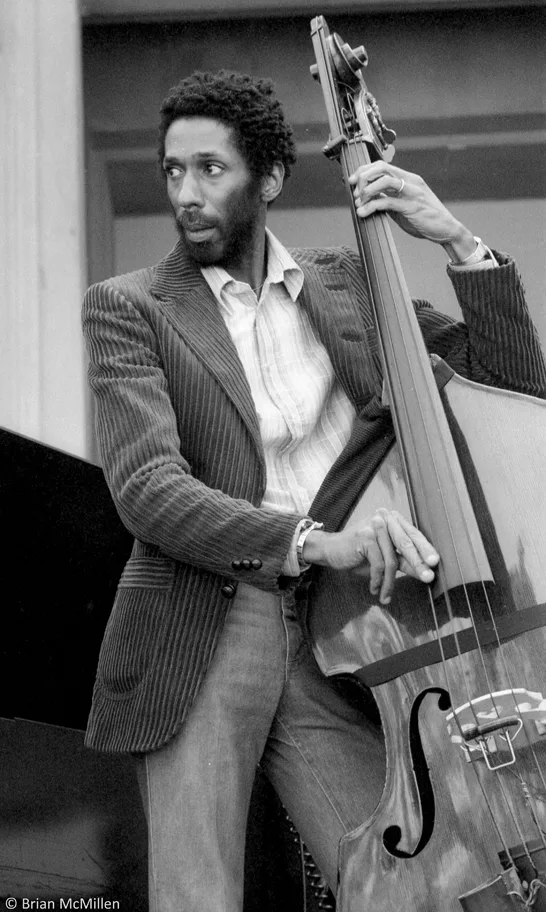
Ron Carter at UC Berkeley Jazz Festival, 5/25/80. Photo by Brian McMillen CC BY-SA 4.0 — Wikimedia Commons — https://commons.wikimedia.org/wiki/File:Ron_Carter_Berkeley1.jpg

Ronald Levin Carter was born May 4, 1937, in Ferndale, Michigan, and started on cello around age ten. He was serious enough about it to aim at an orchestral career, but the path closed early: as a student, he was told directly by conductor Leopold Stokowski that an orchestra seat was off the table because, in Stokowski's own words relayed to him, "the board of directors are not ready to hire a colored boy." Carter switched to double bass at Cass Technical High School in Detroit, and after roughly six months of intensive work on the new instrument, won a scholarship to the Eastman School of Music, graduating in 1959.
He moved to New York and joined the Chico Hamilton Quintet alongside Eric Dolphy, then earned a master's degree at the Manhattan School of Music (1961) while building a session résumé with Cannonball Adderley, Randy Weston, Jaki Byard, Art Farmer, Joe Henderson, and Horace Silver. His own recording debut as a credited co-leader came on Where? (1961, New Jazz), again alongside Dolphy.
In 1963, Miles Davis brought him into what became known as the Second Great Quintet, alongside a 17-year-old Tony Williams on drums and, soon after, Herbie Hancock on piano and Wayne Shorter on tenor. The rhythm section of Carter, Hancock, and Williams is still routinely cited as one of the most influential in jazz history, built on the group's "time, no changes" concept — playing with structural and harmonic freedom over a pulse rather than fixed chord changes. Carter co-wrote "Eighty-One" with Davis for 1965's E.S.P., one of the small number of compositional credits he holds on a Davis studio album, and stayed through Miles Smiles (1967) and Nefertiti (1968). The quintet's acoustic run ended that same year during the Filles de Kilimanjaro sessions, when Davis began pushing the band toward electric instrumentation; Carter, committed to the acoustic bass, was replaced mid-session by Dave Holland.
What followed was less a second act than a parallel career conducted at a scale almost no other musician has matched. Carter holds the Guinness World Record for most-recorded jazz bassist in history — 2,221 individually verified recording credits as of the record's certification on September 15, 2015, with several hundred more logged since. Through the 1960s and '70s he moved fluidly between hard bop and pop/soul sessions: Aretha Franklin's Soul '69 (1969), Roberta Flack's debut First Take (1969, including "The First Time Ever I Saw Your Face"), and Gil Scott-Heron's Pieces of a Man (1971), where his bass line anchors "The Revolution Will Not Be Televised." Creed Taylor's CTI label became a recurring home in the early-to-mid 1970s, producing Carter's own Blues Farm (1973) and Spanish Blue (1975) alongside sideman work like Freddie Hubbard's Red Clay (1970), whose title track later became a favorite hip-hop sample source.
Carter began building his own instrument's vocabulary in this stretch, too. In the early 1970s, luthier Fred Lyman built him a piccolo bass — a downsized instrument strung an octave above a standard double bass — and Carter, who is credited as the first to use the term, debuted it on record on 1973's Blues Farm before dedicating an entire double LP, Piccolo (1977), to it. Bassist Stanley Clarke was pursuing a similar idea with a different luthier around the same time, but Carter's version became the instrument most identified with him going forward.
The late 1970s brought VSOP, a series of reunions with Hancock and Williams (plus Shorter and Freddie Hubbard, standing in for Davis) that revisited the Second Great Quintet's book on record and on tour. Carter kept a heavy leader schedule through the 1980s on Milestone and Elektra Musician — Etudes (1983), a quartet reunion with Williams alongside trumpeter Art Farmer and saxophonist Bill Evans, and All Alone (1988), a full unaccompanied solo-bass album recorded in a single session. A 1988 scoring assignment for Bertrand Tavernier's film La Passion Béatrice, using only period medieval instruments, pulled him back toward classical repertoire; Ron Carter Meets Bach followed, reworking Bach's cello suites on double bass after major classical labels passed on the project and Blue Note picked it up instead.
Carter's reach kept widening. In 1991, Q-Tip called him directly to play bass on A Tribe Called Quest's "Verses from the Abstract," from The Low End Theory — one of the earliest meetings of a hip-hop group and a jazz musician of Carter's stature on record. Carter later said of the group: "They were nice kids, by the way. I was sorry to see them break up, 'cause they were on the right track. They had some really good musical ideas, about changes, form and keys." Around the same period he joined the faculty of the City College of New York, teaching bass technique and post-World War II jazz history for two decades, and he has taught at the Juilliard School's Jazz Studies program since 2008.
He remains active into his late eighties. He continues to lead a working Foursight Quartet — with Jimmy Greene on saxophone since 2019 — holding regular residencies at New York's Birdland Jazz Club and touring internationally, with a booked appearance at the 2026 Monterey Jazz Festival. Honors have kept arriving alongside the touring: the DownBeat Jazz Hall of Fame (2012), France's Commander of the Ordre des Arts et des Lettres (2010), Japan's Order of the Rising Sun, Gold Rays with Rosette (2021), and induction into the Alabama Jazz Hall of Fame (2024).
Carter's playing is defined by the same instinct that got him moved off cello and onto double bass in the first place: precision married to an almost orchestral sense of where a note belongs. His time with Miles Davis's Second Great Quintet crystallized a style built on harmonic sophistication and rhythmic elasticity — walking lines that could imply a chord change without stating it outright, freeing Hancock and Williams to stretch the beat in ways a more literal bassist would have foreclosed. That flexibility is a big part of why bandleaders across radically different idioms kept calling him: the same steadiness that anchors Aretha Franklin's Soul '69 or Gil Scott-Heron's "The Revolution Will Not Be Televised" is recognizably the same musical mind that co-wrote "Eighty-One" with Davis.
He has also spent a career expanding what a jazz bassist's toolkit looks like — commissioning and popularizing the piccolo bass as a distinct voice rather than a novelty, recording an entire unaccompanied solo album (All Alone), and, later, taking double bass into Bach's cello suites on Ron Carter Meets Bach. Across all of it, his reputation rests less on any one signature lick than on an unmatched adaptability: a musician whose bass lines have been the load-bearing wall under hard bop, soul, CTI-era fusion, and golden-age hip-hop alike, without any of those contexts registering as a stretch for him.
- E.S.P. (1965, Miles Davis, Columbia) - The first studio album by the complete Second Great Quintet lineup, and the record on which Carter co-wrote "Eighty-One" with Davis. Spotify - E.S.P. Listen
- Uptown Conversation (1970, Embryo Records) - Carter's debut as a leader, with Herbie Hancock and Hubert Laws, released on Herbie Mann's Embryo label. Spotify - Uptown Conversation
- Soul '69 (1969, Aretha Franklin, Atlantic) - A big-band-scale soul-jazz session on which Carter alternates bass duties across the album, including the closing track "Elusive Butterfly." Spotify - Soul '69 Listen
Ron Carter: Full Discography
Discogs profile summary
- Full name: Ronald Levin Carter
- Born May 4, 1937, Ferndale, Michigan
- Discogs bio: "American bassist, cellist, and composer born May 4, 1937 in Ferndale, Michigan, USA. One of the most recorded bassists in history, he was elected to the DownBeat Jazz Hall of Fame in 2012."
- Verified against the Discogs API (artist ID 95088), identity confirmed via E.S.P. (Miles Davis, Columbia CS 9150, 1965) release credits, where Discogs lists "Ron Carter (anv: Ronald Carter) - Bass" — matching both the birth year in the artist bio and the bassist's own account of his Miles Davis Quintet years.
Scope of this discography
Ron Carter holds the Guinness World Record for most-recorded jazz bassist in history — 2,221 individual recording credits verified as of September 15, 2015, with several hundred more added since. That scale puts a session-by-session catalog outside the reach of any single discography document. This file goes deep on a handful of genuinely landmark releases — his own most important leader albums, the core studio albums of Miles Davis's Second Great Quintet, and a small number of sideman dates significant enough to be historically load-bearing — each individually verified against the Discogs API at the release level (label, catalog number, personnel). Everything else is organized as a scoped chronological/thematic summary by era and by notable collaborator, sourced from Wikipedia, AllMusic, and Discogs' own artist releases list, without individual release-level API verification of each title.
LANDMARK ALBUMS: full session/personnel detail (Discogs-verified)
As Leader
Uptown Conversation (1970)
| Field | Detail |
|---|---|
| Release | Uptown Conversation, Embryo Records, SD 521 |
| Recorded | 1969, A & R Recording Studios, New York |
| Personnel (Discogs extraartists) | Ron Carter (bass, Fender bass, composer, all selections), Herbie Hancock (piano, electric piano), Hubert Laws (flute), Sam Brown (guitar), Billy Cobham / Grady Tate (drums, across tracks); Herbie Mann (producer) |
| Notes | Carter's debut as a leader on record, released on the Herbie Mann-run Embryo label. Track "R.J." is a Carter original later reworked as part of the E.S.P.-era Davis Quintet book. |
| Listen | Spotify - Uptown Conversation (verified) |
| Buy | Amazon search |
Spanish Blue (1975)
| Field | Detail |
|---|---|
| Release | Spanish Blue, CTI Records, CTI 6051 S1 |
| Recorded | November 1974, Van Gelder Studio, Englewood Cliffs, NJ |
| Personnel (Discogs extraartists) | Ron Carter (bass), Roland Hanna (piano), Hubert Laws (flute), Jay Berliner (guitar), Billy Cobham (drums), Ralph MacDonald (percussion); Creed Taylor (producer), Rudy Van Gelder (engineer/mastering) |
| Notes | A CTI-era session built around Latin- and bossa-inflected material, including a version of "So What." Part of the same Creed Taylor/Van Gelder CTI run that produced Freddie Hubbard's Red Clay (below), with several of the same sidemen. |
| Listen | Spotify - Spanish Blue (verified) |
| Buy | Amazon search |
Etudes (1983)
| Field | Detail |
|---|---|
| Release | Etudes, Elektra Musician, 60214-1 |
| Recorded | 1982 |
| Personnel (Discogs extraartists) | Ron Carter (bass, producer, co-writer), Anthony "Tony" Williams (drums, co-writer), Art Farmer (trumpet, flugelhorn), Bill Evans (tenor and soprano saxophone — the saxophonist who later played in Miles Davis's 1980s band, not the pianist) |
| Notes | A reunion of two-thirds of the Second Great Quintet's rhythm section (Carter and Williams) in a quartet format, seventeen years after the group's last studio session together; Carter and Williams co-wrote the album's original material. |
| Listen | Spotify - Etudes (verified) |
| Buy | Amazon search |
All Alone (1988)
| Field | Detail |
|---|---|
| Release | All Alone, EmArcy/Mercury, 836 366-1 |
| Recorded | March 29, 1988 |
| Personnel (Discogs extraartists) | Ron Carter (bass, producer, composer) — a solo bass recording; no other performing musicians credited |
| Notes | A full-length unaccompanied solo bass album, recorded digitally in a single session; Rudy Van Gelder engineered. |
| Listen | Spotify - All Alone (verified) |
| Buy | Amazon search |
With Miles Davis's Second Great Quintet
Carter was the quintet's bassist from 1963 to 1968, across George Coleman's and then Wayne Shorter's tenure on tenor. The three studio albums below are individually Discogs-verified (cross-checked against the release-level data on this site's own Miles Davis discography page); Carter co-wrote "Eighty-One" with Davis on E.S.P., one of only a small number of compositional credits he holds on a Davis studio record.
E.S.P. (1965)
| Field | Detail |
|---|---|
| Release | E.S.P., Columbia, CS 9150 |
| Recorded | January 20-22, 1965 |
| Personnel (Discogs extraartists) | Miles Davis (trumpet), Wayne Shorter (tenor sax), Herbie Hancock (piano), Ron Carter (bass), Anthony (Tony) Williams (drums); Irving Townsend (producer) |
| Notes | The first studio album by the complete Second Great Quintet lineup and the first made up entirely of originals. Carter co-wrote "Eighty-One" with Davis; Wayne Shorter wrote the title track. |
| Listen | Spotify - E.S.P. (verified) |
| Buy | Amazon search |
Miles Smiles (1967)
| Field | Detail |
|---|---|
| Release | Miles Smiles, credited to The Miles Davis Quintet, Columbia, CL 2601 |
| Recorded | October 24-25, 1966 |
| Personnel (Discogs extraartists) | Miles Davis (trumpet), Wayne Shorter (tenor sax), Herbie Hancock (piano), Ron Carter (bass), Anthony (Tony) Williams (drums) |
| Notes | Landmark statement of the quintet's "time, no changes" approach — improvising freely against pulse rather than fixed chord changes, with Carter's walking lines a central anchor of that concept. |
| Listen | Not found on Spotify under the original-LP listing (searched; commonly streamed via later reissues) |
| Buy | Amazon search |
Nefertiti (1968)
| Field | Detail |
|---|---|
| Release | Nefertiti, Columbia, CS 9594 |
| Recorded | June 7, June 22-23, and July 19, 1967, Columbia's 30th Street Studio, NYC |
| Personnel (Discogs extraartists) | Miles Davis (trumpet), Wayne Shorter (tenor sax), Herbie Hancock (piano), Ron Carter (bass), Anthony (Tony) Williams (drums); Teo Macero and Howard A. Roberts (producers) |
| Notes | The quintet's final all-acoustic studio album before electric instrumentation entered the band's sound later that year; Carter's last studio album with Davis was Filles de Kilimanjaro (1968), on which he was replaced mid-session by Dave Holland once Davis moved toward electric bass. |
| Listen | Not found on Spotify under the original-LP listing (searched; commonly streamed via later reissues) |
| Buy | Amazon search |
Landmark sideman dates outside the Davis quintet
Soul '69 (Aretha Franklin, 1969)
| Field | Detail |
|---|---|
| Release | Soul '69, Atlantic, SD 8212 |
| Recorded | Atlantic Studios, New York; released January 17, 1969 |
| Personnel (Discogs extraartists, Carter's tracks) | Ron Carter (bass, tracks A1, A3, A5, A6, B2, B6 — alternating with Jerry Jemmott on the other tracks), Aretha Franklin (vocals, piano), Kenny Burrell (guitar), Junior Mance (piano), Bruno Carr (drums), David "Fathead" Newman and King Curtis (saxophone); Arif Mardin (arranger/conductor), Jerry Wexler and Tom Dowd (producers) |
| Notes | A big-band-scale soul-jazz session; Carter alternates bass duties with Jerry Jemmott across the album, including on the closing track "Elusive Butterfly." |
| Listen | Spotify - Soul '69 (verified) |
| Buy | Amazon search |
First Take (Roberta Flack, 1969)
| Field | Detail |
|---|---|
| Release | First Take, Atlantic, SD 8230 |
| Recorded | February 24-26, 1969, Atlantic Studios, New York |
| Personnel (Discogs extraartists) | Ron Carter (bass), Roberta Flack (piano, vocals), Bucky Pizzarelli (guitar), Ray Lucas (drums), a string/horn section arranged and conducted by William S. Fischer; Joel Dorn (producer) |
| Notes | Flack's debut album, including "The First Time Ever I Saw Your Face." Ranked 451 on Rolling Stone's 2020 list of the 500 Greatest Albums of All Time. |
| Listen | Spotify - First Take (verified) |
| Buy | Amazon search |
Red Clay (Freddie Hubbard, 1970)
| Field | Detail |
|---|---|
| Release | Red Clay, CTI Records, CTI 6001 |
| Recorded | January 27-29, 1970, Van Gelder Studio, Englewood Cliffs, NJ |
| Personnel (Discogs extraartists) | Ron Carter (bass), Herbie Hancock (piano), Joe Henderson (saxophone), Lenny White (drums), Freddie Hubbard (trumpet, composer); Creed Taylor (producer), Rudy Van Gelder (engineer) |
| Notes | Hubbard's first CTI album and the record that set the template for the label's fusion-leaning sound; the title track's bassline has been sampled by later hip-hop producers, including on records associated with A Tribe Called Quest's circle. |
| Listen | Spotify - Red Clay (verified) |
| Buy | Amazon search |
The Low End Theory (A Tribe Called Quest, 1991) — "Verses from the Abstract"
| Field | Detail |
|---|---|
| Release | The Low End Theory, Jive, 1418-2-J |
| Recorded | Battery Studios, Manhattan, 1990-91 |
| Personnel | Ron Carter (bass, "Verses from the Abstract," featuring Vinia Mojica) — Q-Tip contacted Carter directly to play on the track; this is one of the earliest documented collaborations between a hip-hop group and a jazz musician of Carter's stature. Carter has since spoken about the session in interviews: "They were nice kids, by the way. I was sorry to see them break up, 'cause they were on the right track. They had some really good musical ideas, about changes, form and keys." |
| Notes | Composed by Q-Tip. Carter's credit is documented in press interviews and retrospective coverage (KQED, 48hills) rather than in Discogs' own release-level credits for this title, which list only the group's own production/engineering team. |
| Listen | Spotify - The Low End Theory (verified) |
| Buy | Amazon search |
FULL CAREER: leader catalog, chronological summary
Carter's own catalog as leader or co-leader runs well past sixty albums from 1961 to the present. The titles below are drawn from Wikipedia's Ron Carter discography and Discogs' artist releases list as a factual chronological reference, without individual release-level verification of each one beyond the landmarks detailed above.
Pre-Miles Davis and early leader dates (1961-1969): Where? (1961, New Jazz, his first date as a credited co-leader, with Eric Dolphy and Mal Waldron) - Uptown Conversation (1970, full detail above, recorded 1969).
1970s (Embryo, CTI, and Milestone years): Blues Farm (1973, CTI) - All Blues (1973, CTI) - Spanish Blue (1975, full detail above) - Yellow & Green (1976, CTI) - Piccolo (1977, Milestone, a double LP centered on the newly built piccolo bass, his first extensive recorded use of the instrument) - Peg Leg (1978, Milestone) - A Song for You (1978, Milestone) - Parade (1979, Milestone).
1980s (Milestone, Elektra Musician, EmArcy): Patrão (1980, Milestone) - Etudes (1983, full detail above) - Live at Village West (with Jim Hall, 1982) - All Alone (1988, full detail above) - Ron Carter Meets Bach (released 1993, recorded in this period, exploring Bach's cello suites on double bass).
1990s-2000s: Telephone (1985/reissued, duo with Jim Hall) - Dear Miles (2006, a tribute session revisiting the Second Great Quintet book) and a run of trio and quartet dates for Blue Note and other labels through the 2000s.
2010s-2020s, active present-day work: Carter continues to lead his working Foursight Quartet (with Jimmy Greene on saxophone since 2019), maintaining an active international touring and residency schedule, including recurring engagements at Birdland Jazz Club in New York and a booked appearance at the 2026 Monterey Jazz Festival.
Scoped summary: sideman and session work by era/collaborator
Given the scale of this catalog — 2,221 individually verified recording credits as of Guinness's September 2015 count, with several hundred more logged since — this section groups his non-leader work by collaborator and era rather than itemizing session by session, beyond the landmark dates individually verified above.
- Chico Hamilton Quintet (1959-1960) - Carter's first major working group after Eastman, alongside Eric Dolphy; a session for Warner Bros. from this period reportedly went unreleased as "too experimental."
- Early-1960s New York session work - recorded with Cannonball Adderley, Randy Weston, Jaki Byard, Art Farmer, Joe Henderson, and Horace Silver prior to joining Miles Davis in 1963.
- VSOP (1976-1979) - reunited with Herbie Hancock and Tony Williams, plus Wayne Shorter and Freddie Hubbard standing in for Davis, on live and studio dates revisiting the Second Great Quintet's book.
- CTI Records era (1970-1975) - beyond his own Spanish Blue and Freddie Hubbard's Red Clay, a run of Creed Taylor/Van Gelder-produced sideman dates for the label alongside players including Hubert Laws and George Benson (The Other Side of Abbey Road, 1970).
- Soul, R&B, and pop sessions (1969-1980s) - Aretha Franklin's Soul '69 and Roberta Flack's First Take (both full detail above); Gil Scott-Heron's Pieces of a Man (1971, Flying Dutchman), on which Carter plays the bass line under "The Revolution Will Not Be Televised"; later sessions with Lena Horne and Billy Joel's The Bridge (1986).
- A Tribe Called Quest (1991) - "Verses from the Abstract," full detail above.
- Classical crossover - scoring work for Bertrand Tavernier's 1988 film La Passion Béatrice using period medieval instruments, and Ron Carter Meets Bach (1993), interpreting Bach's cello suites on double bass; also recorded with the Kronos Quartet.
- A further multi-hundred-entry tail of jazz and crossover sideman, compilation, and reissue credits spans 1959 to the present, confirmed present in Discogs' artist releases index (2,681 total release entries) but not individually re-fetched here, consistent with this project's scoping approach for artists with catalogs of this size.
The piccolo bass
Carter is one of the earliest jazz musicians to record on a piccolo bass — a downsized instrument tuned an octave above the standard double bass, built for him in the early 1970s by New Jersey luthier Fred Lyman. Carter is credited as the first to use the term "piccolo bass"; his earliest recording on the instrument is 1973's Blues Farm, and Piccolo (1977) is built around it at length. Bassist Stanley Clarke was independently exploring a similar high-tuned bass concept around the same time, working with luthier Carl Thompson.
- Miles Davis - bandleader of the Second Great Quintet (1963-1968), the defining professional relationship of Carter's early career; profiled separately in this system.
- Herbie Hancock and Tony Williams - his rhythm-section partners in the Davis Quintet, later reunited in VSOP (1976-1979) and, in a trio with Williams alone, on Etudes (1983); Hancock is profiled separately in this system's CrossOverJazz vault.
- Wayne Shorter - saxophonist and principal composer of the Second Great Quintet alongside Carter, 1964-1968, and a VSOP bandmate.
- Donald Byrd - bandleader Carter recorded with as a sideman on several Blue Note dates, including I'm Tryin' to Get Home (1965), Electric Byrd (1970), and Kofi (recorded 1969-70); profiled separately in this system's CrossOverJazz vault.
- Paul Motian and Bill Frisell - co-billed with Carter on a 2006 Nonesuch trio record; Motian is profiled separately in this system.
- Creed Taylor - producer of Carter's CTI-era leader albums (Spanish Blue) and sideman dates (Freddie Hubbard's Red Clay) in the early-to-mid 1970s.
- Q-Tip / A Tribe Called Quest - called Carter directly to record "Verses from the Abstract" for 1991's The Low End Theory, one of the earliest jazz/hip-hop crossover sessions of its kind.
- Aretha Franklin and Roberta Flack - bassist on two landmark late-1960s soul/R&B sessions, Soul '69 (1969) and First Take (1969), respectively.
- Letizia Gambi - Naples-born vocalist for whom Carter plays bass on three tracks of her album Blue Monday (2016, ArtistShare), produced by Lenny White; profiled separately in this system's ItalianJazz vault.
More Hard Bop Artists
See all 304 Hard Bop artists →More American Jazz Artists
See all 567 American artists →- Wikipedia: Ron Carter
- NEA Jazz Masters: Ron Carter
- Guinness World Records: Ron Carter earns world record as the most recorded jazz bassist in history
- Encyclopedia.com: Ron Carter
- KQED Arts: Ron Carter and the Low End Theory
- 48 Hills: Five times Ron Carter gave legends that supreme bass boost
- Wikipedia: Piccolo bass
- Discogs: Ron Carter