 JAZZPROFILES lives in the music 1,572 Jazz Artists fully Profiled!
 Jimmy Garrison
Last updated September 7, 2026
Listen on Spotify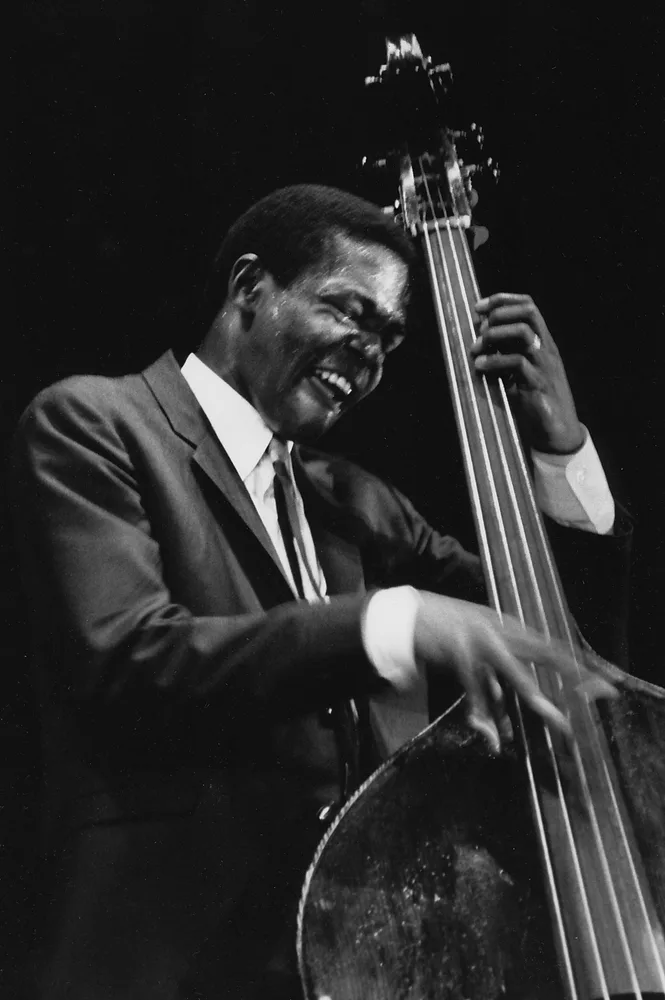
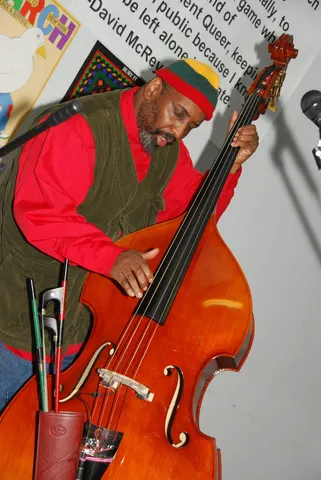
Jimmy Garrison playing double bass, undated; the image used as the lead photograph on his Wikipedia article CC BY-SA 4.0 — Wikimedia Commons — https://commons.wikimedia.org/wiki/File:Jimmyegarrison.jpg

James Emory Garrison was born March 3, 1934, in Miami, Florida, and moved to Philadelphia with his family at the age of ten. He came to the bass late by the standards of his generation, picking up the instrument only in his senior year of high school, but Philadelphia in the early 1950s was an unusually good place to catch up: the same city produced bassists Reggie Workman and Henry Grimes, pianist McCoy Tyner, and trumpeter Lee Morgan, all of them working the same clubs and rehearsal rooms. Garrison worked his way through that scene and moved to New York toward the end of the decade.
His first substantial recording work came in a fast run of late-1950s hard bop dates. He played on three albums by drummer Philly Joe Jones (Blues for Dracula, 1958; Drums Around the World and Showcase, both 1959), and on May 21, 1959, at Van Gelder Studio in Hackensack, he cut Blues-ette with trombonist Curtis Fuller, Benny Golson, Tommy Flanagan, and Al Harewood, a record that has never gone out of favor. Jackie McLean's Swing, Swang, Swingin' (1959), Kenny Dorham's two 1960 Time albums, and J. R. Monterose's Straight Ahead followed. He also spent time in a very different room: the Half Note, where Lee Konitz and Warne Marsh worked the Lennie Tristano orbit and Bill Evans sat in on the nights Tristano stayed home to teach. Tapes from February 1959 with Garrison and Paul Motian in the rhythm section sat unissued until Verve put them out in 1994 as Live at the Half Note. Garrison also passed through a short-lived Bill Evans trio with drummer Kenny Dennis around this period.
The job that first made his name outside the hard bop circuit was with Ornette Coleman. On March 22 and 27, 1961, at Atlantic Studios in New York, Garrison recorded Ornette on Tenor with Coleman, Don Cherry, and Ed Blackwell, the final album by the quartet Coleman had assembled in the 1950s. Coleman broke the group up later that year. Garrison's next employer would keep him for the rest of the saxophonist's life.
John Coltrane brought Garrison onto the bandstand during the Village Vanguard engagement of November 1961, a run in which Reggie Workman was on his way out and Garrison on his way in, the two of them sometimes alternating and sometimes playing together. On November 2, Garrison and Elvin Jones backed Coltrane with no piano at all on "Chasin' the Trane," sixteen minutes of tenor saxophone over bass and drums that became the centerpiece of Coltrane "Live" at the Village Vanguard. Garrison joined the band outright in 1962, completing the lineup now universally called the classic quartet: Coltrane, McCoy Tyner, Garrison, Elvin Jones. Over the next three years that group made Coltrane, Ballads, Duke Ellington & John Coltrane, John Coltrane and Johnny Hartman, Impressions, Live at Birdland (with "Alabama," Coltrane's response to the Birmingham church bombing), and Crescent. On the last of those, recorded April 27 and June 1, 1964, Coltrane takes no solo at all on side two of the original LP: "Lonnie's Lament" hands the space to Garrison instead, in one of the longest bass features on any album released under a major saxophonist's name.
A Love Supreme, cut in a single session at Van Gelder Studio on December 9, 1964, made Garrison's playing famous whether or not listeners knew the name. The suite opens on his bass with the four-note figure that carries the album's title, and the whole first movement is built over it. At the close of "Pursuance" he is left entirely alone, and the long unaccompanied passage he plays is what carries the record out of the storm of the third movement and into the hymn of "Psalm." Coltrane reconvened the following day with Archie Shepp and a second bassist, Art Davis, and remade "Acknowledgement" as a sextet, then set the results aside and issued the quartet version.
Garrison stayed through everything that came next. He was one of two bassists, with Art Davis again, on the eleven-piece Ascension session of June 28, 1965; he is on Transition, Sun Ship, First Meditations, Kulu Sé Mama, Live in Seattle, Om, and Meditations, recorded November 23, 1965, the date that added Rashied Ali as a second drummer alongside Elvin Jones. When Tyner and Jones left within months of each other and Alice Coltrane and Ali took their places, Garrison was the only man left from the quartet, and he held the chair to the end. The clearest single document of what he had become by then is Live at the Village Vanguard Again!, recorded May 28, 1966 with Pharoah Sanders added on tenor: the album's second track is titled "Introduction to My Favorite Things," runs 6:09, is credited as a Garrison composition, and is nothing but Garrison, alone. Indexing a bassist's solo as a separate piece of music on a saxophonist's live album was close to unheard of. He is also on Live in Japan from that July, and on Expression, The Olatunji Concert, and Stellar Regions from 1967. Outside the band he cut East Broadway Run Down with Sonny Rollins, Freddie Hubbard, and Elvin Jones on May 9, 1966.
After Coltrane's passing in July 1967 Garrison kept working with nearly everyone the band had touched. He anchored Alice Coltrane's first records, A Monastic Trio and Cosmic Music (both 1968) and Universal Consciousness (1971). He joined Elvin Jones's piano-less trio with saxophonist Joe Farrell for Puttin' It Together (April 1968) and The Ultimate (September 1968), the latter carrying three Garrison originals among its six tracks. Ornette Coleman called him back in 1968 for New York Is Now! and Love Call, with Dewey Redman and Elvin Jones filling out a rhythm section that DownBeat's five-star review credited with pushing Coleman harder than usual. In Paris in December 1967 he recorded with Hampton Hawes, saxophonist Nathan Davis, and Art Taylor, a session issued as Rules of Freedom. He appeared on Bill Dixon's Intents and Purposes (1967) and Clifford Thornton's Freedom & Unity (1967), and across three of Archie Shepp's most political records: Attica Blues (recorded January 1972), The Cry of My People (September 1972), and There's a Trumpet in My Soul (1975).
Garrison taught as a visiting artist at Wesleyan University and Bennington College in 1971 and 1972, and worked privately with younger bassists, among them William Parker, who names him alongside Richard Davis and Wilbur Ware as the players who taught him the tradition. Lung cancer ended his career and then his life: he passed away in New York City on April 7, 1976, at 42. He left five children from two marriages, including the vocalist Joy Garrison and the bassist Matthew Garrison, who in June 1992 recorded with Rashied Ali and Ravi Coltrane on a quintet session finally released in 2001 as No One in Particular, the sons of two of the classic quartet in a room with the man who had drummed for their fathers.
Garrison rebuilt the job description of the jazz bassist inside the most closely watched band of the 1960s. Rather than walking four to the bar behind John Coltrane, he worked in broken time, dropping in and out of the pulse and running melodic counter-lines against the horn, and he backed it with a heavy, blunt gut-string tone that carried without amplification through Elvin Jones's drumming. His technical vocabulary was unusual for the era: double stops, open strings and fifths struck for resonance, thumb-strummed chordal passages closer to flamenco guitar than to jazz bass, and long stretches of arco. Above all he made the unaccompanied bass solo a standing feature rather than an occasional courtesy, to the point that Coltrane's live sets were built around Garrison's introductions, and Impulse! indexed one of them as its own composition on Live at the Village Vanguard Again!. He also wrote: "Gettin' On Way" on Illumination! and three of the six tracks on Elvin Jones's The Ultimate. Bassists from William Parker onward have taken the solo-bass tradition he opened as ordinary equipment.
- A Love Supreme (recorded Dec. 9, 1964; released Jan. 1965, John Coltrane, Impulse!) - Garrison's four-note bass figure opens the suite and carries its title, and his unaccompanied passage at the close of "Pursuance" leads the record into "Psalm." Spotify - A Love Supreme
- Crescent (recorded Apr. 27 & June 1, 1964; released July 1964, John Coltrane, Impulse!) - Coltrane takes no solo on side two of the original LP, giving "Lonnie's Lament" over to an extended Garrison bass feature. Spotify - Crescent Listen
- Coltrane "Live" at the Village Vanguard (recorded Nov. 1961; released Feb. 1962, John Coltrane, Impulse! A-10) - Garrison's arrival in the band, documented on the piano-less "Chasin' the Trane" of November 2, 1961. Spotify - Live At The Village Vanguard Listen
- Illumination! (recorded Aug. 8, 1963; released Jan. 9, 1964, Elvin Jones/Jimmy Garrison Sextet, Impulse! A-49) - The one album billed to Garrison as a co-leader, sharing top line with Elvin Jones and featuring his composition "Gettin' On Way." Spotify - Illumination! Listen
- Live at the Village Vanguard Again! (recorded May 28, 1966; released Dec. 1966, John Coltrane, Impulse! A-9124) - Track two is "Introduction to My Favorite Things," 6:09 of unaccompanied bass credited to Garrison as a composition of his own. Spotify - Live At The Village Vanguard Again! Listen
- The Ultimate (recorded Sept. 6, 1968; released Aug. 1969, Elvin Jones, Blue Note BST 84305) - A piano-less trio with Joe Farrell carrying three Garrison originals, and the fullest showcase of his writing. Spotify - The Ultimate Listen
- Ornette on Tenor (recorded Mar. 1961; released Dec. 1962, Ornette Coleman, Atlantic) - The last record by Coleman's original quartet, with Garrison, Don Cherry, and Ed Blackwell, cut months before he joined Coltrane. Spotify - Ornette On Tenor
- East Broadway Run Down (recorded May 9, 1966; released Jan. 1967, Sonny Rollins, Impulse!) - Rollins working with the Coltrane rhythm section, Garrison and Elvin Jones, plus Freddie Hubbard on the title track. Spotify - East Broadway Run Down
Jimmy Garrison: Full Discography
Identity confirmed via the live Discogs API, artist ID 254065 ("Jimmy Garrison," realname James Emory Garrison, Miami-born jazz bassist, member of the John Coltrane Quartet). Discogs credits him on 530 releases: 10 in a "Main" role and 520 sideman "Appearance" credits.
Jimmy Garrison led essentially nothing under his own name. Of those 10 "Main" credits, nine are co-billings on other leaders' albums (reissue sleeves crediting "John Coltrane Quartet With McCoy Tyner, Jimmy Garrison And Elvin Jones," "Elvin Jones With Joe Farrell And Jimmy Garrison," and the like), and exactly one is a record where his name is part of the band's billing: Illumination!, credited to the Elvin Jones/Jimmy Garrison Sextet Featuring McCoy Tyner. That is the single genuine co-leader date of his career, and the "As Leader / Co-Leader" table below has one row for that reason. Everything else is sideman work, and that is where the weight of his catalog sits.
The sideman table is a curated selection, not an exhaustive itemisation of 520 credits. It covers the John Coltrane years in depth (Garrison is on roughly two dozen Coltrane titles, including posthumous releases) plus the significant work with Ornette Coleman, Alice Coltrane, Elvin Jones, Archie Shepp, McCoy Tyner, Sonny Rollins, Curtis Fuller, and Philly Joe Jones. Catalog numbers are given only where they were confirmed against Discogs or a release's own documentation; blank cells mean the number was not verified rather than that none exists. Spotify's API returned quota errors throughout this build, so album links were confirmed by opening the Spotify album pages directly; titles that could not be matched to a confident album page are marked "Not confirmed on Spotify." The Buy column is always blank of links because no affiliate program is set up.
As Leader / Co-Leader
| Album Title | Recording Date(s) | Release Date | Label | Catalog Number | Format(s) | Personnel | Role | Reissue History | Spotify | Buy | Notes |
|---|---|---|---|---|---|---|---|---|---|---|---|
| Illumination! | Recorded August 8, 1963, Van Gelder Studio, Englewood Cliffs, NJ | January 1964 (Wikipedia gives January 9, 1964) | Impulse! | A-49 (mono) / AS-49 (stereo) | Vinyl, LP, Album | Elvin Jones/Jimmy Garrison Sextet Featuring McCoy Tyner: Elvin Jones (drums), Jimmy Garrison (bass), McCoy Tyner (piano), Sonny Simmons (alto saxophone, English horn), Prince Lasha (clarinet, flute), Charles Davis (baritone saxophone). Produced by Bob Thiele | Co-leader (billed in the band name) | Impulse! reissues 1968, 1972 and 1974 (ABC Impulse!); Spain 1982 on MCA/Platinum Jazz (H-204459); US vinyl reissue 2009 (Universal Music Special Markets, B0012605-01); on CD | Spotify - Illumination! | Jones, Garrison and Tyner were three-quarters of the John Coltrane Quartet at the time. Garrison contributes the original "Gettin' On Way"; the other five tracks are by Lasha, Tyner, Simmons and Charles Davis. AllMusic 4.5 stars; The Rolling Stone Jazz Record Guide 4 stars |
Two further releases carry Garrison's name in the artist billing without being his dates. Both are listed in the sideman table below at their proper leaders: Impressions of New York (Impulse!, 1967), billed to "The Rolf and Joachim Kühn Quartet Featuring Jimmy Garrison and Aldo Romano," and The Ultimate (Blue Note, 1969), billed on some pressings to "Elvin Jones With Joe Farrell And Jimmy Garrison."
As Sideman (selected major credits)
| Year | Project (Leader) | Title | Label | Catalog | Role | Notes |
|---|---|---|---|---|---|---|
| 1958 | Philly Joe Jones | Blues for Dracula | Riverside | Bass | Garrison's first widely circulated recording | |
| 1959 | Philly Joe Jones | Drums Around the World | Riverside | Bass | ||
| 1959 | Philly Joe Jones | Showcase | Riverside | Bass | ||
| 1959 | Curtis Fuller | Blues-ette | Savoy | MG 12141 | Bass | Recorded May 21, 1959, Van Gelder Studio, Hackensack NJ, with Benny Golson, Tommy Flanagan and Al Harewood. A hard bop standard; AllMusic 4.5 stars, DownBeat 4 stars |
| 1959 | Curtis Fuller | Imagination | Savoy | Bass | ||
| 1959 | Jackie McLean | Swing, Swang, Swingin' | Blue Note | Bass | ||
| 1959 | J. R. Monterose | Straight Ahead | Jaro | Bass | Also issued as The Message | |
| 1959 | Tony Scott | Golden Moments | Muse | Bass | Recorded 1959; not released until 1982 | |
| 1959 | Tony Scott | I'll Remember | Muse | Bass | Recorded 1959; not released until 1984 | |
| 1959 | Lee Konitz / Warne Marsh | Live at the Half Note | Verve | Bass | Recorded February 1959 with Bill Evans (deputising for Lennie Tristano on his teaching nights) and Paul Motian; unissued until Verve's 1994 double CD | |
| 1960 | Kenny Dorham | Jazz Contemporary | Time | Bass | ||
| 1960 | Kenny Dorham | Show Boat | Time | Bass | ||
| 1960 | Curtis Fuller | Images of Curtis Fuller | Savoy | Bass | ||
| 1961 | Ornette Coleman | Ornette on Tenor | Atlantic | Bass | Recorded March 22 and 27, 1961, Atlantic Studios NYC, with Don Cherry and Ed Blackwell; released December 1962. The last album by Coleman's original quartet | |
| 1961 | Ornette Coleman | The Art of the Improvisers | Atlantic | Bass | Compilation of unissued 1959-1961 material; released 1970 | |
| 1961 | Benny Carter | Further Definitions | Impulse! | Bass | ||
| 1961 | Bill Barron | The Tenor Stylings of Bill Barron | Savoy | Bass | ||
| 1961 | Walter Bishop Jr. | Speak Low | Jazztime | Bass | ||
| 1961 | Ted Curson | Plenty of Horn | Old Town | Bass | ||
| 1961 | Cal Massey | Blues to Coltrane | Candid | Bass | Recorded 1961; first issued 1987 | |
| 1961 | Curtis Fuller | The Magnificent Trombone of Curtis Fuller | Epic | Bass | ||
| 1961 | John Coltrane | Coltrane "Live" at the Village Vanguard | Impulse! | A-10 | Bass | Recorded November 1961; released February 1962. Garrison plays "Chasin' the Trane" (November 2, piano-less trio with Elvin Jones); Reggie Workman is the bassist on the other two tracks |
| 1962 | John Coltrane | Coltrane | Impulse! | Bass | First studio album of the classic quartet with Garrison in the chair | |
| 1962 | John Coltrane | Ballads | Impulse! | Bass | ||
| 1962 | Duke Ellington & John Coltrane | Duke Ellington & John Coltrane | Impulse! | Bass | Garrison and Aaron Bell split the bass chair across the session | |
| 1963 | John Coltrane & Johnny Hartman | John Coltrane and Johnny Hartman | Impulse! | Bass | ||
| 1963 | John Coltrane | Impressions | Impulse! | Bass | Live tracks from the Village Vanguard, November 3, 1961 (with Eric Dolphy on "India," where Garrison and Reggie Workman play together for a drone effect) plus 1962-1963 studio sides | |
| 1963 | John Coltrane | Live at Birdland | Impulse! | A-50 | Bass | Live tracks October 8, 1963 at Birdland; studio tracks November 18, 1963. Includes "Alabama" |
| 1963 | McCoy Tyner | Today and Tomorrow | Impulse! | Bass | ||
| 1963 | Lorez Alexandria | For Swingers Only | Argo | Bass | ||
| 1964 | McCoy Tyner | McCoy Tyner Plays Ellington | Impulse! | Bass | ||
| 1964 | John Coltrane | Crescent | Impulse! | Bass | Recorded April 27 and June 1, 1964. Coltrane takes no solo on side two of the original LP; "Lonnie's Lament" is built around an extended Garrison bass feature | |
| 1964 | John Coltrane | A Love Supreme | Impulse! | Bass | Recorded December 9, 1964, Van Gelder Studio; released January 1965. Garrison's four-note ostinato opens "Acknowledgement," and his unaccompanied passage closes "Pursuance" into "Psalm." A December 10 sextet remake with Archie Shepp and second bassist Art Davis was recorded but not used | |
| 1965 | John Coltrane | The John Coltrane Quartet Plays | Impulse! | Bass | ||
| 1965 | John Coltrane | Ascension | Impulse! | A-95 | Bass | Recorded June 28, 1965. Eleven players including a second bassist, Art Davis. Issued in two editions from two takes |
| 1965 | John Coltrane | Transition | Impulse! | Bass | Recorded 1965; released posthumously 1970 | |
| 1965 | John Coltrane | Sun Ship | Impulse! | Bass | Recorded August 26, 1965; released 1971 | |
| 1965 | John Coltrane | First Meditations (for quartet) | Impulse! | Bass | Recorded September 1965; released 1977 | |
| 1965 | John Coltrane | Kulu Sé Mama | Impulse! | Bass | ||
| 1965 | John Coltrane | Live in Seattle | Impulse! | Bass | Recorded September 30, 1965; released 1971 | |
| 1965 | John Coltrane | Om | Impulse! | Bass | Recorded October 1, 1965; released 1968 | |
| 1965 | John Coltrane | Meditations | Impulse! | Bass | Recorded November 23, 1965, the session that added Rashied Ali as a second drummer alongside Elvin Jones | |
| 1965 | Various (John Coltrane) | The New Wave in Jazz | Impulse! | Bass | Live compilation from the March 28, 1965 Village Gate benefit | |
| 1965 | John Coltrane | Live at the Half Note: One Down, One Up | Impulse! | Bass | Radio broadcasts from the Half Note, March and May 1965; released 2005 | |
| 1966 | John Coltrane | Live at the Village Vanguard Again! | Impulse! | A-9124 | Bass | Recorded May 28, 1966, with Pharoah Sanders, Alice Coltrane, Rashied Ali and Emanuel Rahim. Track 2, "Introduction to My Favorite Things" (6:09), is an unaccompanied Garrison solo credited to him as a composition |
| 1966 | John Coltrane | Live in Japan | Impulse! | Bass | Recorded July 1966 in Tokyo; released 1973 as a four-LP set | |
| 1966 | Sonny Rollins | East Broadway Run Down | Impulse! | Bass | Recorded May 9, 1966, Van Gelder Studio, with Elvin Jones and Freddie Hubbard (title track only); released January 1967 | |
| 1967 | John Coltrane | Expression | Impulse! | Bass | The last Coltrane album prepared for release in his lifetime | |
| 1967 | John Coltrane | Stellar Regions | Impulse! | Bass | Recorded February 1967; held in the vault until 1995 | |
| 1967 | John Coltrane | The Olatunji Concert: The Last Live Recording | Impulse! | Bass | Recorded April 23, 1967; released 2001 | |
| 1967 | Bill Dixon | Intents and Purposes | RCA Victor | Bass | ||
| 1967 | Clifford Thornton | Freedom & Unity | Third World | Bass | Reissued by New World | |
| 1967 | Rolf and Joachim Kühn Quartet | Impressions of New York | Impulse! | Bass | Billed "Featuring Jimmy Garrison and Aldo Romano" | |
| 1967 | Archie Shepp | Life at the Donaueschingen Music Festival | SABA | Bass | ||
| 1967 | Robert Pozar | Good Golly Miss Nancy | Savoy | Bass | ||
| 1967 | Nathan Davis (with Hampton Hawes) | Rules of Freedom | Polydor | Bass | Recorded Paris, December 1967, with Nathan Davis (reeds), Hampton Hawes (piano) and Art Taylor (drums); released 1969. The documented Hawes/Garrison meeting | |
| 1968 | Alice Coltrane | A Monastic Trio | Impulse! | Bass | Recorded January 29 and June 6, 1968 at the Coltrane home studio, Dix Hills NY, with Pharoah Sanders and Rashied Ali or Ben Riley; released December 1968. Alice Coltrane's debut as a leader | |
| 1968 | Alice Coltrane | Cosmic Music | Impulse! | Bass | Includes 1966 John Coltrane material alongside 1968 Alice Coltrane sessions | |
| 1968 | Elvin Jones | Puttin' It Together | Blue Note | BST 84282 | Bass | Recorded April 8, 1968, Van Gelder Studio, produced by Duke Pearson. Piano-less trio with Joe Farrell. DownBeat 5 stars |
| 1968 | Elvin Jones | The Ultimate | Blue Note | BST 84305 | Bass, composer | Recorded September 6, 1968; released August 1969. Three of the six tracks are Garrison originals: "What Is This?", "Ascendant" and "Sometimes Joie." DownBeat 5 stars |
| 1968 | Ornette Coleman | New York Is Now! | Blue Note | Bass | Recorded April 29 and May 7, 1968, A&R Studios NYC, with Dewey Redman and Elvin Jones; released November 1968. DownBeat 5 stars | |
| 1968 | Ornette Coleman | Love Call | Blue Note | Bass | Same 1968 sessions as New York Is Now! | |
| 1971 | Alice Coltrane | Universal Consciousness | Impulse! | Bass | Recorded April to June 1971 with Jack DeJohnette, Rashied Ali and Clifford Jarvis; string arrangements transcribed by Ornette Coleman. Released September 1971 | |
| 1972 | Archie Shepp | Attica Blues | Impulse! | Bass | Recorded January 24-26, 1972, A&R Recording NYC. Garrison plays double bass on tracks 3-5, 9 and 10 (Gerald Jemmott takes Fender bass elsewhere) | |
| 1972 | Archie Shepp | The Cry of My People | Impulse! | Bass | Recorded September 25-27, 1972, Allegro Sound Studios NYC; released 1973. Ron Carter plays electric bass on the same date | |
| 1975 | Archie Shepp | There's a Trumpet in My Soul | Freedom | Bass | ||
| 1975 | Beaver Harris | From Ragtime to No Time | 360 Records | Bass | One of Garrison's last recorded sessions | |
| 2018 | John Coltrane | Both Directions at Once: The Lost Album | Impulse! | Bass | Classic quartet session of March 6, 1963, unreleased for 55 years | |
| 2018 | Alice Coltrane | Carnegie Hall '71 | Hi Hat | Bass | Live, February 21, 1971 | |
| 2019 | John Coltrane | Blue World | Impulse! | Bass | Quartet soundtrack session of June 24, 1964, for the Canadian film Le chat dans le sac | |
| 2024 | Alice Coltrane | The Carnegie Hall Concert | Impulse! | Bass | Official release of the February 21, 1971 Carnegie Hall set |
Spotify album pages confirmed during this build for the following titles: Illumination!, A Love Supreme, Crescent, Coltrane "Live" at the Village Vanguard, Live at the Village Vanguard Again!, Live at Birdland, Meditations, Sun Ship, Concert in Japan, The John Coltrane Quartet Plays, Ornette on Tenor, New York Is Now!, East Broadway Run Down, Puttin' It Together, The Ultimate, A Monastic Trio, and Attica Blues. Remaining titles are not confirmed on Spotify from this session and were left unlinked rather than guessed.
Beyond the rows above, Garrison's Discogs "Appearance" log runs to 520 credits once compilations, box sets, anthologies and posthumous Coltrane reissues are counted, including the multi-disc The Complete 1961 Village Vanguard Recordings, The Classic Quartet: Complete Impulse! Studio Recordings, and The Major Works of John Coltrane. Those are not itemised here.
- John Coltrane - bandleader from November 1961 to the saxophonist's death in July 1967, first as the bassist of the classic quartet and then as the only holdover into the final group.
- Elvin Jones - quartet bandmate 1961-1966, co-leader of the Illumination! sextet in 1963, and leader of the trio that made Puttin' It Together and The Ultimate in 1968.
- McCoy Tyner - the third member of the classic quartet rhythm section, 1962-1965; also employed Garrison on his own Today and Tomorrow (1963) and McCoy Tyner Plays Ellington (1964).
- Rashied Ali - bandmate in Coltrane's last group from November 1965 to 1967, and again behind Alice Coltrane on A Monastic Trio and Universal Consciousness.
- Alice Coltrane - bandleader from 1968 into the early 1970s, across A Monastic Trio, Cosmic Music, and Universal Consciousness.
- Ornette Coleman - employer in 1961 for Ornette on Tenor, the last album by his original quartet, and again in 1968 for New York Is Now! and Love Call.
- Archie Shepp - sideman on Life at the Donaueschingen Music Festival (1967), Attica Blues (1972), The Cry of My People (1972), and There's a Trumpet in My Soul (1975).
- Pharoah Sanders - bandmate in Coltrane's late group from 1965, and on Alice Coltrane's A Monastic Trio and Cosmic Music.
- Hampton Hawes - rhythm-section partner on the December 1967 Paris session with Nathan Davis and Art Taylor, released as Rules of Freedom.
- Curtis Fuller - four Savoy and Epic dates between 1959 and 1961, including the hard bop staple Blues-ette.
- Philly Joe Jones - Garrison's most frequent early employer, on Blues for Dracula (1958), Drums Around the World (1959), and Showcase (1959).
- Lee Konitz, Warne Marsh, Bill Evans, and Paul Motian - the February 1959 Half Note nights issued by Verve in 1994 as Live at the Half Note.
- Sonny Rollins - East Broadway Run Down (1966), with Garrison and Elvin Jones carrying the Coltrane rhythm section into a Rollins date.
- William Parker - bass student, one of the younger players Garrison worked with during his teaching years.
More Hard Bop Artists
See all 304 Hard Bop artists →More American Jazz Artists
See all 567 American artists →- Wikipedia: Jimmy Garrison
- Discogs: Jimmy Garrison (artist 254065)
- Wikipedia: Illumination!
- Wikipedia: A Love Supreme
- Wikipedia: Crescent (John Coltrane album)
- Wikipedia: Coltrane "Live" at the Village Vanguard
- Wikipedia: The Complete 1961 Village Vanguard Recordings
- Wikipedia: Live at the Village Vanguard Again!
- Wikipedia: Impressions (John Coltrane album)
- Wikipedia: Live at Birdland (John Coltrane album)
- Wikipedia: Ascension (John Coltrane album)
- Wikipedia: Ornette on Tenor
- Wikipedia: New York Is Now!
- Wikipedia: East Broadway Run Down
- Wikipedia: Puttin' It Together
- Wikipedia: The Ultimate (Elvin Jones album)
- Wikipedia: Blues-ette
- Wikipedia: A Monastic Trio
- Wikipedia: Universal Consciousness
- Wikipedia: Attica Blues (album)
- Wikipedia: The Cry of My People
- Wikipedia: Live at the Half Note (Lee Konitz album)
- Wikipedia: William Parker (musician)
- jazzdisco.org: Hampton Hawes catalog
- WBGO: A Deep Dive into John Coltrane's "A Love Supreme" by His Biographer Lewis Porter