 JAZZPROFILES lives in the music 1,572 Jazz Artists fully Profiled!
 Miles Davis
Last updated September 7, 2026
Listen on Spotify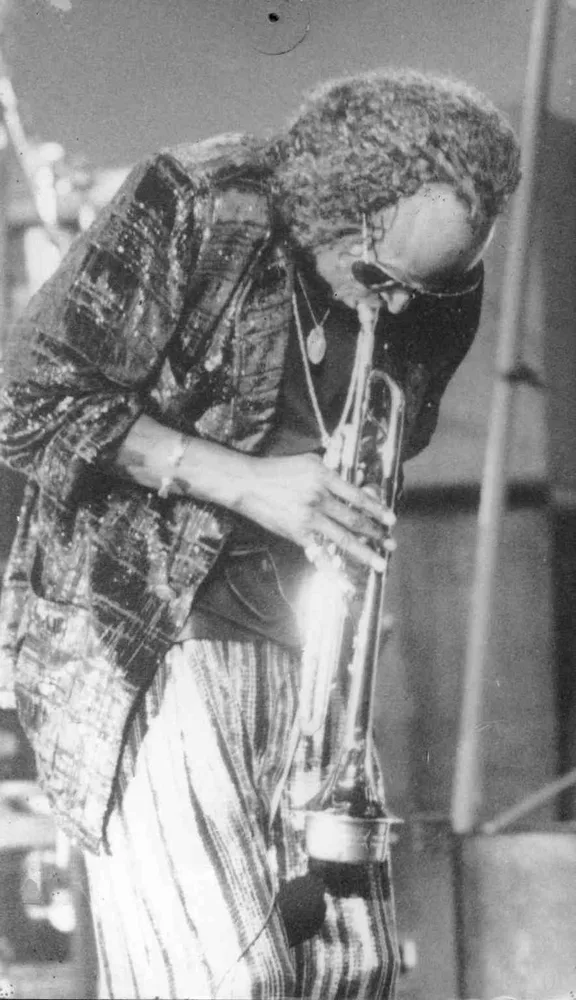
Miles Davis, photo taken between 1989 and 1991 CC BY 2.0 — Wikimedia Commons — https://commons.wikimedia.org/wiki/File:Miles_Davis_23.jpg

Miles Dewey Davis III was born May 26, 1926, in Alton, Illinois, to a comfortably well-off family — his father, Miles Dewey Davis Jr., was a dentist, and his mother, Cleota Mae Henry, was a music teacher and violinist. The family moved to East St. Louis, Illinois, in 1927. Davis got his first trumpet in 1935 and began weekly lessons with Elwood Buchanan, a teacher he later called the biggest influence on his life; Buchanan's insistence on a clear tone without vibrato shaped the sound Davis carried for the rest of his career. By his teens Davis was already working, eventually becoming musical director of Eddie Randle's Blue Devils, a St. Louis territory band. In September 1944, fresh out of high school, he enrolled at Juilliard in New York — nominally to study music, actually to be near Charlie Parker, whom he'd first heard sit in with Billy Eckstine's big band in St. Louis that same year. He skipped classes to chase down Parker and Dizzy Gillespie in Harlem clubs, and dropped out after three semesters, with his father's blessing, to play full-time.
He recorded his first session in April 1945 and by year's end had replaced Gillespie in Parker's quintet, recording with Parker's groups steadily through 1948. In August 1948 he turned down an offer to join Duke Ellington's orchestra and instead assembled a nine-piece band with arrangements by Gil Evans and Gerry Mulligan, built around unusual voicings for jazz — French horn, tuba — aiming for an almost orchestral sound. The Miles Davis Nonet played exactly one live engagement, a two-week stint opening for Count Basie at the Royal Roost in September 1948, and recorded a dozen sides for Capitol across 1949 and 1950 that sold poorly at the time. Compiled in 1957 as the album Birth of the Cool, that material became one of the foundational documents of cool and West Coast jazz.
The years right after were rougher. A May 1949 trip to the Paris Jazz Festival — where he had an affair with singer Juliette Gréco and fell for the city — was followed by a return to New York, little work, and a heroin addiction that hit by the time he was 23. He was arrested for possession in Los Angeles, spent time back in St. Louis with his father, and lived roughly six months in Detroit avoiding New York before returning in February 1954, the habit finally broken. He signed with Prestige Records in January 1951, and once George Avakian signed him to Columbia in 1955 — requiring his Prestige contract be fulfilled first — Davis and a newly assembled quintet (Sonny Rollins, then John Coltrane, on tenor; Red Garland, piano; Paul Chambers, bass; Philly Joe Jones, drums) knocked out two marathon sessions in May and October 1956 that filled four Prestige LPs (Cookin', Relaxin', Workin', Steamin') while the group's real debut, 'Round About Midnight, opened the Columbia era in 1957. That November, in Paris, Davis improvised a full score to Louis Malle's film Ascenseur pour l'échafaud watching the picture with a quartet of French musicians and drummer Kenny Clarke — one night's work that became one of the most influential jazz film scores ever made.
Parallel to the quintet, Davis built a five-album collaboration with arranger Gil Evans between 1957 and 1962: Miles Ahead (1957), Porgy and Bess (1959), and Sketches of Spain (1960) — a set of Spanish-themed orchestral pieces that sold more than 120,000 copies and won a Grammy — stand as the peak of that partnership; a later bossa nova record, Quiet Nights (1963), was released against both men's wishes and caused a two-year rift between Davis and producer Teo Macero. In between, on March 2 and April 22, 1959, Davis's sextet — Coltrane, Cannonball Adderley on alto, Bill Evans and Wynton Kelly splitting the piano chair, Chambers, and Jimmy Cobb — recorded Kind of Blue, built loosely around modal scales rather than fixed chord changes. Released that August, it became a steady, enormous seller: RIAA-certified 5x platinum in 2019, with the US House of Representatives honoring it as a national treasure in 2009. It remains the best-selling jazz album in history.
By late 1962 that quintet had run its course. Davis paid more than $25,000 to cancel bookings while he rebuilt the band, eventually landing on Herbie Hancock (piano, 23 years old) and Tony Williams (drums, 17) alongside Ron Carter (bass), with George Coleman on tenor until Wayne Shorter left Art Blakey's Jazz Messengers to join in 1964. This Second Great Quintet — Davis, Shorter, Hancock, Carter, Williams — became one of the most studied rhythm sections in jazz, pursuing what the band called "time, no changes": improvising with structural freedom over a pulse rather than a fixed harmonic sequence. E.S.P. (1965), Miles Smiles (1967), Sorcerer (1967), and Nefertiti (1968) — the last built almost entirely around Shorter's compositions — mapped that language across four studio albums, alongside touring documented on Miles Davis in Europe, My Funny Valentine, and Four & More. Davis endured serious health trouble through the mid-1960s, including a failed 1965 hip replacement, a second successful one that same year, and a hospitalization for a liver infection in early 1966; through it, his relationship with actress Cicely Tyson helped him cut back on drinking.
Change came again at the decade's end. Miles in the Sky and Filles de Kilimanjaro (both 1968) tentatively brought in electric bass, piano, and guitar, and by the second half of the Filles sessions Chick Corea and Dave Holland had replaced Hancock and Carter. In a Silent Way, recorded in a single session on February 18, 1969, with Corea, Joe Zawinul, and John McLaughlin joining the band, was assembled by Macero from studio takes into two side-long tracks; some critics called it a sellout to rock audiences, but it's now regarded as the opening statement of jazz fusion. Bitches Brew followed that August, a double album of long, spliced, multitracked compositions that reached No. 35 on the Billboard chart, went gold in 1976, and had sold roughly a million copies by 2003 — a genuinely unprecedented commercial result for a record this abstract. Davis began touring with rock acts, sharing a March 1970 Fillmore East bill with the Steve Miller Band and Neil Young, and playing to an estimated 600,000 people at the Isle of Wight Festival that August, the largest crowd of his career. On the Corner (1972), shaped partly by arranger Paul Buckmaster's introduction of Davis to the avant-garde composer Karlheinz Stockhausen, fused funk rhythm with dense, textured production; it topped the Billboard jazz chart but was widely panned by jazz critics at the time and, Davis felt, marketed to the wrong audience entirely. An October 1972 car crash broke both his ankles, and worsening health, alcohol, and cocaine use shadowed the touring bands documented on Get Up with It, Agharta, Pangaea, and Dark Magus through the mid-1970s. After a September 1975 performance at New York's Schaefer Music Festival, Davis stopped performing and recording entirely.
The five years that followed were a genuine retreat — by his own account in his autobiography, a period of heavy drug and alcohol use with almost no music at all — interrupted mainly by a 1975 hip replacement and a near-collapse of his Columbia contract that the label resolved by establishing a standing fund to keep paying him. He began working again in 1980, and after a slow, difficult return to shape on the horn, released The Man with the Horn in 1981 — poorly reviewed but a commercial success — and returned to the stage that June for the first time since 1975. We Want Miles (1982), drawn from that year's live shows, won him a Grammy. A serious stroke in January 1982, which temporarily paralyzed his right hand, slowed him again, but through the rest of the decade he kept recording and touring: Star People (1983), Decoy (1984), and You're Under Arrest (1985) closed out his Columbia contract, and a 1986 move to Warner Bros. produced Tutu, a tribute to South African Archbishop Desmond Tutu built almost entirely around bassist-producer Marcus Miller's arrangements and programming. Tutu split critics on release — some heard a bold new direction, others a synth-driven concession to commercial trends — but won two Grammys and stands as the signature recording of Davis's comeback years. He kept working into 1991, including an unusual return to acoustic, orchestral territory that July at the Montreux Jazz Festival, performing arrangements of his old Gil Evans collaborations, and had begun a hip-hop collaboration with producer Easy Mo Bee that spring. He completed roughly six tracks before he died on September 28, 1991, in Santa Monica, California, from the combined effects of a stroke, pneumonia, and respiratory failure, at 65. Easy Mo Bee finished the album, Doo-Bop, released posthumously in 1992; it won a Grammy for Best R&B Instrumental Performance. Davis was inducted into the Rock and Roll Hall of Fame in 2006.
Davis's earliest and most lasting influence was his childhood teacher Elwood Buchanan, whose insistence on a light, clear, vibrato-free tone gave Davis the melodic voice he kept for the rest of his life; trumpeter Freddy Webster, whose sound Dizzy Gillespie himself called the best he ever heard, was another frequently cited early model. Where many trumpeters filled every available beat, Davis built his style around space and restraint — leaving silence where a phrase could have gone, using a Harmon mute to give his tone a cool, almost vocal quality, and trusting a handful of well-placed notes to carry more weight than a run of them. That instinct for economy over display stayed consistent even as the musical context around it changed completely, from the bebop he learned at Charlie Parker's side, through the modal harmony he explored with pianist Bill Evans and theorist George Russell on Kind of Blue, to the open, pulse-driven "time, no changes" concept his Second Great Quintet pursued and the electric funk-and-rock vocabulary he adopted from the late 1960s onward.
What set Davis apart across five decades wasn't a fixed sound but a career-long habit of moving toward whatever was next before anyone else had gotten there, and doing it as a bandleader rather than a soloist chasing trends alone — hearing something in young, largely unproven musicians (Coltrane at 29, Hancock at 23, Williams at 17, McLaughlin barely known outside London) and building the next phase of his music around them. Critics and historians consistently place him at the center of nearly every major stylistic turn in postwar jazz — bebop, cool jazz, hard bop, modal jazz, and jazz-rock fusion — not as a participant in each but as one of the musicians who defined it. Rolling Stone called him "the most revered jazz trumpeter of all time, not to mention one of the most important musicians of the 20th century."
- Birth of the Cool (1957, Capitol Records) - The Miles Davis Nonet's 1949-50 Capitol sessions, arranged by Gil Evans and Gerry Mulligan, compiled into the album that helped found cool and West Coast jazz. Spotify - Birth Of The Cool
- Kind of Blue (1959, Columbia) - Recorded in two sessions with Coltrane, Cannonball Adderley, Bill Evans, and Wynton Kelly; the best-selling jazz album in history and the clearest statement of modal jazz's arrival. Spotify - Kind Of Blue
- E.S.P. (1965, Columbia) - The first studio album by the complete Second Great Quintet (Shorter, Hancock, Carter, Williams), and the first built entirely from originals rather than standards. Spotify - E.S.P. Listen
- Bitches Brew (1970, Columbia) - The double-LP that fully launched jazz-rock fusion, spliced together by producer Teo Macero from marathon studio sessions; a commercial breakthrough for a genuinely avant-garde record. Spotify - Bitches Brew Listen
- Tutu (1986, Warner Bros.) - The signature album of Davis's 1980s comeback, built around bassist-producer Marcus Miller's arrangements; won two Grammys. Spotify - Tutu
Miles Davis: Full Discography
Discogs profile summary
- Full name: Miles Dewey Davis III
- Born May 26, 1926, Alton, Illinois; died September 28, 1991, Santa Monica, California
- Discogs bio: "Trumpeter, bandleader, and composer... One of the most important figures in jazz history, Davis adopted multiple musical directions in a five-decade career that kept him at the forefront of many major stylistic developments in jazz."
- Verified against the Discogs API (artist ID 23755), identity confirmed via the Kind of Blue main release credits (Miles Davis: Trumpet, Leader, Written-By), which match the trumpeter/bandleader described in the artist bio.
Scope of this discography
Miles Davis's catalog runs to thousands of Discogs entries once reissues, compilations, box sets, and bootlegs are included. This file goes deep on thirteen landmark, era-defining albums — one to three per major creative period, individually verified against the Discogs API at the release level (label, catalog number, format, full extraartists personnel). Everything else is organized as a chronological list by era and label, sourced from Wikipedia and the albums' own release history, without individual Discogs API verification of each title.
LANDMARK ALBUMS: full session/personnel detail (Discogs-verified)
Birth of the Cool (Miles Davis Nonet, 1948-50 sessions)
| Field | Detail |
|---|---|
| Release | Birth Of The Cool, Capitol Records, T-762 |
| Recorded | Capitol sessions, January and April 1949, plus further sides through April 1950 (compiled and first released as an LP in 1957) |
| Personnel (Discogs extraartists) | Miles Davis (trumpet, leader), Lee Konitz (alto sax), Gerry Mulligan (baritone sax), Al McKibbon/Joe Shulman/Nelson Boyd (bass, across sessions), Kenny Clarke/Max Roach (drums, across sessions), Addison Collins/Gunther Schuller/Sandy Siegelstein (French horn, across sessions), Al Haig/John Lewis (piano, across sessions), J.J. Johnson/Kai Winding (trombone, across sessions), John Barber (tuba) |
| Notes | The nonet's arrangements were by Gil Evans and Gerry Mulligan; the group's sole live engagement was a two-week run opening for Count Basie at the Royal Roost, September 1948. The Capitol sides sold little on original release but became foundational to "cool" / West Coast jazz once compiled as an LP. |
| Listen | Spotify - Birth Of The Cool (original LP, verified) |
| Buy | Amazon search |
Walkin' (1954 sessions, released 1957)
| Field | Detail |
|---|---|
| Release | Walkin', credited to Miles Davis All Stars, Prestige, PRLP 7076 |
| Recorded | 1954; compiles two earlier 10-inch releases (Miles Davis All Star Sextet and Miles Davis Quintet) |
| Personnel (Discogs extraartists) | Miles Davis (trumpet), Davey Schildkraut (alto sax), Lucky Thompson (tenor sax), Horace Silver (piano), Percy Heath (bass), Kenny Clarke (drums), J.J. Johnson (trombone); Rudy Van Gelder (recording/lacquer cut) |
| Notes | Widely credited as a key bridge from bebop into hard bop, with the title track's blues-rooted, mid-tempo swing setting the tone for the style. |
| Listen | Not found on Spotify (searched; the compiled sessions are more commonly streamed under later Prestige compilation titles, not a standalone Walkin' listing) |
| Buy | Amazon search |
'Round About Midnight (1955-56 sessions)
| Field | Detail |
|---|---|
| Release | 'Round About Midnight, Columbia, CL 949 |
| Recorded | 1955-56; Davis's first album for Columbia Records |
| Personnel (Discogs extraartists) | Miles Davis (trumpet), John Coltrane (tenor sax), Red Garland (piano), Paul Chambers (bass), "Philly" Joe Jones (drums); George Avakian (producer) |
| Notes | The debut recording of the First Great Quintet as a unit on record for Columbia, following George Avakian's signing of Davis to the label. |
| Listen | Not found on Spotify under this exact original-LP listing (searched; commonly streamed as part of later reissue packaging) |
| Buy | Amazon search |
Milestones (1958)
| Field | Detail |
|---|---|
| Release | Milestones, Columbia, CL 1193 |
| Recorded | February 4, 1958 and surrounding sessions, Columbia 30th Street Studios, NYC |
| Personnel (Discogs extraartists) | Miles Davis (trumpet), Cannonball Adderley (alto sax), John Coltrane (tenor sax), Red Garland (piano), Paul Chambers (bass), "Philly" Joe Jones (drums) |
| Notes | The quintet's expansion to a sextet with Cannonball Adderley added; the title track is an early, influential move toward modal composition, a direct precursor to Kind of Blue. |
| Listen | Not found on Spotify under the original-LP listing (searched; commonly streamed via later reissues) |
| Buy | Amazon search |
Kind of Blue (1959)
| Field | Detail |
|---|---|
| Release | Kind Of Blue, Columbia, CL 1355 |
| Recorded | March 2 and April 22, 1959, Columbia 30th Street Studios, NYC |
| Personnel (Discogs extraartists) | Miles Davis (trumpet, leader, written-by), Cannonball Adderley (alto sax), John Coltrane (tenor sax), Bill Evans (piano), Wynton Kelly (piano, "Freddie Freeloader" only), Paul Chambers (bass), Jimmy Cobb (drums) |
| Notes | Released August 17, 1959. RIAA-certified 5x platinum in 2019 (5 million+ US copies), among the best-selling jazz albums ever; honored by a 2009 US House of Representatives resolution as a national treasure. Built on modal concepts Davis and Bill Evans both drew from George Russell. |
| Listen | Spotify - Kind Of Blue (original LP, verified) |
| Buy | Amazon search |
Sketches of Spain (1959-60)
| Field | Detail |
|---|---|
| Release | Sketches Of Spain, Columbia, CL 1480 |
| Recorded | 1959-60 |
| Personnel (Discogs extraartists) | Miles Davis (trumpet), Gil Evans (arranger, conductor); Teo Macero (producer) |
| Notes | Third of the five Miles Davis/Gil Evans orchestral collaborations for Columbia (1957-62), built on works by Joaquín Rodrigo and Manuel de Falla plus Evans originals. Sold more than 120,000 copies in the US on release, a large number for a jazz album at the time. Won the 1961 Grammy for Best Jazz Composition of More Than Five Minutes Duration. |
| Listen | Not found on Spotify under the original-LP listing (searched; commonly streamed via later reissues) |
| Buy | Amazon search |
E.S.P. (Second Great Quintet, 1965)
| Field | Detail |
|---|---|
| Release | E.S.P., Columbia, CS 9150 |
| Recorded | January 20-22, 1965 |
| Personnel (Discogs extraartists) | Miles Davis (trumpet), Wayne Shorter (tenor sax), Herbie Hancock (piano), Ron Carter (bass), Anthony (Tony) Williams (drums); Irving Townsend (producer) |
| Notes | Released August 16, 1965. The first studio album by the complete Second Great Quintet lineup (Davis, Shorter, Hancock, Carter, Williams), and the first to be made up entirely of originals rather than standards; title track composed by Carter. |
| Listen | Spotify - E.S.P. (verified) |
| Buy | Amazon search |
Miles Smiles (Second Great Quintet, 1966)
| Field | Detail |
|---|---|
| Release | Miles Smiles, credited to The Miles Davis Quintet, Columbia, CL 2601 |
| Recorded | October 24-25, 1966 |
| Personnel (Discogs extraartists) | Miles Davis (trumpet), Wayne Shorter (tenor sax), Herbie Hancock (piano), Ron Carter (bass), Anthony (Tony) Williams (drums) |
| Notes | Released February 16, 1967. Landmark statement of the quintet's "time, no changes" approach — playing freely against pulse rather than fixed chord changes. |
| Listen | Not found on Spotify under the original-LP listing (searched; commonly streamed via later reissues) |
| Buy | Amazon search |
Nefertiti (Second Great Quintet, 1967)
| Field | Detail |
|---|---|
| Release | Nefertiti, Columbia, CS 9594 |
| Recorded | June 7, June 22-23, and July 19, 1967, Columbia's 30th Street Studio ("The Church"), NYC |
| Personnel (Discogs extraartists) | Miles Davis (trumpet), Wayne Shorter (tenor sax, principal composer of the title track), Herbie Hancock (piano), Ron Carter (bass), Anthony (Tony) Williams (drums); Teo Macero and Howard A. Roberts (producers) |
| Notes | Released March 4, 1968. The quintet's final all-acoustic studio album before electric instrumentation entered the band's sound on Miles in the Sky and Filles de Kilimanjaro later that year. |
| Listen | Not found on Spotify under the original-LP listing (searched; commonly streamed via later reissues) |
| Buy | Amazon search |
In a Silent Way (1969)
| Field | Detail |
|---|---|
| Release | In A Silent Way, Columbia, CS 9875 |
| Recorded | February 18, 1969, in a single studio session |
| Personnel (Discogs extraartists) | Miles Davis (trumpet), Wayne Shorter (tenor sax), Herbie Hancock (electric piano), Chick Corea (electric piano), Joe Zawinul (electric piano, organ), John McLaughlin (guitar), Dave Holland (bass), Anthony (Tony) Williams (drums); Teo Macero (producer) |
| Notes | Two side-long tracks assembled by producer Teo Macero from studio takes via editing. Reached No. 134 on the Billboard Top LPs chart, Davis's first charting album since My Funny Valentine. Some critics accused Davis of "selling out" to rock audiences; the album is now regarded as the opening statement of jazz fusion. |
| Listen | Not found on Spotify under the original-LP listing (searched; commonly streamed via later reissues / The Complete In a Silent Way Sessions) |
| Buy | Amazon search |
Bitches Brew (1969-70)
| Field | Detail |
|---|---|
| Release | Bitches Brew, Columbia, GP 26 (double LP) |
| Recorded | August 19-21, 1969, Columbia's Studio B, NYC |
| Personnel (Discogs extraartists) | Miles Davis (trumpet), Wayne Shorter (soprano sax), Bennie Maupin (bass clarinet), Chick Corea (electric piano), Joe Zawinul (electric piano), Larry Young (electric piano), John McLaughlin (electric guitar), Dave Holland (bass), Harvey Brooks (Fender bass), Don Alias, Jack DeJohnette, and Lenny White (drums), Jim Riley (percussion); Teo Macero (producer) |
| Notes | Released March 30, 1970. Long, multi-take compositions spliced and tape-looped by Macero and Davis. Peaked at No. 35 on the Billboard Album chart; RIAA gold-certified in 1976 (500,000+ copies), and had sold roughly one million copies by 2003 — a commercial breakthrough for an avant-garde jazz record. Regarded as the album that fully launched jazz-rock fusion. |
| Listen | Spotify - Bitches Brew (original LP, verified) |
| Buy | Amazon search |
On the Corner (1972)
| Field | Detail |
|---|---|
| Release | On The Corner, Columbia, KC 31906 |
| Recorded | 1972 |
| Personnel (Discogs extraartists) | Miles Davis (trumpet, written-by), Herbie Hancock (electric piano, organ, piano, synthesizer), Chick Corea (electric piano, piano, synthesizer), Harold "Ivory" Williams (electric piano, organ, synthesizer/ring modulator), Dave Liebman and Carlos Garnett (soprano/tenor sax), Bennie Maupin (bass clarinet), Paul Buckmaster (cello), John McLaughlin and David Creamer (guitar), Michael Henderson (electric bass), Jack DeJohnette and Billy Hart (drums), Don Alias and Mtume (percussion), Badal Roy (tabla), Collin Walcott (sitar); Teo Macero (producer) |
| Notes | Released November 14, 1972. Blended funk rhythm with the influence of avant-garde composer Karlheinz Stockhausen (introduced to Davis by arranger Paul Buckmaster). Reached No. 1 on the Billboard jazz chart but only No. 156 on the Top 200; Davis felt Columbia marketed it to the wrong audience, saying the music was "meant to be heard by young black people" but was promoted like a standard jazz release. Poorly received by jazz critics at the time, later reassessed as a major influence on funk, hip-hop, and electronic music production. |
| Listen | Not found on Spotify under the original-LP listing (searched; commonly streamed via later reissues) |
| Buy | Amazon search |
Tutu (1986)
| Field | Detail |
|---|---|
| Release | Tutu, Warner Bros. Records, 1-25490 |
| Recorded | Sessions dated February 6, 10, 11, and 13, 1986, plus March 12, 1986 |
| Personnel (Discogs extraartists) | Miles Davis (trumpet), Marcus Miller (arranger, producer, all other instruments), Paulinho Da Costa (percussion), Adam Holzman and Jason Miles (additional synthesizer programming); Tommy LiPuma (executive producer, producer) |
| Notes | Released September 29, 1986. A tribute to South African Archbishop and anti-apartheid activist Desmond Tutu. Marcus Miller, then 27, was the album's main songwriter, arranger, and de facto co-producer, playing most of the instrumental parts himself around Davis's trumpet. Won two Grammy Awards at the 29th ceremony (February 1987): Best Jazz Instrumental Performance, Soloist, and Best Album Package. Reception was split on release — some heard it as a bold new synth-driven direction, others as a commercial move — but it's now regarded as the signature album of Davis's 1980s comeback. |
| Listen | Spotify - Tutu (verified) |
| Buy | Amazon search |
FULL CAREER: chronological list by era and label
The albums below are organized by era/label as a factual chronological reference; titles and years are drawn from Wikipedia and general discography sources rather than individually re-verified against the Discogs API release-by-release, consistent with the scoping approach used for the George Duke and Chick Corea profiles in this system.
Charlie Parker sideman years (1945-1948): Recorded extensively as a sideman in Charlie Parker's groups (Parker's Reboppers, Charlie Parker Quintet/Sextet/Septet), 1945-1948, prior to leading his own sessions.
Prestige years (1951-1956): Miles Davis Volume 1 (10", 1951-52 sessions) · Miles Davis Volume 2 (10", 1952-53 sessions) · Miles Davis All Star Sextet (1954) · Miles Davis Quintet (10", 1954) · Walkin' (1957, compiling 1954 sessions — full detail above) · Bags' Groove (1957, 1954 sessions) · Miles Davis and the Modern Jazz Giants (1959, 1954 sessions) · Cookin' with the Miles Davis Quintet (1957) · Relaxin' with the Miles Davis Quintet (1958) · Workin' with the Miles Davis Quintet (1960) · Steamin' with the Miles Davis Quintet (1961) — the last four compiled from two marathon sessions, May and October 1956, recorded to fulfill Davis's Prestige contract before his move to Columbia.
Columbia — First Great Quintet and Gil Evans years (1955-1963): 'Round About Midnight (1957, full detail above) · Miles Ahead (1957, with the Gil Evans Orchestra) · Milestones (1958, full detail above) · Porgy and Bess (1959, with Gil Evans, arrangements of the Gershwin opera) · Kind of Blue (1959, full detail above) · Sketches of Spain (1960, full detail above) · Someday My Prince Will Come (1961) · Miles Davis at Carnegie Hall (1961, live) · Quiet Nights (1963, final Gil Evans collaboration, released against both men's wishes) · Seven Steps to Heaven (1963) · soundtrack to Ascenseur pour l'échafaud / Elevator to the Gallows (1958, recorded Paris 1957 with French musicians Barney Wilen, Pierre Michelot, René Urtreger, and drummer Kenny Clarke).
Columbia — Second Great Quintet years (1963-1968): Miles Davis in Europe (1964, live) · My Funny Valentine (1965, live) · Four & More (1966, live) · Miles in Tokyo (1969, live, recorded 1964 with Sam Rivers standing in on tenor) · E.S.P. (1965, full detail above) · Miles Smiles (1967, full detail above) · Sorcerer (1967) · Nefertiti (1968, full detail above) · Miles in the Sky (1968, first sessions to introduce electric bass, piano, and guitar) · Filles de Kilimanjaro (1968, transitional session — Dave Holland and Chick Corea replace Ron Carter and Herbie Hancock partway through).
Electric/fusion era (1969-1975): In a Silent Way (1969, full detail above) · Bitches Brew (1970, full detail above) · A Tribute to Jack Johnson (1971, soundtrack) · Live-Evil (1971) · Miles Davis at Fillmore (1970, live) · On the Corner (1972, full detail above) · In Concert (1973, live) · Big Fun (1974, compiled from 1969-72 sessions) · Get Up with It (1974, includes the 30-minute Duke Ellington tribute "He Loved Him Madly") · Agharta (1975, live, Osaka) · Pangaea (1976, live, Osaka) · Dark Magus (1977, live, recorded 1974) · Water Babies (1976, compiled from 1967-68 sessions) · Circle in the Round (1979, compiled from earlier-decade sessions).
1975-1980 hiatus: No new studio recordings released; Davis withdrew from public performance and recording after his September 1975 Schaefer Music Festival appearance, citing declining health, substance use, and exhaustion, before returning to the studio in mid-1980.
Comeback and 1980s (1981-1991): The Man with the Horn (1981, first post-hiatus studio album) · We Want Miles (1982, live, Grammy winner - Best Jazz Instrumental Performance, Soloist) · Star People (1983) · Decoy (1984) · You're Under Arrest (1985, his final Columbia studio album) · Tutu (1986, full detail above) · Music from Siesta (1987, soundtrack with Marcus Miller) · Amandla (1989) · Dingo (1991, soundtrack) · Doo-Bop (1992, posthumous, produced with hip-hop producer Easy Mo Bee — Davis had completed roughly six tracks before his death; the rest was built by Easy Mo Bee from unreleased Davis trumpet recordings; won the Grammy for Best R&B Instrumental Performance).
Live 1980s box/archival sets confirmed on Discogs' artist page (not individually detailed here): multiple live recordings and box sets spanning the 1980s comeback touring bands, plus numerous later reissues, remasters, and compilation packagings of the studio catalog above.
Selected sideman / guest appearances
Miles Davis led almost his entire recorded career as a bandleader; his handful of significant appearances as a credited sideman on other artists' records predate his own leader career and are worth noting for context:
- Charlie Parker — sideman across numerous Parker-led sessions and groups, 1945-1948, before striking out as a leader; this period is covered in the Biography section above.
- Various collaborators as leader-with-guest arrangements — Gil Evans (arranger/conductor across five albums, not a "sideman" relationship but a defining creative partnership, detailed above), and the many musicians who passed through his own bands (Coltrane, Adderley, Shorter, Hancock, Carter, Williams, Corea, Zawinul, McLaughlin, Holland, Miller, and others) are covered in Personnel & Collaborations in
final-profile.mdrather than duplicated here.
Discogs note on Amazon listings
Every "Buy" link above is a plain, non-affiliate Amazon.com search-results link, matching the precedent set by this project's Chick Corea and George Duke discographies for large catalogs.
- Charlie Parker - the bebop pioneer Davis apprenticed under from 1945 to 1948, replacing Dizzy Gillespie in Parker's quintet as a teenager.
- Gil Evans - arranger and orchestral collaborator across five albums between 1957 and 1962 (Miles Ahead, Porgy and Bess, Sketches of Spain, and others), and the arranger behind the Birth of the Cool nonet sessions; one of the defining creative partnerships of Davis's career.
- John Coltrane - tenor saxophonist in the First Great Quintet (1955-57 and after) and on Kind of Blue and Milestones.
- Cannonball Adderley - alto saxophonist on Milestones and Kind of Blue.
- Red Garland, Paul Chambers, and Philly Joe Jones - the rhythm section of the First Great Quintet, 1955-1958.
- Bill Evans and Wynton Kelly - pianists on Kind of Blue (1959), splitting the piano chair across the session.
- Wayne Shorter - tenor and soprano saxophonist and the Second Great Quintet's principal composer, 1964-1970, carrying into the In a Silent Way and Bitches Brew sessions; profiled separately in this system.
- Herbie Hancock - pianist in the Second Great Quintet (1963-1968) and on In a Silent Way and On the Corner; profiled with a full profile in this system's CrossOverJazz vault.
- Ron Carter - bassist in the Second Great Quintet, 1963-1968; profiled separately in this system.
- Tony Williams - drummer in the Second Great Quintet from age 17, 1963-1968; profiled separately in this system.
- Chick Corea - electric pianist across the Filles de Kilimanjaro, In a Silent Way, Bitches Brew, and On the Corner sessions, 1968-72.
- John McLaughlin - guitarist on In a Silent Way, Bitches Brew, and On the Corner; not yet profiled elsewhere in this system.
- Joe Zawinul - electric pianist/organist on In a Silent Way and Bitches Brew, contributing the In a Silent Way title track.
- Dave Holland and Jack DeJohnette - bassist and drummer across the Filles de Kilimanjaro through Bitches Brew period, 1968-70.
- Teo Macero - Davis's Columbia producer for most of his 1959-1975 output, responsible for the tape-editing techniques that shaped In a Silent Way and Bitches Brew.
- Marcus Miller - bassist, arranger, and de facto co-producer of Tutu (1986) and much of Davis's 1980s Warner Bros. output.
- Easy Mo Bee - hip-hop producer who worked with Davis on the sessions that became Doo-Bop (1992), completing the album after Davis's death.