 JAZZPROFILES lives in the music 1,572 Jazz Artists fully Profiled!
 Count Basie Orchestra
Last updated August 30, 2026
Listen on Spotify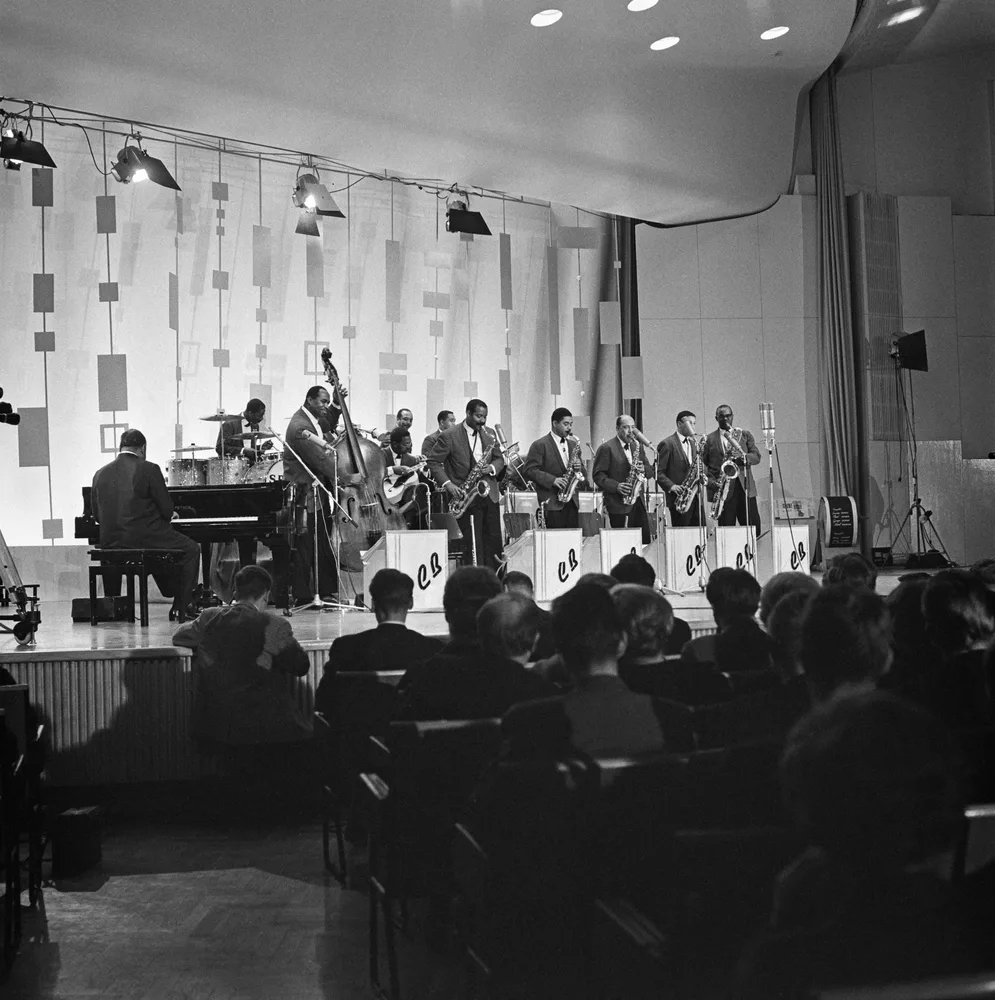
Count Basie and His Orchestra performing at the Helsinki Hall of Culture, April 25, 1962. Photo by an anonymous Hufvudstadsbladet staff photographer, Finnish Heritage Agency (JOKA Press Photo Archive) collection. CC BY 4.0 — Wikimedia Commons — https://commons.wikimedia.org/wiki/File:Count-Basie-Orch-1962.jpg

The Count Basie Orchestra grew directly out of the Kansas City territory-band scene of the early 1930s. Pianist William James Basie — born August 21, 1904, in Red Bank, New Jersey — joined bandleader Bennie Moten's Kansas City Orchestra in 1929, and stayed until Moten's sudden death in April 1935 following a botched tonsillectomy. Rather than fold into another leader's band, Basie assembled his own nine-piece group, initially billed as the Barons of Rhythm, built largely from Moten alumni: bassist Walter Page, drummer Jo Jones, alto saxophonist Buster Smith, tenor saxophonist Lester Young, trumpeters Oran "Hot Lips" Page and Joe Keyes, and blues shouter Jimmy Rushing. The band became the house group at Kansas City's Reno Club, broadcasting late-night sets over the radio — broadcasts during which, according to the band's own oft-repeated history, an announcer decided "Bill Basie" needed more stature next to bandleading peers like Duke Ellington and Earl Hines, and began introducing him on air as "Count" Basie. In 1936, producer and critic John Hammond heard one of those broadcasts by chance while scanning the radio dial and traveled to Kansas City to hear the band in person, becoming the connection that moved Basie's group out of the territory-band circuit entirely.
Hammond's advocacy brought the band to New York in 1936-37 and expanded it to a standard 13-piece lineup. Its first recordings for Decca were cut beginning in January 1937, and in March 1937 guitarist Freddie Green joined — the final piece of what would become, alongside Page and Jones, the "All-American Rhythm Section": a rhythm section built on Green's understated four-to-the-bar chordal comping, Page's smooth walking bass, and Jones's innovation of keeping time on the hi-hat and ride cymbal rather than the bass drum, producing a lighter, more forward-driving pulse than most big bands of the era. On top of that foundation, the Basie band built its identity on riff-based "head arrangements" — tunes worked out collectively in rehearsal and memorized rather than formally notated — a working method carried over directly from the Kansas City jam-session tradition. That approach produced the band's breakout hits: "One O'Clock Jump," recorded for Decca on July 7, 1937 and named for the hour it was typically played during the Reno Club's late-night broadcasts, and "Jumpin' at the Woodside" (1938). Jimmy Rushing was the band's featured blues vocalist through this period; Billie Holiday sang with the band briefly in 1937 but, tied to a rival label's contract, never recorded with it, and Helen Humes took over as featured vocalist in 1938.
The 1940s brought both wider ambition and real disruption. The band increasingly relied on outside arrangers — Andy Gibson, Buster Harding, Jimmy Mundy — moving its sound somewhat away from pure Kansas City riffing toward more polished ensemble writing. A recording ban from 1942 to 1944 hurt the band financially, and the wartime draft took two key members, drummer Jo Jones and tenor saxophonist Lester Young, in 1944; younger players including Buddy Rich, Illinois Jacquet, and Paul Gonsalves filled in. Economic pressure on big bands generally forced Basie to break up the full orchestra for stretches in 1948 and again from 1950 to 1952, leading a much smaller combo — at various points featuring Buddy Rich, Serge Chaloff, and Buddy DeFranco — before reassembling the full big band in 1952. That reconstituted group became known, informally, as the "New Testament" band, distinguishing it from the "Old Testament" swing-era orchestra of the 1930s-40s.
The New Testament band, powered by arrangers Neal Hefti, Ernie Wilkins, Frank Foster, and later Sammy Nestico, produced the records now most closely associated with the "Basie sound": Count Basie Swings, Joe Williams Sings (1955), which introduced vocalist Joe Williams and the hit "Every Day I Have the Blues" (later inducted into the Grammy Hall of Fame); April in Paris (recorded 1955-56, released 1957 on Verve); and Basie, recorded in October 1957 for Roulette and released in January 1958 — an album so identified with its mushroom-cloud cover art and "E=MC²" motif that it became universally known as The Atomic Mr. Basie, and which introduced the standard "Li'l Darlin'." The band toured internationally through this period, including Europe in 1954 and Japan in 1963, and recorded two studio collaborations with Frank Sinatra — Sinatra-Basie: An Historic Musical First (1962, arranged by Neal Hefti) and It Might As Well Be Swing (1964, arranged by Quincy Jones) — along with dates backing Ella Fitzgerald and Sarah Vaughan. Basie died April 26, 1984, in Hollywood, Florida, a few months after the release of his final studio album, 88 Basie Street (Pablo, 1984, arranged by Sammy Nestico), which won the Grammy for Best Jazz Instrumental Performance, Big Band that year.
The orchestra did not disband with its founder. Trumpeter and arranger Thad Jones led the band from 1985 to 1986, followed by saxophonist Frank Foster (1986-1995), Grover Mitchell (1995-2003), trombonist Bill Hughes (2003-2010), drummer Dennis Mackrel (2010-2013), and trumpeter Scotty Barnhart, who has directed the band since 2013. Under Barnhart the orchestra remains an active touring and recording unit; its 2023 album Basie Swings the Blues (Candid Records), pairing the orchestra with blues artists including Buddy Guy, Keb' Mo', and Shemekia Copeland, won the 2024 Grammy for Best Large Jazz Ensemble Album — extending a recording history, under one name, that by then spanned close to nine decades.
The Basie band's most durable contribution to jazz is really a rhythmic idea: the All-American Rhythm Section's shift toward a lighter, more forward-moving 4/4 pulse — Walter Page's steady walking bass, Freddie Green's spare, largely unamplified chordal guitar comping (famously not soloing, just keeping time), and Jo Jones's move of timekeeping onto the cymbals rather than the bass drum — became the template against which essentially every subsequent big-band and small-group rhythm section was measured. Basie's own piano style reinforced the same instinct toward economy: sparse, perfectly placed single notes and short phrases rather than dense chording, a "less is more" approach that let the band's riffs and soloists carry the weight. That combination of a supple, driving rhythm section under simple, punchy, often collectively-composed riffs — the "head arrangement" tradition inherited from Kansas City's competitive jam-session culture — defined the band's 1930s-40s sound and gave swing-era dancers and listeners alike an instantly identifiable groove. The 1950s-60s "New Testament" band, arranged by figures like Neal Hefti, Frank Foster, and later Sammy Nestico, translated that same riff-based sensibility into more fully notated, precision-drilled ensemble writing without losing its blues-rooted, riff-driven core — a sound so influential that "swinging" itself became loosely synonymous with the Basie band's particular brand of relaxed, hard-driving power, and one that shaped everything from Frank Sinatra's big-band vocal recordings to the working vocabulary of virtually every jazz big band that followed it.
- Count Basie Swings, Joe Williams Sings (1955, Clef Records) - Joe Williams's debut as the band's featured vocalist, producing the Grammy Hall of Fame hit "Every Day I Have the Blues." Spotify - Count Basie Swings - Joe Williams Sings Listen
- April in Paris (1955-56 recorded, 1957 release, Verve) - The title track became one of the band's signature numbers of the "New Testament" era. Spotify - April In Paris Listen
- Basie / "The Atomic Mr. Basie" (1957 recorded, 1958 release, Roulette) - Neal Hefti's arrangements and the album's mushroom-cloud cover made this the definitive statement of the Hefti-era band; introduced "Li'l Darlin'." Spotify - The Atomic Mr Basie Listen
- Sinatra-Basie: An Historic Musical First (1962, Reprise) - The first of two studio pairings with Frank Sinatra, arranged and conducted by Neal Hefti. Spotify - Sinatra-Basie: An Historic Musical First Listen
- 88 Basie Street (1984, Pablo Records) - Basie's final studio album, arranged by Sammy Nestico; won the 1984 Grammy for Best Jazz Instrumental Performance, Big Band. Spotify - 88 Basie Street Listen
- Basie Swings the Blues (2023, Candid Records) - The Scotty Barnhart-led current orchestra with guest blues artists including Buddy Guy and Shemekia Copeland; won the 2024 Grammy for Best Large Jazz Ensemble Album. Spotify - Basie Swings The Blues Listen
Count Basie Orchestra: Discography (Selected / Essential)
Identity confirmed via Discogs artist ID 253011 ("Count Basie Orchestra"), whose own profile note instructs that all releases credited to "Count Basie And His Orchestra" and "Count Basie Orchestra" be filed under this ID — distinct from the individual-artist entry for the pianist himself, Discogs ID 145262 ("Count Basie," realname William James Basie). Confirmed by cross-checking known personnel (extraartists credits) on specific releases against this ID rather than by name alone.
The band's recorded output runs from 1937 to the present across roughly 90 years, three named "eras" (the 1930s-40s "Old Testament" band, the 1950s-60s "New Testament" band, and the post-1984 continuation under a succession of directors), and, according to Discogs' own release count for this artist ID, more than 3,000 individual catalog entries (78s, singles, LPs, compilations, and reissues). Itemizing that full catalog is out of scope for this table; instead, this table selects one genuinely landmark release per major era — the record that critics, Grammy voters, and the band's own history most consistently point to — plus the single that gave the band its first hit and the two most recent Grammy-recognized releases from the current, Scotty Barnhart-led incarnation. Readers wanting the exhaustive catalog should consult the live Discogs artist page linked above.
As Leader
| Album/Single Title | Recording Date(s) | Release Date | Label | Catalog Number | Format(s) | Personnel | Role | Reissue History | Spotify | Buy | Notes |
|---|---|---|---|---|---|---|---|---|---|---|---|
| One O'Clock Jump / John's Idea | July 7, 1937, Decca studios (Decca matrix 62332; confirmed via Discography of American Historical Recordings, UC Santa Barbara) | 1937 | Decca | 1363 | Shellac, 10", 78 RPM | Count Basie and His Orchestra, the touring 13-piece lineup assembled after the band's move from Kansas City to New York — the riff was a Basie/band head arrangement, not individually charted, so no formal composer/arranger credit is listed | Leader | Endlessly anthologized on Basie compilation LPs and CDs across every decade since; not independently itemized here | Not confirmed for the original 1937 single specifically; later re-recordings and live versions are widely available on Spotify | — | The band's first true hit and the song that gave it a signature theme for the rest of its history; grew out of Reno Club jam sessions in Kansas City and was named for the hour it was usually played during the band's late-night radio broadcasts. Verified via Discogs release 5713918 (master 689949) and the Library of Congress National Recording Preservation Board's essay on the recording. |
| Count Basie Swings, Joe Williams Sings | May 17 and July 26, 1955, Fine Sound studio, New York City | 1955 | Clef Records | MG C-678 | Vinyl, LP, Album, Mono | Count Basie (piano, leader), Joe Williams (vocals, his recording debut as the band's featured singer), arrangements by Ernie Wilkins and Frank Foster; produced for Norman Granz's Clef label | Leader | Later reissued on Verve as Granz's labels consolidated; specific reissue catalog numbers not independently verified here | Spotify - Count Basie Swings - Joe Williams Sings | — | Introduced Joe Williams as the "New Testament" band's defining vocalist and produced the hit "Every Day I Have the Blues," later inducted into the Grammy Hall of Fame (1992). Verified via Discogs master 96858. |
| Basie (also widely known as The Atomic Mr. Basie) | October 21-22, 1957, Capitol Studios, New York | January 1958 | Roulette | R 52003 (mono) / SR 52003 (stereo) | Vinyl, LP, Album | Count Basie (piano), Thad Jones, Joe Newman, Snooky Young, Wendell Culley (trumpets), Henry Coker, Al Grey, Benny Powell (trombones), Marshal Royal (alto sax, clarinet), Frank Wess (alto/tenor sax, flute), Frank Foster, Eddie "Lockjaw" Davis (tenor sax), Charlie Fowlkes (baritone sax), Freddie Green (guitar), Eddie Jones (bass), Sonny Payne (drums); all arrangements and compositions by Neal Hefti; produced by Teddy Reig | Leader | Widely reissued on CD/streaming under the "Atomic Mr. Basie" title, the popular nickname earned by its mushroom-cloud cover art and the "E=MC²" motif printed on the sleeve; specific reissue catalog numbers not independently itemized here | Spotify - The Atomic Mr Basie | — | The signature album of the Hefti-arranged "New Testament" band and the record that introduced "Li'l Darlin'," one of the band's most enduring standards. Verified via Discogs master 303975, cross-checked against Wikipedia and jazzfuel.com for recording dates and personnel. |
| Sinatra-Basie: An Historic Musical First | October 1962, United Recording, Hollywood | December 10, 1962 | Reprise Records | F-1008 | Vinyl, LP, Album, Mono | Frank Sinatra (vocals), Count Basie and His Orchestra; arranged and conducted by Neal Hefti | Leader/Collaboration | Reissued as part of the box set Sinatra/Basie: The Complete Reprise Studio Recordings; specific later single-disc reissue catalog numbers not independently verified here | Spotify - Sinatra-Basie: An Historic Musical First | — | The first of two studio pairings with Frank Sinatra; the second, 1964's It Might As Well Be Swing (Reprise FS-1012), was arranged by Quincy Jones and recorded in Hollywood circa June 9-12, 1964. Verified via Discogs masters 144095 and 144056. |
| 88 Basie Street | 1983 | 1984 | Pablo Records | 2310-901 | Vinyl, LP, Album | Count Basie (piano, leader), full orchestra; arranged, composed, and conducted by Sammy Nestico; produced by Norman Granz | Leader | Widely reissued on CD as part of Pablo's Basie catalog; specific reissue catalog numbers not independently itemized here | Spotify - 88 Basie Street | — | Basie's last studio album released during his lifetime; won the 1984 Grammy for Best Jazz Instrumental Performance, Big Band. He died April 26, 1984, a few months after its release. Verified via Discogs master 375246. |
| Basie Swings the Blues | Not independently verified (recorded prior to September 2023 release) | September 15, 2023 | Candid Records | Not independently verified | CD, LP (Vinyl, opaque blue), Digital | The Count Basie Orchestra under musical director Scotty Barnhart, with guest vocalists/instrumentalists including Buddy Guy, Bobby Rush, Keb' Mo', Shemekia Copeland, Robert Cray, Charlie Musselwhite, Bettye LaVette, Ledisi, and George Benson; produced by Barnhart with John Burk and Steve Jordan | Leader/Collaboration | Not applicable — current release | Spotify - Basie Swings The Blues | — | Recorded to pair the present-day orchestra with major blues artists; won the 2024 Grammy for Best Large Jazz Ensemble Album, the band's first Grammy in the post-Basie era covered in depth here. A Discogs listing exists (release 28783597) but is flagged there as an "Unofficial Release," so catalog-number detail is not treated as confirmed. |
The full multi-decade catalog — every Decca, Okeh, Columbia, Vocalion, Clef/Verve, Roulette, Reprise, Pablo, and later-era release — is maintained on Discogs under artist ID 253011 and is not exhaustively reproduced here; the selections above are the era-defining landmarks per this project's scoping convention for long-running big-band catalogs.
- Walter Page - bassist, founding member of the All-American Rhythm Section, a Bennie Moten alumnus who followed Basie into the new band in 1935.
- Jo Jones - drummer, founding member of the All-American Rhythm Section; drafted in 1944, disrupting the wartime band.
- Freddie Green - guitarist, joined March 1937 and remained with the band for fifty years until his death in 1987; the rhythm section's defining chordal comper.
- Lester Young - tenor saxophonist and key original soloist in the 1930s band; also drafted in 1944.
- Jimmy Rushing - featured blues vocalist through the 1930s-40s "Old Testament" band.
- Joe Williams - featured vocalist beginning 1954-55; his "Every Day I Have the Blues" became a signature hit of the "New Testament" era.
- Neal Hefti - arranger behind Basie ("The Atomic Mr. Basie," 1958), Basie Plays Hefti (1958), and Sinatra-Basie: An Historic Musical First (1962).
- Sammy Nestico - arranger/composer/conductor on many of the band's later Basie-era and Pablo-label recordings, including 88 Basie Street (1984).
- Frank Foster - saxophonist and arranger with the band from the 1950s; later served as its musical director from 1986 to 1995.
- Thad Jones - trumpeter and arranger with the band through the 1950s-60s; served as its first post-Basie musical director, 1985-1986.
- Quincy Jones - arranged and conducted the band's 1964 Frank Sinatra collaboration, It Might As Well Be Swing.
- Scotty Barnhart - trumpeter and the orchestra's current musical director since 2013, leading it through its 2024 Grammy win for Basie Swings the Blues.

More Big Band Artists
See all 202 Big Band artists →More American Jazz Artists
See all 567 American artists →- Discogs: Count Basie Orchestra (artist 253011) — identity and release-crediting convention verified via Discogs API
- Discogs: Count Basie (artist 145262) — checked to confirm the individual-vs-band artist ID split, via Discogs API
- Discogs: Count Basie Swings, Joe Williams Sings (master 96858) — label, catalog number, arranger credits verified via Discogs API
- Discogs: Basie / "The Atomic Mr. Basie" (master 303975) — label and catalog number verified via Discogs API; recording dates and full personnel cross-checked via WebSearch (Wikipedia, jazzfuel.com)
- Discogs: Sinatra-Basie: An Historic Musical First (master 144095) and It Might As Well Be Swing (master 144056) — verified via Discogs API
- Discogs: 88 Basie Street (master 375246) — verified via Discogs API
- Discogs: One O'Clock Jump / John's Idea (release 5713918 / master 689949) — catalog number verified via Discogs API
- Wikipedia: Count Basie Orchestra — formation history, post-1984 directorial succession, personnel across eras
- Wikipedia: One O'Clock Jump — recording date and Reno Club origin
- Library of Congress National Recording Preservation Board: "One O'Clock Jump"—Count Basie and His Orchestra (1937)
- Discography of American Historical Recordings, UC Santa Barbara: Decca matrix 62332, "One o'clock jump" — recording date/matrix confirmation
- WRTI: The Story About How Count Basie Got His Nickname
- The Syncopated Times: Count Basie, Part 1 – The Old Testament Years and Part 2 – The New Testament Years
- Wikipedia: April in Paris (album)
- Wikipedia: Sinatra–Basie: An Historic Musical First
- FSU News: FSU music professor, internationally renowned jazz trumpeter and Count Basie Orchestra director wins Grammy — Scotty Barnhart, Basie Swings the Blues, 2024 Grammy
- WBGO: The Count Basie Orchestra's new album 'Basie Swings the Blues' — label (Candid Records) and release date confirmation
- Discogs: The Count Basie Orchestra – Basie Swings The Blues (release 28783597) — flagged on Discogs as an "Unofficial Release," noted as such
- Spotify Web API (Client Credentials flow) — used to verify every album's artist name, title, and release year against the corresponding Discogs entry before including a Spotify link in this profile
- This project's own already-built profiles for John Clayton, Jeff Hamilton, Tommy Turrentine, Chico Hamilton, Bruce Harris, and Sarah Vaughan — source of the Related Artists connections; each file's own citations are the primary source for its specific claim