 JAZZPROFILES lives in the music 1,572 Jazz Artists fully Profiled!
 Bud Powell
Last updated September 7, 2026
Listen on Spotify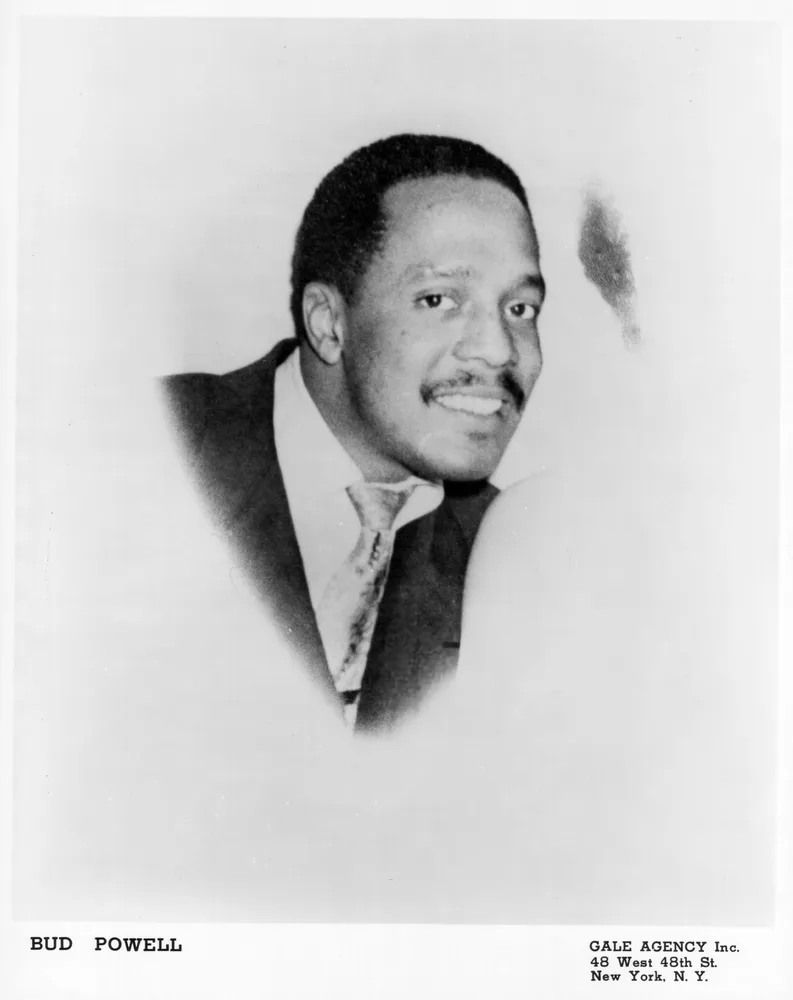
Bud Powell, publicity photo distributed by the Gale Agency, New York, 1953 Public Domain (published in the United States 1931-1977 without a copyright notice) — Wikimedia Commons — https://commons.wikimedia.org/wiki/File:Bud_Powell_(1953_publicity_photo).jpg
.jpg)
Earl Rudolph "Bud" Powell was born September 27, 1924, in Harlem, New York (his birth certificate erroneously lists 1922), the son of stride pianist William Powell and grandson of a flamenco guitarist. He began piano lessons at five, learned church organ as an altar boy, and by his teens was absorbing the harmonic ideas of Fats Waller and Art Tatum, whom he considered his idol. On 52nd Street and at Minton's Playhouse he fell under the wing of Thelonious Monk, who introduced him to the after-hours bebop scene and later dedicated the composition "In Walked Bud" to him. In 1943 Powell joined trumpeter Cootie Williams's swing orchestra, where he pushed the band toward the new music, at one point persuading Williams to record Monk's "'Round Midnight," its first appearance on record; by the time he left Williams's band around 1944 he was serving as its musical director and arranger.
Powell's career was shadowed from young adulthood by a January 1945 beating by railroad and city police in Philadelphia, after a drunken altercation following a gig with Williams's band. The head injuries left him with severe recurring headaches and began a cycle of institutionalization: he was committed to Bellevue Hospital and then Creedmoor State Hospital, the first of several extended psychiatric stays that recurred for the rest of his life, more than one including electroconvulsive therapy. He kept recording regardless: in January 1947 he cut his first date as a leader, the trio session issued as Bud Powell Trio on Roost with Curley Russell and Max Roach, and that May Charlie Parker chose him as pianist for a Savoy Records quintet session with Miles Davis, Tommy Potter, and Roach, the only studio recording the two men made together under Parker's own name. A bar fight later that year sent him back to Creedmoor for eleven months.
His most productive and influential period followed. An August 8, 1949, Blue Note session with Fats Navarro, Sonny Rollins, Tommy Potter, and Roy Haynes, combined with a May 1, 1951, trio date with Curley Russell and Max Roach, became The Amazing Bud Powell, Vol. 1, introducing the originals "Dance of the Infidels," "Bouncing with Bud," "Un Poco Loco," and "Parisian Thoroughfare." A second Blue Note trio session on August 14, 1953, with George Duvivier and Art Taylor, yielded Vol. 2 and the brooding "Glass Enclosure," written, by most accounts, out of frustration at being confined to guardian Oscar Goodstein's apartment. On May 15, 1953, Powell joined Dizzy Gillespie, Charlie Parker (billed as "Charlie Chan" for contractual reasons), Charles Mingus, and Max Roach for the Massey Hall concert in Toronto, which Mingus's own Debut Records issued as Jazz at Massey Hall, still cited as one of the great live jazz recordings; a trio segment by Powell, Mingus, and Roach was issued separately as Jazz at Massey Hall, Vol. 2. New York State declared Powell mentally incompetent that same February, placing him under Goodstein's guardianship for years to come.
Powell kept recording steadily through the mid-1950s for Norgran, Clef, and Verve (Piano Interpretations by Bud Powell, recorded April 1955) and for RCA Victor (Swingin' with Bud, cut February 1957 with Duvivier and Taylor), while returning to Blue Note for Vol. 3: Bud! (1957, with Paul Chambers and trombonist Curtis Fuller), Vol. 4: Time Waits (1958), and Vol. 5: The Scene Changes (1958). A January 1956 farewell engagement at Boston's Storyville club, on his last night there, brought him a lasting friendship with a young Japanese pianist, Toshiko Akiyoshi, who had already named him alongside Tatum as the pianist she most wanted to hear. His brother and fellow pianist Richie Powell was killed alongside trumpeter Clifford Brown in a June 1956 car accident, a loss that hit Powell hard and coincided with the end of his Verve contract that September.
In the spring of 1959 Powell relocated to Paris, settling at the Hotel La Louisiane and quickly finding steady club work. With bassist Pierre Michelot and drummer Kenny Clarke he formed the "Three Bosses" trio, house band at the Blue Note club in Paris, and worked across Europe: a December 1959 concert with Art Blakey's Jazz Messengers became Paris Jam Session; a 1960 tour with Oscar Pettiford and Clarke took in the Essen Jazz Festival, later issued as The Essen Jazz Festival Concert; and July 1960 brought a filmed appearance with Charles Mingus's band at Antibes. In December 1961, Cannonball Adderley, then producing for Columbia, brought Powell, Michelot, and Clarke into a Paris studio for two sessions two days apart: A Tribute to Cannonball (with tenor saxophonist Don Byas, not issued until 1979) and A Portrait of Thelonious (four Monk compositions among its eight tracks, not released until 1965). In February 1963, with financial backing arranged by Frank Sinatra and production by Duke Ellington, he recorded the trio album Bud Powell in Paris for Reprise. Tuberculosis forced a long recuperation at the Bouffémont sanatorium outside Paris in 1963; pianist and future biographer Francis Paudras, who had befriended Powell years earlier, helped nurse him back to health.
Paudras brought Powell back to New York in August 1964 for a widely noted engagement at Birdland, but his health deteriorated again that fall and, after briefly going missing, he chose to remain in New York with Frances Barnes, mother of his daughter Celia, rather than return to Paris. A handful of further sessions followed, most unreleased in his lifetime; only Ups 'n Downs, recorded in 1964-65, reached listeners, and only after his death. Bud Powell passed away from tuberculosis, malnutrition, and the effects of alcoholism on July 31, 1966, in New York, at age 41. Bands led by Barry Harris, with musicians including Lee Morgan and Billy Higgins, marched through Harlem behind his funeral procession that August.
Powell translated Charlie Parker and Dizzy Gillespie's horn-based bebop vocabulary onto the piano, developing a spare, hard-driving left hand that voiced bare root-and-seventh or root-and-tenth shapes to leave room for right-hand lines running with the speed, chromaticism, and rhythmic asymmetry of a saxophone; critic Bill Cunliffe called him simply the first pianist to make Parker's language work at the keyboard. He carried Thelonious Monk's harmonic daring into the jazz mainstream even as his own catalog drifted further from Monk's angularity, and hospitalization-era pieces like "Glass Enclosure" show a more fragmented, interior side of his writing that later critics traced to Monk's influence and to his years of confinement. Herbie Hancock called him "the foundation out of which stemmed the whole edifice of modern jazz piano," and Bill Evans named him, unequivocally, his single greatest influence; the list of pianists who absorbed his vocabulary directly runs from Wynton Kelly, Horace Silver, and McCoy Tyner through Chick Corea and Keith Jarrett. Toshiko Akiyoshi is a direct case in point: she taught herself Powell's vocabulary by ear off records in postwar Japan, years before she ever heard him in person, and it became the foundation of her own bebop piano style and her ticket into Tokyo's best working bands; the two later became genuine friends after meeting at his January 1956 Storyville engagement, and she contributed liner notes to the compilation The Complete Bud Powell on Verve and visited him during his final illness in 1965.
- The Amazing Bud Powell, Vol. 1 (rec. 1949 & 1951, rel. 1952/1955, Blue Note) - His most celebrated leader date, combining an August 1949 quintet session with Fats Navarro and Sonny Rollins and a 1951 trio date; introduced "Un Poco Loco," "Parisian Thoroughfare," and "Dance of the Infidels." Spotify - The Amazing Bud Powell: Vol. 1 (RVG Edition)
- The Genius of Bud Powell (rec. 1950-51, rel. 1956, Mercury/Clef, orig. issued as Bud Powell's Moods) - Trio sides with Ray Brown and Buddy Rich plus unaccompanied solo piano, later a Rolling Stone Jazz Record Guide five-star pick. Spotify - The Genius of Bud Powell (Expanded Edition)
- Jazz at Massey Hall (live, May 15, 1953, Debut Records) - The famous Toronto quintet concert with Dizzy Gillespie, Charlie Parker (billed as "Charlie Chan"), Charles Mingus, and Max Roach; marketed on release as "the greatest jazz concert ever." Spotify - Jazz At Massey Hall Listen
- The Amazing Bud Powell, Vol. 3: Bud! (1957, Blue Note) - Quartet date with Paul Chambers and trombonist Curtis Fuller, including the Bach-quoting "Bud on Bach." Spotify - The Amazing Bud Powell, Vol. 3: Bud! Listen
- The Scene Changes: The Amazing Bud Powell, Vol. 5 (rec. December 1958, rel. 1959, Blue Note) - His last Blue Note leader date, with Paul Chambers and Art Taylor; introduced "Cleopatra's Dream." Spotify - The Scene Changes (Remastered) Listen
- A Portrait of Thelonious (rec. December 17, 1961, rel. 1965, Columbia) - A Paris trio session with Pierre Michelot and Kenny Clarke, produced by Cannonball Adderley and built largely from Thelonious Monk compositions. Spotify - A Portrait of Thelonious Listen
- Bud Powell in Paris (rec. February 1963, rel. 1964, Reprise Records) - A trio date funded by Frank Sinatra and produced by Duke Ellington. Spotify - Bud Powell In Paris Listen
Bud Powell: Full Discography
Identity confirmed via the live Discogs API — artist ID 29992 ("Bud Powell," realname Earl Rudolph Powell, born September 27, 1924, Harlem, died July 31, 1966, New York, matching every biographical source). Discogs credits Powell on 2,351 releases total across 24 API pages (267 in a "Main"/leader role, 1,416 sideman "Appearance" credits, 608 track-level "TrackAppearance" credits, plus 9 unofficial releases). Powell is one of the most heavily reissued and repackaged figures in the jazz catalog — much of that 267-release "Main" total is compilations, box sets, and repeated CD/vinyl reissues of a comparatively compact original body of studio and live recordings, so, per this sweep's standing practice for prolific/heavily reissued catalogs, the table below curates the roughly 20 most significant original sessions rather than itemizing every repackaging. Group-billing entities checked and folded in where they hold his own leader/co-leader work: The Bud Powell Trio (317908, 867538, 552865), Bud Powell Quintet (1972906), Bud Powell's Modernists (446633), Bud Powell Quartet (3987649), Sonny Stitt-Bud Powell Quartet (552741), and the Don Byas-Bud Powell entities (3508182, 6343947) — none surfaced a leader date missing from the personal artist ID.
As Leader / Co-Leader
| Album Title | Recording Date(s) | Release Date | Label | Catalog Number | Format(s) | Personnel | Role | Reissue History | Spotify | Buy | Notes |
|---|---|---|---|---|---|---|---|---|---|---|---|
| Bud Powell Trio | Recorded January 1947, New York | 1947 | Roost Records | 10" LP | Vinyl, 10", Album, Mono | Bud Powell (piano), Curley Russell (bass), Max Roach (drums) | Leader | Repeatedly repackaged on Roost/Roulette compilations through the 1950s-60s | Not confirmed on Spotify under this exact title | — | Powell's recorded debut as a leader |
| Piano Solos / Piano Solos No. 2 (later compiled as Jazz Giant) | February 23, 1949 (Ray Brown, Max Roach) and February 1950 (Curley Russell, Max Roach) | 1950 (10" LPs); compiled as Jazz Giant on Norgran MG N-1063, 1956 | Norgran / Mercury | MG 35012 / MGC 502 / MGC 507; Jazz Giant: Norgran MG N-1063 | Vinyl, 10" (1950); 12" LP compilation (1956) | Bud Powell (piano), Ray Brown or Curley Russell (bass), Max Roach (drums) | Leader | Reissued on Verve; remastered CD, 2001 (Verve Master Edition) | Spotify - Jazz Giant | — | Two Norman Granz-produced trio/solo sessions later compiled into one LP |
| Bud Powell's Moods (later retitled The Genius of Bud Powell) | July 1, 1950 (trio, with Ray Brown/Buddy Rich) and February 1951 (solo piano) | 1956 | Mercury / Clef | Clef MGC 610 | Vinyl, LP, Album, Mono | Bud Powell (piano), Ray Brown (bass, July 1950 session only), Buddy Rich (drums, July 1950 session only) | Leader | Retitled and reissued as The Genius of Bud Powell, Clef MGC 739 and Verve MGV 8115; expanded CD reissue, Verve, 1992 | Spotify - The Genius of Bud Powell (Expanded Edition) | — | Retitle trap: two different Bud Powell albums have carried the name "Bud Powell's Moods" at different times; this one is the Mercury/Clef 1950-51 material, not the later Norgran album of the same name |
| The Amazing Bud Powell (Volume 1) | August 8, 1949 (quintet/trio) and May 1, 1951 (trio/solo) | April 1952 (10", BLP 5003); 12" reissue 1955 | Blue Note | BLP 1503 (12"); orig. BLP 5003 (10") | Vinyl, LP, Album, Mono | Bud Powell (piano), Fats Navarro (trumpet), Sonny Rollins (tenor sax), Tommy Potter (bass), Roy Haynes (drums) [1949]; Curley Russell (bass), Max Roach (drums) [1951] | Leader | Reissued multiple times, incl. Rudy Van Gelder remaster, 2001 | Spotify - The Amazing Bud Powell: Vol. 1 (RVG Edition) | — | Introduced "Un Poco Loco," "Parisian Thoroughfare," "Dance of the Infidels," and "Bouncing with Bud"; widely regarded as his single most important leader date |
| The Amazing Bud Powell, Volume 2 | Recorded August 14, 1953, WOR Studios, New York | 1954 | Blue Note | BLP 5041 | Vinyl, LP, 10", Album, Mono | Bud Powell (piano), George Duvivier (bass), Art Taylor (drums) | Leader | Later reissued at 12" length combined with other material | Spotify - The Amazing Bud Powell, Vol. 2 (1989 Version) | — | Includes "Glass Enclosure," widely read as reflecting his confinement under guardian Oscar Goodstein |
| Jazz at Massey Hall | Live, May 15, 1953, Massey Hall, Toronto | 1953 | Debut Records | DEB-124 | Vinyl, LP, Album | Bud Powell (piano), Dizzy Gillespie (trumpet), Charlie Parker, billed as "Charlie Chan" for contractual reasons (alto sax), Charles Mingus (bass), Max Roach (drums) | Co-leader (quintet billing) | The trio-only segment (Powell/Mingus/Roach) issued separately as Jazz at Massey Hall, Vol. 2; numerous later CD compilations combine both | Spotify - Jazz At Massey Hall | — | Produced by Charles Mingus for his own Debut label; marketed at the time as "the greatest jazz concert ever" |
| Piano Interpretations by Bud Powell | Recorded April 25 & 27, 1955, Fine Sound Studios, New York | 1956 | Norgran | MGN 1077 | Vinyl, LP, Album, Mono | Bud Powell (piano), George Duvivier (bass), Art Taylor (drums) | Leader | Reissued on Verve, MGV 8167, 1957 | Not confirmed on Spotify under this exact title (tracks appear on later compilations) | — | Includes "Crazy Rhythm" and George Shearing's "Conception" |
| Swingin' with Bud | Recorded February 11, 1957, New York | 1958 | RCA Victor | LPM 1507 | Vinyl, LP, Album, Mono | Bud Powell (piano), George Duvivier (bass), Art Taylor (drums) | Leader | Reissued on CD, RCA, 1995; also collected on The Complete RCA Trio Sessions | Not confirmed on Spotify under this exact title (tracks appear on The Complete RCA Trio Sessions) | — | His only leader session for RCA Victor |
| The Amazing Bud Powell, Vol. 3: Bud! | Recorded August 3, 1957, Van Gelder Studio, Hackensack NJ | 1957 | Blue Note | BLP 1571 | Vinyl, LP, Album, Mono | Bud Powell (piano), Paul Chambers (bass), Art Taylor (drums), Curtis Fuller (trombone, selected tracks) | Leader | Reissued on CD | Spotify - The Amazing Bud Powell, Vol. 3: Bud! | — | Includes "Bud on Bach," quoting C.P.E. Bach's "Solfeggietto" |
| Time Waits: The Amazing Bud Powell, Vol. 4 | Recorded May 6, 1958, Van Gelder Studio, Hackensack NJ | 1958 | Blue Note | BLP 1598 | Vinyl, LP, Album, Mono | Bud Powell (piano), Sam Jones (bass), "Philly" Joe Jones (drums) | Leader | Reissued on CD | Spotify - Time Waits: The Amazing Bud Powell, Vol. 4 | — | Introduced the title track and "John's Abbey" |
| The Scene Changes: The Amazing Bud Powell, Vol. 5 | Recorded December 29, 1958, Van Gelder Studio, Hackensack NJ | 1959 | Blue Note | BLP 4009 | Vinyl, LP, Album, Mono | Bud Powell (piano), Paul Chambers (bass), Art Taylor (drums) | Leader | Reissued on CD, incl. Rudy Van Gelder remaster | Spotify - The Scene Changes (Remastered) | — | Final Blue Note leader date; introduced "Cleopatra's Dream" |
| Paris Jam Session | Live, December 18, 1959, Théâtre des Champs-Élysées, Paris | 1961 | Fontana (France) | 660.234 MR | Vinyl, LP, Album | Bud Powell (piano, guest), Art Blakey (drums), Barney Wilen (tenor sax), and the Jazz Messengers | Co-leader / guest (billed to Art Blakey, Bud Powell, Barney Wilen and the Jazz Messengers) | Reissued on CD as part of Verve's "Jazz in Paris" series | Spotify - Paris Jam Session | — | Powell sits in as guest on Blakey's Paris engagement |
| The Essen Jazz Festival Concert | Live, April 2, 1960, Grugahalle, Essen, Germany | 1988 (first release) | Black Lion | Not confirmed | LP / CD | Bud Powell (piano), Oscar Pettiford (bass), Kenny Clarke (drums), Coleman Hawkins (tenor sax, selected tracks) | Leader | First released nearly three decades after the performance | Not confirmed on Spotify under this exact title | — | Documents Powell's 1960 European tour with Pettiford and Clarke |
| A Tribute to Cannonball | Recorded December 15, 1961, Studio Charlot, Paris | March 1979 | Columbia | Not confirmed | Vinyl, LP | Don Byas (tenor sax), Bud Powell (piano), Pierre Michelot (bass), Kenny Clarke (drums), Idrees Sulieman (trumpet, 4 tracks) | Co-leader (billed to Don Byas / Bud Powell) | None found; first issued 18 years after recording | Not confirmed on Spotify | — | Produced by Cannonball Adderley for Columbia; dedicated to Adderley, who produced this session and A Portrait of Thelonious two days later |
| A Portrait of Thelonious | Recorded December 17, 1961, Studio Charlot, Paris | 1965 | Columbia | CS 9017 | Vinyl, LP | Bud Powell (piano), Pierre Michelot (bass), Kenny Clarke (drums) | Leader | None found | Spotify - A Portrait of Thelonious | — | Four tracks are Thelonious Monk compositions; produced by Cannonball Adderley |
| Bud Powell in Paris | Recorded February 1963, Paris | 1964 | Reprise Records | R-6098 | Vinyl, LP, Album, Mono | Bud Powell (piano), Gilbert Rovère (bass), "Kansas" Fields (drums) | Leader | Reissued on CD (SHM), 2016 | Spotify - Bud Powell In Paris | — | Funded by Frank Sinatra; produced by Duke Ellington |
| The Return of Bud Powell | Recorded September 1964, New York | 1964/1969 | Roulette | SR-52115 | Vinyl, LP, Stereo | Bud Powell (piano), John Ore (bass), J.C. Moses (drums) | Leader | None found | Not confirmed on Spotify under this exact title | — | Recorded shortly after Powell's return to New York; session marked by friction with drummer J.C. Moses per contemporary accounts |
| Ups 'n Downs | Recorded 1964-65, New York | 1972 | Mainstream Records | MRL 348 | Vinyl, LP | Bud Powell (piano); bass and drums largely uncredited on the Discogs release entry | Leader | Remastered CD reissue, Mainstream, 1991 | Not confirmed on Spotify under this exact title | — | The only recording from Powell's final New York sessions issued in any form, and only posthumously |
As Sideman (selected major credits)
| Year | Project (Leader) | Title | Label | Catalog | Role | Notes |
|---|---|---|---|---|---|---|
| 1947 | Charlie Parker | Savoy quintet session (issued on various Charlie Parker Savoy compilations) | Savoy Records | Not confirmed | Piano | Recorded May 8, 1947, with Miles Davis, Tommy Potter, Max Roach; the only studio session Parker and Powell made together under Parker's own name |
| 1950 | Charlie Parker / Fats Navarro | One Night in Birdland (live) | Various (posthumous release) | Not confirmed | Piano | Live document from shortly before Navarro's July 1950 death |
| 1963 | Dizzy Gillespie | Dizzy Gillespie and the Double Six of Paris | Philips | Not confirmed | Piano (selected tracks) | Recorded July 1963 in Paris with the Three Bosses (Michelot, Clarke) backing Gillespie and the vocal group Les Double Six |
| 1960 | Charles Mingus | Antibes Jazz Festival (filmed, various releases) | Various | Not confirmed | Piano (guest) | Filmed July 1960 appearance with Mingus's band, including Eric Dolphy and Booker Ervin |
| 1963 | Dexter Gordon | Our Man in Paris | Blue Note | BLP 4146 | Piano | Recorded May 23, 1963, with Pierre Michelot and Kenny Clarke; rated among the top entries in several major jazz guides |
| 1963-64 | Johnny Griffin | Holidays in Edenville (live) | Mythic Sound | Not confirmed | Piano | Live engagement in Jullouville, France; released posthumously, 1989 |
Powell's Discogs sideman log (1,416 "Appearance" credits plus 608 track-level credits) is dominated by reissue and compilation churn rather than distinct sessions — hundreds of the "Appearance" credits are repeated CD/streaming-era repackagings of the same handful of 1940s-60s studio and broadcast recordings under dozens of different compilation titles (The Bebop Boys, Early Buds, Young Bud, the various "Classics" and "Jazz Archive" label series, among many others). This table lists a representative set of the sideman dates with the most documented historical significance; it is not exhaustive.
- Thelonious Monk - mentor and lifelong friend from the early 1940s Minton's/Monroe's Uptown House scene; Monk dedicated "In Walked Bud" to him and was among the visitors at his deathbed in 1966. Already covered in his own JazzProfiles.com profile.
- Max Roach - drummer on more of Powell's essential sessions than anyone else, from the 1947 Roost debut through the 1949-51 Blue Note dates and the 1953 Massey Hall concert.
- Charles Mingus - bassist on the Massey Hall trio segment and the producer whose Debut Records label issued the concert; the two also shared a bandstand at the 1960 Antibes festival.
- Dizzy Gillespie and Charlie Parker - co-headliners of the 1953 Massey Hall concert; Powell had first recorded with Parker in May 1947, for a Savoy Records session under Parker's name.
- George Duvivier - bassist on Vol. 2, Piano Interpretations by Bud Powell, and Swingin' with Bud, among Powell's most frequent studio partners of the mid-1950s.
- Paul Chambers and Curtis Fuller - featured on Vol. 3: Bud! (1957).
- Oscar Pettiford - toured Germany and Scandinavia with Powell in 1960, including the Essen Jazz Festival.
- Cannonball Adderley - produced both of Powell's December 1961 Paris sessions for Columbia, A Tribute to Cannonball and A Portrait of Thelonious.
- Duke Ellington - produced Bud Powell in Paris (1963) for Reprise.
- Art Blakey - fronted the Jazz Messengers on the December 1959 Paris concert released as Paris Jam Session, with Powell sitting in.
- Barry Harris - among those who tried to arrange Powell's return to France in 1964, and led the band at his funeral.
- Richie Powell - younger brother and fellow pianist; killed alongside Clifford Brown in the June 1956 car accident, a loss that struck Bud hard, though the two are not known to have recorded together.
More Bebop Artists
See all 166 Bebop artists →More American Jazz Artists
See all 567 American artists →- Wikipedia: Bud Powell
- Wikipedia: The Genius of Bud Powell
- Wikipedia: Jazz Giant
- Wikipedia: Jazz at Massey Hall
- Wikipedia: The Amazing Bud Powell
- Wikipedia: The Amazing Bud Powell, Vol. 2
- Wikipedia: Piano Interpretations by Bud Powell
- Wikipedia: Swingin' with Bud
- Wikipedia: A Portrait of Thelonious
- Wikipedia: A Tribute to Cannonball
- Wikipedia: Bud Powell in Paris
- Wikipedia: Paris Jam Session
- Discogs: Bud Powell (artist 29992)
- AllMusic: Bud Powell biography