 JAZZPROFILES lives in the music 1,572 Jazz Artists fully Profiled!
 Joe Zawinul
Last updated August 30, 2026
Listen on Spotify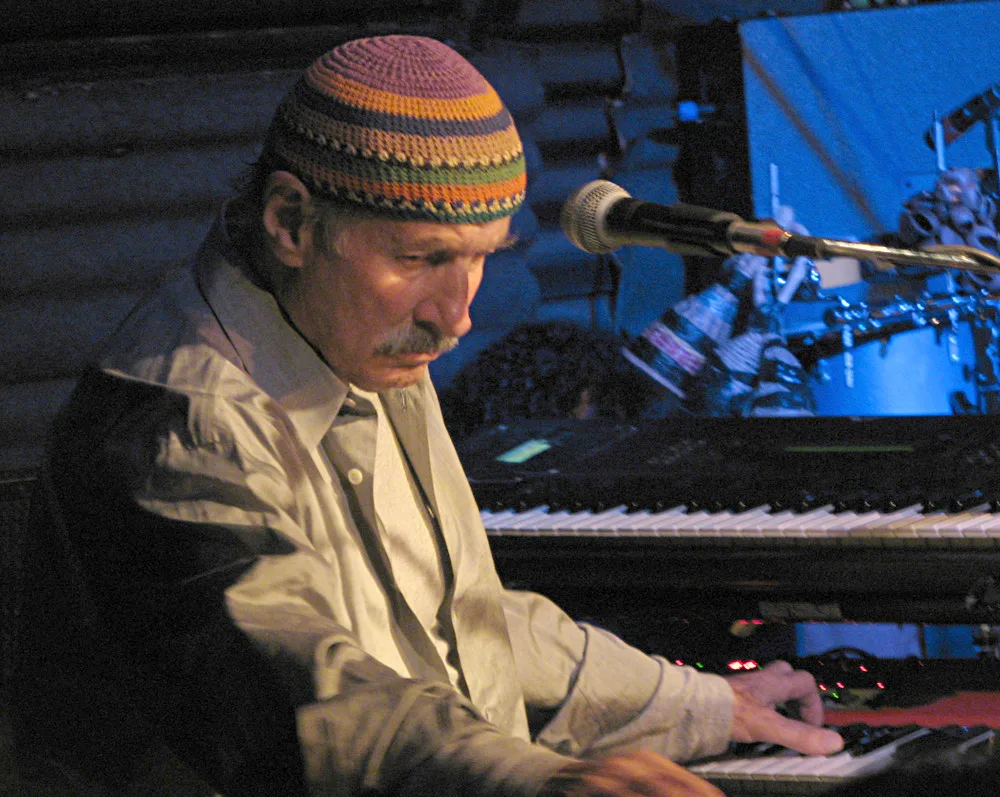
Joe Zawinul performing live in Freiburg, Germany, March 28, 2007 CC BY-SA 3.0 — Wikimedia Commons — photographer Alex Ex
Joe Zawinul started on the accordion at six, playing with his family in Vienna, then moved into classical piano, violin, and clarinet at the Vienna Conservatory. He was still a teenager working the Austrian jazz scene by the early 1950s, playing with saxophonist Hans Koller from 1952 and later fronting his own groups alongside high-profile Austrian bands including the Fatty George band and the Austrian All Stars.
In 1958 he won a scholarship to Berklee College of Music in Boston. He left Vienna on January 2, 1959, crossed the Atlantic by ship, and arrived in New York with his scholarship letter and $800 in savings. He lasted one week at Berklee before leaving to join bandleader Maynard Ferguson's touring band. From there he worked behind vocalist Dinah Washington before Cannonball Adderley hired him as his quintet's pianist in 1961.
Zawinul spent nine years with Adderley, and it was there that he wrote the song that changed his career. "Mercy, Mercy, Mercy," recorded live at a Los Angeles club in October 1966, became a surprise hit the following February: No. 11 on the Billboard Hot 100, No. 2 on the Soul chart. A jazz combo playing a jazz composer's tune on pop radio, years before "crossover" was a genre label anyone used on purpose.
Miles Davis took notice. In the winter of 1968 into 1969, Davis brought Zawinul into the sessions for "In a Silent Way," and Zawinul wrote the title track himself. Davis called on him again for "Bitches Brew," where Zawinul's composition "Pharaoh's Dance" opens the album. Both records are usually credited with inventing jazz fusion outright, and Zawinul was one of the writers in the room, not just a hired hand at the keyboard.
He co-founded Weather Report with Wayne Shorter and bassist Miroslav Vitous in November 1970. As the band's lineup rotated through the decade, Zawinul became its primary composer and creative director, and an increasingly serious student of electronic sound: he was among the first jazz musicians to adopt the electric piano, then moved to the Fender Rhodes with a wah-wah pedal, and by 1971 had become one of the most committed users of the ARP 2600 synthesizer in any genre. "I hear the Moog, it's immediately the Moog," he once said of his preference. "With the Arp I can do things that will fool the heck out of you... to me it's a much more natural sound." That instrument carried Weather Report's sound through "Mysterious Traveller," "Tale Spinnin'," "Black Market," and 1977's "Heavy Weather," whose "Birdland" reached No. 30 on the Billboard pop chart, went on to sell over a million copies, and earned Zawinul a Grammy nomination for Best Instrumental Composition. It entered the Grammy Hall of Fame in 2010.
Weather Report dissolved in 1986 after Zawinul and Shorter parted ways. Zawinul toured solo, then formed the short-lived Weather Update before settling into the Zawinul Syndicate in 1988, a band that leaned further into African and Latin rhythm through bassists Gerald Veasley and later Richard Bona. Grammy nominations followed again for "My People" (1996) and the live double album "World Tour" (1998). Down Beat's readers voted him Best Electric Keyboardist 28 times over his career, and named him Electric Keyboardist of the Year in 2005; the magazine's critics inducted him into its Hall of Fame posthumously in 2008. Austria recognized him with two Amadeus Austrian Music Awards and the Hans Koller Prize for lifetime achievement in 2001, and named him the country's official goodwill ambassador to 17 African nations.
Zawinul passed away in his native Vienna on September 11, 2007, at 75, after a rare form of skin cancer caught up with him not long after he finished a five-week European tour. He was still on the road right up to the end, a keyboardist who spent nearly five decades making the case, one hit at a time, that electric jazz could still be jazz.
Zawinul's playing drew on the world and ethnic rhythms he absorbed across a career that ran from Vienna's postwar jazz clubs to African, Latin American, and Middle Eastern collaborators in the Zawinul Syndicate era. He was a sound-effects hunter as much as a melodist, constantly chasing new timbres rather than settling into one electric-keyboard voice: Wurlitzer, then Fender Rhodes with a wah-wah pedal and Mutron phaser, then dual ARP 2600 synthesizers toured nightly through Weather Report's mid-1970s run. Critics and peers place him at the center of jazz fusion's origin point precisely because his writing (on "Mercy, Mercy, Mercy," "In a Silent Way," "Pharaoh's Dance," and "Birdland") kept melody and hook at the front even as the instrumentation got more radical, the exact trait that let his music cross over to pop radio without losing its jazz identity.
- Mercy, Mercy, Mercy! Live at "The Club" (1967, The Cannonball Adderley Quintet, Capitol) - the song that proved a jazz composer could write a pop hit; No. 11 Billboard Hot 100. Spotify - Mercy, Mercy, Mercy Listen · Buy
- In a Silent Way (1969, Miles Davis, Columbia) - Zawinul wrote the title track for one of the two albums that launched jazz fusion. Spotify - In a Silent Way Listen · Buy
- Bitches Brew (1970, Miles Davis, Columbia) - opens with Zawinul's "Pharaoh's Dance." Spotify - Bitches Brew Listen · Buy
- Heavy Weather (1977, Weather Report, Columbia) - "Birdland," Zawinul's biggest hit as a bandleader; platinum-selling, Grammy Hall of Fame 2010. Spotify - Heavy Weather Listen · Buy
- My People (1996, Jms / CREAM Records) - Grammy-nominated, the Zawinul Syndicate era at its most internationally minded. Spotify - My People Listen · Buy
Joe Zawinul — Full Discography
Verified against the Discogs API (Joe Zawinul, artist ID 56960).
Leader / Solo Discography
| Album | Year | Label | Personnel | Notes | Listen | Buy |
|---|---|---|---|---|---|---|
| Money in the Pocket | 1966 | Atlantic | Joe Zawinul (piano); produced by Joel Dorn; liner notes by Cannonball Adderley | Zawinul's debut as a leader, recorded while he was still Adderley's pianist | Amazon | |
| Zawinul | 1971 | Atlantic | Joe Zawinul, Herbie Hancock (electric piano); Miroslav Vitous, Walter Booker (bass) | Recorded the same year Weather Report formed; features a second pianist (Hancock) alongside Zawinul himself | Amazon | |
| Dialects | 1986 | Columbia | Joe Zawinul (composed, performed, produced); features Bobby McFerrin (voice) | Solo synthesizer/drum-machine album augmented by McFerrin's voice; Zawinul's first release after Weather Report ended | Amazon | |
| Stories of the Danube | 1996 | Philips | Joe Zawinul (composer); Caspar Richter (conductor) | Orchestral/concert work, a departure into large-ensemble composition | Amazon | |
| My People | 1996 | Jms / CREAM Records | Joe Zawinul (arranger); Richard Bona, Matthew Garrison (bass); Paco Sery (drums); Ivan Zawinul (co-producer) | Zawinul Syndicate era; Grammy-nominated | Spotify | Amazon |
| World Tour | 1998 | ESC Records | The Zawinul Syndicate (ensemble); Richard Bona, Victor Bailey (bass); Paco Sery (drums, kalimba) | Two-disc live album; Grammy-nominated | Amazon | |
| Faces & Places | 2002 | ESC Records | Joe Zawinul; Ivan Zawinul (co-producer) | Zawinul Syndicate studio album | Amazon | |
| Brown Street | 2006 | Intuition Records | Joe Zawinul with the WDR Big Band Köln; arranged by Vince Mendoza; Victor Bailey (bass), Nathaniel Townsley III (drums) | Big-band reworkings of Weather Report/Zawinul repertoire, recorded in Cologne | Amazon |
Co-Leader: Weather Report (canonical studio albums)
Weather Report's catalog is filed under its own Discogs artist entity (ID 10082), separate from Zawinul's solo Main-role listing above.
| Album | Year | Label | Notes | Listen | Buy |
|---|---|---|---|---|---|
| Weather Report | 1971 | Columbia | Debut studio album; formed with Wayne Shorter and Miroslav Vitous | Amazon | |
| I Sing the Body Electric | 1972 | Columbia | Amazon | ||
| Sweetnighter | 1973 | Columbia | Amazon | ||
| Mysterious Traveller | 1974 | Columbia | Amazon | ||
| Tale Spinnin' | 1975 | Columbia | Spotify | Amazon | |
| Black Market | 1976 | Columbia | Amazon | ||
| Heavy Weather | 1977 | Columbia | Home of "Birdland"; went platinum, Weather Report's best-selling album | Spotify | Amazon |
| Mr. Gone | 1978 | Columbia | Amazon | ||
| 8:30 | 1979 | Columbia | Double live/studio album | Amazon | |
| Night Passage | 1980 | Columbia | Amazon | ||
| Weather Report | 1982 | Columbia | Self-titled second time; sometimes called "Domino Theory" era's predecessor | Amazon | |
| Procession | 1983 | Columbia | Amazon | ||
| Domino Theory | 1984 | Columbia | Amazon | ||
| Sportin' Life | 1985 | Columbia | Amazon | ||
| This Is This | 1986 | Columbia | Final Weather Report album | Amazon |
Compilations & Archival Releases
Early Vienna years (pre-emigration, 1954-1961): His Majesty Swinging Nephews 1954-1957, De Vienne à New York (1954-1961), Complete 1961-62 Studio Sessions, Complete 1962 Live Performances, Live in Los Angeles, Tokyo & Lugano 1962-63. Later archival/live releases: Live in Graz & Vienna, 1969 (2023), Joe Zawinul and Weather Update (2005), Vienna Nights | Live at Joe Zawinul's Birdland (2005), Bimoya (2008), The Harvest (2016). Compilations/anthologies: Absolute Zawinul (2009), The Columbia Albums 1976-1982 (2011), The ESC Years (2011), Alchimiste Visionnaire (1997). Weather Report's own compilations and box sets (The Best of Weather Report, The Jaco Years, The Columbia Albums 1971-1975, The Columbia Albums 1976-1982, The German Concerts, The Legendary Live Tapes: 1978-1981, and numerous regional "Best Of" packages) repackage the studio albums already listed above and are not relisted here.
As Sideman / Guest
| Album | Artist | Year | Label | Zawinul's Role | Notes | Listen | Buy |
|---|---|---|---|---|---|---|---|
| Mercy, Mercy, Mercy! Live at "The Club" | The Cannonball Adderley Quintet | 1967 | Capitol | Electric Piano | Wrote the title track; No. 11 Billboard Hot 100 / No. 2 Soul chart, early 1967 | Spotify (track) | Amazon |
| In a Silent Way | Miles Davis | 1969 | Columbia | Electric Piano, Organ | Wrote the title track; the two winter 1968-69 sessions are usually credited with launching jazz fusion | Spotify | Amazon |
| Bitches Brew | Miles Davis | 1970 | Columbia | Electric Piano (confirmed at track level on "Pharaoh's Dance") | Wrote "Pharaoh's Dance," the album's opening track | Spotify | Amazon |
Producer / Mixed By Credits
45 Producer and 6 Mixed By credits returned by the API, the large majority self-produced work on his own Zawinul Syndicate-era albums, several co-produced with his son, Ivan Zawinul.
Unofficial Releases
136 items tagged UnofficialRelease by Discogs: bootlegs and unauthorized live recordings.
- Cannonball Adderley Quintet (1961-1970) - pianist; wrote "Mercy, Mercy, Mercy" (1966).
- Miles Davis - contributed compositions and electric piano/organ to In a Silent Way (1969) and Bitches Brew (1970).
- Weather Report (1970-1986) - co-founder with Wayne Shorter and Miroslav Vitous; became the band's primary composer and creative director.
- The Zawinul Syndicate (1988-2007) - bandleader; key members included bassists Gerald Veasley, Richard Bona, and Victor Bailey, and drummer Paco Sery.
- WDR Big Band Köln - collaborated on Brown Street (2006), arranged by Vince Mendoza.
- Herbie Hancock - appears as a second electric pianist on Zawinul's own 1971 solo album Zawinul.
More Crossover Jazz Artists
See all 124 Crossover Jazz artists →- Encyclopedia.com: Joe Zawinul
- Zawinul Online: A Short Biography
- NPR: Eclectic Keyboardist Joe Zawinul Dies at 75
- Grammy.com: The Making of Weather Report's Heavy Weather
- Wikipedia: Birdland (Weather Report song)
- uDiscoverMusic: Mercy, Mercy, Mercy! Cannonball Adderley's Hit Record
- Miles Davis official site: Joe Zawinul
- All About Jazz: Joe Zawinul
- Legacy.com: Joe Zawinul Obituary
- Sound on Sound: Joe Zawinul
- Discogs: Joe Zawinul