 JAZZPROFILES lives in the music 1,572 Jazz Artists fully Profiled!
 Duke Ellington
Last updated September 7, 2026
Listen on Spotify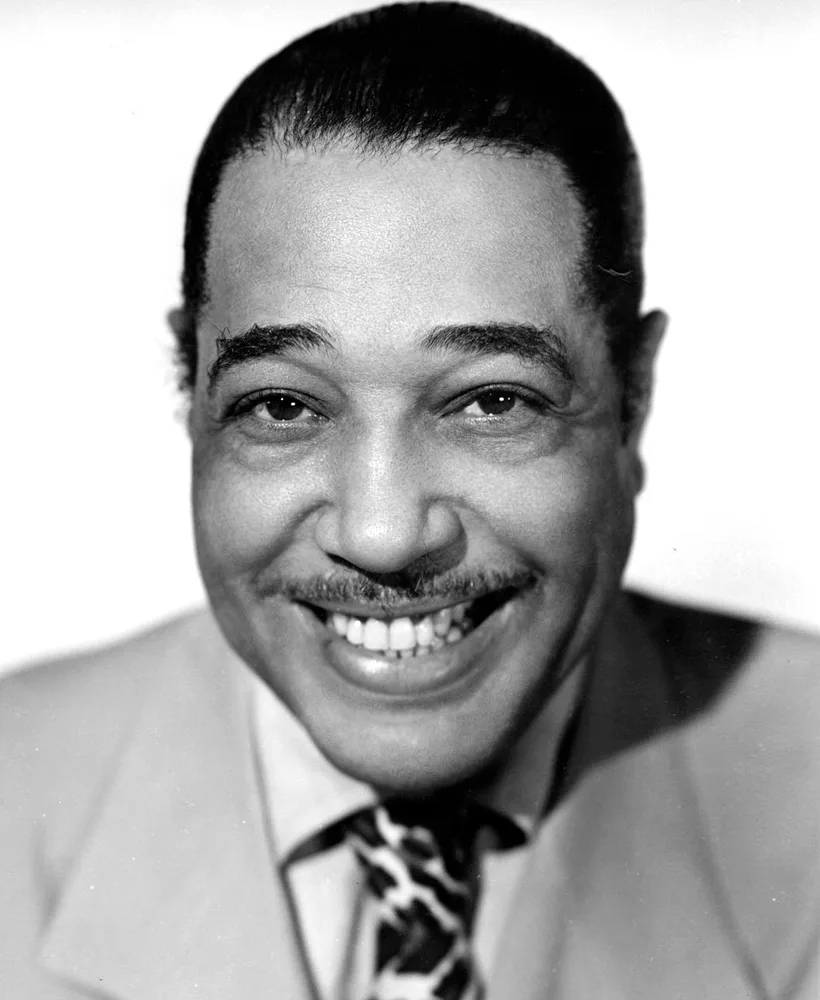
Duke Ellington, publicity photograph, circa 1940 Public domain (published in the United States between 1931 and 1977 without a copyright notice) — Wikimedia Commons — https://commons.wikimedia.org/wiki/File:Duke_Ellington_-_publicity.JPG

Edward Kennedy Ellington was born April 29, 1899, in Washington, D.C., to James Edward Ellington, a butler who later worked as a blueprint maker for the U.S. Navy, and Daisy Kennedy Ellington, both amateur pianists. Childhood friends nicknamed him "Duke" for his dapper bearing. He began piano lessons at seven with local teacher Marietta Clinkscales but preferred baseball until, around fourteen, he grew absorbed by ragtime pianists he heard in Washington poolrooms. Largely self-taught from that point, studying Eubie Blake, Luckey Roberts, and James P. Johnson by ear, he composed his first piece, "Soda Fountain Rag," in 1914 while working as a soda jerk. In 1916 he turned down an art scholarship to Brooklyn's Pratt Institute and left Armstrong Manual Training School three months short of graduation to pursue music full time, taking further instruction from Washington pianist Oliver "Doc" Perry. By late 1917 he was leading his own group, the Duke's Serenaders, with childhood friend Otto Hardwick on saxophone, Arthur Whetsel on trumpet, Elmer Snowden on banjo, and Sonny Greer on drums, playing dances for both Black and white audiences in segregated Washington.
Ellington moved his group to Harlem in 1923, where it became known as the Washingtonians and landed a residency at the Hollywood Club (later the Club Kentucky) that ran roughly four years. Trumpeter James "Bubber" Miley joined during this period and, with his growling, plunger-muted horn, pushed the band toward the "jungle style" heard on 1926's "East St. Louis Toodle-Oo." In October 1926 Ellington signed with agent-publisher Irving Mills, who took 45 percent of his earnings but drove a prolific recording schedule across Brunswick, Victor, Columbia, OKeh, and several smaller labels, often under aliases like "The Jungle Band" and "The Harlem Footwarmers." When King Oliver turned down the house-band job at Harlem's Cotton Club, Mills secured the spot for Ellington instead; the engagement opened December 4, 1927, forced the band to expand to eleven pieces, and, thanks to weekly radio broadcasts, made Ellington a national name. Adelaide Hall's wordless vocal on "Creole Love Call" (1927) became his first significant hit. Alto saxophonist Johnny Hodges joined in 1928 and baritone saxophonist Harry Carney in 1927, both remaining Ellington mainstays for decades; singer Ivie Anderson, hired in 1931, stayed eleven years and recorded the definitive 1932 version of "It Don't Mean a Thing (If It Ain't Got That Swing)." Ellington's first Cotton Club run ended in 1931; the orchestra then toured extensively and, in 1935, recorded "Reminiscing in Tempo," a long-form piece written as a tribute to his recently deceased mother, a clear early sign of his ambitions beyond the three-minute dance side.
The band's most celebrated era began with two arrivals. Composer and arranger Billy Strayhorn joined in 1939, initially as a lyricist, and became Ellington's closest collaborator for the rest of Strayhorn's life, with Ellington crediting him as essential to nearly every part of his own musical thinking; Strayhorn's own composition "Take the 'A' Train" (1941) became the orchestra's theme song. That same year bassist Jimmy Blanton joined and, before tuberculosis forced his departure in 1941 and killed him in 1942 at 23, transformed the bass from a rhythm instrument into a melodic, soloing voice; tenor saxophonist Ben Webster, in the band from 1939 to 1943, gave the reed section its first regular tenor chair. The period's recordings for Victor and its Bluebird subsidiary, later anthologized as The Blanton-Webster Band, are widely regarded as the peak of the pre-war orchestra. On January 23, 1943, Ellington's band gave its first Carnegie Hall concert, premiering the extended suite "Black, Brown and Beige," a "tone parallel to the history of the American Negro" that met a mixed critical reception at the time but that Ellington revisited for the rest of his career, including a 1958 vocal recording with gospel singer Mahalia Jackson.
Big-band jazz's commercial decline after the war left Ellington's orchestra struggling through much of the early 1950s, a slide reversed dramatically at the Newport Jazz Festival on July 7, 1956, when tenor saxophonist Paul Gonsalves's 27-chorus solo on "Diminuendo and Crescendo in Blue" brought the crowd to its feet and Ellington to the cover of Time magazine. The resulting Columbia contract opened a fertile late period built around extended, often Strayhorn-co-written suites and thematic albums: Such Sweet Thunder (1957), inspired by Shakespeare; the film scores for Anatomy of a Murder (1959) and Paris Blues (1961); the Far East Suite (1967), drawn from a 1963 State Department tour of the Middle East and Asia; and ...And His Mother Called Him Bill (1967), recorded as a tribute after Strayhorn's death that May. Ellington also sought out peers from outside his own band for one-off studio summits: Ella Fitzgerald Sings the Duke Ellington Song Book (1957) with Ella Fitzgerald, Duke Ellington Meets Coleman Hawkins and Duke Ellington & John Coltrane (both 1962, Impulse!), and, on September 17, 1962, a trio session with bassist Charles Mingus and drummer Max Roach that produced Money Jungle, a famously combustible, dissonance-embracing date unlike anything else in Ellington's catalog.
Ellington's final years combined sustained world touring with an increasingly explicit religious dimension to his composing. He premiered the first of three Sacred Concerts at San Francisco's Grace Cathedral on September 16, 1965, followed by a second in 1968 and a third in 1973, conducting each from the piano. He continued writing large-scale suites (New Orleans Suite, 1970; Latin American Suite, 1972) and smaller studio dates, including 1972's duo album with bassist Ray Brown, This One's for Blanton!, honoring Jimmy Blanton three decades on. He was awarded the Presidential Medal of Freedom by Richard Nixon in 1969 and, though a 1965 Pulitzer Prize jury recommendation for his life's work was rejected by the full board, an episode Ellington later shrugged off good-naturedly, he received a posthumous special Pulitzer Prize in 1999. Duke Ellington passed away in New York on May 24, 1974, of lung cancer and pneumonia, aged 75; more than 12,000 people attended his funeral at the Cathedral of St. John the Divine, where Ella Fitzgerald delivered a brief, emotional eulogy. His son Mercer Ellington led a continuation of the orchestra until his own death in 1996.
Ellington's central innovation was treating his orchestra itself as his instrument, writing parts to the specific tonal personality of each musician in his band rather than to interchangeable chairs, a practice that let voices like Johnny Hodges's alto, Harry Carney's baritone, and Cootie Williams's and Ray Nance's growling brass become as identifiable as any of his melodies. He resisted the label "jazz" for his own work, preferring to describe it as beyond category, and pushed steadily from three-minute dance sides toward extended concert suites, film scores, and, late in life, an explicitly sacred repertoire, all while remaining commercially viable across five decades of shifting popular taste. His compositional partnership with Billy Strayhorn, so close that the two men's writing is sometimes difficult to disentangle, shaped the harmonic sophistication of the postwar band. Critics have ranked him among the small handful of major American composers regardless of genre; Gunther Schuller called him "a giant among giants," and his influence runs through virtually every large-ensemble jazz composer and arranger who followed, from Gil Evans to Charles Mingus to Wynton Marsalis.
- The Blanton-Webster Band (recorded 1940-1942, released 1986, RCA Bluebird) - A compilation of the Victor/Bluebird sides from Ellington's most acclaimed early-1940s lineup, built around bassist Jimmy Blanton and tenor saxophonist Ben Webster. Listen
- The Duke Ellington Carnegie Hall Concerts: January 1943 (Prestige, released 1977) - The January 23, 1943 Carnegie Hall premiere of the extended suite "Black, Brown and Beige," Ellington's first major concert-hall statement.
- Ellington at Newport (1956, Columbia) - Documents the July 7, 1956 Newport Jazz Festival set, including Paul Gonsalves's 27-chorus solo on "Diminuendo and Crescendo in Blue" that relaunched Ellington's career. Listen
- Such Sweet Thunder (1957, Columbia) - A twelve-part suite with Billy Strayhorn inspired by Shakespeare's plays, one of the era's most acclaimed extended jazz works. Listen
- Anatomy of a Murder (1959, Columbia) - The soundtrack to Otto Preminger's courtroom drama, among the first Hollywood scores built from jazz, and a triple Grammy winner. Listen
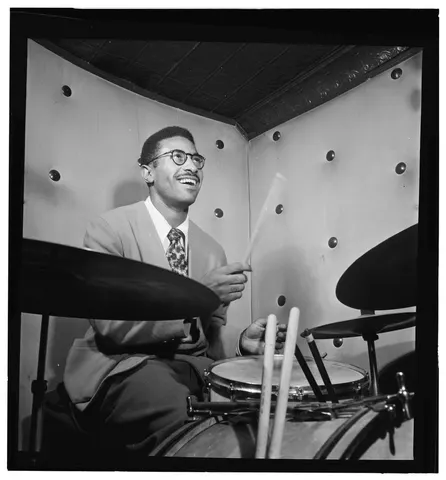
- Money Jungle (recorded September 17, 1962, released 1963, United Artists) - A one-off trio session with bassist Charles Mingus and drummer Max Roach, tense and dissonant in a way unlike any other Ellington recording. Mingus's own catalog and career are covered in full in his JazzProfiles.com profile. Listen
- Far East Suite (recorded 1966, released 1967, RCA Victor) - A Grammy-winning suite inspired by a 1963 State Department tour, co-written with Strayhorn. Listen
- ...And His Mother Called Him Bill (1967, RCA Victor) - A tribute album of Billy Strayhorn compositions, recorded months after Strayhorn's death; won Ellington his third consecutive Grammy for Best Large Jazz Ensemble Album.
Duke Ellington: Full Discography
Identity confirmed via the live Discogs API - artist ID 145257 ("Duke Ellington," realname Edward Kennedy Ellington, born/died dates matching, profile text noting the Cotton Club residency and Billy Strayhorn co-composing partnership). Discogs' release index for this artist ID alone returns more than 24,000 individual entries once every pressing, reissue, and compilation variant across a roughly 50-year recording career is counted; a companion Discogs page for "Duke Ellington And His Orchestra" adds well over 1,300 more. Ellington is estimated to have written or co-written over 1,000 compositions and led sessions issued under dozens of group names (The Washingtonians, The Jungle Band, The Harlem Footwarmers, and others) across at least fifteen labels. Exhaustive discography coverage is not attempted here. The table below curates the 23 leader and co-leader releases most consistently identified by critics, historians, and reference works (Wikipedia, AllMusic, and period Grammy/critical citations) as his essential recordings, spanning the Cotton Club era of the late 1920s through his final decade. No "As Sideman" table is included: across his entire career Ellington is not documented as having recorded as a credited sideman under another leader's name in any significant way: the closest cases (backing Ella Fitzgerald, sparring with Coleman Hawkins or John Coltrane, trio work with Charles Mingus and Max Roach) were all co-star or co-leader billings and are listed below instead.
As Leader / Co-Leader
| Album Title | Recording Date(s) | Release Date | Label | Catalog Number | Format(s) | Personnel | Role | Reissue History | Spotify | Buy | Notes |
|---|---|---|---|---|---|---|---|---|---|---|---|
| Early Ellington: The Complete Brunswick and Vocalion Recordings, 1926-1931 | November 29, 1926 - January 14, 1931 | 1994 (compilation) | GRP/Decca | GRD-3-640 | CD, Compilation, Remastered | Duke Ellington and His Orchestra/Washingtonians, personnel varying by session (Bubber Miley, Otto Hardwick, Sonny Greer, Harry Carney among others) | Leader | Compiles the original Brunswick/Vocalion 78s; some tracks previously anthologized on other labels | Not confirmed on Spotify under this exact compilation title | — | Represents the "jungle style" Cotton Club-era band; not a period LP, since the LP format postdates these recordings |
| The Blanton-Webster Band | 1940-1942 | 1986 (compilation) | RCA Bluebird | 5659-1-RB | Vinyl box set / CD, Compilation | Duke Ellington and His Famous Orchestra, featuring Jimmy Blanton (bass) and Ben Webster (tenor sax) | Leader | Expanded in 2003 as the 3-CD Never No Lament: The Blanton-Webster Band (adds alternate takes) | Spotify - Never No Lament: The Blanton-Webster Band | — | Widely cited as the peak of Ellington's pre-war orchestra |
| The Duke Ellington Carnegie Hall Concerts: January 1943 | Recorded live January 23, 1943, Carnegie Hall, NYC | 1977 | Prestige | P-34004 | Vinyl, LP, 2xLP | Duke Ellington and His Famous Orchestra | Leader | Later CD reissue as 2PCD-24073-2 | Not confirmed on Spotify under this exact live-concert title | — | Premiere of the extended suite "Black, Brown and Beige"; not commercially released until over three decades after the performance |
| Ellington Uptown | Recorded 1951-1952 | 1953 | Columbia | CL 830 | Vinyl, LP, Album | Duke Ellington and His Orchestra, featuring vocalist Betty Roche and drummer Louie Bellson | Leader | Reissued on CD (Columbia/Legacy) | Not confirmed on Spotify under this exact title | — | Includes a bebop-inflected reworking of "Take the 'A' Train" with Roche's vocal |
| Black, Brown and Beige (feat. Mahalia Jackson) | Recorded February 4-5 & 11-12, 1958 | 1958 | Columbia | CL 1162 | Vinyl, LP, Album | Duke Ellington and His Orchestra with Mahalia Jackson (vocals) | Leader | Reissued on CD | Spotify - Black, Brown & Beige (with Mahalia Jackson) | — | Revised, vocal version of the 1943 Carnegie Hall suite, with new lyrics by Ellington |
| Ellington at Newport | Recorded live July 7, 1956 (Newport Jazz Festival) plus studio re-recordings July 9, 1956 | 1956 | Columbia | CL 934 | Vinyl, LP, Album | Duke Ellington and His Orchestra, featuring Paul Gonsalves (tenor sax) | Leader | Original LP mixed roughly 60% studio re-recordings with live tracks; a fully live version issued later as Ellington at Newport 1956 (Complete) | Spotify - Ellington At Newport: The Original Album | — | Gonsalves's 27-chorus solo on "Diminuendo and Crescendo in Blue" relaunched Ellington's career; became his best-selling LP |
| Such Sweet Thunder | Recorded/released 1957 | 1957 | Columbia | CL 1033 | Vinyl, LP, Album | Duke Ellington and His Orchestra; co-written with Billy Strayhorn | Leader | Later CD reissues add previously unissued material as Such Sweet Thunder (Expanded Edition) | Spotify - Such Sweet Thunder | — | Twelve-part suite inspired by Shakespeare's plays, premiered at New York's Town Hall, April 28, 1957 |
| Ella Fitzgerald Sings the Duke Ellington Song Book | Recorded June 25 - October 17, 1957 | 1957 | Verve | MGV 4008-2 / MGV 4009-2 | Vinyl, 2xLP, Album | Ella Fitzgerald (vocals) with Duke Ellington and His Orchestra (Vol. 1) and small group (Vol. 2) | Co-star billing (Ellington and orchestra as featured accompanist) | Reissued and expanded on CD | Not itemized here; billed as an Ella Fitzgerald album | — | Ellington's only "Song Book" collaboration with Fitzgerald; won Fitzgerald a Grammy |
| Anatomy of a Murder | Recorded May 29 & June 1-2, 1959 | 1959 | Columbia | CL 1360 (mono) / CS 8166 (stereo) | Vinyl, LP, Album | Duke Ellington and His Orchestra; score co-written with Billy Strayhorn | Leader | Reissued on CD | Spotify - Anatomy Of A Murder | — | Soundtrack to Otto Preminger's film; won three Grammy Awards |
| Piano in the Background | Recorded May 31 - June 30, 1960 | 1960 | Columbia | CS 8346 | Vinyl, LP, Album | Duke Ellington (piano) with his Orchestra | Leader | Reissued on CD paired with its companion volume | Not confirmed on Spotify under this exact title | — | First of a two-part pair spotlighting Ellington's own piano within orchestral arrangements |
| Piano in the Foreground | Recorded March 1-2, 1961 | 1961 | Columbia | CS 8679 | Vinyl, LP, Album | Duke Ellington (piano), Aaron Bell (bass), Sam Woodyard (drums) | Leader | Reissued on CD | Not confirmed on Spotify under this exact title | — | Trio session emphasizing Ellington's pianism outside the big-band format |
| Duke Ellington Meets Coleman Hawkins | Recorded August 18, 1962 | 1963 | Impulse! | A-26 (AS-26 stereo) | Vinyl, LP, Album | Duke Ellington (piano), Coleman Hawkins (tenor sax), Ray Nance (cornet, violin), Lawrence Brown (trombone), Johnny Hodges (alto sax), Harry Carney (baritone sax, bass clarinet), Aaron Bell (bass), Sam Woodyard (drums) | Co-star billing | None found | Not confirmed on Spotify under this exact title | — | The only recorded studio meeting of two musicians who had known each other since the 1920s |
| Money Jungle | Recorded September 17, 1962 | 1963 | United Artists | UAJ 14017 (mono) / UAS 15017 (stereo) | Vinyl, LP, Album | Duke Ellington (piano), Charles Mingus (bass), Max Roach (drums) | Co-leader (trio) | Later CD reissues add unissued tracks from the same session | Spotify - Money Jungle | — | One-off summit with Mingus and Roach; tense and dissonant compared to Ellington's usual output |
| Duke Ellington & John Coltrane | Recorded September 26, 1962 | 1963 | Impulse! | A-30 (AS-30 stereo) | Vinyl, LP, Album | Duke Ellington (piano), John Coltrane (tenor/soprano sax), Jimmy Garrison and Aaron Bell (bass), Elvin Jones and Sam Woodyard (drums) | Co-star billing | None found | Not confirmed on Spotify under this exact title | — | Completed in a single session; Coltrane brought his own rhythm section alongside Ellington's |
| The Great Paris Concert | Recorded live February 1 & 2, 1963, Olympia Theatre, Paris (some sources also cite Feb. 23) | 1973 | Atlantic | SD 2-304 | Vinyl, 2xLP, Album | Duke Ellington and His Orchestra | Leader | 1989 CD reissue adds 10 additional tracks from the same Paris dates | Not confirmed on Spotify under this exact title | — | Some material from these dates was issued earlier and separately as part of Duke Ellington's Greatest (Reprise) |
| A Concert of Sacred Music (First Sacred Concert) | Recorded December 26, 1965, Fifth Avenue Presbyterian Church, NYC | 1966 | RCA Victor | LSP-3582 | Vinyl, LP, Album | Duke Ellington and His Orchestra, with vocal soloists | Leader | Reissued on CD | Not confirmed on Spotify under this exact title | — | Studio recording of material premiered live at Grace Cathedral, San Francisco, September 16, 1965 |
| Far East Suite | Recorded December 19-21, 1966 | 1967 | RCA Victor | LSP-3782 | Vinyl, LP, Album | Duke Ellington and His Orchestra; co-written with Billy Strayhorn | Leader | Reissued on CD, including a 1995 "Special Mix" edition | Spotify - Far East Suite | — | Inspired by a 1963 State Department tour of the Middle East and Asia; won the 1968 Grammy for Best Instrumental Jazz Performance, Large Group |
| ...And His Mother Called Him Bill | Recorded August 28 - November 15, 1967 | 1968 | RCA Victor | LSP-3906 | Vinyl, LP, Album | Duke Ellington and His Orchestra | Leader | Reissued on CD | Not confirmed on Spotify under this exact title | — | Tribute to Billy Strayhorn, recorded after Strayhorn's May 1967 death; won Ellington's third consecutive Grammy for Best Large Jazz Ensemble Album |
| Francis A. & Edward K. | Recorded December 11-12, 1967 | 1968 | Reprise | FS-1024 | Vinyl, LP, Album | Frank Sinatra (vocals) with Duke Ellington and His Orchestra; arrangements by Billy May | Co-star billing | Reissued on CD | Not confirmed on Spotify under this exact title | — | Sinatra and Ellington's only studio collaboration |
| Second Sacred Concert | Recorded January 22 & February 19, 1968, Fine Studio, NYC | 1968 | America (later Fantasy/Prestige reissue) | AM 006-007 | Vinyl, 2xLP, Album | Duke Ellington and His Orchestra, with vocal soloists including Alice Babs | Leader | Reissued 1970 on Fantasy (F-8407/8) | Not confirmed on Spotify under this exact title | — | Studio recording following the concert's January 19, 1968 premiere at the Cathedral of St. John the Divine |
| New Orleans Suite | Recorded April 27 & May 13, 1970, National Recording Studios, NYC | 1970 | Atlantic | SD 1580 | Vinyl, LP, Album | Duke Ellington and His Orchestra, including final recordings by Johnny Hodges | Leader | Reissued on CD | Not confirmed on Spotify under this exact title | — | Contains Johnny Hodges's last studio recordings; Hodges died between the two sessions. Won the 1971 Grammy for Best Jazz Performance by a Big Band |
| Latin American Suite | Recorded 1968 and 1970 | 1972 | Fantasy | F-9498 | Vinyl, LP, Album | Duke Ellington and His Orchestra | Leader | Reissued on CD | Not confirmed on Spotify under this exact title | — | |
| This One's for Blanton! | Recorded December 5, 1972 | 1973 | Pablo | 2310 721 | Vinyl, LP, Album | Duke Ellington (piano), Ray Brown (bass) | Co-leader (duo) | Reissued on CD and as a 180g audiophile vinyl pressing | Not confirmed on Spotify under this exact title | — | Duo tribute to bassist Jimmy Blanton, 30 years after Blanton's tenure with the band |
As Sideman
Not applicable. Across his roughly 50-year recording career, Duke Ellington is not documented as a credited sideman on any release led by another artist; his outside-the-band studio collaborations (with Ella Fitzgerald, Coleman Hawkins, John Coltrane, Charles Mingus and Max Roach, and Frank Sinatra) were all co-star or co-leader billings and are itemized in the table above rather than in a separate sideman table.
- Billy Strayhorn - composer, arranger, and de facto co-leader from 1939 until Strayhorn's death in 1967; wrote the band's theme "Take the 'A' Train" and co-wrote most of Ellington's major suites.
- Johnny Hodges - featured alto saxophonist from 1928 (with one absence, 1951-1955) until Hodges's death in 1970, one of the orchestra's most identifiable solo voices.
- Harry Carney - baritone saxophonist from 1927 until Ellington's death in 1974, the longest tenure of any Ellington sideman.
- Jimmy Blanton - bassist, 1939-1941, whose two years in the band redefined the instrument's role in jazz; Ellington later paid tribute with 1972's duo album This One's for Blanton!, made with bassist Ray Brown.
- Charles Mingus and Max Roach - co-participants in the single 1962 trio session that produced Money Jungle; both are profiled separately on JazzProfiles.com.
- Ella Fitzgerald, John Coltrane, Coleman Hawkins, Frank Sinatra - among the major artists Ellington recorded full studio collaborations with outside his own band, on Ella Fitzgerald Sings the Duke Ellington Song Book (1957), Duke Ellington & John Coltrane and Duke Ellington Meets Coleman Hawkins (both 1962), and Francis A. & Edward K. (1967-68) respectively.
- Mercer Ellington - son, sometime trumpeter/arranger in the orchestra, and its leader after Duke's 1974 death until his own death in 1996.
More Big Band Artists
See all 202 Big Band artists →More American Jazz Artists
See all 567 American artists →- Wikipedia: Duke Ellington
- Wikipedia: Duke Ellington discography
- Discogs: Duke Ellington (artist 145257)
- AllMusic: Duke Ellington biography
- Wikipedia: Money Jungle
- Wikipedia: Ellington at Newport
- Wikipedia: Such Sweet Thunder
- Wikipedia: Far East Suite
- Wikipedia: Anatomy of a Murder (soundtrack)
- Wikipedia: The Blanton-Webster Band
- Wikipedia: The Carnegie Hall Concerts: January 1943
- Wikipedia: Black, Brown and Beige (1958 album)
- Wikipedia: ...And His Mother Called Him Bill
- Wikipedia: Ella Fitzgerald Sings the Duke Ellington Song Book
- Wikipedia: Sacred Concert (Ellington)
- Wikipedia: Francis A. & Edward K.
- Wikipedia: This One's for Blanton!
- Wikipedia: New Orleans Suite