 JAZZPROFILES lives in the music 2,303 Jazz Artists fully Profiled!
Earl Hines
Last updated November 8, 2026
Listen on Spotify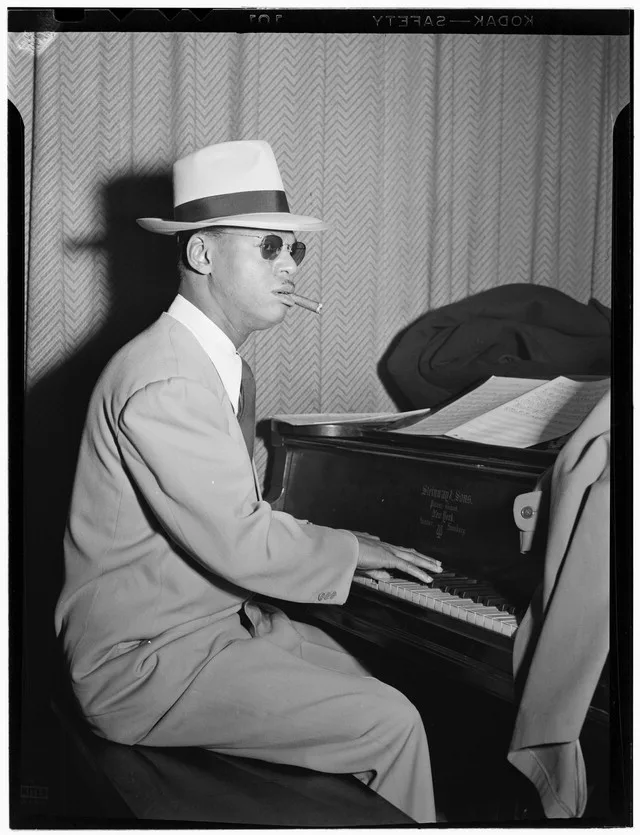
Earl Hines at the piano, 1947, photographed by William P. Gottlieb Public Domain (William P. Gottlieb collection at the Library of Congress; the photographer's photographs entered the public domain on February 16, 2010, in accordance with his wishes) — Wikimedia Commons: https://commons.wikimedia.org/wiki/File:Earl_Hines_1947.jpg

Earl Kenneth Hines was born on December 28, 1903, in Duquesne, Pennsylvania, about twelve miles from Pittsburgh. His father, Joseph Hines, played cornet and led the Eureka Brass Band, and his stepmother was a church organist. Hines meant to follow his father on cornet, but blowing hurt behind his ears, so he took classical piano lessons instead, and by eleven he was playing organ in his Baptist church. At seventeen, with his father's approval, he left home to play piano for the baritone Lois Deppe and his Symphonian Serenaders at the Liederhaus, a Pittsburgh nightclub, for $15 a week and two meals a day. Deppe also used him as a concert accompanist, including on trips to New York, and in 1921 the two performed on the radio, reportedly the first African Americans to do so. Their first records together were four sides for Gennett in 1923, only two of them issued, one being Hines's own composition "Congaine." Around this time he also accompanied the singer Ethel Waters.
In 1925 Hines moved to Chicago, then the center of jazz, working at the Elite No. 2 Club before joining Carroll Dickerson's band, which toured the Pantages theater circuit to Los Angeles and back. In the poolroom of the Black Musicians' Union local on State Street he met Louis Armstrong, then 24 to his 21, and the two played the union's piano together. Armstrong was struck by the fast octaves of Hines's "trumpet-style" right hand, and the two became close friends. Armstrong joined Dickerson's band at the Sunset Cafe, and in 1927 it became his band, with Hines as musical director. That year Armstrong rebuilt his recording-only Hot Five and hired Hines for the piano chair previously held by his wife, Lil Hardin Armstrong. The 1928 sessions produced "West End Blues," "Tight Like This," "Beau Koo Jack," "Muggles" and the trumpet-and-piano duet "Weather Bird," recorded on December 5, 1928. After a plan with Armstrong and the drummer Zutty Singleton to run their own club fell apart, Hines took a midnight-to-six job with the clarinetist Jimmie Noone at the Apex Club, recording 14 sides with Noone in 1928. His first piano solos were cut late that year, eight for QRS in New York and seven for Okeh in Chicago, all but two of them his own compositions, among them "A Monday Date."
On December 28, 1928, his twenty-fifth birthday, Hines opened at Chicago's Grand Terrace Cafe leading his own big band, and for the next twelve years the orchestra, which he preferred to call his "Organization," was the house band there, usually 15 to 20 players and at times up to 28, doing three shows a night. The club was controlled by Al Capone's organization. Nightly coast-to-coast radio broadcasts made it reportedly the most broadcast band in America. The pianists who occasionally took his chair so that he could conduct included Teddy Wilson and Nat King Cole. Each summer the band toured, and in 1931 it was among the first large Black bands to travel extensively through the South. Its members over the years included the saxophonist Budd Johnson, the arranger Jimmy Mundy, the trumpeter Walter Fuller, the reed players Omer Simeon and Darnell Howard, the trumpeter and violinist Ray Nance and the trombonist Trummy Young.
The Grand Terrace closed suddenly in December 1940, and Hines took the band on the road full-time. Billy Eckstine sang with it from 1939 to 1943, and he and Budd Johnson helped bring modern players into the ranks. Charlie Parker joined in 1942 and Dizzy Gillespie around the same time, and Sarah Vaughan replaced Eckstine as the band's singer in 1943 and stayed about a year. Other alumni of the modern wing included the tenor saxophonists Gene Ammons and Wardell Gray, the trombonist Bennie Green and the drummer Shadow Wilson. Late-night jam sessions among these players during the 1942-44 recording ban helped seed bebop, though the band left little on record from the period; Duke Ellington later said the seeds of bop were in Hines's piano style. In 1944 Hines stood in as leader of the Ellington orchestra when Ellington fell ill. In July 1946 a car crash near Houston left him with head injuries that affected his eyesight for the rest of his life. He kept the big band going for two more years, and in 1947 he bought Chicago's El Grotto nightclub, which foundered and cost him about $30,000.
In early 1948 Hines joined Armstrong's All Stars, and he left in 1951 after three years in which, by his own account, he felt used as a sideman next to his old friend. He then led his own small groups, starting with a markedly modern lineup of Bennie Green, Art Blakey, the bassist Tommy Potter and the singer Etta Jones, and, according to AllMusic, a Dixieland band in Los Angeles and later San Francisco through the 1950s. By the early 1960s he had settled in Oakland, opened a tobacconist's shop, and come close to quitting music. In 1964 the critic Stanley Dance persuaded him to give a series of solo and quartet recitals at New York's Little Theatre, his first piano recitals, and the reviews turned him into a rediscovery. In 1966 he won the DownBeat International Critics Poll for its Hall of Fame and was named the magazine's top jazz pianist, a title he took five more times. From then until his death he recorded more than 100 LPs, sixteen of them in 1974 alone, toured Europe, South America, Asia and Australia, and in 1966 spent six weeks in the Soviet Union on a State Department tour, playing 35 concerts. A 1975 television documentary was filmed with him at the Blues Alley club in Washington, and in 1979 he was inducted into the Black Filmmakers Hall of Fame. He played solo at Ellington's funeral and twice at the White House. Hines passed away of a heart attack in Oakland on April 22, 1983, days after his last show, in San Francisco, and is buried at Evergreen Cemetery in Oakland.
Hines is regarded as the pianist who carried jazz piano from stride into swing. Working over loud bands on upright pianos without amplification, he developed the "trumpet style" right hand, a single hornlike line doubled in octaves and capped with tremolos, which could cut through a brass section, while his left hand dropped the steady stride pattern for accents and off-beat figures. He would run a phrase far away from the pulse, stop short, leave a silence, and land back in time, with harmonic detours that other pianists of his generation did not attempt. His own explanation was that he wanted to play on the piano what he would have played on the trumpet. Dizzy Gillespie said the modern piano style came from Hines and traced the roots of Bud Powell and Herbie Hancock to him, and Duke Ellington said the seeds of bop were in his playing. AllMusic lists Teddy Wilson, Jess Stacy, Joe Sullivan, Nat King Cole and, to a degree, Art Tatum among those he influenced, and Erroll Garner said that when people talk about greatness at the piano they talk about Tatum and Hines. His late solo records, dense and layered, with long medleys and constant reharmonizing, are the part of his catalog many critics rate highest, and he was known for walking into a studio and leaving ninety minutes later with an unplanned solo LP.
- "Weather Bird" (1928, Okeh) - the trumpet-and-piano duet with Louis Armstrong recorded on December 5, 1928, often called the most famous duet in jazz history, from the same Hot Five sessions as "West End Blues"; collected on a 1975 Smithsonian Collection LP, Louis Armstrong and Earl Hines 1928.
- A Monday Date (1928, QRS and Okeh) - one of his first piano solos, cut that year in New York and Chicago, mostly his own compositions, and reissued in 2014 on Classic Earl Hines Sessions (1928-1945). Spotify - Classic Earl Hines Sessions (1928-1945), Vol. 1 & 2 Listen
- "Boogie Woogie on St. Louis Blues" (1940, Bluebird) - the Hines big band's treatment of W.C. Handy's tune, recorded in New York on February 13, 1940. Spotify - Classic Earl Hines Sessions (1928-1945), Vol. 5 & 6 Listen
- "Jelly, Jelly" (1940, Bluebird) - the song recorded in Hollywood on December 2, 1940, with Billy Eckstine singing the blues he co-wrote. Spotify - Classic Earl Hines Sessions (1928-1945), Vol. 5 & 6
- The Legendary Little Theater Concert of 1964 (1979, Deluxe) - a trio set with Ahmed Abdul-Malik and Oliver Jackson recorded on March 7, 1964, from the New York recitals that restarted his career.
- Once Upon a Time (1966, Impulse!) - recorded January 10 and 11, 1966, with Hines leading a band of Duke Ellington alumni and guests, including Johnny Hodges, Paul Gonsalves, Pee Wee Russell and Elvin Jones.
- Earl Hines Plays Duke Ellington (1971, Master Jazz Recordings) - a solo piano set including "Sophisticated Lady," "Mood Indigo" and "Come Sunday," one of several Ellington albums he recorded alone.
- Tour de Force (1972, Black Lion) - solo piano recorded in New York on November 22 and 29, 1972, produced by Stanley Dance, with "Mack the Knife" and "Indian Summer" among the six pieces.
Earl Hines: Full Discography
Discogs artist ID 257353 ("Earl Hines," real name Earl Kenneth Hines, born December 28, 1903, in Duquesne, Pennsylvania, died April 22, 1983, in Oakland, California) lists more than 3,000 entries across leader releases, reissues, compilations and appearances, and a catalogue that runs from the 1923 Gennett sides through more than a hundred LPs made after 1964. Discogs also files his big band and small-group work under separate entities, among them "Earl Hines And His Orchestra" (artist ID 341505, 538 entries), "The Earl Hines Trio" (907012, 53 entries), "Earl Hines And His Quartet" (1958079, 25 entries), "Earl Hines Sextet" (344332, 12 entries) and "Earl Hines Quartet" (399273, 6 entries), and a namesake entry, "Earl Hines (2)" (14830417), belongs to a different person; these were checked before the tables below were drawn up. Because the catalogue is so large, the leader table is a curated selection of 26 landmark and representative titles rather than an exhaustive list: the Grand Terrace big-band sides, the Little Theatre comeback, the late solo albums, and the duo and quartet dates. Recording dates, catalog numbers and personnel come from Discogs release pages, MusicBrainz and other profiles on JazzProfiles.com; where a source did not give a recording date or personnel, the cell says so. Catalog numbers are those of the earliest pressing found.
As Leader / Co-Leader
| Album Title | Recording Date(s) | Release Date | Label | Catalog Number | Format(s) | Personnel | Role | Reissue History | Spotify | Buy | Notes |
|---|---|---|---|---|---|---|---|---|---|---|---|
| Boogie Woogie on St. Louis Blues / Number 19 | February 13, 1940, RCA Studio 2, New York | April 1940 | Bluebird | B-10674 | Shellac, 10", 78 rpm single | Earl Hines (piano, director), Walter Fuller, George Dixon, Milton Fletcher, Edward Sims (trumpets), John Ewing, Joe McLewis, Ed Burke (trombones), Leroy Harris (alto saxophone), Jimmy Mundy, Robert Crowder (tenor saxophones), Omer Simeon (clarinet, baritone saxophone), Claude Roberts (guitar), Quinn Wilson (bass), Alvin Burroughs (drums) | Leader (Earl Hines and His Orchestra) | This session is represented, with alternate takes, on the 2014 digital compilation Classic Earl Hines Sessions (1928-1945), Vol. 5 & 6; see Discogs master 654173 | Spotify - Classic Earl Hines Sessions (1928-1945), Vol. 5 & 6 | — | Grand Terrace-era big band; Discogs lists the sidemen as uncredited on the label. |
| I'm Falling for You / Jelly, Jelly | December 2, 1940, RCA Victor Studios, Hollywood | February 1941 | Bluebird | B-11065 | Shellac, 10", 78 rpm single | Earl Hines (piano, director), Billy Eckstine (vocal on "Jelly, Jelly"), Harry "Pee Wee" Jackson, Leroy White, Rostelle Reese (trumpets), Edward Fant, John Ewing (trombones), Budd Johnson, Franz Jackson, Leroy Harris, Scoops Carey, Willie Randall (saxophones), Hurley Ramey (guitar), Truck Parham (bass), Alvin Burroughs (drums) | Leader (Earl Hines and His Orchestra) | Both sides are on the 2014 digital compilation Classic Earl Hines Sessions (1928-1945), Vol. 5 & 6; see Discogs master 1494841 | Spotify - Classic Earl Hines Sessions (1928-1945), Vol. 5 & 6 | — | Discogs does not credit the vocalist; Eckstine's role on "Jelly, Jelly" is documented on his own profile. |
| A Monday Date: 1928 | 1928, Chicago and New York | 1970 | Milestone | MLP 2012 | Vinyl, LP, compilation | Earl Hines (piano) | Leader (solo piano) | The 1928 solos are also on the 2014 digital compilation Classic Earl Hines Sessions (1928-1945), Vol. 1 & 2; see Discogs master 840376 | Spotify - Classic Earl Hines Sessions (1928-1945), Vol. 1 & 2 | — | Discogs lists this 1970 LP as a reissue of his 1928 piano solos, his first, cut late that year for QRS and Okeh. The Spotify link is to the compilation that carries these sides. |
| Fatha Plays Fats | Not confirmed | 1956 | Fantasy | 3-217 | Vinyl, LP | Earl Hines (piano); accompanists, if any, not confirmed | Leader | Reissued under several titles; see Discogs master 481870 | — | — | Piano album of Fats Waller songs. |
| Spontaneous Explorations | 1964 | 1964 | Contact | CS-2 | Vinyl, LP, Album, Stereo | Earl Hines (piano); sidemen, if any, not confirmed | Leader | Reissued on CD in Japan in 2017 (Solid Records CDSOL-45702); see Discogs master 536514 | — | — | Released in 1964, the year of the Little Theatre recitals. |
| The Legendary Little Theater Concert of 1964, Volume 1 | March 7, 1964, the Little Theatre, New York | 1979 | Deluxe | DE 602 | Vinyl, LP, Album | Earl Hines (piano), Ahmed Abdul-Malik (bass), Oliver Jackson (drums) | Leader | Volumes 1 and 2 were issued together in 1984; see Discogs master 1058443 | — | — | Live recording from the recital series that restarted his career; produced by Gary Giddins. |
| Once Upon a Time | January 10 and 11, 1966 | 1966 | Impulse! | A-9108 | Vinyl, LP, Album, Mono | Earl Hines (piano), Cat Anderson, Ray Nance (trumpets), Lawrence Brown, Buster Cooper (trombones), Johnny Hodges, Russell Procope (alto saxophones), Paul Gonsalves, Harold Ashby (tenor saxophones), Jimmy Hamilton (clarinet, tenor saxophone), Pee Wee Russell (clarinet), Aaron Bell (bass), Elvin Jones, Sonny Greer (drums) | Leader | Reissued on CD by Verve in 2003 (654 492-2); see Discogs master 171254 | — | — | Hines fronting a band of Ellington alumni and guests; not every musician plays on every track. Produced by Bob Thiele. |
| Stride Right | January 14, 1966, Van Gelder Studios, Englewood Cliffs, New Jersey | April 1966 | Verve | V6-8647 | Vinyl, LP, Stereo | Johnny Hodges (alto saxophone), Earl Hines (piano, organ), Kenny Burrell (guitar), Richard Davis (bass), Joe Marshall (drums) | Co-leader (billed with Johnny Hodges) | Reissued many times on CD; see Discogs master 420902 | — | — | Personnel and dates follow the Johnny Hodges profile. |
| Blues & Things | July 19, 1967 | 1968 | Master Jazz Recordings | MJR 8101 | Vinyl, LP, Album | Earl Hines (piano), Jimmy Rushing (vocals), Budd Johnson (saxophone), Bill Pemberton (bass), Oliver Jackson (drums) | Co-leader (billed with Jimmy Rushing) | Issued in Britain in 1968 by World Record Club (ST 1021); see Discogs master 381416 | — | — | Blues and standards with the singer Jimmy Rushing. |
| Swing's Our Thing | San Francisco, November 13 and 14, 1967 | 1968 | Verve | V6-8732 (stereo); VLP 9219 (mono) | Vinyl, LP, Album | Johnny Hodges (alto saxophone), Earl Hines (piano), Cat Anderson (trumpet), Buster Cooper (trombone), Jimmy Hamilton (clarinet, tenor saxophone), Jeff Castleman (bass), Sam Woodyard (drums) | Co-leader (billed with Johnny Hodges) | Reissued many times on CD; see Discogs master 855325 | — | — | Personnel and dates follow the Johnny Hodges profile. |
| At Home | Not confirmed | 1969 | Delmark | DS-212 | Vinyl, LP, Album | Earl Hines (piano) | Leader (solo piano) | See Discogs master 558090 | — | — | Solo piano; produced by Robert G. Koester. |
| The Quintessential Recording Session | 1970 | 1970 | Halcyon | HAL 101 | Vinyl, LP | Earl Hines (piano) | Leader (solo piano) | Reissue details are on Discogs master 417647 | — | — | New versions of pieces he first recorded as solos in the late 1920s and 1930s, including "My Monday Date," "Blues in Thirds" and "Panther Rag"; produced by Hank O'Neal. A follow-up, Quintessential Continued, appeared on Chiaroscuro in 1973 (CR 120). |
| Live at the Overseas Press Club | November 1970, Overseas Press Club, New York | 1971 | Chiaroscuro | CR-107 | Vinyl, LP, Album, Stereo | Earl Hines (piano), Maxine Sullivan (vocals on five tracks) | Leader (billed with Maxine Sullivan) | See Discogs master 746465 | — | — | Live set shared with the singer Maxine Sullivan. |
| Earl Hines Plays Duke Ellington | Not confirmed | 1971 | Master Jazz Recordings | MJR 8114 | Vinyl, LP, Album, Stereo | Earl Hines (piano) | Leader (solo piano) | Further Ellington volumes followed; see Discogs master 934666 | — | — | Solo piano on nine Ellington pieces including "Sophisticated Lady," "Mood Indigo" and "Come Sunday"; produced by Bill Weilbacher. |
| My Tribute to Louis: Piano Solos by Earl Hines | Not confirmed | 1971 | Audiophile | AP 111 | Vinyl, LP | Earl Hines (piano) | Leader (solo piano) | See Discogs master 1512662 | — | — | A solo tribute to Louis Armstrong. |
| Hines Does Hoagy | Not confirmed | 1971 | Audiophile | AP 113 | Vinyl, LP | Earl Hines (piano) | Leader (solo piano) | See Discogs master 4129186 | — | — | A solo tribute to the songs of Hoagy Carmichael. |
| Duet! | February 14, 1972 | 1975 | MPS | 20 22022-2 (also issued by BASF) | Vinyl, LP, Album, Stereo | Earl Hines (piano), Jaki Byard (piano) | Co-leader (billed with Jaki Byard) | See Discogs master 408774 | — | — | Two-piano duets; Hines solo on one track, Byard solo on another. |
| Tour de Force | November 22 and 29, 1972, Hank O'Neal Studio, New York | 1973 | Black Lion | BLP 30143 | Vinyl, LP, Album | Earl Hines (piano) | Leader (solo piano) | Issued on CD by Black Lion in 1989 (BLCD 760140) and again in 2017; see Discogs master 396357 | — | — | Solo piano, produced by Stanley Dance and Alan Bates; Discogs lists a 1973 UK first pressing. |
| Earl Hines Plays George Gershwin | October 16, 1973, Milan | 1975 | Disques Festival | ALB 208 | Vinyl, LP, Album | Earl Hines (piano) | Leader (solo piano) | Several later labels reissued the set; see Discogs master 537321 | — | — | Earliest pressing found on Discogs; the French issue dates from 1975. |
| Another Monday Date | Not confirmed | 1974 | Prestige | P 24043 | Vinyl, LP | Earl Hines (piano); accompanists, if any, not confirmed | Leader | Issued on CD by Prestige in 1995 (PRCD-24043-2); see Discogs master 623134 | — | — | A new look at the title of his 1928 solo "A Monday Date." |
| The Giants | July 4, 1974, Chappell Studio, London | 1978 | Black Lion | INT 147.002 | Vinyl, LP | Earl Hines (piano), Stéphane Grappelli (violin) | Co-leader (billed with Stéphane Grappelli) | See Discogs master 373855 | — | — | Piano and violin duets on seven standards; issued four years after the session. |
| Earl Hines in New Orleans | Not confirmed | 1975 | Gold Star | 1500 032 | Vinyl, LP, Album, Stereo | Earl Hines (piano, vocals on two tracks), Wallace Davenport (trumpet, vocals), Tom Elbert (trombone), Orange Kellin (clarinet), Emanuel Sayles (guitar, banjo), Lloyd Lambert (bass), Louis Barbarin (drums) | Leader | See Discogs master 688222 | — | — | Earliest pressing listed on Discogs (UK); the same date was reissued on several labels. |
| Hot Sonatas | Not confirmed | March 1976 | Chiaroscuro | CR 145 | Vinyl, LP, Album, Stereo | Earl Hines (piano), Joe Venuti (violin) | Co-leader (billed with Joe Venuti) | Issued on CD by Chiaroscuro in 1998 (CR(D) 145); see Discogs master 535916 | — | — | Violin and piano duets on eleven pieces; produced by Hank O'Neal. |
| Live at the New School | Not confirmed | 1977 | Chiaroscuro | CR-157 | Vinyl, LP, Album | Earl Hines (piano) | Leader (solo piano) | Issued on CD by Chiaroscuro as CR(D) 157; see Discogs master 1141750 | — | — | Solo concert recording including a Fats Waller medley and "Boogie Woogie on the St. Louis Blues." |
| Earl Meets Harry | April 26, 1978, Studio Sinus, Bern | 1978 | Black & Blue | 33.131 | Vinyl, LP, Album, Stereo | Earl Hines (piano), Harry Edison (trumpet) | Co-leader (billed with Harry Edison) | See Discogs master 890513 | — | — | Duo album of seven standards. |
| Earl Meets Sweets and Jaws | April 30, 1978, International Jazz Festival, Bern | 1979 | Ex Libris | EL 12 368 | Vinyl, LP | Earl Hines (piano), Harry Edison (trumpet), Eddie "Lockjaw" Davis (tenor saxophone), Leonard Gaskin (bass), Oliver Jackson (drums) | Leader | See Discogs master 726920 | — | — | Live festival recording. |
As Sideman (selected major credits)
| Year | Project (Leader) | Title | Label | Catalog | Role | Notes |
|---|---|---|---|---|---|---|
| 1923 | Lois Deppe and His Symphonian Serenaders | "Isabel" / "For the Last Time Call Me Sweetheart" | Gennett | Not itemized | Pianist | Hines's first recordings, four sides in 1923, of which two were issued; Discogs dates this single 1924. |
| 1928 | Louis Armstrong and His Hot Five | "West End Blues," "Weather Bird," "Tight Like This," "Beau Koo Jack," "Muggles" and other sides | Okeh | Not itemized | Pianist | About three dozen sides with Armstrong; "Weather Bird" was recorded December 5, 1928. Collected on The Smithsonian Collection LP Louis Armstrong and Earl Hines 1928 (1975, R 002); see Discogs master 878275. |
| 1928 | Jimmie Noone's Apex Club Orchestra | Apex Club sides including "King Joe" and "Monday Date" | Vocalion | Not itemized | Pianist | 14 sides with Noone in 1928; a Noone-and-Hines LP, At the Apex Club, followed in 1967 (Discogs master 537320). |
| 1940 | Sidney Bechet's New Orleans Feetwarmers | "Blues in Thirds" | Victor | Not itemized | Pianist | Trio with drummer Baby Dodds recorded in Chicago on September 6, 1940, per the Bechet profile. |
| 1948-1951 | Louis Armstrong and His All Stars | Decca sessions including "Honeysuckle Rose" and "My Monday Date" | Decca | Not itemized | Pianist | The 1950-51 Decca sessions with Jack Teagarden, Barney Bigard, Arvell Shaw and Cozy Cole are on the 2002 compilation Complete 1950-1951 All Stars Decca Recordings (Disconforme GV1354); see Discogs master 1869288. |
| 1958 | Benny Carter | Swingin' the '20s | Contemporary | S 7561 | Pianist | Recorded November 2, 1958, in Los Angeles with Leroy Vinnegar and Shelly Manne; per the Carter profile. |
The sideman table is a representative set of his most important credits, not an exhaustive list: his work with other leaders runs to hundreds of sessions. Where a catalog number could not be confirmed it is marked "Not itemized."
- Lois Deppe - Pittsburgh baritone and bandleader who hired Hines at 17 and made his first records, for Gennett in 1923, with him.
- Louis Armstrong - friend and colleague from 1925: musical director of Armstrong's band in 1927, pianist on the 1928 Hot Five sessions that include "West End Blues" and "Weather Bird," and pianist in the All Stars from 1948 to 1951.
- Carroll Dickerson, Jimmie Noone and Zutty Singleton - Chicago bandleaders and a drummer of the 1920s: Dickerson's orchestra was Hines's first Chicago band, Noone's Apex Club group employed him in 1928, and Singleton was the third partner in the short-lived "Unholy Three" with Armstrong and Hines.
- Billy Eckstine - singer and trumpeter in the Hines band from 1939 to 1943, with hits including "Jelly, Jelly" and "Stormy Monday Blues."
- Sarah Vaughan - her first major bandleader; he hired her in April 1943, according to her profile.
- Charlie Parker and Dizzy Gillespie - members of the 1942-43 orchestra, which later became known as the incubator of bebop.
- Budd Johnson - tenor saxophonist and arranger who modernized the band's book from about 1940, and the quartet partner in the 1964 Little Theatre recitals.
- Jimmy Mundy - arranger who wrote for the Grand Terrace orchestra in the 1930s.
- Stanley Dance - writer, friend and informal manager who arranged the 1964 Little Theatre recitals that revived Hines's career.
- Teddy Wilson - pianist who sat in at the Grand Terrace and recorded piano duets with Hines in 1965 and 1970.
- Johnny Hodges - alto saxophonist and co-leader on Stride Right (1966) and Swing's Our Thing (1968), and a member of the all-star band on Once Upon a Time (1966).
- Jaki Byard - two-piano partner on Duet!, recorded in 1972 and issued in 1975, according to his profile.
- Sidney Bechet - clarinetist in the 1940 trio session "Blues in Thirds," with Hines at the piano and Baby Dodds on drums.
- Benny Carter - saxophonist and bandleader whose 1958 date Swingin' the '20s had Hines on piano, per his profile.
- Ben Webster - tenor saxophonist in a 1971 French session led by Hines, per his profile.
- Etta Jones and Johnny Hartman - singers with the Hines groups, Jones in the early 1950s and Hartman in 1947.
- Ayako Hosokawa - Japanese vocalist who worked with Hines as featured singer from 1965 to about 1967, per her profile.
- Duke Ellington, Oscar Peterson, Dave Brubeck and Marian McPartland - pianists with whom he recorded duets in 1966, 1968, 1975 and 1970 respectively.
More Swing Artists
See all 217 Swing artists →More American Jazz Artists
See all 820 American artists →- Wikipedia: Earl Hines
- Wikipedia: Weather Bird
- AllMusic: Earl Hines
- Discogs: Earl Hines (artist 257353)
- MusicBrainz: Earl Hines
- Wikidata: Earl Hines
- Library of Congress: William P. Gottlieb jazz photography collection
- JazzProfiles.com: Sarah Vaughan
- JazzProfiles.com: Billy Eckstine
- JazzProfiles.com: Jaki Byard
- JazzProfiles.com: Sidney Bechet
- JazzProfiles.com: Johnny Hodges
- JazzProfiles.com: Benny Carter
- JazzProfiles.com: Ben Webster
- JazzProfiles.com: Ayako Hosokawa
- JazzProfiles.com: Etta Jones
- JazzProfiles.com: Johnny Hartman
- JazzProfiles.com: John Hicks