 JAZZPROFILES lives in the music 2,059 Jazz Artists fully Profiled!
Sidney Bechet
Last updated October 29, 2026
Listen on Spotify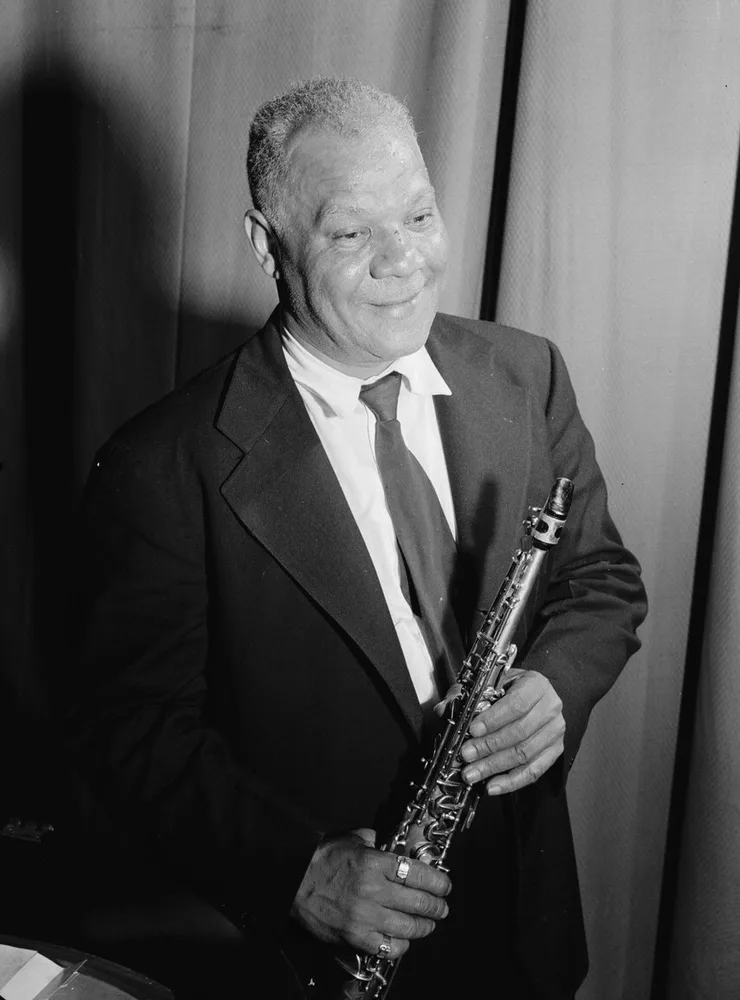
Sidney Bechet with his soprano saxophone, New York, circa July 1946, photographed by William P. Gottlieb Public Domain (William P. Gottlieb collection at the Library of Congress; the photographer dedicated the collection to the public domain in 2010) — Wikimedia Commons — https://commons.wikimedia.org/wiki/File:(Portrait_of_Sidney_Bechet,_New_York,_N.Y.(?),_ca._July_1946)_(LOC)_(4888659740)_(cropped).jpg
,_ca._July_1946)_(LOC)_(4888659740)_(cropped).jpg)
Sidney Joseph Bechet was born on May 14, 1897, in New Orleans, into a middle-class Creole of color family. His father, Omar, was a shoemaker and flute player, and his older brother Leonard was a dentist who played trombone and led a band on the side. Bechet taught himself on the instruments kept around the house, starting on cornet and settling on clarinet, and at six he played with his brother's band at a family birthday party. His early teachers and colleagues included the clarinetists Lorenzo Tio, "Big Eye" Louis Nelson Delisle and George Baquet, and he worked with Freddie Keppard's brass band, with Bunk Johnson in the Eagle Band in 1911 and 1912, and with King Oliver in the Olympia Band in 1913 and 1914. From 1914 to 1917 he traveled, going as far north as Chicago.
In the spring of 1919 he went to New York and joined Will Marion Cook's Syncopated Orchestra, which sailed for Europe and played London's Royal Philharmonic Hall. Bechet was a favorite with the audiences, and in London he came across a straight soprano saxophone, the instrument that became his main voice. The Swiss conductor Ernest Ansermet wrote a tribute to him that year, among the earliest essays on a jazz musician by a classically trained authority, and it linked his playing with Bach. Back in the United States he made his first records on July 30, 1923, "Wild Cat Blues" and "Kansas City Man Blues," with pianist Clarence Williams's Blue Five, a few months after Louis Armstrong made his own recording debut with King Oliver. Armstrong joined the Blue Five the following year, and the two recorded together again later that year and in January 1925, including "Cake Walkin' Babies from Home" under the Red Onion Jazz Babies name. In 1924 Bechet also spent about three months with Duke Ellington's band, where Sonny Greer felt he fit the group perfectly; his habit of missing work, including a stretch of three days in a row, ended the stay, though Ellington later called him the epitome of jazz.
On September 15, 1925, Bechet sailed for France with the Revue Nègre, the show built around Josephine Baker, which opened at the Théâtre des Champs-Élysées in Paris on October 2. He toured Europe with several bands, reaching Russia in mid-1926, and in 1928 led a small band at Bricktop's club in Montmartre. That same year a quarrel with another musician ended in gunfire that wounded bystanders; he spent eleven months in a Paris prison and was then deported to the United States. Back in New York he worked on and off from 1931 with Noble Sissle's orchestra, which kept him recording through the thin years, and in 1932 he formed the New Orleans Feetwarmers with trumpeter Tommy Ladnier, a band that made a celebrated Victor session on September 15, 1932. Work was scarce enough that Bechet and Ladnier ran a tailor shop where musicians jammed in the back. Both men appeared in John Hammond's first From Spirituals to Swing concert at Carnegie Hall in December 1938, and sessions Mezz Mezzrow organized for the French critic Hugues Panassié that November helped start the New Orleans revival.
Recognition began to return in 1939. "Summertime," which Bechet could not place with the established record companies, became the first hit for the young Blue Note label, and the 1939 recording entered the Grammy Hall of Fame in 2011. The same year he and pianist Willie "The Lion" Smith led a group that cut early versions of what was later called Latin jazz, adapting méringue, rhumba and Haitian songs. In 1938 his guitarist Leonard Ware and two session singers wrote "Hold Tight (Want Some Seafood Mama)," with contributions claimed by Bechet, and its suggestive lyrics and the lawsuits over royalties kept it in the news; Fats Waller recorded it for Victor in January 1939. Bechet then signed with Victor's Bluebird line, recorded with the Feetwarmers through 1941, and on April 18, 1941, made "The Sheik of Araby" alone, overdubbing clarinet, soprano and tenor saxophones, piano, bass and drums in an early experiment with the technique.
Through the 1940s he worked in New York, played on some of Eddie Condon's Town Hall concerts, shared a September 1946 Town Hall stage with pianist James P. Johnson, who made his last preserved appearance with a Bechet group in March 1950, took part in the sessions Mezzrow recorded for his King Jazz label, and began teaching a teenage Bob Wilber in 1945. A planned band with the veteran trumpeter Bunk Johnson fell apart in 1945 when Johnson's drinking got in the way. Bechet's contract with the Chicago label Jazz Limited kept him off the 1948 jazz festival in Nice, and he sent Wilber in his place. Paris gave him the welcome the United States had not: his Salle Pleyel appearance at the Paris jazz festival in 1949 caused a sensation, and in 1951 he moved to France for good. He married Elisabeth Ziegler in Antibes that year, signed with Disques Vogue in 1953 on a contract that ran for the rest of his life, and recorded a string of French hits, among them "Les Oignons," "Promenade aux Champs-Élysées" and "Petite Fleur." He worked with the orchestras of Claude Luter and André Réwéliotty, wrote a late-Romantic ballet score, "La nuit est une sorcière" ("The Night Is a Witch"), appeared in three French films, and was nicknamed le dieu by some of the Paris existentialists. In 1958 he was a soloist at the Brussels World's Fair, in concerts that also featured trumpeter Buck Clayton and Sarah Vaughan.
Shortly before his death he told his story in the autobiography Treat It Gentle (1960), a colorful, embellished and often inaccurate account that remains a standard insider's view of New Orleans music. Bechet passed away of lung cancer on May 14, 1959, his 62nd birthday, in Garches, near Paris, and is buried in the local cemetery. He entered the Down Beat Hall of Fame in 1968 and the Big Band and Jazz Hall of Fame in 1983, a blue plaque marks his former London home, and a crater on Mercury and a park in Antibes bear his name.
Bechet was one of the first important soloists in jazz and the first influential soprano saxophonist. He played with a broad, quick vibrato, a big, emotionally charged sound and a lead player's authority, and he was so dominant that trumpeters found it hard to share a front line with him; as a rule it was up to the other horns to stay out of his way. His clarinet and soprano style changed little over his career, but he never lost his drive, and he was as strong in collective improvisation as in extended solos. Like Coleman Hawkins, he had a reputation for an abrasive, impatient manner with younger players, and he never learned to read music. Ansermet's 1919 essay tied his playing to the classical tradition, and the French public later made him a national favorite. His example runs through the revival of early jazz: his pupil Bob Wilber founded a Bechet Legacy band, Steve Lacy built his soprano language on a Bechet-derived vocabulary learned in Dixieland bands, Archie Shepp recorded a tribute to him, Aldo Romano made Because Of Bechet (2002) with a group that included saxophonists Emanuele Cisi and Francesco Bearzatti, and Evan Christopher devoted Blues in Air: The Music of Sidney Bechet (2022) to his music.
- "Wild Cat Blues" and "Kansas City Man Blues" (1923, OKeh) - Bechet's first records, cut with Clarence Williams's Blue Five on July 30, 1923, a few months after Louis Armstrong's recording debut with King Oliver.
- New Orleans Feetwarmers: "Sweetie Dear" and "Maple Leaf Rag" (1932, Victor) - The September 15, 1932 session by the band he formed with trumpeter Tommy Ladnier, a high point of his early recorded work.
- "Summertime" (1939, Blue Note) - The label's first hit and a Grammy Hall of Fame recording, credited to the Sidney Bechet Quintet.
- "Blues in Thirds" (1940, Victor) - A clarinet trio with Earl Hines on piano and Baby Dodds on drums, recorded in Chicago on September 6, 1940.
- "The Sheik of Araby" and "Blues of Bechet" (1941, Victor) - Bechet plays soprano and tenor saxophones, clarinet, piano, bass and drums himself in an early overdubbing experiment, recorded April 18, 1941.
- Days Beyond Recall (1951, Blue Note) - Two sessions, one with trumpeter Bunk Johnson in March 1945 and one with clarinetist Albert Nicholas in February 1946, both recorded in New York.
- "Les Oignons" (1949, Vogue) - Recorded in Paris on October 14, 1949 with Claude Luter's orchestra, one of the French hits of his later career.
- "Petite Fleur" (recorded 1952, Vogue) - Bechet's own composition, cut in January 1952 and issued on Vogue; the song became an international hit in a 1959 clarinet version by Monty Sunshine with Chris Barber's band.
Sidney Bechet: Full Discography
Discogs artist ID 258422 ("Sidney Bechet," real name Sidney Joseph Bechet, born May 14, 1897, in New Orleans, died May 14, 1959, in Garches, France) lists about 4,400 entries across leader, collaborative, track-appearance and compilation releases, most of them reissues and anthologies of the same 1923 to 1959 78 rpm sessions and 10-inch LPs. Records made under group names are filed under separate Discogs entries, among them Sidney Bechet And His New Orleans Feetwarmers (artist ID 373922), Sidney Bechet And His Blue Note Jazz Men (317900), The Mezzrow-Bechet Septet (341492) and The Bechet / Spanier Big Four (1158965). Because his catalog is that large and that heavily reissued, the leader table is a curated selection of landmark records rather than an exhaustive list: the Victor and Blue Note sessions of 1932 to 1953, the Columbia album of 1947, and the Vogue and Swing releases made in France. Recording dates for the Victor sessions come from the Discography of American Historical Recordings; catalog numbers, formats and personnel come from the Discogs release entries, and where an entry does not credit its musicians the Personnel cell says so. Album-level streaming links are not asserted here.
As Leader / Co-Leader
| Album Title | Recording Date(s) | Release Date | Label | Catalog Number | Format(s) | Personnel | Role | Reissue History | Spotify | Buy | Notes |
|---|---|---|---|---|---|---|---|---|---|---|---|
| Maple Leaf Rag / Sweetie Dear (New Orleans Feetwarmers) | September 15, 1932, New York | Not confirmed | Victor | Not confirmed | Shellac, 10", 78 RPM | Sidney Bechet (soprano saxophone, clarinet), Tommy Ladnier (trumpet), Teddy Nixon (trombone), Hank Duncan (piano), Wilson Myers (bass, per Discogs), Morris Morand (drums) | Leader (billed to the New Orleans Feetwarmers) | Collected on the CD The Victor Sessions: Master Takes 1932-43 (Bluebird 2402-2-RB, 1990) and reissued on many LPs; the pressing history is on Discogs master 1307959 | — | — | The first Feetwarmers session, with Ladnier; the same date produced "Shag," "I Found a New Baby," "I Want You Tonight" and "Lay Your Racket." The original Victor catalog number is not confirmed. |
| Pounding Heart Blues / Summertime | June 8, 1939 (probable), New York | September 1939 | Blue Note | 6 | Shellac, 12", 78 RPM | Sidney Bechet Quintet on "Summertime"; the other side is by the Port of Harlem Seven (the Discogs entry credits no individual musicians) | Leader (one side) | Reissued on 78 and on many LPs and CDs; the pressing history is on Discogs master 1217718 | — | — | Blue Note's first hit; the 1939 recording of "Summertime" entered the Grammy Hall of Fame in 2011. |
| Blues in Thirds (single) | September 6, 1940, Chicago | Not confirmed | Victor | 27204 | Shellac, 10", 78 RPM | Sidney Bechet (clarinet), Earl Hines (piano), Baby Dodds (drums) | Leader (billed to the New Orleans Feetwarmers) | Reissued on RCA Victor LPV-535 and on Bluebird AXM2-5516 (per the Discography of American Historical Recordings) | — | — | A trio side built on a composition by Earl Hines, who plays piano on it. |
| Blues of Bechet / The Sheik of Araby | April 18, 1941, New York | June 27, 1941 | Victor | 27485 | Shellac, 10", 78 RPM | Sidney Bechet (soprano saxophone, tenor saxophone, clarinet, piano, bass, drums, all overdubbed) | Leader | The 1941 session was first heard in full on the 1965 LP Bechet of New Orleans (RCA Victor LPV-510); see Discogs master 1279411 | — | — | An early commercial overdubbing experiment: Bechet plays six instruments himself. |
| A Jazz Masterwork | July 14 and 31, 1947, New York | 1948 | Columbia | C-173 | Shellac, 10", 78 RPM, 4 discs in an album | Sidney Bechet (soprano saxophone, clarinet); with Bob Wilber (clarinet), John Glasel (cornet), Bob Mielke (trombone), Dick Wellstood (piano), Charlie Traeger (bass), Dennis Strong (drums) on the Wildcats sides; with Lloyd Phillips (piano), Pops Foster (bass), Arthur Herbert (drums) on the quartet sides | Leader | Reissued in 1956 on the LP The Grand Master of the Soprano Saxophone and Clarinet, some from different takes; the pressing history is on Discogs master 1737717 | — | — | Four sides with Bob Wilber's Wildcats and four with a Bechet quartet; Jim Flora drew the cover. |
| Les Oignons / Ridin' Easy Blues | October 14, 1949, Paris | 1949 | Vogue Productions | V.5015 | Shellac, 10", 78 RPM | Sidney Bechet (soprano saxophone), Claude Luter et son orchestre | Leader (billed with Claude Luter) | Reissued on compilation CDs and LPs; the pressing history is on Discogs master 763512 | — | — | Recorded in Paris during Bechet's 1949 visit; one of the French hits of his later career. The date is from the Discogs release note and matches the Discography of American Historical Recordings. |
| Jazz Classics Vol. 1 | June 8, 1939 (date and place uncertain); March 27, 1940; December 20, 1944; January 29, 1945, New York | 1950 | Blue Note | BLP 7002 | Vinyl, LP, 10" | Sidney Bechet (soprano saxophone, clarinet) with changing groups that, per the Discogs credits, include Sidney De Paris, Max Kaminsky, Vic Dickenson, Art Hodes, Meade "Lux" Lewis, Pops Foster, Sidney Catlett and Teddy Bunn | Leader | Reissued on compilation CDs and LPs; the pressing history is on Discogs master 797405 | — | — | Collects "Muskrat Ramble," "Blue Horizon," "Weary Blues," "Summertime," "Dear Old Southland" and "Salty Dog." Discogs gives December 20, 1940 for two sides, which appears to be a typo for 1944. |
| Jazz Classics Vol. 2 | June 8, 1939 (uncertain); December 20, 1944; January 29, 1945, New York | 1950 | Blue Note | BLP 7003 | Vinyl, LP, 10", Mono | Sidney Bechet (soprano saxophone, clarinet) with changing groups that, per the Discogs credits, include Frank Newton, Max Kaminsky, Sidney De Paris, J.C. Higginbotham, Vic Dickenson, Art Hodes, Meade "Lux" Lewis, Pops Foster, Sidney Catlett and Teddy Bunn | Leader | Reissued on compilation CDs and LPs; the pressing history is on Discogs master 1067037 | — | — | Includes "St. Louis Blues," "Jazz Me Blues," "Pounding Heart Blues," "High Society" and "Blues for Tommy Ladnier." |
| Days Beyond Recall | March 10, 1945 and February 12, 1946, New York | 1951 | Blue Note | BLP 7008 | Vinyl, LP, 10" | Sidney Bechet (clarinet, soprano saxophone), Bunk Johnson (trumpet), Sandy Williams (trombone), Cliff Jackson (piano), Pops Foster (bass), Manzie Johnson (drums) on the 1945 sides; Albert Nicholas (clarinet), Art Hodes (piano), Danny Alvin (drums) on the 1946 sides | Co-leader (billed with Bunk Johnson) | Reissued on compilation CDs and LPs; the pressing history is on Discogs master 583933 | — | — | Two sessions: the March 1945 date with Bunk Johnson and a February 1946 date with Albert Nicholas. The pressing read on Discogs is a 1952 repress. |
| Bechet-Souvenirs | Not specified in the Discogs entry | 1952 | Vogue | LD 025 | Vinyl, LP, 10" | Sidney Bechet (soprano saxophone), Claude Luter, André Réwéliotty et son orchestre | Leader | Reissued on compilation CDs and LPs; the pressing history is on Discogs master 1278950 | — | — | French Vogue album with the Luter and Réwéliotty orchestras; the Discogs entry credits no individual musicians. |
| As-Tu Le Cafard? / Dans Les Rues D'Antibes | Not specified in the Discogs entry | 1952 | Vogue Productions | V. 5078 | Shellac, 10", 78 RPM | Sidney Bechet (soprano saxophone), Claude Luter et son orchestre | Leader (billed with Claude Luter) | Reissued on compilation CDs and LPs; the pressing history is on Discogs master 2557076 | — | — | "Dans les rues d'Antibes" recalls Bechet's 1951 wedding in Antibes. |
| Pleyel Jazz Concert, 31 Janvier 1952, Vol. 1 | January 31, 1952, Salle Pleyel, Paris | 1952 | Vogue | LD 060 | Vinyl, LP, 10", Album | Sidney Bechet (soprano saxophone), Claude Luter et son orchestre | Leader (billed with Claude Luter) | Reissued on compilation CDs and LPs; the pressing history is on Discogs master 1167912 | — | — | Live. The Discogs entry credits no individual musicians; side one opens with "Les Oignons." |
| Dixie by the Fabulous Sidney Bechet | August 25, 1953, Audio-Video Studios, New York | 1953 | Blue Note | BLP 7026 | Vinyl, LP, 10" | Sidney Bechet (soprano saxophone), Jonah Jones (trumpet), Jimmy Archey (trombone), Buddy Weed (piano), Walter Page (bass), Johnny Blowers (drums) | Leader | Reissued on compilation CDs and LPs; the pressing history is on Discogs master 1812631 | — | — | Later paired with an earlier Blue Note date on The Fabulous Sidney Bechet (1958). |
| George Wein Presents Jazz at Storyville, Vol. 1 | October 25, 1953, Storyville, Boston | October 26, 1953 | Storyville | STLP 301 | Vinyl, LP, 10" | Sidney Bechet (soprano saxophone), Vic Dickenson (trombone), George Wein (piano), Jimmy Woode (bass), Buzzy Drootin (drums) | Leader (shared billing) | Reissued on compilation CDs and LPs; the pressing history is on Discogs master 1665437 | — | — | Recorded live at Storyville, George Wein's Boston club. |
| La Nuit Est Une Sorcière | Not specified in the Discogs entry | 1954 | Vogue Productions | LD 190 | Vinyl, LP, 10", Album | Sidney Bechet (soloist, composer), Orchestre Symphonique conducted by Jacques Bazire; arranged by James Tolliver | Leader and composer | Reissued on compilation CDs and LPs; the pressing history is on Discogs master 538546 | — | — | Bechet's ballet score, with a preface credited to Bechet and André Coffrant, who wrote the scenario. |
| Creole Reeds | June 9, 1949 (four tracks) and July 26, 1947 (two tracks), New York | 1956 | Riverside | RLP 12-216 | Vinyl, LP, Mono | Sidney Bechet (soprano saxophone) with Bob Wilber (clarinet, soprano saxophone), Henry Goodwin (trumpet), Jimmy Archey (trombone), Dick Wellstood (piano), Pops Foster (bass), Tommy Benford (drums) on four tracks; with Albert Nicholas (clarinet), Wild Bill Davison (cornet), Ralph Sutton (piano), Danny Barker (guitar), Pops Foster (bass), Baby Dodds (drums) as the All Star Stompers on two | Co-leader (billed with Albert Nicholas) | Remastered 1956 reissue of material first issued on Circle; the pressing history is on Discogs master 1272927 | — | — | Side one is Bechet, taken from radio broadcasts of This Is Jazz and first issued on Circle; side two is Albert Nicholas with other groups, recorded in 1946 and 1947. |
| Sidney Bechet & Sammy Price Bluesicians | May 16, 1956 | Not confirmed | Swing | LDM 30 041 | Vinyl, LP | Sidney Bechet (soprano saxophone), Emmett Berry (trumpet), George Stevenson (trombone), Herb Hall (clarinet), Sammy Price (piano), Pops Foster (bass), Freddie Moore (drums) | Co-leader (billed with Sammy Price) | Reissued on compilation CDs and LPs; the pressing history is on Discogs master 937321 | — | — | Standards and blues recorded for the French label; Stanley Dance wrote the sleeve notes. |
| Sidney Bechet Martial Solal | Not specified in the Discogs entry | 1957 | Swing | LDM 30065 | Vinyl, LP, Album, Mono | Sidney Bechet (soprano saxophone), Martial Solal (piano), Pierre Michelot, Lloyd Thompson (bass), Kenny Clarke, Al Levitt (drums) | Co-leader (billed with Martial Solal) | Reissued on compilation CDs and LPs; the pressing history is on Discogs master 411348 | — | — | Standards with Solal's piano and two bass and drum pairings; the Discogs entry does not say which players are on which tracks. |
| The Fabulous Sidney Bechet | November 5, 1951 (side one); August 25, 1953 (side two) | 1958 | Blue Note | BLP 1207 | Vinyl, LP, Album, Mono | Sidney Bechet (soprano saxophone); side one with Sidney De Paris (trumpet), Jimmy Archey (trombone), Don Kirkpatrick (piano), Pops Foster (bass), Manzie Johnson (drums); side two with Jonah Jones (trumpet), Jimmy Archey (trombone), Buddy Weed (piano), Walter Page (bass), Johnny Blowers (drums) | Leader | Reissued on compilation CDs and LPs; the pressing history is on Discogs master 462343 | — | — | Combines two earlier Blue Note 10-inch sessions on one 12-inch LP. |
| Bravo! Bechet Buckner | Not specified in the Discogs entry (a track is titled "Blue Festival 58") | 1960 | Disques Vogue | LDM 30.092 | Vinyl, LP, Album | Sidney Bechet (soprano saxophone), Teddy Buckner (trumpet), Christian Guérin (trombone), Eddie Bernard (piano), Roland Bianchini (bass), Kansas Fields (drums) | Co-leader (billed with Teddy Buckner) | Reissued on compilation CDs and LPs; the pressing history is on Discogs master 1106203 | — | — | Released after Bechet's death in 1959; the Discogs master dates the album 1958. |
As Sideman (selected major credits)
Bechet was a bandleader for most of his recording career, so this table is a representative set of the sessions he made for other leaders, not an exhaustive list. The Discography of American Historical Recordings lists about 156 of his sides on Victor, Decca, OKeh, Gennett, Columbia, Brunswick and Master alone.
| Year | Project (Leader) | Title | Label | Catalog | Role | Notes |
|---|---|---|---|---|---|---|
| 1923 | Clarence Williams's Blue Five | "Wild Cat Blues" / "Kansas City Man Blues" | OKeh | 4925 | Clarinet | Bechet's first recording session, July 30, 1923; "Texas Moaner Blues" with Louis Armstrong followed in 1924. |
| 1924-1925 | Clarence Williams's Blue Five; Red Onion Jazz Babies | Sessions with Louis Armstrong including "Cake Walking Babies (From Home)" | OKeh; Gennett | Various 78s | Clarinet, soprano saxophone | Red Onion Jazz Babies session for Gennett on December 23, 1924; Blue Five session for OKeh on January 8, 1925, with Eva Taylor singing. |
| 1931 | Noble Sissle and His Orchestra | Six Brunswick sides including "The Basement Blues" and "Roll On, Mississippi, Roll On" | Brunswick | 6129; 6111; others | Clarinet, soprano saxophone | February 24 and April 21, 1931, with Tommy Ladnier and Arthur Briggs. |
| 1934 | Noble Sissle and His International Orchestra | "Polka Dot Rag" / "Under the Creole Moon" | Decca | 153 | Clarinet, soprano saxophone, composer | Recorded August 15, 1934, in Chicago; both titles are Bechet co-compositions. |
| 1936 | Noble Sissle Orchestra | "You Can't Live in Harlem" and other titles | Decca | Various 78s | Clarinet, soprano saxophone | Recorded March 11, 1936; the same session produced the first records by Lena Horne. |
| 1937 | Noble Sissle's Swingsters | "Okey-Doke" / "Characteristic Blues" | Variety | 648 | Clarinet, composer | Recorded April 16, 1937, with Bechet as the only horn. |
| 1938 | Noble Sissle's Swingsters | "Viper Mad" / "Sweet Patootie" and "Blackstick" / "Southern Sunset" | Decca | 7429; 2129 | Clarinet, soprano saxophone, composer | Recorded February 10, 1938; the last Swingsters date. |
| 1938 | Trixie Smith | "Freight Train Blues," "Trixie Blues," "My Daddy Rocks Me" and others | Decca | Various 78s | Clarinet, soprano saxophone | Recorded May 26, 1938. |
| 1938 | Tommy Ladnier Orchestra | "Really the Blues," "Weary Blues," "Ja-Da," "When You and I Were Young, Maggie" | Victor | Not confirmed | Clarinet, soprano saxophone | Recorded November 28, 1938, in the sessions Mezz Mezzrow organized for Hugues Panassié; collected on the LP The Panassié Sessions (RCA Victor LPV 542, 1967). |
| 1939 | Jelly Roll Morton's New Orleans Jazzmen | "High Society," "Oh, Didn't He Ramble," "Winin' Boy Blues," "I Thought I Heard Buddy Bolden Say" | Victor | Not confirmed | Soprano saxophone | Recorded September 14, 1939. |
| 1940 | Henry Levine's Barefooted Dixieland Philharmonic | "Muskrat Ramble" | Victor | Not confirmed | Soprano saxophone (guest) | Recorded November 11, 1940, after Bechet's guest appearance on a radio show with Levine's band. |
| 1949 | Humphrey Lyttelton and His Band | "Who's Sorry Now?," "Sleepy Time Down South," "I Told You Once, I Told You Twice," "Georgia" | Melodisc | EPM 7-51 (1955 EP) | Soprano saxophone | Recorded in 1949, first issued as singles and later collected on a 1955 EP. |
Composer Credit Without a Playing Role
Bechet's composer credit on the Fats Waller recording of "Hold Tight (Want Some Seafood Mama)" for Victor on January 19, 1939 is a non-playing credit. The song, which Bechet's own orchestra had recorded in November 1938 and which the Andrews Sisters also recorded that year, was credited to his guitarist Leonard Ware and two session singers, with contributions claimed by Bechet.
- Clarence Williams - pianist and bandleader whose Blue Five made Bechet's first records on July 30, 1923, and went on to record with him and Louis Armstrong in 1924 and 1925.
- Louis Armstrong - recorded with Bechet in Williams's Blue Five and as the Red Onion Jazz Babies in 1924 and 1925, including "Cake Walkin' Babies from Home."
- Duke Ellington - bandleader who hired him for about three months in 1924; Bechet's New Orleans phrasing left a mark on the band's early style.
- Will Marion Cook - composer and conductor whose Syncopated Orchestra took Bechet to Europe in 1919.
- Josephine Baker - star of the 1925 Revue Nègre in Paris, in which Bechet played a clarinet solo.
- Noble Sissle - bandleader with whom Bechet worked on and off from 1931 to 1938 and for whom he co-wrote "Polka Dot Rag," "Under the Creole Moon" and "Characteristic Blues," according to Sissle's own profile.
- Tommy Ladnier - trumpeter and co-leader of the New Orleans Feetwarmers from 1932, Bechet's partner in the tailor shop, and his colleague at From Spirituals to Swing in December 1938.
- Mezz Mezzrow - clarinetist and producer who organized the 1938 sessions with Bechet and Ladnier for Hugues Panassié and later financed Bechet's King Jazz sessions of the mid-1940s.
- Fats Waller - recorded Bechet's "Hold Tight (Want Some Seafood Mama)" for Victor in January 1939.
- Willie "The Lion" Smith - pianist who led a 1939 group with Bechet that recorded early Latin-flavored jazz.
- Earl Hines and Baby Dodds - pianist and drummer in the trio that recorded "Blues in Thirds" in Chicago on September 6, 1940.
- Jelly Roll Morton - bandleader on whose September 14, 1939 New Orleans Jazzmen session for Victor Bechet played soprano saxophone.
- James P. Johnson - pianist who shared a September 1946 Town Hall concert with Bechet and gave his last preserved performance with a Bechet group on March 5, 1950, per his own profile.
- Bunk Johnson - trumpeter from Bechet's New Orleans youth, recorded with him in New York on March 10, 1945; a band the two planned later that year fell apart.
- Bob Wilber - pupil from 1945 and later Bechet's chosen stand-in at the 1948 Nice festival; founder of the Bechet Legacy band in the late 1970s.
- Claude Luter and André Réwéliotty - French bandleaders whose orchestras backed Bechet on his Vogue records of the early and mid-1950s, including "Les Oignons" and "Petite Fleur."
- Kenny Clarke - drummer who worked in Bechet's bands around 1940 and again after moving to Paris, one of the drummers on the 1957 album with Solal, and shares billing with him on the 1949 single "Klook's Blues."
- Martial Solal - pianist who worked with Bechet and other American expatriates in Paris in the early 1950s and co-led the 1957 album Sidney Bechet Martial Solal.
- Buck Clayton and Sarah Vaughan - fellow performers at the 1958 Brussels World's Fair concerts.
- Vic Dickenson, Muggsy Spanier, Wild Bill Davison, Art Hodes, Sidney De Paris, Albert Nicholas, Sammy Price, Teddy Buckner, Humphrey Lyttelton - fellow soloists who share billing or session credits with Bechet on Blue Note, Storyville, Swing, Vogue and Melodisc releases.
More Dixieland Artists
See all 44 Dixieland artists →More American Jazz Artists
See all 646 American artists →- Wikipedia: Sidney Bechet
- Wikipedia: Sidney Bechet (French edition)
- AllMusic: Sidney Bechet biography, by Scott Yanow
- Discography of American Historical Recordings: Sidney Bechet
- Wikipedia: Blue Note Records
- Wikipedia: Summertime (George Gershwin song)
- Wikipedia: La Revue nègre
- Wikipedia: Southern Syncopated Orchestra
- Wikipedia: Tommy Ladnier
- Wikipedia: Mezz Mezzrow
- Wikipedia: Bob Wilber
- Discogs: Sidney Bechet (artist 258422)
- MusicBrainz: Sidney Bechet
- Library of Congress, Gottlieb collection: portrait of Sidney Bechet, July 1946
- JazzProfiles.com: Noble Sissle
- JazzProfiles.com: James P. Johnson
- JazzProfiles.com: Martial Solal
- JazzProfiles.com: Steve Lacy
- JazzProfiles.com: Evan Christopher
- JazzProfiles.com: Aldo Romano