 JAZZPROFILES lives in the music 1,146 Jazz Artists fully Profiled!
 Stéphane Grappelli
Last updated September 12, 2026
Listen on Spotify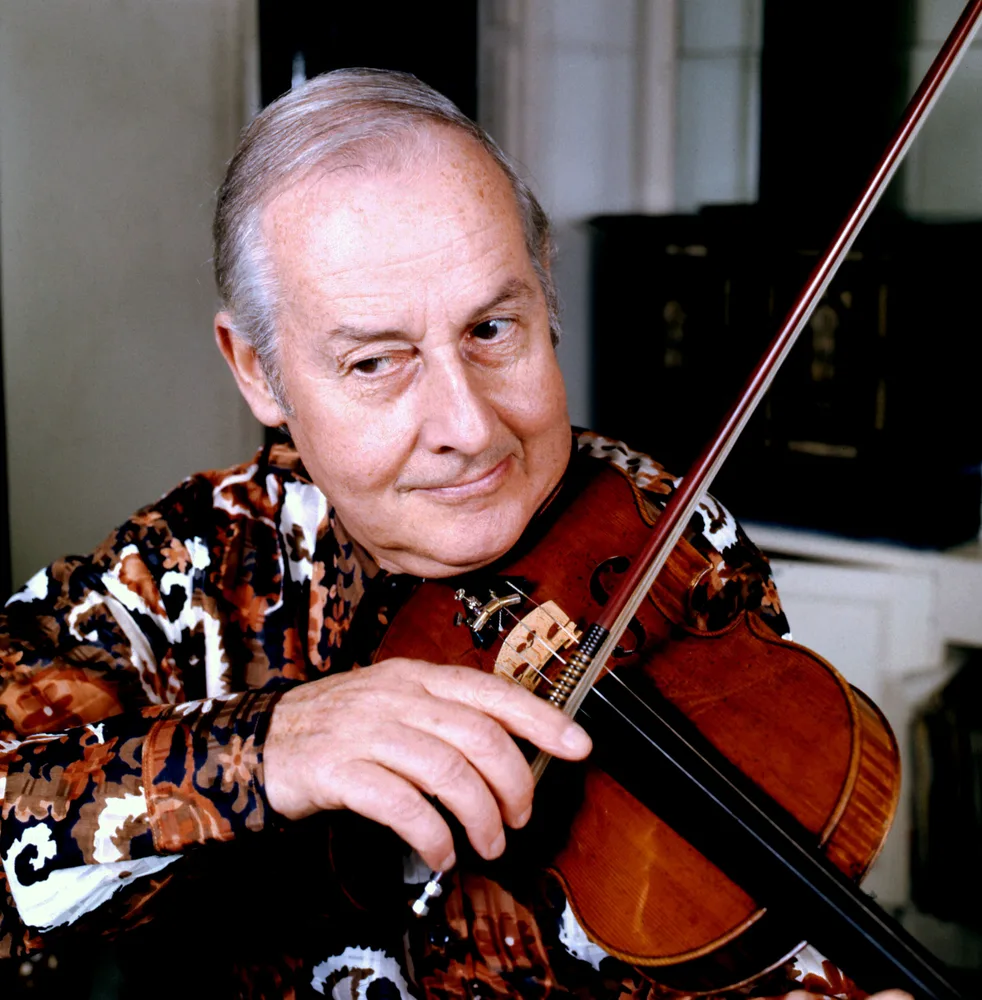
Stéphane Grappelli, portrait taken in London in 1976 CC BY-SA 3.0 (also dual-licensed GFDL) — Wikimedia Commons, photograph by Allan Warren, https://commons.wikimedia.org/wiki/File:Stephane_Grappelli_Allan_Warren.jpg

Stéphane Grappelli was born January 26, 1908, at the Hôpital Lariboisière in Paris, the son of Ernesto Grappelli, an Italian-born scholar and translator from Alatri, and Anna Emilie Hanoque, who died when he was five. His father was drafted into the Italian army in 1914, and the young Grappelli was briefly enrolled at Isadora Duncan's Paris dance school before spending several harsh years in a Catholic orphanage until his father's return in 1918; he was naturalized as a French citizen the following year. He took up the violin at twelve, largely teaching himself, and studied at the Paris Conservatoire during the 1920s, graduating with a second-tier medal. At fifteen he began busking on the streets, then worked accompanying silent films in cinema pit orchestras. He discovered American jazz through records played at a Paris brasserie, and a 1928 Paris concert by the touring American jazz violinist Joe Venuti convinced him the violin could carry a genuine jazz solo voice.
In the early 1930s Grappelli met the guitarist Django Reinhardt, and the two began jamming together in Paris. In the summer of 1934 they formalized a group at the Hôtel Claridge on the Champs-Élysées: the Quintette du Hot Club de France, an unusual all-string lineup pairing Grappelli's violin and Reinhardt's lead guitar with rhythm guitarists Joseph Reinhardt and Roger Chaput and bassist Louis Vola. The quintet's first commercial release, "Dinah" backed with "Lady Be Good," was cut for Ultraphone in Paris on December 28, 1934 (the label misspelled both men's names). Over the rest of the decade the group toured Britain and the Continent and recorded prolifically, becoming Europe's most celebrated jazz act and giving jazz violin its first fully idiomatic voice. The partnership ended when war broke out in September 1939 while the quintet was on a London engagement.
Reinhardt returned to occupied Paris, but Grappelli chose to remain in England for the duration of the war, leading a new band that briefly included a young pianist named George Shearing, who made his own recording debut as a sideman in Grappelli's group. Grappelli and Reinhardt reunited on record intermittently after 1946, including a final run of sessions cut in Rome in January and February 1949 with pianist Gianni Safred, bassist Carlo Pecori and drummer Aurelio De Carolis, but the two never resumed a steady working partnership; Reinhardt died in 1953. Grappelli spent the 1950s and much of the 1960s working steadily in European clubs, including a long residency at Le Toit de Paris atop the Paris Hilton from 1967 to 1972, largely out of the American jazz press's view. Two sessions from that quieter stretch stand out: a September 1966 four-violin meeting in Basel with Stuff Smith, Svend Asmussen and Jean-Luc Ponty, released as Violin-Summit, and a February 1963 Paris date with members of Duke Ellington's orchestra, trumpeter and violinist Ray Nance among them, that was not issued until 1976 as Duke Ellington's Jazz Violin Session.
His career turned decisively in 1971, when a chance duet with the classical violinist Yehudi Menuhin on Michael Parkinson's British television talk show drew wide new attention; the two went on to record together intermittently between 1972 and the mid-1980s. In 1973 the guitarist Diz Disley persuaded Grappelli to return to the acoustic Hot Club instrumentation, and an ecstatic response at that year's Cambridge Folk Festival launched two decades of steady international touring, first with the Diz Disley Trio and later with guitarist Marc Fosset's groups. The revival brought a run of new studio partnerships: a violin-vibraphone duo album with Gary Burton, Paris Encounter (recorded 1969, released 1972 on Atlantic); a quintet session with fellow violinist Jean-Luc Ponty and guitarist Philip Catherine, Ponty-Grappelli (1974); Young Django (1979), pairing him with guitarists Larry Coryell and Philip Catherine; and a live album with mandolinist David Grisman drawn from their 1979 concerts in San Francisco and Boston, released in 1981.
Grappelli also worked steadily in film and on other artists' records during these decades. He composed the scores for Les Valseuses (1974) and Milou en Mai (1990), made cameo screen appearances including King of the Gypsies (1978, alongside Grisman) and an episode of Little House on the Prairie (1975), and played the uncredited violin solo on the title track of Pink Floyd's Wish You Were Here (1975), a contribution mixed nearly inaudible until the 2011 remaster restored it. Late in his life he recorded Flamingo (1996) with pianist Michel Petrucciani, bassist George Mraz and drummer Roy Haynes, one of his last major studio dates. In 1997 he received a Grammy Lifetime Achievement Award and was inducted into the Down Beat Jazz Hall of Fame.
Despite failing health, Grappelli continued touring into 1997, playing dates in the United Kingdom that March before a final tour of Australia and New Zealand; his last public performance was in Christchurch. He died in Paris on December 1, 1997, at eighty-nine, of heart failure following a series of minor strokes. His funeral was held December 5 at the Église Saint-Vincent-de-Paul, within sight of the hospital where he was born, and his ashes were entombed at the Père Lachaise Cemetery.
Grappelli belongs, with Joe Venuti and Stuff Smith, among the three musicians most responsible for establishing the violin as a genuine jazz solo instrument in the years before bebop. Where Venuti's attack could be hard-edged and combative, Grappelli's playing was sweeter and more legato, built on a singing tone, effortless swing and an unfailingly melodic sense of improvisation that he carried, essentially unchanged in its essentials, from the acoustic Quintette du Hot Club de France of the 1930s through five more decades of amplified small-group jazz. He remained remarkably consistent and enthusiastic to the end of his life, adapting to duo settings with a classical virtuoso (Yehudi Menuhin), a vibraphonist (Gary Burton), a bluegrass mandolinist (David Grisman) and fellow violinists (Jean-Luc Ponty, Svend Asmussen, Stuff Smith) without ever forcing his own vocabulary to fit theirs. Critics and younger violinists alike came to regard him as, in the phrase widely used by the end of his career, the grandfather of jazz violinists.
- Dinah / Lady Be Good (1934, Ultraphone) - The Quintette du Hot Club de France's first commercial release, cut in Paris on December 28, 1934; the group's prewar sides are collected today on reissues such as Djangology. Spotify - Djangology (feat. Stéphane Grappelli) Listen
- Feeling + Finesse = Jazz (1962, Atlantic) - A postwar leader date recorded in Paris with guitarist Pierre Cavalli, bassist Guy Pedersen and drummer Daniel Humair, from the quieter stretch of his career before his 1970s international revival. Spotify - Feeling + Finesse = Jazz Listen
- Violin-Summit (1967, SABA) - A four-violin meeting recorded live in Basel, Switzerland in September 1966 with Stuff Smith, Svend Asmussen and Jean-Luc Ponty, backed by pianist Kenny Drew.
- Afternoon in Paris (1971, MPS) - A trio and quartet session recorded at the MPS studio in Villingen with pianist Marc Hemmeler, bassist Eberhard Weber and drummer Kenny Clare, from the year his international career reignited. Spotify - Afternoon in Paris Listen
- Paris Encounter (recorded 1969, released 1972, Atlantic) - A duo album with vibraphonist Gary Burton, backed by Steve Swallow and Bill Goodwin. Spotify - Paris Encounter Listen
- Young Django (1979, MPS) - Recorded in Stuttgart with guitarists Larry Coryell and Philip Catherine and bassist Niels-Henning Ørsted Pedersen. Spotify - Young Django Listen
- Stephane Grappelli/David Grisman Live (1981, Warner Bros.) - Drawn from September 1979 concerts in San Francisco and Boston with mandolinist David Grisman, violinist Mark O'Connor and bassist Rob Wasserman. Spotify - Stephane Grappelli and David Grisman Live Listen
- Flamingo (1996, Dreyfus Jazz) - A late-career quartet date recorded in Paris with pianist Michel Petrucciani, bassist George Mraz and drummer Roy Haynes. Spotify - Flamingo (feat. Roy Haynes & George Mraz) Listen
Stéphane Grappelli: Full Discography
Identity confirmed via the live Discogs API: artist ID 267089 ("Stéphane Grappelli," violinist, matching birth/death dates and the Quintette du Hot Club de France credits). Discogs' artist-releases listing for this ID runs to roughly 2,700 entries, the overwhelming majority of them reissues and compilations of his prewar Quintette sides and his 1960s-90s touring-era albums rather than distinct original sessions. The table below curates the most significant releases from a six-decade career rather than itemizing every reissue: the pre-war Quintette du Hot Club de France era, his postwar leader and co-led catalog, and a representative set of his most notable sideman appearances.
As Leader / Co-Leader
| Album Title | Recording Date(s) | Release Date | Label | Catalog Number | Format(s) | Personnel | Role | Reissue History | Spotify | Buy | Notes |
|---|---|---|---|---|---|---|---|---|---|---|---|
| Dinah / Lady Be Good | Recorded December 28, 1934, Paris | 1934 | Ultraphone | U AP 1422 | Shellac, 10", 78 RPM | Stéphane Grappelli (violin), Django Reinhardt (guitar), Joseph Reinhardt (guitar), Roger Chaput (guitar), Louis Vola (bass) | Co-leader (Quintette du Hot Club de France) | Widely reissued on later compilations | Spotify - Djangology (feat. Stéphane Grappelli) | — | The quintet's first commercial release; the Ultraphone label misspelled both Reinhardt's and Grappelli's names |
| The Quintessential Django Reinhardt & Stéphane Grappelli (25 Classics 1934-1940) | Recorded 1934-1940, Paris and London | 1998 | ASV / Living Era | CD AJA 5267 | CD, Compilation | Stéphane Grappelli (violin), Django Reinhardt (guitar), with rotating rhythm guitarists Joseph Reinhardt, Roger Chaput, Eugène Vées, Marcel Bianchi and Pierre Ferret, and bassist Louis Vola | Co-leader (Quintette du Hot Club de France) | Modern compilation; not the original 78s | Not located under this exact title | — | A modern anthology of the prewar Quintette's most acclaimed sides, gathered from across its six-year run |
| Djangology 49 | Recorded January-February 1949, Rome, Italy | 1990 reissue (CD) | Bluebird / RCA | 9988-2-RB | CD, Album, Remastered | Django Reinhardt (guitar), Stéphane Grappelli (violin), Gianni Safred (piano), Carlo Pecori (bass), Aurelio De Carolis (drums) | Co-leader | Digitally remastered 1990 reissue of the original 1949 sessions | Not located under this exact title | — | Reinhardt and Grappelli's final studio reunion, four years before Reinhardt's 1953 death |
| Feeling + Finesse = Jazz | Not specified in Discogs data | November 1962 | Atlantic | 1391 | Vinyl, LP, Album | Stéphane Grappelli (violin), Pierre Cavalli (electric guitar, all guitar solos), Léo Petit (rhythm guitar), Guy Pedersen (bass), Daniel Humair (drums) | Leader | None found | Spotify - Feeling + Finesse = Jazz | — | A leader date from the quieter, club-based stretch of his career before the 1970s international revival |
| Violin-Summit | Recorded live September 30, 1966, Basel, Switzerland | 1967 | SABA | SB 15 099 ST | Vinyl, LP, Album | Stéphane Grappelli, Stuff Smith, Svend Asmussen, Jean-Luc Ponty (violins), Kenny Drew (piano), Niels-Henning Ørsted Pedersen (bass), Alex Riel (drums) | Co-leader (four-violin summit) | None found | Not confidently located under this exact billing | — | A rare meeting of four leading jazz violinists, recorded for the "Jazz im Fauteuil" concert series |
| Afternoon in Paris | Recorded March 1971, MPS Studio, Villingen | 1971 | MPS Records | 21 20876-1 | Vinyl, LP, Album | Stéphane Grappelli (violin), Marc Hemmeler (piano), Eberhard Weber (bass), Kenny Clare (drums) | Leader | None found | Spotify - Afternoon in Paris | — | Recorded the year his international career began to revive |
| Paris Encounter | Recorded November 1969, Studios Europe Sonor, Paris | 1972 | Atlantic | SD 1597 | Vinyl, LP, Album, Stereo | Gary Burton (vibraharp), Stéphane Grappelli (violin), Steve Swallow (electric bass), Bill Goodwin (drums) | Co-leader (with Gary Burton) | None found | Spotify - Paris Encounter | — | A violin-vibraphone duo date, held for release roughly three years |
| Just One of Those Things! | Recorded live July 4, 1973, Montreux Jazz Festival | 1973 | Black Lion | 2460 211 / BLP 30152 | Vinyl, LP, Album | Stéphane Grappelli (violin), Marc Hemmeler (piano), Jack Sewing (bass), Daniel Humair (drums) | Leader | None found | Not located on Spotify | — | Live document from the year of his Cambridge Folk Festival breakthrough |
| I Got Rhythm! | Recorded live November 5, 1973, Queen Elizabeth Hall, London | 1974 | Black Lion | 2683 047 | Vinyl, LP, Album | Stéphane Grappelli (violin), Diz Disley (guitar), Denny Wright (guitar), Len Skeat (bass) | Leader (with the Diz Disley Trio) | None found | Not located on Spotify | — | Documents the acoustic Hot Club lineup Diz Disley built around Grappelli after 1973 |
| Ponty-Grappelli | Recorded December 27-29, 1973, Studio Fremontel, France | 1974 | America Records | 30 AM 6139 | Vinyl, LP, Album | Jean-Luc Ponty, Stéphane Grappelli (violins), Philip Catherine (guitar), Maurice Vander (piano), Tony Bonfils (bass), André Ceccarelli (drums) | Co-leader (with Jean-Luc Ponty) | None found | Not located on Spotify | — | A studio quintet session pairing Grappelli with the younger, electric-toned Ponty |
| Young Django | Recorded January 19-21, 1979, Tonstudio Zuckerfabrik, Stuttgart | 1979 | MPS Records | 5C 064-62826 | Vinyl, LP, Album | Stéphane Grappelli (violin), Larry Coryell (guitar), Philip Catherine (guitar), Niels-Henning Ørsted Pedersen (bass) | Leader | None found | Spotify - Young Django | — | |
| Stephane Grappelli/David Grisman Live | Recorded live September 7 and 20, 1979, Great American Music Hall, San Francisco, and Berklee Performance Center, Boston | 1981 | Warner Bros. Records | BSK 3550 | Vinyl, LP, Album | Stéphane Grappelli, Mark O'Connor (violins), David Grisman, Mike Marshall (mandolins), Tiny Moore (electric mandolin), Rob Wasserman (bass) | Co-leader (with David Grisman) | None found | Spotify - Stephane Grappelli and David Grisman Live | — | |
| Stephane Grappelli Meets Barney Kessel | Recorded June 23-24, 1969, Studio Davout, Paris | 1990 reissue (CD compilation) | Black Lion | BLCD760150 | CD, Compilation | Stéphane Grappelli (violin), Barney Kessel (guitar), Michel Gaudry (bass), Jean-Louis Viale (drums) | Co-leader (with Barney Kessel) | Compiles the 1971 album I Remember Django plus four further tracks from the same 1969 sessions | Not located on Spotify | — | The CD title dates from 1990, but the music was recorded in 1969 |
| Menuhin & Grappelli Play Jealousy & Other Great Standards | Recorded 1972-1985 across several sessions, London | 1988 (this compilation) | EMI / Angel | CDM 7 69220 2 | CD, Compilation, Remastered | Stéphane Grappelli, Yehudi Menuhin (violins), with rotating rhythm sections including guitarists Marc Fosset and John Etheridge and bassists Niels-Henning Ørsted Pedersen and Pierre Michelot | Co-leader (with Yehudi Menuhin) | Compiles several individually issued Menuhin/Grappelli albums recorded across more than a decade | Not located on Spotify | — | Represents the violin-duo partnership Grappelli and Menuhin began after their 1971 televised encounter |
| Legrand Grappelli | Recorded May 25-27, 1992, Paris | 1992 | Verve Records | 517 028-2 | CD, Album | Michel Legrand (piano, arranger), Stéphane Grappelli (violin), with Stéphane Belmondo (trumpet) among the personnel | Co-leader (with Michel Legrand) | None found | Not located on Spotify | — | Grew out of Legrand's big band concert with Grappelli at the Paris Olympia earlier in 1992 |
| Flamingo | Recorded June 15-17, 1995, Studios Davout, Paris | 1996 | Dreyfus Jazz | FDM 36580-2 | CD, Album | Stéphane Grappelli (violin), Michel Petrucciani (piano), George Mraz (bass), Roy Haynes (drums) | Co-leader (with Michel Petrucciani) | None found | Spotify - Flamingo (feat. Roy Haynes & George Mraz) | — | One of his last major studio recordings |
| Live at the Blue Note | Recorded October 9-11, 1995, New York City | 1996 | Telarc Jazz | CD-83397 | CD, Album | Stéphane Grappelli (violin), Bucky Pizzarelli (guitar), John Pizzarelli (guitar), Jon Burr (bass) | Leader | None found | Not located on Spotify | — | |
| As Time Goes By | Recorded August 1996 | December 12, 1996 | Escalier | ESCK 8036 | CD, Album | Stéphane Grappelli (violin), Iwao Furusawa (violin), Marc Fosset (guitar), Philippe Viret (bass) | Leader | None found | Not located on Spotify | — | His final studio recording, released a little over a year before his death |
As Sideman (selected major credits)
| Year | Project (Leader) | Title | Label | Catalog | Role | Notes |
|---|---|---|---|---|---|---|
| 1937 | Coleman Hawkins and His All-Star "Jam" Band | "Honeysuckle Rose" / "Crazy Rhythm" | Swing | SW. 1 | Piano | Recorded in Paris on April 28, 1937, with Benny Carter and Andre Ekyan (alto saxophone), Alix Combelle (tenor saxophone), Django Reinhardt (guitar), Eugene d'Hellemmes (bass) and Tommy Benford (drums); Grappelli played piano rather than violin on this date |
| 1963 | Duke Ellington | Duke Ellington's Jazz Violin Session | Atlantic | Not specified in Discogs data | Violin | Recorded February 22, 1963, Barclay Studios, Paris, alongside Ray Nance and Svend Asmussen (violins); shelved for over a decade and not released until 1976 |
| 1975 | Pink Floyd | Wish You Were Here | Harvest / Columbia | Not specified in Discogs data | Violin | Uncredited session violin solo on the title track, mixed almost inaudible in the original release; made fully audible on the 2011 remaster |
Beyond the credits above, Grappelli's enormous reissue catalog also documents further sideman and co-billed work with Oscar Peterson and Joe Pass (Skol, recorded 1979, Pablo Live), Earl Hines, Bill Coleman, and dozens of other collaborators across more than sixty years of recording, not itemized exhaustively here.
- Django Reinhardt - co-founder of the Quintette du Hot Club de France in 1934, his most historically significant partnership; the pair worked together through 1939, reunited on and off after the war, and cut a final run of sessions together in Rome in 1949.
- Yehudi Menuhin - classical violinist and duet partner from a 1971 televised encounter through a series of studio recordings made between 1972 and the mid-1980s.
- Diz Disley - the guitarist who brought Grappelli back to the acoustic Hot Club format in 1973 and toured with him through much of the following decade.
- Jean-Luc Ponty - fellow violinist on the 1966 Violin-Summit session and co-leader of the 1974 studio date Ponty-Grappelli.
- David Grisman - mandolin partnership beginning with 1979 concerts in San Francisco and Boston, documented on 1981's Stephane Grappelli/David Grisman Live.
- Michel Petrucciani, George Mraz, Roy Haynes - his rhythm section on Flamingo (1996), one of his final major studio recordings.
- Also recorded with: Gary Burton, Barney Kessel, Larry Coryell, Philip Catherine, Svend Asmussen, Stuff Smith, Duke Ellington's orchestra (on 1963's Jazz Violin Session), Oscar Peterson and Joe Pass (Skol, 1979), Coleman Hawkins (Paris, 1937), and Michel Legrand and Stéphane Belmondo on 1992's Legrand Grappelli.