 JAZZPROFILES lives in the music 2,059 Jazz Artists fully Profiled!
Eartha Kitt
Last updated October 29, 2026
Listen on Spotify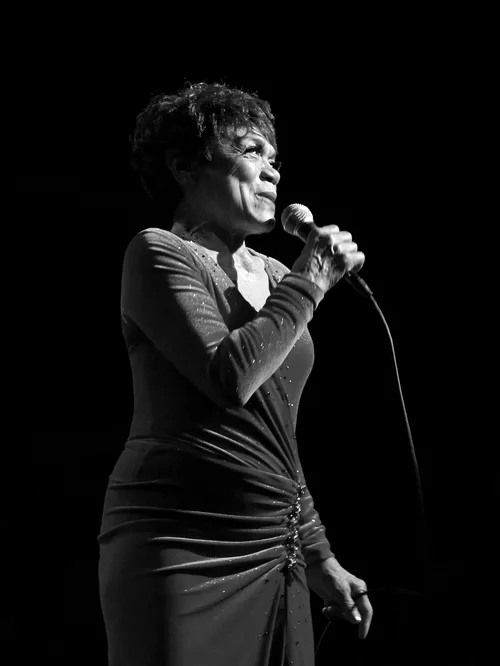
Eartha Kitt performing at Dimitriou's Jazz Alley, Seattle, August 2007 CC BY 2.0 — Wikimedia Commons - https://commons.wikimedia.org/wiki/File:Eartha_Kitt_2007.jpg - Jyh-Lurn Chang (Flickr: homoolympus), original at https://www.flickr.com/photos/homoolympus/1167611523/

Eartha Mae Keith was born on January 17, 1927, in North, South Carolina. After her mother's death she was sent to Harlem to live with a relative, Mamie Kitt, and she attended Metropolitan Vocational High School in New York. In the summer of 1944 she left school at seventeen, spent a season as a wartime farm worker in upstate New York, and returned to the city that September to audition for the Katherine Dunham Company, the first African American modern dance company in the United States. She won a scholarship and, after six months at the Dunham school, made her professional debut with the company in the 1945 Broadway variety show Blue Holiday. Dunham then secured a Broadway run for Carib Song, which opened at the Adelphi Theatre on September 24, 1945, and Kitt's singing began to set her apart from the dancers around her.
She toured the United States with the Dunham company for several years. When the troupe went to London in 1948 and on through Europe, Kitt stayed in Paris in 1949 and built a career as a nightclub singer, performing Afro-Cuban songs and working rumba movements into her act. A March 1950 report in the New Pittsburgh Courier described her radio, television and concert appearances with American jazz musicians in Paris, naming Coleman Hawkins, Buck Clayton and Doc Cheatham. A 1950 Paris session credited to Kitt with Doc Cheatham and his trio produced four recordings that stayed unreleased until a 1985 Swing Disques compilation. That June, at the Edouard VII Theatre, Orson Welles cast her as Helen in Time Runs, his one-act take on the Faust story, staged under the double title The Blessed and the Damned, with Duke Ellington reported to have agreed to supply the music. Welles once called her the most exciting woman in the world.
Her breakthrough in the United States came in the Broadway revue New Faces of 1952, where she introduced "Monotonous" and "Bal, Petit Bal," and she signed with RCA Victor. Her first records for the label, made with Henri René and His Orchestra, made her a hit-maker within a year. She recorded "Uska Dara," her version of the Turkish folk song "Kâtibim," on March 13, 1953, and "Santa Baby," which Joan Javits and Philip Springer had been commissioned to write for her that August, on October 5, 1953. "C'est si bon," sung in French, and "I Want to Be Evil" came the same year. The ten-inch RCA Victor Presents Eartha Kitt reached No. 2 on the pop albums chart, the 1954 EP That Bad Eartha reached No. 5, and "Santa Baby" peaked at No. 4 on Billboard's best-selling singles chart. She had six US Top 30 entries in the early 1950s, and "Under the Bridges of Paris" reached No. 7 on the UK singles chart in 1955. She spoke four languages and sang in seven, and her 1956 autobiography, Thursday's Child, later lent its title to a 1999 David Bowie song.
Her most direct contact with the jazz tradition came in 1958. In Paramount's W. C. Handy film St. Louis Blues, which premiered that April, she played the singer Gogo Germaine opposite Nat King Cole in the title role, with Ella Fitzgerald and Cab Calloway also in the cast. RCA Victor issued an album of songs from the film credited to Kitt with Shorty Rogers and His Giants, with Leonard Feather writing the liner notes, clarinetist Matty Matlock arranging most of the numbers, and a band that included Stan Wrightsman on piano, Al Hendrickson on guitar, Morty Corb on bass and Nick Fatool on drums. She then recorded for Kapp and MGM, with albums that included Revisited (1960), arranged by Maurice Levine, and Bad but Beautiful (1962), and for EMI Columbia in Britain, where Love for Sale (1965) used Tony Osborne's orchestra.
On January 18, 1968, Kitt attended a White House luncheon hosted by First Lady Lady Bird Johnson on the subject of juvenile delinquency. When the discussion turned to the Vietnam War and young people's unrest, she criticized the war, saying that the country was sending its best young people to be shot and maimed. Mrs. Johnson replied that a war was no reason to be uncivilized. The exchange was widely reported, her bookings in the United States reportedly dried up, and she spent much of the next decade performing in Europe and Asia. In 1975 the New York Times reported, in a story by Seymour Hersh, that the Central Intelligence Agency had kept a file on her, and Kitt gave the paper permission to print parts of it. She was invited back to the White House for a reception hosted by President Jimmy Carter on January 29, 1978, and that year returned to Broadway in Timbuktu!, which brought her the first of two Tony Award nominations; the second came for The Wild Party in 2000.
Her comeback on records was a dance single. "Where Is My Man," produced by Jacques Morali and released in the United States on StreetWise in late 1983, reached No. 7 on the Billboard dance chart and No. 36 in the UK, and it led to the 1984 album I Love Men and a new audience in nightclubs. In 1987 she replaced Dolores Gray as Carlotta in the London West End production of Sondheim's Follies, and in 1989 she charted in Britain again with "Cha Cha Heels," recorded with Bronski Beat. The jazz side of her recording life returned in the 1990s. Thinking Jazz (ITM, 1991) paired her with the clarinetist Rolf Kühn, the pianist Joachim Kühn, tenor saxophonist Jerry Bergonzi, bassist Jesper Lundgaard and drummer Daniel Humair, and included "God Bless the Child," "Lullaby of Birdland" and "My Funny Valentine." Back in Business (DRG, 1994), a program of standards with a Sondheim title song, was nominated for a Grammy at the 38th Annual Grammy Awards in 1996, in the traditional pop vocal category. Her only other Grammy nomination was in the children's recording category, for the 1968 spoken-word album Folk Tales of the Tribes of Africa.
In the 2000s she reached a younger audience as a voice actor, most prominently as the villain Yzma in Disney's The Emperor's New Groove and its follow-ups, work that won her an Annie Award in 2000 and Daytime Emmy Awards. She kept performing in New York cabaret rooms such as the Café Carlyle, recorded as Live from the Café Carlyle (DRG, 2006). In April 2008 she appeared at the Cheltenham Jazz Festival in England, and the concert was released as an album and DVD later that year. She passed away from colon cancer on Christmas Day 2008 at her home in Weston, Connecticut, at the age of 81. Her star on the Hollywood Walk of Fame dates from February 1960, South Carolina observes January 17 as Eartha Kitt Day, and in 2013 the jazz singer René Marie released I Wanna Be Evil (With Love to Eartha Kitt) on Motéma, with trumpeter Etienne Charles in her band, described as the first full tribute album to Kitt.
Kitt was a cabaret and theatre performer first, and she is covered here as a crossover figure, not as a core jazz singer. AllMusic files her under vocal music, with traditional pop and show-music styles, and a reviewer of her Cheltenham concert noted that she was not a traditional jazz artist even while praising the set. What gives her a place alongside jazz is where she worked and what she sang: a Paris nightclub scene that, by press report, put her on bills with American jazz musicians, a 1950 session with Doc Cheatham's trio, the film repertoire cut with Shorty Rogers's band, and a catalogue of Cole Porter, Fats Waller and Duke Ellington songs that runs through to her last concerts.
Her sound was a low, purring, deliberately theatrical delivery that treated each lyric as a short scene, and it moved across languages: French, Spanish, Turkish, German, Swedish and Italian songs all turn up on her records, along with a Philippine song, "Waray-Waray," that she learned phonetically on a 1963 tour. She trained as a dancer with the Dunham school before she was known as a singer, and movement stayed central to her act. The press compared her early on to Josephine Baker as another American performer who built a career in Paris, and critics kept describing her in feline terms, an image that carried into her 1967 turn as Catwoman in the television series Batman. The best evidence for the musician underneath the persona is the later work with players such as the Kühn brothers and Daniel Humair on Thinking Jazz, where she sings Billie Holiday's "God Bless the Child" and Cole Porter's "Night and Day" in front of a modern jazz quintet. AllMusic's related-artists list for her includes Dinah Washington, Nancy Wilson and Morgana King.
- RCA Victor Presents Eartha Kitt (1953, RCA Victor) - The ten-inch debut album with Henri René and His Orchestra, collecting "C'est si bon," "Uska Dara," "I Want to Be Evil" and "Angelitos Negros," and her biggest album chart showing. Spotify - C'est Si Bon · Spotify - I Want to Be Evil Listen
- "Santa Baby" (1953, RCA Victor) - The Christmas song written for her by Joan Javits and Philip Springer, recorded October 5, 1953 with Henri René and His Orchestra, and a No. 4 hit that year. Spotify - Santa Baby Listen
- That Bad Eartha (1954, RCA Victor) - The follow-up with "Under the Bridges of Paris," "Let's Do It," "My Heart Belongs to Daddy" and "Smoke Gets in Your Eyes," which reached No. 5 on the albums chart. Spotify - That Bad Eartha Listen
- St. Louis Blues (1958, RCA Victor) - Songs from the Paramount film, credited to Kitt with Shorty Rogers and His Giants, with Matty Matlock's arrangements and Leonard Feather's liner notes; her most directly jazz-oriented album of the 1950s.
- "Where Is My Man" (1983, StreetWise) - The Jacques Morali dance record that restarted her recording career, No. 7 on the Billboard dance chart. Spotify - Where Is My Man Listen
- Thinking Jazz (1991, ITM) - A session with Rolf and Joachim Kühn, Jerry Bergonzi, Jesper Lundgaard and Daniel Humair, built from jazz-vocal and standards repertoire.
- Back in Business (1994, DRG) - Her last studio album, a standards program with a Sondheim title song, nominated for a Grammy.
- Live at the Cheltenham Jazz Festival (2008, Strike Force Entertainment) - The late-career concert recording from the English jazz festival, with Daryl Waters directing a small band.
Eartha Kitt: Full Discography
Discogs artist: Eartha Kitt (16748) · Real name Eartha Mae Keith · Born January 17, 1927, North, South Carolina · Passed away December 25, 2008, Weston, Connecticut
Her sixteen studio albums run from 1953 to 1994, but most of her best-known records are singles, so this list covers the albums, the charted singles and the jazz-leaning sessions. The full release list, including compilations and reissues, is on Discogs.
Leader: Studio Albums
| Album | Year | Label | Personnel & Notes | Charts | Listen | Buy |
|---|---|---|---|---|---|---|
| RCA Victor Presents Eartha Kitt | 1953 | RCA Victor (LPM-3062, 10-inch) | Henri René and His Orchestra. Recorded in March 1953 at the Manhattan Center, New York, and in October 1953 at RCA Victor Studio No. 2. Contains "I Want to Be Evil," "C'est si bon," "Angelitos Negros," "Avril au Portugal," "Uska Dara," "African Lullaby," "Mountain High, Valley Low" and "Lilac Wine" | No. 2 US pop albums | Spotify - C'est Si Bon | — |
| That Bad Eartha | 1954 | RCA Victor (LPM-3187, 10-inch) | Henri René and His Orchestra. Contains "Under the Bridges of Paris," "Let's Do It (Let's Fall in Love)," "The Blues," "My Heart Belongs to Daddy," "Sandy's Tune," "Señor," "Smoke Gets in Your Eyes" and "Salanga Dou." Expanded to a 12-inch LP in 1956 (LPM-1183) | No. 5 US pop albums, 12 weeks | Spotify - That Bad Eartha | — |
| Down to Eartha | 1955 | RCA Victor (LPM-1109) | Henri René and His Orchestra. Includes "(If I Love Ya, Then I Need Ya) I Wantcha Around," "Do You Remember," "Aprés moi," "The Heel," "Mambo de Paree" and "Hey Jacque" | — | — | — |
| Thursday's Child | 1956 | RCA Victor (LPM-1300) | Henri René and His Orchestra. Includes "Lazy Afternoon," "Just an Old Fashioned Girl," "Lullaby of Birdland" and the title song. Some listings date it 1957 | — | — | — |
| St. Louis Blues | 1958 | RCA Victor (LPM-1661) | Credited to Eartha Kitt with Shorty Rogers and His Giants, songs from the Paramount film. Credits on the sleeve: Shorty Rogers (trumpet, leader), John Best (trumpet), Moe Schneider (trombone), Matty Matlock (clarinet; arranger of most numbers), Stan Wrightsman (piano), Al Hendrickson (guitar), Morty Corb (bass), Nick Fatool (drums), Milt Holland (congas); Jester Hairston arranged "Steal Away" and "Hist the Window Noah"; liner notes by Leonard Feather. Contains "St. Louis Blues," "Beale Street Blues," "Hesitating Blues," "Careless Love," "Yellow Dog Blues" and "The Memphis Blues" | — | — | — |
| The Fabulous Eartha Kitt | 1959 | Kapp (KL-1162) | Includes "Mack the Knife," "Yellow Bird," "Love Is a Gamble," "I'd Rather Be Burned as a Witch" and "In the Evening (When the Sun Goes Down)" | — | — | — |
| Revisited | 1960 | Kapp | Arranged and conducted by Maurice Levine. Recorded March 31 and April 1, 1960 in New York. Remakes of her early hits, including "Uska Dara," "Let's Do It," "C'est si bon," "I Want to Be Evil" and "Santa Baby" | No. 17 UK, February 1961 | — | — |
| Bad but Beautiful | 1962 | MGM (E4009) | Includes "Love for Sale," "Lola Lola," "Whatever Lola Wants," "Diamonds Are a Girl's Best Friend" and "Never on Sunday" | — | — | — |
| The Romantic Eartha | 1962 | EMI Columbia | UK release | — | — | — |
| Love for Sale | 1965 | EMI Columbia (SCX-3563) | Tony Osborne and His Orchestra | — | — | — |
| Canta en Español / Sings in Spanish | 1965 | Decca | Spanish-language album | — | — | — |
| Sentimental Eartha | 1970 | Spark | UK release | — | — | — |
| I Love Men | 1984 | Can't Stop Productions | Produced by Jacques Morali, with Henri Belolo as executive producer. Contains "I Love Men," "Arabian Song," "Sugar Daddy," "La Grande Vie," "Tonite" and the extended "Where Is My Man" | No. 34 Germany, No. 42 Sweden | — | — |
| I'm Still Here | 1989 | Ariola | Issued the year her memoir of the same name appeared | — | — | — |
| Thinking Jazz | 1991 | ITM (ITM 1477) | Rolf Kühn (clarinet), Joachim Kühn (piano), Jerry Bergonzi (tenor saxophone), Jesper Lundgaard (bass), Daniel Humair (drums). Thirteen tracks, including "Something May Go Wrong," "God Bless the Child" (vocal and instrumental versions), "Night and Day," "You'd Be So Nice to Come Home To," "Smoke Gets in Your Eyes," "Lullaby of Birdland" and "My Funny Valentine." Reissued by West Wind around 1999 | — | — | — |
| Back in Business | 1994 | DRG (91431) | Produced by Hugh Fordin. Recorded July 18 to 20, 1994. Twelve tracks: the Sondheim title song, "Let's Misbehave," "Solitude," "Ain't Misbehavin'," "The Nearness of You," "Brother, Can You Spare a Dime?," "Angelitos Negros," "Moon River," "Speak Low" and "Here's to Life." Her sixteenth and final studio album | Grammy nominee, 38th Annual Grammy Awards (1996) | — | — |
Leader: Live Albums
| Album | Year | Label | Personnel & Notes | Listen | Buy |
|---|---|---|---|---|---|
| C'est si bon: Live in Tivoli | 1963 | EMI Columbia | Concert album | — | — |
| Eartha Kitt in Person at the Plaza | 1965 | GNP Crescendo | Concert album | — | — |
| Live in London | 1990 | Ariola | Concert album | — | — |
| Standards/Live | 1992 | ITM | Concert album | — | — |
| Live from the Café Carlyle | 2006 | DRG (91499) | New York cabaret set, including "Sell Me," "Uska Dara," "Waray-Waray," "La Vie en Rose," "How Insensitive," "September Song" and "It Was a Very Good Year" | — | — |
| Live at the Cheltenham Jazz Festival | 2008 | Strike Force Entertainment | Recorded at the April 2008 festival, with Daryl Waters as musical director of a small band. Twenty-three tracks, including "I'm Still Here," "What Is This Thing Called Love," "How Insensitive," "Uska Dara," "I Will Survive," "C'est si bon," "September Song," "It Was a Very Good Year" and "Alone" | — | — |
Spoken Word and Cast Recordings
| Title | Year | Label | Notes |
|---|---|---|---|
| Leonard Sillman's New Faces of 1952 (original cast) | 1952 | RCA Victor (LOC-1008) | Kitt as cast member; she introduced "Monotonous" and "Bal, Petit Bal" in the show |
| Mrs. Patterson (original cast) | 1954 | Kitt in the starring role | |
| Folk Tales of the Tribes of Africa | 1968 | Caedmon | Spoken word. Nominated for the Grammy for Best Recording for Children at the 12th Annual Grammy Awards (1970) |
| Black Pioneers in American History | 1968 | Caedmon | Spoken word, with Moses Gunn |
Charted Singles
Chart positions are those listed in Wikipedia's Kitt discography. The 1953 and 1954 US positions come from Billboard's sales charts, which predate the Hot 100.
| Year | Single | Label | Peak positions |
|---|---|---|---|
| 1953 | "Uska Dara" (recorded March 13, 1953) | RCA Victor | US 23 |
| 1953 | "C'est si bon" | RCA Victor (47-5358) | US 8 |
| 1953 | "Santa Baby" (recorded October 5, 1953; written by Joan Javits and Philip Springer) | RCA Victor | US 4 |
| 1953 | "I Want to Be Evil" | RCA Victor | US 22 |
| 1954 | "Lovin' Spree" | RCA Victor | US 20 |
| 1954 | "Somebody Bad Stole de Wedding Bell" | RCA Victor | US 16 |
| 1954 to 1955 | "Under the Bridges of Paris" | RCA Victor / HMV | UK 7 |
| 1983 | "Where Is My Man" (produced by Jacques Morali) | StreetWise | US dance 7, UK 36, Sweden 5, West Germany 31 |
| 1984 | "I Love Men" | Can't Stop Productions | UK 50 |
| 1989 | "Cha Cha Heels" (with Bronski Beat) | Ariola | UK 32 |
Other singles of note: "Monotonous" / "Boston Beguine" (RCA, 1952), "Let's Do It" / "Señor" (RCA, 1954), "Mink Schmink," "Nothin' for Christmas" / "Je Cherche un Homme" (RCA, 1955), "Mack the Knife" (Kapp, 1963), "This Is My Life" (1986) and "This Year's Santa Baby" (1954).
Other Sessions and Appearances
| Year | Project | Title | Notes |
|---|---|---|---|
| 1950 | Eartha Kitt with Doc Cheatham and His Trio | Paris session | Four recordings unreleased until the 1985 Swing Disques compilation |
| 1955 | Pérez Prado | "Freddy" / "Sweet and Gentle" | RCA Victor single, with Pérez Prado |
| 1958 | St. Louis Blues (Paramount film) | Gogo Germaine | Film role opposite Nat King Cole; the soundtrack-linked album is listed above |
| 1985 | Eartha Kitt, Doc Cheatham, Bill Coleman, with George Duvivier and Co. | Swing Disques (SW8410) | Compilation including the four unreleased 1950 Paris tracks |
| 1989 | Bronski Beat | "Cha Cha Heels" | Ariola single |
| 2013 | René Marie | I Wanna Be Evil (With Love to Eartha Kitt) (Motéma) | Tribute album by another singer, with Etienne Charles on trumpet |
Awards and Honors
| Year | Award | Work | Result |
|---|---|---|---|
| 1960 | Hollywood Walk of Fame star (February) | — | Honoree |
| 1970 | Grammy, Best Recording for Children (12th Annual Grammy Awards) | Folk Tales of the Tribes of Africa | Nominee |
| 1978 | Tony Award, Best Actress in a Musical | Timbuktu! | Nominee |
| 1996 | Grammy, Best Traditional Pop Vocal Performance (38th Annual Grammy Awards) | Back in Business | Nominee |
| 2000 | Tony Award | The Wild Party | Nominee |
| 2000 | Annie Award | Voice of Yzma, The Emperor's New Groove | Winner |
- Henri René and His Orchestra - backed her on the RCA Victor recordings of 1953 and after, including "Uska Dara," "C'est si bon," "Santa Baby" and the album Thursday's Child.
- Doc Cheatham - trumpeter whose trio is credited on a 1950 Paris session with Kitt, issued in 1985 on a Swing Disques compilation billed to Kitt, Cheatham, Bill Coleman and George Duvivier and Co.
- Duke Ellington - reported to have agreed to provide the music for Orson Welles's 1950 Paris staging of Time Runs, in which Kitt played Helen.
- Orson Welles - directed and starred in Time Runs in Paris in 1950, and took Kitt on a three-city German tour in An Evening with Orson Welles that August.
- Shorty Rogers, Matty Matlock and Leonard Feather - trumpeter and bandleader, arranger and clarinetist, and liner-note writer on St. Louis Blues (1958).
- Nat King Cole, Ella Fitzgerald and Cab Calloway - fellow cast members in the 1958 film St. Louis Blues.
- Maurice Levine - arranger and musical director on Revisited (1960).
- Tony Osborne - led the orchestra on Love for Sale (1965).
- Jacques Morali - produced "Where Is My Man" and the I Love Men album (1983 to 1984).
- Bronski Beat - her collaborators on "Cha Cha Heels" (1989).
- Rolf Kühn, Joachim Kühn, Jerry Bergonzi, Jesper Lundgaard and Daniel Humair - the quintet on Thinking Jazz (1991).
- Hugh Fordin - producer of Back in Business (1994).
- Daryl Waters - musical director for her Cheltenham Jazz Festival concert in 2008.
- René Marie and Etienne Charles - the singer and trumpeter on the 2013 tribute album I Wanna Be Evil (With Love to Eartha Kitt).
More Vocal Jazz Artists
See all 220 Vocal Jazz artists →More American Jazz Artists
See all 646 American artists →- Wikipedia: Eartha Kitt
- Wikipedia: Eartha Kitt discography
- Wikipedia: That Bad Eartha
- Wikipedia: Santa Baby
- Wikipedia: Uska Dara
- Wikipedia: Back in Business (Eartha Kitt album)
- Wikipedia: Where Is My Man
- Wikipedia: St. Louis Blues (1958 film)
- AllMusic: Eartha Kitt, biography by Steve Huey
- Grammy.com: Eartha Kitt
- HISTORY: Kitt speaks out against the Vietnam War
- Wellesnet: Eartha Kitt as Helen of Troy
- Discogs: Eartha Kitt and Shorty Rogers and His Giants, St. Louis Blues
- MusicBrainz: Eartha Kitt
- The Jazzmann: Eartha Kitt, Live at the Cheltenham Jazz Festival
- Jazzwise: René Marie, I Wanna Be Evil (With Love to Eartha Kitt)