 JAZZPROFILES lives in the music 1,572 Jazz Artists fully Profiled!
 Erroll Garner
Last updated September 7, 2026
Listen on Spotify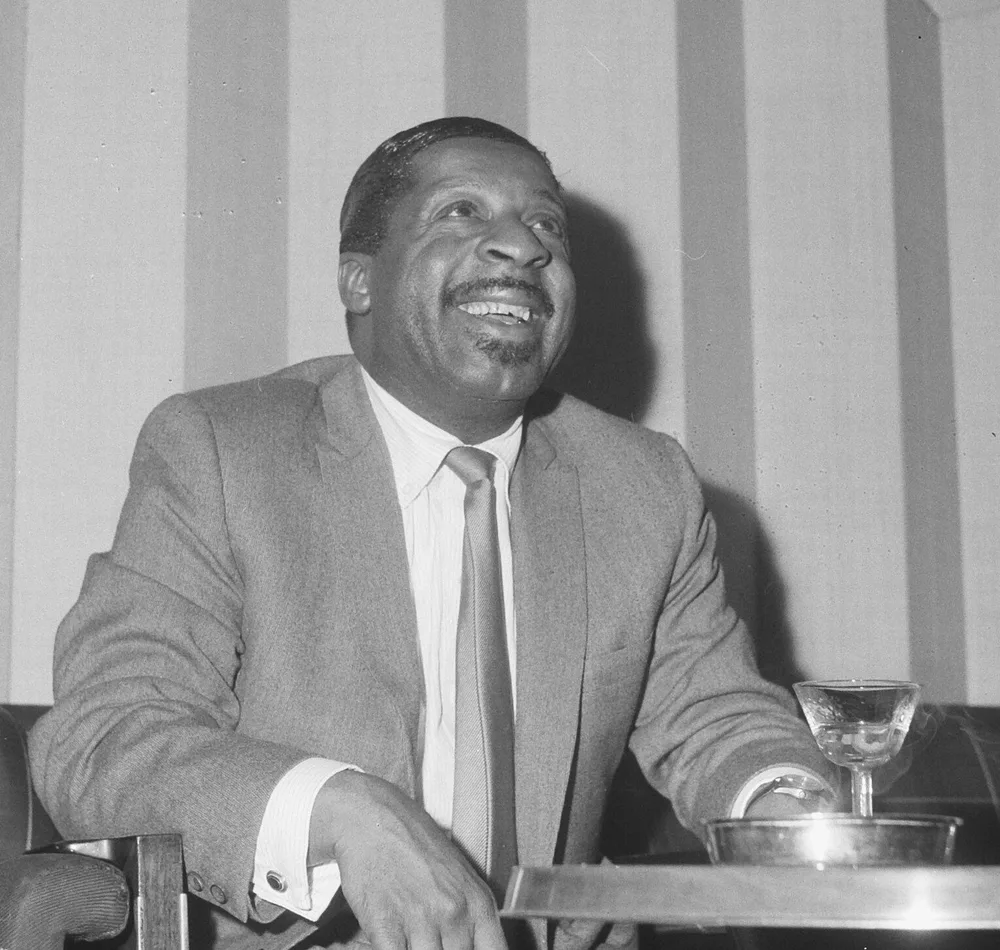
Erroll Garner at a cocktail party in the Amstel Hotel, Amsterdam, on November 5, 1964, two days before the midnight Concertgebouw concert later released as *Nightconcert* CC0 1.0 (Creative Commons Zero, Public Domain Dedication), applied by the Nationaal Archief to the Anefo photo collection — Wikimedia Commons - https://commons.wikimedia.org/wiki/File:Erroll_Garner_(cropped).jpg
.jpg)
Erroll Louis Garner was born June 15, 1921 in Pittsburgh's Hill District, the youngest of six children and a twin (his brother Ernest was born the same day). Music was already in the house: his older brother Linton Garner, born in 1915, became a working pianist and arranger too. Erroll started picking out tunes at three by copying what he heard his older siblings being taught, and when the family's piano teacher discovered he was reproducing pieces by ear rather than reading them off the page, the lessons ended. He never learned to read music, and he never pretended otherwise. Asked about it later, his standard answer was that no one can hear you read, a line that supplied the title of the 2013 documentary about him. He was on Pittsburgh radio station KDKA at seven as part of a children's group, working Allegheny riverboats by eleven, and attended George Westinghouse High School, whose alumni also include Billy Strayhorn and Ahmad Jamal. In 1937 he joined saxophonist Leroy Brown's band. The Pittsburgh musicians' union refused him membership because he would not work from standard notation, a decision it reversed in 1956 by making him an honorary member.
Garner left for New York in the summer of 1944 and was recording within months. His earliest documented sessions were made not in a studio but in the Manhattan apartment of the Danish jazz writer and producer Timme Rosenkrantz across November and December 1944, mostly solo, and those recordings surfaced years later as Blue Note's five-volume Overture to Dawn series. He worked 52nd Street in Slam Stewart's group, cut sides with Stewart and with tenor saxophonist Don Byas, and moved to Los Angeles in 1946. There, on February 19, 1947 at C.P. MacGregor Studios, his trio with bassist Red Callender and drummer Harold "Doc" West backed Charlie Parker on the Dial date that produced "Cool Blues" and "Bird's Nest," and cut its own titles the same day. Garner was not a bebop player and never claimed to be, which is part of what makes that session such an odd and durable document. A solo date at Studio Technisonor in Paris on May 15, 1948 yielded "Early in Paris" and "These Foolish Things," and by April 1948 he was leading a trio at the Three Deuces on 52nd Street with Oscar Pettiford on bass and J.C. Heard on drums. William P. Gottlieb photographed him at that club in the summer of 1948. By 1949 DownBeat's poll had named him the year's best pianist and he was headlining the Apollo.
Martha Glaser became his manager in 1950 and stayed his manager, and eventually his producer and the executor of his estate, until his death. She was unusual in the business: Garner was her only client, and the two of them enforced a booking policy that refused segregated venues outright at a time when that cost money. Under Glaser he moved from clubs into concert halls and onto television, appearing on the Ed Sullivan, Steve Allen, Johnny Carson and Dick Cavett shows, and in 1958 he became the only jazz musician the classical impresario Sol Hurok ever took on. Two records from the mid-1950s did most of the work. On July 27, 1954, at Universal Recording in Chicago with Wyatt Ruther on bass and Fats Heard on drums, he recorded "Misty," a tune he had composed in his head on a flight into Chicago after watching a rainbow through haze, and which he could not write down. It became one of the most recorded songs of the century after Johnny Burke added a lyric and Johnny Mathis had a hit with it in 1959. Then on September 19, 1955, at Sunset School in Carmel-by-the-Sea, California, a concert he played with bassist Eddie Calhoun and drummer Denzil Best was taped by Will Thornbury for Armed Forces Radio. Glaser found the tape, Columbia producer George Avakian approved it despite the primitive sound, and it went out as Concert by the Sea. It sold over a million dollars at retail by 1958 and remains one of the best-selling jazz albums ever made.
The Columbia relationship then collapsed into the most consequential lawsuit of his career. Glaser had signed him to a five-year Columbia deal in 1956 containing a clause almost unheard of at the time: Garner personally had to approve any recording of his that the label released. In 1960, with the contract under renegotiation and Avakian gone from the company, Columbia began issuing material from his backlog anyway, including Swinging Solos, The One and Only Erroll Garner and The Provocative Erroll Garner. Garner sued. Columbia countersued in federal court, and he had to post a $40,000 bond, raised with help from friends, to keep an injunction alive while he was effectively barred from recording. After close to three years the New York Supreme Court found for him. He took a cash settlement reported at $265,297.55, recovered the physical masters and the ownership rights to his unreleased Columbia recordings made after June 1, 1956, and Columbia recalled the unauthorized pressings. It is widely described as the first case in which a recording artist sued a major label and won.
What he did with the money mattered as much as the verdict. Garner and Glaser used Octave Records to own his masters outright and license finished albums to major labels for distribution, an arrangement that ran the opposite way round from every standard record deal of the period. Twelve albums came out under it over the next fifteen years, each carrying "a product of Octave Records, Inc." on the sleeve: Dreamstreet (1961) and Closeup in Swing (1961) through ABC-Paramount, One World Concert (1963, taped in performance at the Seattle World's Fair) and the A New Kind of Love film score through Reprise and Mercury, then a run through MGM with A Night at the Movies (1965), Campus Concert (1966, recorded at Purdue), That's My Kick (1967) and Up in Erroll's Room (1968). The last of those is a brass-and-reeds date arranged by Don Sebesky with Pepper Adams on baritone saxophone and Phil Ramone among the engineers. Feeling Is Believing followed on Mercury in 1970 with George Duvivier and Jerry Jemmott sharing the bass chair, then Gemini (1972) and Magician (1974) on London. Three of these drew Grammy nominations: Dreamstreet at the 1962 ceremony, Up in Erroll's Room in 1969 and Feeling Is Believing in 1971. He never won one in his lifetime. Drummer Harvey Mason spent four months in his touring group in 1970, one of many young players who passed through.
Garner's health broke down after Magician. His last public performance was on February 20, 1975 at Mr. Kelly's in Chicago, and he passed away in Los Angeles on January 2, 1977 at 55, buried in Pittsburgh's Homewood Cemetery. Glaser spent the rest of her life keeping the catalog in print, and after her own death in 2014 her niece Susan Rosenberg took it on. The Erroll Garner Archive went to the University of Pittsburgh and the Erroll Garner Jazz Project launched on what would have been his 94th birthday, June 15, 2015. The reissue programme that followed has been substantial rather than token: The Complete Concert by the Sea (2015), a three-disc expansion with eleven previously unreleased performances that was Grammy- and NAACP Image Award-nominated and took the Jazz Journalists Association's historic record of the year; Ready Take One (2016) on Legacy, fourteen unreleased studio tracks from 1967, 1969 and 1971 co-produced by Geri Allen; Nightconcert (2018) on Mack Avenue, a midnight set from the Royal Concertgebouw in Amsterdam on November 7, 1964 with Calhoun and drummer Kelly Martin; the twelve-album Octave Remastered Series across 2019 and 2020, each title restored from analog masters with an unreleased bonus track; and the Symphony Hall Concert (2021), taped in Boston on January 17, 1959. In 2025 the Recording Academy gave him a posthumous Trustees Award.
Garner's left hand kept a flat, strumming four-to-the-bar chord pulse, close to a rhythm guitarist's, while his right hand landed consistently and deliberately behind it, a delay wide enough that musicians nicknamed the effect the "Russian Dragon" for the rushing and dragging it set against each other. He began in the stride tradition of Fats Waller and James P. Johnson and kept a good deal of it, layered with the lighter swing-era touch of Teddy Wilson and Earl Hines, an orchestral density borrowed from the big-band writing he had absorbed off records by Duke Ellington and Jimmie Lunceford, and harmonic colour that listeners regularly compare to Debussy and Ravel. His trademark was the introduction: a long, rubato, sometimes deliberately misleading preamble that gave no clue what standard was coming until the tempo dropped in. He was 5 feet 2 inches tall and played sitting on a stack of telephone directories, even at Carnegie Hall, humming and grunting audibly throughout. Because he could not notate anything, his roughly 200 published compositions had to be transcribed by other hands from his playing. The influence is easy to trace by name: Ahmad Jamal and Oscar Peterson were contemporaries working nearby territory, while Ramsey Lewis, Don Patterson, Jan Lundgren and Hiromi Uehara have all named Garner's records among the first things that pulled them toward jazz.
- Concert by the Sea (rec. 1955, rel. 1956, Columbia) - The Carmel-by-the-Sea trio concert that Armed Forces Radio taped almost by accident, and the record that made him a concert-hall attraction. Spotify - Concert By The Sea Listen
- Contrasts (1954, EmArcy) - The July 27, 1954 Chicago trio session that produced the first recording of "Misty"; on streaming services it survives mainly under the reissue title The Original Misty. Spotify - The Original Misty Listen
- Dreamstreet (1961, ABC-Paramount) - His first album under the Octave Records arrangement he built after beating Columbia in court, produced by Martha Glaser and Grammy-nominated. Spotify - Dreamstreet (Octave Remastered Series) Listen
- Other Voices (1957, Columbia) - The outlier in the catalog: Garner with a studio orchestra conducted by Mitch Miller, on arrangements he and Nat Pierce built, finished at Columbia's 30th Street studio on May 31, 1957. Spotify - Other Voices Listen
- Up in Erroll's Room (1968, MGM) - A brass-and-reeds setting arranged by Don Sebesky, with Pepper Adams, Jerome Richardson, Jimmy Cleveland and Marvin Stamm in the band; Grammy-nominated. Spotify - Now Playing: A Night at the Movies / Up in Erroll's Room Listen
- Magician (1974, London) - His last studio album, with Bob Cranshaw on bass and Grady Tate on percussion, and the point at which contemporary pop material had fully entered his book. Spotify - Magician (Octave Remastered Series) Listen
- Nightconcert (rec. 1964, rel. 2018, Mack Avenue) - Sixteen tunes in eighty minutes from a midnight concert at Amsterdam's Concertgebouw, unheard for 54 years and the best-recorded live document of the Calhoun/Martin trio. Spotify - Nightconcert Listen
- Ready Take One (2016, Legacy) - Fourteen previously unreleased studio performances from 1967 to 1971, six of them Garner originals, drawn from the archive by Geri Allen and Steve Rosenthal. Spotify - Ready Take One Listen
Erroll Garner: Full Discography
Identity confirmed via the live Discogs API: artist ID 262816, "Erroll Garner," realname Erroll Louis Garner, born June 15, 1921 in Pittsburgh, died January 2, 1977 in Los Angeles. The profile text on that artist page matches Wikipedia and the estate's own site, and it links to the University of Pittsburgh's Erroll Garner Archive.
Scale, and why the raw Discogs number is misleading. A full pull of the artist's release list returned 4,010 releases across 41 API pages, broken down as 728 "Main," 2,336 "Appearance," 908 "TrackAppearance" and 38 "UnofficialRelease." Two things inflate that figure badly. First, most of the pre-1955 "Main" entries are individual 78 rpm and 45 rpm two-sided singles, plus dozens of overlapping European and Japanese repackagings of the same handful of sessions, so the 728 "Main" credits reduce to roughly 590 distinct titles and far fewer distinct recording sessions. Second, and more importantly, the "Appearance" count is not a sideman log: after 1957 the overwhelming majority of those credits are composer credits for albums containing a cover of "Misty" or "Dreamy." Spot-checking the 1959 and 1960 "Appearance" rows returned Johnny Mathis, Sarah Vaughan, Ella Fitzgerald, Toots Thielemans, Count Basie, Henry Mancini, Julie London, Lawrence Welk and Franck Pourcel, none of whom Garner played with. His genuine sideman work is small and confined to 1944 to 1949.
What this file does. Per the site's standard for hugely prolific bandleaders, this is a curated selection of the most significant and historically important leader releases, roughly 35 entries, not an exhaustive listing. It is followed by a short table of his real sideman credits. Everything in the leader table was pulled release-by-release from the Discogs API (label, catalog number, format, credited personnel, and any recording dates printed on the sleeve), cross-checked against Wikipedia album articles and, for the 1944 to 1949 sessions, against JazzDisco.org's Erroll Garner catalog.
A note on the Spotify column. The shared Spotify API credentials were rate-limited for the entire duration of this build (HTTP 429 with retry-after: 57161, roughly 16 hours). Every Spotify link below was instead located by domain-restricted web search and then individually verified by fetching the album's own Spotify embed payload and confirming the album title, the credited artist ("Erroll Garner") and the track count before it was accepted. Where no match could be verified, the cell says "Not found" rather than carrying a guessed link. The Buy column is — throughout: no affiliate programme is set up, and no Amazon or retailer links have been invented.
As Leader / Co-Leader
| Album Title | Recording Date(s) | Release Date | Label | Catalog Number | Format(s) | Personnel | Role | Reissue History | Spotify | Buy | Notes |
|---|---|---|---|---|---|---|---|---|---|---|---|
| Overture to Dawn, Vols. 1-5 | Recorded November 16 to December 23, 1944 at Timme Rosenkrantz's apartment, New York City | 1952 (Vols. 1-2), 1953 (Vols. 3-5) | Blue Note | BLP 5007, 5008, 5014, 5015, 5016 | Vinyl, 10" | Erroll Garner (piano), mostly solo; a handful of titles add John Simmons (bass) and, on one date, possibly Vic Dickenson, Bobby Platt, Barney Bigard and Timme Rosenkrantz | Leader | Later collected on CD as Overture to Dawn 1944 (1988) and The Complete and Long Unavailable Blue Note Recordings (1995) | Not found | — | Garner's earliest documented recordings, made privately in a Manhattan apartment months after he arrived in New York, and not issued for eight years |
| Penthouse Serenade | Recorded September 25, 1945 (New York) and March 29, 1949 (Los Angeles) | 1955 | Savoy Records | MG-12002 | Vinyl, LP, Compilation, Remastered | Erroll Garner (piano), John Levy or John Simmons (bass), George De Hart or Alvin Stoller (drums); remastered by Rudy Van Gelder; liner notes Jack McKinney | Leader | CD reissues on Jazz Heritage (1994) and TKO Magnum (2000) | Spotify - Penthouse Serenade | — | Savoy's LP-era assembly of Garner's mid-1940s and 1949 trio sides; RVG's initials are etched in the runouts |
| Serenade to "Laura" | Recorded September 25, 1945, March 29, 1949 and July 20, 1949 | 1955 | Savoy Records | MG 12003 | Vinyl, LP, Mono | Erroll Garner (piano) with trio accompaniment as above | Leader | Material later folded into The Elf (1976) and The Complete Savoy Master Takes | Not found as a standalone album | — | Companion volume to Penthouse Serenade |
| Erroll Garner Plays for Dancing | Not printed on the sleeve; New York, 1953 | 1953 | Columbia | CL 6259 | Vinyl, LP, 10", Mono | Erroll Garner (piano), Wyatt Ruther (bass), Fats Heard (drums) | Leader | Reissued as a 12" LP by Columbia in 1958 | Not found | — | His first Columbia album, cut with the working trio of the period |
| Mambo Moves Garner | Not printed on the sleeve; 1954 | December 1954 | Mercury | MG-20055 | Vinyl, LP, Album | Erroll Garner (piano), Wyatt Ruther (bass), Fats Heard (drums), Candido (congas) | Leader | Several later Mercury and EmArcy repackagings | Spotify - Mambo Moves Garner | — | The first of his Latin-percussion dates, which recur through 1974 |
| Contrasts | Recorded July 27, 1954, Universal Recording Studio, Chicago | 1954 | EmArcy | MG 36001 | Vinyl, LP, Album | Erroll Garner (piano), Wyatt Ruther (bass), Fats Heard (drums), Candido Camero (congas, one track) | Leader | Reissued 1988 as The Original Misty (Mercury 834 910-2); Verve remaster 1998; Japanese EmArcy CDs 1989-1994 | Spotify - The Original Misty | — | Contains the first recording of "Misty," track 10 on the original LP. Wikipedia's Contrasts article gives a December 1954 release and its Misty article gives October 1954; Discogs dates the earliest US pressings to 1954 either way |
| Gone-Garner-Gonest | Recorded New York, January 11, 1951; January 3 and February 29, 1952; February 27 and March 30, 1953 | January 10, 1955 | Columbia | CL 617 | Vinyl, LP, Album | Erroll Garner (piano); John Simmons and Wyatt Ruther (bass, uncredited on sleeve); Fats Heard and Shadow Wilson (drums, uncredited) | Leader | Various Columbia repackagings | Not found | — | Assembled from five separate Columbia sessions; the recording dates and matrix numbers are printed on the sleeve, which is how they are known |
| Solitaire | Recorded March 14, 1955 | 1955 | Mercury | MG-20063 | Vinyl, LP, Album, Mono | Erroll Garner (solo piano); liner notes Ralph J. Gleason | Leader | Reissued on Mercury and EmArcy; a companion set of four Mercury 7" EPs (Solitaire I-IV) drew on the same material | Spotify - Solitaire | — | A solo ballad album, and one of the few places to hear him without a rhythm section |
| Afternoon of an Elf | Not printed on the sleeve; 1955 | 1955 | Mercury | MG-20090 | Vinyl, LP, Album, Mono | Erroll Garner (piano) with trio | Leader | Afternoon of an Elf [Complete Recordings], Fresh Sound, 2010 | Spotify - Afternoon Of An Elf | — | "The Elf" was a standing nickname, later reused for the 1976 Savoy anthology |
| Concert by the Sea | Recorded live September 19, 1955, Sunset School, Carmel-by-the-Sea, California | 1956 | Columbia | CL 883 | Vinyl, LP, Album, Mono | Erroll Garner (piano), Eddie Calhoun (bass), Denzil Best (drums); liner notes George Avakian; cover photography Art Kane | Leader | 172 Discogs versions. Expanded 3xCD The Complete Concert by the Sea, Sony/Legacy, September 18, 2015 | Spotify - Concert By The Sea | — | Taped by Will Thornbury for Armed Forces Radio, not by Columbia. Discogs dates the US LP to 1956 and a Columbia 7" EP (B-883) to 1955; several secondary sources give an October 1955 LP release, which is not supported by the pressing data |
| The Most Happy Piano | Not printed on the sleeve; 1956 | 1957 | Columbia | CL 939 | Vinyl, LP, Album | Erroll Garner (piano), Al Hall (bass), Specs Powell (drums); liner notes George Avakian; photography Wingate Paine | Leader | An alternate-cover pressing exists; a Columbia 7" EP preceded the LP in 1956 | Not found | — | |
| Other Voices | Recording completed May 31, 1957, Columbia 30th Street Studio, New York City | August 1957 | Columbia | CL 1014 | Vinyl, LP, Album, Mono | Erroll Garner (piano) with studio orchestra; Mitch Miller (conductor); arrangements by Erroll Garner and Nat Pierce; George Avakian (producer); liner notes Martha Glaser; photography Roy DeCarava | Leader | Essential Jazz Classics CD, 2010 | Spotify - Other Voices | — | The one full orchestral album of his Columbia years |
| Soliloquy | Not printed on the sleeve; 1957 | 1958 | Columbia | CL 1060 | Vinyl, LP, Album, Mono | Erroll Garner (solo piano); liner notes George Avakian and Martha Glaser; photography Bob Henriques | Leader | Paired with Swinging Solos on The 1957 Solo Sides (Essential Jazz Classics, 2010) | Spotify - Soliloquy | — | The Spotify edition carries only 6 tracks; whether that matches the original LP sequence was not resolved |
| Encores in Hi Fi | Compiled from Columbia sessions of the early 1950s | 1958 | Columbia | CL 1141 | Vinyl, LP, Album, Mono | Erroll Garner (piano); Al Hall, John Simmons and Wyatt Ruther (bass); Fats Heard, Shadow Wilson and Specs Powell (drums); liner notes Morris Hastings | Leader | Spotify - Encores In Hi Fi | — | Piano credited on the sleeve as courtesy of Baldwin | |
| Paris Impressions | Not printed on the sleeve; 1958 | August 1958 | Columbia | C2L 9 | Vinyl, 2xLP, Album, Mono | Erroll Garner (piano, harpsichord), Eddie Calhoun (bass), Kelly Martin (percussion); sleeve notes Martha Glaser; photography Aram Avakian | Leader | Split into Paris Impressions Vol. 1 (CS 8131) and Vol. 2 (CS 8132) in stereo, May 1959 | Spotify - Paris impressions | — | One of the few records where he plays harpsichord. The verified Spotify edition has 18 tracks against the original double LP's larger sequence, so it is a partial match |
| Swinging Solos | Not printed on the sleeve | 1960 | Columbia | CL 1512 | Vinyl, LP, Album, Mono | Erroll Garner (solo piano) | Leader | Reissued on The 1957 Solo Sides (Essential Jazz Classics, 2010) | Not found | — | One of three albums Columbia issued in 1960 without Garner's contractual approval, triggering his lawsuit |
| The One and Only Erroll Garner | Not printed on the sleeve | 1960 | Columbia | CL 1452 | Vinyl, LP, Album, Mono | Billed to the Erroll Garner Trio; sidemen not credited on the sleeve | Leader | Not found | — | Second of the three unauthorized 1960 Columbia releases | |
| The Provocative Erroll Garner | Not printed on the sleeve | 1961 | Columbia | CL 1587 | Vinyl, LP, Album, Mono | Erroll Garner (piano) with trio; sidemen not credited on the sleeve | Leader | Not found | — | Third of the unauthorized releases | |
| Dreamstreet | Not printed on the sleeve; 1961 | 1961 | ABC-Paramount | ABC 365 (mono) / ABCS 365 (stereo) | Vinyl, LP, Album | Erroll Garner (piano), Eddie Calhoun (bass), Kelly Martin (drums); Martha Glaser (producer); cover design Bernard Kaplan; cover photo Ted Williams | Leader | Telarc Archive CD paired with One World Concert, 1995; Dreamstreet (Octave Remastered Series), Mack Avenue, September 27, 2019 | Spotify - Dreamstreet (Octave Remastered Series) | — | The sleeve reads "A product of Octave Records, Inc.," the earliest hard-copy evidence of the label's existence. Grammy-nominated at the 1962 ceremony |
| Closeup in Swing | Recorded New York City, July to August 1961 (printed on the sleeve) | 1961 | ABC-Paramount | ABC-395 | Vinyl, LP, Album, Mono | Erroll Garner (piano, composer), Eddie Calhoun (bass), Kelly Martin (percussion); Martha Glaser (album producer); Cal Lampley (recording director); cover photo Maynard Frank Wolfe | Leader | Telarc Archive CD paired with A New Kind of Love, CD-83383, 1997; Closeup in Swing (Octave Remastered Series), Mack Avenue, 2019 | Spotify - Closeup in Swing (Octave Remastered Series) | — | Sleeve and labels again read "A product of Octave Records, Inc."; the back cover is a wall of critics' quotes |
| One World Concert | Recorded in performance at the Seattle World's Fair (printed on the sleeve; the fair ran April to October 1962) | 1963 | Reprise Records | R9-6080 | Vinyl, LP, Stereo | Erroll Garner (piano), Eddie Calhoun (bass), Kelly Martin (percussion) | Leader | Telarc Archive CD with Dreamstreet, 1995; One World Concert (Octave Remastered Series), Mack Avenue, 2019 | Spotify - One World Concert (Octave Remastered Series) | — | Issued as a co-production of Reprise and Octave Records |
| Playing "A New Kind of Love" | Not printed on the sleeve; 1963 | 1963 | Mercury / Octave Records | MG 20859 (mono) / SR 60859 (stereo) | Vinyl, LP, Album | Erroll Garner (piano) with full orchestra conducted by Leith Stevens | Leader | Telarc Archive CD with Closeup in Swing, 1997; A New Kind of Love (Octave Remastered Series), Mack Avenue, 2019 | Spotify - A New Kind of Love (Octave Remastered Series) | — | Garner's score for the Paramount film A New Kind of Love. Frequently listed simply as A New Kind of Love; the LP is credited on Discogs to "Erroll Garner With Full Orchestra Conducted By Leith Stevens" |
| Now Playing: A Night at the Movies | Not printed on the sleeve; 1965 | 1965 | MGM Records | E-4335 (mono) / SE-4335 (stereo) | Vinyl, LP, Album | Erroll Garner (piano) with trio | Leader | Telarc Archive CD paired with Up in Erroll's Room, CD-83378, 1996; A Night at the Movies (Octave Remastered Series), Mack Avenue, 2019 | Spotify - A Night at the Movies (Octave Remastered Series) | — | Discogs's master record points at a differently numbered MGM issue (CS 8004); the LP catalog numbers above are from the release-level entries |
| Campus Concert | Recorded live at Purdue University (printed on the sleeve) | 1966 | MGM Records | SE-4361 | Vinyl, LP, Album, Stereo | Erroll Garner (piano), Eddie Calhoun (bass), Kelly Martin (percussion); Martha Glaser (producer); Val Valentin (engineer); liner notes Stacey Williams | Leader | Telarc Archive CD paired with Feeling Is Believing, 1998; Campus Concert (Octave Remastered Series), Mack Avenue, 2019 | Spotify - Campus Concert (Octave Remastered Series) | — | "A product of Octave Records, Inc." on the sleeve |
| That's My Kick | Not printed on the sleeve; 1966-67 | 1967 | MGM Records | E-4463 (mono) | Vinyl, LP, Album, Mono | Erroll Garner (piano), Milt Hinton (bass), George Jenkins and Herbie Lovelle (drums), Wally Richardson and Art Ryerson (guitar), Johnny Pacheco and Jose Mangual (bongos); Martha Glaser (producer); Bob Simpson (engineer); liner notes Mike Zwerin | Leader | Telarc Archive CD paired with Gemini, 1994; That's My Kick (Octave Remastered Series), Mack Avenue, 2020 | Spotify - That's My Kick (Octave Remastered Series) | — | His largest small-group lineup, with two guitars and two percussionists |
| Up in Erroll's Room | Not printed on the sleeve; 1968 | 1968 | MGM Records | SE-4520 | Vinyl, LP, Stereo | Erroll Garner (piano); Pepper Adams (baritone saxophone), Jerome Richardson (tenor saxophone, flute, piccolo), Jimmy Cleveland and Wayne Andre (trombone), Bernie Glow (trumpet), Marvin Stamm (trumpet, flugelhorn), Don Butterfield (tuba); Don Sebesky and Richard O. Spencer (conductors); Esmond Edwards and Martha Glaser (producers); Phil Ramone and Jerry DeClercq (recording), Phil Ramone and David Greene (mixing) | Leader | Telarc Archive CD-83378 with A Night at the Movies, 1996; Up in Erroll's Room (Octave Remastered Series), Mack Avenue, February 14, 2020 | Spotify - Now Playing: A Night at the Movies / Up in Erroll's Room | — | Grammy-nominated at the 1969 ceremony. The standalone Octave Remastered edition exists (its 2020 remastered title track is on Spotify) but the album's own Spotify page was not located, so the verified twofer is linked instead |
| Feeling Is Believing | Not printed on the sleeve; 1970 | 1970 | Mercury | SR 61308 | Vinyl, LP, Album, Stereo | Erroll Garner (piano, all arrangements), George Duvivier and Jerry Jemmott (bass), Charlie Persip, Jimmie Smith and Joe Cocuzzo (drums), Wally Richardson (guitar), Jose Mangual (congas); Martha Glaser (producer) | Leader | Telarc Archive CD with Campus Concert, 1998; Feeling is Believing (Octave Remastered Series), Mack Avenue, 2020 | Spotify - Feeling is Believing (Octave Remastered Series) | — | Grammy-nominated at the 1971 ceremony. "A product of Octave Records, Inc." |
| Gemini | Not printed on the sleeve; 1972 | 1972 | London Records | XPS-617 | Vinyl, LP | Erroll Garner (piano, harpsichord, arrangements), Ernest McCarty Jr. (bass), Jimmie Smith (percussion), Jose Mangual (congas); Martha Glaser (producer); Bob Simpson (engineer); cover art Bob Venosa | Leader | Telarc Archive CD with That's My Kick, 1994; Gemini (Octave Remastered Series), Mack Avenue, 2020 | Spotify - Gemini (Octave Remastered Series) | — | The sleeve states that everything on it was improvised at the sessions, with head arrangements by Garner |
| Magician | Not printed on the sleeve; 1974 | 1974 | London Records | APS 640 | Vinyl, LP, Album | Erroll Garner (piano), Bob Cranshaw (Fender and acoustic bass), Grady Tate (percussion), Jose Mangual (congas), Norman Gold (organ), Jackie Williams (tambourine); Martha Glaser and Garrison Leykam (producers); Bob Simpson (engineer); sleeve notes Dan Morgenstern; photography Norman Seeff | Leader | Magician & Gershwin and Kern, Telarchive CD, 1995; Magician (Octave Remastered Series), Mack Avenue, 2020 | Spotify - Magician (Octave Remastered Series) | — | His final studio album |
| Erroll Garner Plays Gershwin and Kern | Not printed on the sleeve | 1976 | Polydor | 2445 030 | Vinyl, LP, Album | Erroll Garner (piano) with rhythm section; sidemen not credited on the sleeve | Leader | Telarchive CD with Magician, 1995; Gershwin & Kern (Octave Remastered Series), Mack Avenue, 2020 | Spotify - Gershwin & Kern (Octave Remastered Series) | — | The twelfth and last of the Octave albums |
| Play It Again, Erroll! | Recorded New York, June 28 and October 7, 1950; January 3, 1952; February 27 and March 30, 1953 (matrix-by-matrix on the sleeve) | 1975 | Columbia | PG 33424 | Vinyl, 2xLP, Compilation, Mono | Erroll Garner (piano); Al Hall, John Simmons, Wyatt Ruther (bass); Fats Heard, Shadow Wilson, Specs Powell (drums); Mitch Miller (conductor, uncredited); arrangements Nat Pierce (uncredited); Herbie Mann, Hal McKusick, Sam Marowitz and others (saxophones, uncredited); John Hammond (executive producer); Martha Glaser (music consultant); liner notes Dan Morgenstern | Leader (retrospective compilation) | Not found | — | Columbia's own retrospective of the 1950 to 1953 masters, assembled with Glaser's cooperation twenty years after the fact and fifteen years after the lawsuit | |
| The Elf | Recorded New York, September 1945 ("Laura," "Stardust," "Somebody Loves Me," "Indiana") and Los Angeles, summer 1949 (remaining titles) | 1976 | Savoy Records | SJL 2207 | Vinyl, 2xLP, Compilation | Erroll Garner (piano), John Levy and John Simmons (bass), Alvin Stoller and George De Hart (drums); original production Ralph Bass and Teddy Reig; reissue production Bob Porter; photography David Redfern | Leader (anthology) | The Elf / The Savoy Sessions (Master Takes) Vol. 1, 1988 | Spotify - The Complete Savoy Master Takes | — | The Spotify link is to the later 41-track Savoy anthology, which is a superset of this LP rather than a match to it |
| The Complete Concert by the Sea | Recorded live September 19, 1955, Sunset School, Carmel-by-the-Sea | September 18, 2015 | Sony Music / Columbia / Legacy | 88875122452 (3xCD) | 3xCD, Album, Mono | Erroll Garner (piano), Eddie Calhoun (bass), Denzil Best (drums) | Leader (posthumous expansion) | Spotify - The Complete Concert by the Sea (Expanded) | — | Adds 11 previously unreleased performances plus announcer Jimmy Lyons and a post-concert interview; 36 tracks on the streaming edition. Grammy- and NAACP Image Award-nominated, and the Jazz Journalists Association's historic record of the year for 2016 | |
| Ready Take One | Recorded 1967, 1969 and 1971 | September 30, 2016 (CD); November 30, 2016 (LP) | Legacy | LGCY 536332 | LP, Album; CD | Erroll Garner (piano); Ernest McCarty, George Duvivier, Ike Isaacs and Larry Gales (bass); Jimmie Smith and Joe Cocuzzo (drums); Jose Mangual (congas); original recordings produced by Martha Glaser; compilation produced by Geri Allen, Steve Rosenthal and Peter Lockhart; Susan Rosenberg (executive producer); liner notes Geri Allen, Dan Morgenstern, James Doran and Robin D. G. Kelley | Leader (posthumous) | Spotify - Ready Take One | — | 14 previously unreleased performances, six of them Garner originals | |
| Nightconcert | Recorded live November 7, 1964, 11:30 p.m., Royal Concertgebouw, Amsterdam | July 13, 2018 (Discogs gives July 16 for the CD) | Mack Avenue Records | MAC1142 | CD, Album; 2xLP | Erroll Garner (piano), Eddie Calhoun (bass), Kelly Martin (drums); produced by Peter Lockhart, Steve Rosenthal and Christian Sands; liner notes Nate Chinen and Robin D. G. Kelley | Leader (posthumous) | Spotify - Nightconcert | — | 16 tunes in about 80 minutes. A shorter LP drawn from the same concert had appeared in 1966 as Amsterdam Concert (Philips BL7717), whose sleeve carries the same date and time | |
| Octave Remastered Series (12 albums) | Original recordings 1961 to 1976 | September 27, 2019 to June 2020 | Mack Avenue / Octave Music | one catalog number per title | CD; LP; digital | Reissue programme; masters transferred and restored using the Plangent playback system | Leader (posthumous reissue series) | Individual links in the rows above | — | Dreamstreet, Closeup in Swing, One World Concert, A New Kind of Love, A Night at the Movies, Campus Concert, That's My Kick, Up in Erroll's Room, Feeling Is Believing, Gemini, Magician, Gershwin & Kern. Each carries a previously unreleased bonus track, eight of them previously unreleased compositions | |
| Symphony Hall Concert | Recorded live January 17, 1959, Symphony Hall, Boston | September 17, 2021 | Mack Avenue | MAC1189 | CD, Album; LP | Erroll Garner (piano), Eddie Calhoun (bass), Kelly Martin (drums); produced by Peter Lockhart and Steve Rosenthal | Leader (posthumous) | Also issued inside the box sets below | Spotify - Symphony Hall Concert | — | Released for the Garner centenary |
| Liberation in Swing: Centennial Collection | Original recordings 1961 to 1976 plus the 1959 Boston concert | 2021 | Mack Avenue | box set | 12xCD + LPs, Box, Limited | Compilation of the twelve Octave albums and the Symphony Hall concert | Leader (posthumous box) | A parallel vinyl edition, Liberation in Swing: The Octave Records Story & Complete Symphony Hall Concert, was issued the same year | Not found as a single Spotify release | — | The centenary summation of the Octave catalog |
As Sideman (his complete genuine sideman credits, 1944-1949)
Garner led essentially everything he recorded from 1949 onward. The list below is short because it is close to complete for the years in which he worked under other leaders. Discogs's 2,336 "Appearance" credits are dominated by composer credits on other artists' recordings of "Misty," not by playing.
| Year | Project (Leader) | Title | Label | Catalog | Role | Notes |
|---|---|---|---|---|---|---|
| 1945 | Slam Stewart Trio / Slam Stewart Quartet | "Play Fiddle Play" / "Dark-Eyesky"; "Sherry Lynn Flip" / "Blue, Brown and Beige" (1946) | Continental / Manor and others | Piano | Stewart's group was Garner's main employer on arriving in New York; also the source of the Bowin' Singin' Slam compilation | |
| 1945 | Don Byas Quartet featuring Slam Stewart | "Harvard Blues" / "St. Louis Blues Boogie"; "Humoresque" / "Wrap Your Troubles in Dreams" | Super Disc; Arista | Piano | ||
| 1945-46 | Georgie Auld and His Orchestra | "Sweetheart of All My Dreams" / "Georgie Porgie"; "In the Middle" / "Stompin' at the Savoy" | Guild Records | Piano | Credited on Discogs; not independently confirmed against a second discography, so treat as provisional | |
| 1947 | Charlie Parker Quartet / Charlie Parker Quintet | "Cool Blues" / "Bird's Nest"; "Dark Shadows" / "This Is Always" (Earl Coleman, vocal) | Dial | Dial 1016 and others | Piano | Recorded February 19, 1947 at C.P. MacGregor Studios, Los Angeles, with Red Callender (bass) and Harold "Doc" West (drums). Garner's trio also cut its own titles ("Pastel," "Trio") at the same session |
| 1947 | Gene Norman's "Just Jazz" concerts | Gene Norman's Just Jazz Vol. 1; Wardell Gray's Way Out Wardell | Vogue / Jazz Selection; Modern | Piano | Concert recordings from Norman's Los Angeles series | |
| 1949 | Teddy Edwards / Dave Lambert (Shrine Auditorium, Los Angeles) | "Cherokee" | Spotlite (UK) | SPJ 145 | Piano | Mid-April 1949, with John Simmons (bass) and Chuck Thompson (drums), per JazzDisco |
What was not resolved
- Recording dates for most Columbia and MGM albums. Columbia and MGM rarely printed session dates on Garner's sleeves. Where a date appears in the table it comes from the sleeve itself (as with Gone-Garner-Gonest, Closeup in Swing and Play It Again, Erroll!) or from a Wikipedia album article. Elsewhere the cell says "Not printed on the sleeve" rather than carrying an inferred date.
- Sidemen on several Columbia LPs. Swinging Solos, The One and Only Erroll Garner, The Provocative Erroll Garner and Erroll Garner Plays Gershwin and Kern carry no personnel credits in the Discogs release data, and no reliable secondary source was found for them. They are left blank rather than guessed at.
- The Octave Records founding date. See the notes file: the estate's own site says 1960, DownBeat says 1962, and the physical sleeves of Dreamstreet and Closeup in Swing prove the company was operating by 1961.
- Individual catalog numbers for the twelve Octave Remastered Series titles. Only a few were pulled (for example Gershwin & Kern, Mack Avenue, 2020). The series is treated as one row rather than twelve.
- Spotify coverage. Nine leader entries in the table returned no verifiable Spotify album, including all three of the unauthorized 1960-61 Columbia LPs, The Most Happy Piano, Erroll Garner Plays for Dancing, Gone-Garner-Gonest, the Blue Note Overture to Dawn volumes and Play It Again, Erroll!. Because the Spotify API was rate-limited throughout this build, "Not found" here means "not found by verified web lookup," not "definitively absent from Spotify." A later pass with a working API token should recheck them.
- The 78 rpm era. Roughly 200 of the 728 Discogs "Main" credits are individual 1945 to 1954 singles on Manor, Savoy, Mercury, Dial, Roost, Atlantic, Columbia, Signature, Apollo, Imperial, National and a dozen smaller labels. They are not itemized here.
- Martha Glaser - manager from 1950 until his death in 1977, producer of most of the Octave albums, co-founder of Octave, and afterwards executor of his estate. Garner was her only client.
- Eddie Calhoun (bass) and Kelly Martin (drums) - the long-running trio of his peak concert years, together on Paris Impressions, Dreamstreet, Closeup in Swing, One World Concert, Campus Concert and the 1964 Concertgebouw tape issued as Nightconcert. Calhoun is also the bassist on Concert by the Sea, where Denzil Best plays drums.
- Wyatt Ruther (bass) and Fats Heard (drums) - the 1953 to 1955 trio, on Erroll Garner Plays for Dancing, Mambo Moves Garner and the Contrasts session that produced "Misty."
- Charlie Parker - Garner's trio backed Parker at the Dial session of February 19, 1947 in Los Angeles that produced "Cool Blues" and "Bird's Nest."
- Oscar Pettiford and J.C. Heard - his trio at the Three Deuces on 52nd Street in April 1948.
- Slam Stewart, Don Byas, John Simmons, Red Callender, Doc West, John Levy, Leonard Gaskin - the 1944 to 1949 New York and Los Angeles small-group circle documented on the Savoy, Dial, Mercury and Atlantic sessions.
- Candido Camero, José Mangual, Johnny Pacheco - the Latin percussionists on Mambo Moves Garner (1954), That's My Kick (1967), Feeling Is Believing (1970), Gemini (1972) and Magician (1974).
- Pepper Adams, Jerome Richardson, Jimmy Cleveland, Wayne Andre, Bernie Glow, Marvin Stamm, Don Butterfield - the horn section on Up in Erroll's Room (1968), arranged and conducted by Don Sebesky, recorded and mixed in part by Phil Ramone.
- George Duvivier, Jerry Jemmott, Wally Richardson, Charlie Persip, Jimmie Smith - the band on Feeling Is Believing (1970).
- Ernest McCarty Jr., Bob Cranshaw, Grady Tate, Harvey Mason - the 1970s rhythm players; Mason spent four months on the road with Garner in 1970 before moving to Los Angeles.
- George Avakian and Mitch Miller - his Columbia producers. Avakian signed off on Concert by the Sea; Miller conducted Other Voices, and his arrival in Avakian's place preceded the unauthorized releases that triggered the lawsuit.
- Rudy Van Gelder - remastered the Savoy LPs Penthouse Serenade and Serenade to "Laura" that collected Garner's 1945 and 1949 sessions.
More Swing Artists
See all 134 Swing artists →More American Jazz Artists
See all 567 American artists →- Spotify artist page
- Discogs
- Official site (Octave Music)
- Erroll Garner Archive, University of Pittsburgh
- Wikipedia: Erroll Garner
- Wikipedia: Concert by the Sea
- Wikipedia: Contrasts (Erroll Garner album)
- Wikipedia: Misty (song)
- Wikipedia: Ready Take One
- Discogs: Erroll Garner (artist 262816)
- AllMusic: Erroll Garner
- errollgarner.com: About
- errollgarner.com: Life
- Longreads: How Jazz Pianist Erroll Garner Fought for His Rights
- DownBeat: 12 Erroll Garner Albums Reissued in Octave Remastered Series
- Recording Academy: 2025 Special Merit Award honorees
- Grammy.com: Erroll Garner nominations
- Mack Avenue Music Group: Nightconcert
- JazzDisco.org: Erroll Garner catalog
- Monterey County Weekly: Concert By The Sea celebrates 60 years