 JAZZPROFILES lives in the music 1,572 Jazz Artists fully Profiled!
 Gene Ammons
Last updated September 7, 2026
Listen on Spotify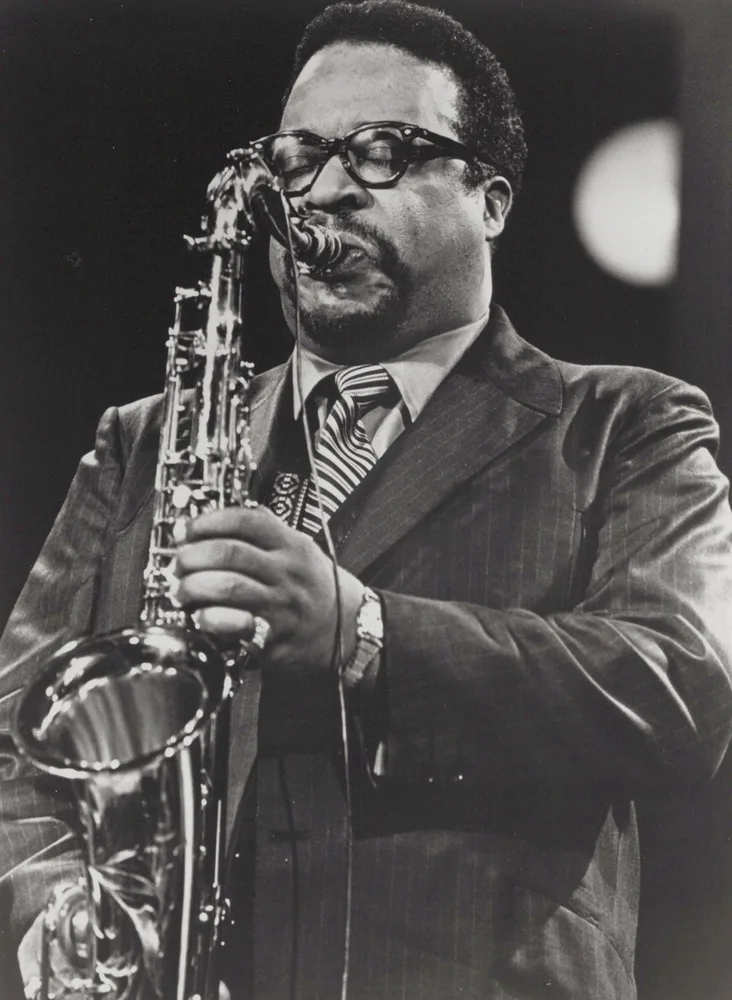
Gene Ammons, publicity photograph from a PBS television appearance, circa 1971 Public Domain (published in the United States between 1931 and 1977 without a copyright notice) — Wikimedia Commons — https://commons.wikimedia.org/wiki/File:Gene_Ammons_PBS_1971.jpg

Eugene Stanley Ammons was born in Chicago on April 14, 1925, the son of boogie-woogie pianist Albert Ammons. He grew up inside the music rather than alongside it, and got his formal grounding at DuSable High School under Walter Dyett, the bandmaster whose classrooms also produced Nat King Cole, Johnny Griffin, and Von Freeman. Ammons was working professionally before he finished school: in 1943, at eighteen, he went on the road with trumpeter King Kolax's band.
In 1944 he joined Billy Eckstine's orchestra, the first big band built around the new bebop language, and stayed until 1947. Eckstine gave him the nickname that stuck when a shipment of straw hats ordered for the band would not fit Ammons's head, and "Jug" followed him for the rest of his life. The band put him next to Charlie Parker and Dizzy Gillespie, and later beside Dexter Gordon, with whom he cut the September 5, 1944 Deluxe single "Blowin' the Blues Away," a two-tenor exchange that became the model for the tenor-battle records Ammons would keep making for the next thirty years. He left in 1947 to lead his own group, which at Chicago's Jumptown Club included Miles Davis and Sonny Stitt, and scored a hit almost immediately with "Red Top," recorded in Chicago on June 19, 1947 and issued on Mercury 8048. In 1949 he replaced Stan Getz in Woody Herman's Second Herd. His 1950 reading of "My Foolish Heart" reached Billboard's Black pop chart, and from 1950 to 1952 he co-led a two-tenor band with Stitt whose March 5, 1950 Prestige recording of "Blues Up and Down" became one of the most copied performances of the era.
The mid-1950s put him at the center of Prestige's loose, blues-anchored jam-session records. The Happy Blues (Prestige PRLP 7039, recorded April 23, 1956) and Jammin' with Gene (July 13, 1956) gathered large casts around him: Donald Byrd and Art Farmer on trumpets, Jackie McLean on alto, Mal Waldron on piano, Doug Watkins and Art Taylor in the rhythm section. On January 3, 1958, at Rudy Van Gelder's Hackensack studio, he led a session that yielded two full albums, The Big Sound and Groove Blues, with John Coltrane on alto rather than his usual tenor, Paul Quinichette on tenor, Pepper Adams on baritone, and Jerome Richardson on flute. Later that year a narcotics conviction took him off the scene, and he served the first of two sentences, from 1958 to 1960.
He returned to Prestige in June 1960 and made the record he is still best known for. Boss Tenor, cut June 16, 1960 at Van Gelder's new Englewood Cliffs studio with Tommy Flanagan on piano, Doug Watkins on bass, Art Taylor on drums, and Ray Barretto on congas, is a quintet date built on tone and time, and its version of "Canadian Sunset" carried well beyond the jazz audience. The two years that followed were the densest of his career, driven in part by his need for cash and a heroin habit. He reunited with Sonny Stitt on Verve for Boss Tenors: Straight Ahead from Chicago (August 27, 1961) and Boss Tenors in Orbit! (February 18, 1962), recorded Up Tight! on October 18, 1961 with Patti Bown, George Duvivier, Art Taylor, and Barretto, and then in a five-month run from April to September 1962 taped the sessions behind Soul Summit Vol. 2, The Soulful Moods of Gene Ammons, Blue Groove, Preachin', Jug & Dodo, Velvet Soul, Sock!, and, on September 9, Bad! Bossa Nova, with Hank Jones, Kenny Burrell, and Bucky Pizzarelli. A second narcotics conviction late that year sent him to Joliet penitentiary for seven years. Prestige spent the rest of the decade releasing the backlog, which is why albums such as Velvet Soul (1964) and Angel Eyes (1965) reached the shops years after the tape was rolled.
Ammons was released in 1969 and signed what Prestige owner Bob Weinstock described as the largest contract the label had ever offered. The Boss Is Back!, recorded November 10 and 11, 1969 with Junior Mance, Buster Williams, Bernard Purdie, and Candido, reached No. 174 on the Billboard Top LPs chart, and the same two days also produced Brother Jug!. His 1970s work leaned harder into organ combos, electric bass, and funk rhythm sections: "Jungle Strut" (1970), The Black Cat! and My Way (1971), Free Again (1972), Big Bad Jug (1973). The tenor battles continued alongside it, on the live The Chase! with Dexter Gordon, taped July 26, 1970 at Chicago's North Park Hotel with two local rhythm sections including bassist Cleveland Eaton, and on You Talk That Talk! with Stitt in February 1971. He played the Montreux Jazz Festival in 1973, documented on Gene Ammons and Friends at Montreux.
His last studio session ran March 18 to 20, 1974 in New York, with Nat Adderley, Gary Bartz, Kenny Drew, Sam Jones, Louis Hayes, and Ray Barretto. He was already ill with bone cancer, and the album was issued posthumously as Goodbye. Gene Ammons passed away in Chicago on August 6, 1974, at 49, of bone cancer and pneumonia, and was buried at Lincoln Cemetery in Blue Island, Illinois.
Ammons built his playing on sound first. Where most of his bebop contemporaries pursued intricate line-running, he favored big gestures, wide vibrato, and scooped blues phrasing that put the weight on each note rather than on the number of them, an approach traceable to Lester Young's phrasing and Ben Webster's tone and pushed toward rhythm and blues. That combination made him a founder of the Chicago tenor school alongside Von Freeman, and one of the direct sources of soul jazz, the idiom that later carried Stanley Turrentine, Houston Person, and a generation of organ-combo tenors. He was equally at home in two settings that rarely overlap: the competitive two-tenor format, where his sound had to stand up to Dexter Gordon, Sonny Stitt, or the crowded January 1958 Prestige date that had John Coltrane playing alto and Pepper Adams on baritone beside him, and the slow ballad, where he could hold a melody almost straight and still make it his. Critics have consistently placed the ballads and Boss Tenor at the top of his catalog; Scott Yanow, reviewing the 1969 comeback album, wrote that his "huge sound was unchanged" after seven years away from a bandstand.
- Boss Tenor (1960, Prestige) - Recorded June 16, 1960 with Tommy Flanagan, Doug Watkins, Art Taylor, and Ray Barretto, and the album most often named as his best; its "Canadian Sunset" became his signature. Spotify - Boss Tenor Listen
- The Big Sound (1958, Prestige) - The January 3, 1958 all-star session with John Coltrane on alto, Paul Quinichette on tenor, Pepper Adams on baritone, and Mal Waldron on piano. Not located on Spotify.
- Groove Blues (1961, Prestige) - The second album drawn from that same January 1958 date, held back three years and released after Ammons had begun his first sentence. Not located on Spotify.
- Boss Tenors: Straight Ahead from Chicago, August 1961 (1962, Verve) - The Sonny Stitt reunion produced by Creed Taylor, recorded August 27, 1961, and the definitive studio document of their tenor duels. Spotify - Boss Tenors Listen
- The Boss Is Back! (1969, Prestige) - The comeback record, cut November 10 and 11, 1969 within weeks of his release from Joliet, and his second album to reach the Billboard chart. Spotify - The Boss Is Back! Listen
- The Chase! (1970, Prestige) - A live tenor battle with Dexter Gordon taped July 26, 1970 at Chicago's North Park Hotel, using two Chicago rhythm sections across the two sets, with Cleveland Eaton and Rufus Reid splitting the bass chair. Not located on Spotify.
- Bad! Bossa Nova (1962, Prestige) - Recorded September 9, 1962, days before his second imprisonment, with Hank Jones, Kenny Burrell, and Bucky Pizzarelli; a bossa nova cash-in that outlived the fad on the strength of the playing. Not located on Spotify.
- Goodbye (1975, Prestige) - The final session, March 18 to 20, 1974, with Nat Adderley, Gary Bartz, Kenny Drew, Sam Jones, and Louis Hayes, recorded while he was terminally ill and released after his death. Spotify - Goodbye Listen
Gene Ammons: Full Discography
Gene Ammons was a hugely prolific leader across nearly three decades on record. His Discogs artist page (artist ID 45107) lists 834 releases credited to him in total, verified against the live Discogs API on August 28, 2026: 180 as leader or co-leader (studio albums, live albums, singles/EPs, and compilations), 363 "Appearance" credits, 261 "TrackAppearance" credits, and 30 unofficial releases. This table does not attempt exhaustive coverage; it curates the leader/co-leader releases that are most historically significant, most frequently cited by critics, or most useful for understanding his stylistic arc from bebop through soul jazz, plus a small representative set of sideman dates from before his own leader career took off.
As Leader / Co-Leader
| Album Title | Recording Date(s) | Release Date | Label | Catalog Number | Format(s) | Personnel | Role | Reissue History | Spotify | Buy | Notes |
|---|---|---|---|---|---|---|---|---|---|---|---|
| Jammin' with Gene | Recorded July 13, 1956 | 1956 | Prestige | PRLP 7060 | Vinyl, LP, Album | Gene Ammons (tenor sax), Donald Byrd & Art Farmer (trumpet), Jackie McLean (alto sax), Mal Waldron (piano), Doug Watkins (bass), Art Taylor (drums) | Leader | Reissued on Original Jazz Classics (CD) | Not confirmed | — | Large-group jam-session date typical of Ammons's mid-1950s Prestige work |
| The Big Sound (Gene Ammons' All Stars) | Recorded January 3, 1958, Van Gelder Studio, Hackensack NJ | 1958 | Prestige | PRLP 7132 | Vinyl, LP, Album, Mono | Gene Ammons (tenor sax), John Coltrane (alto sax), Paul Quinichette (tenor sax), Pepper Adams (baritone sax), Jerome Richardson (flute), Mal Waldron (piano), George Joyner (bass), Art Taylor (drums) | Leader | Reissued on Original Jazz Classics (CD) | Not confirmed | — | Same January 3, 1958 session produced Groove Blues; Coltrane plays alto rather than his usual tenor |
| Groove Blues | Recorded January 3, 1958, Van Gelder Studio, Hackensack NJ | 1961 | Prestige | PRLP 7201 | Vinyl, LP, Album, Mono | Gene Ammons (tenor sax), John Coltrane (alto sax, tracks 1-2 & 4), Paul Quinichette (tenor sax, tracks 1-2), Pepper Adams (baritone sax, tracks 1-2), Jerome Richardson (flute, tracks 1-3), Mal Waldron (piano), George Joyner (bass), Art Taylor (drums) | Leader | Reissued on Original Jazz Classics (CD) | Not confirmed | — | Second LP drawn from the same session as The Big Sound, held back and released three years later |
| Boss Tenor | Recorded June 16, 1960, Van Gelder Studio, Englewood Cliffs NJ | 1960 | Prestige | PRLP 7180 | Vinyl, LP, Album, Mono | Gene Ammons (tenor sax), Tommy Flanagan (piano), Doug Watkins (bass), Art Taylor (drums), Ray Barretto (congas) | Leader | Multiple CD reissues, including Rudy Van Gelder remaster (2006) | Spotify - Boss Tenor | — | Widely regarded as Ammons's best leader date; includes his well-known version of "Canadian Sunset" |
| Angel Eyes | Recorded June 17, 1960 & September 5, 1962, Van Gelder Studio, Englewood Cliffs NJ | 1965 | Prestige | PR 7369 | Vinyl, LP, Album | Gene Ammons (tenor sax), Frank Wess (flute, tenor sax), Johnny "Hammond" Smith (organ), Mal Waldron (piano), Doug Watkins & Wendell Marshall (bass), Art Taylor & Ed Thigpen (drums) | Leader | Reissued on Original Jazz Classics (CD) | Not confirmed | — | Compiles two separate sessions with different personnel, released together five years later |
| Boss Tenors: Straight Ahead from Chicago, August 1961 | Recorded August 27, 1961, Chicago, IL | 1962 | Verve | V/V6-8426 | Vinyl, LP, Album, Mono/Stereo | Gene Ammons & Sonny Stitt (tenor sax), John Houston (piano), Buster Williams (bass), George Brown (drums) | Co-leader (with Sonny Stitt) | CD reissue, 1992 | Spotify - Boss Tenors | — | Produced by Creed Taylor; includes the widely covered jam "Blues Up and Down" |
| Boss Tenors in Orbit! | Recorded February 18, 1962 | 1962 | Verve | V-8468 / V6-8468 | Vinyl, LP, Album | Gene Ammons & Sonny Stitt (tenor sax), Don Patterson (organ), Paul Weeden (guitar), Billy James (drums) | Co-leader (with Sonny Stitt) | Reissued on CD | Spotify - Boss Tenors in Orbit | — | Organ-combo two-tenor session, following up the 1961 Verve reunion |
| Bad! Bossa Nova | Recorded September 9, 1962, Van Gelder Studio, Englewood Cliffs NJ | 1962 | Prestige | PR 7257 | Vinyl, LP, Album | Gene Ammons (tenor sax), Hank Jones (piano), Kenny Burrell & Bucky Pizzarelli (guitar), Norman Edge (bass), Oliver Jackson (drums), Al Hayes (bongos) | Leader | Reissued on Original Jazz Classics (CD) | Not confirmed | — | Cash-in on the early-1960s bossa nova jazz vogue, cut just before Ammons's second imprisonment |
| The Boss Is Back! | Recorded November 10-11, 1969, Van Gelder Studio, Englewood Cliffs NJ | 1969 | Prestige | PR 7739 | Vinyl, LP, Album | Gene Ammons (tenor sax), Junior Mance (piano, most tracks), Buster Williams (bass), Bernard Purdie & Frankie Jones (drums), Houston Person & Prince James (tenor sax, track 1), Candido (congas) | Leader | Reissued on CD | Spotify - The Boss Is Back! | — | Comeback album after Ammons's release from a seven-year prison sentence; reached No. 174 on the Billboard Top LPs chart |
| Brother Jug! | Recorded November 10-11, 1969, Van Gelder Studio, Englewood Cliffs NJ | 1970 | Prestige | PR 7792 | Vinyl, LP, Album | Gene Ammons (tenor sax), Sonny Phillips (organ), Billy Butler (guitar), Bob Bushnell (electric bass), Bernard Purdie (drums) | Leader | Reissued on CD | Not confirmed | — | Second LP drawn from the same 1969 comeback sessions as The Boss Is Back! |
| The Chase! | Recorded live July 26, 1970, North Park Hotel, Chicago, IL | 1970 | Prestige | PR 10010 | Vinyl, LP, Album | Gene Ammons & Dexter Gordon (tenor sax), Jodie Christian & John Young (piano), Cleveland Eaton & Rufus Reid (bass), Wilbur Campbell & Steve McCall (drums), Vi Redd (vocals, one track) | Co-leader (with Dexter Gordon) | Reissued on CD | Not confirmed | — | Live tenor-battle album using two different Chicago rhythm sections across its two sets |
| You Talk That Talk! | Recorded February 8, 1971, Van Gelder Studio, Englewood Cliffs NJ | 1972 | Prestige | PR 10019 | Vinyl, LP, Album | Gene Ammons & Sonny Stitt (tenor sax, Stitt also varitone), Leon Spencer (organ), George Freeman (guitar), Idris Muhammad (drums) | Co-leader (with Sonny Stitt) | Reissued on CD | Not confirmed | — | Later Ammons/Stitt reunion; favors a relaxed groove over head-to-head cutting contests |
| Goodbye | Recorded March 18-20, 1974, CI Recording, NYC | 1975 | Prestige | P 10093 | Vinyl, LP, Album | Gene Ammons (tenor sax), Nat Adderley (cornet), Gary Bartz (alto sax), Kenny Drew (piano), Sam Jones (bass), Louis Hayes (drums), Ray Barretto (congas, tracks 1-5) | Leader | Reissued on CD | Spotify - Goodbye | — | Ammons's final studio session, recorded while terminally ill with bone cancer; released posthumously |
As Sideman (selected major credits)
| Year | Project (Leader) | Title | Label | Catalog | Role | Notes |
|---|---|---|---|---|---|---|
| 1944 | Billy Eckstine and His Orchestra | "Blowin' the Blues Away" (single) | Deluxe Records | 3001 | Tenor saxophone | Recorded September 5, 1944; a landmark early tenor duel with Dexter Gordon, with Dizzy Gillespie in the band |
| 1944-1947 | Billy Eckstine and His Orchestra | Various sides | Deluxe / National | Various | Tenor saxophone | Ammons's first major professional exposure; bandmates included Dexter Gordon, Charlie Parker, and Dizzy Gillespie during his tenure |
| 1949 | Woody Herman and His Second Herd | Various sides | Capitol | Various | Tenor saxophone | Ammons briefly replaced Stan Getz in Herman's Second Herd; specific session details not itemized here |
Ammons's own catalog dominates his Discogs credits; unlike many sideman-heavy players, he spent the great majority of his post-1947 career as a leader or co-leader rather than as a hired sideman, which is why this table is short relative to his leader discography above.
- Sonny Stitt - the central partnership of his career: a co-led band from 1950 to 1952 that produced "Blues Up and Down," then reunions on Verve in 1961 and 1962 (Boss Tenors, Boss Tenors in Orbit!) and on Prestige in 1971 (You Talk That Talk!) and 1973.
- Billy Eckstine - tenor chair in Eckstine's bebop orchestra from 1944 to 1947, alongside Charlie Parker, Dizzy Gillespie, and Dexter Gordon, and the source of the "Jug" nickname.
- Dexter Gordon - the "Blowin' the Blues Away" duel of September 5, 1944 and, twenty-six years later, the live The Chase! in Chicago.
- Bob Weinstock and Prestige Records - his label home from the early 1950s until his death, including the stockpiled 1960 to 1962 sessions the label rationed out during his imprisonment and the contract he signed on release in 1969.
- Pepper Adams, John Coltrane, Paul Quinichette, and Jerome Richardson - the front line of the January 3, 1958 Prestige session that produced both The Big Sound and Groove Blues.
- Mal Waldron - house pianist on a run of Ammons's Prestige jam-session dates, including Jammin' with Gene (1956), the January 1958 session, and part of Angel Eyes.
- Tommy Flanagan, Doug Watkins, Art Taylor, and Ray Barretto - the Boss Tenor quintet of June 16, 1960; Taylor and Barretto also worked the 1961 Up Tight! date, and Barretto returned for the 1974 Goodbye session.
- George Duvivier - bass on the October 18, 1961 Up Tight! session at Van Gelder Studio and on further Prestige dates in April 1962.
- Donald Byrd, Art Farmer, and Jackie McLean - the horn cast of Jammin' with Gene, recorded July 13, 1956.
- Junior Mance, Buster Williams, Bernard Purdie, and Candido - the band on the November 1969 comeback sessions that produced The Boss Is Back! and Brother Jug!.
- Rudy Van Gelder - engineer on most of the Prestige catalog, at Hackensack through 1958 and at Englewood Cliffs from 1960 on.
More Bebop Artists
See all 166 Bebop artists →More American Jazz Artists
See all 567 American artists →- Wikipedia: Gene Ammons
- Discogs: Gene Ammons (artist 45107)
- AllMusic: Gene Ammons
- Britannica: Gene Ammons
- All About Jazz: Gene Ammons
- NPR: Jazz tenor saxophonist Gene Ammons would have turned 100 this week
- Jazz Discography Project: Gene Ammons discography and session personnel
- Wikipedia: The Boss Is Back!
- Wikipedia: Boss Tenor
- Wikipedia: The Big Sound (Gene Ammons album)
- Wikipedia: Groove Blues
- Wikipedia: Bad! Bossa Nova
- Wikipedia: Angel Eyes (Gene Ammons album)
- Wikipedia: Velvet Soul (Gene Ammons album)
- Wikipedia: The Chase!
- Wikipedia: All Star Sessions
- Encyclopedia.com: Ammons, Gene