 JAZZPROFILES lives in the music 1,572 Jazz Artists fully Profiled!
 Fats Waller
Last updated September 7, 2026
Listen on Spotify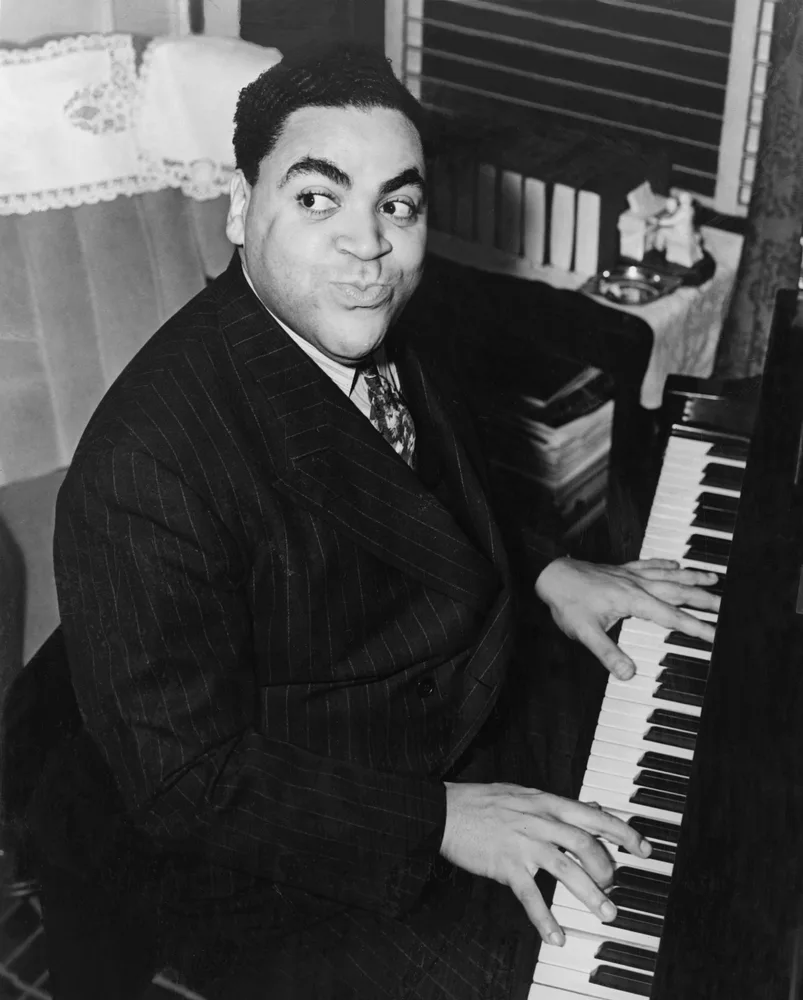
Fats Waller seated at the piano, 1938 Public Domain (no known copyright restrictions) — Wikimedia Commons — https://commons.wikimedia.org/wiki/File:Fats_Waller_edit.jpg (originally from the Library of Congress, New York World-Telegram and the Sun Newspaper Photograph Collection; photographer Alan Fisher)
Thomas Wright "Fats" Waller was born May 21, 1904, in New York City, the seventh of eleven children (five of whom survived childhood) of Edward Martin Waller, a Baptist lay preacher and teamster, and Adeline Lockett Waller, a musician who gave him his first exposure to piano and organ. He began piano at six, later added reed organ, double bass, and violin, and worked in a grocery store to pay for lessons. Hearing pianist Ignacy Jan Paderewski at Carnegie Hall as a boy left a lasting impression. At sixteen he became house organist at Harlem's Lincoln Theatre, earning $23 a week accompanying silent films and vaudeville acts, and around the same time he met stride pianist James P. Johnson, who took him under his wing, taught him the demanding stride left-hand style, and introduced him to Harlem's rent-party and nightclub circuit.
Waller began recording in 1922 through Clarence Williams at Okeh Records, cutting sides behind blues singer Sara Martin, and the following year started making piano rolls for QRS while also meeting lyricists Andy Razaf and J.C. Johnson, both of whom became career-long collaborators. In 1926, talent scout Ralph Peer signed him to the Victor Talking Machine Company, and on November 17 of that year Waller cut his first solo sides, "St. Louis Blues" and "Lenox Avenue Blues." He composed prolifically for Harlem revues through the late 1920s; "Keep Shufflin'" opened in 1928 and moved to Broadway, and in 1929 two Razaf collaborations, "Honeysuckle Rose" (written for the revue "Load of Coal") and "Ain't Misbehavin'" (written for "Connie's Hot Chocolates"), became instant standards. When "Hot Chocolates" transferred to Broadway's Hudson Theatre in June 1929 with Louis Armstrong leading the pit orchestra, Armstrong's trumpet reading of "Ain't Misbehavin'" was received so well that he was brought up out of the pit to perform it onstage, helping turn the song into a national hit. That same year Waller cut a landmark run of unaccompanied piano sides for Victor, including "Handful of Keys," "Numb Fumblin'," "Smashing Thirds," and "Valentine Stomp," and led one of the first racially integrated recording dates, billed as Fats Waller's Buddies, with white and Black musicians together in the studio.
Waller built a parallel career on the radio through the early 1930s, first on CBS starting in 1930 and then on a two-year contract fronting "Fats Waller's Rhythm Club" on WLW in Cincinnati, developing the mix of virtuoso playing, comic patter, and mugging asides that became his trademark. In May 1934 he formed the small working band Fats Waller and His Rhythm, typically a sextet built around clarinetist/tenor saxophonist Gene Sedric, trumpeter Herman Autrey, guitarist Al Casey, bassist Cedric Wallace, and drummer Slick Jones, and began a prolific run of RCA Victor sides that made him a crossover star well beyond Black record buyers, among them "I'm Gonna Sit Right Down and Write Myself a Letter" and the manager-encouraged novelty numbers he turned into comic showcases. Hollywood took notice, casting him in the films "Hooray for Love" and "King of Burlesque" (both 1935).
New manager Ed Kirkeby took Waller to Britain and Scandinavia in 1938 and again in 1939, where he found more discerning audiences than at home, recorded for HMV, and composed the impressionistic solo-organ suite "London Suite." In 1938 Waller and his wife also became one of the first Black families to buy a home in Addisleigh Park, St. Albans, Queens, helping break a racial covenant later crossed by Count Basie, Lena Horne, and Ella Fitzgerald. He attempted to be taken seriously as a concert composer with a January 1942 Carnegie Hall performance that drew mixed reviews, wrote the score for the Broadway show "Early to Bed" (which opened in June 1943, making him the first Black composer to write a full score for a white Broadway cast), and appeared in the all-Black-cast film "Stormy Weather" (1943), reprising "Ain't Misbehavin'" opposite Lena Horne and Bill "Bojangles" Robinson.
By the early 1940s heavy drinking, which had begun in his teens, had worsened, and a wartime musicians' union recording ban further slowed his output. In October 1943 he contracted influenza while playing Hollywood's Zanzibar Room and ignored a doctor's advice to be hospitalized. Returning to New York by train, he died of bronchial pneumonia in the early hours of December 15, 1943, as the Santa Fe Chief stopped at Kansas City, Missouri; he was 39. His funeral drew more than 4,000 mourners to Harlem's Abyssinian Baptist Church, where Congressman Adam Clayton Powell Jr. eulogized him, and his ashes were later scattered over Harlem from an airplane.
Waller took the stride piano style he learned directly from James P. Johnson and pushed it further, driving tirelessly swinging, seamless octave-and-tenth left-hand patterns under a right hand full of rich three-note chord voicings and chromatic passing tones that anticipated and directly shaped Art Tatum's harmonic vocabulary. He was also jazz's first major organist, adapting stride technique to the pipe organ he affectionately called the "God box" and later to the Hammond, influencing swing-era organists including Milt Herth and Glenn Hardman, and by his own account giving a young Count Basie informal organ lessons in Boston. As a songwriter with Andy Razaf he produced a run of standards, "Ain't Misbehavin'," "Honeysuckle Rose," "Keepin' Out of Mischief Now," and "The Joint Is Jumpin'" among them, whose durability in the jazz and popular songbook far outlasted the era that produced them. His public persona, built on comic patter, mugging, and knowing asides delivered over otherwise serious musicianship, sometimes obscured his standing as a pianist and composer during his lifetime, but Dizzy Gillespie called him "my main man," and stride specialists Ralph Sutton and Don Ewell built their own careers directly on his model, adopting techniques like his "backward tenths." He composed hundreds of songs, though he sold outright rights to many of them for quick cash and lost composer credit on a number that were later assigned to other names.
- Handful of Keys and the 1929 Victor solo piano sides - The unaccompanied studio recordings ("Handful of Keys," "Numb Fumblin'," "Smashing Thirds," "Valentine Stomp") that established Waller's reputation as a virtuoso beyond his songwriting and radio fame.
- "Ain't Misbehavin'" (1929, Victor 22108) - Waller and Razaf's standard from "Connie's Hot Chocolates," recorded solo the same year it was popularized on Broadway by Louis Armstrong.
- "Honeysuckle Rose" (1929, Victor) - Written with Razaf for the revue "Load of Coal," among the most-recorded jazz standards of the 20th century.
- Turn On the Heat: The Fats Waller Piano Solos (Bluebird, compiled 1991) - Two-disc collection of all his commercially issued solo piano sides recorded 1927-1941, the essential entry point to his instrumental work.
- A Handful of Keys (1957, RCA Victor) - A compilation drawn largely from previously unreleased 1938 NBC and Yacht Club radio transcriptions with his Rhythm band, among the only authorized live documents of the group.
- The Joint Is Jumpin' (RCA Bluebird, compiled 1987) - A widely reissued anthology of Fats Waller and His Rhythm studio sides from the mid-to-late 1930s.
- Stormy Weather (1943 film) - Waller's onscreen "Ain't Misbehavin'" alongside Lena Horne and Bill "Bojangles" Robinson, one of the few filmed records of his performing style.
Fats Waller: Full Discography
Identity confirmed via Discogs artist ID 253482 ("Fats Waller," real name Thomas Wright Waller, active dates and instrument credits matching). Waller's active recording career (1922-1943) predates the LP entirely: almost everything he made was issued as a single-sided 78 rpm disc (or, earlier, a piano roll), typically two songs per session with no fixed "album" concept, and Discogs and other databases spread his roughly 400 commercial recordings across dozens of period 78s plus hundreds of later compilation reissues. Rather than list every 78 rpm side, the table below curates his most historically significant original recording sessions/issues alongside the standard posthumous LP/CD compilations through which most listeners now encounter his catalog. This is a representative set, not an exhaustive one.
As Leader / Co-Leader (Original Sessions and Key Reissues)
| Album Title | Recording Date(s) | Release Date | Label | Catalog Number | Format(s) | Personnel | Role | Reissue History | Spotify | Buy | Notes |
|---|---|---|---|---|---|---|---|---|---|---|---|
| "St. Louis Blues" / "Lenox Avenue Blues" | November 17, 1926 | 1926 | Victor | Not confirmed | Shellac, 10", 78 RPM | Fats Waller (piano, solo) | Leader | Widely anthologized on later compilations | — | — | Waller's first issued solo recordings, cut shortly after signing with Victor |
| "Ain't Misbehavin'" / "Sweet Savannah Sue" | Recorded August 2, 1929, Camden, NJ | 1929 | Victor | 22108 | Shellac, 10", 78 RPM | Fats Waller (piano, vocal) | Leader | Anthologized on nearly every later Waller compilation | — | — | Written with Andy Razaf for "Connie's Hot Chocolates"; popularized on Broadway the same year by Louis Armstrong |
| Solo piano sides: "Handful of Keys," "Numb Fumblin'," "Smashing Thirds," "Valentine Stomp" | 1929 (exact session date disputed between sources; several 1929 Camden/New York solo dates are cited) | 1929 | Victor | V-38508 and related Victor "V" series numbers | Shellac, 10", 78 RPM | Fats Waller (piano, solo) | Leader | Collected complete on Turn On the Heat (1991) and Complete Victor Piano Solos (2006) | — | — | The recordings most responsible for Waller's reputation as a virtuoso instrumentalist rather than only an entertainer/songwriter |
| Fats Waller's Buddies sessions | 1929 | 1929 | Victor | Not confirmed | Shellac, 10", 78 RPM | Fats Waller (piano) with a mixed-race studio band | Leader | Anthologized on later compilations | — | — | Among the earliest racially integrated jazz recording sessions |
| Fats Waller and His Rhythm - RCA Victor sides | May 1934 to 1942 | 1934-1942 (original issues); ongoing reissue | Victor / Bluebird | Various (hundreds of individual 78 rpm sides) | Shellac, 10", 78 RPM | Fats Waller (piano, vocal, organ) with Gene Sedric (clarinet/tenor sax), Herman Autrey (trumpet), Al Casey (guitar), Cedric Wallace (bass), Slick Jones (drums), rotating personnel | Leader | Bulk of material reissued across the RCA/Bluebird "Complete Fats Waller" chronological series (France, various volumes) and numerous later compilations | — | — | The bulk of Waller's commercial output; includes "I'm Gonna Sit Right Down and Write Myself a Letter" and dozens of comic novelty numbers |
| "London Suite" | Recorded 1939, London | 1939 | HMV | Not confirmed | Shellac, 78 RPM (multi-disc set) | Fats Waller (solo organ) | Leader | Reissued on Complete Victor Piano Solos and Complete London Suite (Fresh Sound) | — | — | Six-movement impressionistic organ suite composed during Waller's British tour |
| A Handful of Keys | Live radio transcriptions, 1938, NBC Studios and the Yacht Club, New York | 1957 | RCA Victor | LPM 1502 | Vinyl, LP, Compilation, Mono | Fats Waller (piano, vocal) with Herman Autrey (trumpet), Gene Sedric (clarinet/tenor sax), Al Casey (guitar), Cedric Wallace (bass), Slick Jones (drums) | Leader | Reissued on CD | — | — | Built from previously unreleased live transcriptions; among the only authorized live documents of the Rhythm band |
| The Joint Is Jumpin' | Various, 1935-1943 | 1987 | RCA Bluebird | ND86288 | Vinyl LP and CD, Compilation, Remastered | Fats Waller and His Rhythm | Leader | Multiple reissues/pressings through the 1990s and 2000s | — | — | Standard-issue anthology of mid-to-late-1930s Rhythm band studio sides |
| Turn On the Heat: The Fats Waller Piano Solos | Various, 1927-1941 | 1991 | RCA Bluebird | 66618-2 | CD, Compilation | Fats Waller (piano, solo), with two duets featuring Benny Payne | Leader | Reissued on vinyl (2-LP) by Bear Family | — | — | Complete commercially issued solo piano recordings plus alternate/rejected takes; the essential instrumental collection |
| Complete Victor Piano Solos | Various, 1929-1941, plus 1939 London Suite and radio transcriptions | 2006 | Properbox / Fresh Sound | Not confirmed | CD, Compilation | Fats Waller (piano, organ, solo) | Leader | — | — | — | Combines the Victor solo sides with the "London Suite" and additional rare transcriptions |
As Featured Performer (Film)
| Year | Project | Title | Studio/Label | Role | Notes |
|---|---|---|---|---|---|
| 1935 | Walter Lang (dir.) | Hooray for Love | Radio Pictures (RKO) | Piano, vocal, onscreen performer | Waller's first film appearance |
| 1935 | Sidney Lanfield (dir.) | King of Burlesque | 20th Century Fox | Piano, vocal, onscreen performer | |
| 1941 | Warren Murray (dir.) | Soundies (4 shorts) | Soundies Distributing Corp. | Piano, vocal, onscreen performer | Short musical films for coin-operated jukebox players |
| 1943 | Andrew L. Stone (dir.) | Stormy Weather | 20th Century Fox | Piano, vocal, onscreen performer | Reprises "Ain't Misbehavin'" alongside Lena Horne and Bill "Bojangles" Robinson; Waller's best-known screen appearance |
Waller's Discogs sideman/guest credits (as an accompanist or ensemble member on other leaders' billed sessions, largely 1920s blues and vaudeville dates for Okeh and related labels, including work behind Sara Martin and with Morris's Hot Babes and McKinney's Cotton Pickers) are not itemized exhaustively here; his career is overwhelmingly a leader/solo one from the mid-1920s onward.
- Andy Razaf - primary lyricist from the early 1920s until Waller's death; co-wrote "Ain't Misbehavin'," "Honeysuckle Rose," "Keepin' Out of Mischief Now," and "The Joint Is Jumpin'," among dozens of others.
- James P. Johnson - mentor who taught Waller stride technique as a teenager and remained a lifelong friend and influence.
- Gene Sedric, Herman Autrey, Al Casey, Cedric Wallace, Slick Jones - core lineup of Fats Waller and His Rhythm, the sextet Waller led on record from 1934 through the early 1940s.
- Clarence Williams - Tin Pan Alley publisher and pianist who produced Waller's first 1922 recordings and co-wrote roughly 70 songs with him, including "Squeeze Me."
- Ed Kirkeby - manager from 1935 who organized Waller's British and Scandinavian tours and later authored a Waller biography.
- Lena Horne and Bill "Bojangles" Robinson - co-stars in the 1943 film "Stormy Weather," Waller's most widely seen screen performance.