 JAZZPROFILES lives in the music 2,303 Jazz Artists fully Profiled!
Johnny Hodges
Last updated November 7, 2026
Listen on Spotify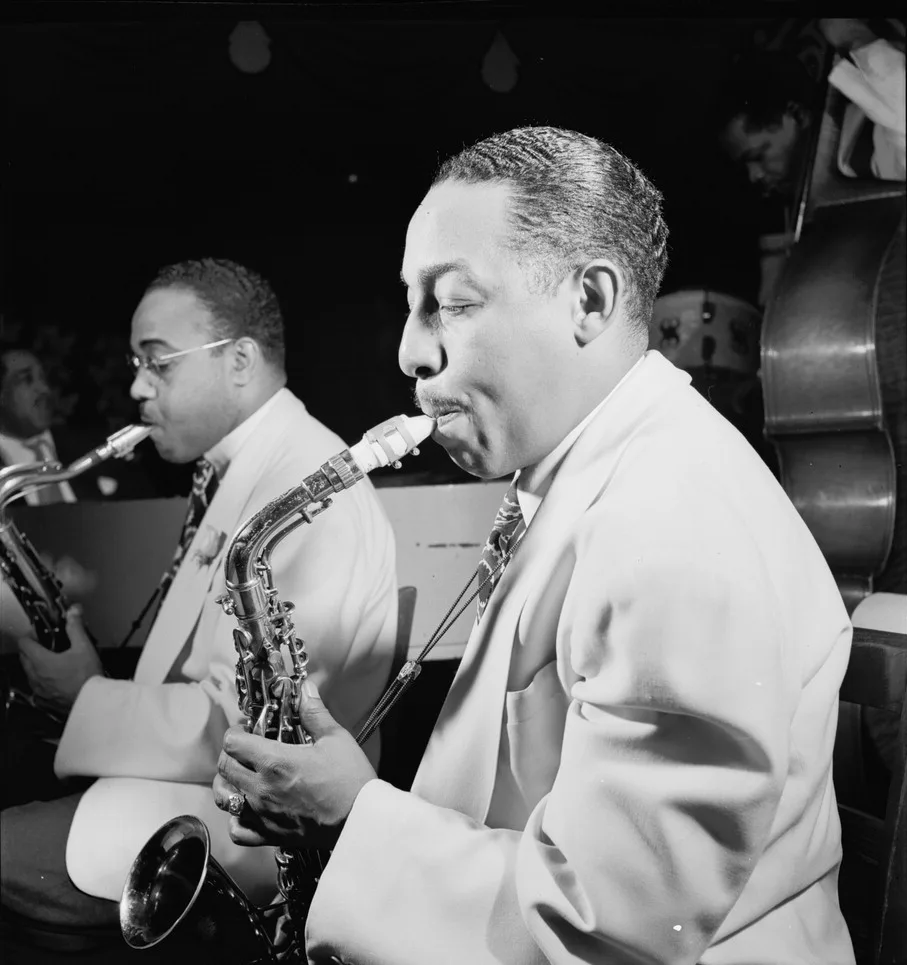
Johnny Hodges (foreground, playing a Conn 6M alto saxophone) with Al Sears behind him at the Aquarium, New York, November 1946, photographed by William P. Gottlieb Public Domain (William P. Gottlieb collection, released by the photographer; Library of Congress: no known copyright restrictions) — Wikimedia Commons: https://commons.wikimedia.org/wiki/File:Johnny_Hodges_and_Al_Sears,_Aquarium,_New_York,_ca._Nov._1946_(William_P._Gottlieb_04191).jpg

John Cornelius Hodges was born on July 25, 1907, in the Cambridgeport neighborhood of Cambridge, Massachusetts, to John H. Hodges and Katie Swan Hodges, who both came from Virginia. After a short stay in North Cambridge the family settled on Hammond Street in Boston's South End, where he grew up alongside the future saxophonists Harry Carney, Charlie Holmes and Howard E. Johnson. His first instruments were drums and piano. His mother was a capable pianist, he was largely self-taught, and as a teenager he earned $8 a night playing piano at dances in private homes. By his teens he had taken up the soprano saxophone, and around the same time he acquired the nickname Rabbit, which people attributed either to his speed as a sprinter or, in Carney's version, to the way he nibbled lettuce and tomato sandwiches.
At fourteen he went with his eldest sister to see Sidney Bechet in Jimmy Cooper's Black and White Revue at a Boston burlesque house. His sister introduced them, Bechet asked the boy to play the soprano saxophone he had brought along, and Hodges performed "My Honey's Lovin' Arms." Bechet encouraged him and gave him formal lessons. Hodges built a local reputation and was working in New York by 1924. In the mid-1920s he played in bands led by Bobby Sawyer, Lloyd Scott, Chick Webb (from late 1926, at the Paddock Club and the Savoy Ballroom) and Luckey Roberts, and he followed Bechet into Willie "The Lion" Smith's quartet at the Rhythm Club, according to All About Jazz. When Duke Ellington set out to enlarge his orchestra in 1928, his clarinetist Barney Bigard recommended Hodges, who joined that year.
Hodges played lead alto in Ellington's saxophone section and was the orchestra's most featured soloist for the next four decades. Ellington wrote showcases for him, including "Confab with Rab," "Jeep's Blues," "Sultry Sunset" and "Hodge Podge," and the ballads tied to his name include "Warm Valley," "Passion Flower," "In a Sentimental Mood," "Prelude to a Kiss," "I Got It Bad (and That Ain't Good)" and "Blood Count." Among the faster pieces he was featured in "Things Ain't What They Used to Be" and "The Jeep Is Jumpin'." From 1937 he also led small studio groups drawn from the orchestra for Victor and other labels. He was one of the Ellington players who took part in Benny Goodman's 1938 Carnegie Hall concert, and Goodman called him the greatest alto saxophonist he had ever heard. After 1940 he stopped playing the soprano saxophone altogether, and through the 1940s he regularly won the readers' polls run by Down Beat, Metronome and Esquire.
In March 1951, to the surprise of the jazz public, Hodges left Ellington to form his own band, taking trombonist Lawrence Brown and drummer Sonny Greer with him. The first sessions produced his one hit, "Castle Rock," a tune by the group's tenor saxophonist Al Sears; AllMusic points out that the record belongs more to Sears's tenor than to Hodges. His records for Norman Granz's Norgran label followed, and the young John Coltrane played in the band in 1953 and 1954, appearing on the sessions for Used to Be Duke. The band struggled and broke up in the spring of 1955. After a short stretch of television work on The Ted Steele Show, Hodges rejoined Ellington in August 1955 and stayed with him for the rest of his life, apart from a few brief absences.
His return came just before the orchestra's revival at the 1956 Newport Jazz Festival, where Ellington introduced him to the crowd and he played "I Got It Bad" and "Jeep's Blues." He is the alto voice on Such Sweet Thunder (1957) and the Anatomy of a Murder soundtrack (1959). Away from the band he led a steady run of small-group dates for Norgran and then Verve, often with Ellington men, among them Duke's in Bed (1956), Blues-A-Plenty (1958), the two albums co-billed with Ellington, Back to Back and Side by Side (1959), and Gerry Mulligan Meets Johnny Hodges (1959). Between 1961 and 1967 he made eight albums with the organist Wild Bill Davis. He also recorded with Coleman Hawkins and Roy Eldridge at the Village Gate in 1962, with the pianist Earl Hines in 1966 and 1967, and in 1965 on an album of standards with Lawrence Welk's orchestra.
His last concerts were at the Imperial Room in Toronto. He passed away on May 11, 1970, in New York City, of a heart attack suffered during a visit to a dentist's office. His final recordings are on Ellington's New Orleans Suite, which was only half finished when he died. Ellington said afterward that the band would never sound the same without him. Hodges was married twice. He and his first wife, Bertha Pettiford, had a daughter, and he and his second wife, Edith Cue, had a son, John C. Hodges II, and a daughter, Lorna Lee.
Hodges was known for a tone that musicians and critics from every school singled out for its beauty, and for his handling of ballads and blues. He used a wide vibrato and sliding portamento, gliding between notes the way a trombone does, and he favored economy over display: the effect came from sound and time, not from the number of notes. His basic style barely changed across four decades, and in later years he stayed closer to the melody on ballads and played short, pointed riffs on the faster pieces, many of them blues. Sidney Bechet was his one major teacher and model. In turn he was widely copied: John Coltrane named him his first model on the saxophone, Ben Webster counted him a major influence during their years together in Duke Ellington's band, and Charlie Parker likened him to the opera soprano Lily Pons. The alto saxophonists Lee Konitz, Phil Woods, Hank Crawford and Dmitry Baevsky have each cited him as an influence, Lou Donaldson's rounded ballad tone has been compared with his, and Owen Broder devoted two albums to his repertoire (Hodges: Front and Center, 2022 and 2024). Along with Benny Carter he is regarded as one of the definitive alto saxophonists of the big band era. He played a Conn 6M in the 1940s, later a Buescher 400, and by the late 1960s a silver-plated Vito Leblanc Rationale. He is a member of the DownBeat Jazz Hall of Fame.
- Castle Rock (1955, Norgran) - Collects 1951 and 1952 sessions by the band Hodges formed after leaving Ellington, with Lawrence Brown, Al Sears and Sonny Greer; the Sears tune that gives the album its name was the group's hit.
- Used to Be Duke (1956, Norgran) - A 1954 Los Angeles date with Ellington colleagues and John Coltrane on four tracks, built around the title blues and a long ballad medley; AllMusic gave it four stars.
- Back to Back: Duke Ellington and Johnny Hodges Play the Blues (1959, Verve) - Seven classic blues with Duke Ellington at the piano and Harry Edison on trumpet. Spotify - Back To Back (Duke Ellington And Johnny Hodges Play The Blues) Listen
- Side by Side (1959, Verve) - Hodges in front of two sessions, one with Ellington at the piano and one with Billy Strayhorn, Ben Webster and Roy Eldridge. Spotify - Side By Side Listen
- Gerry Mulligan Meets Johnny Hodges (1960, Verve) - The only studio album the two saxophonists made together, recorded in Los Angeles on November 17, 1959, with Gerry Mulligan on baritone and Mel Lewis on drums.
- Blue Hodge (1961, Verve) - The first of eight albums with the organist Wild Bill Davis, with Sam Jones and Louis Hayes in the rhythm section and three pieces by Gary McFarland.
- Everybody Knows Johnny Hodges (1964, Impulse!) - An all-star Ellington-band date recorded on February 6, 1964, which The Penguin Guide to Jazz Recordings rated four stars.
- Ellington at Newport (1956, Columbia) - The live album of the concert that revived the Ellington orchestra, on which Ellington introduces Hodges before "I Got It Bad (and That Ain't Good)" and "Jeep's Blues."
Johnny Hodges: Full Discography
Discogs artist ID 258460 ("Johnny Hodges," real name John Cornelius Hodges, born July 25, 1907, in Cambridge, Massachusetts, died May 11, 1970, in New York City) lists more than 3,500 entries across leader, collaborative, track-appearance and compilation releases, most of them reissues and anthologies of the same sessions. His small-group studio sides of 1937 to 1950 and several 1950s albums are billed to "Johnny Hodges and His Orchestra," which Discogs files under a separate entity (artist ID 843805, about 390 entries); that entity was reviewed and is summarized in the third table. Because his recorded output with Duke Ellington runs to hundreds of titles, the leader table is a curated selection of 37 albums rather than an exhaustive list: the Norgran and Verve small-group dates, the Wild Bill Davis series, the Earl Hines and Gerry Mulligan collaborations, and the Impulse! albums. The sideman table covers landmark Ellington orchestra recordings and outside dates on which he is a featured soloist. Catalog numbers are those of the original or best-documented pressing; recording dates come from Discogs release notes and Wikipedia, and where the two differ the Notes column says so.
As Leader / Co-Leader
| Album Title | Recording Date(s) | Release Date | Label | Catalog Number | Format(s) | Personnel | Role | Reissue History | Spotify | Buy | Notes |
|---|---|---|---|---|---|---|---|---|---|---|---|
| Johnny Hodges Collates | Not specified in Discogs data | 1952 | Clef | MGC111 | Vinyl, LP, 10" | Johnny Hodges (alto saxophone), Emmett Berry (trumpet), Lawrence Brown (trombone), Al Sears (tenor saxophone), Billy Strayhorn and Leroy Lovett (piano), Lloyd Trotman (bass), Sonny Greer (drums) | Leader | Reissued many times on CD and streaming; the pressing history is on Discogs master 700259 | — | — | Ten-inch LP of 1951 and 1952 band sessions; includes "Castle Rock." |
| Memories of Ellington | Not specified in Discogs data | 1954 | Norgran | MG N-1004 | Vinyl, LP, Album, Mono | Johnny Hodges (alto saxophone), Emmett Berry (trumpet), Lawrence Brown (trombone), Ben Webster (tenor saxophone, most tracks), Al Sears and Flip Phillips (tenor saxophone, one track each), Leroy Lovett (piano), Lloyd Trotman (bass, three tracks), Sonny Greer (drums, one track) | Leader | Reissued many times on CD and streaming; the pressing history is on Discogs master 576086 | — | — | Ellington repertoire; later reissued as In a Mellow Tone. |
| Dance Bash | New York, January 7, 1955; San Francisco, July 17, 1952; Los Angeles, July 22, 1952 | 1955 | Norgran | MGN 1024 | Vinyl, LP, Album, Mono | January 1955 tracks: Johnny Hodges (alto saxophone), Harold Baker (trumpet), Lawrence Brown (trombone), Arthur Clarke (tenor saxophone), Leroy Lovett (piano), Johnny Williams (bass), Louis Bellson (drums). 1952 tracks: Flip Phillips or Ben Webster (tenor saxophone), Emmett Berry (trumpet), J.C. Heard (drums), Ray Brown or Red Callender (bass) | Leader | Reissued many times on CD and streaming; the pressing history is on Discogs master 951899 | — | — | Discogs notes that the two 1952 tracks came from earlier sessions. |
| Creamy | Not specified in Discogs data | 1955 | Norgran | MG N-1045 | Vinyl, LP, Album, Mono | Johnny Hodges (alto saxophone), Clark Terry (trumpet), Lawrence Brown (trombone), Jimmy Hamilton (tenor saxophone, clarinet), Harry Carney (baritone saxophone), Billy Strayhorn (piano), Jimmy Woode (bass), Sonny Greer (drums) | Leader | Reissued many times on CD and streaming; the pressing history is on Discogs master 304209 | — | — | Opens with a fifteen-minute ballad medley that ends with "Passion Flower." |
| Castle Rock | New York, January 15, February 28 and March 3, 1951, and January 13, 1952 | 1955 | Norgran | MG N-1048 | Vinyl, LP, Album, Compilation, Mono | Johnny Hodges (alto saxophone), Emmett Berry or Nelson Williams (trumpet), Lawrence Brown (trombone), Al Sears (tenor saxophone), Leroy Lovett (piano; Billy Strayhorn on one track), Lloyd Trotman or Al McKibbon (bass), Sonny Greer or Joe Marshall (drums) | Leader (billed as Johnny Hodges and His Orchestra) | Reissued many times on CD and streaming; the pressing history is on Discogs master 625613 | — | — | Collects the first sessions of the band he formed in 1951. Recording dates are from Wikipedia; Discogs lists none. |
| Used to Be Duke | Los Angeles, July 2 and August 5, 1954 | October 1956 | Norgran | MGN-1060 | Vinyl, LP, Album | Johnny Hodges (alto saxophone), Shorty Baker (trumpet), Lawrence Brown (trombone), Jimmy Hamilton (clarinet, tenor saxophone), John Coltrane (tenor saxophone, four tracks), Harry Carney (baritone saxophone), Call Cobbs Jr. and Richie Powell (piano), John "Buddy" Williams (bass), Louie Bellson (drums) | Leader (billed as Johnny Hodges and His Orchestra) | Reissued many times on CD and streaming; the pressing history is on Discogs master 621876 | — | — | Personnel and dates are from Wikipedia; Discogs lists no performers for this release. Some of the material first appeared on Norgran MGN-1009. |
| Ellingtonia '56 | Not specified in Discogs data | 1956 | Norgran | MG N-1055 | Vinyl, LP, Album | Johnny Hodges (alto saxophone), Cat Anderson, Willie Cook, Ray Nance and Clark Terry (trumpets), Lawrence Brown, Quentin Jackson, John Sanders and Britt Woodman (trombones), Jimmy Hamilton (clarinet, tenor saxophone), Russell Procope (alto saxophone), Paul Gonsalves (tenor saxophone), Harry Carney (baritone saxophone), Billy Strayhorn (piano), Jimmy Woode (bass), Sam Woodyard (drums) | Leader | Reissued many times on CD and streaming; the pressing history is on Discogs master 582524 | — | — | Credits are taken from the rear-cover liner notes; several of the players appear on the second side only. |
| Duke's in Bed | New York, September 1, 1956 | 1957 | Verve | MG V-8203 | Vinyl, LP, Mono | Johnny Hodges (alto saxophone), Clark Terry and Ray Nance (trumpets; Nance also violin and vocals), Quentin Jackson (trombone), Jimmy Hamilton (clarinet, tenor saxophone), Harry Carney (baritone saxophone), Billy Strayhorn (piano), Jimmy Woode (bass), Sam Woodyard (drums) | Leader (billed as Johnny Hodges and the Ellington Men) | Reissued many times on CD and streaming; the pressing history is on Discogs master 582530 | — | — | Billy Strayhorn made all the arrangements. Personnel and recording date are from Wikipedia; Discogs lists no performers, and MusicBrainz dates the album 1956. |
| Blues-A-Plenty | Not specified in Discogs data | 1958 | Verve | MGV-8358 | Vinyl, LP, Mono | Johnny Hodges (alto saxophone), Roy Eldridge (trumpet), Vic Dickenson (trombone), Ben Webster (tenor saxophone), Billy Strayhorn (piano), Jimmy Woode (bass), Sam Woodyard (drums) | Leader | Reissued many times on CD and streaming; the pressing history is on Discogs master 558890 | — | — | Includes "Satin Doll" and the nine-minute "Reeling and Rocking." |
| Not So Dukish | Not specified in Discogs data | September 10, 1958 | Verve | MGV-8355 | Vinyl, LP, Album | Johnny Hodges (alto saxophone), Roy Eldridge and Ray Nance (trumpets), Lawrence Brown (trombone), Jimmy Hamilton (clarinet), Ben Webster (tenor saxophone), Billy Strayhorn (piano), Jimmy Woode (bass), Sam Woodyard (drums) | Leader (billed as Johnny Hodges and His Orchestra) | Reissued many times on CD and streaming; the pressing history is on Discogs master 558891 | — | — | Includes "The Last Time I Saw Paris" and "Central Park Swing." |
| The Big Sound | Not specified in Discogs data | March 1959 | Verve | MG V-8271 | Vinyl, LP, Album, Mono | Johnny Hodges, Harry Carney, Jimmy Hamilton, Russell Procope and Paul Gonsalves (reeds; Gonsalves on the first four tracks of side one), Harold Baker, Cat Anderson, Clark Terry, Ray Nance and Willie Cook (trumpets), Britt Woodman, John Sanders and Quentin Jackson (trombones), Billy Strayhorn (piano), Jimmy Woode (bass), Sam Woodyard (drums) | Leader (billed as Johnny Hodges and the Ellington Men) | Reissued many times on CD and streaming; the pressing history is on Discogs master 322786 | — | — | Discogs lists the large group with track restrictions on only some players; Norman Granz supervised. |
| Johnny Hodges and His Strings Play the Prettiest Gershwin | Not specified in Discogs data | November 1959 | Verve | MG V-8314 | Vinyl, LP, Album, Mono | Johnny Hodges (alto saxophone) with a string orchestra; arranged by Russell Garcia | Leader | Reissued many times on CD and streaming; the pressing history is on Discogs master 527669 | — | — | Twelve Gershwin songs; Discogs lists no other performers. |
| Back to Back: Duke Ellington and Johnny Hodges Play the Blues | Not specified in Discogs data | 1959 | Verve | MG V-8317 | Vinyl, LP, Album, Mono | Johnny Hodges (alto saxophone), Duke Ellington (piano), Harry Edison (trumpet), Les Spann (guitar), Jo Jones (drums); no bass player is credited on Discogs | Co-leader (billed with Duke Ellington) | Reissued many times on CD and streaming; the pressing history is on Discogs master 175076 | Spotify - Back To Back (Duke Ellington And Johnny Hodges Play The Blues) | — | Seven classic blues titles, from "Wabash Blues" to "Royal Garden Blues." |
| Side by Side | August 14, 1958, and February 20, 1959, New York | 1959 (March 1960 per Discogs) | Verve | MG V-8345 | Vinyl, LP, Album, Mono | February 1959 tracks: Duke Ellington (piano), Johnny Hodges (alto saxophone), Harry Edison (trumpet), Les Spann (guitar, flute), Al Hall (bass), Jo Jones (drums). August 1958 tracks: Hodges, Roy Eldridge (trumpet), Lawrence Brown (trombone), Ben Webster (tenor saxophone), Billy Strayhorn (piano), Wendell Marshall (bass), Jo Jones (drums) | Co-leader (billed with Duke Ellington) | Reissued many times on CD and streaming; the pressing history is on Discogs master 304210 | Spotify - Side By Side | — | Ellington plays on three tracks only. Wikipedia's prose gives February 26, 1959 for those tracks, while its infobox and the Discogs notes say February 20; the personnel lists are from Wikipedia. |
| Gerry Mulligan Meets Johnny Hodges | Los Angeles, November 17, 1959 | 1960 | Verve | MG V-8367 | Vinyl, LP, Album, Mono | Gerry Mulligan (baritone saxophone), Johnny Hodges (alto saxophone), Claude Williamson (piano), Buddy Clark (bass), Mel Lewis (drums) | Co-leader (billed with Gerry Mulligan) | Reissued many times on CD and streaming; the pressing history is on Discogs master 304194 | — | — | Their only studio meeting; three of the six tunes are by Mulligan and three by Hodges. |
| Blue Hodge | August 23 and 24, 1961, Van Gelder Studio, Englewood Cliffs, New Jersey | 1961 | Verve | V-8406 | Vinyl, LP, Album, Mono | Johnny Hodges (alto saxophone), Wild Bill Davis (organ), Les Spann (guitar, flute), Sam Jones (bass), Louis Hayes (drums) | Leader | Reissued many times on CD and streaming; the pressing history is on Discogs master 663372 | — | — | First of the eight albums with Wild Bill Davis; Gary McFarland wrote three of the pieces. Reissued in 2007 by Lone Hill Jazz. |
| Johnny Hodges with Billy Strayhorn and the Orchestra | December 11 and 12, 1961, Van Gelder Studio, Englewood Cliffs, New Jersey | June 1962 | Verve | V6-8452 | Vinyl, LP, Album, Stereo | Johnny Hodges (alto saxophone, soloist), Billy Strayhorn (arranger, conductor), Bill Berry, Cat Anderson, Ed Mullens, Harold Baker and Howard McGhee (trumpets; McGhee on three tracks), Lawrence Brown, Quentin Jackson and Chuck Connors (trombones), Russell Procope, Harry Carney, Jimmy Hamilton and Paul Gonsalves (reeds), Jimmy Jones (piano), Aaron Bell (bass), Sam Woodyard (drums) | Leader | Reissued many times on CD and streaming; the pressing history is on Discogs master 354342 | — | — | Recording dates and release month are from Wikipedia. |
| The Eleventh Hour | New York, August 15 and 18, 1962 | November 1962 | Verve | V-8492 | Vinyl, LP, Album, Mono | Johnny Hodges (alto saxophone), Oliver Nelson (arranger, conductor) and his orchestra, Bernie Leighton (piano, organ), George Duvivier (bass), Osie Johnson (drums), Ray Nance (violin, one track) | Leader | Reissued many times on CD and streaming; the pressing history is on Discogs master 407671 | — | — | Built around the theme from the television series The Eleventh Hour. |
| Hawkins! Eldridge! Hodges! Alive! At the Village Gate! | Village Gate, New York, August 13 and 15, 1962 | 1962 | Verve | V6-8504 | Vinyl, LP, Album, Stereo | Coleman Hawkins (tenor saxophone), Roy Eldridge (trumpet), Johnny Hodges (alto saxophone, first three tracks), Tommy Flanagan (piano), Major Holley (bass), Eddie Locke (drums) | Co-leader (billed with Coleman Hawkins and Roy Eldridge) | Reissued many times on CD and streaming; the pressing history is on Discogs master 590146 | — | — | Live. Discogs dates the master 1963 and gives August 15 as the recording date; Wikipedia gives August 13 and 15. |
| Mess of Blues | New York, September 3 and 4, 1963 | 1964 | Verve | V6-8570 | Vinyl, LP, Album, Stereo | Johnny Hodges (alto saxophone), Wild Bill Davis (organ), Kenny Burrell (guitar), Joe Wilder (trumpet), Ed Shaughnessy and Osie Johnson (drums) | Co-leader (billed with Wild Bill Davis) | Reissued many times on CD and streaming; the pressing history is on Discogs master 361971 | — | — | Second of the Davis albums on Verve; a 2007 CD reissue from Lone Hill Jazz bills Burrell as featured guitarist. |
| Everybody Knows Johnny Hodges | February 6, 1964 | July 1964 | Impulse! | A-61 | Vinyl, LP, Album, Mono | Johnny Hodges (alto saxophone), Paul Gonsalves (tenor saxophone), Cat Anderson, Ray Nance, Herbie Jones and Rolf Ericson (trumpets), Lawrence Brown, Britt Woodman and Buster Cooper (trombones), Harry Carney, Jimmy Hamilton and Russell Procope (reeds), Jimmy Jones (piano), Ernie Shepard (bass), Grady Tate (drums) | Leader | Reissued many times on CD and streaming; the pressing history is on Discogs master 113368 | — | — | The Penguin Guide to Jazz Recordings gave it four stars and called it essential. The CD reissue adds the whole of Inspired Abandon. |
| Blue Rabbit | Not specified in Discogs data | 1964 | Verve | V-8599 | Vinyl, LP, Album, Mono | Johnny Hodges (alto saxophone), Wild Bill Davis or Ray Jackson (organ), Kenny Burrell or Mundell Lowe (guitar), Richard Davis, Wendell Marshall or Jack Lesberg (bass), Osie Johnson or Bobby Donaldson (drums) | Co-leader (billed with Wild Bill Davis) | Reissued many times on CD and streaming; the pressing history is on Discogs master 512641 | — | — | Personnel varies by track; Discogs gives the track restrictions. |
| Inspired Abandon | March 8, 1965, Van Gelder Studios, Englewood Cliffs, New Jersey | 1965 | Impulse! | A-89 | Vinyl, LP, Album, Mono | Lawrence Brown (trombone), Johnny Hodges and Russell Procope (alto saxophones), Ray Nance (cornet), Cat Anderson (trumpet), Buster Cooper (trombone), Harold Ashby and Paul Gonsalves (tenor saxophones), Jimmy Jones (piano), Richard Davis (bass), Gus Johnson and Johnny Hodges Jr. (drums) | Featured artist (billed as Lawrence Brown's All-Stars with Johnny Hodges) | Reissued many times on CD and streaming; the pressing history is on Discogs master 570555 | — | — | Includes three Hodges originals, among them "Good Queen Bess"; his son Johnny Hodges Jr. plays drums on two tracks. |
| Joe's Blues | January 6, 1965, Van Gelder Studios, Englewood Cliffs, New Jersey | 1965 | Verve | V-8617 | Vinyl, LP, Album, Mono | Johnny Hodges (alto saxophone), Wild Bill Davis (organ), Grant Green (guitar), Lawrence Brown (trombone), Bob Cranshaw and Bob Bushnell (bass), Grady Tate (drums) | Leader | Reissued many times on CD and streaming; the pressing history is on Discogs master 693294 | — | — | Davis series. |
| Con-Soul & Sax | RCA Victor Studio A, New York; dates not specified | 1965 | RCA Victor | LPM-3393 | Vinyl, LP, Album, Mono | Johnny Hodges (alto saxophone), Wild Bill Davis (organ), Mundell Lowe and Dickie Thompson (guitars), George Duvivier and Milt Hinton (bass), Osie Johnson (drums) | Co-leader (billed with Wild Bill Davis) | Reissued many times on CD and streaming; the pressing history is on Discogs master 486034 | — | — | Hodges appears courtesy of Verve; the stereo issue is LSP-3393. |
| Wings & Things | July 27, 1965 | November 1965 | Verve | V6-8630 | Vinyl, LP, Album, Stereo | Johnny Hodges (alto saxophone), Wild Bill Davis (organ), Grant Green (guitar), Hank Jones (piano), Lawrence Brown (trombone), Richard Davis (bass), Ben Dixon (drums) | Leader | Reissued many times on CD and streaming; the pressing history is on Discogs master 362009 | — | — | Includes "Take the 'A' Train." |
| Lawrence Welk & Johnny Hodges | Los Angeles, December 20 and 21, 1965 | 1965 | Dot | DLP 25682 | Vinyl, LP, Album, Stereo | Johnny Hodges (alto saxophone, soloist) with Lawrence Welk and his orchestra | Featured soloist (billed with Lawrence Welk) | Reissued many times on CD and streaming; the pressing history is on Discogs master 813658 | — | — | An album of standards; a mono edition is DLP 3682. Hodges appears courtesy of Verve. |
| Blue Pyramid | Not specified in Discogs data | 1966 | Verve | V-8635 | Vinyl, LP, Album, Mono | Johnny Hodges (alto saxophone), Wild Bill Davis (organ), Lawrence Brown (trombone), Jimmy Hamilton (clarinet), Jimmy Jones (piano, arranger), Billy Butler (guitar), Bob Bushnell (Fender bass), Herbie Lovelle, Joe Marshall and Johnny Hodges Jr. (drums) | Leader | Reissued many times on CD and streaming; the pressing history is on Discogs master 304206 | — | — | Davis series. |
| Stride Right | January 14, 1966, Van Gelder Studios, Englewood Cliffs, New Jersey | April 1966 | Verve | V6-8647 | Vinyl, LP, Stereo | Johnny Hodges (alto saxophone), Earl Hines (piano, organ), Kenny Burrell (guitar), Richard Davis (bass), Joe Marshall (drums) | Co-leader (billed with Earl Hines) | Reissued many times on CD and streaming; the pressing history is on Discogs master 420902 | — | — | Produced by Creed Taylor. |
| Blue Notes | August 15 and 19, and October 24, 1966 | May 1967 | Verve | V6-8680 | Vinyl, LP, Album, Stereo | Johnny Hodges (alto saxophone), Jimmy Jones (arranger, conductor), Hank Jones (piano), Frank Wess and Jerome Richardson (alto saxophones, flutes), Jimmy Hamilton (clarinet, tenor saxophone), Danny Bank and Don Ashworth (baritone saxophone, bass clarinet), Ernie Royal and Snooky Young (trumpets, flugelhorns), Kenny Burrell and Eric Gale (guitar), Bob Cranshaw and George Duvivier (bass), Grady Tate (drums), Buddy Lucas (harmonica), Joe Venuto (vibraphone), Tony Studd (bass trombone) | Leader | Reissued many times on CD and streaming; the pressing history is on Discogs master 420901 | — | — | Produced by Creed Taylor; recording dates are from the Discogs notes. |
| In Atlantic City | Not specified in Discogs data | 1967 | RCA Victor | LSP-3706 | Vinyl, LP, Album, Stereo | Johnny Hodges (alto saxophone), Wild Bill Davis (organ), Lawrence Brown (trombone), Bob Brown (tenor saxophone, flute), Dickie Thompson (guitar), Bobby Durham (drums) | Co-leader (billed with Wild Bill Davis) | Reissued many times on CD and streaming; the pressing history is on Discogs master 942064 | — | — | Reissued in 1990 as In a Mellotone. |
| Triple Play | January 9 and 10, 1967, RCA Victor Studio A, New York | December 1967 | RCA Victor | LSP-3867 | Vinyl, LP, Stereo | Johnny Hodges (alto saxophone, leader), Ray Nance (cornet), Cat Anderson, Roy Eldridge (trumpets), Lawrence Brown, Buster Cooper and Benny Powell (trombones), Paul Gonsalves and Jimmy Hamilton (tenor saxophones), Harry Carney (baritone saxophone, two tracks), Hank Jones, Jimmy Jones and Nat Pierce (piano), Aaron Bell, Joe Benjamin and Milt Hinton (bass), Gus Johnson, Oliver Jackson and Rufus Jones (drums), Tiny Grimes, Billy Butler and Les Spann (guitars), Bill Berry (vibraphone) | Leader | Reissued many times on CD and streaming; the pressing history is on Discogs master 419082 | — | — | Three rhythm-section and horn groupings, each credited by track on Discogs. |
| Don't Sleep in the Subway | Not specified in Discogs data | 1967 | Verve | V6-8726 | Vinyl, LP, Album, Stereo | Johnny Hodges (alto saxophone), Jimmy Jones (arranger, conductor), Frank Wess and Jerome Richardson (alto saxophones, flutes, clarinets), Jimmy Hamilton (tenor saxophone, clarinet), Danny Bank (baritone saxophone), Ernie Royal, Snooky Young and Bill Berry (trumpets), Hank Jones (piano), Milt Hinton (bass), Grady Tate (drums), Everett Barksdale and Carl Lynch (guitars), Buddy Lucas (harmonica) | Leader | Reissued many times on CD and streaming; the pressing history is on Discogs master 433691 | — | — | Orchestrated studio album with arrangements by Jimmy Jones. |
| Swing's Our Thing | San Francisco, November 13 and 14, 1967 | 1968 | Verve | VLP 9219 | Vinyl, LP, Album, Mono | Johnny Hodges (alto saxophone), Earl Hines (piano), Cat Anderson (trumpet), Buster Cooper (trombone), Jimmy Hamilton (clarinet, tenor saxophone), Jeff Castleman (bass), Sam Woodyard (drums) | Co-leader (billed with Earl Hines) | Reissued many times on CD and streaming; the pressing history is on Discogs master 855325 | — | — | Recorded at Coast Recorders; AllMusic notes that six of the songs run under three minutes. |
| Rippin' & Runnin' | December 1968, A&R Studios, New York | 1969 | Verve | V6-8753 | Vinyl, LP, Album, Stereo | Johnny Hodges (alto saxophone), Billy Gardner (organ), Jimmy Ponder (guitar), Ron Carter (bass), Freddie Waits (drums) | Leader | Reissued many times on CD and streaming; the pressing history is on Discogs master 390675 | — | — | Produced by Esmond Edwards. |
| 3 Shades of Blue | New York, March 17 and 19, 1970 | 1970 | Flying Dutchman | FDS-120 | Vinyl, LP, Album, Stereo | Johnny Hodges (alto saxophone), Leon Thomas (vocals), Oliver Nelson (arranger, conductor), Hank Jones and Earl Hines (piano), David Spinozza (guitar), Ron Carter (bass), Grady Tate (drums), Danny Bank, Frank Wess, Jerome Richardson, Jerry Dodgion, Joe Farrell and Robert Ashton (reeds), Ernie Royal, Marvin Stamm, Randy Brecker and Snooky Young (trumpets), Al Grey, Garnett Brown, Quentin Jackson and Thomas Mitchell (trombones) | Leader (co-billed with Leon Thomas and Oliver Nelson) | Reissued many times on CD and streaming; the pressing history is on Discogs master 309944 | — | — | His last album as a leader; the liner notes were written before his death on May 11, 1970. Produced by Bob Thiele. |
| At the Sportpalast, Berlin | Sportpalast, Berlin, March 22, 1961 | 1978 | Pablo Live | 2620-102 | Vinyl, LP, Album, Stereo | Johnny Hodges (alto saxophone), Ray Nance (cornet, violin, vocals), Lawrence Brown (trombone), Harry Carney (baritone saxophone), Al Williams (piano), Aaron Bell (bass), Sam Woodyard (drums) | Leader | Reissued many times on CD and streaming; the pressing history is on Discogs master 601125 | — | — | Live concert recording issued on the Pablo label founded by Norman Granz; much of the concert had been issued earlier on the LP Rarities 38. |
As Featured Soloist and Sideman (selected major credits)
| Year | Project (Leader) | Title | Label | Catalog | Role | Notes |
|---|---|---|---|---|---|---|
| 1938 | Benny Goodman | The Famous 1938 Carnegie Hall Jazz Concert | Columbia | SL-160 | Guest alto and soprano saxophone, one of several Ellington players who joined the band | Recorded January 16, 1938; first issued in 1950. |
| 1956 | Duke Ellington | Ellington at Newport | Columbia | Not confirmed | Alto saxophone | Recorded July 7 and 8, 1956; Ellington introduces Hodges before "I Got It Bad (and That Ain't Good)" and "Jeep's Blues." |
| 1956 | Rosemary Clooney | Blue Rose | Columbia | CL 872 | Alto saxophone in the Ellington orchestra | Recorded January and February 1956; Billy Strayhorn arranged every song. |
| 1957 | Duke Ellington | Such Sweet Thunder | Columbia | Not confirmed | Alto saxophone; "The Star-Crossed Lovers" is the best-known Hodges feature | Shakespeare suite recorded between August 1956 and May 1957. |
| 1957 | Clark Terry | Duke with a Difference | Riverside | RLP 12-246 | Alto saxophone on five of the eight tracks | Recorded July 29 and September 6, 1957; Paul Gonsalves is the other featured Ellington soloist. |
| 1957 | Billy Taylor | Taylor Made Jazz | Argo | Not confirmed | Alto saxophone | Recorded November 17, 1957, in Chicago, with Ellington sidemen and arrangements by Johnny Pate. |
| 1959 | Billy Strayhorn (billed) | Cue for Saxophone | Felsted | FAJ 7008 | Featured alto saxophone | Recorded April 14, 1959. Hodges was under contract to Verve, so the album was released under Strayhorn's name; Hodges is the featured soloist. |
| 1959 | Duke Ellington | Anatomy of a Murder | Columbia | Not confirmed | Alto saxophone | Soundtrack recorded May 29 and June 1 and 2, 1959; won three Grammy Awards. |
| 1962 | Duke Ellington and Coleman Hawkins | Duke Ellington Meets Coleman Hawkins | Impulse! | A-26 | Alto saxophone; co-writer of "Wanderlust" and "The Jeep Is Jumpin'" | Recorded August 18, 1962. |
| 1965 | Ella Fitzgerald | Ella at Duke's Place | Verve | Not confirmed | Alto saxophone in the Ellington orchestra | Recorded October 18 to 20, 1965, in Hollywood. |
| 1967 | Duke Ellington | Far East Suite | RCA Victor (Bluebird) | Not confirmed | Alto saxophone; featured soloist on "Isfahan" | Recorded December 19 to 21, 1966; released June 1967. |
| 1968 | Frank Sinatra | Francis A. & Edward K. | Reprise | Not confirmed | Alto saxophone in the Ellington orchestra | Recorded December 11 and 12, 1967; Dan Morgenstern singled out the Hodges solo on "Indian Summer." |
| 1970 | Duke Ellington | New Orleans Suite | Atlantic | Not confirmed | Alto saxophone on tracks 1, 2, 4, 6 and 8 | His last recordings; Hodges died between the two sessions (April 27 and May 13, 1970). Won the 1971 Grammy Award for best jazz performance by a big band. |
Small-Group Sides, 1937 to 1950
| Year | Project (Leader) | Label | Contents | Notes |
|---|---|---|---|---|
| 1937-1950 | Johnny Hodges and His Orchestra | Vocalion, Okeh and other labels | Small-group studio sides drawn from the Ellington orchestra, including "Rendezvous with Rhythm" and "Jeep's Blues" (1938), "Prelude to a Kiss" and "The Jeep Is Jumpin'" (1938), "Day Dream" (1941), "Things Ain't What They Used to Be" (1942) and "Passion Flower" (1944). | Discogs files these under a separate entity, artist ID 843805, with 66 Main releases and 72 Main masters, mostly singles and EPs. |
Compilations and Boxed Sets (selected)
| Year | Title | Label | Format | Notes |
|---|---|---|---|---|
| 1989 | The Complete Johnny Hodges Sessions 1951-1955 | Mosaic | Six-LP boxed set | The Norgran and Clef sessions after he left Ellington. |
| 2000 | The Complete Verve Johnny Hodges Small Group Sessions 1956-61 | Mosaic | Six-CD boxed set | The Verve small-group dates between his return to Ellington and the Wild Bill Davis years. |
| 2001 | The Complete 1937-1954 Small Group Sessions | Blue Moon | Four-CD set | His small-group sides from 1937 to 1954, issued earlier in smaller volumes from 1995. |
- Duke Ellington - bandleader and employer from 1928 to 1951 and again from August 1955 until Hodges's death in 1970. They are credited together as composers of "Jeep's Blues" and "The Jeep Is Jumpin'," and Ellington plays piano on Back to Back and on part of Side by Side (both 1959).
- Billy Strayhorn - Ellington's composer-arranger and Hodges's regular pianist on small-group dates. He wrote "Passion Flower" and "Blood Count," arranged Duke's in Bed (1956), played piano on Creamy (1955) and Blues-A-Plenty (1958), and arranged and conducted the orchestra on Johnny Hodges with Billy Strayhorn and the Orchestra (1962).
- Lawrence Brown and Sonny Greer - trombonist and drummer who left Ellington with Hodges in March 1951 to join his new band; Brown was also the leader of the 1965 Impulse! album Inspired Abandon, billed to his All-Stars with Hodges.
- Al Sears - tenor saxophonist in the 1950s band and the composer of "Castle Rock."
- Harry Carney - baritone saxophonist and boyhood friend in Boston, who played on Used to Be Duke, Creamy and Duke's in Bed.
- Sidney Bechet - the soprano saxophonist who heard Hodges as a teenager in Boston and gave him his first formal lessons.
- John Coltrane - tenor saxophonist in Hodges's band in 1953 and 1954, and a player on four tracks of Used to Be Duke.
- Ben Webster - tenor saxophonist on Blues-A-Plenty and Not So Dukish (1958) and the 1958 half of Side by Side.
- Gerry Mulligan - baritone saxophone partner on Gerry Mulligan Meets Johnny Hodges, recorded November 17, 1959, with Claude Williamson, Buddy Clark and Mel Lewis.
- Wild Bill Davis - organist who made eight albums with Hodges between 1961 and 1967 and later joined the Ellington orchestra for a time in 1969.
- Coleman Hawkins and Roy Eldridge - co-stars on the live Hawkins! Eldridge! Hodges! Alive! At the Village Gate! (1962), with Tommy Flanagan on piano; Hodges plays on the first three tracks.
- Earl Hines - pianist on Stride Right (1966) and Swing's Our Thing (1967).
- Clark Terry - trumpeter in Hodges's bands of the mid-1950s and the leader of Duke with a Difference (Riverside), a set of Ellington repertoire with Hodges and Paul Gonsalves as featured soloists.
- Gary McFarland - wrote three of the pieces on Blue Hodge (1961), the first of the Wild Bill Davis albums.
- Grant Green and Kenny Burrell - guitarists on the Davis-Hodges albums Joe's Blues and Wings & Things (Green) and Mess of Blues (Burrell).
- Oliver Nelson - arranger and conductor of The Eleventh Hour (1962) and a co-leader of 3 Shades of Blue (1970), his last album as a leader.
- Benny Goodman - the clarinetist whose January 1938 Carnegie Hall concert Hodges joined as one of several Ellington players.
- Lionel Hampton and Teddy Wilson - bandleaders on small-group sessions of the 1930s in which Hodges took part, according to All About Jazz.
- Ella Fitzgerald, Rosemary Clooney and Frank Sinatra - singers who recorded with the Ellington orchestra, with Hodges in the saxophone section, on Ella at Duke's Place (1965), Blue Rose (1956) and Francis A. & Edward K. (1967).
- Owen Broder - baritone saxophonist who recorded the two-volume tribute Hodges: Front and Center (2022, 2024).
More Swing Artists
See all 217 Swing artists →More American Jazz Artists
See all 820 American artists →- Wikipedia: Johnny Hodges
- AllMusic: Johnny Hodges biography by Scott Yanow
- Encyclopaedia Britannica: Johnny Hodges
- All About Jazz: Johnny Hodges
- Wikipedia: Ellington at Newport
- Wikipedia: Used to Be Duke
- Wikipedia: Side by Side (Duke Ellington and Johnny Hodges album)
- Wikipedia: Everybody Knows Johnny Hodges
- Wikipedia: Gerry Mulligan Meets Johnny Hodges
- Wikipedia: New Orleans Suite
- Wikipedia: Blood Count
- Discogs: Johnny Hodges (artist 258460)
- MusicBrainz: Johnny Hodges
- JazzProfiles.com: Duke Ellington
- JazzProfiles.com: Ben Webster
- JazzProfiles.com: Gerry Mulligan
- JazzProfiles.com: Lee Konitz
- JazzProfiles.com: Phil Woods
- JazzProfiles.com: Hank Crawford
- JazzProfiles.com: Dmitry Baevsky
- JazzProfiles.com: Lou Donaldson
- JazzProfiles.com: Owen Broder
- JazzProfiles.com: Jim McNeely