 JAZZPROFILES lives in the music 2,059 Jazz Artists fully Profiled!
Nat King Cole
Last updated October 29, 2026
Listen on Spotify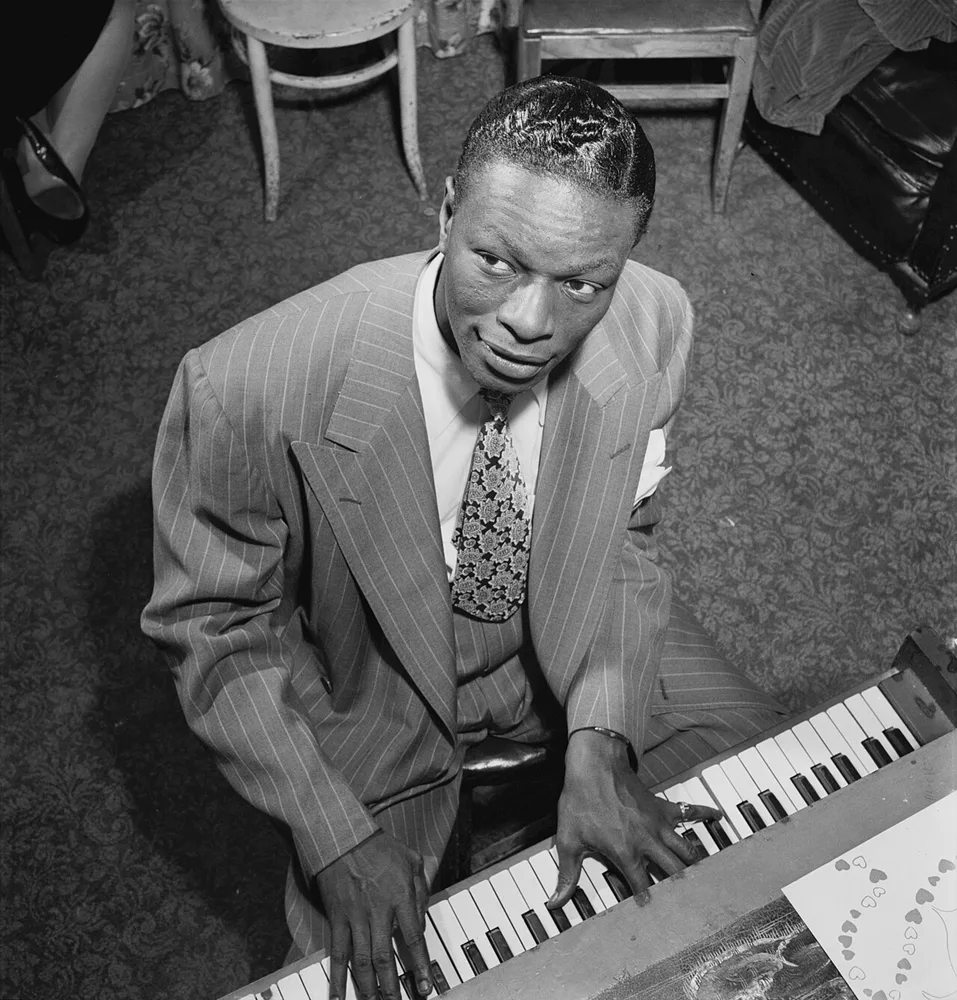
Nat King Cole at the piano, New York, circa June 1947, photographed by William P. Gottlieb Public Domain (William P. Gottlieb collection, Library of Congress; Gottlieb released the photographs to the public domain and the Library of Congress lists no known restrictions) — Wikimedia Commons — https://commons.wikimedia.org/wiki/File:Nat_King_Cole_(Gottlieb_01511).jpg

Nathaniel Adams Coles was born on March 17, 1919, in Montgomery, Alabama, and moved with his family to Chicago when he was four. His father, Edward, became a Baptist minister there, and his mother, Perlina, the church organist, taught him to play. He began formal piano lessons at 12, working through jazz, gospel and classical repertoire, attended Wendell Phillips Academy High School, and took part in Walter Dyett's music program at DuSable High School. As a teenager he sneaked out to listen from outside the clubs where Louis Armstrong, Earl Hines and Jimmie Noone were playing, and the Encyclopedia of Alabama adds that he heard Art Tatum and Teddy Wilson at nearby clubs.
At 15 he left school for music. With his older brother Eddie, a bassist, he formed a sextet that made two Decca singles in 1936 as Eddie Cole's Swingsters, and he went on tour with a revival of the musical Shuffle Along, where he met the dancer Nadine Robinson, whom he married in 1937. When the show ended in Los Angeles, the couple stayed. Cole led a big band and played piano in nightclubs until a club owner asked him to form a small group. He hired the bassist Wesley Prince and the guitarist Oscar Moore, and the King Cole Swingsters became the King Cole Trio: piano, guitar and bass, with no drummer. The trio made radio transcriptions and records for small labels, and in 1939 it appeared in New York on a bill with Billie Holiday. Its first hit, "Sweet Lorraine" (1940), led audiences to ask for more vocals, and in 1942 the group became the house band at the 331 Club in Los Angeles. That year Cole also recorded a trio session with Lester Young and the bassist Red Callender. After Prince was drafted in August 1942, Johnny Miller became the regular bassist.
The trio signed with Capitol Records, the label Johnny Mercer helped found in 1942, and its first Capitol session, on November 30, 1943, in Hollywood with Mercer producing, yielded "Straighten Up and Fly Right." Cole wrote it with Irving Mills from a folk tale his father had used in a sermon, and it reached number nine on the pop chart and number one on the Harlem Hit Parade for ten non-consecutive weeks. The trio became Capitol's top-selling group of the 1940s and its only Black act. Cole was also the house pianist for Norman Granz's first Jazz at the Philharmonic concert, at the Philharmonic Auditorium in Los Angeles on July 2, 1944; because of his Capitol exclusivity he was billed on the Mercury releases as "Shorty Nadine" and under other pseudonyms, always as an instrumentalist and never as a singer. He also recorded with Illinois Jacquet and with Young, including a 1946 trio date with the drummer Buddy Rich. In 1946 the trio began the radio series King Cole Trio Time, said to be the first radio program hosted by a Black musician, and its hits included "(I Love You) For Sentimental Reasons" (1946), "The Christmas Song" (written by Mel Tormé and Bob Wells; Cole's first recording is dated June 1946) and "Nature Boy" (1948). Moore left in October 1947 to join Johnny Moore's Three Blazers, and Irving Ashby took over the guitar chair.
From 1950 Cole was billed as a solo singer, usually with strings or a studio orchestra. "Mona Lisa" was the top song of 1950, with an arrangement by Nelson Riddle that was credited to Les Baxter, and "Too Young" was the top song of 1951. In 1950 he also recorded "Orange Colored Sky" with the Stan Kenton orchestra. Riddle arranged many of his 1950s albums, beginning with Nat King Cole Sings for Two in Love (1953), and Gordon Jenkins arranged Love Is the Thing (1957), the only Cole album to reach number one. Jazz critics accused him of selling out, but he kept returning to the piano: in 1956 he made The Piano Style of Nat King Cole, with Riddle conducting and his last instrumental album, and After Midnight, a small-group jazz date with the guitarist John Collins, the bassist Charlie Harris, the drummer Lee Young and guests including the saxophonist Willie Smith, the trumpeter Harry Edison, the trombonist Juan Tizol and the violinist Stuff Smith.
On April 10, 1956, he was attacked on stage in Birmingham, Alabama, by members of the North Alabama Citizens Council, and several of the men were later convicted. From November 5, 1956, to December 17, 1957, he hosted The Nat King Cole Show on NBC, the first nationally broadcast television show hosted by a Black American; it never found a national sponsor, and Ella Fitzgerald, Tony Bennett, Eartha Kitt, Peggy Lee and Mel Tormé were among those who appeared to help it. In 1958 he played W. C. Handy in the film St. Louis Blues and recorded Cole Español in Havana, the first of three Spanish-language albums. He took part in planning the 1963 March on Washington. The 1960s brought hits such as "Let There Be Love" with George Shearing (1961), "Ramblin' Rose" (1962) and "Those Lazy-Hazy-Crazy Days of Summer" (1963).
In December 1964, while working in San Francisco, he was found to have lung cancer, and he made his final recordings there on December 1 to 3 with an orchestra conducted by Ralph Carmichael; they were released as L-O-V-E. His left lung was removed on January 25, 1965, and he passed away at Saint John's Health Center in Santa Monica on February 15, 1965, at age 45. Count Basie and Frank Sinatra were among the honorary pallbearers at his funeral. He received a Grammy Lifetime Achievement Award in 1990 and was inducted into the DownBeat Jazz Hall of Fame in 1997. His daughter Natalie Cole, a singer, joined his 1951 recording of "Unforgettable" on a 1991 duet, and Mosaic's 1991 box set gathered 349 of the Capitol trio recordings.
Cole's place in jazz rests on his piano playing and on the trio he led from 1937 into the early 1950s. The pop-vocal side of his career, orchestral ballads sung in an unhurried baritone from 1950 on, accounts for most of his chart success and for what most listeners know him for, so he is best understood as a jazz pianist whose singing eventually eclipsed his playing. Wikipedia calls his trio the model for the small jazz groups that followed, and the profiles of other musicians on JazzProfiles.com bear that out: Oscar Peterson named Cole among his early models and built his piano-guitar-bass trio on the same format, Herb Ellis modeled the Soft Winds on the Cole Trio, and Ray Charles began with a close copy of his trio sound and voice. The pianists Horace Silver, Tommy Flanagan, Cedar Walton and Hampton Hawes have all named him among the pianists they absorbed, and Art Tatum said in a 1944 interview that he admired Cole's guitarist Oscar Moore. AllMusic's review of The Piano Style of Nat King Cole praised his nimble keyboard work with the Riddle orchestra, and The Penguin Guide to Jazz lists After Midnight in its core collection. Among the singers who followed him is Gregory Porter, who learned phrasing from his mother's Cole records and devoted the 2017 album Nat King Cole & Me to him. Wikipedia adds that many of Cole's later albums, scored for big band without strings but built around the vocal, stayed jazz-based even as he moved away from the trio.
- Straighten Up and Fly Right (1943, Capitol) - The King Cole Trio's first Capitol single, cut on November 30, 1943, and its biggest hit, a Cole original that reached number nine on the pop chart.
- Nat King Cole at the Piano (1950, Capitol) - Eight trio pieces with Oscar Moore on guitar and Johnny Miller on bass, recorded on August 13, 1947, and first issued on 78s in 1949 before this 10-inch LP.
- The Complete Capitol Recordings of the Nat King Cole Trio (1991, Mosaic) - An 18-CD set of 349 songs, the fullest record of the trio's Capitol years.
- The Lester Young Trio (recorded 1946, issued 1950, Mercury) - Young on tenor saxophone, Cole on piano and Buddy Rich on drums, recorded under Norman Granz's supervision; Cole appears on the cover only under the pseudonym "Aye Guy."
- The Piano Style of Nat King Cole (1956, Capitol) - A big-band date with Nelson Riddle conducting, and Cole's last instrumental album.
- After Midnight (recorded 1956, issued 1957, Capitol) - The small-group jazz album of his Capitol years, with Harry Edison, Willie Smith, Juan Tizol and Stuff Smith as guests; its CD reissues added further tracks from the same sessions. Spotify - After Midnight: The Complete Session Listen
- Love Is the Thing (1957, Capitol) - His first collaboration with arranger Gordon Jenkins and his only number one album. Spotify - Love Is the Thing Listen
- Nat King Cole Sings/George Shearing Plays (1962, Capitol) - Cole with the pianist George Shearing and arrangements by Ralph Carmichael, a reunion of two of the era's best-known piano-trio pioneers. Spotify - Nat King Cole Sings/George Shearing Plays Listen
Nat King Cole: Full Discography
Nat King Cole's catalog is among the largest in American music, and it is dominated by pop-vocal albums with orchestras, so the first table is a curated selection of 25 releases rather than an exhaustive list: the trio and piano albums that carry his jazz credentials, the landmark vocal albums, and the archival sets. Discogs files his solo releases under artist ID 145288 (real name Nathaniel Adams Coles, born March 17, 1919, in Montgomery, Alabama, died February 15, 1965, in Santa Monica, California) and his trio recordings under a separate entity, The Nat King Cole Trio (artist ID 320797); a sideman entry billed as the Lester Young-Buddy Rich Trio (artist ID 2261700) holds the 1946 trio date listed in the second table. Catalog numbers are those of the first US pressing as listed on MusicBrainz, release dates and personnel come from Wikipedia where given, and a cell reads "Not itemized" or "Not confirmed" where a detail could not be checked against a primary release. He recorded more than 100 chart singles, which are not listed individually.
As Leader / Co-Leader
| Album Title | Recording Date(s) | Release Date | Label | Catalog Number | Format(s) | Personnel | Role | Reissue History | Spotify | Buy | Notes |
|---|---|---|---|---|---|---|---|---|---|---|---|
| The King Cole Trio (Volumes 1 to 4) | Not itemized | 1945, 1946, 1947 and 1949 | Capitol | Not confirmed | 78 rpm album sets | King Cole Trio: Nat King Cole (piano, vocals), Oscar Moore (guitar), bass | Leader | Collected in the Mosaic box set listed below | — | — | Four 78 rpm booklets issued as separate albums: volumes 1 and 2 hold four records each, volumes 3 and 4 hold three each. |
| Nat King Cole at the Piano | August 13, 1947 | 1949 (78 rpm); 1950 (10-inch LP) | Capitol | CC-135 (78 rpm); H-156 (LP) | 78 rpm album; 10-inch LP | Nat King Cole (piano), Oscar Moore (guitar), Johnny Miller (bass) | Leader | See Discogs master 518512 | — | — | Eight trio pieces, including "Three Little Words," "How High the Moon" and "Cole Capers." |
| Penthouse Serenade | Not itemized | September 1952 (10-inch); 1955 (12-inch) | Capitol | H-332 (10-inch); T-332 (12-inch) | 10-inch LP; LP | Nat King Cole (piano, vocals); other personnel not itemized | Leader | Reissued on CD by Capitol Jazz, CDP 7243 4 94504 2 4 (1998); see Discogs master 518949 | — | — | MusicBrainz classes the 1952 10-inch release as a compilation of earlier recordings; track contents not itemized. |
| Unforgettable | Not itemized | 1952 | Capitol | H-357 | 10-inch LP | Nat King Cole (vocals); orchestras and arrangers not itemized | Leader | Reissued as T-357 (1953) | Spotify - Unforgettable | — | Track contents not itemized; MusicBrainz dates the first pressing 1952, while Wikipedia lists a 1954 10-inch album of the same name. |
| Nat King Cole Sings for Two in Love | Not itemized | August 1953 (10-inch); 1955 (12-inch, four songs added) | Capitol | H-420 (10-inch); T-420 (12-inch) | 10-inch LP; LP | Nat King Cole (vocals), Nelson Riddle (arranger, conductor) | Leader | Reissued on CD as "Sings for Two in Love (and More)," CDP 7 46650 2 (1987); see Discogs master 147628 | — | — | His first 10-inch LP with Riddle; reached number 8 on Billboard's album chart. |
| The Piano Style of Nat King Cole | Not itemized | February 1956 | Capitol | W 689 | LP | Nat King Cole (piano), Nelson Riddle (arranger, conductor) | Leader | Reissued on CD by Capitol Jazz, 0777 7 81203 2 2 (1993) | — | — | His last instrumental album; Wikipedia's discography list places it in 1955, the album article and MusicBrainz in 1956. |
| After Midnight | 1956 | 1957 | Capitol | W-782 | LP | Nat King Cole (piano, vocals), John Collins (guitar), Charlie Harris (bass), Lee Young (drums); guests Willie Smith (alto saxophone), Harry Edison (trumpet), Juan Tizol (trombone), Stuff Smith (violin), Jack Costanzo (bongos) | Leader | Expanded on CD as "The Complete After Midnight Sessions," CDP 7 48328 2 (1987), and as "After Midnight: The Complete Session," Blue Note 20087 (1999) | Spotify - After Midnight: The Complete Session | — | Seventeen songs from the 1956 sessions in all; The Penguin Guide to Jazz lists it in its core collection. Guests appear on selected tracks only. |
| Love Is the Thing | Not itemized | 1957 | Capitol | W-824 (mono); SW-824 (stereo) | LP | Nat King Cole (vocals), Gordon Jenkins (arranger, conductor), Charlie LaVere (piano) | Leader | Reissued on CD as "Love Is the Thing (and more)," CDP 7 46648 2 (1987) | Spotify - Love Is the Thing | — | Reached number one on Billboard's album chart; his only number one album and his first gold album. The mono and stereo editions differ by two tracks. |
| Just One of Those Things | Not itemized | 1957 | Capitol | W-903 | LP | Nat King Cole (vocals), Billy May (arranger) | Leader | Reissued on CD as "Just One of Those Things (and More)," CDP 7 46649 2 (1987) | — | — | Up-tempo big-band set. |
| St. Louis Blues | Not itemized | 1958 | Capitol | SW-993 | LP | Nat King Cole (vocals); other personnel not itemized | Leader | Reissued on CD, CDP 7243 8 32162 2 2 | — | — | Soundtrack album for the film in which he played W. C. Handy. |
| Cole Español | 1958, Havana | August 1958 | Capitol | W-1031 | LP | Nat King Cole (vocals); other personnel not itemized | Leader | Reissued on CD as "Cole Español and More, Volume 1," CDP 7 46469 2 (1987) | — | — | Sung entirely in Spanish; followed by A Mis Amigos (1959) and More Cole Español (1962). |
| The Very Thought of You | Not itemized | 1958 | Capitol | W-1084 (mono); SW-1084 (stereo) | LP | Nat King Cole (vocals), Gordon Jenkins (arranger, conductor) | Leader | Reissued by Analogue Productions, CAPP 1084 SA (2010) | — | — | Second of the four Cole albums with Jenkins. |
| A Mis Amigos | Not itemized | 1959 | Capitol | Not confirmed | LP | Nat King Cole (vocals); other personnel not itemized | Leader | Not itemized | Spotify - A Mis Amigos | — | His second Spanish-language album. |
| Every Time I Feel the Spirit | Not itemized | 1960 | Capitol | W 1249 | LP | Nat King Cole (vocals), Gordon Jenkins (arranger, conductor) | Leader | Reissued on CD, CDP 7 96263 2 (1991) | — | — | A gospel and spirituals album; dated 1959 on some listings. |
| Wild Is Love | Not itemized | 1960 | Capitol | SWAK 1392 | LP | Nat King Cole (vocals), Nelson Riddle (arranger, conductor) | Leader | Not itemized | — | — | Concept album with lyrics by Ray Rasch and Dotty Wayne; Cole later reworked it into an Off-Broadway show. |
| The Magic of Christmas | Not itemized | 1960 | Capitol | SW 1444 | LP | Nat King Cole (vocals); other personnel not itemized | Leader | Reissued in 1963 as "The Christmas Song," SW 1967, with his 1961 stereo recording of the title song | — | — | The best-selling Christmas album released in the 1960s. |
| The Nat King Cole Story | 1961 | September 1961 | Capitol | WCL 1613 (1961); SWCL 1613 (stereo issue, 1965) | LP | Nat King Cole (vocals), with a trio on the early songs and the arrangers and bands of the original hits | Leader | Reissued on CD, CDP 7 95129 2 (1991) | Spotify - The Nat King Cole Story | — | Stereo re-recordings of his hits; his last recording with a trio; nominated for Album of the Year at the 1962 Grammy Awards. |
| Nat King Cole Sings/George Shearing Plays | Not itemized | December 1961 (MusicBrainz); 1962 (Wikipedia) | Capitol | W 1675 (mono); SW 1675 (stereo) | LP | Nat King Cole (vocals), George Shearing (piano, arranger), Ralph Carmichael (arranger, conductor), Al Hendrickson (guitar), Emil Richards and Warren Chiasson (vibraphone), Israel Crosby and Al McKibbon (bass), Shelly Manne and Vernell Fournier (drums), Armando Peraza (congas) | Leader (co-billed with Shearing) | Reissued by Mobile Fidelity, MFSL 1-081 (1983) | Spotify - Nat King Cole Sings George Shearing Plays | — | Peaked at number 27 on Billboard's album chart; Wikipedia credits the orchestra members on tracks 5 to 15 only. |
| Ramblin' Rose | Not itemized | 1962 | Capitol | T-1793 (mono); ST 1793 (stereo) | LP | Nat King Cole (vocals); other personnel not itemized | Leader | Reissued on CD as "Ramblin' Rose (and More)," CDP 7 46651 2 | — | — | Country-flavored title song reached number 2 on the pop chart. |
| Those Lazy-Hazy-Crazy Days of Summer | Not itemized | 1963 | Capitol | ST 1932 | LP | Nat King Cole (vocals); other personnel not itemized | Leader | Not itemized | — | — | Title song reached number 6, his last top-ten hit. |
| Where Did Everyone Go? | Not itemized | 1963 | Capitol | SW 1859 | LP | Nat King Cole (vocals), Gordon Jenkins (arranger, conductor) | Leader | Reissued by Analogue Productions, CAPP 1859 SA (2010) | — | — | Last of the four albums with Jenkins. |
| Let's Face the Music! | 1961 | 1964 | Capitol | SW 2008 | LP | Nat King Cole (vocals), Billy May (arranger) | Leader | Not itemized | — | — | Recorded in 1961 and issued in 1964. |
| L-O-V-E | December 1 to 3, 1964, San Francisco | December 1964 | Capitol | ST-2195 | LP | Nat King Cole (vocals), orchestra conducted by Ralph Carmichael | Leader | Reissued on CD, 0777 7 80536 2 0 (1992) | — | — | His last studio album, released shortly before his death; peaked at number 4 on Billboard's album chart. |
| The Complete Capitol Recordings of the Nat King Cole Trio | Not itemized | 1991 | Mosaic | Not confirmed | 18-CD or 27-LP box set | The King Cole Trio in its successive lineups | Leader (archival set) | Re-released as a digital download in 2008 | — | — | 349 songs. |
| Hittin' the Ramp: The Early Years (1936-1943) | 1936 to 1943 | 2019 | Resonance | Not confirmed | CD | Nat King Cole (piano, vocals) with early trio lineups | Leader (archival set) | Not itemized | — | — | Collects his pre-Capitol recordings. |
As Sideman (selected major credits)
| Year | Project (Leader) | Title | Label | Catalog | Role | Notes |
|---|---|---|---|---|---|---|
| 1936 | Eddie Cole's Swingsters | Two singles | Decca | Not confirmed | Pianist | Led by his brother, the bassist Eddie Cole; Discogs files the group as "Eddie Cole's Solid Swingers" (artist ID 875290). |
| 1940 | Lionel Hampton and His Orchestra | "Dough-Ra-Me" / "I Don't Stand a Ghost of a Chance with You" | Victor | 26696 | Pianist | Small-group session with Hampton on vibraphone, Oscar Moore on guitar, Wesley Prince on bass and Al Spieldock on drums; the vocal on the second title is by Helen Forrest, according to her profile. |
| 1942 | Lester Young (tenor saxophone) with Red Callender (bass) | "Indiana," "I Can't Get Started," "Tea for Two," "Body and Soul" | Philo (first issue); later on Classics, "1941-1943" | CLASSICS 786 (1994) | Pianist | Trio session for which Cole was billed under a pseudonym, according to Young's profile. Discogs places Young on tracks 9 to 12 of the Classics CD. |
| 1944 | Jazz at the Philharmonic (Norman Granz) | "Norman Granz's Jazz at the Philharmonic: The First Concert" | Verve (1994 issue of the 1944 concert) | 521 646-2 | Pianist | Recorded July 2, 1944, at the Philharmonic Auditorium in Los Angeles and first issued in 1946. Discogs credits Les Paul (guitar), J.J. Johnson (trombone), Jack McVea (tenor saxophone), Shorty Sherock (trumpet), Johnny Miller and Red Callender (bass) and Lee Young (drums) at release level; which tracks Cole plays on is not itemized. |
| 1946 | Lester Young-Buddy Rich Trio | "Lester Young Trio" (10-inch LP) and "The Lester Young Buddy Rich Trio" | Mercury (1950); Norgran (1956) | C-104; MG N-1074 | Pianist | Recorded in 1946 under Norman Granz's supervision, with Young on tenor saxophone and Buddy Rich on drums; Cole is credited on the covers only under the pseudonym "Aye Guy." |
| 1950 | Stan Kenton and His Orchestra | "Orange Colored Sky" | Capitol | Not confirmed | Featured vocalist | Cole later re-recorded the song for The Nat King Cole Story (1961). |
- Oscar Moore - guitarist in the King Cole Trio from its formation until October 1947, and who placed or topped DownBeat, Metronome and Esquire polls from 1943 through 1948.
- Wesley Prince - bassist in the original trio, from the late 1930s until he was drafted in 1942.
- Johnny Miller - bassist who took Prince's chair in the Capitol years, played at the first Jazz at the Philharmonic concert in 1944, and was succeeded in 1948 by Joe Comfort.
- Irving Ashby - guitarist who replaced Moore in 1947.
- Jack Costanzo - bongo player with Cole from 1949 to 1953, and a guest on After Midnight.
- John Collins, Charlie Harris, Lee Young - the guitar, bass and drums of the small group on After Midnight.
- Johnny Mercer - songwriter and Capitol co-founder who signed the trio and produced its first Capitol session.
- Norman Granz - producer of Jazz at the Philharmonic, where Cole was the original house pianist in 1944, and of the 1946 trio date with Lester Young and Buddy Rich.
- Lester Young - tenor saxophonist who recorded trio sessions with Cole, first in 1942 with Red Callender and later in 1946 with Buddy Rich.
- Illinois Jacquet - tenor saxophonist who sat in with Cole's trio after moving to Los Angeles in 1939, and a fellow performer at the 1944 Jazz at the Philharmonic concert.
- Dexter Gordon - tenor saxophonist who, according to his own profile, recorded a small-label session in 1943 under Cole's name with trumpeter Harry Edison.
- Lionel Hampton - vibraphonist whose 1940 Victor session with singer Helen Forrest had Cole on piano and Oscar Moore on guitar, according to her profile; Cole also introduced Jacquet to Hampton that year.
- Nelson Riddle - arranger of "Mona Lisa" and of many of Cole's 1950s albums, including Nat King Cole Sings for Two in Love and The Piano Style of Nat King Cole.
- Billy May - arranger of Just One of Those Things and Let's Face the Music! and of many of Cole's singles.
- Gordon Jenkins - arranger of Love Is the Thing and three later Cole albums.
- George Shearing, Ralph Carmichael - pianist and arranger on Nat King Cole Sings/George Shearing Plays (1962); Carmichael also conducted the sessions for L-O-V-E.
- Stan Kenton - bandleader whose orchestra accompanied Cole on "Orange Colored Sky" in 1950.
- Frank Sinatra - fellow Capitol star who sang in Cole's place at the opening of the Dorothy Chandler Pavilion in December 1964 while Cole was in the hospital.
- Walter Norris - pianist who, according to his own profile, toured with Cole.
- Count Basie - bandleader and an honorary pallbearer at Cole's funeral.
More Swing Artists
See all 179 Swing artists →More American Jazz Artists
See all 646 American artists →- Wikipedia: Nat King Cole
- Wikipedia: Nat King Cole discography
- Wikipedia: After Midnight (Nat King Cole album)
- Wikipedia: Love Is the Thing
- Wikipedia: The Piano Style of Nat King Cole
- Wikipedia: Nat King Cole at the Piano
- Wikipedia: Nat King Cole Sings/George Shearing Plays
- Wikipedia: Straighten Up and Fly Right
- Wikipedia: Jazz at the Philharmonic
- Wikipedia: Oscar Moore
- Wikipedia: Wesley Prince
- Wikipedia: Irving Ashby
- Wikipedia: Nelson Riddle
- Encyclopedia of Alabama: Nat King Cole
- Discogs: Nat King Cole (artist 145288)
- Discogs: The Nat King Cole Trio (artist 320797)
- MusicBrainz: Nat King Cole
- JazzProfiles.com: Lester Young
- JazzProfiles.com: Oscar Peterson
- JazzProfiles.com: Herb Ellis
- JazzProfiles.com: Ray Charles
- JazzProfiles.com: Dexter Gordon
- JazzProfiles.com: Helen Forrest
- JazzProfiles.com: Walter Norris
- JazzProfiles.com: Gregory Porter
- JazzProfiles.com: Carmen McRae
- JazzProfiles.com: Mel Tormé
- JazzProfiles.com: Horace Silver
- JazzProfiles.com: Tommy Flanagan
- JazzProfiles.com: Cedar Walton
- JazzProfiles.com: Hampton Hawes
- JazzProfiles.com: Charles Davis
- JazzProfiles.com: Gene Ammons