 JAZZPROFILES lives in the music 1,572 Jazz Artists fully Profiled!
 Oscar Peterson
Last updated September 12, 2026
Listen on Spotify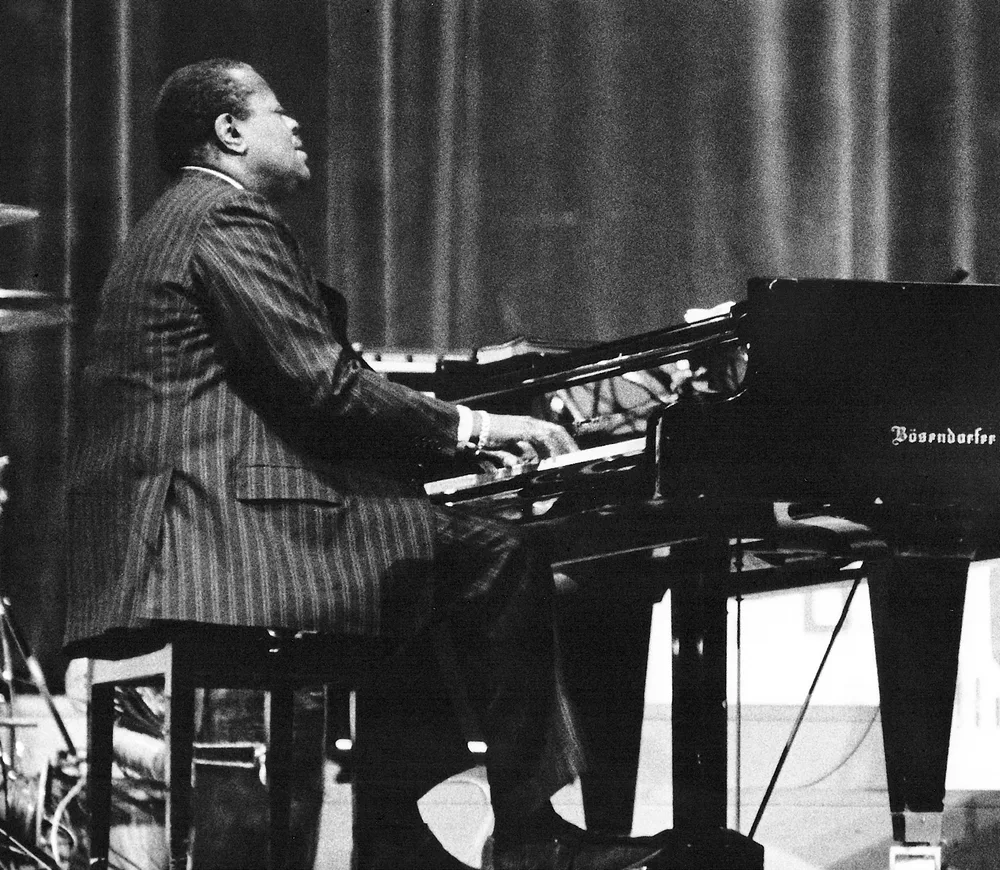
Oscar Peterson performing at the piano, Munich, 1977 CC BY-SA 3.0 (dual-licensed with GFDL 1.2+) — Wikimedia Commons — https://commons.wikimedia.org/wiki/File:Oscar_Peterson_1.JPG (photograph by Hans Bernhard / "Schnobby," own work, 1977; file size 2.65 MB, well under the 19.9 MB cap)

Oscar Emmanuel Peterson was born August 15, 1925, in the Little Burgundy neighborhood of Montreal, the son of West Indian immigrants: his mother Kathleen worked as a domestic, his father Daniel as a Canadian Pacific Railway porter who had taught himself organ, trumpet, and piano and became his first music teacher. Peterson began on trumpet and piano at five, but a bout of tuberculosis at seven sidelined his lungs and pushed him toward the keyboard exclusively. His sister Daisy gave him a classical grounding, and from age nine or so he studied with the Hungarian-born pianist Paul de Marky, himself a pupil of a Liszt student, drilling scales and études for hours a day. Hearing a recording of Art Tatum as a boy left a permanent mark; Peterson later said Tatum "scared me to death" and that he "was never cocky again." He dropped out of Montreal High School to work steadily, played in the Johnny Holmes Orchestra as a teenager, won a CBC national music competition in 1940 at fourteen, and built a local reputation on Montreal radio broadcasts through the mid-1940s.
Norman Granz heard one of those broadcasts by chance and brought Peterson to New York in 1949 for an unbilled, unrehearsed guest spot at a Jazz at the Philharmonic concert in Carnegie Hall; the ovation was immediate, and Granz became his manager and producer for most of the rest of his career. Peterson began working as a duo with bassist Ray Brown around 1950, then built a full trio around 1952 with Brown and a rotating guitar chair: Irving Ashby, then Barney Kessel, then, from 1953, Herb Ellis, whom Peterson later called the "most stimulating" of his early partners. That working trio was on tour in Japan in the fall of 1953 as part of a Jazz at the Philharmonic package when Peterson heard a young Tokyo pianist named Toshiko Akiyoshi and told Granz to record her; Granz did, cutting Toshiko's Piano (1954, Norgran) in Tokyo with Peterson's own touring rhythm section, Ray Brown on bass, Herb Ellis on guitar, and J.C. Heard on drums, behind her. It became her debut LP and the specific break that led to her scholarship at Berklee two years later; her career from that point on is covered in full in her JazzProfiles.com profile. Ellis left the trio in 1958 after On the Town with the Oscar Peterson Trio, recorded live at Toronto's Town Tavern; rather than replace him, Peterson brought in drummer Ed Thigpen, reasoning that no other guitarist could match what Ellis had done.
The Brown/Thigpen trio became Peterson's most heavily recorded unit. For Verve he cut an extended run of "Songbook" albums between 1959 and 1961 devoted to Duke Ellington, Cole Porter, George Gershwin, and other American songwriters (the Ellington volume, recorded in Chicago in the summer of 1959, is representative), alongside Very Tall (1961/62) with vibraphonist Milt Jackson and the trio's signature album Night Train (1963), which included Peterson's own "Hymn to Freedom," later adopted as an anthem during the civil rights era. In the early 1960s Peterson also co-founded and headed the Advanced School of Contemporary Music in Toronto with Brown and Thigpen, a short-lived jazz-education venture that closed after about five years for lack of funding. He composed Canadiana Suite, an eight-part tribute to the country he crossed repeatedly by rail, recorded September 9, 1964, and released the following year on Limelight; We Get Requests, cut at RCA's New York studios between October 19 and November 20, 1964, closed out a fourteen-year run with Verve. Brown and Thigpen both left in 1965, replaced by bassist Sam Jones and drummer Louis Hayes (later Bobby Durham).
Through the late 1960s and into the 1970s Peterson recorded extensively for the German MPS label at producer Hans Georg Brunner-Schwer's private studio in Villingen, releasing his first unaccompanied solo album, My Favorite Instrument (1968); Motions and Emotions (1969), an orchestral date with Claus Ogerman arrangements that took in Beatles material; and Tristeza on Piano (1970); much of this run was later compiled as the Exclusively for My Friends series. When Granz founded Pablo Records in 1973, Peterson followed him and rebuilt a piano-guitar-bass trio in the 1950s mold, this time with guitarist Joe Pass and bassist Niels-Henning Ørsted Pedersen; The Trio, recorded live at Chicago's London House in May 1973, won a Grammy for Best Jazz Performance by a Group. British drummer Martin Drew joined in 1974 to make it a working quartet that toured for years. The Pablo period was extraordinarily prolific: duo and small-group dates with Dizzy Gillespie (1974), Joe Pass (a duo Porgy and Bess, 1976), Count Basie ("Satch" and "Josh", recorded December 1974, and a 1977 sequel), Ella Fitzgerald and Ray Brown (Ella and Oscar, recorded May 1975), and live recordings from Montreux and elsewhere including Digital at Montreux (recorded July 1979) and Nigerian Marketplace (1981).
Peterson's honors accumulated steadily across these decades: DownBeat named him its readers'-poll pianist of the year for thirteen consecutive years beginning in 1950, and Canada made him an Officer of the Order of Canada in 1972 and a Companion in 1984. He continued performing and recording through the 1980s despite worsening arthritis and weight gain that limited his mobility, and chaired York University's jazz program in the early 1990s. A stroke in 1993 weakened his left side and kept him off the bandstand for two years; Prime Minister Jean Chrétien offered him the post of Lieutenant-Governor of Ontario, which Peterson declined because of his health. He returned to performing and recording for Telarc from the mid-1990s on, playing a style now led almost entirely by his right hand; friend and Ontario premier Bob Rae remarked that "a one-handed Oscar was better than just about anyone with two hands." Later albums included A Summer Night in Munich (1998) and Trail of Dreams: A Canadian Suite (1999-2000, with Michel Legrand), and he received a Grammy Lifetime Achievement Award in 1997. Peterson passed away of kidney failure at his home in Mississauga, Ontario, on December 23, 2007, at eighty-two.
Peterson's playing fused a classical virtuoso's technique, drilled into him as a boy by Paul de Marky, with a jazz vocabulary built on Art Tatum's example and, by his own account, on Teddy Wilson, Nat King Cole, and James P. Johnson before him. The result was a famously torrential, harmonically dense style, capable of stride-derived left-hand work, blues-drenched swing, and long, cascading right-hand runs, all delivered with a technical command that few pianists in jazz history have matched; Duke Ellington called him the "Maharaja of the keyboard," and guitarist Joe Pass said only Tatum and Peterson had achieved "total mastery" of their instrument. Some critics found the sheer density of notes a liability, arguing his playing could crowd out space and understatement in a way more minimalist pianists avoided; even admirers singled out his more restrained work, particularly as an accompanist behind singers like Ella Fitzgerald, as some of his most effective playing. His working format, a piano trio built around a guitarist rather than a horn, echoed Nat King Cole's earlier trio and, in its 1970s Joe Pass/Niels-Henning Ørsted Pedersen incarnation, became one of the most celebrated small groups in mainstream jazz. He was also a serious composer, most visibly on Canadiana Suite and the civil-rights-era standard "Hymn to Freedom."
- Oscar Peterson Plays the Duke Ellington Song Book (rec. 1959, rel. 1960, Verve) - Trio with Ray Brown and Ed Thigpen; representative of the extended Verve "Songbook" series devoted to major American composers. Spotify - Plays the Duke Ellington Song Book
- Night Train (1963, Verve) - The Brown/Thigpen trio's best-known album, built from blues and standards and including Peterson's own "Hymn to Freedom." Spotify - Night Train Listen
- Canadiana Suite (rec. 1964, rel. 1965, Limelight) - An eight-movement suite of Peterson's own compositions inspired by cross-Canada train travel, his most ambitious work as a composer. Spotify - Canadiana Suite Listen
- We Get Requests (rec. 1964, rel. 1965, Verve) - A popular-standards trio date that closed out Peterson's fourteen-year run on Verve. Spotify - We Get Requests Listen
- My Favorite Instrument (1968, MPS) - Peterson's first unaccompanied solo piano album, recorded at Hans Georg Brunner-Schwer's studio in Villingen, West Germany. Spotify - My Favorite Instrument Listen
- The Trio (rec. 1973, rel. 1974, Pablo) - Live at Chicago's London House with Joe Pass and Niels-Henning Ørsted Pedersen; won the Grammy for Best Jazz Performance by a Group. Spotify - The Trio Listen
- Ella and Oscar (rec. 1975, rel. 1976, Pablo) - Duo and trio sides backing Ella Fitzgerald, with Ray Brown joining on the second half of the album.
Oscar Peterson: Discography
Identity confirmed via the live Discogs API — artist ID 254394 ("Oscar Peterson," realname Oscar Emmanuel Peterson, born/died dates matching). Discogs credits Peterson on 3,440 releases — an extraordinarily prolific catalog built over nearly six decades, swelled further by heavy reissue and compilation activity across Verve, MPS, Pablo, and Telarc. Per this sweep's standing rule for hugely prolific artists, no attempt is made at exhaustive coverage. The table below curates 27 of his most significant, acclaimed, and historically important leader/co-leader albums across the Verve, MPS, Pablo, and Telarc eras, plus a short sideman section addressing the one credit most relevant to this profile's own origin (his role in launching Toshiko Akiyoshi's recording career). It does not itemize his hundreds of additional Jazz at the Philharmonic tour recordings, Verve "Songbook" volumes beyond the one listed, or later Pablo/Telarc live dates.
As Leader / Co-Leader
| Album Title | Recording Date(s) | Release Date | Label | Catalog Number | Format(s) | Personnel | Role | Reissue History | Spotify | Buy | Notes |
|---|---|---|---|---|---|---|---|---|---|---|---|
| At the Stratford Shakespearean Festival | 1956 | 1957 | Verve Records | MGV-8024 | Vinyl, LP, Album, Mono | Oscar Peterson (piano), Ray Brown (bass), Herb Ellis (guitar) | Leader (The Oscar Peterson Trio) | None found | Not confirmed on Spotify | — | Live trio recording from the Stratford Festival, Ontario |
| Oscar Peterson Plays the Duke Ellington Song Book | Recorded July 14 - August 9, 1959, Universal Recording Corp., Chicago | 1960 | Verve Records | Catalog number varies by pressing; not fully confirmed | Vinyl, LP, Album, Mono | Oscar Peterson (piano), Ray Brown (bass), Ed Thigpen (drums) | Leader | Reissued on CD; part of the wider Verve "Songbook" series which also includes Cole Porter and George Gershwin volumes | Spotify - Plays the Duke Ellington Song Book | — | Discogs master shows 1959; Wikipedia gives a February 1960 release, both noted |
| The Oscar Peterson Trio at the Concertgebouw | Recorded live 1957/1958, Concertgebouw, Amsterdam | 1959 | Verve Records (Clef series) | MG V-8268 | Vinyl, LP, Album, Mono | Oscar Peterson (piano), Ray Brown (bass), Herb Ellis (guitar) | Leader | None found | Not confirmed on Spotify | — | European live document of the original guitar-trio lineup |
| Very Tall | Recorded November 1961, New York | 1962 | Verve Records | V-8429 | Vinyl, LP, Album | Oscar Peterson (piano), Milt Jackson (vibraphone), Ray Brown (bass), Ed Thigpen (drums) | Co-leader (with Milt Jackson) | Reissued 1999 by Telarc as The Very Tall Band (a separate, later reunion recording, not a reissue of this album) | Not confirmed on Spotify | — | |
| Night Train | Recorded 1962 | 1963 | Verve Records | V/V6-8538 | Vinyl, LP, Album | Oscar Peterson (piano), Ray Brown (bass), Ed Thigpen (drums) | Leader (The Oscar Peterson Trio) | Reissued/expanded on CD | Spotify - Night Train | — | Includes Peterson's own composition "Hymn to Freedom," later adopted as a civil-rights-era anthem |
| Canadiana Suite | Recorded September 9, 1964 | 1965 | Limelight | LM 82010 | Vinyl, LP, Album, Stereo | Oscar Peterson (piano), Ray Brown (bass), Ed Thigpen (drums) | Leader | Reissued on CD | Spotify - Canadiana Suite | — | Eight original Peterson compositions inspired by cross-Canada rail travel |
| We Get Requests | Recorded October 19 - November 20, 1964, RCA Studios, New York | 1965 | Verve Records | V6-8606 | Vinyl, LP, Album, Stereo | Oscar Peterson (piano), Ray Brown (bass), Ed Thigpen (drums) | Leader | Reissued on CD | Spotify - We Get Requests | — | Closed out Peterson's fourteen-year run on Verve |
| My Favorite Instrument | Recorded April 1968, Hans Georg Brunner-Schwer's private studio, Villingen, West Germany | 1968 | MPS Records | MPS 15181 ST | Vinyl, LP, Album | Oscar Peterson (piano, solo) | Leader | Later compiled into the Exclusively for My Friends series | Spotify - My Favorite Instrument | — | Peterson's first unaccompanied solo piano album |
| Motions and Emotions | Recorded 1969, A&R Studios, New York / MPS-Studio, Villingen | 1970 | MPS Records | MPS 15251 ST | Vinyl, LP, Album | Oscar Peterson (piano) with orchestra arranged and conducted by Claus Ogerman | Leader | Reissued on CD as part of Three Originals (with Hello Herbie and Tristeza on Piano), 1993 | Not confirmed on Spotify | — | Orchestral date including arrangements of Beatles material |
| Tristeza on Piano | Recorded 1970, MPS-Studio, Villingen | 1970 | MPS Records | MPS 15275 ST | Vinyl, LP, Album | Oscar Peterson Trio (personnel not fully confirmed in Discogs data) | Leader | Reissued on CD as part of Three Originals, 1993 | Not confirmed on Spotify | — | |
| Exclusively for My Friends | Sessions 1963-1968, MPS-Studio, Villingen | 1972 (compiled box set) | MPS Records / BASF | Catalog number varies by pressing and volume; not fully confirmed | Vinyl, LP box set | Oscar Peterson (piano), Ray Brown or Sam Jones (bass), Ed Thigpen or Louis Hayes (drums), varying by session | Leader | Later reissued in various single-volume configurations | Not confirmed on Spotify | — | Compilation series drawn from multiple MPS sessions across the 1960s, not a single recording date |
| The History of an Artist | Recorded 1972 | 1974 | Pablo Records | 2625 702 | Vinyl, 2xLP, Album | Oscar Peterson (piano), Niels-Henning Ørsted Pedersen (bass), and others | Leader | None found | Not confirmed on Spotify | — | Peterson's first release on Granz's newly founded Pablo label |
| The Trio | Recorded live May 16-19, 1973, London House, Chicago | 1974 | Pablo Records | 2310 701 | Vinyl, LP, Album | Oscar Peterson (piano), Joe Pass (guitar), Niels-Henning Ørsted Pedersen (bass) | Leader | Reissued on CD | Spotify - The Trio | — | Won the Grammy Award for Best Jazz Performance by a Group |
| Oscar Peterson & Dizzy Gillespie | Recorded 1974 | 1975 | Pablo Records | 2310-740 | Vinyl, LP, Album | Oscar Peterson (piano), Dizzy Gillespie (trumpet), and rhythm section | Co-leader (with Dizzy Gillespie) | None found | Not confirmed on Spotify | — | |
| "Satch" and "Josh" | Recorded December 2, 1974, Los Angeles | 1975 | Pablo Records | 2310-722 | Vinyl, LP, Album, Stereo | Oscar Peterson and Count Basie (piano), Freddie Green (guitar), Ray Brown (bass), Louie Bellson (drums) | Co-leader (with Count Basie) | Followed by a 1978 sequel, "Satch" and "Josh"...Again, recorded September 22, 1977 | Not confirmed on Spotify | — | A twin-piano date; Basie also plays organ on some tracks |
| Ella and Oscar | Recorded May 19, 1975, Cherokee Studios, Los Angeles | 1976 | Pablo Records | 2310-759 | Vinyl, LP, Album | Ella Fitzgerald (vocals), Oscar Peterson (piano); Ray Brown (bass) added for the second half of the album | Co-leader (Ella Fitzgerald and Oscar Peterson) | Reissued on CD | Not confirmed on Spotify | — | |
| Porgy and Bess | Recorded 1976 | 1976 | Pablo Records | 2310-779 | Vinyl, LP, Album | Oscar Peterson (piano), Joe Pass (guitar) | Co-leader (duo, with Joe Pass) | None found | Not confirmed on Spotify | — | Duo reading of the Gershwin score |
| The Giants | Recorded 1977 | 1977 | Pablo Records | 2310-796 | Vinyl, LP, Album | Oscar Peterson (piano), Joe Pass (guitar), Milt Jackson (vibraphone), Ray Brown (bass) | Co-leader | None found | Not confirmed on Spotify | — | |
| The London Concert | Recorded live 1978, Royal Festival Hall, London | 1979 | Pablo Live | 2620-111 | Vinyl, 2xLP, Album | Oscar Peterson (piano), John Heard (bass), Louis Bellson (drums) | Leader | None found | Not confirmed on Spotify | — | |
| Digital at Montreux | Recorded July 16, 1979, Mountain Studios, Montreux | 1980 | Pablo Live | D2308224 | Vinyl, LP, Album | Oscar Peterson (piano), Niels-Henning Ørsted Pedersen (bass), and drums (not fully confirmed in Discogs data) | Leader | None found | Spotify - Digital at Montreux | — | One of the first commercial jazz albums recorded fully digitally |
| Nigerian Marketplace | Recorded live 1981, Montreux Jazz Festival | 1982 | Pablo Live | D2308231 | Vinyl, LP, Album | The Oscar Peterson Trio | Leader | None found | Not confirmed on Spotify | — | |
| Freedom Song: The Oscar Peterson Big 4 in Japan '82 | Recorded live 1982, Japan | 1983 | Pablo Records / Pablo Live | 2640-101 | Vinyl, LP, Album | The Oscar Peterson Big 4 | Leader | None found | Not confirmed on Spotify | — | |
| If You Could See Me Now | Recorded 1983 | 1986 | Pablo Records | 2310-918 | Vinyl, LP, Album | The Oscar Peterson Four | Leader | None found | Not confirmed on Spotify | — | |
| Saturday Night at the Blue Note | Recorded live 1990, the Blue Note, New York | 1991 | Telarc | CD-83306 | CD, Album | Oscar Peterson (piano), and trio (personnel not fully confirmed in Discogs data) | Leader | None found | Not confirmed on Spotify | — | Recorded before Peterson's 1993 stroke; won the 1991 Grammy for Best Jazz Instrumental Performance, Group |
| A Summer Night in Munich | Recorded 1998, Philharmonie im Gasteig, Munich | 1999 | Telarc | CD-83450 | CD, Album | The Oscar Peterson Quartet | Leader | None found | Not confirmed on Spotify | — | Post-stroke recording |
| Trail of Dreams: A Canadian Suite | Recorded 1999-2000 | 2000 | Telarc | CD-83500 | CD, Album | Oscar Peterson (piano), Michel Legrand, and orchestra | Co-leader (with Michel Legrand) | None found | Not confirmed on Spotify | — | Companion piece to the 1964 Canadiana Suite |
| A Night in Vienna | Recorded 2002 | 2004 | Verve Records | B0003003-09 | DVD/CD | Oscar Peterson (piano), Niels-Henning Ørsted Pedersen (bass), Ulf Wakenius (guitar), Martin Drew (drums) | Leader | None found | Not confirmed on Spotify | — |
As Sideman
Peterson himself is not a credited performer on any release in this catalog in a conventional "sideman" sense; virtually everything he recorded from the early 1950s on was billed to him as leader or co-leader. The one recording most relevant to this profile's own origin, Toshiko Akiyoshi's debut LP Toshiko's Piano (1954, Norgran, catalog MGN-22), does NOT actually credit Peterson: per the Discogs release data, the credited performers are Toshiko Akiyoshi (piano), Ray Brown (bass), Herb Ellis (guitar), and J.C. Heard (drums), with Norman Granz as supervisor. Peterson's real role there was as catalyst rather than performer: he heard Akiyoshi play during a 1953 Jazz at the Philharmonic tour stop in Japan and told Granz to record her, and the session was cut with his own touring rhythm section (Brown, Ellis, Heard) rather than with Peterson at the piano. Her full career is covered in her own JazzProfiles.com profile.
Peterson's Discogs credits also include hundreds of Jazz at the Philharmonic tour recordings and small-group Verve sessions from the 1950s backing artists including Ella Fitzgerald, Roy Eldridge, Coleman Hawkins, Lester Young, Charlie Parker, Ben Webster, and Stan Getz, among others — not itemized individually here.
- Ray Brown - bassist and closest long-term musical partner, from their 1950 duo through the trio's entire 1952-1965 run and on into the 1970s-80s Pablo reunions (Ella and Oscar, Satch and Josh, The Giants); also on the 1954 Tokyo session behind Toshiko Akiyoshi.
- Herb Ellis - guitarist in Peterson's trio 1953-1958, a configuration Peterson called his "most stimulating"; also the guitarist on Toshiko Akiyoshi's 1954 Toshiko's Piano.
- J.C. Heard - drummer on the same 1954 Tokyo session backing Toshiko Akiyoshi.
- Ed Thigpen - drummer 1958-1965, brought in after Ellis's departure rather than replacing him with another guitarist; on Night Train, the Songbook series, and Canadiana Suite.
- Louis Hayes and Sam Jones - drummer and bassist who replaced Brown and Thigpen in 1965; Hayes was later succeeded by Bobby Durham.
- Joe Pass and Niels-Henning Ørsted Pedersen - guitarist and bassist of Peterson's 1970s-80s Pablo-era trio, joined from 1974 by drummer Martin Drew; recorded The Trio (1973/74) and toured for years.
- Milt Jackson - vibraphonist, co-star of Very Tall (1961/62) and The Giants (1977).
- Dizzy Gillespie - trumpeter, co-led a 1974 Pablo duo/quartet date.
- Count Basie - pianist and bandleader; the two recorded the piano-duo albums "Satch" and "Josh" (1974) and "Satch" and "Josh"...Again (1977) for Pablo, with Ray Brown and Louie Bellson completing the rhythm section on the first date. Basie's own career is covered in the Count Basie Orchestra's JazzProfiles.com profile.
- Ella Fitzgerald - vocalist; countless Jazz at the Philharmonic tour dates plus the 1975 duo/trio album Ella and Oscar.
- Norman Granz - producer and manager for virtually all of Peterson's career, from his 1949 Carnegie Hall discovery through Verve, MPS-era encouragement, and the 1973 founding of Pablo Records built partly around Peterson's own trio.
More Bebop Artists
See all 166 Bebop artists →More Canadian Jazz Artists
See all 19 Canadian artists →- Wikipedia: Oscar Peterson
- Wikipedia: Oscar Peterson discography
- Wikipedia: Night Train (Oscar Peterson album)
- Wikipedia: Canadiana Suite
- Wikipedia: We Get Requests
- Wikipedia: The Trio (1973 album)
- Wikipedia: Digital at Montreux
- Wikipedia: Ella and Oscar
- Wikipedia: Satch and Josh
- Wikipedia: Oscar Peterson Plays the Duke Ellington Song Book
- Discogs: Oscar Peterson (artist 254394)
07-toshiko-akiyoshi-spotlight/final-profile.md, JapaneseJazz vault (source for the 1953 discovery / 1954 Toshiko's Piano connection)