 JAZZPROFILES lives in the music 2,059 Jazz Artists fully Profiled!
Ethel Waters
Last updated October 29, 2026
Listen on Spotify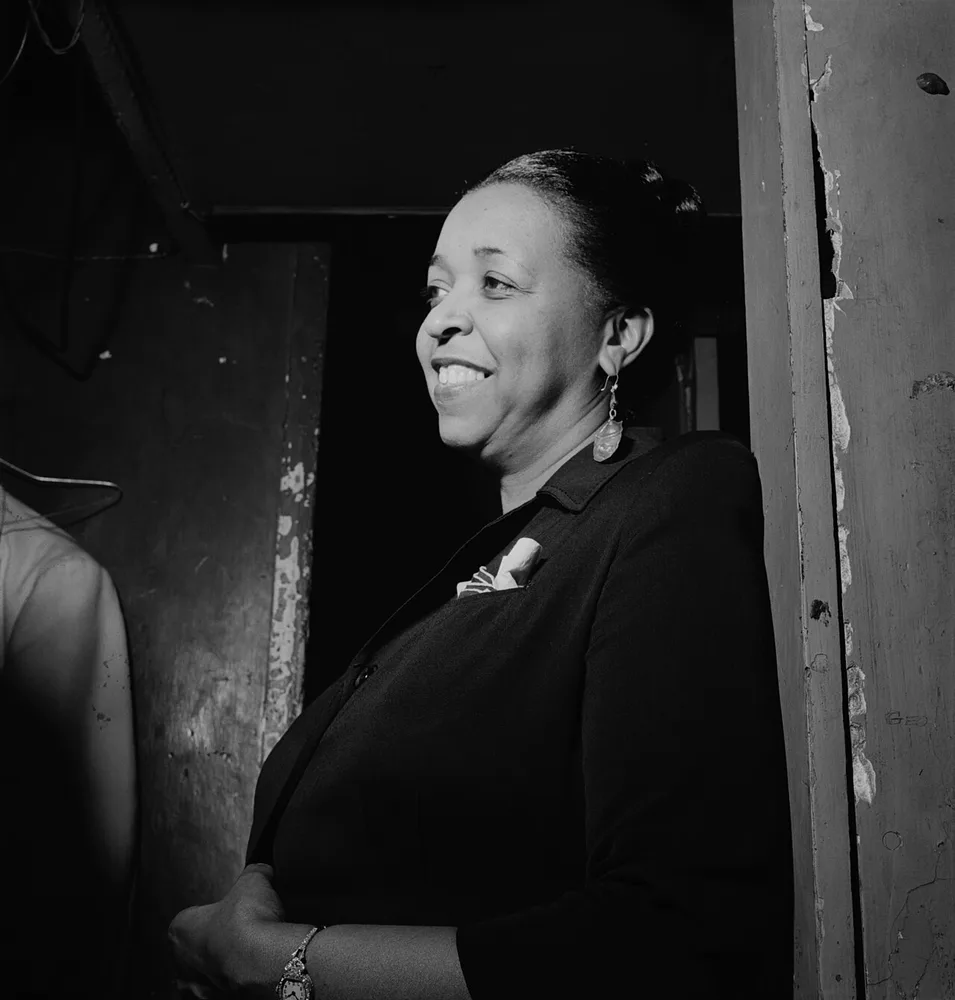
Ethel Waters, New York, between 1938 and 1948, photographed by William P. Gottlieb Public domain. The Gottlieb collection at the Library of Congress carries no known copyright restrictions; in accordance with the photographer's wishes the photographs entered the public domain on February 16, 2010. — Wikimedia Commons: https://commons.wikimedia.org/wiki/File:Ethel_Waters_-_William_P._Gottlieb.jpg (restored scan of Library of Congress Music Division item gottlieb.08911, https://hdl.loc.gov/loc.music/gottlieb.08911), William P. Gottlieb

Ethel Waters was born in Chester, Pennsylvania, on October 31, 1896, and grew up poor in and around Philadelphia in the care of her grandmother, a housemaid, moving so often that she rarely stayed in one home for more than a year. She married at thirteen, left the marriage soon after, and worked as a hotel maid in Philadelphia for $4.75 a week. On her seventeenth birthday she was talked into singing two songs at a costume party in a Juniper Street nightclub, and the reaction produced an offer to sing and dance at the Lincoln Theatre in Baltimore. From there she worked the Black vaudeville circuit, then a carnival headed for Chicago, then Atlanta, where she shared a club with Bessie Smith. Smith objected to competing with her on the blues, so Waters stuck to ballads and popular songs. Around 1919 she moved to Harlem, took a job at Edmond's Cellar, and became part of the Harlem Renaissance scene.
Her recording career began in 1921, when she became the fifth Black woman to make a record, for the small Cardinal label. She soon moved to Black Swan, the Black-owned label run by Harry Pace, where Fletcher Henderson was her accompanist and the company's musical director. "Down Home Blues" and "Oh, Daddy" became Black Swan's first real hit, and her contract made her the highest-paid Black recording artist of the day. From October 1921 to July 1922 she toured with Henderson and the Black Swan Troubadours. Paramount bought Black Swan in early 1924 and she stayed with the label through that year. She was playing the Plantation Club on Broadway in 1924 when she introduced "Dinah," and the Columbia record she made of it in 1925, credited to Ethel Waters and Her Plantation Orchestra, became the first of the hits that carried her through the decade.
The Columbia sessions of 1925 to 1931 put her in front of a changing set of jazz players. Discographers credit Coleman Hawkins on bass saxophone, cornetist Joe Smith and pianist Pearl Wright on "No Man's Mamma," recorded October 28, 1925, and Henderson on piano with Smith in January 1926 for "I've Found a New Baby." James P. Johnson played piano on "Guess Who's in Town" and "My Handy Man" in August 1928, and Clarence Williams played on her "West End Blues," the first of several 1928 recordings of that song. The sides of 1929 to 1934 credit Jimmy and Tommy Dorsey, Benny Goodman, Manny Klein and Joe Venuti among the studio players. Meanwhile she was a headliner. She toured the white Keith vaudeville circuit with Earl Dancer, appeared in the Broadway revues Africana (1927), The Ethel Waters Broadway Revue (1928), Lew Leslie's Blackbirds (1930) and Rhapsody in Black (1931), and in 1929 sang "Am I Blue?" in the Warner Brothers film On with the Show!, a song she and Wright had arranged themselves. It became her signature number.
On December 22, 1932, she recorded "I Can't Give You Anything but Love" and "Porgy" for Brunswick with Duke Ellington and his orchestra. In spring 1933 she was a headliner at the Cotton Club in Harlem, where she introduced "Stormy Weather" by Harold Arlen and Ted Koehler; she recorded it for Brunswick in New York on May 3, 1933, with a studio band that discographers link to the Dorsey brothers. Irving Berlin heard her at the club and wrote for her in his revue As Thousands Cheer, which opened that year. It was the first Broadway show to give a Black star billing equal to its white stars, and she sang "Heat Wave," "Harlem on My Mind" and "Supper Time," Berlin's quiet lament of a woman whose husband has been lynched. Late in 1933 she cut "A Hundred Years from Today" and "I Just Couldn't Take It, Baby" for Columbia with Benny Goodman's orchestra. She was in the revue At Home Abroad in 1935 and 1936, and her Bluebird sides of 1938 to 1941 were made with a band led by the trumpeter Eddie Mallory, her husband from 1938 to 1945; the August 15, 1939 session credits Danny Barker on guitar, Milt Hinton on bass and Tyree Glenn on trombone.
The stage and screen work then moved to the center. She starred in Mamba's Daughters on Broadway in January 1939, and on June 14 of that year NBC broadcast The Ethel Waters Show, a variety special that made her the first African American to star in her own television program. Cabin in the Sky opened at the Martin Beck Theatre on October 25, 1940, with her as Petunia; "Taking a Chance on Love" went into the score three days before opening after she objected to another song. In the 1943 film version, directed by Vincente Minnelli, she shared the screen with Lena Horne and Louis Armstrong and sang "Happiness Is Just a Thing Called Joe." On April 16, 1946, she recorded for Continental with a combo led by drummer J.C. Heard, remaking "Taking a Chance on Love," "Cabin in the Sky," "Dinah" and "Am I Blue," and in 1948 and 1949 she toured again with Henderson.
Dramatic roles brought her the widest acclaim. She received an Academy Award nomination for Best Supporting Actress for Pinky (1949), directed by Elia Kazan, which made her the second African American performer nominated for an Academy Award. She won the New York Drama Critics Circle Award in 1950 for The Member of the Wedding on Broadway and repeated the role of Berenice Sadie Brown with Julie Harris in the 1952 film. She starred in the ABC television series Beulah from 1950, left in 1951 because she felt the portrayal of Black people was degrading, and published her autobiography His Eye Is on the Sparrow in 1951, written with Charles Samuels. Her last film role was Dilsey in The Sound and the Fury (1959), and she received an Emmy nomination in 1962 for an episode of Route 66.
The last chapter was gospel. In 1957 she attended Billy Graham's crusade at Madison Square Garden, rededicated her life, and in later years often toured with Graham. She sang "His Eye Is on the Sparrow," the hymn that gave her autobiography its title, as a soloist with the crusade's New York choir on record, and made a gospel LP of the same name for Word in 1960. She passed away on September 1, 1977, at age 80, in Chatsworth, California, and is buried at Forest Lawn Memorial Park in Glendale. Her 1933 recording of "Stormy Weather" is in the Library of Congress National Recording Registry, three of her recordings ("Dinah," "Stormy Weather" and "Am I Blue?") are in the Grammy Hall of Fame, and she was inducted into the Gospel Music Hall of Fame in 1983 and the Christian Music Hall of Fame in 2007. Her papers are held at the Harry Ransom Center in Texas.
Waters was a singing actress first and a jazz singer by association, and her career ran on four tracks: Black vaudeville and the classic blues of the 1920s, Broadway and Harlem nightclub revues, film and television, and, in her last decades, gospel. Her jazz credentials come from the musicians behind her: Fletcher Henderson, Coleman Hawkins, James P. Johnson, Duke Ellington, the Dorseys, Benny Goodman and, in 1946, a combo led by J.C. Heard. She said later that Henderson's piano leaned classical and left her wanting more bass underneath. Gary Giddins and others have noted that she scatted on record in the 1920s, ahead of Louis Armstrong. Histories of classic blues single her out as one of the singers who adapted to the swing era while many of her peers faded, and after her early run of blues and novelty songs she moved to ballads and show songs, the material that suited the theaters, nightclubs and film studios that hired her. In her later life she praised Mel Tormé as the one white singer who sang with the soul of a Black man. Most of her public fame came from the stage, the screen and gospel, and the Subgenres tags above describe only the jazz and blues side of the work.
- "Oh Daddy" / "Down Home Blues" (1921, Black Swan 2010) - Her first hit and the first big seller for Black Swan, with Cordy Williams' Jazz Masters and Fletcher Henderson as house pianist and musical director. Apple Music - Oh Daddy
- "Dinah" (1925, Columbia 487-D) - The song she introduced at the Plantation Club on Broadway, recorded with her Plantation Orchestra; Grammy Hall of Fame, 1998. Apple Music - Dinah Listen
- "No Man's Mamma" (1925, Columbia 14116-D) - A blues date with Coleman Hawkins on bass saxophone, Joe Smith on cornet and Pearl Wright on piano. Apple Music - No Man's Mama
- "Guess Who's in Town" / "My Handy Man" (1928, Columbia 14353-D) - Recorded with James P. Johnson, the Harlem stride pianist. Apple Music - My Handy Man
- "Am I Blue?" (1929, Columbia 1837-D) - Her signature song, introduced in the film On with the Show!; Grammy Hall of Fame, 2007. Apple Music - Am I Blue Listen
- "I Can't Give You Anything but Love" and "Porgy" (1932, Brunswick 6517 and 6521) - Recorded December 22, 1932 with Duke Ellington and his orchestra. Apple Music - I Can't Give You Anything But Love
- "Stormy Weather" (1933, Brunswick 6564) - Introduced at the Cotton Club and recorded May 3, 1933; Grammy Hall of Fame, 2003, and the National Recording Registry. Apple Music - Stormy Weather Listen
- Continental sides with J.C. Heard (1946, Continental C-10006 to C-10009) - "Taking a Chance on Love," "Cabin in the Sky," "Dinah," "Am I Blue" and four more, recorded April 16, 1946 with a jazz combo.
Ethel Waters: Full Discography
Discogs artist: Ethel Waters (307217) · Born October 31, 1896, Chester, Pennsylvania
Waters recorded in the 78 rpm era, so her catalogue is a long run of singles with a handful of period albums and many later compilations. Discogs lists well over a hundred releases under her name as main artist, and this is a selection of the most important, grouped by kind. Accompanist details come from Discogs release notes and credits and, where noted, from the Chronological Classics reissue booklets; where a credit is marked probable or unverified, it is given that way here.
Selected singles, 1921 to 1946
| Year | Sides | Label (catalog) | Accompaniment & Notes | Listen | Buy |
|---|---|---|---|---|---|
| 1921 | "At the New Jump Steady Ball" / "The New York Glide" | Cardinal 2036 | Her first records, with Albury's Blue and Jazz Seven. She was the fifth Black woman to record. | Apple Music | — |
| 1921 | "Oh Daddy" / "Down Home Blues" | Black Swan 2010 | Recorded May 1921 with Cordy Williams' Jazz Masters, with Fletcher Henderson on piano per the Classics credits. The label's first big hit. | Apple Music | — |
| 1922 | "Jazzin' Babies Blues" / "Kind Lovin' Blues" | Black Swan 14117 | Billed with Joe Smith's Jazz Band. | — | — |
| 1923 | "Brown Baby" / "Ain't Goin' Marry" | Black Swan 14145 | Recorded about late March 1923. Side A with the Jazz Masters; Henderson on piano is listed as probable. | — | — |
| 1925 | "Sweet Man" / "Dinah" | Columbia 487-D | Billed as Ethel Waters and Her Plantation Orchestra. "Dinah" comes from the Plantation Revue. | Apple Music | — |
| 1925 | "Loud Speakin' Papa" / "Pickininny Blues" | Columbia 472-D | Ethel Waters and Her Ebony Four; recorded August 25 and September 12, 1925. | — | — |
| 1926 | "No Man's Mamma" / "Shake That Thing" | Columbia 14116-D | Side A recorded October 28, 1925 with Coleman Hawkins (bass saxophone), Joe Smith (cornet) and Pearl Wright (piano); side B December 23, 1925. | Apple Music | — |
| 1926 | "I've Found a New Baby" / "Tell 'Em About Me" | Columbia 561-D | Piano and cornet accompaniment; the Chronological Classics credits list Henderson on piano and Joe Smith on cornet for "I've Found a New Baby," January 22, 1926. | Apple Music | — |
| 1926 | "Make Me a Pallet on the Floor" / "Bring Your Greenbacks" | Columbia 14125-D | Henderson on piano and Joe Smith on cornet per the Classics credits for the January 22, 1926 date. | Apple Music | — |
| 1926 | "Sugar" / "You'll Want Me Back" | Columbia 14146-D | Recorded February 20, 1926; Maceo Pinkard (A) and Nathaniel Reed (B), uncredited, on piano. | — | — |
| 1926 | "Take What You Want" / "We Don't Need Each Other Anymore" | Columbia 14162-D | Recorded September 14 and 18, 1926. Written by J.C. Johnson. | — | — |
| 1927 | "Take Your Black Bottom Outside" / "Weary Feet" | Columbia 14214-D | Joe Smith (cornet) and Alex Jackson (alto saxophone) are credited on "Weary Feet" in the Classics listing. | — | — |
| 1928 | "Guess Who's in Town" / "My Handy Man" | Columbia 14353-D | Recorded August 21, 1928 with James P. Johnson at the piano. | Apple Music | — |
| 1928 | "West End Blues" / "Organ Grinder Blues" | Columbia 14365-D | Clarence Williams on piano in the Classics credits; the first of several 1928 recordings of "West End Blues" with Williams's lyrics. | Apple Music | — |
| 1928 | "Lonesome Swallow" / "My Baby Sure Knows How to Love" | Columbia 14411-D | Side A recorded August 21, 1928 and side B August 23, 1928. Discogs credits James P. Johnson on side A and Clarence Williams, uncredited, on side B. | — | — |
| 1929 | "Do What You Did Last Night" / "Get Up Off Your Knees" | Columbia 14380-D | The Classics credits list Johnson on "Do What You Did Last Night" and Clarence Williams on "Get Up Off Your Knees." | — | — |
| 1929 | "Birmingham Bertha" / "Am I Blue?" | Columbia 1837-D | Both from the Warner Brothers film On with the Show! "Am I Blue?" is her signature song (written by Harry Akst and Grant Clarke). | Apple Music | — |
| 1929 | "Second Handed Man" / "True Blue Lou" | Columbia 1871-D | Columbia studio orchestra. | Apple Music | — |
| 1929 | "Shoo Shoo Boogie Boo" / "Do I Know What I'm Doin'" | Columbia 1905-D | From the film Why Bring That Up? Recorded June 7, 1929 with Jimmy Dorsey (clarinet, alto saxophone), Tommy Dorsey (trombone), Bob Effros (trumpet), Frank Signorelli (piano), Tony Colucci (guitar), Joe Tarto (bass) and Stan King (drums); a violin credit for Ben Selvin is unverified. | Apple Music | — |
| 1930 | "Porgy" / "(What Did I Do to Be So) Black and Blue" | Columbia 2184-D | Recorded April 1, 1930. The Classics credits list Manny Klein (trumpet), Frank Signorelli (piano) and others. | Apple Music | — |
| 1930 | "My Kind of a Man" / "You Brought a New Kind of Love to Me" | Columbia 2222-D | Recorded June 3, 1930. Benny Goodman (clarinet), Tommy Dorsey (trombone), Manny Klein (trumpet) and Rube Bloom (piano) are credited in the Classics listing. | — | — |
| 1930 | "I Got Rhythm" / "Three Little Words" | Columbia 2346-D | Jimmy Dorsey (clarinet, alto saxophone), Tommy Dorsey (trombone), Manny Klein (trumpet), Ben Selvin (violin) per the Classics credits. | Apple Music | — |
| 1931 | "When Your Lover Has Gone" / "Please Don't Talk About Me When I'm Gone" | Columbia 2409-D | Recorded February 10, 1931. Benny Goodman, Tommy Dorsey, Manny Klein and Rube Bloom are credited in the Classics listing. | Apple Music | — |
| 1931 | "You Can't Stop Me from Lovin' You" / "Without That Gal" | Columbia 2481-D | Recorded June 16, 1931. | Apple Music | — |
| 1931 | "River, Stay 'Way from My Door" / "Shine On, Harvest Moon" | Columbia 2511-D | Studio orchestra. | Apple Music | — |
| 1932 | "I Can't Give You Anything but Love" | Brunswick 6517 | Recorded December 22, 1932 with Duke Ellington and his orchestra. Coupled on this release with "Doin' the New Lowdown" by the Mills Brothers with Cab Calloway. | Apple Music | — |
| 1932 | "Porgy" / "St. Louis Blues" | Brunswick 6521 | Recorded December 22, 1932 with Ellington and his orchestra; "St. Louis Blues" is credited to the Cecil Mack Choir with Waters. | — | — |
| 1933 | "Stormy Weather" / "Love Is the Thing" | Brunswick 6564 | Recorded in New York on May 3, 1933. The accompanists are not definitively identified; Wikipedia names the Dorsey Brothers' Orchestra, and Brian Rust's discography lists as probable Sterling Bose and Bunny Berigan (trumpets), Tommy Dorsey (trombone), Jimmy Dorsey and Larry Binyon (reeds), Joe Venuti and others (violins), Fulton McGrath (piano), Dick McDonough (guitar), Artie Bernstein (bass) and Stan King or Chauncey Morehouse (drums). Grammy Hall of Fame, 2003. | Apple Music | — |
| 1933 | "Heat Wave" / "Harlem on My Mind" | Columbia 2826-D | Both from Irving Berlin's revue As Thousands Cheer. Benny Goodman (clarinet) and Bunny Berigan (trumpet) are credited in the Classics listing. | Apple Music | — |
| 1933 | "I Just Couldn't Take It, Baby" / "A Hundred Years from Today" | Columbia 2853-D | Recorded November 27, 1933 with Benny Goodman's orchestra. | — | — |
| 1934 | "Come Up and See Me Sometime" / "You've Seen Harlem at Its Best" | Brunswick 6885 | Recorded March 16, 1934. The Classics credits list the same Dorsey-circle players as on "Stormy Weather," including Bunny Berigan, Sterling Bose, Joe Venuti and Dick McDonough. | — | — |
| 1934 | "Miss Otis Regrets (She's Unable to Lunch Today)" / "Moonglow" | Decca 140 | Recorded August 20, 1934, vocal with orchestra. | Apple Music | — |
| 1934 | "Dinah" / "You're Going to Leave the Old Home, Jim" | Decca 234 | "Dinah," August 20, 1934, with Victor Young and his orchestra (uncredited). The B side, September 5, 1934, credits Edgar Sampson (alto saxophone, violin), John Kirby (bass), John Trueheart (guitar) and Joe Steele (piano), uncredited. | — | — |
| 1934 | "Give Me a Heart to Sing To" / "I Ain't Gonna Sin No More" | Decca 141 | Recorded September 5, 1934, from the film Gift of Gab and the show Frankie and Johnnie. | — | — |
| 1935 | "Hottentot Potentate" / "Thief in the Night" | Liberty Music Shop L-188 | With Russell Wooding and his orchestra; recorded October 16, 1935. | Apple Music | — |
| 1938 | "They Say" / "Jeepers Creepers" | Bluebird B-10025 | With Ed Mallory and his orchestra; recorded November 9, 1938. | Apple Music | — |
| 1938 | "You're Mine" / "Frankie and Johnnie" | Bluebird B-10038 | With Ed Mallory and his orchestra; recorded November 9, 1938. | — | — |
| 1939 | "Lonesome Walls" / "If You Ever Change Your Mind" | Bluebird B-10222 | With Ed Mallory and his orchestra; recorded March 27, 1939. "Lonesome Walls" is from Mamba's Daughters. | — | — |
| 1939 | "Y' Had It Comin' to You" / "What Goes Up Must Come Down" | Bluebird B-10207 | With Ed Mallory and his orchestra; recorded March 27, 1939. | — | — |
| 1940 | "Taking a Chance on Love" / "Love Turned the Light Out" | Liberty Music Shop L-310 | With the Max Meth Orchestra, from Cabin in the Sky; recorded November 7, 1940. | — | — |
| 1941 | "Down in My Soul" / "Stop Myself from Worrying over You" | Bluebird B-11284 | Recorded August 15, 1939 and issued in 1941. Discogs lists Milt Hinton (bass), Danny Barker (guitar), Tyree Glenn (trombone), Castor McCord (clarinet), Reginald Beane (piano) and Eddie Mallory (trumpet), all uncredited on the label. | — | — |
| 1941 | "Georgia on My Mind" / "Old Man Harlem" | Bluebird B-11028 | With Ed Mallory and his orchestra; recorded August 15, 1939. | Apple Music | — |
| 1946 | "Taking a Chance on Love," "Cabin in the Sky," "Dinah," "Man Wanted," "Am I Blue," "You Took My Man," "Honey in a Hurry" and "I Shoulda Quit When I Was Ahead" | Continental C-10006 to C-10009 | Recorded in New York on April 16, 1946 with J.C. Heard and his orchestra, the combo from his Cafe Society Downtown period. Issued on 78 rpm discs and as an album set. | — | — |
Albums and compilations
| Album | Year | Label | Notes | Listen | Buy |
|---|---|---|---|---|---|
| The Music of Cabin in the Sky | 1940 | Liberty Music Shop | Three-disc 78 rpm set of songs from the Broadway musical, billed as featuring Waters, with the Max Meth Orchestra. | — | — |
| Ethel Waters | 1953 | Remington (RJ-504) | LP gathering her sides with J.C. Heard and his orchestra. | — | — |
| The Favorite Songs of Ethel Waters | 1954 | Mercury (MG 20051) | Mono LP. | — | — |
| His Eye Is on the Sparrow | 1960 | Word (W-3100-LP) | Gospel album; stereo edition WST-8044-LP. | — | — |
| Ethel Waters Reminisces | 1962 | Word (W 3173 LP) | The digital reissue lists Reginald Beane at the piano. | Apple Music (digital reissue) | — |
| On Stage and Screen 1925-1940 | 1968 | Columbia (CL 2792) | Compilation of 78 rpm sides originally issued by Columbia, Brunswick and Liberty Music Shop. | — | — |
| Ethel Waters' Greatest Years | 1972 | Columbia (KG 31571) | Two-LP compilation of recordings from 1925 through 1934. | — | — |
| The Incomparable Ethel Waters | 2003 | Columbia (CD) | Seventeen-track CD compilation of her best-known sides. | Apple Music | — |
The Classics label's Chronological Classics CDs reissue her recordings in date order and carry detailed personnel: 1921-1923 (Classics 796), 1923-1925 (Classics 775), 1925-1926 (Classics 672), 1926-1929 (Classics 688), 1929-1931 (Classics 721), 1931-1934 (Classics 735), 1935-1940 (Classics 755), 1946-1947 (Classics 1249).
Gospel singles
"His Eye Is on the Sparrow" / "Just a Closer Walk with Thee" (Chancel CR 2003) features Waters as soloist with the New York Crusade Choir, directed by Cliff Barrows, from a Billy Graham crusade. The album His Eye Is on the Sparrow (Word, 1960) is listed above.
Hit records
Peak chart positions from Joel Whitburn's Pop Memories 1890-1954, as tabulated on Wikipedia.
| Year | Single | Peak position |
|---|---|---|
| 1921 | "Down Home Blues" | 5 |
| 1921 | "There'll Be Some Changes Made" | 5 |
| 1922 | "Spread Yo' Stuff" | 7 |
| 1922 | "Tiger Rag" | 14 |
| 1923 | "Georgia Blues" | 10 |
| 1925 | "Sweet Georgia Brown" | 6 |
| 1926 | "Dinah" | 2 |
| 1926 | "I've Found a New Baby" | 11 |
| 1926 | "Sugar" | 9 |
| 1927 | "I'm Coming, Virginia" | 10 |
| 1929 | "Am I Blue?" | 1 |
| 1929 | "Birmingham Bertha" | 20 |
| 1929 | "True Blue Lou" | 15 |
| 1931 | "Three Little Words" | 8 |
| 1931 | "I Got Rhythm" | 17 |
| 1931 | "You Can't Stop Me from Lovin' You" | 13 |
| 1931 | "Shine On, Harvest Moon" | 9 |
| 1931 | "River, Stay 'Way from My Door" | 18 |
| 1933 | "Stormy Weather" | 1 |
| 1933 | "Don't Blame Me" | 6 |
| 1933 | "Heat Wave" | 7 |
| 1933 | "A Hundred Years from Today" | 7 |
| 1934 | "Come Up and See Me Sometime" | 9 |
| 1934 | "Miss Otis Regrets (She's Unable to Lunch Today)" | 19 |
| 1938 | "You're a Sweetheart" | 16 |
Stage
| Year | Production | Notes |
|---|---|---|
| 1919 | Hello 1919! | Harlem revue; her first Harlem work was at Edmond's Cellar |
| 1923 | Plantation Days | Joined the company in Chicago in August 1923 |
| 1927 | Africana | Broadway revue; she sang "I'm Coming, Virginia" |
| 1928 | The Ethel Waters Broadway Revue | Broadway |
| 1930 | Lew Leslie's Blackbirds | Broadway revue |
| 1931 | Rhapsody in Black | Broadway revue |
| 1933 | As Thousands Cheer | Irving Berlin and Moss Hart revue; "Heat Wave," "Harlem on My Mind," "Supper Time" |
| 1935 | At Home Abroad | Broadway revue, 1935 to 1936 |
| 1939 | Mamba's Daughters | Hagar; opened January 3, 1939 |
| 1940 | Cabin in the Sky | Petunia; opened October 25, 1940 with "Taking a Chance on Love" |
| 1950 | The Member of the Wedding | Berenice Sadie Brown; New York Drama Critics Circle Award |
| 1953 | At Home with Ethel Waters | Broadway, 23 performances |
Film
| Year | Title | Notes |
|---|---|---|
| 1929 | On with the Show! | Sang "Am I Blue?" |
| 1933 | Rufus Jones for President | Short film with the young Sammy Davis Jr. |
| 1943 | Cabin in the Sky | Petunia, with Lena Horne and Louis Armstrong; directed by Vincente Minnelli. Apple Music (soundtrack) |
| 1949 | Pinky | Dicey Johnson; Academy Award nomination, Best Supporting Actress |
| 1952 | The Member of the Wedding | Berenice Sadie Brown, with Julie Harris |
| 1959 | The Sound and the Fury | Dilsey; her last film role |
She also starred in the ABC series Beulah (1950 to 1951) and in The Ethel Waters Show on NBC (June 14, 1939), the first television program starring an African American.
Awards and honors
| Year | Honor | Work | Result |
|---|---|---|---|
| 1949 | Academy Award, Best Supporting Actress | Pinky | Nominee |
| 1950 | New York Drama Critics Circle Award | The Member of the Wedding | Winner |
| 1962 | Primetime Emmy, Outstanding Single Performance by an Actress in a Series | Route 66, "Good Night, Sweet Blues" | Nominee |
| 1983 | Gospel Music Hall of Fame | Career | Inducted |
| 1998 | Grammy Hall of Fame | "Dinah" (1925) | Inducted |
| 2003 | Grammy Hall of Fame | "Stormy Weather" (1933) | Inducted |
| 2007 | Grammy Hall of Fame | "Am I Blue?" (1929) | Inducted |
| 2007 | Christian Music Hall of Fame | Career | Inducted |
Her 1933 recording of "Stormy Weather" is also in the Library of Congress National Recording Registry.
- Fletcher Henderson - pianist, bandleader and musical director of her Black Swan Troubadours tour, October 1921 to July 1922, played on her early recordings, including "I've Found a New Baby" (January 1926), and toured with her again in 1948 and 1949.
- James P. Johnson - pianist on her Columbia sides of August 1928, including "Guess Who's in Town" and "My Handy Man."
- Duke Ellington - recorded "I Can't Give You Anything but Love" and "Porgy" with her on December 22, 1932, and led the house band for the 1937 Cotton Club Parade revues that featured her.
- Coleman Hawkins - credited on bass saxophone, with cornetist Joe Smith and pianist Pearl Wright, on "No Man's Mamma," recorded October 28, 1925.
- J.C. Heard - led the combo on her Continental sides of April 16, 1946.
- Lena Horne and Louis Armstrong - castmates in the 1943 film Cabin in the Sky, directed by Vincente Minnelli, in which Waters played Petunia.
- Noble Sissle - first president of the Negro Actors Guild of America, which Waters helped found in 1936 with Fredi Washington, W. C. Handy and Paul Robeson.
- Benny Goodman, Jimmy Dorsey, Tommy Dorsey, Joe Venuti and Manny Klein - studio accompanists on Columbia sessions from 1929 to 1933.
- Clarence Williams, Pearl Wright and J.C. Johnson - pianists on her 1920s Columbia and Black Swan sides; she and Wright reworked "Am I Blue?" before it reached the screen.
- Eddie Mallory - trumpeter and bandleader, her husband from 1938 to 1945, who led the orchestra on her Bluebird sessions of 1938 to 1941; Danny Barker, Milt Hinton and Tyree Glenn are credited on the August 1939 date.
- Irving Berlin, Harold Arlen and Vernon Duke - the songwriters of As Thousands Cheer, "Stormy Weather" and Cabin in the Sky, whose best-known songs she introduced.
- Billy Graham - the evangelist whose crusade she attended in 1957 and with whom she often toured in later years.
More Vocal Jazz Artists
See all 220 Vocal Jazz artists →More American Jazz Artists
See all 646 American artists →- Wikipedia: Ethel Waters
- Wikipedia: Stormy Weather (song)
- Wikipedia: Dinah (song)
- Wikipedia: Supper Time
- Wikipedia: As Thousands Cheer
- Wikipedia: Cabin in the Sky (musical)
- Wikipedia: Cabin in the Sky (film)
- Wikipedia: Black Swan Records
- Wikipedia: I Can't Give You Anything but Love, Baby
- Wikipedia: Fletcher Henderson
- Wikipedia: Cotton Club
- Wikipedia: Negro Actors Guild of America
- Discogs: Ethel Waters
- MusicBrainz: Ethel Waters
- Wikimedia Commons: portrait by William P. Gottlieb