 JAZZPROFILES lives in the music 2,303 Jazz Artists fully Profiled!
Rahsaan Roland Kirk
Last updated November 3, 2026
Listen on Spotify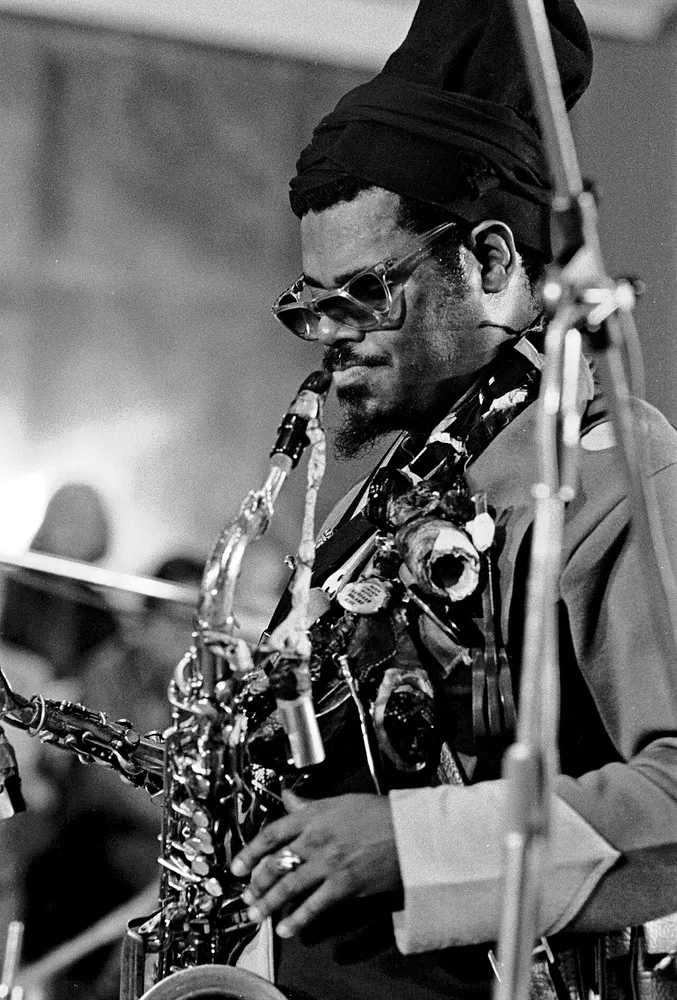
Rahsaan Roland Kirk performing live in the large broadcast hall of NDR in Hamburg, Germany, 1972, photographed by Heinrich Klaffs CC BY-SA 2.0 (Heinrich Klaffs; license confirmed on the Commons file page, which carries a Flickr review pass) — Wikimedia Commons — https://commons.wikimedia.org/wiki/File:Roland-Kirk.jpg

Ronald Theodore Kirk was born on August 7, 1935, in Columbus, Ohio, and grew up in the neighborhood known as Flytown. He lost his sight at about the age of two, which he attributed to improper medical treatment. He studied at the Ohio State School for the Blind, began on bugle and trumpet, then moved to clarinet and C-melody saxophone, and by fifteen was traveling on weekends with Boyd Moore's rhythm and blues band. The saxophonist Hank Crawford remembered the blind teenager playing two horns at once and tearing the joint up. As a teenager Kirk also found the manzello (a modified saxello with a larger, upturned bell) and the stritch (a straight alto saxophone with no upturned bell), and he began altering both, along with his tenor, so that he could hold several in his mouth at the same time. A dream led him to swap two letters of his first name and become Roland.
His first record, Triple Threat, was cut for King in New York on November 9, 1956, with a quartet led from the tenor, and appeared the following year. After working in Louisville he recorded Introducing Roland Kirk for Argo in Chicago on June 7, 1960, with Ira Sullivan on trumpet and tenor. In 1961 he made Kirk's Work for Prestige with organist Jack McDuff (July 11, at Van Gelder Studio) and the Mercury quartet sessions of August 16 and 17 that became We Free Kings, with Richard Wyands or Hank Jones at the piano and drummer Charlie Persip. That autumn he joined Charles Mingus's Jazz Workshop: a Birdland broadcast on October 21, 1961 caught him in the band, and on November 6 he played on the Atlantic session that produced Oh Yeah, released in April 1962, on which he doubled on flute, siren, tenor, manzello and stritch.
The years 1962 and 1963 were his busiest run on Mercury. He recorded most of Domino in New York on April 18, 1962 with Wynton Kelly at the piano and Roy Haynes on drums, and the rest in Chicago on September 6 with Andrew Hill; an April 17 session with Herbie Hancock at the piano was left in the vault and appeared on later reissues. In May 1962 he was the front line on Haynes's Out of the Afternoon for Impulse!, with Tommy Flanagan and Henry Grimes. That September he was the flute soloist on Quincy Jones's "Soul Bossa Nova," which later became familiar from the Austin Powers films. Reeds & Deeds (February 1963) and a June 1963 date with an orchestra arranged by Benny Golson followed. In October 1963 he toured Europe, recording the live album Kirk in Copenhagen at the Club Montmartre with pianist Tete Montoliu and the young bassist Niels-Henning Ørsted Pedersen, and making his first visit to London, where he played a season at Ronnie Scott's club.
Gifts & Messages (Los Angeles, July 1964) was followed by I Talk with the Spirits (Limelight, September 1964), a flutes-only album that contains the first recording of "Serenade to a Cuckoo." On January 13, 1965 he recorded Rip, Rig and Panic at Van Gelder Studio with Jaki Byard, bassist Richard Davis and Elvin Jones. A live set taped in New York that March, with Lonnie Liston Smith and Byard sharing the piano chair, was his first release for Atlantic, issued in 1967 as Here Comes the Whistleman. His Atlantic albums continued with The Inflated Tear (Webster Hall, November 1967), and the label released Left & Right with strings and the live and studio mix Volunteered Slavery, built from his July 7, 1968 Newport Jazz Festival set and July 1969 sessions. Ian Anderson of Jethro Tull, who recorded "Serenade to a Cuckoo" on the band's 1968 debut, met Kirk when both played the 1969 Newport festival.
By then Kirk had become a public figure beyond the clubs. With Mark Davis he founded the Jazz and People's Movement, which demanded more airtime and more work for Black jazz musicians. Its members disrupted The Merv Griffin Show in August 1970 with whistles and placards and broke into a taping of The Dick Cavett Show, which ended with producers agreeing to book jazz players the following week, among them Freddie Hubbard, Cecil Taylor and Andrew Cyrille. In January 1971 he was invited to The Ed Sullivan Show and brought a nine-piece band that included Mingus, Archie Shepp and Haynes, playing his own "The Inflated Tear" and Mingus's "Haitian Fight Song" instead of the pop tune the producers had requested. In 1970 he added Rahsaan to his name after hearing it in a dream, and the mayor of Columbus declared December 10, 1970 "Rahsaan Day." The records of that period include the live Rahsaan Rahsaan (Village Vanguard, May 1970), the spare Natural Black Inventions: Root Strata (early 1971), the soul and pop-oriented Blacknuss (1971), A Meeting of the Times with the singer Al Hibbler (March 1972), and Prepare Thyself to Deal with a Miracle (January 1973), which added strings and the singers Dee Dee Bridgewater and Jeanne Lee. In 1972 he played Montreux with pianist Les McCann and joined the all-star jam sessions of Newport in New York at Radio City Music Hall, and in June 1973 he recorded the double album Bright Moments at the Keystone Korner in San Francisco. He was a guest on Mingus's Carnegie Hall concert of January 19, 1974.
The Case of the 3 Sided Dream in Audio Color (1975) mixed tape loops, spoken commentary and a studio band, and also hid a telephone-message track on its apparently blank fourth side. In 1975 Kirk suffered a major stroke that left one side of his body partially paralyzed. He adapted his instruments so he could play with one hand, kept touring and recording, and made three albums for Warner Bros., The Return of the 5000 Lb. Man (1976), Kirkatron (1977) and Boogie-Woogie String Along for Real, along with the Atlantic release Other Folks' Music (1976). At a London engagement at Ronnie Scott's club after the stroke he still managed to play two instruments at once. A second stroke ended his life on December 5, 1977, the morning after a performance in the Frangipani Room of the Indiana University Student Union in Bloomington, Indiana. He was 42. His widow, Dorthaan Kirk, joined the public jazz station WBGO in Newark in 1978 and received the 2020 A.B. Spellman NEA Jazz Masters Fellowship for Jazz Advocacy. John Kruth's biography Bright Moments: The Life and Legacy of Rahsaan Roland Kirk appeared in 2000.
Kirk is remembered for the sight of three horns hanging from his neck, but his reputation among players rests on the music he made with them: he fingered the tenor with one hand and the manzello with the other while sounding a drone on the stritch, he held notes for long stretches with circular breathing, and he sang or hummed into the flute and paired a standard flute with a nose flute. The critic Gary Giddins wrote that his tenor playing alone would have secured his place, and called him the first major jazz innovator on flute after Eric Dolphy. He drew on the whole history of the music, from ragtime and the stride playing of Fats Waller and the clarinet of Sidney Bechet to John Coltrane and free playing, and he borrowed freely from classical composers and from pop writers such as Burt Bacharach and Smokey Robinson. He preferred the term "black classical music" for what he did, spoke to audiences between tunes about African-American history and politics, and brought alarm clocks, sirens and a length of garden hose he called the black mystery pipes into the performances. From the early 1970s his studio albums used tape manipulation and found sound. His work traveled well beyond jazz: Jethro Tull covered "Serenade to a Cuckoo," the British band Rip Rig + Panic took its name from his 1965 album, Frank Zappa named him in the liner notes of Freak Out!, the guitarist Charlie Hunter formed the band T. J. Kirk in tribute to Kirk, Monk and James Brown, and Pitchfork ranked The Inflated Tear number 170 on its 2017 list of the best albums of the 1960s.
- We Free Kings (1962, Mercury) - The quartet album recorded August 16 and 17, 1961, with a title track that reworks "We Three Kings" and a much-admired reading of Charlie Parker's "Blues for Alice." Spotify - We Free Kings Listen
- Rip, Rig and Panic (1965, Limelight) - Recorded January 13, 1965 with Jaki Byard, Richard Davis and Elvin Jones, mostly original Kirk compositions with homages to Lester Young, Sidney Bechet and Clifford Brown. Spotify - Rip, Rig And Panic Listen
- I Talk with the Spirits (1965, Limelight) - A flutes-only date that holds the first recording of "Serenade to a Cuckoo." Spotify - I Talk With The Spirits Listen
- The Inflated Tear (1968, Atlantic) - His Atlantic breakthrough, recorded at Webster Hall in November 1967 with Ron Burton, Steve Novosel and Jimmy Hopps. Spotify - The Inflated Tear Listen
- Volunteered Slavery (1969, Atlantic) - Part live at the 1968 Newport Jazz Festival and part studio, with his Spirit Choir, a Coltrane tribute medley and the title tune. Spotify - Volunteered Slavery Listen
- Bright Moments (1974, Atlantic) - A double album recorded at the Keystone Korner on June 8 and 9, 1973, regarded as the clearest document of his live show. Spotify - Bright Moments Listen
- The Case of the 3 Sided Dream in Audio Color (1975, Atlantic) - A two-LP concept album of loops, found sound, spoken commentary and a large studio band, with a hidden track on the apparently blank side four. Spotify - The Case of the 3 Sided Dream in Audio Color Listen
- Oh Yeah (1962, Atlantic) - As a sideman: the November 6, 1961 session on which Charles Mingus played piano and sang, with Kirk, Booker Ervin, Jimmy Knepper, Doug Watkins and Dannie Richmond. Spotify - Oh Yeah
Rahsaan Roland Kirk: Full Discography
Discogs artist ID 218045 ("Roland Kirk," real name Ronald Theodore Kirk, born August 7, 1935, in Columbus, Ohio, died December 5, 1977, in Bloomington, Indiana) was read in full on Discogs: it lists 800 entries across leader releases, sideman appearances, track appearances, unofficial releases and compilations, most of them reissues of the same sessions. Several leader dates are filed under separate Discogs entities and were checked and reconciled here: The Roland Kirk Quartet (artist ID 911810, including Rip, Rig and Panic and the Benny Golson Orchestra album), Rahsaan Roland Kirk & The Vibration Society (ID 519534), The Roland Kirk Quintet (ID 10262305) and Roland Kirk Sextet (ID 8039736). Because he recorded prolifically and many releases are compilations of the same sessions, the leader table is a curated selection of 28 original albums rather than an exhaustive list: the original studio and live albums issued in his lifetime or shortly after his death, from Triple Threat (1957) through Boogie-Woogie String Along for Real (1978). Recording dates, catalog numbers and personnel come from the Jazz Discography Project's session listing and Wikipedia, checked against Discogs; where a source gave a date only to the year, it is shown that way. Release years follow Discogs and Wikipedia, and where they differ the Notes column says so. Catalog numbers are those of the original US pressing.
As Leader / Co-Leader
| Album Title | Recording Date(s) | Release Date | Label | Catalog Number | Format(s) | Personnel | Role | Reissue History | Spotify | Buy | Notes |
|---|---|---|---|---|---|---|---|---|---|---|---|
| Triple Threat | November 9, 1956, New York | 1957 | King | 539 | Vinyl, LP, Album, Mono | Roland Kirk (tenor saxophone, manzello, stritch), James Madison (piano), Carl Pruitt (bass), Henry Duncan (drums) | Leader | Reissued many times on CD and streaming; the pressing history is on Discogs master 404012 | — | — | His first record as a leader. Discogs dates the pressing to July 1957. |
| Introducing Roland Kirk | June 7, 1960, Chicago | 1960 | Argo | LP 669 | Vinyl, LP, Album, Mono | Roland Kirk (tenor saxophone, manzello, stritch, whistle), Ira Sullivan (trumpet, tenor saxophone), William Burton (organ, piano), Donald Garrett (bass), Sonny Brown (drums) | Leader | Reissued many times on CD and streaming; the pressing history is on Discogs master 261470 | Spotify - Introducing Roland Kirk | — | Discogs files the quintet billing under The Roland Kirk Quintet (ID 10262305). |
| Kirk's Work | July 11, 1961, Van Gelder Studio, Englewood Cliffs, New Jersey | 1961 | Prestige | PRLP 7210 | Vinyl, LP, Album, Mono | Roland Kirk (tenor saxophone, manzello, stritch, flute, siren), Jack McDuff (organ), Joe Benjamin (bass), Arthur Taylor (drums) | Leader (billed with Jack McDuff) | Reissued many times on CD and streaming; the pressing history is on Discogs master 33326. Reissued as Funk Underneath (Prestige PR 7450, 1966) and on Original Jazz Classics OJC-459 | Spotify - Kirk's Work feat. Jack McDuff | — | Organ quartet date for Prestige. |
| We Free Kings | August 16-17, 1961, Nola Penthouse Sound Studios, New York | January 1962 | Mercury | MG-20679 (mono), SR-60679 (stereo) | Vinyl, LP, Album, Mono | Roland Kirk (tenor saxophone, manzello, stritch, flute, siren), Richard Wyands (piano, August 16), Art Davis (bass, August 16), Hank Jones (piano, August 17), Wendell Marshall (bass, August 17), Charlie Persip (drums) | Leader | Reissued many times on CD and streaming; the pressing history is on Discogs master 200672 | Spotify - We Free Kings | — | Includes "Blues for Alice" and a title track built on "We Three Kings." |
| Domino | April 17-18, 1962, New York; September 6, 1962, Chicago | 1962 | Mercury | MG-20748 (mono), SR-60748 (stereo) | Vinyl, LP, Album, Mono | Roland Kirk (tenor saxophone, manzello, stritch, flute), Wynton Kelly (piano, April 18), Andrew Hill (piano, celeste, September 6), Vernon Martin (bass), Roy Haynes (drums, April), Henry Duncan (drums, September) | Leader | Reissued many times on CD and streaming; the pressing history is on Discogs master 33302. A 2000 Verve CD adds the April 17 session with Herbie Hancock on piano | Spotify - Domino | — | The original LP mixes the April 18 New York and September 6 Chicago sessions. |
| Reeds & Deeds | February 25-26, 1963, New York | 1963 | Mercury | MG-20800 (mono), SR-60800 (stereo) | Vinyl, LP, Album, Mono | Roland Kirk (tenor saxophone, manzello, stritch, clarinet, flute, siren), Virgil Jones (trumpet), Charles Greenlee and Tom McIntosh (trombone), Harold Mabern (piano), Abdullah Rafik and Richard Davis (bass), Walter Perkins (drums), Benny Golson (arranger, February 26) | Leader | Reissued many times on CD and streaming; the pressing history is on Discogs master 377179 | Spotify - Reeds & Deeds | — | Sextet on February 25, septet on February 26. |
| The Roland Kirk Quartet Meets the Benny Golson Orchestra | June 11-12, 1963, A&R Studios, New York | 1963 | Mercury | MG-20844 (mono), SR-60844 (stereo) | Vinyl, LP, Album, Mono | Roland Kirk (tenor saxophone, manzello, stritch, clarinet, flute), Harold Mabern (piano), Abdullah Rafik (bass), Sonny Brown (drums), with an orchestra arranged and conducted by Benny Golson (Virgil Jones, Richard Williams, trumpet; Charles Greenlee, Tom McIntosh, trombone; Don Butterfield, tuba; Richard Davis, bass; Albert Heath, drums) | Leader | Reissued many times on CD and streaming; the pressing history is on Discogs master 749206 | — | — | Filed on Discogs under The Roland Kirk Quartet (ID 911810). The Jazz Discography Project gives a 1964 release. |
| Kirk in Copenhagen | October 1963, Club Montmartre, Copenhagen | 1964 | Mercury | MG-20894 (mono), SR-60894 (stereo) | Vinyl, LP, Album, Mono | Roland Kirk (tenor saxophone, manzello, stritch, flute, nose flute, siren), Tete Montoliu (piano), Niels-Henning Ørsted Pedersen or Don Moore (bass), J. C. Moses (drums), Sonny Boy Williamson (harmonica, one track) | Leader | Reissued many times on CD and streaming; the pressing history is on Discogs master 386196 | — | — | Live. The harmonica player is credited as Big Skol. |
| Gifts & Messages | July 22, 1964, Los Angeles | 1964 | Mercury | MG-20939 (mono), SR-60939 (stereo) | Vinyl, LP, Album, Mono | Roland Kirk (tenor saxophone, manzello, stritch, flute, siren, oboe), Horace Parlan (piano), Michael Fleming (bass), Steve Ellington (drums) | Leader | Reissued many times on CD and streaming; the pressing history is on Discogs master 388279 | — | — | Recorded in Los Angeles. |
| I Talk with the Spirits | September 16-17, 1964, Nola Penthouse Sound Studios, New York | 1965 | Limelight | LM-82008 (mono), LS-86008 (stereo) | Vinyl, LP, Album, Mono | Roland Kirk (flute, alto flute, amplified flute, African wood flute, vocal interjections, cuckoo clock, music box), Bobby Moses (vibraphone), Horace Parlan (piano, celeste), Michael Fleming (bass), Walter Perkins (drums, percussion), Cyristal-Joy Albert (vocal) | Leader | Reissued many times on CD and streaming; the pressing history is on Discogs master 178701 | Spotify - I Talk With The Spirits | — | Flutes only. First recording of "Serenade to a Cuckoo." |
| Rip, Rig and Panic | January 13, 1965, Van Gelder Studio, Englewood Cliffs, New Jersey | 1965 | Limelight | LM-82027 (mono), LS-86027 (stereo) | Vinyl, LP, Album, Mono | Roland Kirk (tenor saxophone, stritch, manzello, flute, siren, oboe, castanets), Jaki Byard (piano), Richard Davis (bass), Elvin Jones (drums) | Leader (billed as The Roland Kirk Quartet Featuring Elvin Jones) | Reissued many times on CD and streaming; the pressing history is on Discogs master 176809. Reissued with Now Please Don't You Cry, Beautiful Edith on a 1990 compilation | Spotify - Rip, Rig And Panic | — | Filed on Discogs under The Roland Kirk Quartet (ID 911810). |
| Here Comes the Whistleman | March 14, 1965, Atlantic Studios, New York (live) | 1967 | Atlantic | LP 3007 (mono), SD 3007 (stereo) | Vinyl, LP, Album, Mono | Roland Kirk (tenor saxophone, manzello, stritch, clarinet, flute), Lonnie Liston Smith and Jaki Byard (piano), Major Holley (bass), Charles Crosby (drums), Leon Thomas (vocal, two tracks) | Leader | Reissued many times on CD and streaming; the pressing history is on Discogs master 295129 | — | — | His first release for Atlantic. |
| Slightly Latin | November 16-17, 1965, New York | 1966 | Limelight | LM-82033 (mono), LS-86033 (stereo) | Vinyl, LP, Album, Mono | Roland Kirk (tenor saxophone, manzello, stritch, clarinet, flute, bagpipes, piccolo, baritone saxophone, siren), Virgil Jones (trumpet), Martin Banks (flugelhorn), Garnett Brown (trombone, arranger), Horace Parlan (piano, celeste, vibraphone), Eddie Mathias (bass), Sonny Brown (drums), Montego Joe (congas), Manuel Ramos (percussion) | Leader | Reissued many times on CD and streaming; the pressing history is on Discogs master 33319 | — | — | Octet with a choir on three tracks. |
| Now Please Don't You Cry, Beautiful Edith | May 2, 1967, New York | 1967 | Verve | V-8709 (mono), V6-8709 (stereo) | Vinyl, LP, Album, Mono | Roland Kirk (tenor saxophone, manzello, stritch, flute), Lonnie Liston Smith (piano), Ronald Boykins (bass), Grady Tate (drums) | Leader | Reissued many times on CD and streaming; the pressing history is on Discogs master 256227 | — | — | Issued by Verve. |
| The Inflated Tear | November 27 and 30, 1967, Webster Hall, New York | 1968 | Atlantic | SD 1502 | Vinyl, LP, Album, Stereo | Roland Kirk (tenor saxophone, manzello, stritch, clarinet, flute, whistle, English horn, flexatone), Ron Burton (piano), Steve Novosel (bass), Jimmy Hopps (drums), Dick Griffin (trombone, one track) | Leader | Reissued many times on CD and streaming; the pressing history is on Discogs master 33347. Reissued by Rhino with a bonus track and new liner notes in 1998 | Spotify - The Inflated Tear | — | Pitchfork ranked it number 170 on its 2017 list of the best albums of the 1960s. |
| Left & Right | June 17-18, 1968, New York | 1969 | Atlantic | SD 1518 | Vinyl, LP, Album, Stereo | Roland Kirk (tenor saxophone, manzello, stritch, clarinet, flute, organ, thumb piano, celeste), Ron Burton (piano), Vernon Martin (bass), Roy Haynes or Jimmy Hopps (drums), strings arranged by Gil Fuller; on "Expansions" also Pepper Adams (baritone saxophone) and Alice Coltrane (harp) | Leader | Reissued many times on CD and streaming; the pressing history is on Discogs master 200671 | — | — | Partly with strings. Discogs gives 1969; the Jazz Discography Project dates the LP to 1968. |
| Volunteered Slavery | July 7, 1968, Newport Jazz Festival, Newport, Rhode Island (live); July 22-23, 1969, Regent Sound Studios, New York | 1969 | Atlantic | SD 1534 | Vinyl, LP, Album, Stereo | Roland Kirk (tenor saxophone, manzello, stritch, clarinet, flute, nose flute, whistle, voice, Stylophone), Charles McGhee (trumpet), Dick Griffin (trombone), Ron Burton (piano), Vernon Martin (bass), Sonny Brown, Charles Crosby and Jimmy Hopps (drums), Joe Habao Texidor (tambourine), the Roland Kirk Spirit Choir | Leader | Reissued many times on CD and streaming; the pressing history is on Discogs master 33307 | Spotify - Volunteered Slavery | — | Half live, half studio. The Jazz Discography Project dates the LP to 1970. |
| Rahsaan Rahsaan | May 11-15, 1970, New York and Village Vanguard (live) | 1970 | Atlantic | SD 1575 | Vinyl, LP, Album, Stereo | Rahsaan Roland Kirk (tenor saxophone, manzello, stritch, clarinet, flute), Ron Burton (piano), Vernon Martin (bass), James Madison (drums), Joe Habao Texidor (percussion); studio track also Dick Griffin (trombone), Howard Johnson (tuba), Leroy Jenkins (violin) | Leader (billed with The Vibration Society) | Reissued many times on CD and streaming; the pressing history is on Discogs master 200677 | Spotify - Rahsaan Rahsaan | — | First album under the name Rahsaan. |
| Natural Black Inventions: Root Strata | January 26 and February 4, 1971, Regent Sound Studios, New York | 1971 | Atlantic | SD 1578 | Vinyl, LP, Album, Stereo | Rahsaan Roland Kirk (tenor saxophone, manzello, stritch, clarinet, flute, piccolo, harmonium and many other instruments), Maurice McKinley (drums), Joe Habao Texidor (percussion), Sonelius Smith (piano, three tracks) | Leader | Reissued many times on CD and streaming; the pressing history is on Discogs master 295128 | — | — | Spare drums and percussion accompaniment, with Kirk playing a long list of instruments. |
| Blacknuss | August 31 and September 8, 1971, Regent Sound Studios, New York | 1972 | Atlantic | SD 1601 | Vinyl, LP, Album, Stereo | Rahsaan Roland Kirk (tenor saxophone, manzello, stritch and other reeds), Sonelius Smith, Richard Tee and Mickey Tucker (keyboards), Billy Butler, Cornell Dupree and Keith Loving (guitar), Bill Salter and Henry Mattathias Pearson (bass), Bernard Purdie and Khalil Mhrdi (drums), Charles McGhee (trumpet), Dick Griffin (trombone), Cissy Houston (vocal), percussion | Leader | Reissued many times on CD and streaming; the pressing history is on Discogs master 212585 | — | — | Includes readings of "What's Goin' On," "Ain't No Sunshine" and "My Girl." Cornell Dupree is on the September 8 session. |
| A Meeting of the Times | March 30-31, 1972, Atlantic Studios, New York; one track from 1965 | 1972 | Atlantic | SD 1630 | Vinyl, LP, Album, Stereo | Rahsaan Roland Kirk (tenor and baritone saxophone, manzello, stritch, flute, clarinet), Hank Jones (piano), Ron Carter (bass), Oliver Jackson (drums), Al Hibbler (vocal) | Co-leader (billed with Al Hibbler) | Reissued many times on CD and streaming; the pressing history is on Discogs master 446680 | Spotify - A Meeting Of The Times | — | Standards sung by Al Hibbler, including Duke Ellington's "Don't Get Around Much Anymore" and "Do Nothin' Till You Hear from Me." |
| Prepare Thyself to Deal with a Miracle | January 22, 1973, Regent Sound Studios, New York | 1973 | Atlantic | SD 1640 | Vinyl, LP, Album, Stereo | Rahsaan Roland Kirk (tenor saxophone, clarinet, flute, nose flute, E-flat saxophone, pipes), Charles McGhee (trumpet), Dick Griffin (trombone), Harry Smiles (English horn, oboe), Ron Burton (piano), Henry Mattathias Pearson (bass), Robert Shy (drums), a string section, Dee Dee Bridgewater and Jeanne Lee (vocals) | Leader | Reissued many times on CD and streaming; the pressing history is on Discogs master 212586 | — | — | Dated 1972 on some listings; Discogs gives 1973. |
| Bright Moments | June 8-9, 1973, Keystone Korner, San Francisco (live) | 1974 | Atlantic | SD 2-907 | Vinyl, 2xLP, Album, Stereo | Rahsaan Roland Kirk (tenor saxophone, manzello, stritch, clarinet, flute, nose flute), Ron Burton (piano), Todd Barkan (synthesizer, tambourine), Henry Mattathias Pearson (bass), Robert Shy (drums), Joe Habao Texidor (percussion) | Leader | Reissued many times on CD and streaming; the pressing history is on Discogs master 358612 | Spotify - Bright Moments | — | Double album. |
| The Case of the 3 Sided Dream in Audio Color | 1975, Regent Sound Studios, New York | 1975 | Atlantic | SD 1674 | Vinyl, 2xLP, Album, Stereo | Rahsaan Roland Kirk (tenor and bass saxophone, flute, trumpet, manzello, stritch), Pat Patrick (baritone saxophone), Hilton Ruiz and Richard Tee (keyboards), Cornell Dupree, Keith Loving and Hugh McCracken (guitar), Francisco Centeno, Henry Mattathias Pearson and Bill Salter (bass), Sonny Brown, Steve Gadd and John Goldsmith (drums), Lawrence Killian and Ralph MacDonald (percussion), William Eaton (arranger) | Leader | Reissued many times on CD and streaming; the pressing history is on Discogs master 33335 | Spotify - The Case of the 3 Sided Dream in Audio Color | — | Double LP whose apparently blank fourth side carries a hidden track. The Jazz Discography Project gives the session date as May 14, 1975 with a question mark. |
| Other Folks' Music | March 1976, Regent Sound Studios, New York | 1976 | Atlantic | SD 1686 | Vinyl, LP, Album, Stereo | Rahsaan Roland Kirk (tenor saxophone, manzello, stritch, clarinet, flute, reed trumpet, harmonica), Richard Williams (trumpet), Kermit Moore (cello), Gloria Agostini (harp), Trudy Pitts, Hilton Ruiz and Henry Mattathias Pearson, with Roy Haynes or Sonny Brown on drums | Leader | Reissued many times on CD and streaming; the pressing history is on Discogs master 529493 | — | — | Mostly other composers' music; March 1976 is the Jazz Discography Project's date with a question mark. |
| The Return of the 5000 Lb. Man | 1976, Regent Sound Studios, New York | 1976 | Warner Bros. | BS 2918 | Vinyl, LP, Album, Stereo | Rahsaan Roland Kirk (tenor saxophone, manzello, stritch, clarinet, flute), Howard Johnson (tuba), Romeo Penque (baritone saxophone, oboe), Hilton Ruiz (piano, celeste), Buster Williams (bass), Charlie Persip (drums), Joe Habao Texidor (percussion, vocal) | Leader | Reissued many times on CD and streaming; the pressing history is on Discogs master 230703 | — | — | The first of his three Warner Bros. albums. |
| Kirkatron | 1975-1976, Regent Sound Studios, New York; live at the Montreux Jazz Festival, July 18, 1975 | 1977 | Warner Bros. | BS 2982 | Vinyl, LP, Album, Stereo | Rahsaan Roland Kirk (tenor saxophone, manzello, stritch, clarinet, flute) with Hilton Ruiz (piano), Henry Pete Pearson (bass), Steve Turre (trombone) and others; Frank Foster (arranger, one track) | Leader | Reissued many times on CD and streaming; the pressing history is on Discogs master 628362 | — | — | Partly live. A mix of studio sessions and the Montreux concert. |
| Boogie-Woogie String Along for Real | 1977, Regent Sound Studios, New York | 1978 | Warner Bros. | BSK 3085 | Vinyl, LP, Album, Stereo | Rahsaan Roland Kirk (tenor saxophone, manzello, stritch, clarinet, flute), Steve Turre (trombone), Sammy Price (piano), Hilton Ruiz (keyboards), Phil Bowler (bass), Percy Heath (cello), Sonny Brown (drums), Eddie Preston (trumpet), strings and others | Leader | Reissued many times on CD and streaming; the pressing history is on Discogs master 303580 | Spotify - Boogie-Woogie String Along For Real | — | His last studio album. Wikipedia lists it as 1977; Discogs and the Jazz Discography Project give 1978. |
Posthumous Releases and Major Compilations (selected)
| Year | Title | Label | Notes |
|---|---|---|---|
| 1978 | The Vibration Continues | Atlantic | Two-LP retrospective of his Atlantic years, 1968 to 1976 (SD 2-1003). |
| 1978 | Pre-Rahsaan | Prestige | Compilation of his 1961 and 1968 Prestige recordings (P-24080). |
| 1990 | Rahsaan: The Complete Mercury Recordings of Roland Kirk | Mercury | Ten-CD set of his Mercury sessions, 1961 to 1964. |
| 1993 | Does Your House Have Lions: The Rahsaan Roland Kirk Anthology | Rhino | Two-CD anthology. |
| 1996 | (I, Eye, Aye): Live at the Montreux Jazz Festival, Switzerland 1972 | Rhino | Live concert issued posthumously. |
| 2003 | Compliments of the Mysterious Phantom | Hyena | Live 1974 recording issued posthumously. |
| 2006 | Brotherman in the Fatherland | Hyena | Live 1972 recording from Germany, issued posthumously. |
| 2021 | Live at Ronnie Scott's (1963) | Not confirmed | Concert recorded in London on October 15, 1963, with a British rhythm section led by pianist Stan Tracey; first issued in 2021. Spotify - Live at Ronnie Scott's 1963 |
As Sideman (selected major credits)
| Year | Project (Leader) | Title | Label | Catalog | Role | Notes |
|---|---|---|---|---|---|---|
| 1962 | Charles Mingus | Oh Yeah | Atlantic | LP 1377 / SD 1377 | Tenor saxophone, manzello, stritch, flute, siren | Recorded November 6, 1961, with Booker Ervin, Jimmy Knepper, Doug Watkins and Dannie Richmond; Mingus on piano and vocal. Spotify - Oh Yeah |
| 1964 | Charles Mingus | Tonight at Noon | Atlantic | LP 1416 / SD 1416 | Tenor saxophone, manzello, stritch, siren, flute | Three tracks ("Invisible Lady," "Old Blues for Walt's Torin," "Peggy's Blue Skylight") from the November 6, 1961 Oh Yeah session. |
| 1974 | Charles Mingus | Mingus at Carnegie Hall | Atlantic | SD 1667 | Tenor saxophone, stritch | Live, January 19, 1974, on "C Jam Blues" and "Perdido"; with George Adams and Charles McPherson among the horns. |
| 1962 | Quincy Jones | Big Band Bossa Nova | Mercury | MG-20751 / SR-60751 | Flute | Flute soloist on "Soul Bossa Nova" (September 13, 1962), alongside Jerome Richardson and Lalo Schifrin. |
| 1963 | Quincy Jones | Quincy Jones Plays Hip Hits | Mercury | MG-20799 / SR-60799 | Woodwinds | Sessions of June 15, 1962 and April 9, 1963. |
| 1964 | Quincy Jones | Quincy Jones Explores the Music of Henry Mancini | Mercury | MG-20863 / SR-60863 | Woodwinds | Sessions of February 5-6, 1964. |
| 1965 | Quincy Jones | I/We Had a Ball | Limelight | LM-82002 / LS-86002 | Tenor saxophone | Session of December 20, 1964, with a star horn section including Dizzy Gillespie and Freddie Hubbard; on a Various Artists billing. |
| 1969 | Quincy Jones | Walking in Space | A&M | SP-3023 | Saxophone, flute, reeds | Sessions of June 18-19, 1969, with Hubert Laws and Freddie Hubbard. |
| 1962 | Roy Haynes | Out of the Afternoon | Impulse! | A-23 / AS-23 | Tenor saxophone, manzello, stritch, C flute, nose flute | Recorded May 16 and 23, 1962, with Tommy Flanagan and Henry Grimes; Kirk is the only horn. |
| 1962 | Tubby Hayes and the All Stars | Tubby's Back in Town | Smash | MGS-27026 | Tenor saxophone, manzello, flute, nose flute | Recorded June 23, 1962, in New York, with James Moody listed as "Jimmy Gloomy." |
| 1962 | Eddie Baccus | Feel Real | Smash | MGS-27029 | Flute | One track, "A Breath in the Wind," recorded in Chicago in October 1962. |
| 1967 | Tommy Peltier | The Jazz Corps Under the Direction of Tommy Peltier Featuring Roland Kirk | Pacific Jazz | PJ-10116 | Featured soloist, tenor saxophone, flute, manzello, stritch | Recorded October 11-12, 1966, in Los Angeles. |
| 1969 | Jaki Byard | The Jaki Byard Experience | Prestige | PRST 7615 | Tenor saxophone, clarinet, whistle, manzello, kirkbam | Recorded September 17, 1968, with Richard Davis and Alan Dawson. |
| 1972 | Various Artists | Newport in New York '72: The Jam Sessions | Cobblestone | CST 9026-2 | Tenor saxophone, stritch, manzello | "So What" jam recorded at Radio City Music Hall, July 3, 1972, with Dexter Gordon, Herbie Hancock and Tony Williams. |
| 1973 | Les McCann | Live at Montreux | Atlantic | SD 2-312 | Tenor saxophone | Two tracks, "Get Yourself Together" and "Home Again," recorded June 24, 1972. |
| 1993 | Sonny Stitt | Loose Walk | Philology | W 43.2 | Stritch | One track, "Au Privave," recorded in Berlin on September 24, 1964. |
Kirk rarely worked as a sideman after the mid-1960s and led his own groups, so this table is a representative set of his guest and ensemble credits rather than an exhaustive one.
- Charles Mingus - Kirk joined his Jazz Workshop in the autumn of 1961 and recorded on Oh Yeah (November 6, 1961), the same session's tracks later issued on Tonight at Noon, and the 1974 Carnegie Hall concert released as Mingus at Carnegie Hall.
- Quincy Jones - woodwind and flute soloist in Jones's big band from 1962, including "Soul Bossa Nova" on Big Band Bossa Nova, Quincy Jones Explores the Music of Henry Mancini (1964), I/We Had a Ball (December 1964) and Walking in Space (June 1969).
- Roy Haynes - drummer on Kirk's Domino (April 1962) and leader of the quartet on Out of the Afternoon (May 1962, Impulse!), with Tommy Flanagan and Henry Grimes.
- Jaki Byard - pianist on Rip, Rig and Panic and part of Here Comes the Whistleman (1965); Kirk was a guest on Byard's The Jaki Byard Experience (September 1968).
- Elvin Jones - drummer on Rip, Rig and Panic (January 13, 1965), with bassist Richard Davis.
- Jack McDuff - organist on Kirk's Work (July 11, 1961), with bassist Joe Benjamin and drummer Arthur Taylor.
- Richard Wyands, Hank Jones - the two pianists on We Free Kings, Wyands on the first day's tracks and Jones on the second, with drummer Charlie Persip throughout. Jones returned on A Meeting of the Times (1972) with Ron Carter on bass.
- Herbie Hancock, Wynton Kelly, Andrew Hill - pianists on the 1962 Domino sessions: Kelly (April 18) and Hill (September 6) on the original album, and Hancock (April 17) on tracks added to later reissues.
- Benny Golson - arranger for The Roland Kirk Quartet Meets the Benny Golson Orchestra (June 1963) and on three tracks of Reeds & Deeds.
- Tete Montoliu, Niels-Henning Ørsted Pedersen - pianist and bassist on the live Kirk in Copenhagen (October 1963).
- Lonnie Liston Smith - pianist in Kirk's group from 1965, on the March 1965 live sessions that became Here Comes the Whistleman.
- Ron Burton, Vernon Martin, Jimmy Hopps, Sonny Brown, Joe Habao Texidor - members of the rhythm sections behind the Atlantic albums of 1967 to 1973; Texidor's percussion is on most of them.
- Al Hibbler, Les McCann - Hibbler is the vocalist on A Meeting of the Times (March 1972); Kirk played tenor in McCann's quartet at the Montreux Jazz Festival on June 24, 1972, issued on Live at Montreux.
- Dee Dee Bridgewater, Jeanne Lee - vocalists on Prepare Thyself to Deal with a Miracle (January 22, 1973).
- Steve Gadd, Cornell Dupree, Richard Tee, Hugh McCracken - among the New York studio musicians on The Case of the 3 Sided Dream in Audio Color.
- Frank Foster - credited as arranger on the 1975 New York session that produced "Bright Moments" on Kirkatron.
- Sonny Stitt, Tubby Hayes, Tommy Peltier - Kirk played stritch with Stitt's quintet in Berlin on September 24, 1964, appeared on Hayes's June 23, 1962 New York session for Tubby's Back in Town, and was the featured guest on Peltier's Jazz Corps album recorded in Los Angeles in October 1966.
- Steve Turre, Hilton Ruiz - trombonist and pianist in Kirk's last working bands, on the Warner Bros. albums and the Paris concert of November 14, 1976.
More Post-Bop Artists
See all 817 Post-Bop artists →More American Jazz Artists
See all 820 American artists →- Wikipedia: Rahsaan Roland Kirk
- Wikipedia: We Free Kings
- Wikipedia: Rip, Rig and Panic
- Wikipedia: The Inflated Tear
- Wikipedia: Volunteered Slavery
- Wikipedia: Bright Moments (Rahsaan Roland Kirk album)
- Wikipedia: Oh Yeah (Charles Mingus album)
- AllMusic: Rahsaan Roland Kirk biography by Chris Kelsey
- Jazz Discography Project: Roland Kirk discography
- Discogs: Roland Kirk (artist 218045)
- MusicBrainz: Rahsaan Roland Kirk
- uDiscover Music: How Rahsaan Roland Kirk shook up The Ed Sullivan Show
- Jazz Fuel: Rahsaan Roland Kirk, Dick Cavett and the Jazz and People's Movement
- The Blue Moment: Roland Kirk in Swinging London
- JazzProfiles.com: Jaki Byard
- JazzProfiles.com: Roy Haynes
- JazzProfiles.com: Lonnie Liston Smith