 JAZZPROFILES lives in the music 1,572 Jazz Artists fully Profiled!
 Hubert Laws
Last updated September 7, 2026
Listen on Spotify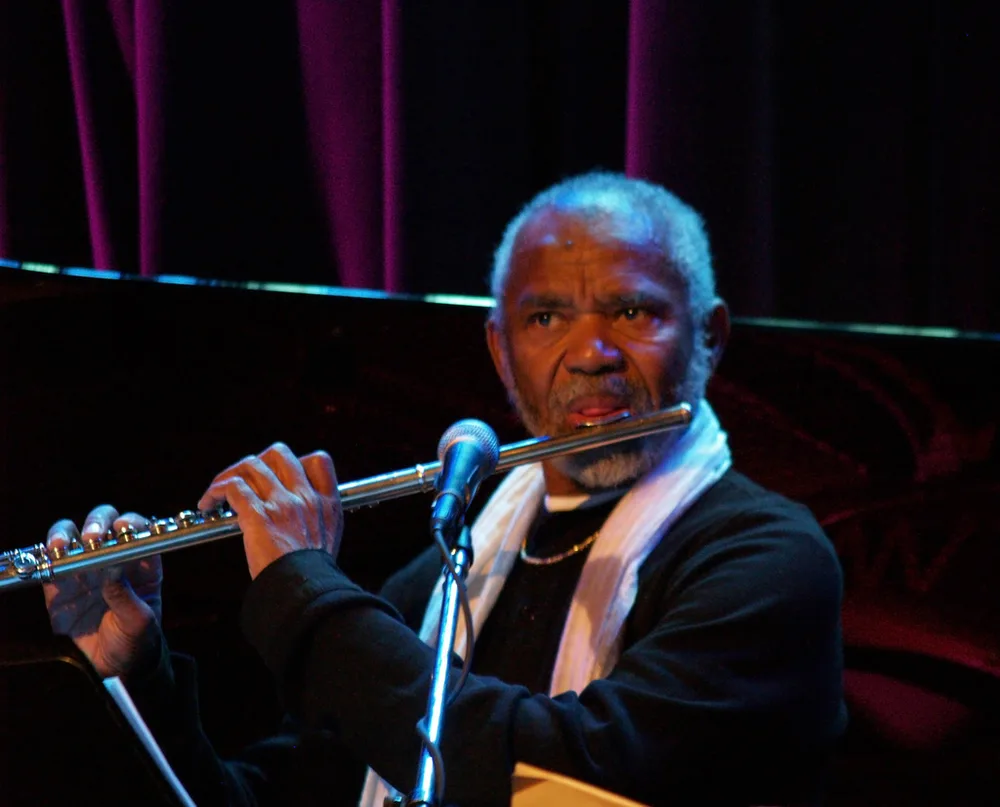
Hubert Laws, 2007. (Photo: Catalin Neacsu) CC BY 2.0 — Wikimedia Commons — https://commons.wikimedia.org/wiki/File:Hubert_Laws.jpg

Hubert Laws was born November 10, 1939, the second of eight children in a musical household in Houston's Studewood section. His mother sang, his grandfather played, and most of his siblings went on to music careers of their own, including saxophonist Ronnie Laws and vocalist Debra Laws, whose 1981 album Very Special Hubert would later produce himself. He picked up flute in high school, and by 1954 he was already playing alongside a young group of Houston musicians who would go on to become the Jazz Crusaders. He stayed with them until 1960, the year he won a scholarship to Juilliard.
That scholarship split his career in two directions at once. At Juilliard he studied under Julius Baker, one of the era's leading classical flutists, and from 1969 to 1972 he held a chair in both the New York Philharmonic and the Metropolitan Opera Orchestra. At the same time, he was moonlighting on tenor saxophone in Mongo Santamaria's band from 1963 to 1967. Most players pick a lane; Laws kept two full-time musical lives running in parallel for the better part of a decade.
Creed Taylor's CTI label is where those two lives actually met on record. Laws signed in the late 1960s, debuting on the label with 1970's Crying Song, which put a young George Benson on guitar three years before Benson's own CTI run. That same year's Afro-Classic set a jazz reading of James Taylor's "Fire and Rain" next to reworked Bach and Mozart on the same album, laying out the two-directional crossover — classical repertoire filtered through jazz, and jazz filtered through pop — that would define his 1970s catalog. The Rite of Spring (1971) went further still: an entire record built from Stravinsky's ballet score, recorded that June and released August 26. The personnel on that session — Bob James on piano and electric harpsichord, Ron Carter on bass, Jack DeJohnette on drums, and Airto Moreira on percussion, all arranged and conducted by Don Sebesky — puts Laws in direct contact with players and a producer who each receive a full profile of their own on this site.
Morning Star followed at the end of 1972, recorded at Rudy Van Gelder's studio with James, Carter, and drummer Billy Cobham, arranged again by Sebesky, and pulled Laws into a funkier soul-jazz setting that included a version of "Amazing Grace." Between Morning Star and 1975's In the Beginning, Laws picked up two Grammy nominations for Best Jazz Performance, one for each album, and a third nomination arrived in 1980 for "Land of Passion" in the Best R&B Instrumental Performance category. He never won, but three nominations across three different records and two different genre categories says as much about his range as any single trophy would. His CTI run closed out with 1977's live The San Francisco Concert and 1982's three-way co-led Studio Trieste, billed alongside Chet Baker and Jim Hall.
By the mid-1970s Laws had moved to Columbia, where the relationship with Bob James deepened from sideman to producer: James produced 1976's Romeo & Juliet, Laws's first Columbia-era album, and Laws returned the favor by appearing on several of James's own CTI and Tappan Zee records — Two (1975), Three (1976), BJ4 (1977), and Touchdown (1978). Laws's Columbia catalog also leaned harder into family: Land of Passion (1979) brought together Ronnie, Debra, Eloise, and Johnny Laws on one session, and 1980's Family included a tribute cut, "Memory of Minnie (Riperton)," written for Minnie Riperton after her death that July.
Laws never really stopped moving between worlds. He kept recording through the 1990s, worked sessions with Stevie Wonder, Paul Simon, and Aretha Franklin, and appeared on Gil Scott-Heron's Pieces of a Man back in 1971. In 2011, the National Endowment for the Arts named him an NEA Jazz Master, jazz's highest honor in the United States. Downbeat's readers voted him Flutist of the Year in the magazine's 85th Annual Readers Poll in 2020, and he's still playing live: a Baltimore performance was on the calendar as recently as March 2026. Six decades in, he's still the artist critics reach for first when the conversation turns to jazz flute.
Laws's defining trait is that he never treated "classical" and "jazz" as separate jobs. A Juilliard-trained flutist who held chairs in the New York Philharmonic and the Metropolitan Opera Orchestra at the same time he was recording jazz albums for Creed Taylor, he built his CTI-era reputation on running full classical works — Stravinsky's The Rite of Spring, passages of Bach and Mozart, later a Ravel adaptation on Family — through a jazz rhythm section without diluting either side. That's the "classical crossover" half of his sound. The other half runs the opposite direction: pop and soul material (James Taylor, Burt Bacharach-adjacent songcraft, "Amazing Grace") reworked as jazz-funk, often over the same Don Sebesky arrangements and the same CTI house rhythm section — Bob James, Ron Carter, and a rotating cast of drummers (Billy Cobham, Jack DeJohnette, Steve Gadd) and percussionists (Airto Moreira, Ralph MacDonald) — that gave the label's whole catalog its polished, radio-ready sheen.
As a flutist specifically, Laws is widely credited with helping establish the instrument as a legitimate lead voice in jazz at a moment when it was still mostly treated as a doubling instrument for saxophonists. His tone and technique carry the classical discipline directly into jazz improvisation rather than softening it, which is the throughline from his Juilliard training to his still-active live career fifty years later.
- Afro-Classic (1970, CTI Records) — The album that set the template: a jazz reading of James Taylor's "Fire and Rain" alongside reworked Bach and Mozart, with Bob James on electric piano. Spotify - Afro Classic Listen · Buy
- The Rite of Spring (1971, CTI Records) — An entire album built from Stravinsky's ballet score; the session that puts Laws in the same room as Bob James, Ron Carter, Jack DeJohnette, and Airto Moreira. Spotify - Rite Of Spring Listen · Buy
- Morning Star (1972, CTI Records) — The funkier, soul-jazz counterpart to The Rite of Spring's classical program, arranged by Don Sebesky and featuring a take on "Amazing Grace." Spotify - Morning Star (CTI Records 40th Anniversary Edition) Listen · Buy
- Romeo & Juliet (1976, Columbia) — The first Laws album Bob James produced rather than just played on, marking the start of his Columbia era. Spotify - Romeo & Juliet Listen · Buy
Hubert Laws: Full Discography (Discogs-Verified)
LEADER: full detail
| Album | Year | Label / Catalog | Personnel (selected) | Notes | Listen | Buy |
|---|---|---|---|---|---|---|
| The Laws of Jazz | 1964 | Atlantic, 1432 | Hubert Laws (flute, piccolo flute); Chick Corea (piano); Richard Davis (bass); Jimmy Cobb, Bobby Thomas (drums) | Debut album, recorded April 1964; straight-ahead jazz, pre-dates the CTI/classical-crossover era entirely | Spotify (2005 reissue w/ Flute By-Laws) | Amazon search |
| Crying Song | 1970 | CTI Records, CTI 1002 | Hubert Laws (flute); Bob James (organ, piano, string arranger); Ron Carter (bass); Billy Cobham, Grady Tate (drums); George Benson (guitar); large horn/string section; Creed Taylor (producer) | George Benson's presence here, three years before his own CTI/CrossoverJazz spotlight, is a genuine session credit, not a compilation repackaging | Spotify | Amazon search |
| Afro-Classic | 1970 | CTI Records, CTI 6006 | Hubert Laws (flute); Bob James (electric piano); Ron Carter (bass); Airto Moreira (percussion); Don Sebesky (arranger); Creed Taylor (producer) | Jazz reading of James Taylor's "Fire and Rain" alongside Bach and Mozart pieces | Spotify | Amazon search |
| The Rite of Spring | 1971 | CTI Records, CTI 6012 | Hubert Laws (flute); Bob James (piano, electric piano, electric harpsichord); Ron Carter (bass); Jack DeJohnette (drums); Airto Moreira (percussion); Don Sebesky (arranger/conductor); Creed Taylor (producer) | All-Stravinsky program; recorded June 1971, released August 26, 1971 | Spotify | Amazon search |
| Morning Star | 1972 | CTI Records, CTI 6022 | Hubert Laws (flute, alto flute, piccolo flute); Bob James (electric piano); Ron Carter (bass); Billy Cobham (drums); Ralph MacDonald (percussion); sister Eloise Laws (vocals); Don Sebesky (arranger/conductor); Creed Taylor (producer) | Funkier soul-jazz setting than the classical-crossover records; includes "Amazing Grace" | Spotify (40th Anniversary Edition) | Amazon search |
| In the Beginning | 1974 | CTI Records, CTX 3+3 | Hubert Laws (flute, arranger); Bob James (piano); Ron Carter (bass); Steve Gadd (drums); Airto Moreira (percussion); brother Ronnie Laws (tenor saxophone); Creed Taylor (producer) | Double album; brother Ronnie Laws's earliest documented session credit alongside Hubert on Discogs | Spotify | Amazon search |
| The Chicago Theme | 1975 | CTI Records, CTI 6058 S1 | Hubert Laws (flute); Steve Gadd (drums); Randy Brecker (trumpet); Don Grolnick (keyboards); Ralph MacDonald (percussion); Creed Taylor (producer) | Title track composed by Bob James (not a session credit here, writing credit only per Discogs) | Spotify | Amazon search |
| Romeo & Juliet | 1976 | Columbia, PC 34330 | Hubert Laws (flute, piccolo flute, alto flute, bass flute); Bob James (clavinet, electric piano, producer); Steve Gadd, Andy Newmark (drums); Eric Gale, Steve Khan (guitar); large horn/string section | First Bob-James-produced (not just played-on) Laws album; his CTI run had ended, this is Columbia-era | Spotify | Amazon search |
| The San Francisco Concert | 1977 | CTI Records, CTI 7071 | Hubert Laws (flute); Bob James (keyboards, arranger); Gary King (bass); Harvey Mason (drums); large orchestral string/horn section; Creed Taylor (producer) | Live album; recorded 1975 at the Paramount Theatre, released 1977 | Spotify (Live) | Amazon search |
| Say It with Silence | 1978 | Columbia, JC 35022 | Hubert Laws (arranger, conductor, producer); brother Ronnie Laws (producer) | Self- and brother-produced; no outside personnel credited on Discogs beyond engineering roles | Spotify | Amazon search |
| Land of Passion | 1979 | Columbia, JC 35708 | Hubert Laws (flute, alto flute, producer); Patrice Rushen (piano); Leon "Ndugu" Chancler (drums); Larry Dunn, Roland Bautista (of Earth, Wind & Fire); siblings Ronnie, Debra, Eloise, and Johnny Laws (vocals/sax/synth) | Full-family session; title track earned Laws's third Grammy nomination (Best R&B Instrumental Performance, 22nd Annual Grammy Awards) | Spotify (Bonus Track Version) | Amazon search |
| Family | 1980 | Columbia, JC 36396 | Hubert Laws (arranger, composer, conductor, producer); Nathan East (composer/arranger); George Butler (executive producer) | Includes an adaptation of Ravel's "Bolero" and a tribute cut, "Memory of Minnie (Riperton)," for Minnie Riperton, who had died that July | Spotify | Amazon search |
| Studio Trieste | 1982 | CTI Records, CTI 9007 | Co-billed: Chet Baker (flugelhorn, trumpet), Jim Hall (guitar), Hubert Laws (flute); Steve Gadd (drums); Don Sebesky (arranger); Creed Taylor (producer) | Genuine three-way co-led session, not a Laws solo date; recorded March-April 1982 | Spotify (billed to Chet Baker) | Amazon search |
| Make It Last | 1983 | Columbia, FC 38850 | Hubert Laws (arranger, conductor, producer, remix engineer); George Butler (executive producer); backing vocalists and horn section | Released November 11, 1983; includes a re-recorded "Morning Star" and "Swan Lake" | Spotify | Amazon search |
Additional Main-role Titles
After the 14 titles detailed above, Laws's catalog includes roughly 76 further release entries — true studio albums (from 1966's Flute By-Laws forward), live albums, compilations, reissues, and singles — listed here by title and year.
- 1966: Flute By-Laws (Atlantic)
- 1967: Let Her Go
- 1969: Laws' Cause (Atlantic)
- 1970: La Jean, Feelin' Alright (singles/tracks)
- 1971: Fire and Rain (7" single)
- 1972: Wild Flower (CTI)
- 1973: Carnegie Hall, Amazing Grace (single)
- 1974: Come Ye Disconsolate (promo 7"), Goodbye, Screaming Mothers, Then There Was Light Vol. 1 & 2
- 1975: Firebird (2xLP comp), The Chicago Theme (7" single)
- 1976: Indeciso (Undecided) (7"), In Concert - Carnegie Hall, The Main Attraction
- 1977: Nightbird & Company: Cosmic Connections (radio transcription), The Best of Hubert Laws (comp), Sound of Elegance Vol. 3 (comp)
- 1978: Library of Dynamic-Sounds (promo), False Faces, California Suite, Love Gets Better
- 1979: Tender Variations "Der Windhund" (soundtrack)
- 1980: The Best of Hubert Laws (comp), How to Beat the High Cost of Living (soundtrack), Europa Jazz
- 1981: Special Edition with Sid McCoy (radio transcription), Morning Sun (CTI)
- 1982: The Power the Glory and the Music (comp), Hubert Laws (comp), Goodbye for Now (Theme From "Reds")
- 1984: Flute Suites (comp), Song for Janet Lee
- 1985: Blanchard: New Earth Sonata / Telemann: Suite in A Minor (classical), Drums and Flutes
- 1990: The Best of Hubert Laws (comp)
- 1993: My Time Will Come
- 1994: Storm Then the Calm
- 1998: Remembers the Unforgettable Nat "King" Cole, Summertime
- 1999: A Certain Smile
- 2000: Soulero / Laws' Cause (comp), Plays French Classics in Memory of Jean-Pierre Rampal
- 2002: Baila Cinderella, Bridge Over Troubled Water
- 2003: Passion
- 2004: North Sea Jazz Sessions Vol. 3 (comp), Moondance
- 2005: Plays Bach for Barone & Baker
- 2006: Bolling's Greatest Hits (Claude Bolling collaboration)
- 2008: Siciliano (RM)
- 2009: Burt Bacharach Songbook
- 2014: Crying Song / Afro-Classic / The Rite of Spring (2xCD comp)
- 2015: Symphonic Arrangement - Suite for Flute and Jazz Piano Trio
- 2016: Cosmos
- 2018: Morning Star/Carnegie Hall/The Chicago Theme (comp), The Original Documentary Soundtrack for Gregory Porter: Don't Forget Your Music
- 2019: In the Beginning / In Concert - Carnegie Hall (box reissue)
- 2022: Loulou / Florence - Bandes Originales des Films
PRODUCER credits
Laws is credited as producer — solo or with brother Ronnie Laws — on twelve releases, all his own Columbia-era albums already detailed above (Say It with Silence, Land of Passion, Family, Make It Last), rather than outside production work for other artists.
APPEARANCE / SIDEMAN credits
- Herbie Hancock — The Prisoner (1970, Blue Note).
- Gil Scott-Heron — Pieces of a Man (1971) and Free Will (1972), both studio albums, plus the live The Revolution Will Not Be Televised (1974).
- Aretha Franklin — Young, Gifted and Black (1972, Atlantic).
- Grover Washington Jr. — Soul Box (1973, Kudu), separately confirmed as a Bob-James-arranged Kudu session in that profile's own discography.
- Stanley Turrentine — Salt Song (1974, CTI), Nightwings (1977, Fantasy), West Side Highway (1978, Elektra/Fantasy).
- Bob James — Two (1975), Three (1976, the same session credited alongside Grover Washington Jr.), BJ4 (1977), Touchdown (1978).
- George Benson — Tell It Like It Is (1969), The Other Side of Abbey Road (1970), White Rabbit (1972), In Concert - Carnegie Hall (1976, joint billing with Laws's own 1976 live album of the same title), Space (1978).
- George Duke — Snapshot (1992).
- Stevie Wonder — A Time 2 Love (2005), confirming the session credit named in Wikipedia's Laws biography.
- Earl Klugh — The Spice of Life (2008).
- The Jazz Crusaders — Chile Con Soul (1965) and Aqua Dulce / Soul Bourgeoisie (1966), documenting continued studio contact with his old group years after he'd formally left in 1960; Tough Talk (1973) and The Young Rabbits (1975) follow later, after the band's 1971 rename to The Crusaders.
- Bob James — piano/electric piano/electric harpsichord on Crying Song (1970), Afro-Classic (1970), The Rite of Spring (1971), and Morning Star (1972); producer of Romeo & Juliet (1976); the relationship runs both ways — Laws later appeared on James's own Two (1975), Three (1976), BJ4 (1977), and Touchdown (1978).
- Don Sebesky — arranger/conductor on the core CTI catalog (Afro-Classic, The Rite of Spring, Morning Star, The San Francisco Concert, Studio Trieste).
- Creed Taylor — producer for nearly all of Laws's CTI/Kudu-era output, 1970 through 1982's Studio Trieste.
- Ron Carter, Jack DeJohnette, Airto Moreira, Billy Cobham, Steve Gadd — the rotating CTI house rhythm section across his early-1970s records.
- George Benson — guitar on Laws's 1970 debut CTI album Crying Song, three years before Benson's own CTI run; the two later shared joint billing on In Concert - Carnegie Hall (1976).
- Chet Baker and Jim Hall — genuine three-way co-led session on Studio Trieste (1982, CTI), not a Laws solo date.
- Ronnie, Debra, Eloise, and Johnny Laws — siblings who appear across his Columbia-era catalog, most fully on Land of Passion (1979); Hubert also produced Debra's Very Special (1981) and co-produced several of his own albums with Ronnie.
- Gil Scott-Heron — sideman on Pieces of a Man (1971) and Free Will (1972).
- Aretha Franklin — sideman on Young, Gifted and Black (1972, Atlantic).
- Stevie Wonder, Paul Simon — later session credits, including Wonder's A Time 2 Love (2005).
- The Jazz Crusaders — founding-era member, 1954–1960, and continued studio contact after formally leaving, including Chile Con Soul (1965) and Aqua Dulce / Soul Bourgeoisie (1966), later billed as The Crusaders.
- Grover Washington Jr. — sideman on Soul Box (1973, Kudu).
- Stanley Turrentine — sideman on Salt Song (1974, CTI), Nightwings (1977), and West Side Highway (1978).
- Herbie Hancock — sideman on The Prisoner (1970, Blue Note).
- George Duke — sideman on Snapshot (1992).
- Earl Klugh — sideman on The Spice of Life (2008).
More Crossover Jazz Artists
See all 124 Crossover Jazz artists →More American Jazz Artists
See all 567 American artists →- Wikipedia: Hubert Laws
- AllMusic: Hubert Laws
- Grammy.com: Hubert Laws
- NEA: Hubert Laws, 2011 NEA Jazz Master
- Draft source:
final-blog.mdin this folder (existing r/CrossoverJazz post, used as a starting point and cross-checked against the sources above)