 JAZZPROFILES lives in the music 1,174 Jazz Artists fully Profiled!
 Ramsey Lewis
Last updated September 7, 2026
Listen on Spotify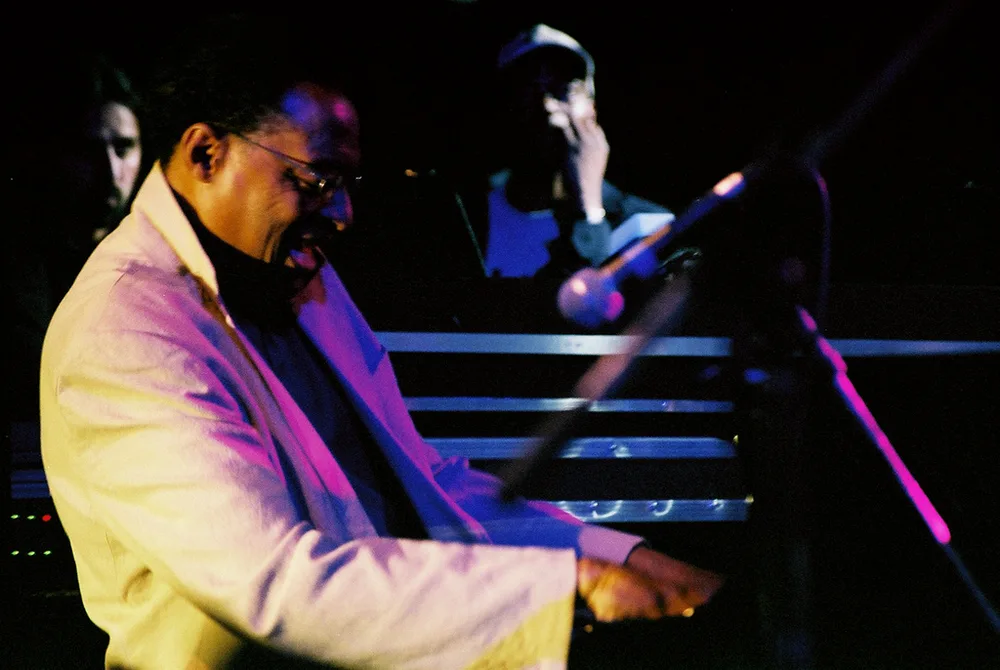
Ramsey Lewis performing at JazzFe, 2006. (Photo: Tomas Forgac) CC BY 2.0 — Wikimedia Commons — https://commons.wikimedia.org/wiki/File:Ramsey_Lewis.jpg
In 1966, a young drummer named Maurice White joined the Ramsey Lewis Trio. He stayed about four years, then left to co-found Earth, Wind & Fire. That connection, and White's eventual return, runs through the center of Lewis's story: a working jazz trio that produced one of the most influential drummers in American pop music, and that drummer coming back years later to help make his old bandleader's biggest crossover record.
Lewis was born in Chicago on May 27, 1935, and started at the piano as a kid at church. By 15 he had joined a group called the Clefs, and not long after he formed his own trio with bassist Eldee Young and drummer Isaac "Redd" Holt. Their debut album came out in 1956. For almost a decade they were a respected, straight-ahead jazz act, nothing more.
Then came a fluke. Recording live at the Bohemian Caverns, a nightclub in Washington, D.C., over three nights in May 1965, the trio added a song to the set at the last minute: an instrumental cover of "The 'In' Crowd." Nobody built the album around it. It became the hit anyway, climbing to No. 5 on the Billboard Hot 100 and No. 2 on the R&B chart, while the album itself hit No. 2 on the Billboard 200 and went gold. The record won Lewis his first Grammy, for Best Instrumental Jazz Performance, Small Group, and the single was inducted into the Grammy Hall of Fame in 2009.
Young and Holt left in 1966 to form their own act, Young-Holt Unlimited, and Lewis rebuilt around bassist Cleveland Eaton and a new drummer, Maurice White. White's stay was short by career standards, out again by 1970 to start Earth, Wind & Fire. But he didn't disappear from Lewis's story. In 1974, White came back, this time behind the boards as producer, and helped Lewis make Sun Goddess, the album that marked Lewis's first time on an electronic keyboard. It hit No. 1 on the R&B albums chart and went gold, funk and soul running straight through a record still built by a jazz pianist. White returned to produce Lewis again on Sălongo (1976) and Sky Islands (1993), nearly 20 years after Sun Goddess.
Lewis kept working for another five decades. He recorded more than 130 album-length titles across labels from Argo and Chess to Columbia, GRP, and Concord, earned the National Endowment for the Arts' Jazz Masters Award in 2007, and in 2011 revisited his own catalog with Taking Another Look, a reworking of the Sun Goddess material. In 2002, in one of the stranger honors a jazz musician has picked up, he carried the Olympic Torch through Chicago on its way to the Salt Lake City Winter Games. Ramsey Lewis passed away on September 12, 2022, in Chicago, at 87.
Lewis's career traces a direct arc through crossover jazz's own history: a straight-ahead piano trio in the 1950s, an accidental pop/R&B crossover hit in 1965 that never fully let him return to being just a jazz act, and a deliberate move into electric keyboards and funk-inflected production in the mid-1970s under Maurice White's direct influence. Sun Goddess and its immediate follow-ups placed him squarely inside the jazz-funk sound White was simultaneously building with Earth, Wind & Fire, while his later Concord Jazz work in the 2000s shows a return toward more straightforwardly acoustic, orchestral jazz piano.
On the keyboard itself, Lewis pointed to no single influence when asked directly, but named several pianists as formative: his father brought home records of Teddy Wilson, Dorothy Donegan, and Art Tatum, whose technique Lewis said sounded like "six hands and 40 fingers," and later records by Erroll Garner and Oscar Peterson. A mentor named Burton showed him what Peterson, Garner, Tatum, and George Shearing could do inside the standard American songbook. Critics have generally heard that Tatum/Peterson lineage most clearly in his earliest trio recordings, before the 1965 hit and the 1970s electric turn pulled his sound toward funk and soul.
- The In Crowd (1965, Cadet) - His accidental breakthrough, recorded live at the Bohemian Caverns, Washington D.C. Spotify - The In Crowd Listen
- Sun Goddess (1974, Columbia) - His first prominent use of electronic keyboards, produced by Maurice White; No. 1 R&B albums, gold certified. Spotify - Sun Goddess Listen · Buy
- Sălongo (1976, Columbia) - A second confirmed Maurice White production credit, continuing the jazz-funk direction of Sun Goddess. Spotify - Sălongo Listen · Buy
- Wade In The Water (1966, Cadet) - The first Main-role release with Maurice White on drums. Spotify - Wade In The Water Listen · Buy
Ramsey Lewis: Full Discography (Discogs-Verified)
Discogs profile summary
- Real name: Ramsey Emmanuel Lewis Jr.
- Discogs bio: "American jazz pianist and keyboardist, born May 27, 1935 in Chicago, Illinois, USA, died September 12, 2022 in Chicago, Illinois, USA."
- Name variations on file: Davis, Lewis, R. Lewis, R.E. Lewis Jr., Ramesy Lewis, Ramsel Lewis, Remsey Lewis, Remsy Lewis, plus Cyrillic and Japanese transliterations.
- Group affiliations on file: Urban Knights, The Ramsey Lewis Trio, Max Roach Quintet, Ramsey Lewis Quintet, Ramsey Lewis Quartet, Ramsey Lewis And His Electric Band.
LEADER (solo): full detail
Personnel pulled directly from each release's Discogs extraartists credits (one representative release per title/year, generally the original pressing). Limited to 16 titles chosen for historical/narrative significance (the trio-era classics, the Maurice White/Sun Goddess run, and a spread across his later GRP/Concord decades); see the scoping note below the table.
| Album | Year | Label / Catalog | Personnel (selected) | Notes | Listen | Buy |
|---|---|---|---|---|---|---|
| Wade In The Water | 1966 | Cadet, LPS 774 | Cleveland Eaton (bass), Maurice White (drums); Richard Evans (arranger/conductor); Esmond Edwards (producer) | Recorded June 1966, Universal Studios, Chicago. First Main-role release with Maurice White on drums. | Spotify | Amazon search |
| Maiden Voyage | 1968 | Cadet, LPS 811 | Cleveland Eaton (bass), Maurice White (drums); Charles Stepney (producer/arranger) | Recorded Universal Studios, Chicago, April 1968. | Spotify | Amazon search |
| Mother Nature's Son | 1969 | Cadet, LPS-821 | Charles Stepney (arranger/conductor/Moog effects, producer); all-instrumental covers of the Beatles' White Album | Recorded Ter Mar Studios, Chicago, December 1968. | Spotify | Amazon search |
| Them Changes | 1970 | Cadet, LPS-844 | Cleveland Eaton (electric bass), Morris Jennings (drums), Phil Upchurch (guitar); Lewis self-produced | Live, recorded at The Depot, Minneapolis, May 8-9, 1970. Maurice White not credited here; his departure from the trio dates to around this point. | Spotify | Amazon search |
| Back To The Roots | 1971 | Cadet, CA-60001 | Cleveland Eaton (bass), Henry Gibson (congas/percussion), Morris Jennings (drums); Esmond Edwards (producer) | YouTube (not found on Spotify) | Amazon search | |
| The Groover | 1972 | Cadet, CA 50020 | Eldee Young (bass), Isaac "Redd" Holt (drums); Esmond Edwards (producer) | Vault release: recorded live October 1965 at the Lighthouse Cafe, Hermosa Beach, CA, with the original trio lineup, issued seven years later in 1972. | not found (no Spotify listing; the previous full-album YouTube upload and the album's Bandcamp page have both been taken down; no live replacement located) | Amazon search |
| Funky Serenity | 1973 | Columbia, KC 32030 | Cleveland Eaton (bass/percussion), Morris Jennings (drums/congas/percussion); Teo Macero (executive producer); Lewis (producer/arranger) | First Columbia-label album after leaving Chess/Cadet. | Spotify | Amazon search |
| Sun Goddess | 1974 | Columbia, KC 33194 | Lewis (piano, Fender Rhodes/Wurlitzer, ARP synth, arranger, producer); Teo Macero (producer); Richard Evans (horn/string arrangements). Flag: this specific release's Discogs extraartists list does not itself name Maurice White or Earth, Wind & Fire, but multiple independent sources (Wikipedia's "Sun Goddess" song and album pages, mauricewhite.com) confirm Maurice White produced the title track and that Verdine White, Philip Bailey, Johnny Graham, and Don Myrick of Earth, Wind & Fire performed on it, alongside Charles Stepney on synthesizer. Treating the Discogs entry as incomplete rather than the other sources as wrong. |
Recorded/released 1974. Lewis's first prominent use of electronic keyboards. Peaked No. 12 Billboard 200, No. 1 R&B albums, gold certified. | Spotify | Amazon search |
| Don't It Feel Good | 1975 | Columbia, PC 33800 | Lewis (clavinet/piano/Fender Rhodes/Steinway/ARP, producer); Morris Jennings (drums/percussion); Charles Stepney (synths, producer, engineer); Derf Reklaw (flute/vocals) | Direct follow-up to "Sun Goddess," same jazz-funk direction. | Spotify | Amazon search |
| Sălongo | 1976 | Columbia, PC 34173 | Maurice White (producer, alongside Charles Stepney); Lewis (acoustic/electric piano); Byron Gregory (guitar); Steve Cobb (drums/vocals); Tang (vocals) | Recorded at Wally Heider Recording, LA. Second confirmed Maurice White production credit on a Lewis album, this one appearing directly in the Discogs extraartists data (unlike "Sun Goddess," above). | Spotify | Amazon search |
| Tequila Mockingbird | 1977 | Columbia, JC 35018 | Larry Dunn of Earth, Wind & Fire and Bert DeCoteaux (producers/arrangers); Ernie Watts, George Bohanon, Oscar Brashear (horns); Byron Gregory (guitar) | A second, later Earth, Wind & Fire personnel connection (Larry Dunn, EW&F's keyboardist, as co-producer) beyond the Maurice White thread used in the blog. | Spotify | Amazon search |
| Three Piece Suite | 1981 | Columbia, FC 37153 | Large ensemble date: Robert Irving III and Tom Washington (electric piano/piano), Henry Johnson and Randy Hall (guitar), Vincent Wilburn (drums), full horn and string section; Tom Tom 84 (producer/arranger/conductor) | Vincent Wilburn Jr. later became Miles Davis's drummer and nephew-by-marriage collaborator; not otherwise used in the blog. | Spotify | Amazon search |
| Chance Encounter | 1982 | Columbia, FC 38294 | Tom Tom 84 (producer/arranger/conductor); recorded at PS Studios, Chicago, with vocals at CBS Recording Studios, New York | Spotify | Amazon search | |
| Urban Renewal | 1989 | Columbia, FC-44190 | Kevyn Lewis (Ramsey's son, producer/arranger/co-writer); Bill Dickens and Vaughn Halyard (co-producers); George Butler (executive producer) | A family collaboration; Kevyn Lewis co-produced and co-wrote. | Spotify | Amazon search |
| Sky Islands | 1993 | GRP, GRD-9742 | Dave Grusin and Larry Rosen (executive producers, GRP's own founders); Maurice White and Carl Griffin (producers); Frayne Lewis (producer) | Third confirmed Maurice White production credit on a Lewis album (after "Sălongo" and the "Sun Goddess" sources above), on Lewis's GRP-era work nearly 20 years after "Sun Goddess." | Spotify | Amazon search |
| Songs From The Heart: Ramsey Plays Ramsey | 2009 | Concord Jazz, CJA-31313-02 | Larry Gray (bass), Leon Joyce Jr. (drums); Lewis (piano, producer); Frayne Lewis (assistant producer) | His first Concord Jazz release; string/orchestra pieces that premiered live at Ravinia. | Spotify | Amazon search |
Additional solo-billed albums (Discogs-confirmed title/year, personnel not individually pulled in this pass)
Discogs lists 134 distinct album-length "Main"-role titles for artist 55738 after removing 7" two-sided singles. Full extraartists-level personnel was pulled for the 16 titles above. For the remaining 118 titles, most are earlier trio-era LPs not otherwise central to the crossover-jazz narrative, later-career studio dates, live archival releases, or compilations (marked with an asterisk where the title itself indicates a compilation/"Best of"/anthology package). Genuinely flagging this as a scoping decision, not a guess: pulling full session personnel for every one of a nearly-70-year, 130-plus title catalog was not completed in this pass.
Titles marked with an asterisk are, based on their naming pattern (Best Of / Anthology / two-fer reissue / mood-series titles), most likely compilations or reissue packages rather than newly recorded studio sessions; not individually confirmed track-by-track in this pass.
- 1962: Country Meets The Blues
- 1966: DeLuxe Album*, The Look Of Love
- 1967: The Movie Album, Hey Mrs. Jones, Dancing In The Street, Goin' Latin
- 1968: No Calor Da Noite*, Ramsey Lewis' Greatest Hits!*, Have Yourself A Merry Little Christmas, Party Time, "Live" In Tokyo, Up Pops Ramsey Lewis
- 1969: Julia
- 1970: Ramsey Lewis, The Piano Player, The Best Of Ramsey Lewis*, Do Whatever Sets You Free
- 1971: The Way We Feel*
- 1972: The "In" Crowd (1972 Chess reissue of the 1965 original)*, Inside Ramsey Lewis, Kufanya Mapenzi (Making Love)
- 1973: Golden Hits*, Hang On Sloopy (Funky Reggae Style)
- 1974: Nostalgia - Number One*, The Everywhere Calypso, Solar Wind, Solid Ivory, Hot Dawgit
- 1975: What's The Name Of This Funk (Spider Man)
- 1976: Prime Cuts*, Ramsey Lewis - Vol. 1 "Solid Ivory", Spotlight On Ramsey Lewis, His Greatest Hits*, Brazilica, Solid Ivory: His Greatest Hits*, Three With Spirit*
- 1977: Reflection - Ramsey Lewis*, Spotlight On Jazz Piano Essence*, Skippin', Love Notes
- 1978: Legacy
- 1979: Wearin' It Out, Ramsey
- 1980: Whisper Zone, Ramsey Lewis '80, Body & Soul, Come Back Jack, The Best Of*, Routes
- 1981: Romance Me, Lakeshore Cowboy, Blues For The Night Owl
- 1982: A Conversation With Ramsey Lewis, Sassy Stew, Live At The Savoy
- 1983: Les Fleurs, His Greatest Sides: Volume One*
- 1984: The Two Of Us, Quiet Storm
- 1985: Slow Dancin', This Ain't No Fantasy, Fantasy
- 1986: I Love Contemporary Jazz*
- 1987: The Greatest Hits Of Ramsey Lewis*, 7-11, Keys To The City
- 1988: Greatest Hits*, Classic Encounter
- 1989: Ramsey Lewis (self-titled), Eye On You, The "In" Crowd - 18 Greatest Hits*, We Meet Again
- 1991: The "In" Crowd & Other Greatest Hits*, 16 Greatest Hits*, Electric Collection*
- 1992: Instrumental Soul Hits*, Ivory Pyramid
- 1993: Tonight, People Make The World Go 'Round
- 1994: The "Swinging" And "Boppin" Ramsey Lewis*
- 1995: Collection*
- 1996: In Person, Between The Keys
- 1997: This Is Jazz*
- 1998: Sound Of Christmas, Priceless Jazz Collection*, Dance Of The Soul
- 1999: Appassionata
- 2000: Ramsey Lewis's Finest Hour*
- 2001: Meant To Be
- 2003: Simple Pleasures
- 2004: Love Songs*
- 2005: With One Voice (gospel/inspirational project)
- 2006: The In Crowd Anthology*, Legends Of Jazz With Ramsey Lewis* (companion release to his PBS "Legends of Jazz" TV series), Legends Of Jazz Showcase With Ramsey Lewis*, The Very Best Of Ramsey Lewis*
- 2009: The Best Of Ramsey Lewis "The In Crowd"*
- 2010: Upendo Ni Pamoja & Sun Goddess* (two-fer reissue), Plays The Beatles Songbook*
- 2011: Sun Goddess - The Best Of Ramsey Lewis* (compilation; the 2011 studio remake "Taking Another Look" was not found as a standalone Discogs Main-role title and may be catalogued only under a different entry, not resolved in this pass)
- 2013: Routes & Three Piece Suite* (two-fer reissue), A Simple Discovery
- 2014: Complete Recordings 1957-1960*, Vol. 2 - Eight Classic Albums*, Complete Recordings 1960-1962*
- 2017: Milestones Of A Legend*, Black Eyed Peas (compilation title, unclear if related to the group of the same name or a coincidental title, not resolved in this pass)
- 2019: VII
- 2022: The Beatles Songbook*, His Eight Finest Lp's*
- Undated: The Best Of Ramsey Lewis Vol. 2*, Golden Jazz-Rock*, Soul Man*, Golden Jazz-Rock Vol. 2*, Fusion The Fusion Special*, Tobacco Road, Sunday Blues
Singles (7" two-sided releases, Main role)
Discogs-verified title/year, excluded from the album count above since these are 45 rpm singles, not LPs: Up Tight / Wade In The Water (1966), Day Tripper / Rudolph The Red-Nosed Reindeer (1966), Up Tight / Money In The Pocket (1966), One, Two, Three / Down By The Riverside (1967), Function At The Junction / Hey, Mrs. Jones (1967), Soul Man / Struttin' Lightly (1967), Girl Talk / Dancing In The Street (1967), China Gate / Saturday Night After The Movies (1967), Since You've Been Gone / Les Fleur (1968), The Look Of Love / Bear Mash (1968), Mother Nature's Son / Julia (1969), Cry Baby Cry / Rocky Raccoon (1969), Cry Baby Cry / Wade In The Water (1969), Encore! / Ramsey Lewis In Tokyo Vol. 2 (1969), Everybody's Talkin' / The Love I Feel For You (1970), We've Only Just Begun / Back To The Roots (1971), Candida / Love Now On (1971), He Ain't Heavy, He's My Brother / Up In Yonder (1971), Wade In The Water / Soul Man (1972), Slipping Into Darkness / Upendo Ni Pamoja (1972), Summertime / Look-A-Here (1972), Slipping Into Darkness / Collage (1972), Wade In The Water / The In Crowd (1973), Hi Heel Sneakers / Wade In The Water (1973), Spider Man / Sun Goddess (1975), Upendo Ni Pamoja / Funky Serenity (1975), Sun Goddess / Jungle Strut (1975), Hot Dawgit / Sun Goddess (1974), Don't It Feel Good / Fish Bite (1976), and several dozen further two-sided pressings/reissues of the same handful of hit singles across international markets (Bellaphon, Hispavox, CBS/Sony) through the 1970s-80s, not individually reproduced here.
Notable connections (curated)
Unlike a horn player who logs dozens of sideman dates for other leaders, Ramsey Lewis's non-leader Discogs credits (311 "Appearance" + 774 "TrackAppearance" entries, 1,085 total) are overwhelmingly additional pressings, foreign releases, and various-artists/anthology compilations of his own catalog, not genuine session work for other named artists. Genuinely distinct items surfaced in this pull:
- Lem Winchester and the Ramsey Lewis Trio (Jazzville) — a real joint billing with vibraphonist Lem Winchester, undated in the Discogs entry, likely early 1960s.
- The Music Of Earth, Wind & Fire (2009) — a various-artists tribute compilation that includes a Lewis track, surfacing the Maurice White/EW&F connection from a different angle than the "Sun Goddess"/"Sălongo" production credits above.
- Oscar, With Love (2015) and Grover Live (2010, likely a Grover Washington Jr. tribute/reissue project, not independently confirmed) — tribute-compilation appearances involving other jazz figures also covered or coverable on r/CrossoverJazz.
- Maurice White - his trio's drummer (1966-c.1970) before co-founding Earth, Wind & Fire; returned as producer on Sun Goddess (1974), Sălongo (1976), and Sky Islands (1993).
- Eldee Young and Isaac "Redd" Holt - his original trio partners (bass and drums), 1956-1966, before leaving to form Young-Holt Unlimited.
- Cleveland Eaton - bassist through the Maurice White era and beyond, on Wade In The Water, Maiden Voyage, and other Cadet-era albums.
- Charles Stepney - arranger and producer across multiple Cadet-era albums, including Mother Nature's Son (1969) and Don't It Feel Good (1975).
- Larry Dunn - Earth, Wind & Fire's keyboardist, co-producer on Tequila Mockingbird (1977), a second EW&F personnel connection beyond White.
- Kevyn Lewis - his son, producer/arranger/co-writer on Urban Renewal (1989).