 JAZZPROFILES lives in the music 1,572 Jazz Artists fully Profiled!
 Duke Pearson
Last updated August 30, 2026
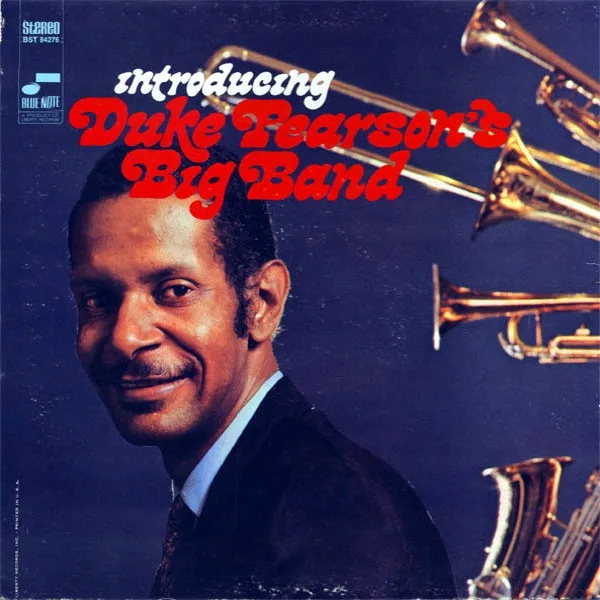
Cover art for Duke Pearson's "Introducing Duke Pearson's Big Band" (Blue Note, 1968), used as a stand-in — no free-licensed photo of Pearson could be located after a genuine search. Standard copyright, all rights reserved — held by Blue Note Records. Cover photograph by Joel Brodsky. This is not a Creative Commons–licensed image; it is used here as an honestly-disclosed editorial stand-in for a real photo. — Downloaded directly from the release's Discogs listing (https://www.discogs.com/release/7049820-Duke-Pearsons-Big-Band-Introducing-Duke-Pearsons-Big-Band), full-resolution cover scan hosted at i.discogs.com. Saved locally as portrait.jpg in this folder.
Columbus Calvin "Duke" Pearson Jr. was born August 17, 1932, in Atlanta, Georgia. His mother started him on piano before he was six; at twelve he shifted toward brass instruments, including mellophone, baritone horn, and trumpet, before eventually returning to piano as his primary instrument. His uncle gave him the nickname "Duke," a nod to Duke Ellington. He moved to New York in January 1959, played with the Art Farmer-Benny Golson Jazztet, then joined the quintet co-led by Donald Byrd and baritone saxophonist Pepper Adams, and was soon recording for Blue Note as a leader in his own right. Donald Byrd's own career is covered in full in his JazzProfiles.com profile.
From 1963 to 1970, Pearson produced numerous recording sessions for Blue Note while also recording most of his own albums as a leader. After saxophonist Ike Quebec's death, he took over as the label's A&R man, a role he held until 1971, effectively shaping the sound and direction of Blue Note's output during one of its most creatively significant stretches. He also led a big band from 1967 to 1970 and again in 1972, hiring players including Pepper Adams, Chick Corea, Lew Tabackin, Randy Brecker, and Garnett Brown.
Pearson's own compositions became jazz standards in their own right: the somber "Cristo Redentor," written for Donald Byrd, "Sweet Honey Bee," recorded by himself and Lee Morgan, and "Jeannine," one of the most-covered pieces in the modern jazz repertoire. He was diagnosed with multiple sclerosis in the 1970s and died at Atlanta Veterans Hospital on August 4, 1980.
Pearson's dual role, working pianist/composer and Blue Note's own A&R gatekeeper, gave him a rare vantage point on soul-jazz's development in the 1960s, shaping the label's output as much through his production judgment as through his own compositions and performances.
- "Cristo Redentor" (with Donald Byrd) - His best-known composition, a somber jazz standard.
- Sweet Honey Bee (1967, Blue Note) - Featuring Lee Morgan; a defining leader session.
- "Jeannine" - One of the most-covered pieces in the modern jazz repertoire.
Duke Pearson: Discography (Leader)
Identity confirmed via Discogs artist ID 29955 ("Duke Pearson").
| Album | Year | Label | Notes |
|---|---|---|---|
| Profile | 1960 | Blue Note | |
| Tender Feelin's | 1960 | Blue Note | |
| Wahoo! | 1965 | Blue Note | |
| Prairie Dog | 1966 | Blue Note | |
| Sweet Honey Bee | 1967 | Blue Note | Featuring Lee Morgan. |
| The Right Touch | 1967 | Blue Note | |
| The Phantom | 1968 | Blue Note | |
| Introducing Duke Pearson's Big Band | 1968 | Blue Note | |
| Merry Ole Soul | 1969 | Blue Note | |
| Now Hear This | 1969 | Blue Note | |
| How Insensitive | 1969 | Blue Note | |
| Dedication! | 1970 | Blue Note | |
| It Could Only Happen with You | 1974 | (period label) |
His extensive production/A&R credits for Blue Note (1963-1971) are not itemized individually here. Donald Byrd's own catalog, including "Cristo Redentor," is covered in Donald Byrd's own profile.
- Donald Byrd - bandmate in the Byrd-Adams quintet; wrote "Cristo Redentor" for him; profiled separately on JazzProfiles.com.
- Pepper Adams - Byrd-Adams quintet bandmate and big-band collaborator.
- Chick Corea, Lew Tabackin, Randy Brecker, Garnett Brown - big band personnel, 1967-1972.