 JAZZPROFILES lives in the music 1,572 Jazz Artists fully Profiled!
 Bill Dixon
Last updated September 26, 2026
Listen on Spotify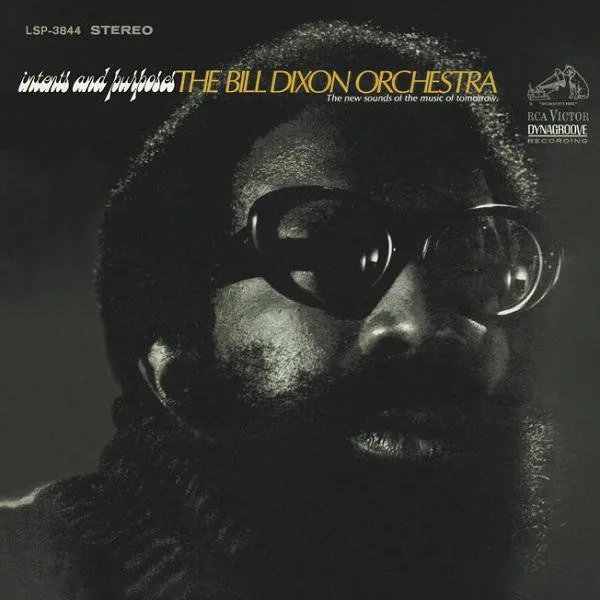
Bill Dixon on the cover of *Intents and Purposes*, credited to The Bill Dixon Orchestra (RCA Victor LSP-3844, 1967). Cover photograph by David B. Hecht. Album cover art (not a CC-licensed artist photo) - used as the only available image showing the artist — Discogs release page for Intents and Purposes, RCA Victor LSP-3844 - https://www.discogs.com/release/1442126
William Robert Dixon was born October 5, 1925, on Nantucket, Massachusetts, and moved with his family to Harlem in 1934. He came to music late by the standards of his generation: he enlisted in the Army in 1944, served with a unit stationed in Germany, and was discharged in 1946, after which he used the GI Bill to enroll at the Hartnette Conservatory of Music, where he studied from 1946 to 1951. He trained as a painter in parallel, at Boston University, the WPA Arts School, and the Art Students League, and he never treated the two disciplines as separate careers. From 1956 to 1962 he held a staff job at the United Nations, where he founded the UN Jazz Society, running concerts inside an institution that had no music program of its own.
Dixon's first records came out of a partnership with tenor saxophonist Archie Shepp. The two co-led a pianoless quartet that cut Archie Shepp - Bill Dixon Quartet for Savoy in October 1962, issued the following year, with Don Moore and Reggie Workman splitting the bass chair and Paul Cohen and Howard McRae on drums. A contractual obligation to deliver Savoy a second album, by which point Shepp and Dixon had gone their separate professional ways, produced the 1964 split LP Bill Dixon 7-tette / Archie Shepp and the New York Contemporary 5, with Dixon's septet on one side and Shepp's group, including Don Cherry and John Tchicai, on the other. Dixon also produced both dates himself, the beginning of a long habit of controlling the terms on which his music reached the public.
The event that fixed his place in the music's history was not a record. In April 1964, living on Manhattan's Upper West Side, Dixon found the Cellar Café at 251 West 91st Street and began booking Sunday concerts there. That October 1 through 4 he organized and produced the October Revolution in Jazz, four days of more than forty performances and panel discussions that drew roughly 700 people, financed largely out of his own pocket. Paul Bley, Jimmy Giuffre, Sun Ra, Rashied Ali, Giuseppi Logan, Ken McIntyre, John Tchicai, Roswell Rudd, Alan Silva, and the Albert Ayler trio appeared; Cecil Taylor, Pharoah Sanders, Ornette Coleman, Steve Lacy, and Gil Evans were among those who took part in the discussions. Within weeks Dixon co-founded the Jazz Composers Guild with Taylor, Shepp, Sun Ra, Rudd, Tchicai, and Burton Greene, a cooperative meant to give musicians bargaining power against club owners and force the press to pay attention. The Guild put on a "Pre-Halloween Jazz Party" on October 30 and 31 and the four-night "Four Days in December" series at Judson Hall, and although it collapsed within a year, the big band Carla Bley and Michael Mantler assembled under its umbrella survived as the Jazz Composer's Orchestra.
Dixon was working the other side of Greenwich Village at the same time, as a participant in the Judson Dance Theater at Judson Memorial Church. He was among the first musicians to build concerts around free improvisation and dance together, working for several years with the dancer Judith Dunn as the Judith Dunn/Bill Dixon Company. Their premiere of his piece "Pomegranate" at the 1966 Newport Jazz Festival led to a contract with RCA Victor. Signed to deliver a quartet record, he delivered instead Intents and Purposes, built around "Metamorphosis 1962-1966" for a ten-piece ensemble that mixed free players with mainstream ones: Jimmy Cheatham, Byard Lancaster, Robin Kenyatta, George Marge, Catherine Norris, Jimmy Garrison and Reggie Workman on two basses, Robert Frank Pozar, and Marc Levin, the last two his students at the time. Recorded across three sessions between October 1966 and February 1967 and released later that year, it was reviewed at five stars in DownBeat, then went out of print for decades, surfacing only on a 1972 Japanese pressing and a 1976 French one before International Phonograph finally reissued it on CD in 2011. That October he had also gone into Van Gelder's studio for Cecil Taylor's Conquistador!, alongside Jimmy Lyons, Henry Grimes, Alan Silva, and Andrew Cyrille.
In 1968 Dixon took a teaching post at Bennington College in Vermont and kept it until 1995, founding and chairing the college's Black Music Division. The move effectively removed him from the New York scene. From 1970 to 1976 he played, in his own phrase, "in total isolation from the market places of this music," recording solo trumpet at Bennington with no label waiting for the tapes. That material eventually reached the public backward: two Italian Fore LPs, Considerations 1 and Considerations 2, in 1981; a Cadence double LP, Collection, in 1985; and finally the self-released six-CD box Odyssey, issued in 2001 with two booklets of interviews, essays, and reproductions of his paintings. He continued to paint and exhibit throughout, and assembled his letters, scores, and drawings into the volume L'Opera. Twenty-five lithographs he made at URDLA in Villeurbanne in 1994 are held by the Bibliothèque nationale de France.
His recording career restarted in Italy. Giovanni Bonandrini brought a Dixon sextet to Barigozzi Studios in Milan in June 1980 and was impressed enough to ask for two albums instead of one, yielding Bill Dixon in Italy Volumes One and Two on Soul Note. A decade-and-a-half run of Soul Note records followed: the double November 1981, split between a live Zurich set and a Milan studio date and rated four stars out of four by the Penguin Guide to Jazz, which called it his small-group masterpiece; Thoughts, cut at Bennington's Paul Robeson House in May 1985 with Peter Kowald, William Parker, and Mario Pavone all on bass; Son of Sisyphus, from 1988; and the two volumes of Vade Mecum, drawn from three days at Milan's Mu Rec Studio in August 1993 with Barry Guy and Parker on basses and the British percussionist Tony Oxley, the partner who defined his late work. Dixon and Oxley recorded the two Papyrus volumes as a duo in 1998 and reconvened with bassists Matthias Bauer and Klaus Koch for Berlin Abbozzi, taped at the Podewil in Berlin in November 1999.
The last stretch of his life was his most visible in thirty years. He and Taylor, who had not recorded together in a studio since Conquistador!, cut the duo sessions later issued as Duets 1992, then met again onstage with Oxley at Victoriaville in May 2002. In June 2007 the Vision Festival gave Dixon its Lifetime Recognition and commissioned a large-ensemble premiere, taped at the Angel Orensanz Center on June 20 and released as 17 Musicians in Search of a Sound: Darfur. That September he recorded in Chicago with Rob Mazurek's Exploding Star Orchestra, and in July 2008 convened a nine-piece band at Firehouse 12 in New Haven for Tapestries for Small Orchestra, a two-CD set with a documentary film, which DownBeat gave five stars and called the strongest case for his stature since November 1981. His final performance came at Victoriaville on May 22, 2010, weeks before his death; his health had deteriorated to the point that his own solos were prerecorded and played back during the concert. The tape was issued in 2011 as Envoi. Dixon passed away in his sleep at his home in North Bennington on June 16, 2010, at 84.
Dixon built a trumpet vocabulary out of the parts of the horn most players avoid. He worked constantly in the pedal register, below the instrument's conventional floor and down into trombone and tuba territory, used half-valve positions and unvoiced breath as sound in their own right, and applied electronic delay and reverb to smear and extend what came out. He almost never used mutes, the Harmon being the one exception. What that produced was less a solo style than an orchestrator's ear applied to a single horn: a dark, pan-tonal music built around silence and long-held color, closer in its structural thinking to Webern (he titled pieces after him) than to bebop lineage. The Penguin Guide to Jazz noted that he often kept himself in the background of his own records, spreading the high voicing across his front line rather than soloing over it, and AllMusic's Brian Olewnick heard "solitary, thoughtful melancholy" with "more than a touch of Miles Davis" in the solo work. Francis Davis, writing in the Village Voice after the 2011 reissue of Intents and Purposes, called it as bold as anything released that year. Dixon's influence ran as much through organizing and teaching as through records: the October Revolution and the Jazz Composers Guild are routinely cited as the starting point of musician-run jazz presentation in the United States, a line that runs on through the Jazz and People's Movement and the AACM, and twenty-seven years at Bennington put him in front of several generations of players, among them Arthur Brooks and Stephen Haynes, who were still in his bands decades later.
- Intents and Purposes (recorded 1966-67; released 1967, RCA Victor) - His first album as a leader and the record his reputation rests on, a ten-piece orchestral session built around "Metamorphosis 1962-1966," with Jimmy Garrison and Reggie Workman on two basses. Not confirmed on Spotify.
- November 1981 (recorded 1981; released 1982, Soul Note) - A double album split between a Zurich concert and a Milan studio date, awarded four stars out of four by the Penguin Guide to Jazz, which called it his small-group masterpiece. Spotify - November 1981 Listen
- Vade Mecum (recorded 1993; released 1994, Soul Note) - The first of two volumes from three days in Milan with Barry Guy and William Parker on basses and Tony Oxley on percussion, the quartet that defined his later music. Spotify - Vade Mecum Listen
- Vade Mecum II (recorded 1993; released 1996, Soul Note) - Drawn from the same sessions and rated higher than the first volume by both AllMusic and the Penguin Guide. Spotify - Vade Mecum II Listen
- Tapestries for Small Orchestra (recorded 2008; released 2009, Firehouse 12) - A nine-piece commission recorded over three days in New Haven, issued as two CDs plus a documentary film, and given five stars by DownBeat. Not confirmed on Spotify.
- 17 Musicians in Search of a Sound: Darfur (recorded 2007; released 2008, AUM Fidelity) - The large-ensemble premiere commissioned for his Lifetime Recognition at Vision Festival XII, written in response to the killings in Darfur. Spotify - 17 Musicians in Search of a Sound: Darfur Listen
- Archie Shepp - Bill Dixon Quartet (recorded 1962; released 1963, Savoy) - The debut record for both men, a pianoless quartet whose free-but-swinging approach Ekkehard Jost compared to the early Don Cherry and Ornette Coleman groups. Spotify - Quartet
- Conquistador! (recorded 1966; released 1968, Cecil Taylor, Blue Note) - As a sideman: Taylor's Blue Note sextet date with Jimmy Lyons, Henry Grimes and Alan Silva on two basses, and Andrew Cyrille. Spotify - Conquistador!
Bill Dixon: Full Discography
Identity confirmed via the live Discogs API: artist ID 258128 ("Bill Dixon," realname William Robert Dixon, born October 5, 1925 in Nantucket MA, died June 16, 2010 in North Bennington VT). Discogs credits that artist page with 81 releases (29 "Main"/leader, 34 sideman "Appearance," 8 "Producer," 3 "TrackAppearance," 7 unofficial). Four of his leader dates are filed on Discogs under separate group entities rather than his personal page and are folded into the table below: The Bill Dixon Orchestra (1207274), Bill Dixon 7-Tette (1713109), The Archie Shepp-Bill Dixon Quartet (2296486), and Bill Dixon Quartet (9272440). Dixon's leader catalog is small enough to itemize in full; the sideman/producer table lists every significant credit rather than a selection.
As Leader / Co-Leader
| Album Title | Recording Date(s) | Release Date | Label | Catalog Number | Format(s) | Personnel | Role | Reissue History | Spotify | Buy | Notes |
|---|---|---|---|---|---|---|---|---|---|---|---|
| The Archie Shepp - Bill Dixon Quartet | Recorded October 1962, New York | 1963 | Savoy Records | MG-12178 | Vinyl, LP, Album, Mono | Bill Dixon (trumpet, flugelhorn), Archie Shepp (tenor sax), Don Moore and Reggie Workman (bass), Paul Cohen and Howard McRae (drums) | Co-leader; also co-producer with Shepp | Reissued 1970 in France on BYG as Peace, with the side-two running order flipped; unofficial Free Factory CD, 2010; two tracks on 7-Tette & Orchestra Revisited (ezz-thetics 1157, 2023) | Spotify - Quartet | — | Debut record for both leaders. Discogs gives the location as New York; the 2023 ezz-thetics reissue says Savoy Studios, Newark |
| Bill Dixon 7-Tette / Archie Shepp and the New York Contemporary 5 | Dixon side recorded March 4, 1964, Savoy Studios, Newark; NYC5 side recorded February 5, 1964, New York City | September 8, 1964 | Savoy Records | MG-12184 | Vinyl, LP, Album, Mono | Dixon side: Bill Dixon (trumpet, composer), Ken McIntyre (alto sax, oboe), Howard Johnson (baritone sax, tuba), George Barrow (tenor sax), Ted Curson (guest trumpet), David Izenzon and Harold Dotson (bass), Howard McRae (drums). NYC5 side: Archie Shepp (tenor sax), John Tchicai (alto sax), Don Cherry (trumpet), Ronnie Boykins (bass), Sunny Murray (drums) | Co-leader (split LP); also co-producer | Tracks reissued on New Music: Second Wave (Savoy, 1979), The History of Savoy (1984), and 7-Tette & Orchestra Revisited (ezz-thetics, 2023) | Not confirmed on Spotify | — | Delivered to satisfy a Savoy contract for a second album after Dixon and Shepp had separated professionally. Discogs lists both sides' personnel in one block, so the bass assignments per side are not itemized there |
| Intents and Purposes (as The Bill Dixon Orchestra) | Recorded October 10, 1966; January 17 and February 21, 1967; RCA Victor Studio B, New York | 1967 | RCA Victor | LSP-3844 | Vinyl, LP, Album, Stereo | Bill Dixon (trumpet, flugelhorn), Jimmy Cheatham (bass trombone), Byard Lancaster (alto sax, bass clarinet), Robin Kenyatta (alto sax), George Marge (English horn, flute), Catherine Norris (cello), Jimmy Garrison and Reggie Workman (bass), Robert Frank Pozar (drums), Marc Levin (percussion); produced by Brad McCuen | Leader | Japanese RCA pressing, 1972; French RCA pressing, 1976; CD reissue by International Phonograph, 2011; excerpted on 7-Tette & Orchestra Revisited (ezz-thetics, 2023) | Not confirmed on Spotify | — | Five stars in DownBeat (November 30, 1967). Grew out of "Pomegranate," premiered with Judith Dunn at the 1966 Newport Jazz Festival |
| Considerations 1 | Recorded 1973-1976, Bennington College VT (one track in Paris) | 1981 | Fore | FORE 80/THREE | Vinyl, LP | Bill Dixon (trumpet, piano), Stephen Horenstein (tenor sax), Alan Silva (bass) and others, across two trios and three solo pieces | Leader | Two solo tracks later included on Odyssey (2001); never reissued on vinyl or CD in its own right | Not confirmed on Spotify | — | First public release of the 1970-1976 Bennington material |
| Considerations 2 | Recorded 1972-1975, Bennington College VT and Madison WI | 1981 | Fore | FORE 80/FIVE | Vinyl, LP | Bill Dixon plus small ensembles and orchestra; includes a solo work, a trumpet-and-orchestra composition, a trumpet/drums duo, and a chamber piece | Leader | Never reissued | Not confirmed on Spotify | — | Companion volume to Considerations 1 |
| Bill Dixon 1982 | Recorded 1970 and 1973 | 1982 | Edizioni Ferrari | BD1 | Vinyl, LP, Limited Edition | Bill Dixon (solo trumpet) | Leader | Material later absorbed into Odyssey (2001) | Not confirmed on Spotify | — | Two sets of solo pieces; issued in limited numbers |
| Bill Dixon in Italy Volume One | Recorded June 11-13, 1980, Barigozzi Studios, Milan | 1980 | Soul Note | SN 1008 | Vinyl, LP, Album | Bill Dixon (trumpet, piano), Arthur Brooks and Stephen Haynes (trumpet), Stephen Horenstein (tenor and baritone sax), Alan Silva (bass), Freddie Waits (drums); produced by Giovanni Bonandrini | Leader | Included in The Complete Remastered Recordings on Black Saint & Soul Note (9xCD box, BXS 1009, 2010) | Spotify - In Italy Volume 1 | — | Closes with the 19:55 "For Cecil Taylor" |
| Bill Dixon in Italy Volume Two | Recorded June 11-13, 1980, Barigozzi Studios, Milan | 1981 | Soul Note | SN 1011 | Vinyl, LP, Album | Same sextet as Volume One | Leader | Included in the 2010 Black Saint/Soul Note 9xCD box | Spotify - In Italy Volume Two | — | Bonandrini asked the sextet for two albums instead of the single one planned |
| November 1981 | Recorded live November 8, 1981, Volkshaus, Zurich; studio November 16-17, 1981, Barigozzi Studios, Milan | 1982 | Soul Note | SN 1037/38 | Vinyl, 2xLP, Album | Bill Dixon (trumpet), Mario Pavone and Alan Silva (bass), Laurence Cook (drums) | Leader | CD reissue omits the two stage announcements and programs the live tracks first; included in the 2010 Black Saint/Soul Note box | Spotify - November 1981 | — | Four stars out of four in the Penguin Guide to Jazz, which called it his small-group masterpiece |
| Collection | Recorded 1972-1976, Bennington College, Bennington VT | 1985 | Cadence Jazz Records | CJR 1024, CJR 1025 | Vinyl, 2xLP, Box Set, Limited Edition, Numbered | Bill Dixon (solo trumpet on most tracks); one track adds two percussionists, three feature the voice of Dixon's young son; produced by Bob Rusch | Leader | Reissued as a 2xCD set in 2000; all tracks folded into Odyssey (2001) | Not confirmed on Spotify | — | Includes the three-part "I See Your Fancy Foot Work" (January 1973) |
| Thoughts | Recorded May 16, 1985, Paul Robeson House, Bennington College, Bennington VT | 1987 | Soul Note | SN 1111 | Vinyl, LP, Album | Bill Dixon (trumpet, flugelhorn, piano), John Buckingham (tuba), Marco Eneidi (alto sax), Peter Kowald, William Parker and Mario Pavone (bass), Lawrence Cook (drums); produced by Giovanni Bonandrini | Leader | Included in the 2010 Black Saint/Soul Note box | Spotify - Thoughts | — | Contains the four-part suite "For Nelson and Winnie" |
| Son of Sisyphus (billed to the Bill Dixon Quartet) | Recorded June 28-29, 1988, Barigozzi Studio, Milan | 1990 | Soul Note | 121 138 | CD / LP, Album | Bill Dixon (trumpet, piano), John Buckingham (tuba), Mario Pavone (bass), Lawrence Cook (drums); produced by Giovanni Bonandrini | Leader | Included in the 2010 Black Saint/Soul Note box | Spotify - Son Of Sisyphus | — | Elliott Sharp listed it among "Ten Free Jazz Albums to Hear Before You Die" |
| Vade Mecum | Recorded August 2-4, 1993, Mu Rec Studio, Milan | 1994 | Soul Note | 121 208 | CD, Album | Bill Dixon (trumpet, flugelhorn), Barry Guy and William Parker (bass), Tony Oxley (percussion); produced by Giovanni Bonandrini | Leader | Included in the 2010 Black Saint/Soul Note box | Spotify - Vade Mecum | — | The Penguin Guide singled out "Anamorphosis" as one of his most thoughtful conceptions |
| Vade Mecum II | Recorded August 2-4, 1993, Mu Rec Studio, Milan | 1996 | Soul Note | 121 211 | CD, Album | Same quartet as Vade Mecum | Leader | Included in the 2010 Black Saint/Soul Note box | Spotify - Vade Mecum II | — | AllMusic's Brian Olewnick called it one of the finest jazz albums of the 1990s |
| Papyrus Volume I | Recorded June 22-23, 1998, MuRec Studio, Milan | January 11, 2000 (Discogs dates the pressing 1999) | Soul Note | 121308-2 | CD, Album | Bill Dixon (trumpet, piano), Tony Oxley (drums, percussion); produced by Giovanni Bonandrini | Co-leader (billed "Bill Dixon with Tony Oxley") | Included in the 2010 Black Saint/Soul Note box | Spotify - Papyrus Volume I | — | Twelve duo miniatures, all improvised |
| Papyrus Volume II | Recorded June 22-23, 1998, MuRec Studio, Milan | September 12, 2000 | Soul Note | 121 338 | CD, Album | Bill Dixon (trumpet, piano), Tony Oxley (drums, percussion) | Co-leader | Included in the 2010 Black Saint/Soul Note box | Spotify - Papyrus Volume II | — | Companion volume from the same two days |
| Berlin Abbozzi | Recorded November 8, 1999, Podewil, Berlin | October 17, 2000 | FMP | FMP CD 110 | CD, Album | Bill Dixon (trumpet, flugelhorn), Matthias Bauer and Klaus Koch (bass), Tony Oxley (drums); produced by Jost Gebers | Leader | None found | Not confirmed on Spotify | — | A two-part hour-long Dixon composition followed by a free improvisation, in the same trumpet/two-bass/drums format as November 1981 and the Vade Mecum pair |
| Odyssey (Solo Works) | Recorded 1970-1992, various locations including the Institute of Black Music Studies, Research & Performance | 2001 | Archive/Edition | 510 1925 1 | 6xCD, Box Set, Limited Edition, Numbered | Bill Dixon (solo trumpet); sixth disc is spoken commentary by Dixon | Leader; self-released | Absorbs all of Collection (1985) plus tracks from Considerations 1 (1981) and Bill Dixon 1982 | Not confirmed on Spotify | — | Distributed by Triple Point Records; includes two booklets of interviews, essays, and reproductions of Dixon's paintings |
| Bill Dixon with Exploding Star Orchestra | Recorded September 1 and 3, 2007, Electrical Audio, Chicago | February 8, 2008 | Thrill Jockey | THRILL 192 | CD, Album | Bill Dixon (trumpet), Rob Mazurek (cornet), Nicole Mitchell (flute, voice), Matt Bauder (bass clarinet, tenor sax), Jeb Bishop (trombone), Josh Berman (cornet), Jeff Parker (guitar), Jim Baker (piano), Jason Adasiewicz (vibraphone, tubular bells), Matthew Lux (bass guitar), Jason Ajemian (double bass), Mike Reed (drums, timpani), John Herndon (drums), Damon Locks (voice) | Co-leader | None found | Spotify - Bill Dixon with Exploding Star Orchestra | — | Two versions of Dixon's "Entrances" bookend Mazurek's "Constellations for Innerlight Projections (For Bill Dixon)" |
| 17 Musicians in Search of a Sound: Darfur | Recorded live June 20, 2007, Angel Orensanz Center, New York (Vision Festival XII) | 2008 | AUM Fidelity | AUM046 | CD, Album | Bill Dixon (trumpet), Graham Haynes, Stephen Haynes, Taylor Ho Bynum (cornet, flugelhorn), Dick Griffin, Steve Swell (trombone), Joseph Daley (tuba), Karen Borca (bassoon), Will Connell (bass clarinet), Michel Cote (contrabass clarinet), Andrew Raffo Dewar (soprano sax), John Hagen (tenor and baritone sax), J.D. Parran (bass sax, bamboo flute), Andrew Lafkas (bass), Glynis Loman (cello), Jackson Krall (drums, percussion), Warren Smith (vibraphone, timpani, drums); produced by Dixon | Leader | None found | Spotify - 17 Musicians in Search of a Sound: Darfur | — | Commissioned by Arts for Art for Dixon's Lifetime Recognition at Vision Festival XII |
| Tapestries for Small Orchestra | Recorded July 8-10, 2008, Firehouse 12, New Haven CT | 2009 | Firehouse 12 Records | FH12-04-03-008 | 2xCD, Album, plus DVD-Video | Bill Dixon (trumpet, electronics), Taylor Ho Bynum (cornet, flugelhorn, bass trumpet, piccolo trumpet), Graham Haynes (cornet, flugelhorn, electronics), Stephen Haynes (trumpet, cornet, flugelhorn), Rob Mazurek (cornet, electronics), Glynis Loman (cello), Michel Cote (contrabass and bass clarinet), Ken Filiano (bass, electronics), Warren Smith (percussion); produced by Dixon | Leader | None found | Not confirmed on Spotify | — | Five stars in DownBeat; the third disc is a documentary film of interviews and session footage. Personnel largely carried over from the Darfur orchestra |
| Weight/Counterweight | Recording dates not specified in Discogs data | 2009 | Editions Brokenresearch | br-041 | Vinyl, 2xLP, Album, Limited Edition (500 copies) | Bill Dixon (trumpet), Aaron Siegel and Ben Hall (percussion) | Co-leader | None found | Not confirmed on Spotify | — | One of his final recordings |
| Envoi | Recorded live May 22, 2010, Festival International de Musique Actuelle de Victoriaville, Quebec | 2011 | Les Disques Victo | VICTO cd 120 | CD, Album | Bill Dixon (trumpet), Stephen Haynes (trumpet, cornet, flugelhorn), Taylor Ho Bynum (cornet, flugelhorn), Rob Mazurek (cornet), Graham Haynes (cornet, flugelhorn), Glynis Loman (cello), Michel Cote (contrabass clarinet), Ken Filiano (bass), Warren Smith (vibraphone, drums, percussion); produced by Dixon | Leader | None found | Spotify - Envoi | — | His last concert, less than a month before his death; his failing health meant his solos were prerecorded and played back during the performance. The Spotify release carries the two long "Envoi" sections but not the 57-second "Epilogue" |
| Duets 1992 (with Cecil Taylor) | Recorded July 2-3, 1992, La Masterbox, L'École Nationale de Musique, Villeurbanne, France | June 27, 2019 | Triple Point Records | TPR 241 | Vinyl, 2xLP, Album, Limited Edition, Numbered | Bill Dixon (trumpet), Cecil Taylor (piano); produced by Sharon Vogel | Co-leader | None found | Not confirmed on Spotify | — | Their first studio reunion since Conquistador! in 1966; per Ben Young's liner notes the pair neither rehearsed nor discussed the music beforehand |
As Sideman, Producer, or Composer
| Year | Project (Leader) | Title | Label | Catalog | Role | Notes |
|---|---|---|---|---|---|---|
| 1966 | Cecil Taylor | Conquistador! | Blue Note | BST 84260 | Trumpet | Recorded October 6, 1966 at Van Gelder Studio, Englewood Cliffs NJ; released 1968. With Jimmy Lyons (alto sax), Henry Grimes and Alan Silva (bass), Andrew Cyrille (drums). Spotify - Conquistador! |
| 1967 | Robert F. Pozar Ensemble | Good Golly Miss Nancy | Savoy | Producer | Pozar was Dixon's student and the drummer on Intents and Purposes | |
| 1967 | Ed Curran Quartet | Elysa | Savoy | SMG-12191 | Producer | Recorded in New York, March 10, 1967; released 1968 |
| 1968 | Marc Levin and his Free Unit | The Dragon Suite | BYG Actuel | Producer | Levin played percussion on Intents and Purposes | |
| 1968 | The Marzette Watts Ensemble | The Marzette Watts Ensemble | Savoy | Producer, composer | Released 1969 | |
| 1969 | Jacques Coursil Unit | Way Ahead | BYG | Composer | ||
| 1976 | Franz Koglmann | Opium for Franz | Pipe Records | PR 152 | Trumpet (co-billed) | Recorded at Studio Heinz, Vienna, November 3, 1976; released 1977. Three tracks reissued on the compilation Opium (Between the Lines, 2001), alongside Steve Lacy material |
| 1978 | Arthur Brooks Ensemble V | Nightcaller | Trumpet | Brooks was a Bennington student and long-running Dixon sideman | ||
| 1994 | Tony Oxley's Celebration Orchestra | The Enchanted Messenger: Live from Berlin Jazz Festival | Soul Note | 121284-2 | Trumpet | Recorded at JazzFest Berlin, November 1994; released 1995. Spotify - The Enchanted Messenger |
| 2002 | Cecil Taylor / Bill Dixon / Tony Oxley | Cecil Taylor / Bill Dixon / Tony Oxley | Les Disques Victo | VICTO cd 082 | Trumpet (co-billed) | Recorded live May 19, 2002 at the 19th Festival International de Musique Actuelle de Victoriaville. Spotify - Cecil Taylor, Bill Dixon, Tony Oxley |
Dixon also appears on the 1981 Canadian documentary Imagine the Sound alongside Cecil Taylor, Archie Shepp, and Paul Bley, and on assorted Savoy and Musica Jazz compilations drawn from the 1962-1964 Savoy sessions. His complete Soul Note and Black Saint leader catalog was collected in 2010 as The Complete Remastered Recordings on Black Saint & Soul Note (Black Saint/Soul Note BXS 1009, 9xCD box set).
- Archie Shepp - co-leader of the pianoless quartet that recorded for Savoy in October 1962 and shared the 1964 split LP that closed out their Savoy contract; Dixon co-produced both.
- Cecil Taylor - fellow October Revolution participant and Jazz Composers Guild co-founder; Dixon played trumpet on Taylor's Conquistador! (recorded October 6, 1966), reunited with him for the 1992 duo sessions issued as Duets 1992, and joined him and Tony Oxley onstage at Victoriaville in May 2002.
- Tony Oxley - the drummer of his later career: the Vade Mecum quartet (1993), the Papyrus duos (1998), Berlin Abbozzi (1999), the 2002 Victoriaville trio with Taylor, and Oxley's own Celebration Orchestra on The Enchanted Messenger (1994).
- William Parker and Barry Guy - the two bassists on both volumes of Vade Mecum; Parker had already played on Thoughts (1985).
- Peter Kowald - one of three bassists, with Parker and Mario Pavone, on Thoughts, recorded at Bennington College in May 1985.
- Judith Dunn - dancer and choreographer, his closest collaborator outside music; they ran the Judith Dunn/Bill Dixon Company for several years and premiered "Pomegranate" at Newport in 1966, the performance that led to the RCA contract.
- Jimmy Garrison and Reggie Workman - the two bassists on Intents and Purposes (1966-67); Workman had also played on the 1962 Savoy quartet date.
- Henry Grimes, Alan Silva, Jimmy Lyons, and Andrew Cyrille - his bandmates on Conquistador!; Silva went on to play bass in Dixon's Milan sextet on both Bill Dixon in Italy volumes (1980).
- Rashied Ali, David Izenzon, and Charles Moffett - among the players in Dixon's unrecorded mid-1960s New York small groups; Ali also performed at the October Revolution in 1964.
- Rob Mazurek - cornetist and leader of the Exploding Star Orchestra, which recorded with Dixon in Chicago in September 2007 after the two met at the Guelph Jazz Festival the previous year; Mazurek then played in the Tapestries and Envoi nonets.
- Arthur Brooks and Stephen Haynes - trumpeters who came up through Bennington and played in his bands from the 1980 Milan sextet through the final ensembles.
- Robert Frank Pozar, Marc Levin, Ed Curran, and Marzette Watts - musicians whose Savoy and BYG records Dixon produced (and, in Watts's case, wrote for) between 1967 and 1969, several of them former students.
- Giancarlo Barigozzi (recording engineer) - credited as recording engineer on In Italy - Volume One (Soul Note SN 1008, 1980), per Discogs.
More Avant-Garde Jazz Artists
See all 343 Avant-Garde Jazz artists →More American Jazz Artists
See all 567 American artists →- Spotify artist page
- Discogs: Bill Dixon
- Bill Dixon Papers, Fales Library and Special Collections, New York University
- Wikipedia: Bill Dixon
- Discogs: Bill Dixon (artist 258128)
- Wikipedia: October Revolution in Jazz
- Wikipedia: Jazz Composers Guild
- Wikipedia: Intents and Purposes
- Wikipedia: Archie Shepp - Bill Dixon Quartet
- Wikipedia: Bill Dixon 7-tette/Archie Shepp and the New York Contemporary 5
- Wikipedia: November 1981
- Wikipedia: Thoughts
- Wikipedia: Son of Sisyphus
- Wikipedia: Vade Mecum
- Wikipedia: Vade Mecum II
- Wikipedia: Considerations 1972-1976
- Wikipedia: Collection
- Wikipedia: Odyssey: Solo Works
- Wikipedia: 17 Musicians in Search of a Sound: Darfur
- Wikipedia: Tapestries for Small Orchestra
- Wikipedia: Envoi
- Wikipedia: Duets 1992
- Wikipedia: Conquistador!
- Bennington College: Celebrating the Legacy of the Black Music Division
- Bill Dixon Papers, NYU Fales Library finding aid
- JazzTimes: Jazz Trumpeter and Composer Bill Dixon Dies
- All About Jazz: "Bill Dixon: In Medias Res," interview by Clifford Allen