 JAZZPROFILES lives in the music 1,572 Jazz Artists fully Profiled!
 Gerry Mulligan
Last updated September 26, 2026
Listen on Spotify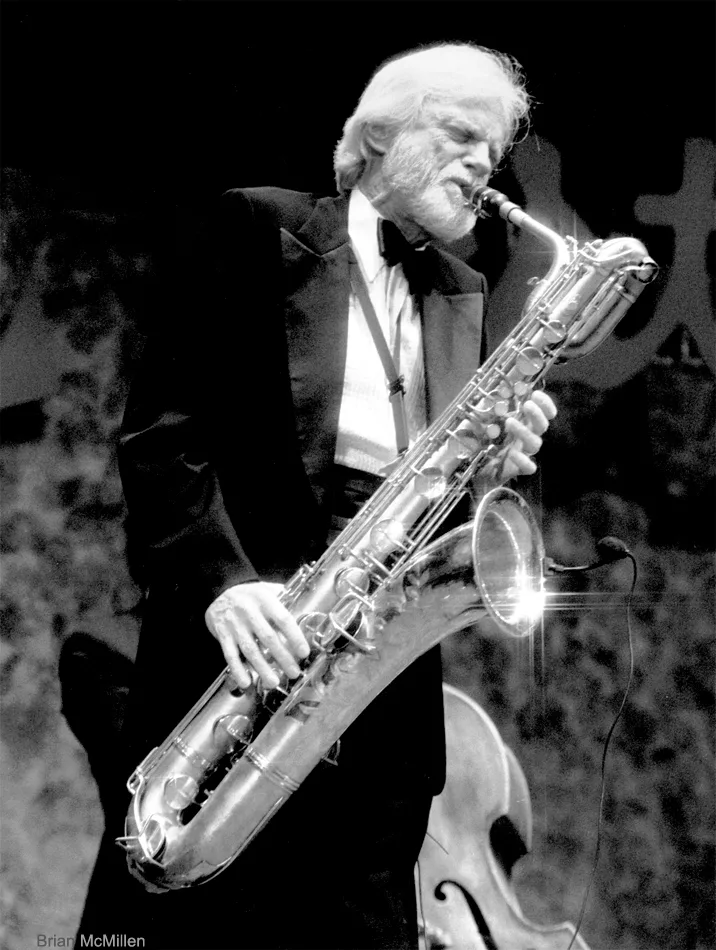
Gerry Mulligan performing on baritone saxophone at the Monterey Jazz Festival, California, 1992 CC BY-SA 4.0 (Creative Commons Attribution-ShareAlike 4.0 International), photograph by Brian McMillen — Wikimedia Commons — https://commons.wikimedia.org/wiki/File:Gerry_Mulligan_1992.jpg

Gerald Joseph Mulligan was born April 6, 1927, in Queens Village, New York, the youngest of four sons of an Irish-American engineer father and a Philadelphia-born mother. The family moved constantly for his father's work: Marion, Ohio, before Mulligan turned one, then southern New Jersey, Chicago, Kalamazoo, Detroit, Reading, and finally Philadelphia. A childhood nanny, Lily Rose, kept a player piano stocked with Fats Waller rolls and welcomed visiting Black musicians into the house, which gave Mulligan his first sustained contact with the music. He started clarinet in a Kalamazoo school orchestra, studied with the Reading dance-band musician Sammy Correnti, and was already writing charts by high school. At sixteen he walked into WCAU radio in Philadelphia and talked staff arranger Johnny Warrington into buying his arrangements. He dropped out of West Philadelphia Catholic High School for Boys in his senior year, took a three-month contract writing for bandleader Tommy Tucker at $100 a week, and then wrote for Elliot Lawrence's band.
In January 1946 Mulligan moved to New York as a staff arranger for Gene Krupa's bebop-leaning orchestra, contributing "Disc Jockey Jump," "Birdhouse," and a "How High the Moon" that quoted Charlie Parker's "Ornithology." He soon began arranging for Claude Thornhill, occasionally sitting in with the reed section, and there he met Gil Evans. Evans's basement apartment on West 55th Street turned into an open workshop where a rotating cast of musicians argued out a new orchestral language for small ensembles. Out of that room came the nine-piece band Miles Davis assembled in September 1948, which played a two-week run at the Royal Roost and two nights at the Clique Club before recording twelve sides for Capitol across three sessions (January 21, 1949; April 22, 1949; March 9, 1950). Mulligan wrote and arranged "Jeru," "Venus de Milo," and "Rocker," and arranged "Godchild," "Deception," and "Darn That Dream." He was one of only four players present at all three sessions, alongside Davis, Lee Konitz, and tubist Bill Barber; Max Roach drummed on the first and third. Capitol collected the sides on a 12-inch LP in 1957 under the title Birth of the Cool.
Mulligan cut his first date under his own name in New York on August 27, 1951, released by Prestige and later reissued as Mulligan Plays Mulligan, with George Wallington on piano and Allen Eager on tenor. Early in 1952 he drove west to Los Angeles, where he wrote for Stan Kenton's orchestra. Most of that work was routine dance-band fare, but "Walkin' Shoes" and "Young Blood" showed the interlocking contrapuntal writing that became his signature. He was also playing Monday nights at The Haig, a small club on Wilshire Boulevard, and there the idea that made his reputation fell into place. With Erroll Garner's piano hauled out of the room to make space for Red Norvo's trio, Mulligan simply did without one. Producer Richard Bock taped a trio session at engineer Phil Turetsky's house on June 10, 1952, with Red Mitchell on bass and Chico Hamilton on drums. On August 16, 1952, at the same house, the pianoless quartet proper was recorded for the first time: Mulligan on baritone, Chet Baker on trumpet, Bob Whitlock on bass, Hamilton on drums. "Bernie's Tune" became a surprise hit single, launched Bock's new Pacific Jazz label, and made Baker a star. Carson Smith took over the bass chair and Larry Bunker the drums in 1953, and the Haig dates sold out nightly. The run ended in mid-1953 when Mulligan was arrested on narcotics charges and served roughly six months at the Sheriff's Honor Farm. By the time he was released, Baker had a band of his own and turned down the offer to come back.
Mulligan rebuilt the quartet around valve trombonist Bob Brookmeyer, with trumpeters Jon Eardley and Art Farmer, saxophonists Zoot Sims, Al Cohn, and Konitz, and singer Annie Ross cycling through the group over the rest of the decade. Sessions cut at The Haig and in Los Angeles in January and February 1953 with Konitz sitting in were issued as Lee Konitz Plays With the Gerry Mulligan Quartet (World Pacific PJM-406), later retitled Konitz Meets Mulligan. He also began a run of encounter records that became a signature format: Reunion With Chet Baker, cut in New York on December 3, 11, and 17, 1957, and Mulligan Meets Monk, recorded August 12 and 13, 1957, at Reeves Studios with Thelonious Monk, Wilbur Ware, and Shadow Wilson. Gerry Mulligan Meets Johnny Hodges followed in Los Angeles on November 17, 1959, and Gerry Mulligan Meets Ben Webster on November 3 and December 2, 1959, with Jimmy Rowles, Leroy Vinnegar, and Mel Lewis as the rhythm section. The last of his 1950s pianoless quartets, with Art Farmer, Bill Crow, and Dave Bailey, made What Is There to Say? for Columbia between December 17, 1958, and January 15, 1959.
In the spring of 1960 Mulligan put together the Concert Jazz Band, a thirteen-piece group built as a big band with a small band's transparency: six brass, five reeds, and a rhythm section that still carried no full-time pianist. The Verve albums document a shifting cast including Conte Candoli, Nick Travis, Don Ferrara, and Doc Severinsen on trumpets, Brookmeyer and Alan Raph on trombones, Gene Quill, Gene Allen, and Zoot Sims in the reeds, Buddy Clark and Bill Crow on bass, and Mel Lewis and Dave Bailey on drums. Mulligan and Brookmeyer wrote most of the book, with outside charts from Gary McFarland ("Weep," "Chuggin'"), George Russell ("All About Rosie"), and John Carisi ("Israel") filling out Gerry Mulligan Presents a Concert in Jazz, taped at Webster Hall on July 10 and 11, 1961. The band toured Europe and recorded at the Village Vanguard before Mulligan folded it at the end of 1964. He kept small-group work going alongside it: Two of a Mind with Paul Desmond at RCA Victor's Studio A in the summer of 1962, the Columbia quartet-plus-conga date Jeru on June 30, 1962, and the ballad sextet album Night Lights, cut at Nola Penthouse Studios in September 1963 with Art Farmer, Brookmeyer, Jim Hall, Bill Crow, and Dave Bailey. Through the same years he was a recognizable face outside jazz, appearing on screen in I Want to Live! (1958), Jazz on a Summer's Day, The Subterraneans, and Bells Are Ringing (1960), the last opposite Judy Holliday, his partner from 1958 until her death in 1965.
After Dave Brubeck disbanded his classic quartet in 1967, Mulligan joined him as a regular front-line partner through 1973, recording Live at the Berlin Philharmonie, The Last Set at Newport, and We're All Together Again for the First Time. His own large-ensemble instincts resurfaced on The Age of Steam, cut at A&M and Poppi Studios in Hollywood between February and July 1971 with Harry "Sweets" Edison, Bud Shank, Brookmeyer, Tom Scott, and Roger Kellaway. In Milan in late September and early October 1974 he recorded Summit with the bandoneonist Astor Piazzolla, and met the photojournalist Franca Rota, whom he married in 1982. That November he and Chet Baker reunited on stage at Carnegie Hall on November 24, 1974, backed by Bob James, John Scofield, Ron Carter, and Harvey Mason; it was the last time the two recorded together. A revived big band produced Walk on the Water, recorded at Downtown Sound in September 1980, which won the Grammy for Best Jazz Instrumental Performance, Big Band, in 1982. He turned to a contemporary studio sound on Little Big Horn (GRP, 1983) with Dave Grusin and Michael Brecker, and spent much of the 1980s writing and premiering concert works, including Entente for Baritone Saxophone and Orchestra in 1984 and Octet for Sea Cliff in 1988.
Mulligan had contacted Miles Davis in 1991 about revisiting the nonet book; Davis was enthusiastic but died that September, so the project went ahead with Wallace Roney and Art Farmer taking the trumpet parts. Re-Birth of the Cool, recorded in New York January 29 to 31, 1992, and released on GRP, reunited Mulligan with two survivors of the 1949 band, pianist John Lewis and tubist Bill Barber, alongside Phil Woods on alto and Mel Tormé singing "Darn That Dream." His last album, the Telarc quartet date Dragonfly, was recorded in the summer of 1995 with Ted Rosenthal, Dean Johnson, and Ron Vincent, plus guests including Grover Washington Jr., John Scofield, and Dave Samuels. He played his final concert on November 9, 1995, at the Floating Jazz Festival, and passed away on January 20, 1996, in Darien, Connecticut, at 68, from complications of knee surgery; his widow reported he had also been living with liver cancer. His papers and his gold-plated Conn baritone went to the Library of Congress, where the Gerry Mulligan Collection remains open to researchers.
Mulligan took an instrument most listeners heard as a section anchor and made it a lead voice, playing with a light, dry, almost conversational tone modelled on Lester Young's tenor rather than on the baritone's own big-band tradition. His real innovation was structural: by removing the piano from his 1952 quartet he freed the two horns to improvise counterpoint against each other instead of running lines over a fixed chordal grid, and the resulting transparency carried straight into the writing for his Concert Jazz Band a decade later. He described the experience of trading contrapuntal lines with Chet Baker as something he never found again. As an arranger he was one of the architects of the sound codified on Miles Davis's Birth of the Cool, and the pianoless quartet, along with the Pacific Jazz records that documented it, gave the West Coast scene of the 1950s much of its identity. Along with Serge Chaloff, he built the baritone's postwar reputation on melodic restraint rather than power. Where Pepper Adams later drove the horn through hard bop with a raw, bark-edged attack, Mulligan's model stayed light and linear, and the two men effectively defined the instrument's opposite poles. Mulligan dominated DownBeat's readers' poll on baritone from 1953 onward; his estate claims 42 consecutive wins, though Adams was named the readers' poll winner in December 1982. DownBeat inducted Mulligan into its Hall of Fame in 1994.
- Birth of the Cool (1957, Capitol) - As arranger, composer, and baritone player on all three Miles Davis nonet sessions (1949 to 1950); Mulligan wrote "Jeru," "Venus de Milo," and "Rocker" and arranged three more. Elected to the Grammy Hall of Fame in 1982. Spotify - Birth Of The Cool
- Gerry Mulligan Quartet (1955, Pacific Jazz) - The 12-inch collection of the pianoless quartet's 1952 to 1953 sessions with Chet Baker, the records that invented a format and launched a label.
- Mulligan Meets Monk (1957, Riverside) - Two days at Reeves Studios with Thelonious Monk, Wilbur Ware, and Shadow Wilson: the most improbable and most rewarding of Mulligan's encounter albums. Spotify - Mulligan Meets Monk Listen
- Gerry Mulligan Meets Ben Webster (1960, Verve) - A two-tenor-generation summit produced by Norman Granz, with Jimmy Rowles, Leroy Vinnegar, and Mel Lewis; widely rated the best of his "meets" series. Spotify - The Complete Sessions Listen
- The Concert Jazz Band (1960, Verve) - The debut of the thirteen-piece band Mulligan led from 1960 to 1964, still built without a full-time pianist. Spotify - The Concert Jazz Band Listen
- Night Lights (1963, Philips) - An all-ballad sextet date with Art Farmer, Bob Brookmeyer, and Jim Hall; Mulligan plays piano on the title track. Spotify - Night Lights Listen
- The Age of Steam (1972, A&M) - His first major large-ensemble writing in a decade, cut in Hollywood with Harry "Sweets" Edison, Bud Shank, and Tom Scott; Grammy-nominated. Spotify - The Age Of Steam Listen
- Carnegie Hall Concert (1975, CTI) - The November 24, 1974, reunion with Chet Baker, with Ron Carter and John Scofield in the band; the last recording the two made together. Spotify - Carnegie Hall Concert Listen
Gerry Mulligan: Full Discography
Identity confirmed via the live Discogs API: artist ID 37733 ("Gerry Mulligan," realname Gerald Joseph Mulligan, born April 6, 1927, Queens, New York; died January 20, 1996, Darien, Connecticut). Discogs credits Mulligan on 2,845 releases across a 1947 to 2026 span, broken down as 344 "Main" (leader or co-leader billing, including reissues and compilations), 1,490 sideman "Appearance" credits, 919 track-level "TrackAppearance" credits, 88 unofficial releases, and 4 producer credits.
That is far too large a catalog to itemize. What follows is a curated selection of the most significant and historically important releases, verified release by release against the Discogs API, plus a representative set of major sideman credits. It is not exhaustive. Where a detail could not be confirmed from the Discogs data pulled for this build, the cell says so rather than guessing.
As Leader / Co-Leader
| Album Title | Recording Date(s) | Release Date | Label | Catalog Number | Format(s) | Personnel | Role | Reissue History | Spotify | Buy | Notes |
|---|---|---|---|---|---|---|---|---|---|---|---|
| Mulligan Plays Mulligan | Recorded August 27, 1951, New York City | 1956 (12" LP; sides first issued on 10" Prestige) | Prestige | PRLP 7006 | Vinyl, LP, Compilation, Mono | Gerry Mulligan (baritone sax), Max McElroy (2nd baritone sax), Allen Eager (tenor sax), Ollie Wilson (trombone), Jerry Hurwitz and Nick Travis (trumpet), George Wallington (piano), Phil Leshin (bass), Walter Bolden (drums), Gail Madden (maracas) | Leader | Remastered by Rudy Van Gelder for the 12" edition | Spotify - Mulligan Plays Mulligan | — | His first date as a leader, and the first extended showcase for his contrapuntal writing |
| Gerry Mulligan Quartet | Recorded August 1952 to early 1953, Los Angeles (Phil Turetsky's house and Gold Star Studios) | 1955 | Pacific Jazz | PJ-1207 | Vinyl, LP, Mono | Gerry Mulligan (baritone sax), Chet Baker (trumpet), Bob Whitlock and Carson Smith (bass), Chico Hamilton and Larry Bunker (drums); produced by Richard Bock | Leader | 12" collection drawing on the earlier 10" issues PJ LP-1 and PJ-8 | No confirmed single-album match on Spotify | — | The pianoless quartet records that made Mulligan's and Baker's names and launched Pacific Jazz |
| California Concerts (Jazz Goes to High School) | Recorded live November 12, 1954, Stockton High School Auditorium, Stockton CA; and December 14, 1954, Hoover High School Auditorium, San Diego CA | 1955 | Pacific Jazz | PJ 1201 / PJ LP-1201 | Vinyl, LP, Album, Mono | Gerry Mulligan (baritone sax, piano), Jon Eardley (trumpet), Bob Brookmeyer (valve trombone, piano), Zoot Sims (tenor sax, guest), Red Mitchell (bass), Chico Hamilton and Larry Bunker (drums); recorded by Phil Turetsky, produced by Richard Bock | Leader (Quartet and Sextet) | Substantially expanded on later CD editions | Spotify - California Concerts | — | 1988 CD edition runs 14 tracks against the original LP's 7 |
| Lee Konitz Plays With the Gerry Mulligan Quartet | Recorded January 23, 1953 (The Haig, Hollywood); January 30 and February 1, 1953 (Los Angeles) | 1957 | World Pacific | PJM-406 | Vinyl, LP, Album, Mono | Lee Konitz (alto sax), Gerry Mulligan (baritone sax), Chet Baker (trumpet), Carson Smith and Joe Mondragon (bass), Larry Bunker (drums); produced by Richard Bock | Co-leader | Retitled Konitz Meets Mulligan on most reissues | Spotify - Konitz Meets Mulligan | — | Spotify edition runs 12 tracks against the original LP's 10 |
| Gerry Mulligan - Paul Desmond Quartet (later retitled Blues in Time) | Recorded 1957 (exact session dates not given in the Discogs data) | 1957 | Verve | MGV-8246 | Vinyl, LP, Album, Mono | Paul Desmond (alto sax), Gerry Mulligan (baritone sax), Joe Benjamin (bass), Dave Bailey (drums) | Co-leader | Reissued under the title Blues in Time | No confirmed album match on Spotify | — | Includes "Line for Lyons," "Battle Hymn of the Republican," and the title track |
| Mulligan Meets Monk | Recorded August 12-13, 1957, Reeves Studios, New York City | 1957 | Riverside | RLP 12-247 | Vinyl, LP, Album, Mono | Thelonious Monk (piano), Gerry Mulligan (baritone sax), Wilbur Ware (bass), Shadow Wilson (drums); produced by Orrin Keepnews | Co-leader | 1987 CD reissue on Fantasy's Original Jazz Classics adds three alternate takes | Spotify - Mulligan Meets Monk | — | Four Monk tunes, one Mulligan original ("Decidedly"), one standard |
| Reunion With Chet Baker | Recorded December 3, 11, and 17, 1957, New York City | 1958 | World Pacific | STEREO-1241 | Vinyl, LP, Album | Gerry Mulligan (baritone sax), Chet Baker (trumpet), Henry Grimes (bass), Dave Bailey (drums) | Leader (Gerry Mulligan Quartet) | CD reissue expands the original 8 tracks to 15 | Spotify - Reunion With Chet Baker | — | First studio reunion with Baker after the 1953 split |
| The Jazz Combo From "I Want to Live!" | Recorded 1958 | 1958 | United Artists | UAL-4006 (mono) / UAS 5006 (stereo) | Vinyl, LP, Album | Full personnel not confirmed in the Discogs data retrieved | Leader | Also paired with Johnny Mandel's orchestral score on the United Artists compilation UXS 51 | No confirmed album match on Spotify | — | Jazz combo material from Robert Wise's film, for which Mulligan also appeared on screen |
| What Is There to Say? | Recorded December 17, 1958 to January 15, 1959 | 1959 | Columbia | CL 1307 (mono) / CS 8116 (stereo) | Vinyl, LP, Album | Gerry Mulligan (baritone sax), Art Farmer (trumpet), Bill Crow (bass), Dave Bailey (drums); produced by Teo Macero | Leader (Gerry Mulligan Quartet) | Reissued repeatedly on CD | Spotify - What Is There To Say? | — | The last of the 1950s pianoless quartet albums |
| Gerry Mulligan Meets Johnny Hodges | Recorded November 17, 1959, Los Angeles | 1960 | Verve | MG V-8367 | Vinyl, LP, Album, Mono | Johnny Hodges (alto sax), Gerry Mulligan (baritone sax), Claude Williamson (piano), Buddy Clark (bass), Mel Lewis (drums) | Co-leader | Expanded 14-track CD edition issued 2011 | Spotify - Meets Johnny Hodges | — | Includes "What's the Rush," co-written with Judy Holliday |
| Gerry Mulligan Meets Ben Webster | Recorded November 3 and December 2, 1959 | 1960 | Verve | MG V-8343 | Vinyl, LP, Album, Mono | Ben Webster (tenor sax), Gerry Mulligan (baritone sax), Jimmy Rowles (piano), Leroy Vinnegar (bass), Mel Lewis (drums); produced by Norman Granz | Co-leader | Verve issued The Complete Gerry Mulligan Meets Ben Webster Sessions (26 tracks) in 1997 | Spotify - The Complete Sessions | — | Five stars in AllMusic, DownBeat, and the Rolling Stone Jazz Record Guide; the original 6-track LP is not on Spotify as a standalone |
| The Concert Jazz Band | Recorded May 1960 (one track) and July 1960 | 1960 | Verve | MG V-8388 | Vinyl, LP, Album, Mono | Gerry Mulligan (baritone sax, leader), Conte Candoli, Don Ferrara, Nick Travis, Danny Stiles, Phil Sunkel (trumpet), Bob Brookmeyer (valve trombone), Wayne Andre, Alan Raph (trombone), Gene Quill (alto sax, clarinet), Dick Meldonian, Jim Reider, Zoot Sims, Gene Allen (saxes), Buddy Clark and Bill Takas (bass), Mel Lewis and Dave Bailey (drums) | Leader | Remastered edition available | Spotify - The Concert Jazz Band | — | The debut album of the 13-piece band he led 1960 to 1964 |
| Gerry Mulligan and the Concert Jazz Band at the Village Vanguard | Recorded live at the Village Vanguard, New York City, late 1960 | 1961 | Verve | Original catalog not confirmed in the Discogs data retrieved (1981 Mobile Fidelity audiophile reissue: MFSL 1-179) | Vinyl, LP, Album | Concert Jazz Band personnel as above | Leader | Mobile Fidelity Sound Lab reissue 1981; remastered CD 2012 | Spotify - At the Village Vanguard | — | |
| Gerry Mulligan Presents a Concert in Jazz | Recorded July 10-11, 1961, Webster Hall, New York City | 1961 | Verve | V6-8415 | Vinyl, LP, Album, Stereo | Gerry Mulligan (baritone sax, piano, leader), Doc Severinsen, Don Ferrara, Nick Travis (trumpet), Bob Brookmeyer (valve trombone), Willie Dennis (slide trombone), Alan Raph (bass trombone), Bob Donovan (alto sax, flute), Gene Quill (alto sax, clarinet), Jim Reider (tenor sax), Gene Allen (baritone sax, bass clarinet), Bill Crow (bass), Mel Lewis (drums) | Leader | No confirmed album match on Spotify | — | Charts by George Russell ("All About Rosie"), Gary McFarland ("Weep," "Chuggin'"), John Carisi ("Israel"), and Brookmeyer | |
| Holliday With Mulligan | Recorded April 10-17, 1961, Olmsted Studios, New York City | 1980 (masters mixed April 1980; shelved 19 years) | DRG | CDSL 5191 (CD reissue) | CD, Album, Reissue | Judy Holliday (vocals), Gerry Mulligan (baritone sax, conductor), Bob Brookmeyer (valve trombone), Nick Travis, Don Ferrara, Al De Risi (trumpet), Gene Allen, Al Klink, Walt Levinsky, Don Ashworth (reeds), Gunther Schuller, Earl Chapin, Fred Klein (French horn), Alan Raph (bass trombone), Bernie Leighton (piano), Bill Crow (bass), Mel Lewis (drums) | Co-leader | First released 1980 | No confirmed album match on Spotify | — | Four songs co-written by Mulligan and Holliday, including "What's the Rush" and "Summer's Over" |
| Jeru | Recorded June 30, 1962 | 1963 | Columbia | CL 1932 | Vinyl, LP, Album, Mono | Gerry Mulligan (baritone sax), Tommy Flanagan (piano), Ben Tucker (bass), Dave Bailey (drums), Alec Dorsey (congas) | Leader | Spotify - Jeru | — | Named after the nickname Miles Davis gave him in 1949 | |
| Two of a Mind | Recorded summer 1962, RCA Victor Studio A, New York City | 1962 | RCA Victor | LSP-2624 | Vinyl, LP, Album, Stereo | Paul Desmond (alto sax), Gerry Mulligan (baritone sax), with Joe Benjamin, Wendell Marshall, or John Beal (bass) and Connie Kay or Mel Lewis (drums) rotating by track; produced by George Avakian and Bob Prince | Co-leader | Spotify - Two Of A Mind | — | Bass and drums change from track to track; only Desmond and Mulligan appear throughout | |
| Night Lights | Recorded September 12 and October 3, 1963, Nola Penthouse Studios, New York City | 1963 | Philips | PHS 600-108 (stereo) / PMH 600-108 (mono) | Vinyl, LP, Album | Gerry Mulligan (baritone sax, piano, arranger), Art Farmer (trumpet, flugelhorn), Bob Brookmeyer (valve trombone), Jim Hall (guitar), Bill Crow (bass), Dave Bailey (drums); produced by Hal Mooney | Leader | Later Verve reissues add a 1965 bonus version of the title track; vinyl reissue 2022 (New Land) | Spotify - Night Lights (Expanded) | — | An all-ballad program built around the title tune |
| The Age of Steam | Recorded February to July 1971, A&M Studios and Poppi Studios, Hollywood | 1972 | A&M | SP 3036 | Vinyl, LP, Album | Gerry Mulligan (baritone and soprano sax, piano, composer), Harry "Sweets" Edison (trumpet), Bob Brookmeyer (valve trombone), Jimmy Cleveland (trombone), Ken Shroyer (bass trombone), Roger Bobo (tuba), Bud Shank (alto sax, flute), Tom Scott (soprano and tenor sax), Ernie Watts (tenor sax), Roger Kellaway (piano), Howard Roberts (guitar), Chuck Domanico (bass), John Guerin and Joe Porcaro (drums), Emil Richards (percussion) | Leader | Reissued on CD | Spotify - The Age Of Steam | — | Grammy-nominated, Best Jazz Performance by a Big Band; all eight compositions by Mulligan |
| Summit (Reunión Cumbre) | Recorded September 24-26 and October 1-4, 1974, Milan | 1974 | Erre T.V. (Italy) | RTV 25046 | Vinyl, LP, Album, Stereo | Gerry Mulligan (baritone sax), Astor Piazzolla (bandoneon, arranger, conductor), Angel "Pocho" Gatti (piano, organ), Giuseppe Prestipino (electric bass), Bruno De Filippi and Filippo Daccò (guitar), Tullio De Piscopo (drums, percussion), Alberto Baldan Bembo and Gianni Zilioli (marimba), plus strings | Co-leader | Widely reissued, including as Reunión Cumbre in Latin America | No confirmed album match on Spotify | — | The sessions where Mulligan met his third wife, Franca Rota |
| Carnegie Hall Concert | Recorded live November 24, 1974, Carnegie Hall, New York City | 1975 | CTI | CTI 6054/55 (US double LP) | Vinyl, 2xLP, Album | Gerry Mulligan (baritone sax), Chet Baker (trumpet, vocals), Ed Byrne (trombone), Bob James (piano, electric piano), Dave Samuels (vibraphone, percussion), John Scofield (guitar), Ron Carter (bass), Harvey Mason (drums) | Co-leader | Also issued as separate Volumes 1 and 2; 1995 CD reissue adds "Margarine" | Spotify - Carnegie Hall Concert | — | The final Mulligan/Baker recording |
| Gerry Mulligan Meets Enrico Intra | Recorded 1975, Milan | 1976 | Produttori Associati (Italy); Pausa (US) | PA/LP 60 (Italy) / PR-7010 (US) | Vinyl, LP | Gerry Mulligan (baritone sax), Enrico Intra (piano, composer), with Pino Presti (bass) and Giancarlo Barigozzi (flute) among the Italian personnel | Co-leader | US issue on Pausa Records; Japanese issue on Epic (25AP 334) | No confirmed album match on Spotify | — | One of several Milan-based projects from Mulligan's Italian years |
| Walk on the Water | Recorded September 1980, Downtown Sound, New York City | 1980 | DRG | SL 5194 | Vinyl, LP, Album, Stereo | Gerry Mulligan and His Orchestra: Mulligan (baritone and soprano sax), Laurie Frink, Barry Ries, Tom Harrell, Mike Davis, Danny Hayes (trumpet), Alan Raph, Dave Glenn, Keith O'Quinn (trombone), Gerry Niewood, Ken Hitchcock, Gary Keller, Ralph Olson, Eric Turkel, Seth Broedy, Joe Temperley (reeds), Mitchel Forman (piano), Jay Leonhart and Michael Bocchiccio (bass), Rich DeRosa (drums) | Leader | Spotify - Walk On The Water | — | Won the 1982 Grammy for Best Jazz Instrumental Performance, Big Band | |
| Little Big Horn | Recorded 1983 (digital master) | 1983 | GRP | GRP-A-1003 | Vinyl, LP, Album | Gerry Mulligan (baritone sax, vocals, arranger, producer), Michael Brecker (tenor sax), Lou Marini (alto sax), Marvin Stamm and Alan Rubin (trumpet), Keith O'Quinn (trombone), Dave Grusin (piano, electric piano, synthesizer), Richard Tee (piano), Jay Leonhart (bass), Anthony Jackson (electric bass), Buddy Williams (drums) | Leader | Spotify - Little Big Horn | — | All six compositions by Mulligan; his most overtly contemporary studio production | |
| Soft Lights & Sweet Music | Recorded 1986 | 1986 | Concord Jazz | CJ-300 (LP) / CCD 4300 (CD) | Vinyl, LP; CD | Gerry Mulligan (baritone sax) and Scott Hamilton (tenor sax) with rhythm section (full personnel not confirmed in the Discogs data retrieved) | Co-leader | No confirmed album match on Spotify | — | Grammy-nominated, Best Jazz Instrumental Performance, Group | |
| Re-Birth of the Cool | Recorded January 29-31, 1992, New York City | 1992 | GRP | GRD-9679 | CD, Album | Gerry Mulligan (baritone sax, arranger), Wallace Roney (trumpet), Dave Bargeron (trombone), John Clark (French horn), Bill Barber (tuba), Phil Woods (alto sax), John Lewis (piano), Dean Johnson (bass), Ron Vincent (drums), Mel Tormé (vocals) | Leader | Spotify - Re-Birth Of The Cool | — | Re-recording of the 1949-50 nonet book; Lewis and Barber both played on the originals. Art Farmer also took trumpet parts on the project after Miles Davis's 1991 death | |
| Dragonfly | Recorded 1995, New York City | 1995 | Telarc Jazz | CD-83377 | CD, Album | Gerry Mulligan Quartet (Mulligan, baritone sax; Ted Rosenthal, piano; Dean Johnson, bass; Ron Vincent, drums) with guests Dave Grusin, Dave Samuels, John Scofield, Warren Vaché, and Grover Washington Jr. | Leader | Spotify - Dragonfly | — | His final studio album, released months before his death |
As Sideman (selected major credits)
| Year | Project (Leader) | Title | Label | Catalog | Role | Notes |
|---|---|---|---|---|---|---|
| 1947-1949 | Gene Krupa and His Orchestra | "Disc Jockey Jump," "Birdhouse," "How High the Moon" | Columbia | Arranger (and occasional saxophone) | His first steady New York job, from January 1946 | |
| 1947-1948 | Claude Thornhill and His Orchestra | Various sides, later collected as Play the Great Jazz Arrangements of Gerry Mulligan | Trend / Hep | Arranger, occasional reed section | Where he met Gil Evans | |
| 1949-1950 | Miles Davis Nonet | Birth of the Cool (12" LP compilation) | Capitol | T-762 (1957 LP) | Baritone saxophone, composer, arranger | Wrote "Jeru," "Venus de Milo," "Rocker"; arranged "Godchild," "Deception," "Darn That Dream"; present at all three sessions (Jan 21, 1949; Apr 22, 1949; Mar 9, 1950). Grammy Hall of Fame, 1982 |
| 1949 | Kai Winding Sextet | "Sid's Bounce," "Broadway," "Crossing the Channel" and other Roost sides | Roost | Baritone saxophone, arranger | ||
| 1950-1954 | Chubby Jackson All Stars | Flying the Coop, Sax Appeal, and later compilations | New Jazz / Prestige | Baritone saxophone, arranger | ||
| 1952 | Stan Kenton Orchestra | "Walkin' Shoes," "Young Blood" | Capitol | Arranger, composer | The job that brought him to Los Angeles | |
| 1956 | Elliot Lawrence Band | Plays Gerry Mulligan Arrangements | Fantasy | Arranger | An album made entirely from Mulligan charts | |
| 1958 | Duke Ellington and His Orchestra | Newport 1958 | Columbia | Guest baritone saxophone | Mulligan sits in with the Ellington reed section | |
| 1958 | Stan Getz, Harry Edison, Louis Bellson, Oscar Peterson Trio | Jazz Giants '58 | Verve | Baritone saxophone | Norman Granz all-star date | |
| 1959 | Jimmy Witherspoon | Witherspoon at the Renaissance | HiFi Jazz | Baritone saxophone | With Ben Webster, Jimmy Rowles, Leroy Vinnegar, and Mel Lewis | |
| 1960 | André Previn / Carmen McRae | The Subterraneans (original soundtrack) | MGM | Baritone saxophone | Mulligan also appears on screen in the film | |
| 1963 | Billy Taylor Trio with Quincy Jones | My Fair Lady Loves Jazz | Impulse! | Baritone saxophone | ||
| 1968-1973 | Dave Brubeck | Compadres, Blues Roots, Live at the Berlin Philharmonie, The Last Set at Newport, We're All Together Again for the First Time | Columbia / Atlantic | Baritone saxophone | The billed "Gerry Mulligan / Dave Brubeck Quartet" period, with Jack Six and Alan Dawson | |
| 1971 | Dave Brubeck Trio with Gerry Mulligan and the Cincinnati Symphony Orchestra, cond. Erich Kunzel | Brubeck/Mulligan/Cincinnati | Decca | Baritone saxophone | Recorded around the May 1970 performance of Brubeck's oratorio The Light in the Wilderness | |
| 1972 | Charles Mingus | Charles Mingus and Friends in Concert | Columbia | Baritone saxophone | Philharmonic Hall, New York | |
| 1977 | Charles Mingus | Lionel Hampton Presents the Music of Charles Mingus | Who's Who in Jazz | Baritone saxophone | With Lionel Hampton and Woody Shaw; reissued under several titles |
Mulligan's Discogs credit log also spans Georgie Auld, J.J. Johnson and Kai Winding trombone dates, the Modern Jazz Quartet and Oscar Peterson Trio at the Newport festivals, Teddy Wilson, the 1972 Newport in New York jam sessions, and hundreds of compilations and anthologies, none of which are itemized here.
- Chet Baker - trumpet partner in the pianoless quartet from June 1952 until Mulligan's arrest in mid-1953, then again on Reunion With Chet Baker (1957) and the November 24, 1974, Carnegie Hall Concert, their final recording together.
- Gil Evans and Miles Davis - co-architects of the nonet that recorded Birth of the Cool between 1949 and 1950; Evans's West 55th Street apartment was the workshop where the concept was worked out.
- Bob Brookmeyer - valve trombonist, second pianist, and co-arranger; replaced Baker in the quartet from 1954, and was the Concert Jazz Band's principal writer besides Mulligan.
- Art Farmer - trumpet and flugelhorn in the late-1950s quartet (What Is There to Say?, 1959) and on Night Lights (1963); returned in 1992 to share the trumpet parts on Re-Birth of the Cool.
- Mel Lewis - drummer on Gerry Mulligan Meets Ben Webster (1959), Gerry Mulligan Meets Johnny Hodges (1959), and much of the Concert Jazz Band's Verve output.
- Stan Kenton - employed Mulligan as a staff arranger in 1952; "Walkin' Shoes" and "Young Blood" came out of that job.
- Paul Desmond - alto saxophone counterpart on the August 1957 Verve quartet date later reissued as Blues in Time, and on Two of a Mind (1962), and a frequent guest with Dave Brubeck's groups that Mulligan later joined.
- Dave Brubeck - regular touring and recording partner from 1968 to 1973 in the "Gerry Mulligan / Dave Brubeck Quartet," and sporadically thereafter.
- Thelonious Monk, Ben Webster, Johnny Hodges, Lee Konitz, Stan Getz - the "meets" partners across a decade of encounter albums for Riverside, Verve, and World Pacific.
- Astor Piazzolla - co-led Summit in Milan in autumn 1974; the sessions also introduced Mulligan to his third wife, Franca Rota.
- Judy Holliday - partner from 1958 to 1965 and lyricist on "What's the Rush"; their album Holliday with Mulligan was recorded in 1961 and shelved until 1980.
- Giancarlo Barigozzi (soprano saxophone) - soprano saxophone on Gerry Mulligan Meets Enrico Intra, recorded October 16 and 17, 1975 in Milan (Produttori Associati / Pausa), per the Discogs credit.
More Cool Jazz Artists
See all 63 Cool Jazz artists →More American Jazz Artists
See all 567 American artists →- Wikipedia: Gerry Mulligan
- Discogs: Gerry Mulligan (artist 37733)
- gerrymulligan.com: Awards
- Jazzdisco.org: Pacific Jazz Records discography 1952-1954
- Wikipedia: Birth of the Cool
- Wikipedia: Mulligan Meets Monk
- Wikipedia: Gerry Mulligan Meets Ben Webster
- Wikipedia: What Is There to Say?
- Wikipedia: The Concert Jazz Band
- Wikipedia: Gerry Mulligan Presents a Concert in Jazz
- Wikipedia: Night Lights
- Wikipedia: Walk on the Water
- Wikipedia: Carnegie Hall Concert
- AllMusic: Gerry Mulligan