 JAZZPROFILES lives in the music 1,002 Jazz Artists fully Profiled!
 Art Farmer
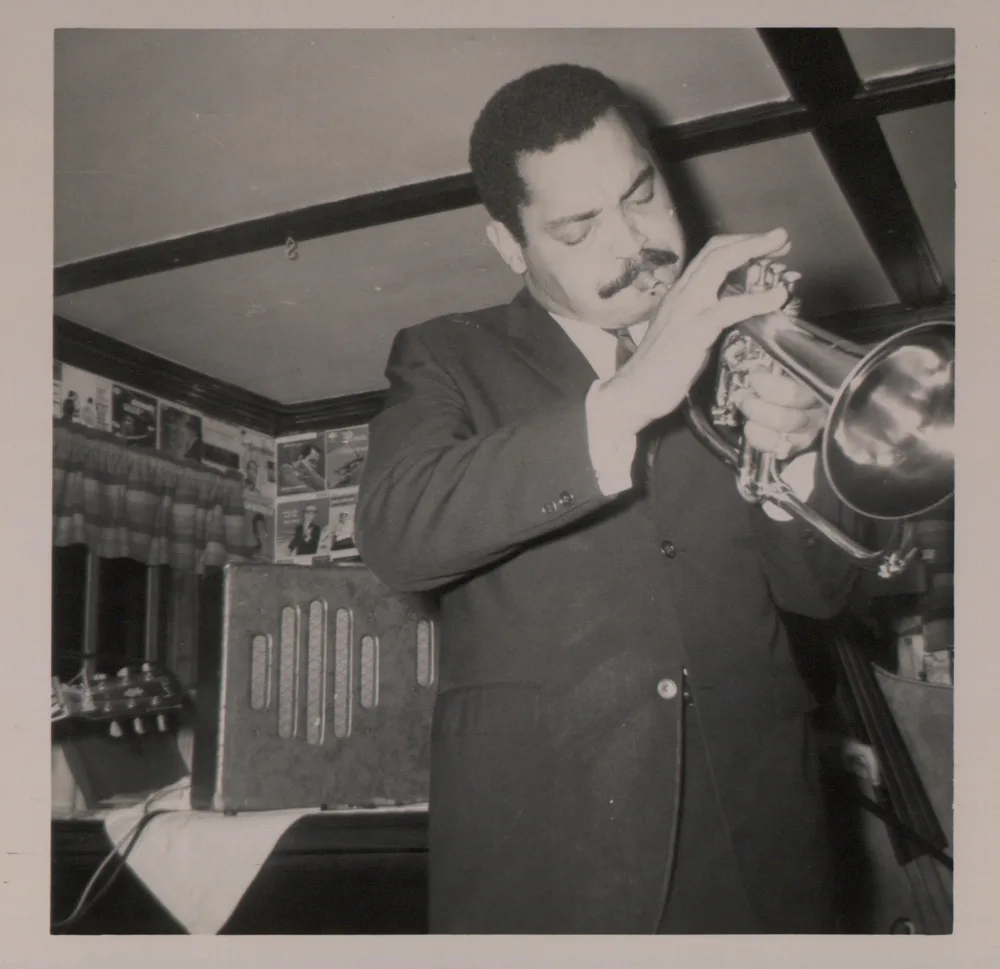
Art Farmer playing flugelhorn at Lennie's on the Turnpike, Newbury Street (Route 1), Peabody, Massachusetts, c. 1964. From the Lennie's on the Turnpike Collection, Salem State University Archives and Special Collections, Salem, Massachusetts. CC BY 4.0 — Wikimedia Commons — https://commons.wikimedia.org/wiki/File:Art_Farmer_on_flugelhorn.jpg (original: Salem State Archives on Flickr, https://www.flickr.com/photos/68317878@N04/6217714852/)

Arthur Stewart Farmer was born on August 21, 1928, in Council Bluffs, Iowa, an hour ahead of his identical twin brother, the bassist Addison Farmer. Their parents divorced when the boys were four, and their father, a steelworker, was killed in a workplace accident soon afterward. The family moved to Phoenix, Arizona, where Farmer's grandfather served as a minister in the African Methodist Episcopal Church and his mother played piano for the choir. He began on piano, passed through bass tuba and violin, and settled on cornet and then trumpet at thirteen. Phoenix schools were segregated and no teacher at his school could help him, so he taught himself to read music. In 1945 the twins moved to Los Angeles and enrolled at Jefferson High School, a music-oriented school whose other students included Sonny Criss, Ernie Andrews and Ed Thigpen. Farmer was working professionally on trumpet by sixteen, in bands led by Horace Henderson, Jimmy Mundy and Floyd Ray, partly because so many older players were still in the armed forces.
An early tour with Johnny Otis ended after four months when the seven-nights-a-week schedule lacerated his lip and he could no longer play. He went to New York for technique training, worked as a janitor and freelanced through 1947 and 1948, failed an audition for Dizzy Gillespie's big band, and returned to the West Coast in 1948 with Jay McShann. Studio and club work in Los Angeles was largely closed to Black musicians in that period, but Farmer played and toured with Benny Carter, Roy Porter and Gerald Wilson before joining Wardell Gray in 1951. His first known studio date was in Los Angeles in mid-1948, backing the singer Big Joe Turner and pianist Pete Johnson for Swing Time Records. On January 21, 1952, a Wardell Gray sextet session produced "Farmer's Market," a Farmer original that gave him his first real visibility.
Farmer joined Lionel Hampton's orchestra in 1952 and toured Europe with it from September to December 1953, sharing the trumpet chairs with Clifford Brown, Quincy Jones and Benny Bailey. In 1953 he also joined Teddy Charles's New Directions band, whose written material pushed him toward a wider improvisational vocabulary. He relocated to New York and cut his first session as a leader on July 2, 1953; combined with a second date eleven months later, it became the Prestige LP The Art Farmer Septet, with arrangements by Quincy Jones and Gigi Gryce. He worked steadily with Gryce from 1954 to 1956, with Horace Silver's quintet from 1956 to 1958, and with Gerry Mulligan's pianoless quartet from 1958 to 1959. Label politics kept the Silver association to two records: Silver was a Blue Note artist and Farmer was signed to Prestige, and the two companies' owners did not lend players to each other. Farmer played in a Thelonious Monk sextet on a Steve Allen Show broadcast on June 10, 1955, and in the Charles Mingus sextet at the Newport Jazz Festival the following month. In New York, Lester Young told him to tighten up and tell a story in every solo, and for a period Farmer rented his horn by the night to Miles Davis, who had pawned his own. His reputation for being able to read and play anything put him on records by the leading arrangers of the day, George Russell and Quincy Jones among them, and in 1957 on a set of experimental sessions with the composer Edgard Varèse, who wanted the players to improvise inside approximate notation. Farmer was one of the fifty-seven musicians in Art Kane's 1958 photograph "A Great Day in Harlem," and was interviewed for the 1994 documentary built around it.
In 1959 Farmer and the tenor saxophonist and composer Benny Golson formed the Jazztet, each having independently decided the other should be in his new sextet. The band ran until 1962, recorded for Argo and Mercury, and gave early exposure to the pianist McCoy Tyner and the trombonist Grachan Moncur III. Farmer then built a group around the guitarist Jim Hall and the bassist Steve Swallow, a partnership that ran from 1962 to 1964 and included two European tours, one of which the BBC filmed for its Jazz 625 series. Hall left partway through the second tour while the group was working in Berlin; a pianist took his place, and after some churn that chair went to Steve Kuhn, the lineup that recorded Sing Me Softly of the Blues for Atlantic in 1964. Farmer toured Europe again in 1965 and 1966, came home and co-led a small group with Jimmy Heath, and, as rock cut into the work available to jazz players, spent six months in Elliot Lawrence's pit orchestra for the Broadway production of The Apple Tree.
Farmer moved to Europe in 1968 and settled in Vienna. He played with the Kenny Clarke / Francy Boland Big Band and joined the Austrian Radio Orchestra, a post that at first asked only ten days a month and left him free to work with other expatriates in Europe including Don Byas, Dexter Gordon and Ben Webster. As the orchestra's repertoire drifted away from jazz and took more of his time, he left after three or four years. He toured constantly from his Vienna base, telling an interviewer in 1976 that he was traveling ninety percent of the time and could live anywhere so long as he could reach an airport. A 1982 revival of the Jazztet with Golson brought him back to American stages far more often than he had been in the previous decade, and through the 1980s he also led an international touring quintet featuring the tenor saxophonist Clifford Jordan. He gave up smoking and drinking in the early 1980s and lost thirty pounds, changes he described to The New Yorker in 1985 as the difference between needing a drink to play and being unable to do both.
From the early 1990s Farmer kept a second house in New York and split his time between the two cities, with regular runs at the Sweet Basil Jazz Club alongside Clifford Jordan and later at the Village Vanguard with Ran Blake and Jerome Richardson. Austria awarded him its Gold Medal of Merit in 1994, the year a concert in his honor was held at Alice Tully Hall in New York. He recorded prolifically to the end, including orchestral projects with American and European ensembles, and reviewing Silk Road from 1996 the critic Scott Yanow judged the sixty-eight-year-old Farmer to be still in his prime. In 1999 the National Endowment for the Arts named him a Jazz Master. A few months after that, on October 4, 1999, Farmer suffered a fatal heart attack at his home in Manhattan. He was seventy-one, and was survived by his companion and manager Lynne Mueller and by his son Georg.
Farmer's first models on trumpet were Dizzy Gillespie, Miles Davis and Fats Navarro, but hearing Freddie Webster redirected him: he decided to work on sound while, as he put it, everyone his age was working on speed. That decision defines the playing. He avoided the bright, penetrating attack of orthodox trumpet in favor of a rounded, unhurried lyricism, letting the beat run slightly ahead of him in a way The Guardian compared to Billie Holiday's phrasing, and the switch to flugelhorn in the early 1960s let him get the warmth he wanted without reaching for a mute. Alongside Clark Terry he did more than anyone to establish the flugelhorn as a solo voice in jazz rather than a section color, and in 1989 he worked with the instrument maker David Monette to create the flumpet, a trumpet and flugelhorn hybrid he played almost exclusively in his last decade. Critics recognized the individuality early: writing about a 1957 Hal McKusick date, Whitney Balliett called Farmer one of the few genuinely individual modern trumpeters at a time when most were copying Gillespie or Davis. He never settled, moving from bebop through the composed frameworks of George Russell and Teddy Charles, absorbing the harmonic language of John Coltrane's Giant Steps period, and playing melodious, unhurried music through the years when the avant-garde dominated the conversation. A reviewer hearing him at sixty-seven still described a style that was continuing to evolve.
- Meet the Jazztet (1960, Argo) - The first record by the sextet Farmer co-led with Benny Golson, with Curtis Fuller on trombone and a twenty-one-year-old McCoy Tyner on piano. Spotify - Meet The Jazztet Listen
- Modern Art (1958, United Artists) - A quartet-plus-horns date with Benny Golson, Bill Evans on piano and Addison Farmer on bass, widely regarded as the strongest of his early leader albums. Spotify - Modern Art Listen
- Portrait of Art Farmer (1958, Contemporary) - A pianoless-free, drum-forward quartet with Hank Jones, Addison Farmer and Roy Haynes, produced by Nat Hentoff. Spotify - Portrait Of Art Farmer Listen
- Interaction (1963, Atlantic) - The first studio album by the quartet with Jim Hall, Steve Swallow and Walter Perkins, and the record on which Farmer's flugelhorn identity is fully formed. Spotify - Interaction Listen
- "Live" at the Half-Note (1964, Atlantic) - The same quartet captured on the bandstand in New York, a benchmark of chamber-scaled small-group jazz. Spotify - "Live" At The Half-Note Listen
- Sing Me Softly of the Blues (1965, Atlantic) - The reconfigured quartet with Steve Kuhn on piano and Pete La Roca on drums, recorded after Hall's departure. Spotify - Sing Me Softly Of The Blues Listen
- Something to Live For: The Music of Billy Strayhorn (1987, Contemporary) - A Strayhorn program with Clifford Jordan, James Williams, Rufus Reid and Marvin "Smitty" Smith, and one of the finest showcases for Farmer's flugelhorn ballad playing. Spotify - Something To Live For Listen
- Silk Road (1997, Arabesque) - One of his last studio dates, played on the flumpet with Geoff Keezer, Kenny Davis and Carl Allen. Spotify - Silk Road Listen
- What Is There to Say? (1959, Columbia) - As a sideman: the Gerry Mulligan Quartet album that put Farmer's trumpet in the pianoless format he compared to walking down the street naked. Spotify - What Is There To Say?
Art Farmer: Full Discography
Identity confirmed via the live Discogs API: artist ID 179055 ("Art Farmer," real name Arthur Stewart Farmer, born August 21, 1928 in Council Bluffs, Iowa, died October 4, 1999 in New York City), which is a separate entry from his twin brother the bassist Addison Farmer, artist ID 255979. Discogs credits Farmer's ID with 1,251 releases, of which 183 carry his own billing; he recorded more than fifty albums as a leader, a dozen with the Jazztet, and several hundred more as a sideman, so this page does not attempt exhaustive coverage. The table below curates the leader and co-leader catalog across the whole career, from the 1953 Prestige debut to the Arabesque flumpet records of the 1990s, followed by a selected set of the most historically significant sideman credits. Every row was checked against the individual Discogs release record rather than the artist-level listing, and where a detail could not be confirmed it is left blank rather than guessed.
As Leader / Co-Leader
| Album Title | Recording Date(s) | Release Date | Label | Catalog Number | Format(s) | Personnel | Role | Reissue History | Spotify | Buy | Notes |
|---|---|---|---|---|---|---|---|---|---|---|---|
| The Art Farmer Septet | Recorded July 2, 1953 and June 1954 | 1956 | Prestige | PRLP 7031 | Vinyl, LP, Compilation, Mono | Art Farmer (trumpet), Jimmy Cleveland (trombone), Clifford Solomon and Charlie Rouse (tenor saxophone), Oscar Estell and Danny Bank (baritone saxophone), Quincy Jones and Horace Silver (piano), Monk Montgomery (electric bass), Percy Heath (bass), Sonny Johnson and Art Taylor (drums); arrangements by Gigi Gryce and Quincy Jones | Leader | Reissued by Original Jazz Classics as OJC-054 (LP) and OJCCD-054-2 (CD) | Spotify - The Art Farmer Septet | — | Combines Farmer's first session as a leader with a second cut eleven months later; Monk Montgomery's electric bass is among the earliest on a jazz record |
| When Farmer Met Gryce | Recorded May 1954 and 1955 | 1957 | Prestige | PRLP 7085 | Vinyl, LP, Album, Compilation, Mono | Art Farmer (trumpet), Gigi Gryce (alto saxophone), Horace Silver (piano, A1 to A4), Freddie Redd (piano, B1 to B4), Percy Heath (bass, A1 to A4), Addison Farmer (bass, B1 to B4), Kenny Clarke (drums, A1 to A4), Art Taylor (drums, B1 to B4) | Co-leader (with Gigi Gryce) | Reissued in the Original Jazz Classics series | Spotify - When Farmer Met Gryce | — | Two separate quintet dates on one LP; the rhythm section changes completely between sides |
| 2 Trumpets | Recorded August 1956 | 1956 | Prestige | PRLP 7062 | Vinyl, LP, Album, Mono | Art Farmer (trumpet, A1 to A3 and B1), Donald Byrd (trumpet, A1, A2, B1, B2), Jackie McLean (alto saxophone, A1, A2, B1), Barry Harris (piano), Doug Watkins (bass), Art Taylor (drums) | Co-leader (with Donald Byrd) | Reissued in the Original Jazz Classics series | Spotify - 2 Trumpets | — | A two-trumpet blowing session; the horns are on different combinations of tracks rather than paired throughout |
| Farmer's Market | Recorded November 1956 | 1958 | Prestige | PRLP 8203 | Vinyl, LP, Album, Mono | Art Farmer (trumpet), Hank Mobley (tenor saxophone, A1 to A3 and B3), Kenny Drew (piano), Addison Farmer (bass), Elvin Jones (drums) | Leader | Reissued in the Original Jazz Classics series | Spotify - Farmer's Market | — | Named for the Farmer original first recorded with Wardell Gray in 1952 |
| Portrait of Art Farmer | Recorded 1958 | 1958 | Contemporary Records | C 3554 | Vinyl, LP, Album, Mono | Art Farmer (trumpet), Hank Jones (piano), Addison Farmer (bass), Roy Haynes (drums); produced by Nat Hentoff | Leader | Reissued in the Original Jazz Classics series and on CD with bonus tracks | Spotify - Portrait Of Art Farmer | — | An unusually spare quartet setting for the period, and one of the clearest early documents of Farmer's tone |
| Modern Art | Recorded September 1958 | 1958 | United Artists Records | UAL-4007 | Vinyl, LP, Album, Mono | Art Farmer (trumpet), Benny Golson (tenor saxophone), Bill Evans (piano), Addison Farmer (bass), Dave Bailey (drums) | Leader | Multiple CD reissues, including a Liberty remaster | Spotify - Modern Art | — | The record that immediately preceded the Jazztet, with the same front line |
| Brass Shout | Recorded 1959 | 1959 | United Artists Records | UAL 4047 | Vinyl, LP, Album, Mono | Art Farmer, Ernie Royal and Lee Morgan (trumpets), Curtis Fuller, Jimmy Cleveland and Wayne Andre (trombones), Julius Watkins and Robert Northern (french horns), Don Butterfield (tuba), Percy Heath (bass), "Philly" Joe Jones and Elvin Jones (drums); arranged and conducted by Benny Golson | Leader | None found | Spotify - Brass Shout | — | An all-brass-and-rhythm date with no reeds at all; the two drummers split the program |
| Art | Recorded 1960 | 1960 | Argo | LP-678 | Vinyl, LP, Album, Mono | Art Farmer (trumpet), Tommy Flanagan (piano), Tommy Williams (bass), Albert Heath (drums) | Leader | None found | Spotify - Art | — | A straightforward quartet date cut in the Jazztet's first year |
| Meet the Jazztet | Recorded February 1960 | 1960 | Argo | LP-664 / LPS-664 | Vinyl, LP, Album, Mono and Stereo | Art Farmer (trumpet), Benny Golson (tenor saxophone), Curtis Fuller (trombone), McCoy Tyner (piano), Addison Farmer (bass), Lex Humphries (drums) | Co-leader (The Jazztet) | Widely reissued on LP and CD, including in the Complete Argo/Mercury Jazztet box | Spotify - Meet The Jazztet | — | The band's debut and McCoy Tyner's first recording; includes Golson's "Killer Joe" and "Blues March" |
| Big City Sounds | Recorded 1960 | 1961 | Argo | LP 672 | Vinyl, LP, Album, Mono | Art Farmer (trumpet), Benny Golson (tenor saxophone), Tom McIntosh (trombone), Cedar Walton (piano), Tommy Williams (bass), Albert Heath (drums) | Co-leader (The Jazztet) | Reissued in the Complete Argo/Mercury Jazztet box | Spotify - Big City Sounds | — | Almost the entire rhythm section and trombone chair turned over from the debut |
| The Jazztet and John Lewis | Recorded 1960 | 1961 | Argo | LP 684 | Vinyl, LP, Album, Mono | Art Farmer (trumpet), Benny Golson (tenor saxophone), Tom McIntosh (trombone), Cedar Walton (piano), Tommy Williams (bass), Albert Heath (drums); compositions written and conducted by John Lewis | Co-leader (The Jazztet) | Reissued in the Complete Argo/Mercury Jazztet box | — | — | An entire program of John Lewis pieces, with Lewis conducting but not playing |
| Here and Now | Recorded 1962 | 1962 | Mercury | MG 20698 / SR 60698 | Vinyl, LP, Album, Mono and Stereo | Art Farmer (flugelhorn on A1, A2, A4 to B3; trumpet on A3 and B4), Benny Golson (tenor saxophone), Grachan Moncur III (trombone), Harold Mabern (piano), Herbie Lewis (bass), Roy McCurdy (drums) | Co-leader (The Jazztet) | Reissued on Verve in 1998 | Spotify - Here And Now | — | The clearest documentation of Farmer's changeover to flugelhorn: the sleeve credits split the two horns track by track |
| Another Git Together | Recorded 1962 | 1962 | Mercury | MG-20737 / SR-60737 | Vinyl, LP, Album, Mono and Stereo | Art Farmer (trumpet and flugelhorn), Benny Golson (tenor saxophone), Grachan Moncur III (trombone), Harold Mabern (piano), Herbie Lewis (bass), Roy McCurdy (drums) | Co-leader (The Jazztet) | Reissued on CD in Japan (UCCU-9970, UCCU-90340) | Spotify - Another Git Together | — | The last studio album of the Jazztet's original run |
| Interaction | Recorded July 1963 | 1963 | Atlantic | 1412 / SD 1412 | Vinyl, LP, Album, Mono and Stereo | Art Farmer (flugelhorn), Jim Hall (guitar), Steve Swallow (bass), Walter Perkins (drums) | Leader (Art Farmer Quartet featuring Jim Hall) | Reissued on CD by Rhino (8122-79694-7) and in Japan | Spotify - Interaction | — | The studio debut of the guitar quartet, and the album on which the flugelhorn becomes Farmer's main voice |
| "Live" at the Half-Note | Recorded December 1963 | 1964 | Atlantic | 1421 / SD-1421 | Vinyl, LP, Album, Mono and Stereo | Art Farmer (flugelhorn), Jim Hall (guitar), Steve Swallow (bass), Walter Perkins (drums) | Leader (Art Farmer Quartet featuring Jim Hall) | Reissued on CD (7567-90666-2) and on audiophile vinyl by Speakers Corner | Spotify - "Live" At The Half-Note | — | The same quartet in a New York club; often cited as the group's definitive record |
| To Sweden with Love | Recorded 1964, Stockholm | 1964 | Atlantic | 1430 | Vinyl, LP, Album, Mono | Art Farmer (flugelhorn), Jim Hall (guitar), Steve Swallow (bass), Pete La Roca (drums); supervised by Anders Burman | Leader | None found | Spotify - To Sweden With Love | — | A program of Swedish folk melodies, recorded in Stockholm during a European tour |
| Sing Me Softly of the Blues | Recorded 1965 | 1965 | Atlantic | 1442 / SD 1442 | Vinyl, LP, Album, Mono and Stereo | Art Farmer (flugelhorn), Steve Kuhn (piano), Steve Swallow (bass), Pete La Roca (drums) | Leader (Art Farmer Quartet) | Reissued on CD in Europe (7567-80773-2) and Japan | Spotify - Sing Me Softly Of The Blues | — | The first record of the piano quartet Farmer assembled after Jim Hall left the band mid-tour in Berlin |
| Baroque Sketches | Recorded 1966 | 1967 | Columbia | CS 9388 | Vinyl, LP, Album, Stereo | Art Farmer with orchestra: George Duvivier (bass), Don Lamond (drums), Phil Kraus (percussion), Don Butterfield (tuba); arranged by Benny Golson, produced by Teo Macero | Leader | Paired with The Time and the Place on a 2001 Collectables CD | — | — | A jazz-and-strings project drawing on baroque material |
| The Time and the Place | Recorded live 1966 | 1967 | Columbia | CS 9449 | Vinyl, LP, Album, Stereo | Art Farmer (trumpet), Jimmy Heath (tenor saxophone), Cedar Walton (piano), Walter Booker (bass), Mickey Roker (drums); produced by Teo Macero | Leader (Art Farmer Quintet, live) | Paired with Baroque Sketches on a 2001 Collectables CD | Spotify - The Time And The Place | — | The working group Farmer co-led with Jimmy Heath just before leaving for Europe |
| What Happens?... | Recorded 1968 | 1968 | Campi-Editore Recording | SJG 12.001 | Vinyl, LP, Album, Stereo | Art Farmer (flugelhorn), Phil Woods (alto saxophone), Martial Solal (piano), Henri Texier (bass), Daniel Humair (drums) | Co-leader (with Phil Woods) | None found | — | — | An Italian-issued date from Farmer's first year based in Europe |
| Crawl Space | Recorded 1977 | 1977 | CTI Records | CTI 7073 | Vinyl, LP, Album | Art Farmer (trumpet, flugelhorn), Jeremy Steig (flute), Eric Gale (guitar), Dave Grusin (keyboards), Will Lee (bass), George Mraz (bass on A2), Steve Gadd (drums); produced by Creed Taylor, engineered by Rudy Van Gelder | Leader | Reissued on CD | Spotify - Crawl Space | — | The first of three CTI dates, and the most electric music of Farmer's career |
| Big Blues | Recorded 1978 | 1979 | CTI Records | CTI 7083 | Vinyl, LP, Album | Art Farmer (flugelhorn), Jim Hall (guitar), Mike Mainieri (vibraphone), Michael Moore (bass), Steve Gadd (drums); arranged by Dave Matthews, produced by Creed Taylor | Leader | Reissued on CD | Spotify - Big Blues | — | Reunites Farmer with Jim Hall fourteen years after the Atlantic quartet |
| Yama | Recorded 1979 | 1979 | CTI Records | CTI 9000 | Vinyl, LP, Album | Art Farmer (flugelhorn), Joe Henderson (tenor saxophone), Mike Mainieri (vibraphone, arranger), Warren Bernhardt, Don Grolnick and Fred Hersch (keyboards), David Spinozza and John Tropea (guitars), Eddie Gomez (bass), Will Lee (electric bass), Steve Gadd (drums), Sammy Figueroa (percussion); produced by Creed Taylor | Co-leader (with Joe Henderson) | Multiple Japanese pressings | — | — | Billed as Art Farmer with Joe Henderson; the Japanese promo pressing omits Henderson from its credit block, the US and other Japanese pressings carry him |
| Manhattan | Recorded 1981 | 1982 | Soul Note | SN 1026 | Vinyl, LP, Album | Art Farmer (flugelhorn), Sahib Shihab (soprano and baritone saxophone), Kenny Drew (piano), Mads Vinding (bass), Ed Thigpen (drums); liner notes by Nat Hentoff | Leader (Art Farmer Quintet) | Reissued on CD (121026-2, JCD07) | Spotify - Manhattan | — | A European-based quintet of American expatriates plus the Danish bassist Mads Vinding |
| Mirage | Recorded 1982 | 1982 | Soul Note | SN 1046 | Vinyl, LP, Album | Art Farmer (flugelhorn, producer), Clifford Jordan (tenor saxophone), Fred Hersch (piano), Ray Drummond (double bass), Akira Tana (drums) | Leader (Art Farmer Quintet) | Reissued on CD (121046-2) | Spotify - Mirage | — | First record by the Clifford Jordan quintet Farmer toured with through the 1980s |
| A Work of Art | Recorded 1981 | 1982 | Concord Jazz | CJ-179 | Vinyl, LP, Album | Art Farmer (flugelhorn), Fred Hersch (piano), Bob Bodley (bass), Billy Hart (drums); liner notes by Stanley Crouch | Leader (Art Farmer Quartet) | Reissued on CD (CCD-4179) and in Japan | — | — | The first of two Concord quartet albums built around Fred Hersch |
| Warm Valley | Recorded 1982 | 1983 | Concord Jazz | CJ-212 | Vinyl, LP, Album | Art Farmer (flugelhorn), Fred Hersch (piano), Ray Drummond (bass), Akira Tana (drums); produced by Carl E. Jefferson, liner notes by Leonard Feather | Leader (Art Farmer Quartet) | Reissued on CD (CCD-4212) | — | — | A ballad-weighted quartet program |
| Moment to Moment | Recorded 1983 | 1983 | Soul Note | SN 1066 | Vinyl, LP, Album | Art Farmer (flugelhorn), Benny Golson (tenor saxophone), Curtis Fuller (trombone), Mickey Tucker (piano), Ray Drummond (bass), Albert Heath (drums) | Co-leader (The Jazztet) | Reissued on CD (121066-2) | Spotify - Moment To Moment | — | First studio album of the reunited Jazztet, twenty-one years after the original band folded |
| Back to the City | Recorded live 1986 | 1986 | Contemporary Records | C-14020 | Vinyl, LP, Album | Art Farmer (flugelhorn, arranger), Benny Golson (tenor saxophone, arranger), Curtis Fuller (trombone), Mickey Tucker (piano), Ray Drummond (bass), Marvin "Smitty" Smith (drums); produced by Helen Keane | Co-leader (The Jazztet featuring Curtis Fuller) | Reissued as OJCCD-842-2 | Spotify - Back To The City | — | Recorded live at Sweet Basil in New York |
| Something to Live For: The Music of Billy Strayhorn | Recorded 1987 | 1987 | Contemporary Records | C-14029 / CCD-14029-2 | Vinyl LP and CD, Album | Art Farmer (flugelhorn), Clifford Jordan (tenor saxophone), James Williams (piano), Rufus Reid (bass), Marvin "Smitty" Smith (drums); produced by Helen Keane | Leader | Reissued on CD in Europe and Japan | Spotify - Something To Live For | — | An all-Strayhorn program; among the most highly regarded records of Farmer's later career |
| Azure | Recorded 1987 | 1987 | Soul Note | SN 1126 | Vinyl, LP, Album | Art Farmer (flugelhorn), Fritz Pauer (piano) | Co-leader (duo with Fritz Pauer) | Reissued on CD | Spotify - Azure | — | A flugelhorn and piano duo with Farmer's longtime Viennese colleague; the LP sleeve miscredits Pauer with bass |
| Real Time | Recorded live 1986 | 1988 | Contemporary Records | C-14034 | Vinyl, LP, Album | Art Farmer (flugelhorn), Benny Golson (tenor saxophone, arranger), Curtis Fuller (trombone), Mickey Tucker (piano), Ray Drummond (bass), Marvin "Smitty" Smith (drums); produced by Helen Keane | Co-leader (The Jazztet featuring Curtis Fuller) | Issued in France as Real Time / Live at Sweet Basil Vol. 2 | Spotify - Real Time | — | The companion volume to Back to the City, from the same Sweet Basil run |
| Blame It on My Youth | Recorded 1988 | 1988 | Contemporary Records | C-14042 | Vinyl, LP, Album | Art Farmer (flugelhorn, arranger), Clifford Jordan (saxophone), James Williams (piano), Rufus Reid (bass), Victor Lewis (drums); produced by Helen Keane | Leader (Art Farmer Quintet) | Reissued on CD (CCD-14042-2) | Spotify - Blame It On My Youth | — | Victor Lewis replaces Marvin "Smitty" Smith in the working quintet |
| Ph.D. | Recorded 1989 | 1989 | Contemporary Records | CCD-14055-2 | CD, Album | Art Farmer (flugelhorn, trumpet), Clifford Jordan (tenor saxophone), Kenny Burrell (guitar), James Williams (piano), Rufus Reid (bass), Marvin "Smitty" Smith (drums); produced by Helen Keane | Leader | None found | Spotify - Ph. D | — | Adds Kenny Burrell's guitar to the Contemporary quintet |
| Central Avenue Reunion | Recorded live May 26 and 27, 1989, Kimball's East | 1990 | Contemporary Records | C-14057 / CCD-14057-2 | Vinyl LP and CD, Album | Art Farmer (flugelhorn, trumpet, arranger), Frank Morgan (alto saxophone), Lou Levy (piano), Eric Von Essen (bass), Albert "Tootie" Heath (drums); produced by Helen Keane | Co-leader (with Frank Morgan) | None found | — | — | A reunion of Los Angeles Central Avenue veterans; one track appears only on the CD |
| Soul Eyes: Live at the Blue Note | Recorded live 1991 | 1992 | Enja Records | ENJ-7047 2 | CD, Album | Art Farmer (flumpet), Geoff Keezer (piano), Kenny Davis (bass), Lewis Nash (drums); liner notes by Gene Lees | Leader | Reissued in the Enja Heritage Collection | Spotify - Soul Eyes | — | One of the first records on which Farmer plays the flumpet throughout |
| The Company I Keep | Recorded 1994 | 1994 | Arabesque Jazz | AJ0112 | CD, Album | Art Farmer (flumpet), Tom Harrell (trumpet, flugelhorn), Ron Blake (tenor and soprano saxophone), Geoff Keezer (piano), Kenny Davis (bass), Carl Allen (drums); produced by Helen Keane | Co-leader (billed as Art Farmer Meets Tom Harrell) | Reissued in 2006 | Spotify - The Company I Keep | — | A two-trumpet front line with a player nearly twenty years his junior |
| The Meaning of Art | Recorded 1995 | 1995 | Arabesque Jazz | AJ0118 | CD, Album | Art Farmer (flumpet), Slide Hampton (trombone), Ron Blake (tenor and soprano saxophone), Geoff Keezer (piano), Kenny Davis (bass), Carl Allen (drums); produced by Helen Keane | Leader | None found | Spotify - The Meaning Of Art | — | Adds Slide Hampton's trombone to the standing Arabesque group |
| Silk Road | Recorded 1996 | 1997 | Arabesque Jazz | AJ0130 | CD, Album | Art Farmer (flumpet, producer), Ron Blake and Don Braden (tenor and soprano saxophone), Geoff Keezer (piano), Kenny Davis (bass), Carl Allen (drums) | Leader | None found | Spotify - Silk Road | — | One of his last studio dates, and the album Scott Yanow reviewed by saying the sixty-eight-year-old Farmer was still in his prime |
As Sideman (selected major credits)
| Year | Project (Leader) | Title | Label | Catalog | Role | Notes |
|---|---|---|---|---|---|---|
| 1952 | Wardell Gray | Farmer's Market / Lover Man | Prestige | 770 | Trumpet | Recorded January 21, 1952 with the Wardell Gray sextet; the A side is a Farmer composition and the record that first brought him wide attention |
| 1953 | Quincy Jones | Quincy Jones and His Swedish-American All Stars, Vol. 1 | Metronome | MEP 30 | Trumpet | Cut in Stockholm during the Lionel Hampton band's European tour, with Arne Domnérus, Lars Gullin and Jimmy Cleveland |
| 1955 | Gigi Gryce | Nica's Tempo | Signal | S1201 | Trumpet (A1 to A6) | Farmer plays on the Gigi Gryce Orchestra side; the quartet side is Gryce with Thelonious Monk, Percy Heath and Art Blakey |
| 1956 | Teddy Charles | The Teddy Charles Tentet | Atlantic | 1229 | Trumpet | Farmer is credited on the sleeve under the pseudonym "Peter Urban," used because he was under contract to Prestige at the time |
| 1957 | Horace Silver | The Stylings of Silver | Blue Note | BLP 1562 | Trumpet | With Hank Mobley, Teddy Kotick and Louis Hayes; one of only two records Farmer made with Silver's quintet, label politics preventing more |
| 1957 | George Russell | The Jazz Workshop | RCA Victor | LPM-1372 | Trumpet | Russell's smalltet, with Hal McKusick, Bill Evans and Barry Galbraith |
| 1957 | Quincy Jones | This Is How I Feel About Jazz | ABC-Paramount | ABC-149 | Trumpet | A large-ensemble Jones arranging showcase, with Phil Woods, Herbie Mann and Charles Mingus |
| 1958 | Horace Silver | Further Explorations | Blue Note | BLP 1589 | Trumpet | The second and last Silver quintet album, with Clifford Jordan on tenor |
| 1958 | Benny Golson | Benny Golson's New York Scene | Contemporary Records | C 3552 | Trumpet | With Gigi Gryce, Julius Watkins, Wynton Kelly and Paul Chambers, recorded a year before the Jazztet |
| 1959 | Gerry Mulligan | What Is There to Say? | Columbia | CL 1307 | Trumpet | The pianoless quartet with Bill Crow and Dave Bailey; Farmer's best-known sideman record |
| 1959 | George Russell | New York, N.Y. | Decca | DL 9216 | Trumpet | Russell's large-ensemble suite, narrated by Jon Hendricks, with Bill Evans, Max Roach and Benny Golson |
| 1971 | Clarke-Boland Big Band | Off Limits | Polydor | 2310 147 | Trumpet, flugelhorn | Farmer's work with the Kenny Clarke and Francy Boland band during his first years based in Europe |
| 1977 | Yusef Lateef | Autophysiopsychic | CTI Records | CTI 7082 | Flugelhorn | A CTI date co-billed to Lateef and Farmer, from the same period as Farmer's own CTI albums |
Farmer's sideman log runs to several hundred further entries across five decades, including dates with Gigi Gryce, Hal McKusick, Manny Albam, Jimmy Cleveland, Teddy Charles, Mark Murphy, Nancy Wilson, Enrico Pieranunzi and the ORF Big Band in Vienna, and it is not itemized exhaustively here.
- Benny Golson - co-founder with Farmer of the Jazztet in 1959, his partner across the group's original 1959 to 1962 run and its 1982 revival, and the arranger on Farmer's Brass Shout (1959) and Baroque Sketches (1967).
- Addison Farmer - Farmer's twin brother, and the bassist on a long run of his 1950s and early-1960s records including When Farmer Met Gryce, Farmer's Market, Portrait of Art Farmer, Modern Art and Meet the Jazztet. He passed away suddenly in February 1963 at thirty-four.
- Jim Hall - guitarist in Farmer's quartet from 1962 to 1964, on Interaction, "Live" at the Half-Note and To Sweden with Love, and again on the 1978 CTI date Big Blues.
- Gigi Gryce - alto saxophonist and arranger, Farmer's closest musical partner from 1954 to 1956 across When Farmer Met Gryce and the Gryce-led Nica's Tempo.
- Horace Silver - Farmer held the trumpet chair in his quintet from 1956 to 1958, documented on The Stylings of Silver and Further Explorations.
- Gerry Mulligan - bandleader of the pianoless quartet Farmer joined from 1958 to 1959, which also put him on screen in I Want to Live! and The Subterraneans.
- Curtis Fuller - trombonist on Meet the Jazztet and on the Jazztet's 1980s reunion records Back to the City and Real Time.
- McCoy Tyner - the Jazztet's first pianist, whose career the band helped launch before he joined John Coltrane.
- Clifford Jordan - tenor saxophonist in Farmer's international quintet through the 1980s and on the Contemporary albums Mirage, Something to Live For, Blame It on My Youth and Ph.D.
- Fred Hersch - pianist on the early-1980s quartet records Mirage, A Work of Art and Warm Valley.
- George Russell - composer and arranger who used Farmer on The Jazz Workshop (1957) and New York, N.Y. (1959).
- Quincy Jones - Hampton band colleague, arranger of half of The Art Farmer Septet, and leader of This Is How I Feel About Jazz (1957).
- Tom Harrell - fellow trumpeter and co-billed partner on The Company I Keep (1994).
- Wikipedia: Art Farmer
- Wikipedia: Addison Farmer
- Discogs: Art Farmer (artist 179055)
- Discogs: Addison Farmer (artist 255979)
- AllMusic: Art Farmer biography by Scott Yanow
- National Endowment for the Arts: Art Farmer, 1999 NEA Jazz Master
- The Washington Post: "Musician Art Farmer Dies at 71," October 7, 1999
- artfarmer.org: Art Farmer and Addison Farmer