 JAZZPROFILES lives in the music 2,059 Jazz Artists fully Profiled!
Lena Horne
Last updated October 29, 2026
Listen on Spotify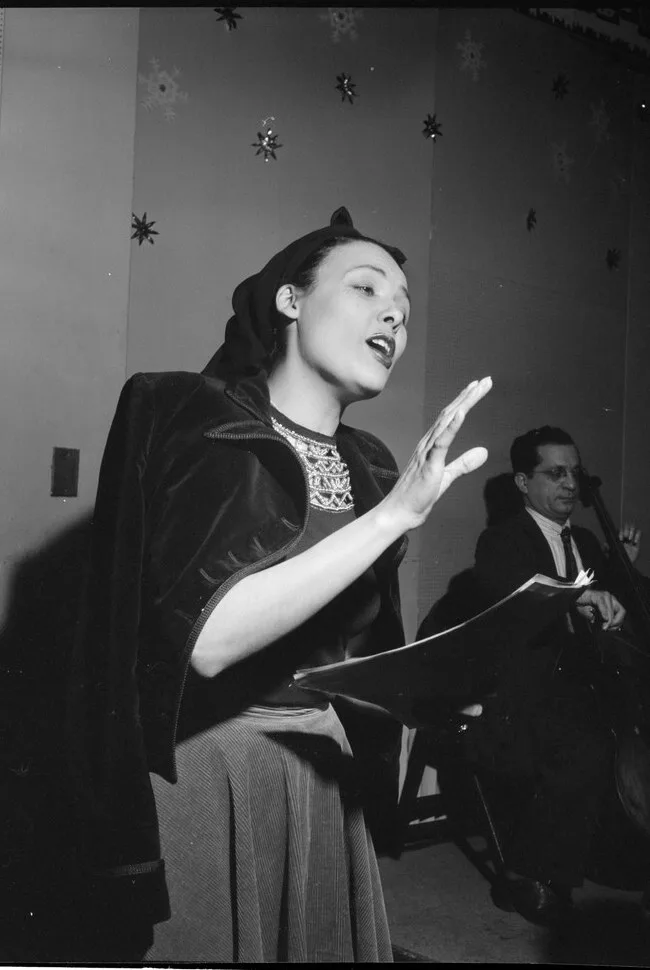
Lena Horne singing at a New York session, between 1946 and 1948, photographed by William P. Gottlieb (cropped from the original frame) Public Domain (William P. Gottlieb collection, dedicated to the public domain by the photographer; Library of Congress: no known copyright restrictions) — Wikimedia Commons — https://commons.wikimedia.org/wiki/File:(Portrait_of_Lena_Horne,_New_York,_N.Y.,_between_1946_and_1948)_(LOC)_(4843132965).jpg

Lena Mary Calhoun Horne was born on June 30, 1917, in Bedford-Stuyvesant, Brooklyn, to Edwin and Edna Horne, into the well-educated upper stratum of Black New York. Her father, a gambler and onetime hotel and restaurant owner, left the family when she was three and settled in Pittsburgh's Hill District; her mother, an actress with a Black theater troupe, traveled widely, and Horne was raised mainly by her paternal grandparents. At five she was sent to Georgia, and from 1927 to 1929 she lived at Fort Valley with her uncle Frank S. Horne, a college dean. Back in New York at twelve, she attended St. Peter Claver School and then Girls High School in Brooklyn, which she left at sixteen. In the fall of 1933 she joined the chorus line of the Cotton Club in Harlem, where the performers were Black and the audience was white only, and in the spring of 1934 she had a featured spot in the Cotton Club Parade starring Adelaide Hall, who took her under her wing. Her first screen appearance was as a dancer in the short Cab Calloway's Jitterbug Party (1935), and during years spent with her father in Pittsburgh she learned music from, among others, Billy Strayhorn and Billy Eckstine. She married Louis Jordan Jones there in January 1937.
Her first records came as a band singer. She toured with Noble Sissle's orchestra, billed as Helena Horne, and sang "That's What Love Did to Me" and "I Take to You" at his Decca session in New York on March 11, 1936. After separating from her husband she toured in 1940 and 1941 with Charlie Barnet's band, which recorded four sides with her for Victor on January 7 and 23, 1941, among them "Good-for-Nothin' Joe," "You're My Thrill," and "Haunted Town." She disliked life on the road and left to work at Café Society, New York's first integrated nightclub, where she worked with Paul Robeson. She replaced Dinah Shore on NBC's jazz series The Chamber Music Society of Lower Basin Street, which led to Victor records with the program's Dixieland group under Henry Levine on June 23 and 25, 1941 ("St. Louis Blues," "Careless Love," "Aunt Hagar's Blues," and "Beale Street Blues"). The next day she cut "Love Me a Little Little" and "Don't Take Your Love from Me" with Artie Shaw's orchestra, and on September 16, 1941 she recorded "Out of Nowhere" and "Prisoner of Love" for Columbia with Teddy Wilson's orchestra. Her own Victor sides of December 15 to 17, 1941, arranged and conducted by Lou Bring, included "Stormy Weather," issued in 1942, which reached number 21 on the US popularity chart. In 1945 and 1946 she sang with Billy Eckstine's orchestra, and in the same years she recorded with Horace Henderson's orchestra and the Phil Moore Four.
In January 1942 she made her Hollywood nightclub debut at the Little Troc on the Sunset Strip, and a few weeks later MGM signed her. She made her MGM debut in Panama Hattie (1942), sang the title song of Stormy Weather (1943) on loan to 20th Century Fox in a film that also featured Fats Waller and Cab Calloway, and appeared in Cabin in the Sky (1943). Because her scenes had to be removable for cities where theaters would not show films with Black performers, most of her film work consisted of stand-alone musical numbers, and she became the first African-American elected to the Screen Actors Guild board. In December 1947 she married Lennie Hayton in Paris. Hayton, MGM's music director, had been a pianist in Paul Whiteman's orchestra, where he played alongside Bix Beiderbecke and Frankie Trumbauer, and he became her conductor and arranger. She was blacklisted in the 1950s for her 1940s associations with communist-backed groups, which she later disavowed. After Duchess of Idaho (1950) and Meet Me in Las Vegas (1956) she made few films, saying she was tired of the typecast role of standing against a pillar to sing a song.
As a nightclub headliner she played the Sands in Las Vegas, the Cocoanut Grove in Los Angeles, and the Waldorf-Astoria in New York. Her first complete LP for RCA Victor was It's Love (1955). Lena Horne at the Waldorf Astoria, recorded on the evening of December 31, 1956 and issued in 1957, was one of the first non-classical live albums made in stereo, peaked at number 24 on the Billboard album chart, and became the best-selling record by a female artist in RCA Victor's history up to that time. Hayton arranged and conducted her studio albums Stormy Weather (1957), Give the Lady What She Wants (1958, number 20), and Songs by Burke and Van Heusen (1959), the last two with Ralph Burns also credited as arranger. In 1957 she starred on Broadway in the Caribbean-flavored musical Jamaica, with Adelaide Hall in the cast at her request, and became the first African-American woman nominated for a Tony Award for best actress in a musical. Porgy and Bess (1959), a set of Gershwin songs with Harry Belafonte, reached number 13. Her 1962 album Lena...Lovely and Alive paired her with Marty Paich's arrangements and a Los Angeles band that included drummer Shelly Manne, trumpeters Jack Sheldon and Pete Candoli, trombonist Frank Rosolino, saxophonists Bill Perkins and Joe Maini, and pianist Gene DiNovi; it earned a Grammy nomination.
Horne's activism ran alongside the music. In 1941 she worked with Paul Robeson at Café Society, and she later worked with Eleanor Roosevelt on anti-lynching legislation, appeared at an NAACP rally in Jackson, Mississippi, with Medgar Evers the weekend before his assassination, and spoke and sang at the March on Washington in August 1963 on behalf of the NAACP, SNCC, and the National Council of Negro Women. The NAACP awarded her its Spingarn Medal in 1983.
Her recordings after 1965 leaned toward pop and soul, with some jazz-world collaborators. Lena & Gabor (1970, Skye) paired her with guitarist Gábor Szabó in arrangements by Gary McFarland, with Cornell Dupree and Eric Gale among the guitarists, and Lena & Michel (1975, RCA) was arranged by Michel Legrand, with Ron Carter on bass and Thad Jones among the trumpeters. A 1973 television special with Tony Bennett led to a joint tour of the United States and Britain, and the 1976 album Lena: A New Album, arranged by Robert Farnon, includes Phil Woods on saxophone. She announced her retirement in March 1980, but on May 12, 1981, she opened Lena Horne: The Lady and Her Music at the Nederlander Theatre in New York. The one-woman show ran 333 performances until June 30, 1982, her 65th birthday, then toured 41 cities in the United States and Canada through June 17, 1984 before playing London and Stockholm. It earned her a Special Tony Award, and its cast album, produced by Quincy Jones for his Qwest label, won two Grammys. A 1983 duet project with Frank Sinatra, to be produced by Jones, was abandoned.
Her 1988 studio album The Men in My Life included duets with Joe Williams and Sammy Davis Jr., and in 1989 she received the Grammy Lifetime Achievement Award. In the 1990s she recorded for Blue Note. We'll Be Together Again (1994), a Grammy nominee, includes four songs by Strayhorn and one he wrote with Duke Ellington, with Toots Thielemans on harmonica and Jerome Richardson on tenor saxophone. An Evening with Lena Horne (1995), recorded live at the Supper Club in New York in September 1994 with Mike Renzi's rhythm section and members of the Count Basie Orchestra, won the Grammy for Best Jazz Vocal Performance. Being Myself (1998), her last studio album, features George Benson, Milt Jackson, and Donald Harrison. Her voice is also on Simon Rattle's Classic Ellington (2000). She withdrew from public life in 2000, and Seasons of a Life (2006), outtakes assembled by her guitarist and music director Rodney Jones, has Herbie Hancock on piano on two tracks.
Horne died of congestive heart failure in New York City on May 9, 2010, at the age of 92. Her honors include the Kennedy Center Honors (1984), the Grammy Lifetime Achievement Award (1989), and an NAACP Image Award for Outstanding Jazz Artist (1999). In 2021 the bandshell in Brooklyn's Prospect Park was renamed the Lena Horne Bandshell, and in 2022 the Brooks Atkinson Theatre on Broadway became the Lena Horne Theatre, the first Broadway house named for a Black woman.
Horne was not only a jazz singer. English Wikipedia describes her first as a singer, actress, dancer, and civil rights activist and lists her genres as R&B, soul, Broadway, traditional pop, and vocal jazz; the MGM musicals, Jamaica, the pop and soul albums of the late 1960s and 1970s, and the Broadway one-woman show all sit largely outside jazz. Her jazz credentials are nonetheless documented. She sang with the orchestras of Noble Sissle, Charlie Barnet, Artie Shaw, Teddy Wilson, and Billy Eckstine, and with Henry Levine's Dixieland group on radio and record, and her Victor and Columbia sides of 1941 are filed as jazz and dance band recordings with a female vocal. Billy Strayhorn, a Pittsburgh teacher of her youth, remained what Wikipedia calls an important professional mentor who helped her singing technique; she recorded his "You're the One" on It's Love (1955), "Maybe" on Lena Horne at the Sands (1961), and four of his songs on We'll Be Together Again (1994). Her Waldorf-Astoria set mixed Cole Porter and Broadway material with a Duke Ellington medley and a Fats Waller standard, "Honeysuckle Rose." In the 1990s she recorded for Blue Note, won the Grammy for Best Jazz Vocal Performance, was nominated in the jazz vocal category for The Men in My Life (1988), and received the NAACP Image Award for Outstanding Jazz Artist. Her studio style was shaped by the arrangers around her: Lennie Hayton's orchestral settings in the 1950s, the Marty Paich band in 1962, and in the 1990s small groups led by pianist Mike Renzi. Billboard called the 1957 Stormy Weather a powerful package with a smartly sexy delivery, and AllMusic's review of Lena & Gabor heard a soulful sass missing from her earlier albums. Nancy Wilson's profile lists Horne as a model for her overall look.
- Stormy Weather (1942, Victor) - Recorded December 15, 1941 under Lou Bring's direction and issued in 1942, her signature song and her first chart record, at number 21; she sang it again in the 1943 film and in many later versions. Listen
- Lena Horne at the Waldorf Astoria (1957, RCA Victor) - Live at the Waldorf-Astoria on December 31, 1956 with Nat Brandwynne's orchestra and Lennie Hayton conducting; it became RCA Victor's best-selling record by a female artist up to that time. Spotify - At The Waldorf Astoria (Live) Listen
- Porgy and Bess (1959, RCA Victor) - Gershwin songs shared with Harry Belafonte, with Lennie Hayton conducting her tracks and Robert Corman Belafonte's; it reached number 13 on the Billboard album chart. Spotify - Porgy and Bess Listen
- Lena...Lovely and Alive (1962, RCA Victor) - Arranged by Marty Paich with a West Coast jazz band including Shelly Manne, Jack Sheldon, Frank Rosolino, and Bill Perkins; Grammy-nominated. Spotify - Lena...Lovely and Alive Listen
- Lena Horne: The Lady and Her Music (1981, Qwest) - The cast album of her Broadway one-woman show, produced by Quincy Jones and recorded live at the Nederlander Theatre; it won two Grammys. Spotify - Live On Broadway Lena Horne: The Lady And Her Music
- We'll Be Together Again (1994, Blue Note) - The first of her three 1990s Blue Note albums, with songs by Billy Strayhorn and Duke Ellington, Toots Thielemans on harmonica, and Jerome Richardson on tenor saxophone; nominated for the Grammy for Best Jazz Vocal Performance. Spotify - We'll Be Together Again Listen
- An Evening with Lena Horne (1995, Blue Note) - Recorded live at the Supper Club in September 1994 with Mike Renzi, Rodney Jones, and members of the Count Basie Orchestra; winner of the Grammy for Best Jazz Vocal Performance.
- Being Myself (1998, Blue Note) - Her last studio album, with George Benson, Milt Jackson, and Donald Harrison alongside her regular rhythm section. Spotify - Being Myself Listen
Lena Horne: Full Discography
Discogs artist ID 300050 ("Lena Horne," real name Lena Mary Calhoun Horne, born June 30, 1917, in Brooklyn, New York, died May 9, 2010, in Manhattan) lists about 2,560 entries, most of them reissues, compilations, and track appearances. A name search of Discogs found no separate entity for a numbered namesake or a named group of hers; her 1930s and 1940s band sides are filed under the bandleaders and are summarized in the second table. Wikipedia counts 24 studio albums, four live albums, one soundtrack album, and 19 compilations, so the first table is a curated selection of 29 releases: the RCA Victor albums, the Skye, Qwest, and Blue Note albums, the major live recordings, and the early 78-rpm sets. Her film and television soundtracks are not itemized. Catalog numbers are those of the first or best-documented US pressing found on Discogs; recording dates come from the Discography of American Historical Recordings, Discogs release notes, and Wikipedia, and where the sources differ the Notes column says so.
As Leader / Co-Leader
| Album Title | Recording Date(s) | Release Date | Label | Catalog Number | Format(s) | Personnel | Role | Reissue History | Spotify | Buy | Notes |
|---|---|---|---|---|---|---|---|---|---|---|---|
| Moanin' Low | December 15 and 17, 1941 | April 3, 1942 | Victor | P-118 | Shellac, 4 x 10 in., 78 rpm, Album | Lena Horne (vocals), Lou Bring (conductor), Ned Freeman (arranger) | Leader | Titles later collected on the 1990 Bluebird/RCA compilation Stormy Weather: The Legendary Lena (1941-1958) | — | — | Her first album-format release; includes the original recording of "Stormy Weather." |
| The Birth of the Blues (An Album of W. C. Handy Music) | June 23 and 25, 1941 (Horne titles) | 1941 (Discogs master year; the pressing consulted is dated 1943) | Victor | P 82 | Shellac, 4 x 10 in., 78 rpm, Album | Lena Horne (vocals on four of the eight sides), The Dixieland Jazz Group of NBC's Chamber Music Society of Lower Basin Street, Henry Levine (conductor) | Featured vocalist (co-billed) | Titles later heard on the 1964 RCA Camden compilation NBC's Chamber Music Society of Lower Basin Street (CAL 321) | — | — | Horne sings "St. Louis Blues," "Beale Street Blues," "Aunt Hagar's Blues," and "Careless Love"; the other four sides carry no vocal credit for her. |
| Classics in Blue | Not confirmed | 1947 | Black & White | Album 75 | Shellac, 4 x 10 in., 78 rpm, Album | Lena Horne (vocals), Phil Moore (conductor) | Leader | Reissue history not itemized | — | — | Eight sides including "Beale Street Blues," "Hesitation Blues," and "Frankie and Johnny." |
| Lena Horne Sings | Not confirmed | 1953 (Discogs; Wikipedia gives 1952) | MGM Records | E-545 | Vinyl, 10 in. LP, Compilation | Lena Horne (vocals); accompanists not itemized | Leader | Reissue history not itemized | — | — | Collects her MGM recordings. |
| It's Love | Not confirmed | 1955 (Wikipedia; the US LP is dated 1956 on Discogs) | RCA Victor | LPM-1148 | Vinyl, LP, Album, Mono | Lena Horne (vocals), Lennie Hayton (arranger, conductor) and His Orchestra | Leader | Reissued with Songs by Burke and Van Heusen on a 2004 two-on-one CD (RCA Victor Originals, 82876 625972) | — | — | Her first complete LP for RCA Victor; includes Billy Strayhorn's "You're the One." |
| Lena Horne at the Waldorf Astoria | December 31, 1956, Waldorf-Astoria Hotel, New York | February 20, 1957 | RCA Victor | LOC-1028 (mono); LSO-1028 (stereo, 1958) | Vinyl, LP, Album, Mono and Stereo | Lena Horne (vocals), Nat Brandwynne and His Orchestra, Lennie Hayton (conductor) | Leader | Reissued on CD in 2002 by Collectables with Lena Horne at the Sands | Spotify - At The Waldorf Astoria (Live) | — | Peaked at number 24 on the Billboard album chart; best-selling record by a female artist in RCA Victor's history up to that time. Some sources give February 20, 1957, which is the release date, as the recording date. |
| Stormy Weather | Webster Hall, New York, 1957 (dates not confirmed) | September 1957 | RCA Victor | LPM-1375 | Vinyl, LP, Album, Mono | Lena Horne (vocals), Lennie Hayton (arranger, conductor) and His Orchestra | Leader | Reissued on CD in 2002 with ten additional tracks | Spotify - Stormy Weather | — | Includes a new recording of the title song. The Spotify listing is an edition with bonus tracks. |
| Give the Lady What She Wants | Not confirmed | 1958 | RCA Victor | LPM-1879 | Vinyl, LP, Album, Mono | Lena Horne (vocals), Lennie Hayton and Ralph Burns (arrangers), Lennie Hayton and His Orchestra | Leader | Reissued on CD in Japan in 2004 and in a 2010 two-CD set with Stormy Weather and A Friend of Yours | — | — | Peaked at number 20 on the Billboard album chart. |
| Songs by Burke and Van Heusen | December 1 and 9, 1958, completed January 5, 1959, RCA Victor studio, New York | December 1959 (Discogs) | RCA Victor | LSP-1895 (stereo); LPM-1895 (mono) | Vinyl, LP, Album, Stereo and Mono | Lena Horne (vocals), Lennie Hayton and Ralph Burns (arrangers), Lennie Hayton and His Orchestra | Leader | Issued in some countries as A Friend of Yours; CD reissues in Japan (1999, 2004) and the UK (2004) | — | — | All songs by Jimmy Van Heusen and Johnny Burke. |
| Porgy and Bess | Not confirmed | 1959 | RCA Victor | LOP-1507 | Vinyl, LP, Album, Mono | Lena Horne and Harry Belafonte (vocals), Lennie Hayton and Bob Corman (arrangers, conductors) | Co-leader (billed with Harry Belafonte) | Reissued in 2003 on a two-CD set with Jamaica | Spotify - Porgy and Bess | — | Peaked at number 13 on the Billboard album chart; Horne and Belafonte sing two songs together, the rest are solos. |
| Lena Horne at the Sands | November 3 to 5, 1960, Copa Room, Sands Hotel, Las Vegas | 1961 | RCA Victor | LPM-2364 | Vinyl, LP, Album, Mono | Lena Horne (vocals), Anthony Morelli and His Sands Hotel Orchestra, Lennie Hayton (conductor) | Leader | Reissued on CD in 2002 by Collectables with Lena Horne at the Waldorf Astoria | — | — | Grammy nominee; includes Billy Strayhorn's "Maybe." |
| Lena on the Blue Side | Summer 1961, New York | February 1962 | RCA Victor | LSP-2465 | Vinyl, LP, Album, Stereo | Lena Horne (vocals), Marty Gold (arranger, conductor), Andy Ackers (piano), Al Caiola (guitar), George Duvivier (bass), Osie Johnson (drums), Bernie Glow and Mel Davis (trumpets), Sy Berger and Tony Studd (trombones), strings | Leader | Complete CD reissue only in Japan (1991) | Spotify - Lena On The Blue Side | — | Mostly blues-flavored songs; peaked at number 102 on the Billboard album chart. |
| Lena...Lovely and Alive | Not confirmed | 1962 | RCA Victor | LSP-2587 | Vinyl, LP, Album, Stereo | Lena Horne (vocals), Marty Paich (arranger, conductor), Gene DiNovi (piano), Bill Pitman (guitar), Joe Mondragon (bass), Shelly Manne and Frank Capp (drums), Jack Sheldon and Pete Candoli (trumpets), Bob Enevoldsen and Frank Rosolino (trombones), Bill Perkins and Joe Maini (saxophones) | Leader | Reissue history not itemized | Spotify - Lena...Lovely and Alive | — | Grammy nominee for Best Solo Vocal Performance, Female; the Spotify listing is a later edition of the 12-song album. |
| Lena Like Latin | July 1963, Hollywood | Summer 1963 | CRC Charter | CLS-106 (stereo) | Vinyl, LP, Album, Stereo | Lena Horne (vocals), Lennie Hayton (arranger, conductor), Shorty Rogers and Marty Paich (arrangers) | Leader | Also issued as Lena Goes Latin; 2008 CD reissue by Fresh Sound with Lena Horne Sings Your Requests | — | — | Includes Jobim's "Meditation." |
| Here's Lena Now! | Not confirmed | 1963 | 20th Century Fox Records | TFM-3115 (mono) | Vinyl, LP, Album, Mono | Lena Horne (vocals); accompanists not itemized | Leader | Reissue history not itemized | — | — | Includes the single "Now!", which reached number 92 on the Hot 100 and number 18 on the R&B chart. |
| Feelin' Good | Not confirmed | 1965 | United Artists Records | ULP 1114 (mono) | Vinyl, LP, Album, Mono | Lena Horne (vocals); accompanists not itemized | Leader | Reissue history not itemized | — | — | Her first United Artists album. |
| Soul | September 9, 1965 to March 11, 1966 | June 1966 | United Artists Records | UAL 3496 (mono) | Vinyl, LP, Album, Mono | Lena Horne (vocals), Ray Ellis (arranger) | Leader | CD reissues by EMI (1996) and DRG (2007, with six bonus tracks) | — | — | Includes Herbie Hancock's "You Know What to Do." |
| Lena in Hollywood | Not confirmed | 1966 | United Artists Records | ULP 1132 (mono) | Vinyl, LP, Album, Mono | Lena Horne (vocals); accompanists not itemized | Leader | Reissue history not itemized | — | — | Second of four United Artists albums. |
| Merry from Lena | Not confirmed | 1966 | United Artists Records | UAS 6546 (stereo) | Vinyl, LP, Album, Stereo | Lena Horne (vocals); accompanists not itemized | Leader | Reissue history not itemized | — | — | Christmas album; includes "Let It Snow! Let It Snow! Let It Snow!" |
| Lena & Gabor | October and November 1969, A&R Studios, New York | 1970 | Skye Records | SK-15 | Vinyl, LP, Album | Lena Horne (vocals), Gábor Szabó (guitar, producer), Gary McFarland (arranger, producer), Cornell Dupree and Eric Gale (guitars), Richard Tee (organ), Chuck Rainey (electric bass), Grady Tate (drums) | Co-leader (billed with Gábor Szabó) | Reissued in 1971 as Watch What Happens after Skye Records closed | — | — | Peaked at number 162 on the Billboard album chart; includes "Watch What Happens." |
| Nature's Baby | Not confirmed | 1971 | Buddah Records | BDS 5084 | Vinyl, LP, Album | Lena Horne (vocals), Ray Ellis (arranger) | Leader | Reissue history not itemized | — | — | Pop and soul songs of the early 1970s. |
| Lena & Michel | February 1975, RCA Studios, New York | June 1975 | RCA Victor | BGL1-1026 | Vinyl, LP, Album, Stereo | Lena Horne (vocals), Michel Legrand (arranger), Ron Carter (bass), Grady Tate (drums), Paul Griffin (piano), Richard Tee (organ), Joe Beck and Cornell Dupree (guitars), Ralph MacDonald (percussion), Thad Jones and Jon Faddis among the trumpeters | Co-leader (billed with Michel Legrand) | CD reissues by BMG Japan (2002) and Sony UK (2010) | — | — | Arranged by Michel Legrand. |
| Lena, a New Album | April 1976, Olympic Studios, London | September 1976 | RCA Victor | BGL1-1799 | Vinyl, LP, Album, Stereo | Lena Horne (vocals), Robert Farnon (arranger, conductor), Phil Woods (saxophone), Chris Laurence (bass), David Snell (harp), Gordon Beck (keyboards), Raymond Cohen (violin) | Leader | Reissue history not itemized | — | — | Lennie Hayton is also credited as an arranger; includes Strayhorn's "A Flower Is a Lovesome Thing." |
| Lena Horne: The Lady and Her Music (Live on Broadway) | 1981, live, Nederlander Theatre, New York | 1981 | Qwest Records | 2QW 3597 | Vinyl, 2 x LP, Album | Lena Horne (vocals), Quincy Jones (producer); Discogs credits arrangers including Harold Wheeler, Coleridge-Taylor Perkinson, Gil Askey, and Lennie Hayton (two titles) | Leader | CD reissue not itemized | Spotify - Live On Broadway Lena Horne: The Lady And Her Music | — | Cast album of the Broadway one-woman show; won two Grammys (Best Pop Vocal Performance, Female, and Best Cast Show Album). |
| The Men in My Life | May to July 1988, Clinton Recording Studios, New York | 1988 | Three Cherries Records | TC 44411 | Vinyl, LP, Album; also CD | Lena Horne (vocals), Mike Renzi and Frank Owens (music directors), Joe Williams and Sammy Davis Jr. (duets) | Leader | Reissue history not itemized | — | — | Grammy nominee for Best Jazz Vocal Performance, Female; "I Won't Leave You Again" (with Joe Williams) was nominated in the duo category. |
| We'll Be Together Again | 1993 to 1994 (full dates not confirmed) | 1994 | Blue Note | 7243 8 28974 2 2 | CD, Album | Lena Horne (vocals), Frank Owens and Mike Renzi (pianos, arrangers, co-producers), Rodney Jones (guitars), Benjamin Brown (bass), Akira Tana (drums), Toots Thielemans (harmonica), Jerome Richardson (tenor saxophone), Houston Person, Jesse Levy (cello), Johnny Mathis (duet on "Day Follows Day") | Leader | Reissue history not itemized | Spotify - We'll Be Together Again | — | Grammy nominee for Best Jazz Vocal Performance; includes four Billy Strayhorn songs and "Something to Live For," which he wrote with Duke Ellington. |
| An Evening with Lena Horne | September 19, 1994, The Supper Club, New York | 1995 | Blue Note | CDP 7243 8 31877 2 0 | CD, Album | Lena Horne (vocals), Mike Renzi (piano, synthesizer, music director), Rodney Jones (guitar), Ben Brown (bass), Akira Tana (drums), Count Basie Orchestra on tracks 1, 8, 9, 14, and 16 | Leader | Later reissued as An Evening with Lena Horne: Live at the Supper Club; a DVD followed in 2005 | — | — | Won the Grammy for Best Jazz Vocal Performance; some sources date the album 1994, the year of the recording. |
| Being Myself | 1995 and 1997 | June 2, 1998 | Blue Note | CDP 7243 8 34286 2 5 | CD, Album | Lena Horne (vocals), George Benson (guitar), Donald Harrison (saxophone), Milt Jackson (vibraphone), Mike Renzi (piano), Rodney Jones (guitar), Benjamin Brown (bass), Akira Tana (drums), Jeremy Lubbock (string arrangements on two titles) | Leader | Reissue history not itemized | Spotify - Being Myself | — | Her last studio album released in her lifetime; the release carries no personnel credits on Discogs, so the personnel come from Wikipedia. |
| Seasons of a Life | 1993 to 1997 (outtakes) | January 24, 2006 | Blue Note | 7243 4949265 2 8 | CD, Compilation | Lena Horne (vocals), Rodney Jones (guitar, music director, remix), Mike Renzi (piano), Akira Tana (drums), Benjamin Brown (bass), Bobby Forrester (organ), Donald Harrison (saxophone), Herbie Hancock (piano on "Chelsea Bridge" and "Willow Weep for Me") | Leader | Reissue history not itemized | — | — | Outtakes from her Blue Note sessions, put together by Rodney Jones. |
As Featured Vocalist (selected band, collaborative, and cast recordings)
| Year | Project (Leader) | Title | Label | Catalog | Role | Notes |
|---|---|---|---|---|---|---|
| 1936 | Noble Sissle and His Orchestra | "That's What Love Did to Me"; "I Take to You" | Decca | 778 and 847 (matrices 60888 and 60892) | Vocalist | Recorded March 11, 1936, in New York; her first records, made while touring with the band as Helena Horne. |
| 1941 | Charlie Barnet and His Orchestra | "Good-for-Nothin' Joe"; "The Captain and His Men"; "You're My Thrill"; "Haunted Town" | Victor | Not confirmed | Vocalist | Recorded January 7 and 23, 1941. |
| 1941 | Dixieland Jazz Group of NBC's Chamber Music Society of Lower Basin Street (Henry Levine) | "St. Louis Blues"; "Careless Love"; "Aunt Hagar's Blues"; "Beale Street Blues" | Victor | P 82 (album) | Vocalist | Recorded June 23 and 25, 1941; issued in The Birth of the Blues. |
| 1941 | Artie Shaw and His Orchestra | "Love Me a Little Little"; "Don't Take Your Love from Me" | Victor | Not confirmed | Vocalist | Recorded June 26, 1941. |
| 1941 | Teddy Wilson and His Orchestra | "Out of Nowhere"; "Prisoner of Love" | Columbia | Matrices CO 31320 and CO 31321 | Vocalist | Recorded September 16, 1941. |
| 1944 | Horace Henderson's orchestra (Lena Horne with) | "I Didn't Know About You"; "One for My Baby (and One More for the Road)"; "As Long as I Live"; "I Ain't Got Nothin' but the Blues" | Victor | Not confirmed | Featured vocalist | Recorded November 21, 1944; "One for My Baby" reached number 21 on the US chart, per Wikipedia. |
| 1944 | Cab Calloway and His Orchestra | "Diga Diga Do" | V-Disc | Not confirmed | Vocalist | Wartime V-Disc issued for the armed forces. |
| 1945 | The Phil Moore Four | "How Long Has This Been Going On?"; "I Want a Little Doggie" | Victor | Not confirmed | Featured vocalist | Dated 1945 on Discogs. |
| 1955 | Ella Fitzgerald, Lena Horne, and Billie Holiday with Teddy Wilson and His Orchestra | Ella, Lena and Billie | Columbia | CL 2531 (Discogs) | Featured vocalist | Compilation of vocal sides with Teddy Wilson's orchestra; the catalog number is as listed on Discogs and not independently confirmed. |
| 1957 | Jamaica (original cast, with Ricardo Montalban) | Jamaica | RCA Victor | LOC 1036 (mono); LSO-1036 (stereo) | Lead vocalist | Songs by Harold Arlen and E. Y. Harburg; a four-song EP, EPA-4038, was also issued. |
| 1970 | Harry Belafonte and Lena Horne | Harry & Lena | RCA Victor | PRS-295 (Discogs) | Co-leader | Studio album with Belafonte, their second together; catalog number as listed on Discogs. |
| 2000 | Duke Ellington, arranged by Luther Henderson; Simon Rattle conducting the City of Birmingham Symphony Orchestra | Classic Ellington | EMI Classics | 7243 5 57014 2 8 | Guest vocalist | Instrumental soloists credited on the release include Clark Terry (trumpet), Joe Lovano and Joshua Redman (tenor saxophones), Geri Allen (piano), Regina Carter (violin), and Lewis Nash (drums); which tracks each plays on is not confirmed. |
- Billy Strayhorn - taught her music in Pittsburgh in her youth and remained an important professional mentor and close friend; she recorded his songs on It's Love (1955), Lena Horne at the Sands (1961), Lena: A New Album (1976), and We'll Be Together Again (1994).
- Lennie Hayton - her second husband from 1947 (they separated in the early 1960s but never divorced); MGM music director and former Paul Whiteman pianist who arranged and conducted her RCA Victor albums of the 1950s and early 1960s.
- Noble Sissle - bandleader whose orchestra she toured with and first recorded with, at the Decca session of March 11, 1936.
- Charlie Barnet - bandleader on whose Victor sides of January 1941 she sang, including "Good-for-Nothin' Joe" and "You're My Thrill."
- Henry Levine - leader of the Dixieland group of NBC's Chamber Music Society of Lower Basin Street, with whom she recorded for Victor in June 1941.
- Artie Shaw - bandleader whose orchestra backed her on two Victor sides in June 1941.
- Teddy Wilson - pianist and bandleader whose orchestra accompanied her on "Out of Nowhere" and "Prisoner of Love" (Columbia, September 16, 1941), per his own profile also among the vocalists on his Brunswick series.
- Billy Eckstine - taught her music in Pittsburgh and later led the orchestra with which she sang in 1945 and 1946.
- Phil Moore, Horace Henderson - bandleaders on her 1940s Victor and Black & White sides (the Phil Moore Four on "How Long Has This Been Going On?").
- Cab Calloway, Fats Waller - co-stars in the 1943 film Stormy Weather; Horne also recorded "Diga Diga Do" with Calloway's orchestra for V-Disc in 1944.
- Duke Ellington - composer-bandleader whose songs ran through her Waldorf, Blue Note, and Classic Ellington recordings, including "Mood Indigo" and "Something to Live For," written with Strayhorn.
- Harry Belafonte - duet partner on Porgy and Bess (1959) and the ABC television special Harry & Lena (1970).
- Tony Bennett - co-star of the 1973 television special Tony and Lena and her partner on a joint tour of the United States and Britain.
- Gary McFarland, Gábor Szabó - arranger-producer and guitarist behind Lena & Gabor (1970).
- Michel Legrand - arranger of Lena & Michel (1975), with Ron Carter on bass and Thad Jones among the trumpeters.
- Quincy Jones - producer of the 1981 cast album of The Lady and Her Music, and of the abandoned 1983 duet project with Frank Sinatra.
- George Benson, Milt Jackson, Donald Harrison - guests on Being Myself (1998).
- Herbie Hancock - pianist on "Chelsea Bridge" and "Willow Weep for Me" on Seasons of a Life (2006).
- Phil Woods - saxophonist on Lena: A New Album (1976).
- Bill Perkins - saxophonist on Lena...Lovely and Alive (1962), alongside Shelly Manne, Jack Sheldon, Pete Candoli, Frank Rosolino, Joe Maini, and Gene DiNovi.
- George Duvivier - bassist who, per his own profile, toured Europe accompanying her in the 1950s; he also plays on Lena on the Blue Side (1962).
- Cornell Dupree, Eric Gale - guitarists on Lena & Gabor and (Dupree) Lena & Michel.
- Toots Thielemans, Houston Person, Jerome Richardson, Mike Renzi, Rodney Jones, Akira Tana, Ben Brown - players on her Blue Note albums of 1994 to 1998; Jones was her guitarist and music director.
- Joe Williams, Sammy Davis Jr. - duet partners on The Men in My Life (1988).
- Adelaide Hall - Cotton Club star who took Horne under her wing in 1934 and appeared at her request in Jamaica in 1957.
More Vocal Jazz Artists
See all 220 Vocal Jazz artists →More American Jazz Artists
See all 646 American artists →- Wikipedia: Lena Horne
- Wikipedia: Lena Horne discography
- Wikipedia: Lena Horne at the Waldorf Astoria
- Wikipedia: Lena...Lovely and Alive
- Wikipedia: We'll Be Together Again (Lena Horne album)
- Wikipedia: An Evening with Lena Horne
- Wikipedia: Being Myself
- Wikipedia: Lena Horne: The Lady and Her Music
- Wikipedia: Billy Strayhorn
- Wikipedia: Lennie Hayton
- Discography of American Historical Recordings: Lena Horne
- Discogs: Lena Horne (artist 300050)
- MusicBrainz: Lena Horne
- JazzProfiles.com: Noble Sissle
- JazzProfiles.com: Teddy Wilson
- JazzProfiles.com: George Duvivier
- JazzProfiles.com: Nancy Wilson