 JAZZPROFILES lives in the music 2,059 Jazz Artists fully Profiled!
Les Paul
Last updated October 29, 2026
Listen on Spotify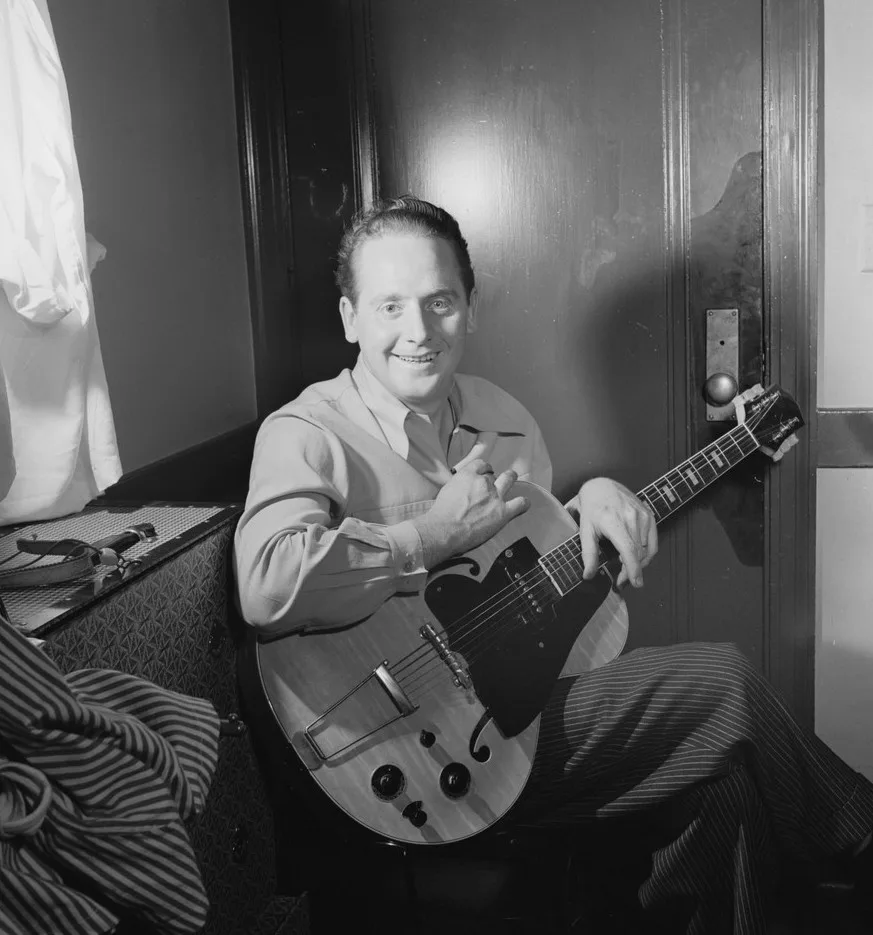
Les Paul, circa January 1947, photographed by William P. Gottlieb Public domain (William P. Gottlieb collection, Library of Congress; the photographs entered the public domain on February 16, 2010, in accordance with Gottlieb's wishes) — Wikimedia Commons: https://commons.wikimedia.org/wiki/File:Les_Paul,_ca._Jan._1947_(William_P._Gottlieb_07001).jpg (original: Library of Congress, Gottlieb collection, item 07001)

Les Paul was born Lester William Polsfuss in Waukesha, Wisconsin, on June 9, 1915, the son of George and Evelyn Polsfuss. He took up the harmonica at eight, then the piano, the banjo and finally the guitar, and he was largely self-taught. By thirteen he was working semi-professionally as a country singer, guitarist and harmonica player in Waukesha-area drive-ins and roadhouses, and he was already wiring a phonograph needle to his acoustic guitar and running it through a radio speaker so that more people could hear him. At seventeen he played with Rube Tronson's Texas Cowboys, then left high school to join Sunny Joe Wolverton's radio band in St. Louis, heard on KMOX.
He moved to Chicago with Wolverton in 1934 and lived a double life on the air. By day he was Rhubarb Red, a hillbilly singer and guitarist on WBBM; at night he was Les Paul, playing jazz on the South Side, often in an imitation of Django Reinhardt's quartet. Meeting the pianist Art Tatum persuaded him to stay with the guitar rather than play jazz on the piano, and the playing of Django Reinhardt became his model. His first two records, in 1936, came out under the Rhubarb Red name, and he also accompanied other Decca artists, among them the blues singer Georgia White. In 1937 he formed a trio with the rhythm guitarist Jim Atkins, the older half-brother of Chet Atkins, and the bassist and percussionist Ernie "Darius" Newton. In 1938 the trio left Chicago for New York and a featured spot on Fred Waring's radio show.
Two parallel lines of work started in these years and ran through the rest of his life. In 1940, after hours at the Epiphone factory in New York, he built the Log, a one-off solid-body electric guitar made around a four-by-four post of Douglas fir, with the two sawn halves of an Epiphone hollow body bolted on for appearance. Without a resonating body it avoided the feedback and weak sustain that plagued amplified acoustic guitars. He took the idea to Gibson in 1941 and was turned away. That same year an electric shock in his basement nearly killed him, and he spent two years recovering in Chicago as music director of the radio stations WJJD and WIND. In 1943 he moved to Hollywood, formed a new trio and was drafted into the Army, where he served on the Armed Forces Radio Network and backed Bing Crosby and the Andrews Sisters.
His clearest moment as a working jazz musician came on July 2, 1944, at the Philharmonic Auditorium in Los Angeles. Stepping in at the last minute for the guitarist Oscar Moore, he played the first Jazz at the Philharmonic concert, produced by Norman Granz, alongside Nat King Cole, Illinois Jacquet and others. His "Body and Soul" solo and a chase sequence with Cole on the blues are the performances AllMusic singles out as the best surviving evidence of what he could do as a jazz player. Later in 1944 his trio began appearing on Crosby's radio show, Crosby sponsored his recording experiments, and the two recorded "It's Been a Long, Long Time," a No. 1 record in December 1945. The trio also made Decca records from 1944 to 1947 that mixed jazz, country and Hawaiian material, and it backed singers including Dick Haymes, Helen Forrest and the Andrews Sisters, who hired it to open their 1946 tour.
On Crosby's suggestion he built a recording studio in the garage of his home on North Curson Street in Hollywood. After roughly five hundred discarded test discs, "Lover (When You're Near Me)," released by Capitol, layered eight electric guitar parts, some recorded at half speed so that they played back twice as fast; it became a hit in 1948. In January 1948 a car driven by Mary Ford went off an icy stretch of Route 66 in Oklahoma, shattering his right elbow. Doctors offered amputation; instead the arm was set at an angle just over ninety degrees that allowed him to cradle and pick the guitar, and he needed about a year and a half to recover. In 1949 Crosby gave him one of the first Ampex Model 200A tape recorders, and by adding a playback head ahead of the record head he built sound-on-sound recording, in which a new part is played against an earlier one and both are mixed onto a fresh track. He later worked with Ampex on an eight-track machine for his home studio, which he called the Octopus.
Mary Ford was Iris Colleen Summers, a country singer and guitarist he met in 1945 and renamed; they married in Milwaukee in 1949. From 1950 to 1954 Les Paul and Mary Ford had sixteen top-ten hits, with Paul playing every guitar part and Ford singing her own harmonies on multiple tracks. "Tennessee Waltz" and "Mockin' Bird Hill" reached No. 1 on the Cash Box chart. "How High the Moon," recorded on January 4, 1951 in the home studio of their Queens apartment, spent nine weeks at No. 1 on Billboard, and "Vaya Con Dios" spent eleven weeks there in 1953. They also hosted a fifteen-minute radio program on NBC in 1950 and a television version in 1954 and 1955. The hits stopped in 1955, and a stretch at Columbia from 1958 to 1963 did not bring them back.
Gibson came around only after Fender began selling a solid-body guitar in 1950. Its designer Ted McCarty developed the instrument from Paul's drawings under a royalty agreement, and the Gibson Les Paul went on sale in 1952. In 1952 he also invented the flanging effect, first heard on "Mammy's Boogie." He stopped lending his name to Gibson guitars from 1964 to 1966, unhappy with the more modern-looking redesign of 1960, now called the SG, which he thought too weak in the body and neck. He and Ford divorced at the end of 1964, and in 1965 he went into semi-retirement. His 1968 album Les Paul Now! remade old hits with George Barnes adding guitar tracks.
Chet Atkins coaxed him back into the studio for Chester & Lester (RCA, 1976), which won the Grammy for Best Country Instrumental Performance at the 19th Annual Grammy Awards on February 19, 1977; a second album, Guitar Monsters, followed in 1978. In 1980 he took a duet with Al Di Meola on "Spanish Eyes" from Di Meola's Splendido Hotel. From 1984 he played Monday nights at Fat Tuesday's in New York, and from 1996 until the end of his life he held the Monday residency at the Iridium, across from Lincoln Center, with the guitarist Lou Pallo, the bassists Paul Nowinski and Nicki Parrott, and for periods Frank Vignola on guitar and John Colianni on piano. He appeared on Pat Martino's All Sides Now (Blue Note, 1997) with Nowinski, playing "I'm Confessin' (That I Love You)." The four-disc retrospective The Legend and the Legacy (1991) was followed by American Made World Played (2005), with guests including Eric Clapton, Keith Richards, Jeff Beck, Buddy Guy and Richie Sambora, and at the 48th Annual Grammy Awards in February 2006, at the age of ninety, he won two Grammys, Best Pop Instrumental Performance for "Caravan" and Best Rock Instrumental Performance for "69 Freedom Special."
He was inducted into the Big Band and Jazz Hall of Fame in 1990, received the Grammy Trustees Award in 1983 and a Technical Grammy in 2001, was inducted into the Rock and Roll Hall of Fame in 1988, the National Inventors Hall of Fame in 2005 and the Songwriters Hall of Fame the same year, and received the National Medal of Arts in 2007. Les Paul passed away on August 12, 2009, at White Plains Hospital in White Plains, New York, from complications of pneumonia, at the age of ninety-four. He was buried at Prairie Home Cemetery in Waukesha on August 21, 2009.
Les Paul's fame rests on three different achievements, and only one of them is jazz. As a pop artist he had some of the best-selling records of the early 1950s, pairing his own stacked guitars with Mary Ford's multitracked vocals on standards and country songs. As an engineer and inventor he helped establish the solid-body electric guitar, sound-on-sound recording, tape delay, flanging and multitrack recording as ordinary tools of popular music; those contributions are the main reason the Rock and Roll Hall of Fame presents him as an architect of rock and roll. His country work began under the name Rhubarb Red and returned in the Chet Atkins records of 1976 and 1978.
The jazz case is narrower but real. AllMusic describes his playing as built on very fast runs, bent bluesy notes, fluttering repeated single-note lines and a chunking rhythm underneath, with country licks and showman's comedy mixed in, and it treats his pre-1948 work as the clearest picture of a jazz guitarist. The model was Django Reinhardt, whom he sought out after the war and whose widow later gave him a Selmer guitar; Art Tatum kept him on the guitar. He could not read music and composed whole arrangements in his head before building them track by track, and even the Capitol pop hits use jazz material, with "How High the Moon," "Lover," "Brazil," "Tiger Rag," "Caravan" and "The World Is Waiting for the Sunrise" among the best known. George Benson, Al Di Meola, Stanley Jordan, Pat Martino and Bucky Pizzarelli have all named him as an influence on their playing. His brassy, showy manner drew criticism from jazz writers during his lifetime. Herb Alpert has said that hearing "How High the Moon" led him to apply the same overdubbing to the trumpet.
- Norman Granz's Jazz at the Philharmonic: The First Concert (recorded July 2, 1944; Verve, 1994 reissue) - The live document of his place in a jazz concert of the swing and early bebop years, with his guitar on "Body and Soul" and the blues alongside Nat King Cole. See the discography for the release details.
- "It's Been a Long, Long Time" with Bing Crosby (1945, Decca) - His first No. 1 record, made with his trio behind Crosby. Spotify - It's Been A Long, Long Time Listen
- "Lover (When You're Near Me)" and "Brazil" (1948, Capitol) - The first multitracked pop-jazz singles, for eight electric guitars, assembled on acetate discs.
- "How High the Moon" with Mary Ford (1951, Capitol) - The best-known sound-on-sound record, nine weeks at No. 1 on Billboard, built on a jazz standard.
- "Vaya Con Dios" with Mary Ford (1953, Capitol) - Eleven weeks at No. 1, and the biggest pop success of the Les Paul and Mary Ford duo. Spotify - Vaya Con Dios Listen
- The Hit Makers! (1953, Capitol) - The Capitol-era Les Paul and Mary Ford album collecting the early 1950s hits. Spotify - The Hit Makers Listen
- Chester & Lester (1976, RCA Victor) - A loose, jazz-inflected guitar session with Chet Atkins, and the Grammy winner for Best Country Instrumental Performance. Spotify - Chester & Lester
- American Made World Played (2005, Capitol) - The late-career guest album that won two Grammys at the age of ninety. See the discography for the release details.
Les Paul: Full Discography
Discogs artist: Les Paul (154207) · Duo records: Les Paul & Mary Ford (554528) · Early trio: Les Paul And His Trio (1140899) · Born Lester William Polsfuss, June 9, 1915, Waukesha, Wisconsin
This is a curated list of the releases that define his career, not an exhaustive catalog: Discogs holds well over two thousand releases and reissues under his three main entries, most of them compilations and repackaged hits. The records are grouped by era, and the pop-chart singles that made him famous appear in their own table so the jazz-trio and guitar-duo albums are not buried.
Leader and Co-Leader: Albums
| Album | Year | Label (Catalog) | Personnel & Notes | Listen | Buy |
|---|---|---|---|---|---|
| Hawaiian Paradise (Les Paul and His Trio) | 1946 | Decca | Trio record of Hawaiian-flavored material from the Decca years; issued as a 78 rpm album set, then on 10-inch LP in 1949 (DL 5018) | — | — |
| The New Sound! | 1950 | Capitol (H-226) | Ten-inch LP collecting the multitracked singles that began with "Lover" and "Brazil"; reissued on 12-inch LP in 1955 | — | — |
| Les Paul's New Sound, Vol. 2 (with Mary Ford) | 1951 | Capitol (H-286) | Capitol ten-inch LP billing Mary Ford alongside Paul | — | — |
| Galloping Guitars (Les Paul and His Trio) | 1952 | Decca (DL 5376) | Ten-inch LP of trio sides from the 1940s | — | — |
| Bye Bye Blues! (with Mary Ford) | 1952 | Capitol (H-356) | Ten-inch LP | — | — |
| The Hit Makers! (with Mary Ford) | 1953 | Capitol (H-416) | Ten-inch LP of the first run of duo hits | Spotify | — |
| Les and Mary (with Mary Ford) | 1955 | Capitol (W 577) | Capitol LP of 1955 | Spotify | — |
| Time to Dream (with Mary Ford) | 1957 | Capitol (T 802) | Capitol LP of 1957 | — | — |
| The Hits of Les and Mary (with Mary Ford) | 1960 | Capitol (T 1476) | Compilation of the Capitol hits | — | — |
| Warm and Wonderful (with Mary Ford) | 1962 | Columbia (CL 1688) | From the Columbia stretch of 1958 to 1963 | — | — |
| Bouquet of Roses (with Mary Ford) | 1962 | Columbia (CL 1821) | From the Columbia stretch of 1958 to 1963 | — | — |
| Les Paul Now! | 1968 | Decca / London Phase 4 (PFS 4138 in the UK) | Remakes of earlier hits; Paul recorded the first guitar track and George Barnes added the others | — | — |
| Chester & Lester (with Chet Atkins) | 1976 | RCA Victor (APL1-1167) | Guitar duets with Chet Atkins and a Nashville rhythm section; won the Grammy for Best Country Instrumental Performance at the 19th Annual Grammy Awards, February 19, 1977 | Spotify | — |
| Guitar Monsters (with Chet Atkins) | 1978 | RCA Victor (APL1-2786) | Second Atkins duet album; Joe Osborne on bass, Buddy Harman and Larrie Londin among the drummers; nominated for a Grammy for Best Instrumental Performance in 1978 | Spotify | — |
| American Made World Played (Les Paul & Friends) | 2005 | Capitol (09463-34064-2) | Released August 30, 2005. Sixteen tracks with guests including Eric Clapton, Keith Richards, Jeff Beck, Buddy Guy, Richie Sambora, Peter Frampton, Joe Perry, Neal Schon, Billy Gibbons, Sting, Joss Stone and Steve Miller. "Caravan" won the 2006 Grammy for Best Pop Instrumental Performance and "69 Freedom Special" the Grammy for Best Rock Instrumental Performance | — | — |
Compilations, Reissues and Video
| Title | Year | Label (Catalog) | Notes | Listen | Buy |
|---|---|---|---|---|---|
| Early Les Paul | 1982 | Capitol (N-16286) | Capitol-era anthology | — | — |
| Masters of the Guitar: Together (with Chet Atkins) | 1989 | CD reissue | The two Atkins albums reissued together on CD, with some tracks omitted; the two LPs later returned intact on a single CD | — | — |
| The Legend and the Legacy | 1991 | Capitol (C2-97654) | Four-disc box set; one disc holds 34 previously unreleased tracks, among them "Cookin'," an electrified tribute to the Benny Goodman Sextet | — | — |
| The Trio's Complete Decca Recordings Plus (1936-47) | 1997 | Decca / MCA (MCAD2-11708) | Two-disc set of the Decca trio sides, the clearest record of the jazz-trio years | — | — |
| A Tribute to a Legend (Les Paul & Friends) | 2008 | Immergent (281168-2) | Tribute album issued in Europe | — | — |
| How High the Moon: Hits & Rarities from the Wizard of Waukesha | 2009 | Fantastic Voyage (FVTD035) | UK compilation issued in the year of his passing | — | — |
| Les Paul: Live in New York | 2010 (video) | Questar (QBD3942) | Concert film recorded at the Iridium Jazz Club on his 90th birthday, with archival clips; first shown on public television in 2009 | — | — |
Key Singles
| Single | Year | Label (Catalog) | Notes | Listen | Buy |
|---|---|---|---|---|---|
| "It's Been a Long, Long Time" (Bing Crosby with Les Paul and His Trio) | 1945 | Decca | No. 1 on the Billboard pop singles chart, week of December 8, 1945 | Spotify | — |
| "Lover (When You're Near Me)" / "Brazil" | 1948 | Capitol (15037) | The first multitracked records, eight guitar parts on "Lover" | — | — |
| "Caravan" / "The Swiss Woodpecker" | 1948 | Capitol (15313) | Solo guitar | — | — |
| "Tennessee Waltz" / "Little Rock Getaway" | 1950 | Capitol | "Tennessee Waltz" reached No. 1 on the Cash Box chart (Les Paul and Mary Ford) | — | — |
| "Mockin' Bird Hill" / "Chicken Reel" | 1951 | Capitol (F1373) | No. 1 on the Cash Box chart | — | — |
| "How High the Moon" / "Walkin' and Whistlin' Blues" | 1951 | Capitol (1451) | Recorded January 4, 1951; nine weeks at No. 1 on Billboard (April 21 to June 16), two at No. 1 on Cash Box; Grammy Hall of Fame | — | — |
| "The World Is Waiting for the Sunrise" / "Whispering" | 1951 | Capitol (F1748) | No. 2 on Billboard | Spotify | — |
| "Tiger Rag" | 1952 | Capitol | No. 2 on Billboard | — | — |
| "Bye Bye Blues" / "Mammy's Boogie" | 1952 | Capitol | "Mammy's Boogie" is the first example of his flanging effect | — | — |
| "Vaya Con Dios" / "Johnny (Is the Boy for Me)" | 1953 | Capitol (2486) | Eleven weeks at No. 1 on Billboard and five on Cash Box; Grammy Hall of Fame | Spotify | — |
Guest and Sideman Appearances (selected)
| Year | Project (Leader) | Title | Label (Catalog) | Role | Notes |
|---|---|---|---|---|---|
| 1944 (recorded; first issued 1946) | Norman Granz's Jazz at the Philharmonic | The First Concert | Verve (521 646-2, 1994 CD) | Guitar | Recorded July 2, 1944 at the Philharmonic Auditorium in Los Angeles. Seven tracks including "Blues" and "Body and Soul"; Nat King Cole on piano, Illinois Jacquet's group on the blues sides, J.J. Johnson on trombone. Paul replaced Oscar Moore at the last minute |
| 1950 | Jack McVea, Illinois Jacquet and others | "Blues, Part 2" / "Blues, Part 3" | Mercury (11053-X45) | Guitar | Single drawn from the same 1944 concert, with Johnny Miller on bass and Lee Young on drums |
| 1980 | Al Di Meola | Splendido Hotel | Columbia (C2X 36270) | Guitar | Guest on "Spanish Eyes" |
| 1997 | Pat Martino | All Sides Now | Blue Note | Guitar | Plays on "I'm Confessin' (That I Love You)" with Paul Nowinski on bass |
Other Collaborators on Record
Singers and bands he accompanied or recorded with include Bing Crosby, the Andrews Sisters ("Rumors Are Flying," 1946), Dick Haymes, Helen Forrest, Gene Austin, Clancy Hayes, the Delta Rhythm Boys and Kay Starr, and in 1964 he shared the album Three of a Kind with Art Van Damme and Page Cavanaugh.
- Mary Ford - vocalist and rhythm guitarist, his partner on the Capitol hits of the 1950s and his wife from 1949 to 1964; she died on September 30, 1977.
- Chet Atkins - co-leader of Chester & Lester (1976) and Guitar Monsters (1978), and the half-brother of Jim Atkins, who played rhythm guitar in Paul's first trio.
- Bing Crosby - sponsor, collaborator and benefactor: his radio show gave the trio national exposure from 1944, and he gave Paul one of the first Ampex tape recorders in 1949.
- Nat King Cole and Illinois Jacquet - fellow headliners at the first Jazz at the Philharmonic concert, July 2, 1944.
- Django Reinhardt - his main guitar model; Paul befriended him after the war and helped pay for his funeral in 1953.
- The Andrews Sisters - he backed them on records and Army broadcasts, and his trio opened for them on a 1946 tour.
- Helen Forrest and Dick Haymes - singers he accompanied with his trio on Decca recordings of the mid-1940s.
- George Barnes - added guitar parts to Les Paul Now! (1968).
- Al Di Meola - guest on "Spanish Eyes" from Splendido Hotel (1980).
- Pat Martino - Paul guested on All Sides Now (1997), with Paul Nowinski on bass.
- Lou Pallo, Paul Nowinski, Nicki Parrott, Frank Vignola and John Colianni - the regular members of his Monday-night band at Fat Tuesday's and then the Iridium. Parrott's own profile describes how she joined the band in 2000.
- Steve Miller - godson and first guitar pupil, and a guest on American Made World Played.
- Ted McCarty - the Gibson president and designer who turned his drawings into the Les Paul guitar of 1952.
More Swing Artists
See all 179 Swing artists →More American Jazz Artists
See all 646 American artists →- Wikipedia: Les Paul
- AllMusic: Les Paul biography by Richard S. Ginell
- Wikipedia: Jazz at the Philharmonic
- Wikipedia: How High the Moon
- Wikipedia: Vaya con Dios (song)
- Wikipedia: Mary Ford
- Wikipedia: Guitar Monsters
- Wikipedia: All Sides Now (Pat Martino album)
- Wikipedia: 19th Annual Grammy Awards
- Wikipedia: 48th Annual Grammy Awards
- Wikipedia: Iridium Jazz Club
- Wikipedia: Gibson Les Paul
- Discogs: Les Paul
- MusicBrainz: Les Paul