 JAZZPROFILES lives in the music 2,059 Jazz Artists fully Profiled!
Peggy Lee
Last updated October 29, 2026
Listen on Spotify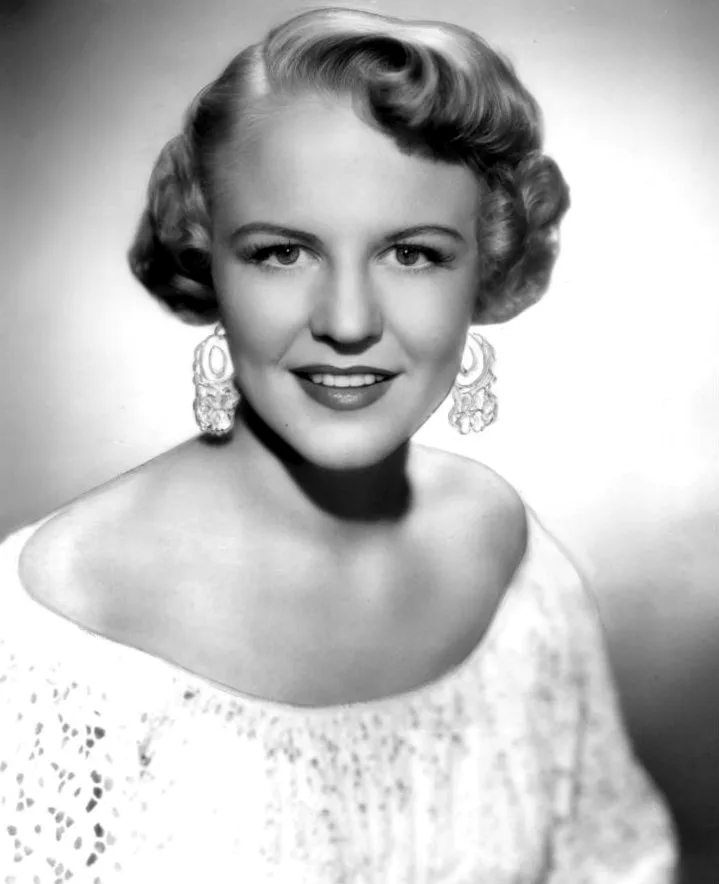
Peggy Lee in a publicity portrait, circa 1950 Public Domain (a publicity photograph issued without a copyright notice, per the Wikimedia Commons PD-Pre1978 tag) — Wikimedia Commons - https://commons.wikimedia.org/wiki/File:Peggy_Lee_1950.JPG

Peggy Lee was born Norma Deloris Egstrom on May 26, 1920, in Jamestown, North Dakota, the seventh of eight children of Marvin Egstrom, a railroad station agent, and Selma Egstrom, who died when her daughter was four. The family followed the Midland Continental line through several small towns, and she graduated from high school in Wimbledon, North Dakota, in 1937. She sang with a local college dance band led by Lyle "Doc" Haines, made her radio debut on KOVC in Valley City in 1936, and in October 1937 was auditioned and renamed Peggy Lee by Ken Kennedy of Fargo's WDAY. She left for Hollywood in March 1938, returned home after a collapse from overwork, then spent 1939 singing at the Powers Hotel in Fargo and touring with the Sev Olson and Will Osborne orchestras. Back in California in 1940, a job at the Doll House in Palm Springs taught her the approach that became her trademark: unable to outsing a noisy room, she sang more quietly until the room came to her. That hushed delivery got her booked into the Buttery Room of Chicago's Ambassador West hotel, where bandleader Benny Goodman, shopping for a replacement for Helen Forrest, heard her.
Lee joined the Benny Goodman Orchestra in the summer of 1941 and stayed about two years. Her first record with the band was "Elmer's Tune," and after a four-song session on November 13, 1941, "Somebody Else Is Taking My Place" gave her a top-ten hit in 1942. On July 27, 1942, in New York, she recorded "Why Don't You Do Right?," a reworking of a blues first cut by the Harlem Hamfats in 1936 and popularized by Lil Green in 1941; it sold more than a million copies, appeared on the flip side of "Six Flats Unfurnished" on Columbia, and made her famous, with film appearances alongside Goodman in Stage Door Canteen and The Powers Girl (both 1943). In March 1943 she married the band's guitarist, Dave Barbour, and left Goodman. Her official biography records that she won the 1946 best female vocalist polls of both Metronome and Down Beat.
From 1944 Lee recorded for Capitol, where she and Barbour wrote many of her hits, among them "I Don't Know Enough About You," "It's a Good Day," and "Mañana (Is Soon Enough for Me)," which held the top spot for nine weeks in 1948. Her first album, Rendezvous with Peggy Lee, came out on Capitol in March 1948, the same year she began co-hosting NBC's Chesterfield Supper Club with Perry Como and Jo Stafford. As a lyricist she also wrote "What More Can a Woman Do?," recorded by Sarah Vaughan with Dizzy Gillespie and Charlie Parker. She and Barbour divorced in 1951.
Moving to Decca in 1952, Lee had a No. 3 pop hit with "Lover" and worked with Gordon Jenkins and Bing Crosby, then recorded the album that jazz listeners return to most. Over sessions on April 30, May 1, and May 4, 1953, at Decca's New York studio, she cut the songs of Black Coffee with a small group built around trumpeter Pete Candoli and pianist Jimmy Rowles, with bassist Max Wayne and drummer Ed Shaughnessy; Decca issued it as a ten-inch LP in 1953 and as an expanded twelve-inch LP in 1956 after she cut four more songs in Hollywood. She also turned to film. Playing an alcoholic singer in Jack Webb's Pete Kelly's Blues (1955) earned her an Academy Award nomination for best supporting actress, the companion album with Ella Fitzgerald reached No. 7 on the pop chart, and the same year she co-wrote the songs for Disney's Lady and the Tramp with Sonny Burke and voiced four of its characters.
Returning to Capitol in 1957, she made the records that define her peak. The Man I Love paired Nelson Riddle's arrangements with Frank Sinatra on the podium. In May 1958 she recorded her own arrangement of "Fever" with Jack Marshall, a spare setting of bass, finger-snaps, and a barely-there drum kit played by Shelly Manne, which became her only top-ten hit on the Hot 100 and drew three nominations at the first Grammy Awards. Things Are Swingin' (1958), Beauty and the Beat! (1959, with the George Shearing quintet), Blues Cross Country (1962, mostly arranged by Quincy Jones), and Mink Jazz (1963, with arrangements by Benny Carter and Max Bennett) are the core of her jazz-leaning Capitol work. In 1969 "Is That All There Is?," written and produced by Jerry Leiber and Mike Stoller with an orchestral setting by Randy Newman, won her a Grammy and reached No. 11 on the Hot 100. In 1971 she sang the Lord's Prayer at the funeral of Louis Armstrong.
Her later years were quieter on the charts but busy elsewhere. Paul McCartney produced the title track of Let's Love (Atlantic, 1974), she wrote "The Nickel Ride" with Dave Grusin for the 1974 film, and after suing Disney in 1988 over video-cassette royalties on Lady and the Tramp she was awarded more than $3 million in 1991, a judgment upheld on appeal in 1992. She returned to straight jazz with Miss Peggy Lee Sings the Blues (1988, her first album in nine years, with pianist Mike Renzi and drummer Grady Tate), recorded a set of rare Harold Arlen songs later released as Love Held Lightly (1993), and made her last studio album, Moments Like This (Chesky, 1993). She kept performing into the 1990s, sometimes from a wheelchair. Peggy Lee passed away on January 21, 2002, aged 81, of complications from diabetes and a heart attack. Her honors include a Hollywood Walk of Fame star (1960), induction into the Big Band Jazz Hall of Fame (1992), a Grammy Lifetime Achievement Award (1995), and the Songwriters Hall of Fame (1999). A 2003 tribute concert at Carnegie Hall, with Marian McPartland among the performers, was broadcast on NPR's JazzSet.
Lee built her style on understatement. By her own account she learned in Palm Springs to sing under the noise rather than over it, and the result was a sultry, slightly behind-the-beat delivery in which a single held note or a clipped syllable does the work another singer would do with volume. Her best-known arrangement trick, the finger-snap-and-bass skeleton of "Fever," reduced a rhythm-and-blues song to almost nothing, and critic Will Friedwald counted Black Coffee among his desert-island records. William Ruhlmann heard in her restrained 1957 recordings with Riddle and Sinatra something close to Billie Holiday. Joni Mitchell called Black Coffee one of her favorites and opened her 2000 album Both Sides Now with "You're My Thrill" from it, and later singers from Diana Krall to k.d. lang and Elvis Costello have cited her. Her catalog divides between jazz-oriented albums (the Goodman sides, Black Coffee, Beauty and the Beat!, Blues Cross Country, Mink Jazz, the late blues and Arlen sets) and mainstream pop, country-tinged novelties, film work, and Broadway material; Wikipedia's opening sentence calls her a jazz and popular music singer, and it files her under jazz singers, big band singers, and traditional pop. She also wrote more than 270 songs, many of which have become standards.
- Why Don't You Do Right? (1942, Columbia, with Benny Goodman and His Orchestra) - Recorded July 27, 1942, her breakout hit and the best document of her Goodman years; it sold over a million copies.
- Black Coffee (1953, Decca) - A small-group torch-song set with Pete Candoli, Jimmy Rowles, Max Wayne, and Ed Shaughnessy, widely regarded as the jazz vocal landmark of her career. Spotify - Black Coffee Listen
- Dream Street (1957, Decca) - Her last album for the label, a concept record of dreamy ballads rated four and a half stars by AllMusic. Spotify - Dream Street Listen
- "Fever" (1958, Capitol) - Her self-arranged, finger-snapping reinvention of Little Willie John's R&B hit, with Joe Mondragon on bass and Shelly Manne on drums; it reached No. 8 on the Hot 100.
- Beauty and the Beat! (1959, Capitol) - A collaboration with the George Shearing quintet, including Toots Thielemans on guitar, that pairs her whisper with Shearing's block-chord piano.
- Blues Cross Country (1962, Capitol) - A tour of regional blues songs arranged mostly by Quincy Jones, with a studio band of West Coast jazz players that includes Jimmy Rowles.
- Mink Jazz (1963, Capitol) - Small-group sessions with arrangements by Benny Carter and bassist Max Bennett, a late-night jazz record with Jack Sheldon, Stan Levey, and Mel Lewis among the players.
- Is That All There Is? (1969, Capitol) - The Leiber and Stoller title song that won her a Grammy and gave her a late-career hit.
Peggy Lee: Full Discography
Identity confirmed via the live Discogs API: artist ID 79742 ("Peggy Lee," real name Norma Deloris Egstrom, born May 26, 1920, in Jamestown, North Dakota, died January 21, 2002, in Bel Air, California). Discogs files roughly seven thousand entries under this ID, most of them compilations, singles, and reissues; related Discogs entities for her bands (Peggy Lee Orchestra, Dave Barbour Orchestra, and the Benny Goodman groups she sang with) were checked, and one alias, Susan Melton, is attached to the same person. This is a curated selection: her studio albums and co-billed records with the most jazz relevance, plus a handful of her Goodman-era records and one film-related project. It is not exhaustive. Catalog numbers and labels were checked against Discogs and MusicBrainz, personnel against album notes as summarized on Wikipedia and Discogs, and cells read "Not confirmed" or "band not itemized" where no source gave the detail. Her catalog also holds dozens of pop, country-flavored, and holiday albums and 90-odd compilations that are left out here.
As Leader / Co-Leader
| Album Title | Recording Date(s) | Release Date | Label | Catalog Number | Format(s) | Personnel | Role | Reissue History | Spotify | Buy | Notes |
|---|---|---|---|---|---|---|---|---|---|---|---|
| Rendezvous with Peggy Lee | Not confirmed | March 1948 | Capitol | CC 72 | Shellac, 10", 78 RPM, album set | Peggy Lee (vocals) with Dave Barbour and his orchestra; Lee Gillette (producer, uncredited) | Leader | Later issued with the number 151 (CCF 151, EBF 151) | — | — | Her first album under her own name |
| Black Coffee | April 30, May 1, and May 4, 1953, Decca Studios, New York; four added tracks April 3, 1956, Hollywood | 1953 (10-inch); August 1956 (12-inch) | Decca | DL 5482 (10-inch); DL 8358 (12-inch) | Vinyl, LP, 10" and 12" | 1953: Peggy Lee (vocals), Pete Candoli (trumpet; the Discogs credit reads Cootie Chesterfield), Jimmy Rowles (piano), Max Wayne (bass), Ed Shaughnessy (drums). 1956 additions: Stella Castellucci (harp), Lou Levy (piano), Bill Pitman (guitar), Buddy Clark (bass), Larry Bunker (drums, vibraphone, percussion) | Leader | Verve Master Edition reissue, October 26, 2004 (Verve 3093), following the 1956 sequence | Spotify - Black Coffee | — | Eight songs on the original ten-inch LP; the twelve-inch edition adds four |
| Songs from Pete Kelly's Blues | Not confirmed | August 1955 | Decca | DL 8166 | Vinyl, LP | Peggy Lee and Ella Fitzgerald (vocals); Hal Mooney (director, per Discogs) | Co-leader (billed with Ella Fitzgerald) | None found | Spotify - Songs from Pete Kelly's Blues | — | Songs from the Jack Webb film in which Lee played a singer; reached No. 7 on the Billboard pop albums chart |
| Dream Street | June 5-7, 1956 | 1957 | Decca | DL 8411 | Vinyl, LP | Peggy Lee (vocals), Lou Levy (piano); the rest of the band is not itemized | Leader | UK issue on Brunswick, LAT 8171 (1957) | Spotify - Dream Street | — | Her last Decca album; rated four and a half stars by AllMusic |
| The Man I Love | April 2 to August 30, 1957 | August 1957 | Capitol | T 864 | Vinyl, LP, mono | Peggy Lee (vocals); Nelson Riddle (arranger); Frank Sinatra (conductor) | Leader | CD reissue on DRG, 2009 (DRG-CD-94783) | — | — | Reached No. 20 on the US album chart |
| Jump for Joy | December 5 and 20, 1957, and January 3, 1958 | 1958 (mono); 1959 (stereo) | Capitol | T 979 (mono); ST 979 (stereo) | Vinyl, LP | Peggy Lee (vocals); Nelson Riddle (arranger, conductor); Lee Gillette (producer) | Leader | Paired with Things Are Swingin' on a 1996 CD | — | — | Reached No. 15 on the US album chart |
| Things Are Swingin' | May 19-30, 1958, Hollywood | 1958 | Capitol | T 1049 (mono); ST 1049 (stereo) | Vinyl, LP | Peggy Lee (vocals); Jack Marshall (arranger, conductor); Pete Candoli, Don Fagerquist, Conrad Gozzo, Mannie Klein, Uan Rasey (trumpets); Milt Bernhart (trombone); Bob Enevoldsen (valve trombone); Justin Gordon (reeds); Joe Harnell (piano); Howard Roberts, Barney Kessel (guitars); Joe Mondragon (double bass); Shelly Manne (drums) | Leader | Paired with Jump for Joy on a 1996 CD | — | — | Reached No. 16 on the US album chart |
| I Like Men! | May 1959 | 1959 | Capitol | T 1131 (mono); ST 1131 (stereo) | Vinyl, LP | Peggy Lee (vocals); Jack Marshall (arranger, conductor) | Leader | Later paired with Sugar 'n' Spice on a 1996 CD | Spotify - I Like Men! | — | Rated three stars by AllMusic |
| Beauty and the Beat! | May 28-30, 1959 per the reissue notes (another source gives April 29, 1959) | 1959 | Capitol | T 1219 (mono); ST 1219 (stereo) | Vinyl, LP | Peggy Lee (vocals) with George Shearing (piano), Ray Alexander (vibraphone), Toots Thielemans (guitar), Jimmy Bond (bass), Roy Haynes (drums), Armando Peraza (congas); the 2003 reissue credits Carl Pruitt (bass) and Ray Mosca (drums) in place of Bond and Haynes | Co-leader (billed with George Shearing) | 2003 CD reissue adds "Nobody's Heart" and "Don't Ever Leave Me" | — | — | The original sleeve presented it as a live recording at a Miami disc jockey convention; the reissue notes say it was made in the studio with added applause. Reached No. 19 in the US and No. 16 in the UK |
| Latin ala Lee! | August 1959 | January 1960 | Capitol | T 1290 | Vinyl, LP | Peggy Lee (vocals); Jack Marshall (arranger, conductor) | Leader | Paired with Olé ala Lee! on a 1997 two-on-one CD | — | — | Reached No. 11 in the US and No. 8 in the UK; the cover won the Grammy for best album cover at the 2nd Annual Grammy Awards |
| If You Go | Not confirmed | 1961 | Capitol | T 1630 (mono); ST 1630 (stereo) | Vinyl, LP | Peggy Lee (vocals); Quincy Jones (arranger) | Leader | Paired with Sugar 'n' Spice on a 1965 release | — | — | The first of her albums with Quincy Jones |
| Blues Cross Country | Not confirmed (1961-62) | January 1962 | Capitol | T 1671 (mono); ST 1671 (stereo) | Vinyl, LP | Peggy Lee (vocals); Quincy Jones (arranger, conductor; Benny Carter arranged "San Francisco Blues"); Jimmy Rowles, Lou Levy, Frank Strazzeri (piano); Artie Kane (organ); Max Bennett (bass); Stan Levey, Earl Palmer (drums); Bob Bain, Dennis Budimir, John Pisano, Howard Roberts, Toots Thielemans (guitars); Bob Cooper, Harry Klee, Bud Shank, Bill Green, Plas Johnson, Bill Perkins, Buddy Collette, Justin Gordon, Jack Nimitz (reeds); Jack Sheldon, Pete Candoli, Conrad Gozzo, Al Porcino, Ray Triscari and others (trumpets); Frank Rosolino, Lew McCreary, Dick Nash, George Roberts and others (trombones) | Leader | 1999 CD reissue adds Johnny Mandel's arrangement of "The Shining Sea" | — | — | Rated four stars by AllMusic |
| Mink Jazz | March 28, 1962, and February 2, 5, and 7, 1963, Hollywood | 1963 | Capitol | T 1850 (mono); ST 1850 (stereo) | Vinyl, LP | Peggy Lee (vocals); Max Bennett (bass, arranger); Justin Gordon (tenor saxophone, flute); Jack Sheldon (trumpet); Bob Corwin (piano); Stan Levey (drums); John Pisano (guitar); Francisco Aguabella (percussion). Benny Carter (arranger, leader of three tracks) with Mel Lewis (drums), Herb Ellis and Al Hendrickson (guitars), Lou Levy (piano), Francisco Pozo (percussion) | Leader | Capitol Jazz CD reissue, 1998 (CDP 95450) | — | — | Rated two and a half stars by AllMusic |
| I'm a Woman | March 28, 1962, and January 2-5, 1963 | July 1963 | Capitol | T 1857 (mono); ST 1857 (stereo) | Vinyl, LP | Peggy Lee (vocals); Dick Hazard (conductor, most tracks); Benny Carter (conductor on two tracks); Mannie Klein (trumpet); Al Hendrickson, John Pisano (guitars); Mike Melvoin (piano); Max Bennett (bass); Stan Levey (drums) | Leader | Later paired with Norma Deloris Egstrom from Jamestown, North Dakota on a 2004 CD | — | — | Title song a Leiber and Stoller number; rated three and a half stars by AllMusic |
| Then Was Then - Now Is Now! | Not confirmed | 1965 | Capitol | T 2388 (mono); ST 2388 (stereo) | Vinyl, LP | Peggy Lee (vocals); band not itemized | Leader | None found | Spotify - Then Was Then - Now Is Now! | — | — |
| Is That All There Is? | 1969, Capitol Studios, Hollywood | 1969 | Capitol | ST 386 | Vinyl, LP | Peggy Lee (vocals); Jerry Leiber and Mike Stoller (producers); Randy Newman (orchestral arrangement and conducting on the title song) | Leader | Paired with A Natural Woman on a 2003 CD | — | — | The title single reached No. 11 on the Hot 100 and won her a Grammy; later inducted into the Grammy Hall of Fame |
| Where Did They Go | Not confirmed | 1971 | Capitol | ST-810 | Vinyl, LP | Peggy Lee (vocals); band not itemized | Leader | Paired with Make It with You on a 2008 CD | Spotify - Where Did They Go? | — | — |
| Norma Deloris Egstrom from Jamestown, North Dakota | Not confirmed | June 1972 | Capitol | ST 11077 | Vinyl, LP | Peggy Lee (vocals); band not itemized | Leader | Paired with I'm a Woman on a 2004 CD | — | — | Her last album for Capitol |
| Let's Love | July 1974 (title track, Record Plant, Los Angeles) | 1974 | Atlantic | SD 18108 | Vinyl, LP | Peggy Lee (vocals); Paul McCartney (producer of the title track, which he and Linda McCartney wrote) | Leader | Rhino reissue, 2003 (RHM2 7853) | — | — | Her only album for Atlantic |
| Mirrors | Not confirmed | 1975 | A&M | SP-4547 | Vinyl, LP | Peggy Lee (vocals); band not itemized | Leader | Reissued in 2005 on Hip-O Select as part of Peggy Lee Sings Leiber & Stoller | — | — | — |
| Close Enough for Love | Not confirmed | 1979 | DRG | Not confirmed | Vinyl, LP | Peggy Lee (vocals); band not itemized | Leader | None found | — | — | Includes songs by Cy Coleman |
| Miss Peggy Lee Sings the Blues | February 1988 | 1988 | MusicMasters | CIJD 60155 | CD | Peggy Lee (vocals); Mike Renzi (piano); John Chiodini (guitar); Jay Leonhart (double bass); Grady Tate (drums); Mark Sherman (percussion); Gregory K. Squires (producer) | Leader | None found | — | — | Her first album in nine years; rated three stars by AllMusic |
| Love Held Lightly: Rare Songs by Harold Arlen | August 29 to September 2, 1988 | February 16, 1993 | Angel (EMI) | CDC 0777 7 54798 2 9 | CD | Peggy Lee (vocals) with Keith Ingham and his octet; producers Bill Rudman, Keith Ingham, and Ken Bloom | Leader | Harbinger reissue, 2006 (HCD-2401) | — | — | Songs by Harold Arlen; Ken Peplowski is among the players |
| Moments Like This | Not confirmed | 1993 | Chesky | JD84 | CD | Peggy Lee (vocals); band not itemized | Leader | None found | Spotify - Moments Like This | — | Her final studio album |
As Sideman (selected major credits)
Lee was a featured vocalist rather than a sideman. These are the records that bill her inside someone else's project, led by her Benny Goodman sides of 1941 to 1943.
| Year | Project (Leader) | Title | Label | Catalog | Role | Notes |
|---|---|---|---|---|---|---|
| 1941 | Benny Goodman and His Orchestra | Somebody Else Is Taking My Place / That Did It, Marie | OKeh | 6497 | Vocals | Recorded November 13, 1941; the first of her hits with the band |
| 1942 | Benny Goodman and His Orchestra | Why Don't You Do Right? / Six Flats Unfurnished | Columbia | 36652 | Vocals | Recorded July 27, 1942, in New York; sold more than a million copies |
| 1948 | Benny Goodman, His Orchestra and Sextet | Vocals by Peggy Lee | Columbia | C 170 | Vocals | Album of her Goodman-era vocals, issued after she had left the band |
| 1954 | Bing Crosby, Danny Kaye, and Peggy Lee | Selections from Irving Berlin's White Christmas | Decca | DL 8083 | Vocals | Lee substituted for Rosemary Clooney; reached No. 2 on the Billboard best-selling LP chart. Spotify - Selections from Irving Berlin's White Christmas |
| 1955 | Walt Disney | Songs from Walt Disney's Lady and the Tramp | Decca | Not confirmed | Vocals, co-writer | Lee wrote the songs with Sonny Burke and voiced four characters in the film |
- Benny Goodman - bandleader whose orchestra and sextet she sang with from the summer of 1941 until 1943, including the 1942 session that produced "Why Don't You Do Right?"
- Dave Barbour - Goodman's guitarist; her husband from 1943 to 1951, bandleader on her early Capitol sides, and co-writer of hits such as "Mañana (Is Soon Enough for Me)."
- Jimmy Rowles - pianist on Black Coffee (1953) and one of the pianists on Blues Cross Country (1962).
- Pete Candoli, Max Wayne, and Ed Shaughnessy - trumpeter, bassist, and drummer in the quintet on Black Coffee.
- Nelson Riddle and Frank Sinatra - arranger and conductor of The Man I Love (1957); Riddle also arranged and conducted Jump for Joy (1958).
- Jack Marshall - arranger and conductor of Things Are Swingin' (1958), I Like Men! (1959), and Latin ala Lee! (1960), and her arranging partner on "Fever."
- George Shearing - pianist and leader of the quintet on Beauty and the Beat! (1959), with Toots Thielemans on guitar and Armando Peraza on congas.
- Quincy Jones - arranger and conductor of Blues Cross Country (1962), which followed his work on her 1961 album If You Go.
- Benny Carter and Max Bennett - arrangers of Mink Jazz (1963); the Carter-led tracks feature Herb Ellis on guitar and Mel Lewis on drums, and Bennett plays bass on several of her early-1960s Capitol dates.
- Ella Fitzgerald - co-billed on Songs from Pete Kelly's Blues (1955).
- Bing Crosby - duet partner on the 1952 single "Watermelon Weather" and co-star of the 1954 album Selections from Irving Berlin's White Christmas, on which she substituted for Rosemary Clooney.
- Mel Tormé - duet partner on Capitol singles in 1949 and 1951.
- Gordon Jenkins - arranger and conductor of her 1952 Decca hits, including "Lover."
- Jerry Leiber, Mike Stoller, and Randy Newman - writers, producers, and orchestrator of "Is That All There Is?" (1969).
- Duke Ellington - listed among her songwriting collaborators, alongside Harold Arlen, Cy Coleman, Johnny Mandel, Quincy Jones, Lalo Schifrin, and Victor Young.
- Dave Grusin - co-writer, with Lee, of "The Nickel Ride" (1974).
- Ken Peplowski - reedman who recorded with Lee on Love Held Lightly: Rare Songs by Harold Arlen, made with Keith Ingham's octet.
- Mike Renzi, Grady Tate, Jay Leonhart, John Chiodini, and Mark Sherman - the rhythm section on Miss Peggy Lee Sings the Blues (1988).
- Paul McCartney - wrote and produced the title track of Let's Love (1974).
More Vocal Jazz Artists
See all 220 Vocal Jazz artists →More American Jazz Artists
See all 646 American artists →- Wikipedia: Peggy Lee
- Wikipedia: Black Coffee (Peggy Lee album)
- Wikipedia: Beauty and the Beat!
- Wikipedia: Mink Jazz
- Wikipedia: Blues Cross Country
- Wikipedia: Why Don't You Do Right?
- Wikipedia: Fever (Little Willie John song)
- Wikipedia: Is That All There Is?
- Wikipedia: Pete Kelly's Blues (film)
- Peggy Lee official site: biography
- Discogs: Peggy Lee (artist 79742)
- MusicBrainz: Peggy Lee