 JAZZPROFILES lives in the music 1,572 Jazz Artists fully Profiled!
 Lenny McBrowne
Last updated September 7, 2026
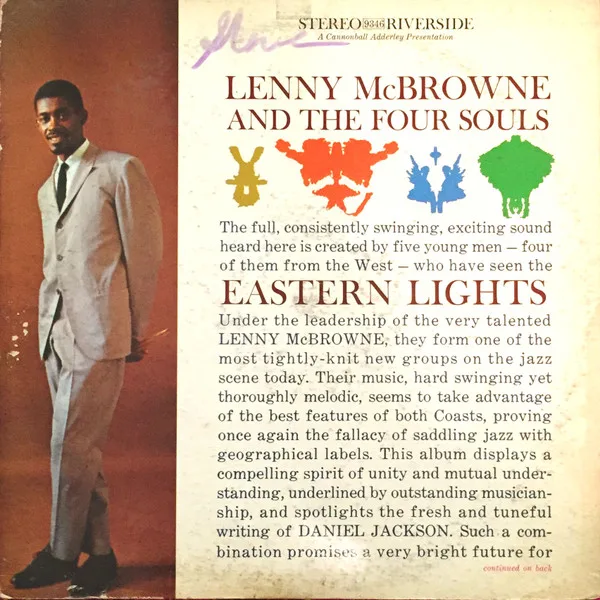
Cover art for Lenny McBrowne and the Four Souls' "Eastern Lights" (1960, Pacific Jazz/World Pacific), used as a stand-in — no free-licensed photo of McBrowne could be located after a genuine search. Standard copyright, all rights reserved — held by Pacific Jazz / World Pacific Records. This is not a Creative Commons–licensed image; it is used here as an honestly-disclosed editorial stand-in for a real photo. — Downloaded directly from the release's Discogs listing (https://www.discogs.com/release/4842822-Lenny-McBrowne-And-The-Four-Souls-Eastern-Lights), cover scan hosted at i.discogs.com. Saved locally as portrait.jpg in this folder.
Leonard Louis McBrowne was born January 24, 1933, in Brooklyn, New York. His father Arnold was a working drummer, and Lenny followed him into the instrument early, playing in street marching bands between the ages of twelve and fifteen while also studying bass on the side. After finishing high school in 1951, he got the kind of grounding few young drummers can claim: a full year of direct study with his idol, Max Roach — whose own career, including that mentorship, is covered in full in his JazzProfiles.com profile — and further instruction from drummer and educator Sticks Evans.
His professional start came in Pete Brown's group, which at the time featured a young Paul Bley on piano. McBrowne worked Brooklyn clubs alongside Randy Weston and Cecil Payne, then went out on the road touring with Bley's trio as far as Montreal. In 1956 he was in New York playing with clarinetist Tony Scott — four tracks on Scott's RCA Victor album The Touch of Tony Scott carry his drum credit — before relocating to California. The West Coast years put him in high company fast: engagements and recordings with Billie Holiday, Sonny Stitt, Harold Land, Benny Golson, Curtis Fuller, and Sonny Rollins all date from this period. Critics of the day, per the label copy circulating with his later reissues, hailed him and his working band as among the greatest promise for the future of West Coast jazz. He was, plainly, "a disciple of Max Roach," and reviewers of the time routinely likened the "suavely exotic tendencies" of his solo work to Chico Hamilton's.
In 1959 McBrowne formed his own group, the Four Souls, with pianist Terry Trotter, bassist Herbie Lewis, tenor saxophonist Daniel Jackson, and trumpeter Donald Sleet. Recorded between January and March 1960, Lenny McBrowne and the 4 Souls came out that year on Pacific Jazz. A second album, Eastern Lights, followed on Riverside, recorded in Los Angeles on October 13, 1960, with Jimmy Bond on bass in Herbie Lewis's chair — and produced, notably, by Cannonball Adderley. Between the two records McBrowne also cut a Riverside single, "Saudi" backed with "Even Dozen" (both tracks resurface on Eastern Lights itself), under his own name.
When the Four Souls dissolved, McBrowne went back to freelancing, and the sideman work only got deeper. He recorded across the mid-to-late 1960s with Sonny Criss, Booker Ervin — some of the drummer's most driving, aggressive playing is on Ervin's Prestige dates — Barry Harris, Teddy Edwards, Charles McPherson, and Pat Martino, and worked with vocalist Sarah Vaughan. 1970 was a Japan-heavy year for McBrowne specifically. He joined Thelonious Monk's touring quartet, alongside tenor saxophonist Paul Jeffrey and bassist Larry Ridley, for Monk's autumn tour of Japan; a live recording from the Shinjuku Koseinenkin Kaikan date on October 4, 1970, was issued in Japan the following year as Thelonious Monk in Tokyo on the Express label — a genuinely rare release, distinct from (and not to be confused with) the far better-known 1963 Columbia live album of nearly the same title, which used a different rhythm section entirely. The same year, and reunited with the same bassist, Larry Ridley, he also recorded in Japan on Helen Merrill and Teddy Wilson's Helen Sings, Teddy Swings and on the three-guitar summit Guitar Genius in Japan with Kenny Burrell, Attila Zoller, and Jim Hall — the first documented dates of his long working relationship with Burrell.
McBrowne relocated again in the early 1970s, this time to San Francisco, where he became a regular presence in guitarist Kenny Burrell's bands — appearing on Burrell's 'Round Midnight (1972), Both Feet on the Ground (1973), Up the Street, 'Round the Corner, Down the Block (1974), and Stormy Monday (1978) — alongside continuing dates with Randy Weston (Blues, 1975; Berkshire Blues, 1977) and pianist Red Garland, whose 1973 MPS session The Quota also carries his credit. His recording career effectively wound down after 1976. He died in San Francisco on October 4, 1980, at age forty-seven.
His influence outlived him in an unexpected way: avant-garde drummer Andrew Cyrille has named Willie Jones and Lenny McBrowne as his first drum teachers in Brooklyn — and it was through McBrowne and Jones that Cyrille first met Max Roach, closing a small, direct lineage running from Roach through McBrowne to the next generation.
McBrowne was a textbook hard bop drummer, shaped directly by a year of study with Max Roach: an aggressive, propulsive ride cymbal pushed ahead of the beat, driving without overwhelming the front line. What set him apart from other Roach-schooled drummers of his generation was the character of his solo playing, which contemporary critics consistently described as "suavely exotic" — a quality that drew repeated comparisons to Chico Hamilton, another drummer known for coloristic, texture-conscious soloing rather than pure power. That range made him equally credible behind Booker Ervin's hard-charging Prestige dates and inside the more chamber-like settings of Paul Bley's early quartet work or his own Four Souls records, which leaned into a cooler, West Coast-inflected hard bop.
- Lenny McBrowne and the 4 Souls (1960, Pacific Jazz) - His debut as bandleader, cut January-March 1960 with the group he formed the year before: Terry Trotter (piano), Herbie Lewis (bass), Daniel Jackson (tenor sax), Donald Sleet (trumpet). Available on Spotify via the 2010/2011 Fresh Sound complete-recordings reissue. Spotify - Lenny McBrown... Listen · Buy
- Eastern Lights (1960, Riverside) - The Four Souls' second and final album, recorded in LA that October with Jimmy Bond now on bass, and produced by Cannonball Adderley. Also folded into the Fresh Sound complete-recordings reissue. Spotify - Lenny McBrown... Listen · Buy
- Lady Sings the Blues (1956, Clef Records) - Billie Holiday's last album for Clef before the label was absorbed into Verve; McBrowne shares the drum chair with Chico Hamilton, credited on seven of the twelve tracks including the title song and "God Bless the Child." Spotify - Lady Sings The...
- Solemn Meditation (1957, GNP Crescendo) - The Paul Bley Quartet's early date, historically notable as the recording debut of both bassist Charlie Haden and vibraphonist Dave Pike; McBrowne is the quartet's drummer throughout. Spotify - Solemn Meditation
- 'Round Midnight (1972, Fantasy) - One of several Kenny Burrell albums McBrowne played on during his San Francisco years, with Richard Wyands and Joe Sample on piano and Reggie Johnson on bass. Spotify - 'Round Midnight
- Thelonious Monk in Tokyo (1970, rec.; Express, 1971) - Live document of Monk's October 4, 1970 Shinjuku Koseinenkin Kaikan concert in Tokyo, with Paul Jeffrey (tenor sax) and Larry Ridley (bass); a genuinely rare Japan-only pressing. Not verified as available on Spotify — do not confuse with the unrelated, far more widely reissued 1963 Columbia album of nearly the same title, which features a different drummer.
Lenny McBrowne: Full Discography
Identity confirmed via Discogs artist ID 340559 ("Lenny McBrowne," realname Leonard Louis McBrowne). Every entry below was checked against the individual release's own Discogs credits (not just the artist-level index) to confirm a genuine "Lenny McBrowne — Drums" credit before inclusion.
As Leader
| Album Title | Recording Date(s) | Release Date | Label | Catalog Number | Format(s) | Personnel | Role | Reissue History | Spotify | Buy | Notes |
|---|---|---|---|---|---|---|---|---|---|---|---|
| Lenny McBrowne and the 4 Souls | January-March 1960 | 1960 | Pacific Jazz | PJ-1 (Stereo-1) | Vinyl, LP | Lenny McBrowne (drums), Herbie Lewis (bass), Terry Trotter (piano), Daniel Jackson (tenor sax), Don Sleet (trumpet) | Leader | Fully reissued on the 2010/2011 Fresh Sound Complete Recordings below | Spotify - Lenny McBrown... | Amazon | Debut as bandleader, the group he formed in 1959 |
| Saudi / Even Dozen | 1960 | 1960 | Riverside Records | 45460 | Vinyl, 7", 45 RPM, Single | Lenny McBrowne and the Four Souls (full session personnel not itemized separately on Discogs for the single) | Leader | Both tracks resurface on Eastern Lights the same year | — | — | Standalone single issued between the two LPs |
| Eastern Lights | Recorded Los Angeles, October 13, 1960 | 1960 | Riverside Records | RLP 9346 | Vinyl, LP, Stereo | Lenny McBrowne (drums), Jimmy Bond (bass), Terry Trotter (piano), Daniel L. Jackson (tenor sax), Don Sleet (trumpet); produced by Cannonball Adderley | Leader | Fully reissued on the 2010/2011 Fresh Sound Complete Recordings below | Spotify - Lenny McBrown... | Amazon | Jimmy Bond replaces Herbie Lewis on bass; produced by Cannonball Adderley |
| Lenny McBrowne and the 4 Souls - Complete Recordings | See above (compiles both 1960 LPs) | 2010 (CD) / 2011 (digital/Spotify) | Fresh Sound Records | FSR-CD 614 | CD, Compilation; digital | Same personnel as the two source LPs, plus Gloria Smyth (vocals) on 4 bonus tracks from her own Like Soul! session featuring the same rhythm section | Leader (compilation) | Compiles Pacific Jazz LP + Riverside's Eastern Lights + 4 bonus tracks from Gloria Smyth's Like Soul! | Spotify - Lenny McBrown... | Amazon | Confirmed via Discogs release notes: sources both original LPs plus the Gloria Smyth bonus tracks; this is the version verified on Spotify |
Neither of the two 1960 LPs appears to have its own standalone Spotify listing separate from the Complete Recordings compilation — both Key Recordings links above point to that compilation honestly rather than to a nonexistent standalone page.
As Sideman (confirmed via individual release credits)
| Year | Project (Leader/Artist) | Title | Label | Catalog Number | Role | Notes |
|---|---|---|---|---|---|---|
| 1956 | Tony Scott | The Touch of Tony Scott | RCA Victor | LPM 1353 | Drums (4 of the album's tracks: "Deep Purple," "Aeolian Drinking Song," "'Round About Midnight," "Vanilla Frosting on a Beef Pie") | McBrowne's own account places this as his last New York work before relocating to California |
| 1956 | Billie Holiday | Lady Sings the Blues | Clef Records | MG C-721 | Drums (7 of 12 tracks, incl. the title track and "God Bless the Child") | Shares the drum chair with Chico Hamilton; Holiday's last album for Clef before Verve absorbed the label |
| 1957 | Paul Bley Quartet | Solemn Meditation | GNP Crescendo | GNP 31 | Drums (all tracks) | Recording debut of both Charlie Haden (bass) and Dave Pike (vibraphone) |
| 1959 | Sonny Stitt Quartet | The Hard Swing | Verve Records | MG V-8306 | Drums (all tracks) | With George Morrow (bass), Amos Trice (piano) |
| 1960 | Fred Katz And His Jammers | Fred Katz and His Jammers | Decca | DL 79217 | Drums (3 tracks; the rest use Billy Higgins or Frank Butler) | Session split across three different drummers |
| 1963 | The Sal Salvador Quartet | Music to Stop Smoking By | Roulette | SR 25262 | Drums (all tracks) | With John Beal (bass), Ray Sterling (piano) |
| 1966 | Randy Weston Sextet | Randy! | Bakton Records | BRS 1001 | Drums (all tracks) | With Booker Ervin (tenor sax), Ray Copeland (trumpet/flugelhorn), Vishnu Wood (bass) |
| 1967 | Booker Ervin | Booker 'n' Brass | Pacific Jazz | ST-20127 | Drums (all tracks) | Big-band-scale Ervin date; Kenny Barron (piano), Freddie Hubbard, Charles Tolliver, Richard Williams (trumpets) |
| 1967 | Booker Ervin | Structurally Sound | Pacific Jazz | ST-20119 | Drums (all tracks) | With Red Mitchell (bass), John Hicks (piano), Charles Tolliver (trumpet) |
| 1967 | Sonny Criss | Up, Up and Away | Prestige | PR 7530 / PRST 7530 | Drums (all tracks) | |
| 1967 | The Barry Harris Sextet | Luminescence! | Prestige | PR 7498 / PRST 7498 | Drums (all tracks) | With Pepper Adams (baritone sax), Slide Hampton (trombone), Junior Cook (tenor sax), Bob Cranshaw (bass) |
| 1967 | The Teddy Edwards Sextet | It's All Right | Prestige | PRST 7522 | Drums (all tracks) | |
| 1968 | Charles McPherson | From This Moment On! | Prestige | PR 7559 / PRST 7559 | Drums (all tracks) | |
| 1968 | Pat Martino | East! | Prestige | PR 7562 / PRST 7562 | Drums (all tracks) | |
| 1968 | Houston Person | Trust in Me | Prestige | PR 7548 / PRST-7548 | Drums (all tracks) | |
| 1968 | Booker Ervin | The In Between | Blue Note | BST 84283 | Drums (all tracks) | Rudy Van Gelder-engineered; with Bobby Few (piano), Richard Williams (trumpet) |
| 1970 | Kohsuke Mine | First | Philips (Japan) | FX-8508 | Drums (all tracks); also credited Written-By on "Bar' L' Len'" | Japanese hard bop; one of the few sideman dates where McBrowne also contributes a composition |
| 1970 | Helen Merrill / Teddy Wilson | Helen Sings, Teddy Swings | Victor World Group (Japan) | SMJX-10111 | Drums (all tracks) | Recorded in Japan; Larry Ridley also on the date (bass) |
| 1970 | Kenny Burrell, Attila Zoller, Jim Hall | Guitar Genius in Japan | Overseas Records (Japan) | UPS-81-V | Drums (all tracks) | Three-guitar summit; Larry Ridley again on bass — same Japan-based rhythm section as the Merrill/Wilson date and Monk's tour the same year |
| 1970 (rec.) / 1971 (issued) | Thelonious Monk | Thelonious Monk in Tokyo | Express (Japan) | EP-8010 | Drums (all tracks) | Live recording of Monk's October 4, 1970 concert at Shinjuku Koseinenkin Kaikan, Tokyo, with Paul Jeffrey (tenor sax) and Larry Ridley (bass); a rare Japan-only pressing, not to be confused with the 1963 Columbia album of nearly the same title |
| 1972 | Kenny Burrell | 'Round Midnight | Fantasy | 9417 / FANT-9417 | Drums (5 of 7 tracks; Paul Humphrey drums the rest) | With Joe Sample and Richard Wyands (piano), Reggie Johnson (bass) |
| 1973 | Red Garland | The Quota | MPS Records / BASF | 21 20909-1 | Drums (all tracks) | With Jimmy Heath (tenor/soprano sax), Peck Morrison (bass) |
| 1973 | Sonny Stitt | So Doggone Good | Prestige | P 10074 | Drums (all tracks) | With Hampton Hawes (piano) |
| 1973 | Kenny Burrell | Both Feet on the Ground | Fantasy | 9427 / F 9427 | Drums (all tracks) | Arrangements by Benny Golson and Mike Wofford |
| 1974 | Kenny Burrell | Up the Street, 'Round the Corner, Down the Block | Fantasy | F-9458 | Drums (all tracks) | With Richard Wyands (piano), Andrew Simpkins (bass) |
| 1975 | Randy Weston | Blues | Mercury | BT-5018 | Drums (all tracks) | With Frank Haynes (tenor sax), Ray Copeland (trumpet) |
| 1975 | Jon Hendricks | Tell Me the Truth | Arista | AL 4043 | Drums (2 of the album's tracks) | |
| 1975 | Sam Noto | Entrance! | Xanadu Records | Xanadu 103 | Drums (all tracks) | |
| 1975 | Sonny Criss | Saturday Morning | Xanadu Records | XANADU 105 | Drums (all tracks) | With Barry Harris (piano), Leroy Vinnegar (bass) |
| 1977 | Randy Weston | Berkshire Blues | Arista / Freedom | AL 1026 | Drums (3 of the album's tracks) | |
| 1978 | Kenny Burrell | Stormy Monday | Fantasy | F-9558 | Drums (2 of the album's tracks; Richie Goldberg drums the rest) | McBrowne's latest confirmed sideman credit; recording career winds down after this |
| 2014 (reissue of a 1967 concert) | Booker Ervin Quartet feat. Chick Corea (paired with the Wes Montgomery Quartet) | Live at Newport '67 | Paradox Records | 630930 | Drums (3 of the disc's tracks, the Ervin set) | Newport Jazz Festival 1967, released decades later; Chick Corea on piano in the Ervin quartet |
| 2022 (reissue of 1959-60 material) | Don Sleet Quintet | All Members | Fresh Sound Records | FSR-CD 1119 | Drums (2 tracks) | Reissue project centered on trumpeter Don Sleet, McBrowne's own Four Souls bandmate |
Additional Discogs-credited appearances (not individually re-verified beyond the artist-index credit)
Discogs' artist releases index (/artists/340559/releases) lists roughly 80 further items beyond the 33 sessions verified above. The great majority are not separate recording dates — they are later compilations, box sets, and reissues that repackage tracks from sessions already listed in the table, most heavily:
- Billie Holiday — numerous Lady Sings the Blues repressings and Verve-catalog box sets/compilations from 1973 through 2024 (e.g. The Complete Billie Holiday on Verve 1945-1959, Lady in Autumn, Billie's Best, The Complete Verve Studio Master Takes), all drawing on the same 1956 Clef session credited above.
- Sonny Stitt — several Verve-years compilations and reissues of So Doggone Good and The Hard Swing.
- Kenny Burrell — later compilations and a 2001 reissue of Stormy Monday Blues, drawing on the Fantasy-era sessions already listed.
- Sonny Criss — 1970 and 1989 compilations drawing on Saturday Morning.
- Various-artist samplers and box sets (The Verve Story, Jazz 'Round the Clock, several Japanese Universal Music "Jazz 100" compilation volumes, Pannonica - A Tribute to Pannonica) that include a single previously-listed track.
- A handful of track-level "TrackAppearance" and "UnofficialRelease" credits (bootleg/unofficial pressings of the Kenny Burrell and Booker Ervin/Newport material already listed, and a compilation era otherwise covered above).
These were not individually pulled and cross-checked release-by-release for this pass — they represent the same underlying sessions rather than new discography, so are summarized here rather than duplicated as separate table rows.
- Max Roach - studied with him for a year, direct mentor; profiled separately on JazzProfiles.com.
- Sticks Evans - second drum teacher, alongside Roach.
- Terry Trotter, Herbie Lewis, Daniel Jackson, Donald Sleet - the Four Souls, 1959-1960; Jimmy Bond replaced Lewis on bass for Eastern Lights.
- Cannonball Adderley - produced Eastern Lights (1960).
- Paul Bley, Charlie Haden, Dave Pike - Solemn Meditation (1957), the recording debut of both Haden and Pike.
- Billie Holiday, Tony Scott, Sonny Stitt, Harold Land, Benny Golson, Curtis Fuller, Sonny Rollins - West Coast-era sideman engagements, late 1950s.
- Booker Ervin, Sonny Criss, Barry Harris, Teddy Edwards, Charles McPherson, Pat Martino, Sarah Vaughan, Randy Weston, Red Garland - mid-to-late 1960s and 1970s recording collaborators.
- Thelonious Monk, Paul Jeffrey, Larry Ridley - Monk's touring quartet, Japan, autumn 1970.
- Kenny Burrell - regular working relationship through the San Francisco years, 1972-1978.
- Andrew Cyrille - taught the future avant-garde drummer alongside Willie Jones in Brooklyn, and introduced him to Max Roach.