 JAZZPROFILES lives in the music 1,572 Jazz Artists fully Profiled!
 Cab Calloway
Last updated September 7, 2026
Listen on Spotify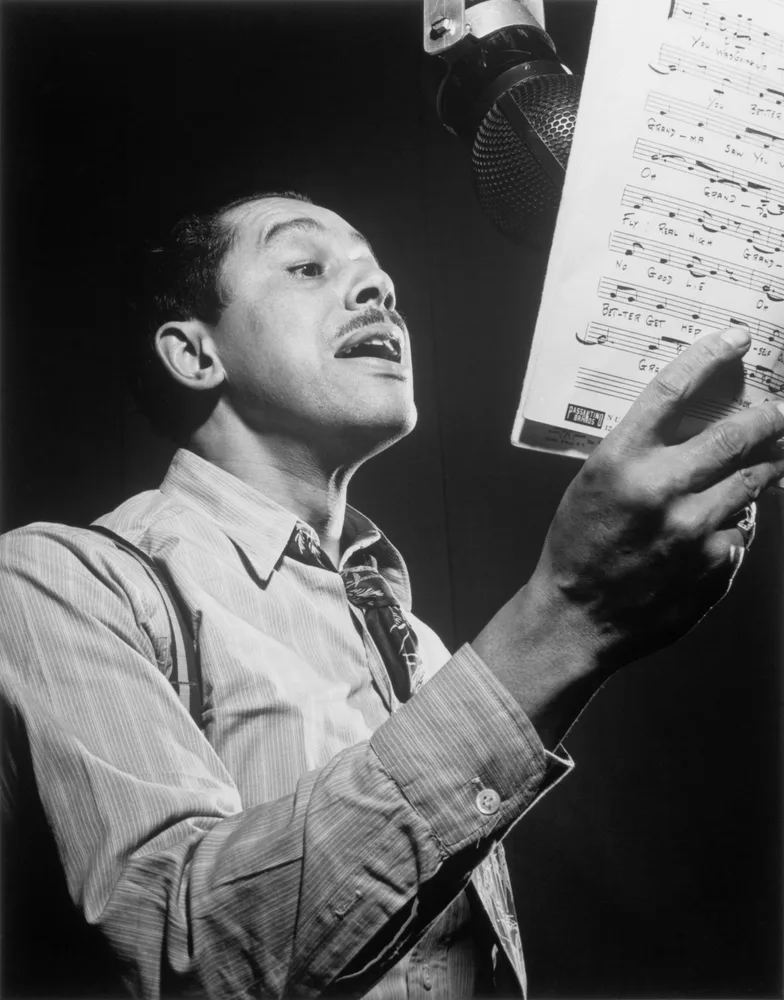
Cab Calloway, studio portrait taken at Columbia Records' New York studio, circa March 1947 Public Domain (PD-Gottlieb: William P. Gottlieb dedicated his entire photo collection to the public domain in 2010) — Wikimedia Commons: https://commons.wikimedia.org/wiki/File:Cab_Calloway_Gottlieb.jpg (original from the Library of Congress Music Division, William P. Gottlieb Collection, digital ID gottlieb.00961)

Cabell "Cab" Calloway III was born December 25, 1907, in Rochester, New York, to Cabell Calloway Jr., a Lincoln University graduate, and Martha Eulalia Reed, a Morgan State College graduate who worked as a teacher, church organist, and lawyer. The family moved to Baltimore's Druid Hill neighborhood in 1919, where young Calloway sold newspapers and shined shoes at Pimlico racetrack while developing an early taste for gambling. After he was caught shooting dice on church steps, his mother sent him in 1921 to Downingtown Industrial and Agricultural School in Pennsylvania, a reform institution run by her uncle. He began formal vocal lessons in 1922, graduated from Baltimore's Frederick Douglass High School in 1925, and worked Baltimore nightclubs against his parents' wishes, mentored informally by drummer Chick Webb and pianist Johnny Jones. He later drifted from Chicago's Crane College, choosing nightlife over class, and turned down an offer to play for the Harlem Globetrotters to stay in music.
His break came through his older sister, singer Blanche Calloway, who brought him onto the 1927 tour of the revue Plantation Days; he credited her as the reason he went into show business. In Chicago he sang, drummed, and emceed at "Black and tan" clubs including the Dreamland Café and the Sunset Cafe, where he understudied Adelaide Hall and worked alongside Louis Armstrong, who taught him the rudiments of scat singing. He fronted the Alabamians, moved with them to New York in 1929, and opened at the Savoy Ballroom on September 20, 1929. When that band folded, Armstrong recommended him as his own replacement in the revue Connie's Hot Chocolates, where Calloway made his name singing Fats Waller's "Ain't Misbehavin'."
In 1930, Calloway took over the Missourians, rebranding them Cab Calloway and His Orchestra. The band was booked into Harlem's Cotton Club to cover for Duke Ellington's touring orchestra, proved popular enough to stay on as the house band, and began twice-weekly NBC radio broadcasts that made Calloway one of the first Black entertainers with a nationally syndicated radio presence. On March 3, 1931, at a Brunswick session in New York, he recorded "Minnie the Moocher" (Brunswick 6074), whose nonsense "hi-de-ho" scat refrain became his catchphrase and earned him the nickname "The Hi De Ho Man"; the record is widely credited as the first by a Black artist to sell a million copies. Calloway's rotoscoped dance moves and voice anchored a run of Fleischer Studios cartoons opposite Betty Boop, including Minnie the Moocher (1932) and Snow-White (1933), and he followed the hit that October with the drug-themed sequel "Kickin' the Gong Around" (Brunswick 6209). Through the 1930s he starred in Paramount shorts, played "Reefer Man" in the 1933 feature International House, made his Hollywood feature debut opposite Al Jolson in The Singing Kid (1936), and in 1938 published Cab Calloway's Cat-alogue: A "Hepster's" Dictionary, reportedly the first dictionary published by an African American and later adopted by the New York Public Library as a jive-language reference.
By the late 1930s and into the 1940s, Calloway's orchestra was a proving ground for major jazz talent, carrying at various times Ben Webster, Leon "Chu" Berry, and Illinois Jacquet on saxophones, Milt Hinton on bass, Cozy Cole on drums, Danny Barker on guitar, Doc Cheatham and Dizzy Gillespie in the trumpet section, and Tyree Glenn on trombone. A stripped-down unit from the band, billed as the Cab Jivers, cut "(Hep-Hep!) The Jumpin' Jive" at a New York session on July 17, 1939 (Vocalion 5005), a million-selling side later revived by the Blues Brothers and by Joe Jackson. A backstage spitball incident in 1941 ended with Calloway firing Gillespie and Gillespie stabbing him in the leg, effectively closing that chapter of the collaboration. During World War II, Calloway toured to entertain troops and recorded topical specialty numbers, and in 1943 he appeared in Stormy Weather, one of the first Hollywood films built around a Black cast, alongside Lena Horne, Bill "Bojangles" Robinson, and Fats Waller. Poor financial decisions and heavy gambling losses caught up with him by decade's end, and his full orchestra broke up around 1948, a casualty of the same economics that ended most of the big bands.
Through the 1950s and 1960s Calloway rebuilt his career around theater and cabaret work. He played Sportin' Life in the Blevins Davis/Robert Breen touring revival of Porgy and Bess from 1952 to 1954, a run that included a State Department-sponsored European tour and a broadcast performance from Berlin. He led The Cotton Club Revue of 1958 on Broadway and on record for Gone Records, with the show later touring South America, and in 1961 and 1962 he provided halftime entertainment on the road with the Harlem Globetrotters. He took a rare dramatic film role in The Cincinnati Kid (1965) with Steve McQueen, and in 1967 he co-starred with Pearl Bailey, alongside his own daughter Chris Calloway, in the all-Black Broadway cast of Hello, Dolly!, whose RCA Victor cast recording (LOC/LSO-1147) is still regarded by many theater critics as the finest version of the score on record.
Calloway's final decades brought a second wave of fame. His 1976 autobiography, Of Minnie the Moocher and Me, reprinted the Hepster's Dictionary as an appendix, and a 1978 disco remake of "Minnie the Moocher" charted on Billboard's R&B listings. His 1980 cameo in The Blues Brothers, reprising "Minnie the Moocher" in white tie and tails, introduced him to an entirely new audience; director John Landis later summed up his influence bluntly: "Cab Calloway is hip-hop." He kept performing into his eighties, taping a BBC special from London's Ritz Hotel in 1985 with Doc Cheatham and Max Roach, recording "Minnie the Moocher" again with the Cincinnati Pops in 1988, appearing with the Baltimore Symphony and in Janet Jackson's "Alright" video in 1990, and touring European jazz festivals as late as 1992. A fall at home forced him to withdraw from a scheduled 1993 concert; he suffered a stroke on June 12, 1994, and died of pneumonia on November 18, 1994, at a nursing home in Hockessin, Delaware, at age 86. He was buried at Ferncliff Cemetery in Hartsdale, New York.
Calloway built his career less as an instrumentalist than as a bandleading showman: a scat vocalist who absorbed the technique directly from Louis Armstrong, a physical performer whose zoot suit and "hi-de-ho" call-and-response routines turned Cotton Club broadcasts into mass entertainment, and a shrewd bandleader who stocked his orchestra with some of the era's best soloists. His gliding backstep, called "the Buzz" in his own day, has repeatedly been cited as a forerunner of Michael Jackson's moonwalk, and critics and directors alike have traced a direct line from his hi-de-ho showmanship and rhythmic vocal patter to James Brown, Michael Jackson, and hip-hop performance generally. He charted on Billboard across five separate decades, an unusually long commercial run for a swing-era bandleader. His reach extended well beyond his own generation: pianist and composer Pepper Adams grew up in Depression-era Rochester and Detroit absorbing Fats Waller, Fletcher Henderson, Jimmie Lunceford, Duke Ellington, and Calloway from records, one strand of the big-band tradition that fed directly into Adams's own bebop and hard-bop vocabulary a generation later (Pepper Adams profile).
- "St. Louis Blues" (1930, Brunswick) - Recorded July 24, 1930, Calloway's first hit fronting the newly renamed Cab Calloway and His Orchestra. Spotify - St. Louis Blues (07-24-30) Listen
- "Minnie the Moocher" (1931, Brunswick 6074) - Calloway's signature hit and the song that gave him his "Hi De Ho Man" nickname; reportedly the first record by a Black artist to sell a million copies. Spotify - Minnie the Moocher (Theme Song) Listen
- "Kickin' the Gong Around" (1931, Brunswick 6209) - The drug-themed sequel to "Minnie the Moocher," cut that October at the height of the original's success. Spotify - Kickin' the Gong Around Listen
- "St. James' Infirmary" (early 1930s, Brunswick/Vocalion era) - A blues standard that became a fixture of Calloway's live sets and Betty Boop cartoon appearances. Spotify - St. James' Infirmary Listen
- "(Hep-Hep!) The Jumpin' Jive" (1939, Vocalion 5005) - Cut July 17, 1939, by the small-group Cab Jivers pulled from the full orchestra; a million-seller later covered by the Blues Brothers and Joe Jackson. Spotify - (Hep-Hep!) The Jumpin' Jive (07-17-39) Listen
- Hello, Dolly! (1967 Broadway Cast Recording, RCA Victor) - The all-Black cast recording led by Pearl Bailey and Calloway, with daughter Chris Calloway also in the company. Spotify - Hello, Dolly! (Broadway Cast Recording 1967) Listen
- "Minnie the Moocher" (1980, from The Blues Brothers soundtrack, Atlantic) - Calloway's white-tie-and-tails reprise of his signature song in the film, which introduced him to a new generation of listeners. Spotify - Minnie the Moocher Listen
Cab Calloway: Full Discography
Identity confirmed via the live Discogs API - artist ID 253474 ("Cab Calloway," realname Cabell Calloway III, birth/death dates matching Wikipedia and encyclopedia sources). Discogs credits the artist entry alone with 195 releases (24 albums, 33 singles/EPs, 129 compilations, 5 videos, 4 miscellaneous), and the combined releases feed for the "Cab Calloway" credit across all billings returns 1,738 items once decades of reissues, compilations, and his various backing-band credits (Cab Calloway And His Orchestra, And His Cotton Club Orchestra, And His Cab Jivers, and others) are included. Calloway recorded almost exclusively as a bandleader rather than a sideman, and nearly everything he cut before the 1950s was released as a 78rpm single rather than an album, so this table does not attempt exhaustive coverage. It curates his most historically significant recordings, film and stage work, and the compilation packages generally regarded as the standard way to hear his prewar catalog today; recording dates and catalog numbers are given where they could be confirmed via Discogs, Wikipedia, or contemporary discographical sources, and marked "not confirmed" elsewhere rather than guessed.
As Bandleader (selected singles, albums, and cast/film recordings)
| Title | Recording Date(s) | Release Date | Label | Catalog Number | Format(s) | Personnel | Role | Reissue History | Spotify | Buy | Notes |
|---|---|---|---|---|---|---|---|---|---|---|---|
| "St. Louis Blues" | Recorded July 24, 1930, New York | 1930 | Brunswick | Not confirmed | Shellac, 10", 78 RPM | Cab Calloway and His Orchestra (the newly renamed Missourians) | Leader/vocalist | Reissued on numerous "early years" compilations, e.g. JSP Records' Volume 1: The Early Years 1930-1934 (2001) | Spotify - St. Louis Blues (07-24-30) | - | His first hit fronting the band, months before the Cotton Club engagement began |
| "Minnie the Moocher" | Recorded March 3, 1931, Brunswick studio, New York | 1931 | Brunswick | 6074 | Shellac, 10", 78 RPM | Cab Calloway and His Orchestra | Leader/vocalist | Reissued continuously since; entered the Grammy Hall of Fame (1999) and the Library of Congress National Recording Registry (2019) | Spotify - Minnie the Moocher (Theme Song) | - | Reportedly the first record by a Black artist to sell a million copies; gave Calloway his "Hi De Ho Man" nickname |
| "Kickin' the Gong Around" | Recorded/released October 1931 | 1931 | Brunswick | 6209 | Shellac, 10", 78 RPM | Cab Calloway and His Orchestra | Leader/vocalist | Frequently paired with "Minnie the Moocher" on later reissue LPs and CDs | Spotify - Kickin' the Gong Around | - | Drug-themed sequel to "Minnie the Moocher," released the same year |
| "St. James' Infirmary" | Not confirmed (early 1930s Brunswick/Vocalion era) | Early 1930s | Brunswick/Vocalion | Not confirmed | Shellac, 10", 78 RPM | Cab Calloway and His Orchestra | Leader/vocalist | Reissued on nearly every Calloway anthology since | Spotify - St. James' Infirmary | - | Blues standard closely associated with Calloway's stage act and Betty Boop cartoon appearances |
| "Reefer Man" | Not confirmed | 1932 (film); commercial single 1934 pairing | Banner (1934 reissue single) | 32944 (1934 Banner pairing w/ "Minnie the Moocher") | Shellac, 10", 78 RPM | Cab Calloway and His Orchestra | Leader/vocalist | Reissued widely on drug-song and swing-era compilations | Not found on Spotify under this exact title/version; not linked rather than guessed | - | Performed in the 1933 Paramount feature International House |
| "The Man from Harlem" | Not confirmed | 1932 | Brunswick | Not confirmed | Shellac, 10", 78 RPM | Cab Calloway and His Orchestra | Leader/vocalist | Reissued on compilation LPs including The Man from Harlem: Cab Calloway 1930-1932 (Jazz Panorama) | Not found on Spotify under this exact title; not linked rather than guessed | - | Recording date/catalog not independently confirmed beyond period compilations |
| "Zaz Zuh Zaz" | Not confirmed | 1933 | Not confirmed | Not confirmed | Shellac, 10", 78 RPM | Cab Calloway and His Orchestra | Leader/vocalist | Reissued on A Proper Introduction to Cab Calloway: Zah, Zuh, Zaz (Proper Records, 2004) among others | Not found on Spotify under this exact title; not linked rather than guessed | - | One of several nonsense-scat vocal features from the same period as "Minnie the Moocher" |
| "(Hep-Hep!) The Jumpin' Jive" | Recorded July 17, 1939, New York | 1939 | Vocalion | 5005 | Shellac, 10", 78 RPM | Doc Cheatham, Irving Randolph, Lammar Wright, Mario Bauza (trumpets); Claude Jones, DePriest Wheeler, Keg Johnson (trombones); Andrew Brown, Chauncey Haughton (clarinet/alto sax); Chu Berry, Walter Thomas (tenor sax); Bennie Payne (piano); Danny Barker (guitar); Milt Hinton (bass); Cozy Cole (drums); Cab Calloway (vocals/leader) | Leader/vocalist (billed "Cab Calloway and His Orchestra," small-group "Cab Jivers" personnel) | Reissued on numerous swing-era anthologies; covered by the Blues Brothers (1980) and Joe Jackson (1981, Jumpin' Jive) | Spotify - (Hep-Hep!) The Jumpin' Jive (07-17-39) | - | Million-selling single; personnel per period discographical sources |
| "Are You Hep to the Jive? (Yas, Yas)" | Not confirmed | 1940 | Not confirmed | Not confirmed | Shellac, 10", 78 RPM | Cab Calloway and His Orchestra | Leader/vocalist | Title track of the 1994 Columbia/Legacy compilation Are You Hep to the Jive? | Spotify - Are You Hep to the Jive? (Yas, Yas) | - | |
| Porgy and Bess (Sportin' Life, touring revival) | Live performances, 1952-1954, including a State Department-sponsored European tour | Broadcast September 21, 1952, Berlin (archival release only; no confirmed contemporaneous studio LP featuring Calloway) | Not confirmed | Not confirmed | Live broadcast recording | William Warfield (Porgy), Leontyne Price (Bess), Cab Calloway (Sportin' Life), Alexander Smallens (conductor) | Featured cast member | Archival Berlin-broadcast recordings have circulated commercially; not to be confused with the 1963 RCA Victor studio LP (LM-2679, Price/Warfield only, no Calloway) | Not found on Spotify; not linked rather than guessed | - | Calloway toured as Sportin' Life for roughly two years; recording provenance for this run is thin and not fully confirmed |
| Cotton Club Revue of 1958 | Not confirmed | 1958 | Gone Records | Not confirmed | Vinyl, LP | Cab Calloway and company, arranged by Eddie Barefield | Leader | Not confirmed | Not found on Spotify; not linked rather than guessed | - | Companion to the stage revue starring Calloway with young tap dancers Maurice and Gregory Hines; the revue subsequently toured South America in 1959 |
| Hello, Dolly! (1967 Broadway Cast Recording) | Recorded 1967 | 1967 | RCA Victor | LOC-1147 (mono) / LSO-1147 (stereo) | Vinyl, LP, Album | Pearl Bailey, Cab Calloway, Jack Crowder, Emily Yancy, Winston DeWitt Hemsley, Chris Calloway, ensemble | Featured cast member (Horace Vandergelder) | Reissued on CD (RCA Victor 3814-2-RG) | Spotify - Hello, Dolly! (Broadway Cast Recording 1967) | - | All-Black replacement cast that revived the show's Broadway business; Calloway's daughter Chris Calloway also appeared |
| "Minnie the Moocher" (from The Blues Brothers soundtrack) | Not confirmed (film released 1980) | 1980 | Atlantic | Not confirmed | Vinyl, LP, Album (soundtrack) | Cab Calloway with the Blues Brothers Band | Featured performer | Soundtrack reissued on CD and digitally | Spotify - Minnie the Moocher | - | Calloway's white-tie reprise of his signature song, credited with introducing him to a new generation of listeners |
As Featured Performer / Notable Compilations (selected)
| Year | Project | Title | Label | Catalog | Role | Notes |
|---|---|---|---|---|---|---|
| 1943 | Various (film cast) | Stormy Weather | 20th Century Fox (film); soundtrack material reissued on various labels | Not confirmed | Featured performer | One of the first major Hollywood films built around a Black cast, with Lena Horne, Bill "Bojangles" Robinson, and Fats Waller |
| 1965 | The Cincinnati Kid | Film role ("Yeller") | MGM | Not confirmed | Actor (non-musical role) | Dramatic film appearance with Steve McQueen and Edward G. Robinson |
| 1994 | Sony/Legacy compilation | Are You Hep to the Jive? | Columbia/Legacy | Not confirmed | Compiler artist | Widely cited retrospective covering the Brunswick/Vocalion/OKeh-era catalog |
| 2001 | JSP Records reissue series | Volume 1: The Early Years 1930-1934 | JSP Records | JSPCD908 | Compiler artist | Chronological reissue of Calloway's earliest Brunswick sides |
Discogs also lists 770 further "Appearance" credits and 1,018 "TrackAppearance" credits under the Cab Calloway name (spanning the 1930s to posthumous compilations released as recently as the 2020s) that are not itemized here; these are overwhelmingly repackagings of the same prewar and wartime recordings already represented above, not additional distinct sessions.
- Blanche Calloway - older sister and singer who brought Calloway into show business via the 1927 revue Plantation Days.
- Louis Armstrong - taught Calloway scat-singing technique at Chicago's Sunset Cafe in the late 1920s and recommended him as his own replacement in Connie's Hot Chocolates (1929-1930).
- Dizzy Gillespie - trumpeter in Calloway's orchestra from the late 1930s until a 1941 onstage dispute ended with Calloway firing him.
- Chu Berry, Ben Webster, Illinois Jacquet - saxophonists who passed through Calloway's late-1930s/1940s orchestra, several going on to define their instruments elsewhere in jazz.
- Milt Hinton, Cozy Cole, Danny Barker, Doc Cheatham - rhythm section and trumpet mainstays of the Calloway orchestra through its 1930s-1940s peak, including the 1939 "Jumpin' Jive" session.
- Pearl Bailey - co-star in the 1967 all-Black Broadway cast of Hello, Dolly!, alongside Calloway's daughter Chris Calloway.
- Max Roach - fellow performer on the 1985 BBC special The Cotton Club Comes to the Ritz, filmed in London with Calloway's orchestra, Adelaide Hall, and Doc Cheatham.