 JAZZPROFILES lives in the music 1,146 Jazz Artists fully Profiled!
 Michel Legrand
Last updated September 12, 2026
Listen on Spotify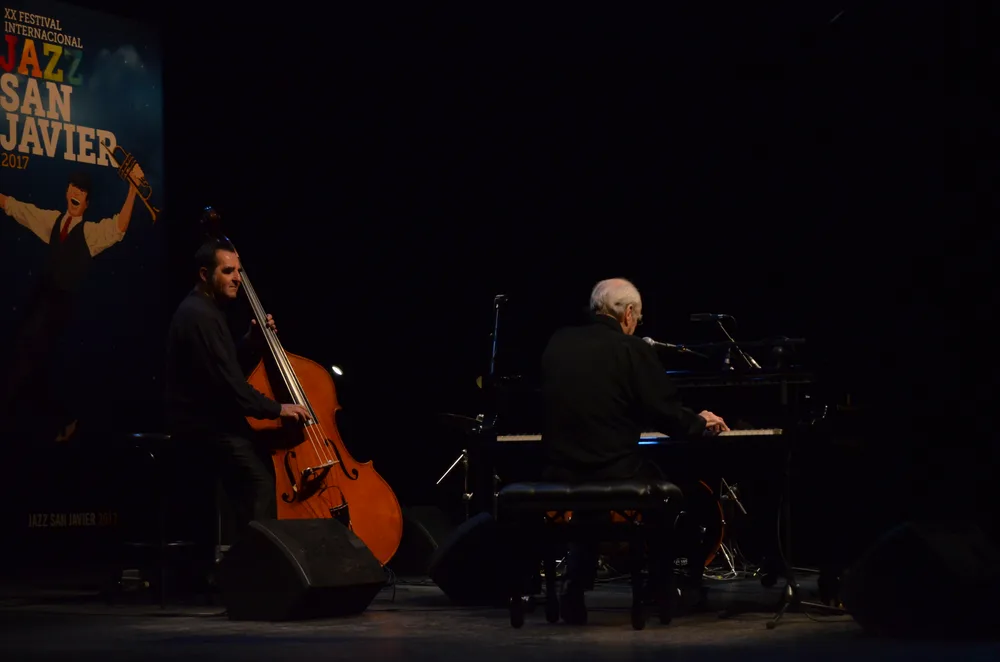
Michel Legrand performing at the closing concert of the 20th International Jazz Festival of San Javier, Spain, July 30, 2017 CC BY-SA 4.0 — Wikimedia Commons — https://commons.wikimedia.org/wiki/File:Michel_Legrand_2017_JazzSanJavier.jpg_02.jpg

Michel Jean Legrand was born February 24, 1932, in Bécon-les-Bruyères, in the Paris suburbs, to conductor and composer Raymond Legrand and Marcelle Der-Mikaëlian, whose brother was the bandleader Jacques Hélian. His parents separated when he was three, and he later said the family piano became "my only friend, my only love" as he taught himself to pick out melodies he had heard on the radio. At ten he entered the Paris Conservatoire, where he studied under Nadia Boulanger, Henri Challan, and Noël Gallon and graduated with top honors as both a pianist and a composer. His sister, Christiane Legrand, went on to a career as a jazz vocalist, later a member of the Swingle Singers. The turn toward jazz came in 1947, when the teenage Legrand heard Dizzy Gillespie play a concert in Paris: "I was ecstatic," he recalled, describing the discovery of "another world, another planet."
Out of the Conservatoire, Legrand became musical director and accompanist to Maurice Chevalier, a job that took him on tour to the United States for the first time in the early 1950s. His own 1954 orchestral debut, the mood album I Love Paris, became a surprise hit and established him commercially, but it was a 1958 trip back to New York, made possible by his Columbia Records contract, that produced his defining jazz statement. Over three sessions on June 25, 27, and 30, 1958, Legrand assembled and conducted an extraordinary cross-section of the era's leading jazzmen for Legrand Jazz: Miles Davis, John Coltrane, Bill Evans, Ben Webster, Paul Chambers, Herbie Mann, Phil Woods, Hank Jones, Donald Byrd, and Art Farmer among them, reimagining eleven jazz standards through his own dense, classically trained orchestral arrangements. Critic Leonard Feather later called it "unquestionably one of the most successful orchestral jazz albums of all time."
Legrand kept a working jazz career going alongside his fast-growing reputation as a film composer through the 1960s. In 1959 he recorded the trio date Paris Jazz Piano in Paris with bassist Guy Pedersen and drummer Gus Wallez, a set of Paris-themed standards issued in France on Philips and released in the United States the following year, retitled Legrand Piano, on Columbia. Nearly a decade later, in 1968, he cut At Shelly's Manne-Hole for Verve, a live trio session recorded at Shelly Manne's Hollywood club with bassist Ray Brown and drummer Shelly Manne, several of its pieces improvised on the spot; a period reviewer singled out Legrand's own piano work on "Another Blues" and "Ray's Riff."
The 1970s brought a run of high-profile jazz collaborations built around Legrand's arranging. In 1972 he arranged and conducted Sarah Vaughan with Michel Legrand for Mainstream, built largely from songs he had written with lyricists Alan and Marilyn Bergman, and won the Grammy Award for Best Instrumental Arrangement Accompanying Vocalist(s) for "What Are You Doing the Rest of Your Life?" from that record. The same year he composed, arranged, and played on Stan Getz's Communications '72 for Verve. In 1975 he arranged Lena Horne's Lena & Michel for RCA and, in the same year, orchestrated and conducted Phil Woods's Images, which won Grammy Awards for Best Instrumental Composition and Best Jazz Performance by a Big Band. He led his own big band on Le Jazz Grand, recorded at RCA Studios in New York in March 1978 and released the following year on Gryphon, built around a jazz suite drawn from his own soundtrack to Les Routes du Sud and featuring septet tracks with Phil Woods, trumpeter Jon Faddis, and baritone saxophonist Gerry Mulligan.
Legrand's jazz output continued into the 1980s and 1990s even as his soundtrack work reached its commercial peak. He recorded the septet album After the Rain in New York in May 1982 (released 1983, Pablo) again with Phil Woods, alongside Zoot Sims, trumpeter Joe Wilder, guitarist Gene Bertoncini, bassist Ron Carter, and drummer Grady Tate. In 1991 he reunited with Miles Davis, who also appeared on screen, for the soundtrack to the film Dingo, their first joint project since Legrand Jazz thirty-three years earlier. In 1992 he recorded the trio album Autumn in Paris and, that May in Paris, Legrand Grappelli for Verve with violinist Stéphane Grappelli, a session that also featured trumpeter Stéphane Belmondo, who had joined Legrand's big band around 1990 and was on stage for the pair's first meeting at the Paris Olympia earlier that year. He led an all-star sextet including trumpeter Arturo Sandoval, trombonist Bill Watrous, and flutist Hubert Laws on Michel Plays Legrand, recorded in Hollywood in September 1993 and released in 1995, and followed it with the trio date The Warm Shade of Memory (recorded March 1995, released 1996), which added a guest turn from harmonica player Toots Thielemans.
In 2002 Legrand released Michel Legrand by Michel Legrand, his first solo piano recording devoted entirely to his own compositions. Alongside this steady jazz output ran the far more widely known career for which he is best remembered outside jazz circles: scores for Jacques Demy's The Umbrellas of Cherbourg (1964) and The Young Girls of Rochefort (1966), for directors including Jean-Luc Godard, Agnès Varda, and Orson Welles, and, from the late 1960s, a long run of Hollywood work that brought him three Academy Awards, for the song "The Windmills of Your Mind" from The Thomas Crown Affair (1968), the score for Summer of '42 (1971), and the adapted score for Yentl (1983), plus multiple Grammy Awards. He remained active into his final years, scoring Peter Bogdanovich's 2018 completion of Orson Welles's long-unfinished The Other Side of the Wind. Michel Legrand died January 26, 2019, in Neuilly-sur-Seine, France, at eighty-six, after being hospitalized with a pulmonary infection.
Legrand's jazz identity was that of an arranger-pianist whose conservatory training shaped everything he touched: dense, harmonically sophisticated big-band and chamber-jazz voicings built to frame world-class soloists rather than compete with them. Legrand Jazz remains the clearest statement of that approach, pairing hard-bop-caliber improvisers with orchestrations a jazz combo alone could not produce; reviewing the album decades later, All About Jazz found "Legrand's genuine love of jazz" and "his commitment to sleek, modern swing" self-evident, while noting the results lacked the "legendary status" of Gil Evans's comparable work with Miles Davis, a touch of what the reviewer called Gallic insouciance. As a player, Legrand favored an elegant, harmonically alert touch rather than a percussive one, evident on his trio recordings and singled out by critics on At Shelly's Manne-Hole. He kept returning to jazz throughout a career that made him vastly more famous as a film composer, treating it not as a sideline but as a working practice he never abandoned, from a 1947 Dizzy Gillespie concert that redirected his ear as a teenager to a solo piano album of his own songbook released when he was seventy.
- Legrand Jazz (1958, Columbia) - Legrand's all-star reimagining of eleven jazz standards, arranged and conducted for a rotating cast that included Miles Davis, John Coltrane, and Bill Evans; called by Leonard Feather one of the most successful orchestral jazz albums ever made. Spotify - Legrand Jazz Listen
- Paris Jazz Piano (1959, Philips) - A Paris-recorded trio session with bassist Guy Pedersen and drummer Gus Wallez, later reissued in the U.S. as Legrand Piano (Columbia, 1960). Spotify - Paris Jazz Piano Listen
- At Shelly's Manne-Hole (1968, Verve) - A live trio date at Shelly Manne's Hollywood club with bassist Ray Brown and drummer Shelly Manne, including pieces composed on the spot. Spotify - At Shelly's Manne-Hole Listen
- Sarah Vaughan with Michel Legrand (1972, Mainstream) - Legrand's Grammy-winning arranging showcase built around his own songs with Alan and Marilyn Bergman. Spotify - With Michel Legrand Listen
- Le Jazz Grand (rec. 1978, rel. 1979, Gryphon) - A big-band leader date built around a jazz suite drawn from his own film score to Les Routes du Sud, with septet features for Phil Woods, Jon Faddis, and Gerry Mulligan. Spotify - Le Jazz Grand Listen
- After the Rain (rec. 1982, rel. 1983, Pablo) - A septet leader date reuniting Legrand with Phil Woods, alongside Zoot Sims, Ron Carter, and Gene Bertoncini. Spotify - After The Rain Listen
- Legrand Grappelli (1992, Verve) - A duo-led session with violinist Stéphane Grappelli, recorded in Paris with trumpeter Stéphane Belmondo in the band. Spotify - Michel Legrand / Stephane Grappelli Listen
- Images (1975, RCA Victor) - As arranger and conductor: Phil Woods's Grammy-winning big-band leader date, one of Legrand's most acclaimed orchestration credits.
Michel Legrand: Full Discography
Identity confirmed via the live Discogs API, artist ID 84236 ("Michel Legrand," realname Michel-Jean Legrand, matching birth/death dates and biography). Legrand's main Discogs entry runs to thousands of releases, the overwhelming majority film soundtracks, classical recordings, and French-language popular-song singles and albums he arranged or conducted for other performers, spanning a seven-decade career far broader than this site's jazz focus. Several related Discogs entities exist for group billings, including "Michel Legrand Et Son Orchestre," "Michel Legrand & Co.," and "Michel Legrand Trio"; these were checked and appear to be the same person under different billing conventions rather than a different musician, and were not merged into the table below release by release. This table itemizes his jazz-relevant leader and co-leader catalog plus a representative set of his most significant jazz sideman and arranging credits; it does not attempt to catalog his film, classical, or chanson-arranging work.
As Leader / Co-Leader
| Album Title | Recording Date(s) | Release Date | Label | Catalog Number | Format(s) | Personnel | Role | Reissue History | Spotify | Buy | Notes |
|---|---|---|---|---|---|---|---|---|---|---|---|
| Legrand Jazz | Recorded June 25, 27 & 30, 1958, New York City | 1958 | Columbia | CS 8079 | Vinyl, LP, Album, Stereo | Michel Legrand (conductor, arranger) with, across the three sessions: Miles Davis (trumpet), John Coltrane (tenor sax), Bill Evans & Hank Jones (piano), Ben Webster (tenor sax), Herbie Mann (flute), Phil Woods & Gene Quill (alto sax), Paul Chambers & George Duvivier & Milt Hinton (bass), Barry Galbraith (guitar), Betty Glamann (harp) | Leader | Reissued on CD by Columbia/Legacy; a 2009 French compilation pairs it with the Ascenseur pour l'échafaud soundtrack | Spotify - Legrand Jazz | — | Legrand's landmark all-star date, made possible by his own Columbia contract; three distinct personnel groupings across the three sessions |
| Paris Jazz Piano | Recorded 1959, Blanqui studio, Paris | 1961 | Philips | B 76.519 R | Vinyl, LP, 10", Album, Mono | Michel Legrand (piano), Guy Pedersen (double bass), Gus Wallez (drums) | Leader | Reissued on CD | Spotify - Paris Jazz Piano | — | A set of Paris-themed jazz standards; the same trio and largely the same session material were issued in the U.S. as Legrand Piano |
| Legrand Piano | Recorded 1959, Paris (same sessions as Paris Jazz Piano) | 1960 | Columbia | CL1441 | Vinyl, LP, Album, Mono | Michel Legrand (piano), Guy Pedersen (double bass), Gus Wallez (drums) | Leader | None found | Not confirmed via Spotify search under this specific U.S. title | — | U.S. repackaging of the Paris Jazz Piano trio material under a new title for the American market |
| At Shelly's Manne-Hole | Recorded live, Shelly's Manne-Hole, Hollywood, CA, 1968 | 1968 | Verve Records | V6-8760 | Vinyl, LP, Album | Michel Legrand (piano), Ray Brown (bass), Shelly Manne (drums) | Leader | None found | Spotify - At Shelly's Manne-Hole | — | Live trio date; several pieces reportedly improvised on the spot; Legrand also takes a vocal on "My Funny Valentine" |
| Le Jazz Grand | Recorded RCA Studios, New York, March 1978 | 1979 | Gryphon Records | G-786 | Vinyl, LP, Gatefold | Michel Legrand (piano, composer, arranger), Phil Woods (alto sax), Gerry Mulligan (baritone sax), Jon Faddis (trumpet), Ron Carter (bass), Jimmy Madison (drums), Portinho (percussion) | Leader | None found | Spotify - Le Jazz Grand | — | Big-band suite ("Southern Routes") drawn from Legrand's own soundtrack to the film Les Routes du Sud, plus septet tracks |
| After the Rain | Recorded New York City, May 28, 1982 | 1983 | Pablo Records | 2312-139 | Vinyl, LP, Album | Michel Legrand (piano, producer), Phil Woods (sax, clarinet), Zoot Sims (sax), Joe Wilder (trumpet, flugelhorn), Gene Bertoncini (guitar), Ron Carter (bass), Grady Tate (drums) | Leader | Reissued on CD | Spotify - After The Rain | — | Septet reunion with Phil Woods; the Discogs release notes flag that the printed cover track list does not match the actual audio |
| Autumn in Paris | Recorded Acousti Studio, Paris, June 26, 27 & 29, 1992 | 1992-11-21 | Alfa Jazz | ALCR-235 | CD, Album | Michel Legrand (piano, composer), Marc-Michel Le Bévillon (contrabass), André Ceccarelli (drums) | Leader | None found | Not confirmed via Spotify search under this specific title | — | Trio date issued in Japan; liner notes in Japanese |
| Legrand Grappelli | Recorded Paris, May 25-27, 1992 | 1992 | Verve Records | 517 028-2 | CD, Album | Michel Legrand (piano, producer), Stéphane Grappelli (violin), André Ceccarelli (drums), Marc-Michel Le Bévillon (electric bass), Stéphane Belmondo, Jon Faddis & Tony Russo (trumpet), Denis Leloup & Jacques Bolognesi (trombone) | Co-leader (with Stéphane Grappelli) | None found | Spotify - Michel Legrand / Stephane Grappelli | — | Followed the pair's first on-stage meeting at the Paris Olympia earlier in 1992 |
| Michel Plays Legrand | Recorded direct to two-track digital, Hollywood, September 27-28, 1993 | 1995 | LaserLight Digital | 12 306 | CD, Album | Michel Legrand (piano, arranger, vocals), Arturo Sandoval (trumpet, flugelhorn), Bill Watrous (trombone), Bud Shank (alto sax), Buddy Collette & Hubert Laws (flute), John Pisano (guitar), Brian Bromberg (acoustic bass), Peter Erskine (drums) | Leader | None found | Not confirmed via Spotify search under this specific title | — | An all-star sextet/septet reworking Legrand's own songbook |
| The Warm Shade of Memory | Recorded March 27-29, 1995 | 1996 | Evidence / Alfa Jazz | ECD 22153-2 | CD, Album | Michel Legrand (piano, vocals on 2 tracks), Marc-Michel Le Bévillon (bass), Umberto Pagnini (drums), Toots Thielemans (harmonica, 2 tracks) | Leader | None found | Not confirmed via Spotify search under this specific title | — | Trio date with a guest harmonica turn from Toots Thielemans |
| Michel Legrand by Michel Legrand | Recorded October 25-27, 2000 | 2002 | Decca | 468 512-2 | CD, Album | Michel Legrand (piano, composer, arranger) | Leader | None found | No confidently matching Spotify album identified; a similarly but not identically titled 2001 release exists and was not treated as the same recording | — | Legrand's first solo piano recording devoted entirely to his own compositions, drawn largely from his film scores |
As Sideman / Arranger (selected major jazz credits)
| Year | Project (Leader) | Title | Label | Catalog | Role | Notes |
|---|---|---|---|---|---|---|
| 1972 | Sarah Vaughan | Sarah Vaughan with Michel Legrand | Mainstream Records | MRL 361 | Arranger, Conductor | Won the Grammy Award for Best Instrumental Arrangement Accompanying Vocalist(s) for "What Are You Doing the Rest of Your Life?"; recorded April 17-20, 1972 |
| 1972 | Stan Getz | Communications '72 | Verve Records | V6-8807 | Composer, Arranger, Orchestrator | Getz credited on saxophone though listed as "uncredited" in the Discogs release data |
| 1975 | Phil Woods and Orchestra | Images | RCA Victor | BGL1-1027 | Arranger, Conductor, Piano | Won Grammy Awards for Best Instrumental Composition and Best Jazz Performance by a Big Band; joint billing to Woods and Legrand's orchestra |
| 1975 | Lena Horne | Lena & Michel | RCA Victor | Not confirmed via Discogs | Arranger | Not confirmed in detail against Discogs; cited in secondary sources (AllMusic) |
| 1991 | Michel Legrand (soundtrack) | Dingo (Original Motion Picture Soundtrack) | Not confirmed via Discogs for this specific credit | Composer, with Miles Davis performing and appearing on screen | First joint project between Legrand and Davis since 1958's Legrand Jazz; a film soundtrack rather than a standalone jazz album, included here only for the Davis reunion it documents |
- Phil Woods - Legrand's most recurring jazz partner: a session player on Legrand Jazz (1958), featured soloist on Le Jazz Grand (1979) and After the Rain (1982), and subject of Legrand's Grammy-winning orchestration on Images (1975).
- Miles Davis - lead trumpet on three tracks of Legrand Jazz (1958) and, in 1991, an on-screen and on-record reunion for the soundtrack to Dingo.
- Stéphane Grappelli - co-billed on Legrand Grappelli (1992, Verve), following their first meeting on stage at the Paris Olympia earlier that year.
- Stéphane Belmondo - trumpeter in Legrand's big band from around 1990 and on the Legrand Grappelli session.
- Sarah Vaughan - arranger and conductor of her 1972 Mainstream album Sarah Vaughan with Michel Legrand, a Grammy-winning collaboration.
- Stan Getz - composer, arranger, and orchestrator of Getz's 1972 Verve album Communications '72.
- Ray Brown and Shelly Manne - trio partners on the 1968 live album At Shelly's Manne-Hole.
- Also recorded and toured with: John Coltrane, Bill Evans, Ben Webster, Herbie Mann, Hank Jones, Donald Byrd, Art Farmer, Zoot Sims, Ron Carter, Gene Bertoncini, Gerry Mulligan, Hubert Laws, Lena Horne, Toots Thielemans, and Arturo Sandoval.