 JAZZPROFILES lives in the music 2,059 Jazz Artists fully Profiled!
Frank Sinatra
Last updated October 29, 2026
Listen on Spotify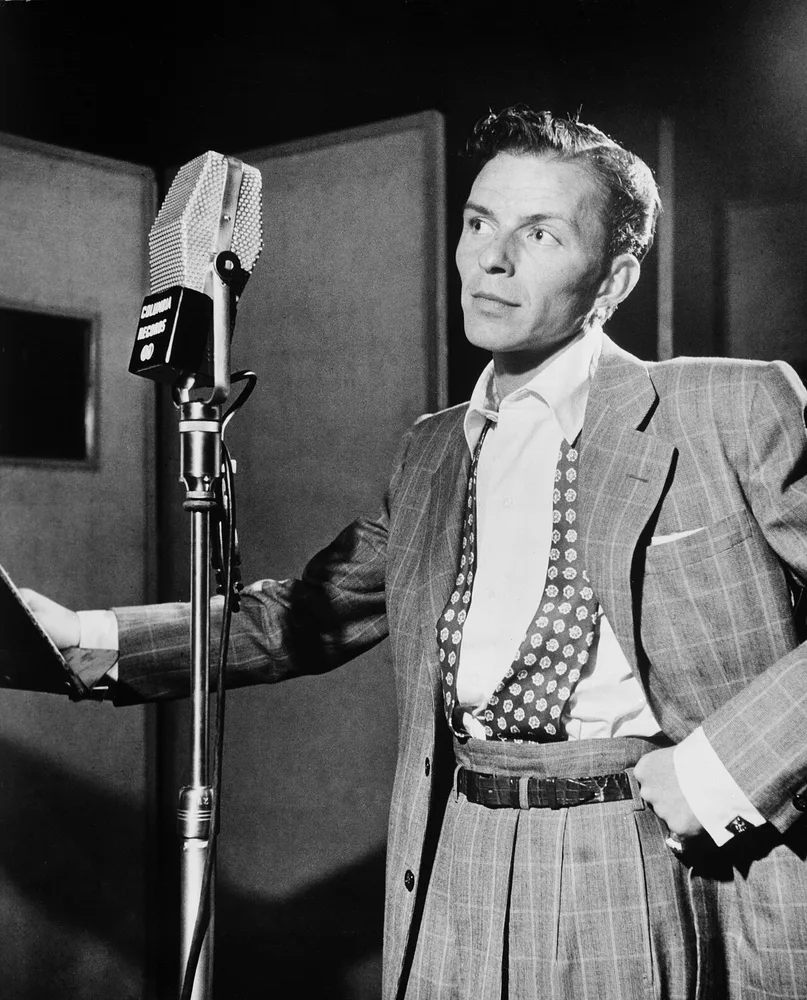
Frank Sinatra at a Columbia Records microphone, Liederkranz Hall, New York, circa 1947 Public domain (William P. Gottlieb Collection, Library of Congress; the photographs entered the public domain in 2010 in accordance with Gottlieb's wishes) — Wikimedia Commons — https://commons.wikimedia.org/wiki/File:Frank_Sinatra_by_Gottlieb_c1947-_2.jpg — William P. Gottlieb, Library of Congress

Francis Albert Sinatra was born on December 12, 1915, in a tenement at 415 Monroe Street in Hoboken, New Jersey, the only child of Natalina "Dolly" Garaventa, who came from Genoa, and Antonino Martino "Marty" Sinatra, who came from Sicily and later rose to captain in the Hoboken Fire Department. He left high school without graduating, sang for spare change in his parents' tavern and for free on local radio, and never learned to read music well, working instead by ear. As a teenager he listened to big-band jazz and idolized Bing Crosby. In 1935 he joined a local vocal trio that went on the Major Bowes Amateur Hour as the Hoboken Four, won the contest, and toured on the prize contract.
His first real break came from the bands. In June 1939 bandleader Harry James signed him as vocalist at 75 dollars a week, and his first commercial record, "From the Bottom of My Heart," came out with the James band in July 1939, followed by "All or Nothing at All," recorded that August. He left James in November 1939 for the more successful orchestra of trombonist Tommy Dorsey, made his first appearance with it on January 26, 1940, in Rockford, Illinois, and recorded more than forty songs in his first year there. "I'll Never Smile Again" spent twelve weeks at the top of the charts beginning in mid-July 1940. He later credited Dorsey with a lesson that shaped his singing: Dorsey took quiet breaths at the side of his mouth while playing, and Sinatra trained his lungs, by swimming underwater among other methods, to carry a phrase through a whole stanza without a visible break. He recorded his first solo session on January 19, 1942, with the arranger Axel Stordahl, and left Dorsey that September after a legal dispute over the contract.
The solo years began with a frenzy. His opening at the Paramount Theatre in New York on December 30, 1942, set off a frenzy among teenage fans, the bobby soxers, that became known as "Sinatramania". He signed with Columbia as a solo artist on June 1, 1943, and his debut album, The Voice of Frank Sinatra (1946), reached No. 1 on the Billboard album chart. In December 1947 he sang "Sweet Lorraine" on a Metronome All-Stars date that included Coleman Hawkins, Harry Carney and Charlie Shavers, with Nat King Cole at the piano. By 1949 his popularity was falling, a throat hemorrhage interrupted a New York booking in 1950, and Columbia and his talent agency dropped him in 1952. His last Columbia studio session, on September 17, 1952, produced "Why Try to Change Me Now."
The turnaround came in 1953. He signed with Capitol Records on March 13, 1953, and on April 30 made his first record with the arranger Nelson Riddle, "I've Got the World on a String." His performance in From Here to Eternity (1953) won the Academy Award for Best Supporting Actor. The Capitol albums that followed are the core of his reputation: Songs for Young Lovers and Swing Easy! (both 1954), In the Wee Small Hours (April 25, 1955), a set of torch songs that helped establish the 12-inch LP in popular music, and Songs for Swingin' Lovers! (March 1956), arranged by Riddle and inducted into the Grammy Hall of Fame in 2000. Where Are You? (1957) was his first stereo album and the first with Gordon Jenkins instead of Riddle. Come Fly with Me (January 6, 1958), with Billy May, spent five weeks at No. 1, Only the Lonely (September 8, 1958) went back to Riddle's arrangements and the saloon-song mood, and Come Dance with Me! (January 5, 1959) won the Grammy for Album of the Year at the second Grammy Awards, with May winning Best Arrangement. In 1959 he toured Australia backed by the quintet of the vibraphonist Red Norvo, and tapes from the Melbourne shows were issued in 1997 as a live album.
In 1960 he left Capitol after a feud with its president, first tried to buy Norman Granz's Verve Records, then started his own label, Reprise. Its first record was Ring-a-Ding-Ding! (1961), arranged by Johnny Mandel, and its early artists included Duke Ellington. The jazz-band collaborations of the Reprise years came next. Sinatra-Basie: An Historic Musical First was recorded on October 2 and 3, 1962, in Hollywood with the Count Basie Orchestra and arrangements by Neal Hefti. It Might as Well Be Swing followed on June 9 to 12, 1964, his first studio record arranged by Quincy Jones, and the source of one of his best-known versions of "Fly Me to the Moon." The two men appeared together at the 1965 Newport Jazz Festival, and in January and February 1966 he recorded Sinatra at the Sands in the Copa Room of the Sands Hotel in Las Vegas, with the Basie band under Jones's direction. It was his first commercially released live album and was certified gold.
Two more jazz-world meetings followed. Francis Albert Sinatra & Antonio Carlos Jobim was recorded on January 30 and February 1, 1967, at United Western Recorders in Hollywood, with arrangements by Claus Ogerman and Jobim on guitar and piano; it was released in March 1967 and was nominated for Album of the Year at the 1968 Grammy Awards, losing to the Beatles' Sgt. Pepper's Lonely Hearts Club Band. A second set of Jobim sessions was shelved in 1969, and parts of it surfaced on Sinatra & Company (1971). In December 1967 he recorded Francis A. & Edward K. with Duke Ellington and his orchestra, with arrangements by Billy May. Dan Morgenstern gave it four stars in DownBeat and singled out "Indian Summer," with an alto solo by Johnny Hodges, as its masterpiece. "My Way," recorded just after Christmas 1968 and adapted from a French song, became one of his best-known songs.
He announced his retirement in June 1971 and returned in 1973 with Ol' Blue Eyes Is Back. In October 1974 he performed at Madison Square Garden with Woody Herman's Young Thundering Herd, and in 1975 he appeared in New York with Basie and Ella Fitzgerald and at the London Palladium with Basie and Sarah Vaughan. Trilogy: Past Present Future (1980) produced "Theme from New York, New York." In 1984 he made L.A. Is My Lady with Quincy Jones producing, his first studio album with Jones since 1964; it reached No. 8 on the Top Jazz Albums chart, and on its version of "Mack the Knife" he names Jones, Michael Brecker, Frank Foster and Lionel Hampton among the musicians he salutes. Duets (1993), on which contemporary stars added their voices to tracks he had recorded, became his best-selling album, and Duets II followed in 1994. His last public concerts were at the Fukuoka Dome in Japan on December 19 and 20, 1994. He passed away on May 14, 1998, at Cedars-Sinai Medical Center in Los Angeles after a heart attack, at the age of 82.
Away from the microphone his career had two very different halves. He worked as an actor for four decades: besides the Oscar for From Here to Eternity, he was nominated for Best Actor for The Man with the Golden Arm (1955), won a Golden Globe for Pal Joey (1957) and starred in The Manchurian Candidate (1962). He also spent decades answering questions about his associations. In 1951 investigators for the Kefauver Senate committee questioned him about photographs with figures from organized crime; he said he knew some of them and denied any business dealings. The FBI kept a file on him that ran to 2,403 pages. In 1963 the Nevada Gaming Control Board temporarily suspended his gambling license after the gangster Sam Giancana was seen at the Cal Neva Lodge, and he gave up his shares in that casino and the Sands. In 1981 his ten-day engagement at Sun City in the Bophuthatswana homeland drew criticism for breaking the cultural boycott of apartheid-era South Africa. He had a documented temper, particularly toward journalists, and was married four times. He also took public positions against racial segregation: he played a benefit at Carnegie Hall for Martin Luther King Jr. on January 27, 1961, and joined the push to desegregate Nevada's hotels and casinos in the 1950s and 1960s.
Sinatra was a pop standards singer, not a jazz improviser. He almost never scatted, he did not improvise on chord changes the way Ella Fitzgerald or Sarah Vaughan did, and a profile of Mel Tormé points out that Tormé, unlike Sinatra, would cut loose with scat choruses on up-tempo numbers. His jazz side is real but it is in the phrasing, the time and the company he kept. He started as a Bing Crosby admirer, took Tommy Dorsey's breath control as a model for long legato lines, and learned from Billie Holiday the importance of sounding as if he meant the words and from the cabaret singer Mabel Mercer the idea of a song as a short story. He told Ebony in 1958 that Holiday was the greatest single musical influence on him. A biographer of his recordings described his timing as letting him toy with the rhythm of a melody. The saxophonist Bob Berg recalled Miles Davis telling him to listen to the way Sinatra phrases, and Micky Weisman, a member of Sinatra's management team, recalled Davis saying he got a lot of his phrasing from Sinatra's records. The writer David Finck, in a 1995 article, called the Basie sessions among the favorite recordings of jazz musicians while noting that Sinatra himself probably would not have called himself a jazz musician.
The arrangers shaped the sound as much as the singer did. Nelson Riddle gave him the swinging brass-and-strings frame of the Capitol years, Billy May the punchier big-band setting of Come Fly with Me and Come Dance with Me!, Gordon Jenkins the string-heavy ballad albums, Johnny Mandel, Neal Hefti and Sy Oliver the Reprise swing dates, Don Costa the orchestral ones, and Claus Ogerman the bossa nova settings of the Jobim album. His own contribution was the insistence on recording live with the band in the room and on having direct input into the arrangements and tempos. Tony Bennett, whom Sinatra called the best singer in the business, said Sinatra had perfected the art of intimacy.
Whether he belongs in jazz is still argued. The case for it rests on his phrasing, his timing and his work with jazz musicians, and the case against rests on the near absence of improvisation and scat. The two subgenre tags above, Swing and Vocal Jazz, reflect the Capitol and Reprise swing albums and the three recordings with Basie, Ellington and Jobim, and leave out the pop, film and Las Vegas work that made up much of his career.
- In the Wee Small Hours (1955, Capitol) - The first of his torch-song concept albums, arranged by Nelson Riddle, with the mood and sequencing that critics trace through every later ballad record he made. Spotify - In the Wee Small Hours Listen
- Songs for Swingin' Lovers! (1956, Capitol) - Riddle's swing arrangements of standards, the record most often cited as the best of the Capitol swing albums and an early Grammy Hall of Fame inductee. Spotify - Songs for Swingin' Lovers! Listen
- Only the Lonely (1958, Capitol) - A set of saloon songs and blues-tinged ballads, which Sinatra himself chose as his favorite when asked in the mid-1970s. Spotify - Only the Lonely Listen
- Sinatra-Basie: An Historic Musical First (1962, Reprise) - His first studio record with the Count Basie Orchestra, arranged by Neal Hefti. Spotify - Sinatra-Basie Listen
- It Might as Well Be Swing (1964, Reprise) - The second Basie date, with Quincy Jones arranging and conducting and the definitive "Fly Me to the Moon." Spotify - It Might as Well Be Swing Listen
- Sinatra at the Sands (1966, Reprise) - The live Las Vegas album with the Basie band and Quincy Jones conducting, and the best document of how he sounded in front of a swinging orchestra. Spotify - Sinatra at the Sands Listen
- Francis Albert Sinatra & Antonio Carlos Jobim (1967, Reprise) - A quiet bossa nova record with Antonio Carlos Jobim and Claus Ogerman, and one of the best-selling albums of its year. Spotify - Francis Albert Sinatra & Antonio Carlos Jobim Listen
- Francis A. & Edward K. (1968, Reprise) - Sinatra with the Duke Ellington orchestra and Billy May's arrangements, slow-tempo and uneven in places but with the Johnny Hodges solo on "Indian Summer."
Frank Sinatra: Full Discography
Discogs artist: Frank Sinatra (52833) · Born December 12, 1915, Hoboken, New Jersey · Passed away May 14, 1998, Los Angeles
Sinatra made more than 1,000 recordings, including dozens of singles, compilations and posthumous live issues, so this discography is a selection: the Capitol and Reprise studio albums that carry his jazz-related reputation, the albums made with jazz bandleaders, and the live recordings. Arrangers are named because they are the main variable in his sound. The Discogs link on each row opens that album's master page, which lists every pressing with its catalog number.
Leader: Capitol Records, 1953 to 1962
| Album | Year | Label | Arranger, Personnel & Notes | Listen | Buy |
|---|---|---|---|---|---|
| Songs for Young Lovers | 1954 | Capitol | Arranged by Nelson Riddle; his first album for Capitol, released January 4, 1954, with "My Funny Valentine" and "They Can't Take That Away from Me". Discogs | Spotify | — |
| Swing Easy! | 1954 | Capitol (H-528) | Arranged by Riddle; released August 2, 1954, as an eight-song 10-inch LP; Billboard named it Album of the Year. Discogs | Spotify | — |
| In the Wee Small Hours | 1955 | Capitol | Arranged by Riddle, produced by Voyle Gilmore; released April 25, 1955, as a 12-inch LP and a pair of 10-inch discs; peaked at No. 2 on the Billboard 200. Discogs | Spotify | — |
| Songs for Swingin' Lovers! | 1956 | Capitol | Arranged by Riddle; recorded October 1955 to January 1956 at Capitol Studio A and released in March 1956; the first album to top the UK Albums Chart; Grammy Hall of Fame, 2000. Discogs | Spotify | — |
| Close to You | 1957 | Capitol | Arranged by Riddle; recorded over eight months and released January 22, 1957. Discogs | Spotify | — |
| A Swingin' Affair! | 1957 | Capitol | Arranged by Riddle; recorded November 15 to 28, 1956 and released May 6, 1957. Discogs | — | — |
| Where Are You? | 1957 | Capitol | Arranged by Gordon Jenkins; his first stereo album and the first Capitol album without Riddle. Discogs | Spotify | — |
| Come Fly with Me | 1958 | Capitol | Arranged by Billy May; recorded October 1, 3 and 8, 1957 and released January 6, 1958; five weeks at No. 1 on the Billboard album chart; nominated for Album of the Year at the first Grammy Awards; Grammy Hall of Fame, 2004. Discogs | Spotify | — |
| Sings for Only the Lonely | 1958 | Capitol | Arranged by Riddle; recorded May 29 and June 24 and 26, 1958 and released September 8, 1958; reached No. 1; the album Sinatra named as his favorite in the mid-1970s. Discogs | Spotify | — |
| Come Dance with Me! | 1959 | Capitol | Arranged by Billy May; released January 5, 1959; won the Grammy for Album of the Year, Best Vocal Performance, Male, and, for May, Best Arrangement. Discogs | Spotify | — |
| No One Cares | 1959 | Capitol | Arranged by Gordon Jenkins; released July 20, 1959; a collection of torch songs. Discogs | Spotify | — |
| Nice 'n' Easy | 1960 | Capitol | Arranged by Riddle; released July 25, 1960; mostly ballads with an up-tempo title song. Discogs | — | — |
| Point of No Return | 1962 | Capitol | Arranged by Axel Stordahl, with whom he had made his early Columbia records; recorded in September 1961 and released in March 1962, the last album of his Capitol contract. Discogs | Spotify | — |
Leader: Reprise and later studio and live albums
| Album | Year | Label | Arranger, Personnel & Notes | Listen | Buy |
|---|---|---|---|---|---|
| Ring-a-Ding-Ding! | 1961 | Reprise | Arranged by Johnny Mandel; the first album on his own label, built entirely from up-tempo numbers. Discogs | Spotify | — |
| I Remember Tommy | 1961 | Reprise | Arranged by Sy Oliver, a former Dorsey arranger; songs from his years with Tommy Dorsey. Discogs | — | — |
| Sinatra and Strings | 1962 | Reprise | Arranged by Don Costa; ballads with a large string orchestra. Discogs | Spotify | — |
| Sinatra and Swingin' Brass | 1962 | Reprise | Arranged by Neal Hefti; his first album project with Hefti. Discogs | Spotify | — |
| Sinatra-Basie: An Historic Musical First | 1962 | Reprise (FS 1008) | With the Count Basie Orchestra, arranged by Neal Hefti; recorded October 2 and 3, 1962 at United Recording, Hollywood and released December 10, 1962. Basie and Sinatra's pianist Bill Miller at the piano; reeds include Frank Wess and Frank Foster, trumpets include Thad Jones, trombones Henry Coker and Benny Powell, with Freddie Green on guitar, Buddy Catlett on bass and Sonny Payne on drums. Discogs | Spotify | — |
| The Concert Sinatra | 1963 | Reprise | Arranged and conducted by Nelson Riddle with a very large orchestra recorded on motion-picture sound stages; his first full album with Riddle on Reprise. Discogs | Spotify | — |
| It Might as Well Be Swing | 1964 | Reprise (FS 1012) | With Count Basie and his orchestra, arranged and conducted by Quincy Jones, produced by Sonny Burke; recorded June 9 to 12, 1964 in Hollywood and released in August 1964; includes "Fly Me to the Moon" and a new second verse for "Hello, Dolly!" that salutes Louis Armstrong. Peaked at No. 13 on Billboard. Discogs | Spotify | — |
| September of My Years | 1965 | Reprise | Arranged by Gordon Jenkins, his fifth album with Jenkins; won the Grammy for Album of the Year, and "It Was a Very Good Year" won Best Vocal Performance, Male. Discogs | Spotify | — |
| Strangers in the Night | 1966 | Reprise | Ernie Freeman's arrangement of the title track won a Grammy, and the title single won Record of the Year. Discogs | Spotify | — |
| Sinatra at the Sands | 1966 | Reprise (FS 1019) | Live in the Copa Room of the Sands Hotel and Casino, Las Vegas, recorded in January and February 1966 and released in July 1966; the Count Basie Orchestra conducted by Quincy Jones, with Basie and Bill Miller at the piano; produced by Sonny Burke; his first commercially released live album, certified gold. Discogs | Spotify | — |
| That's Life | 1966 | Reprise | Arranged and conducted by Ernie Freeman; the title single and the album both reached the Billboard top ten. Discogs | Spotify | — |
| Francis Albert Sinatra & Antonio Carlos Jobim | 1967 | Reprise (FS 1021) | With Antonio Carlos Jobim (piano, acoustic guitar, backing vocals), arranged and conducted by Claus Ogerman, produced by Sonny Burke; recorded January 30 and February 1, 1967 at United Western Recorders, Hollywood and released in late March 1967; nominated for Album of the Year and Best Vocal Performance, Male at the 1968 Grammy Awards. Discogs | Spotify | — |
| Francis A. & Edward K. | 1968 | Reprise | With Duke Ellington and his orchestra, arranged by Billy May, produced by Sonny Burke; recorded December 11 and 12, 1967 at Western Recorders, Hollywood. Band members include Johnny Hodges, Paul Gonsalves, Cootie Williams, Cat Anderson, Harry Carney and Jimmy Hamilton; Sam Woodyard on drums. The only Ellington composition used is "I Like the Sunrise". Discogs | — | — |
| Sinatra & Company | 1971 | Reprise (FS 1033) | Side one is bossa nova material from the shelved second Jobim sessions, arranged by Eumir Deodato and produced by Sonny Burke; side two is soft-rock material produced by Don Costa, including two John Denver songs. Discogs | — | — |
| Ol' Blue Eyes Is Back | 1973 | Reprise | Arranged by Gordon Jenkins and Don Costa; released after his short retirement; reached No. 13 on Billboard. Discogs | — | — |
| The Main Event: Live | 1974 | Reprise | Recorded at Madison Square Garden in October 1974 with Woody Herman and the Young Thundering Herd. Discogs | — | — |
| Trilogy: Past Present Future | 1980 | Reprise | A three-disc set that includes "Theme from New York, New York"; peaked at No. 17 on Billboard. Discogs | Spotify | — |
| L.A. Is My Lady | 1984 | Qwest | Produced by Quincy Jones; reached No. 58 on the Billboard 200 and No. 8 on the Top Jazz Albums chart; its "Mack the Knife" calls out Jones, Randy Brecker, Michael Brecker, George Benson, Joe Newman, Bobby Darin, Frank Foster and Lionel Hampton. Discogs | Spotify | — |
Leader: Duets albums
| Album | Year | Label | Arranger, Personnel & Notes | Listen | Buy |
|---|---|---|---|---|---|
| Duets | 1993 | Capitol | Produced by Phil Ramone and Hank Cattaneo; released November 2, 1993; contemporary singers added their voices to tracks Sinatra had recorded; his best-selling album. Discogs | — | — |
| Duets II | 1994 | Capitol | The sequel, released in 1994; won the Grammy for Best Traditional Pop Vocal Performance. | — | — |
Earlier recordings
Sinatra's first commercial record, "From the Bottom of My Heart," was made with the Harry James orchestra in July 1939, followed by "All or Nothing at All" that August, which became a hit only after Columbia reissued it in 1943. With Tommy Dorsey's orchestra from 1940 he made more than forty recordings in the first year alone, including the RCA Victor hit "I'll Never Smile Again." His first solo session, with Axel Stordahl arranging, was on January 19, 1942. His Columbia solo debut album, The Voice of Frank Sinatra (1946), reached No. 1 on the Billboard album chart, and in December 1947 he took part in a Metronome All-Stars session of "Sweet Lorraine" with Coleman Hawkins, Harry Carney and Charlie Shavers and Nat King Cole at the piano. Listen to the Columbia debut on Spotify; its Discogs master page lists the pressings.
Collaborations with jazz leaders and bands
| Year | Project | Collaborator | Notes |
|---|---|---|---|
| 1947 | "Sweet Lorraine" (Metronome All-Stars) | Coleman Hawkins, Harry Carney, Charlie Shavers, Nat King Cole | Columbia-era session with jazz stars. |
| 1959 | With the Red Norvo Quintet: Live in Australia, 1959 (Blue Note, 1997) | Red Norvo (vibraphone), Jerry Dodgion (flute, alto saxophone), Bill Miller (piano), Jimmy Wyble (guitar), Red Wooten (bass), John Markham (drums) | Recorded March 31 to April 1, 1959 at West Melbourne Stadium, released April 8, 1997. |
| 1962 | Sinatra-Basie: An Historic Musical First | Count Basie Orchestra, Neal Hefti arranging | See the table above. |
| 1964 | It Might as Well Be Swing | Count Basie Orchestra, Quincy Jones arranging | See the table above. |
| 1966 | Sinatra at the Sands | Count Basie Orchestra, Quincy Jones conducting | Live at the Copa Room. |
| 1967 | Francis Albert Sinatra & Antonio Carlos Jobim | Antonio Carlos Jobim, Claus Ogerman arranging | See the table above. |
| 1968 | Francis A. & Edward K. | Duke Ellington and his orchestra, Billy May arranging | See the table above. |
| 1974 | The Main Event: Live | Woody Herman and the Young Thundering Herd | Madison Square Garden. |
| 1984 | L.A. Is My Lady | Quincy Jones producing | See the table above. |
Jazz tributes to Sinatra
A Jazz Portrait of Frank Sinatra by Oscar Peterson (1959) is the best-known jazz tribute. Others include Very Sinatra by Ruby Braff (1981), Blue Note Plays Sinatra (various artists, 1996), Sinatraland by Patrick Williams and His Big Band (1998), Plays Sinatra His Way by Joey DeFrancesco (2004) and Dear Mr. Sinatra by John Pizzarelli (2006).
Awards
| Year | Category | Work | Result |
|---|---|---|---|
| 1959 | Album of the Year | Come Dance with Me! | Winner |
| 1959 | Best Vocal Performance, Male | Come Dance with Me! | Winner |
| 1966 | Album of the Year | September of My Years | Winner |
| 1966 | Best Vocal Performance, Male | "It Was a Very Good Year" | Winner |
| 1967 | Record of the Year | "Strangers in the Night" | Winner |
| 1967 | Album of the Year | A Man and His Music | Winner |
| 1968 | Album of the Year | Francis Albert Sinatra & Antonio Carlos Jobim | Nominee |
| 1979 | Grammy Trustees Award | Career | Winner |
| Various | Grammy Lifetime Achievement Award and Grammy Legend Award | Career | Winner |
| 1980 | Big Band and Jazz Hall of Fame | Career | Inducted |
- Harry James - signed him as the new band's vocalist in June 1939 and recorded him that summer, before Sinatra left for Dorsey in November 1939.
- Tommy Dorsey - leader of the orchestra he sang with from January 1940 to September 1942, and the model for his breath control.
- Axel Stordahl - arranger of his first solo session in January 1942, who left Dorsey with him and stayed through the Columbia years; he returned for Point of No Return (1961).
- Nelson Riddle - arranger and conductor of the Capitol swing and torch albums from 1953, including In the Wee Small Hours, Songs for Swingin' Lovers! and Only the Lonely.
- Billy May - arranger of Come Fly with Me (1958) and Come Dance with Me! (1959), and of Francis A. & Edward K. (1968).
- Gordon Jenkins - arranger of Where Are You? (1957) and No One Cares (1959) and, in the Reprise years, September of My Years (1965).
- Johnny Mandel, Neal Hefti, Sy Oliver and Don Costa - arrangers on the first Reprise albums, including Ring-a-Ding-Ding!, Sinatra-Basie, I Remember Tommy and Sinatra and Strings.
- Count Basie Orchestra - the band on Sinatra-Basie (1962), It Might as Well Be Swing (1964) and Sinatra at the Sands (1966), with Count Basie at the piano and, on the two studio dates, Frank Wess and Frank Foster in the reed section and Freddie Green on guitar.
- Quincy Jones - arranger and conductor of It Might as Well Be Swing and Sinatra at the Sands, and producer of L.A. Is My Lady (1984).
- Antonio Carlos Jobim and Claus Ogerman - Jobim as guest vocalist-guitarist-pianist and Ogerman as arranger on the 1967 bossa nova album; Eumir Deodato arranged the follow-up sessions of 1969.
- Duke Ellington - led the orchestra on Francis A. & Edward K. (December 1967), with Johnny Hodges, Paul Gonsalves, Cootie Williams and Harry Carney in the band.
- Red Norvo - vibraphonist whose quintet, with pianist Bill Miller, flutist and saxophonist Jerry Dodgion and guitarist Jimmy Wyble, backed him on the 1959 Australian tour.
- Bill Miller and Sonny Burke - his longtime pianist, who played on the Basie dates and at the Sands, and the producer of most of the Reprise albums of the 1960s.
- Woody Herman - his Young Thundering Herd backed Sinatra at Madison Square Garden in October 1974 and on a European tour that month.
- Ella Fitzgerald - shared the stage with him in 1967 on a CBS special with Jobim, again in New York in 1975, and for the last time at the Society of Singers ceremony in 1990.
- Sarah Vaughan - sang on a London Palladium bill with Sinatra and Basie in 1975.
- Don Baldwin - his bassist on world tours from 1984 to 1987.
- Lionel Hampton, Frank Foster, Michael Brecker, Randy Brecker and George Benson - named in the spoken roll call on "Mack the Knife" from L.A. Is My Lady, an album on which Michael Brecker also plays.
More Swing Artists
See all 179 Swing artists →More American Jazz Artists
See all 646 American artists →- Wikipedia: Frank Sinatra
- Wikipedia: Frank Sinatra's recorded legacy
- Wikipedia: List of awards and nominations received by Frank Sinatra
- Wikipedia: Sinatra-Basie: An Historic Musical First
- Wikipedia: It Might as Well Be Swing
- Wikipedia: Sinatra at the Sands
- Wikipedia: Francis Albert Sinatra & Antonio Carlos Jobim
- Wikipedia: Francis A. & Edward K.
- Wikipedia: Sinatra & Company
- Wikipedia: L.A. Is My Lady
- Wikipedia: With the Red Norvo Quintet: Live in Australia, 1959
- Wikipedia: Reprise Records
- Village Voice: David Finck, Sinatra at 80: Frank Swings
- Discogs: Frank Sinatra
- JazzProfiles: Billie Holiday
- Wikimedia Commons: Frank Sinatra by Gottlieb, c. 1947