 JAZZPROFILES lives in the music 2,059 Jazz Artists fully Profiled!
Billie Holiday
Last updated October 29, 2026
Listen on Spotify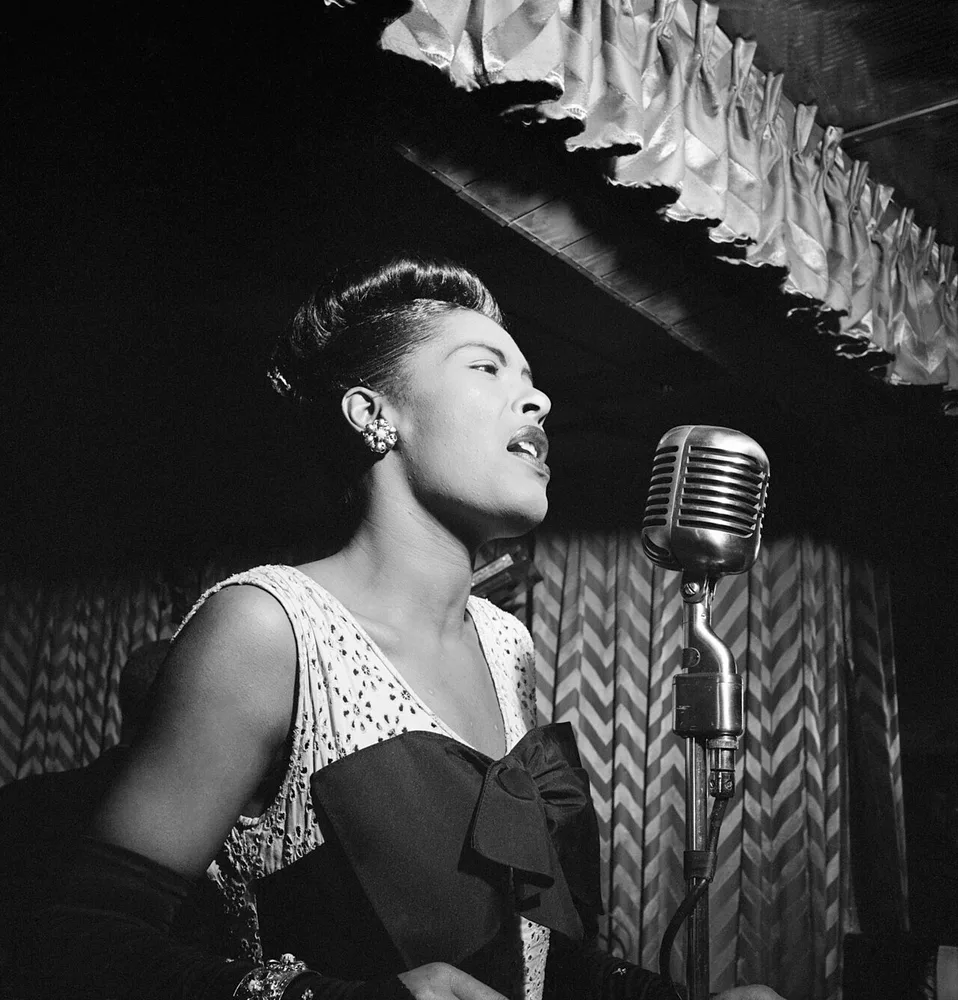
Billie Holiday singing at the Downbeat club, New York City, circa February 1947. Photograph by William P. Gottlieb. Public Domain (William P. Gottlieb collection, Library of Congress; in accordance with the photographer's wishes, the collection entered the public domain on February 16, 2010) — Wikimedia Commons: https://commons.wikimedia.org/wiki/File:Billie_Holiday,_Downbeat,_New_York,_N.Y.,_ca._Feb._1947_(William_P._Gottlieb_04251).jpg (Library of Congress Music Division, digital ID gottlieb.04251)

Billie Holiday was born Eleanora Fagan (some sources spell the first name Eleonora) on April 7, 1915, in Philadelphia, the daughter of two teenagers, Sarah "Sadie" Fagan and Clarence Halliday, a banjo player and guitarist who left the family soon after her birth and later played in Fletcher Henderson's band. Her paternity and some early details are disputed: a copy of a birth certificate held in the Baltimore archives names a man called Frank DeViese as her father, which many historians treat as a clerical anomaly, and her 1956 autobiography is inconsistent about her childhood. She grew up in Baltimore in the care of relatives, was brought before a juvenile court at nine and sent to a Catholic reform school, and left school at eleven. By early 1929 she had joined her mother in Harlem, and she later named the records of Louis Armstrong and of Bessie Smith as the first music that mattered to her, singling out "West End Blues."
She began singing in Harlem nightclubs as a young teenager, taking her stage name from the film actress Billie Dove and from her father, whose surname she first spelled Halliday. In late 1932 she replaced Monette Moore at Covan's, a club on West 132nd Street, and the producer John Hammond heard her there in early 1933. He arranged her first recording session, on November 27, 1933, with Benny Goodman's orchestra, and "Riffin' the Scotch" became her first hit. In 1935 Hammond signed her to Brunswick to record current pop songs in a small-group swing style with the pianist Teddy Wilson, starting with "What a Little Moonlight Can Do" and "Miss Brown to You." The studio bands drew on top swing-era soloists, among them the tenor saxophonists Lester Young, who had boarded at her mother's house in 1934 and gave her the nickname "Lady Day" (she called him "Prez"), and Ben Webster. From July 1936 she also released records under her own name on Vocalion, and Wilson accompanied her more than anyone else; they made 95 recordings together. In late 1937 she spent a few months as the vocalist with Count Basie's orchestra, choosing her own songs and shaping the arrangements, but she was gone by February 1938 for reasons that sources report differently, among them temperament and a dispute over pay and conditions. A month later she joined Artie Shaw's band, one of the first Black women to work full time with a white orchestra and the first Black female singer to tour the segregated South in that role. Her one studio side with Shaw was "Any Old Time" (1938), and she left in November 1938 after the Lincoln Hotel in New York insisted that she use the service elevator.
In 1939 Holiday brought a new song to Café Society, the integrated Greenwich Village nightclub: "Strange Fruit," a protest against lynching that the Bronx schoolteacher Abel Meeropol had published as a poem and set to music himself. She closed her sets with it under a single spotlight, with service in the room stopped. Columbia declined to record it, then released her from her contract for one session so that she could cut it for Milt Gabler's Commodore label on April 20, 1939, backed with her own blues "Fine and Mellow." It became the biggest seller of her career, reaching roughly a million copies, and the recording was later chosen for the Library of Congress's National Recording Registry and the Grammy Hall of Fame. "God Bless the Child," which she wrote with Arthur Herzog Jr. and recorded on May 9, 1941, also sold more than a million copies and ranked third on Billboard's 1941 year-end list.
Gabler moved to Decca and signed her there on August 7, 1944. Her first Decca record, "Lover Man," made with strings on October 4, 1944, reached number 5 on the R&B chart, and "Don't Explain," which she wrote herself, followed. In 1946 she filmed New Orleans, co-starring with Armstrong and Woody Herman, though much of her footage was cut. Heroin addiction led to her arrest for narcotics possession in her New York apartment on May 16, 1947. She pleaded guilty, served her sentence at the Alderson Federal Prison Camp in West Virginia, and was released early on March 16, 1948; the conviction cost her New York cabaret card, which barred her from clubs that sold alcohol. Eleven days after her release she played a sold-out Carnegie Hall concert, with 2,700 tickets sold in advance, a record for the hall at the time. She was arrested again in San Francisco on January 22, 1949.
From 1952 she recorded for Norman Granz's Clef label and its successor Verve, mostly in small groups. Oscar Peterson and Ray Brown joined her on the first sessions in 1952 and a 1954 date; in Los Angeles in August 1955 she recorded Music for Torching and Velvet Mood with trumpeter Harry "Sweets" Edison, altoist Benny Carter, and pianist Jimmy Rowles; and in January 1957 she made three Verve albums with Edison, Rowles, guitarist Barney Kessel, and Webster. In January 1954 she made her first European tour, part of a Leonard Feather "Jazz Club USA" package that played Sweden, Germany, the Netherlands, France, and Switzerland. Her autobiography Lady Sings the Blues, ghostwritten by William Dufty, appeared in 1956, and on November 10 she gave two Carnegie Hall concerts to mark it. From April 1957 Mal Waldron was her regular accompanist; he was at the piano when she sang at the Newport Jazz Festival in July 1957 and on the CBS broadcast The Sound of Jazz on December 8, 1957, where she sang "Fine and Mellow" in a reunion with Young. Her last two albums used orchestral settings by Ray Ellis: Lady in Satin for Columbia (February 1958), and a final MGM session in March 1959, with a rhythm section that included pianist Hank Jones, bassist Milt Hinton, and drummer Osie Johnson, released after her death as Last Recording.
Young died on March 15, 1959. Holiday, by then diagnosed with cirrhosis, was taken to Metropolitan Hospital in New York on May 31, and federal narcotics agents placed her under arrest in her hospital room. She received last rites on July 15 and passed away on July 17, 1959, at age 44, of pulmonary edema and heart failure brought on by cirrhosis. Her funeral was held on July 21 at the Church of St. Paul the Apostle in Manhattan, and she is buried at Saint Raymond's Cemetery in the Bronx. DownBeat elected her to its Hall of Fame in 1961, and Columbia soon reissued nearly a hundred of her early records. She later received four posthumous Grammy Awards for Best Historical Album and, in 2000, was inducted into the Rock and Roll Hall of Fame as an early influence.
Holiday had almost no formal musical training and built her art on her ear. She said she wanted her voice to behave like an instrument, named Armstrong and Bessie Smith among her influences, and from her first sessions reshaped melodies and stretched or compressed phrases against the beat; John Hammond called her the first girl singer he had heard who sang like an improvising jazz genius, and Young remarked that on their old records the two of them sounded like one mind. Her small-group Brunswick and Vocalion sides of the 1930s are often heard as band records with a vocal line rather than singer-and-accompaniment dates, since the soloists answered her phrases and took choruses of their own. From "Strange Fruit" onward she also helped make protest and personal testimony part of a mainstream repertoire. By the late 1950s years of illness had given her voice a thinner, raspier texture and cost it much of its upper range, which divided critics on Lady in Satin, though her rhythmic phrasing remained unmistakable. Frank Sinatra told Ebony in 1958 that she was the greatest single musical influence on him, and singers from Ella Fitzgerald to Anita O'Day and Peggy Lee found models in her Brunswick and Vocalion records. The historian Loren Schoenberg has called her the definitive jazz singer, the Rock and Roll Hall of Fame says she changed jazz forever, and Rolling Stone placed her fourth in its 2023 ranking of the 200 greatest singers.
- Strange Fruit / Fine and Mellow (1939, Commodore) - The anti-lynching song she premiered at Café Society, cut in one session for Milt Gabler's label with a band led by trumpeter Frankie Newton, and the biggest seller of her career.
- Teddy Wilson and His Orchestra: "What a Little Moonlight Can Do" (1935, Brunswick) - The song most often called her claim to fame, from the first of the small-group sessions that she and Teddy Wilson made into the foundation of her reputation.
- God Bless the Child (1941, Okeh) - Her own song, written with Arthur Herzog Jr., and her most popular and most-covered record.
- Lover Man (1944, Decca) - Her first Decca record, with strings, and a top-five R&B hit that moved her toward solo concert work.
- Music for Torching (1955, Clef) - Eight torch songs recorded over two Los Angeles sessions with Harry "Sweets" Edison, Benny Carter, and Jimmy Rowles, her first 12-inch LP for Granz.
- Lady Sings the Blues (1956, Clef) - The companion LP to her autobiography, with Paul Quinichette, Charlie Shavers, Wynton Kelly, and Kenny Burrell, plus a 1954 Los Angeles session; DownBeat gave it five stars. Spotify - Lady Sings the Blues Listen
- Body and Soul (1957, Verve) - Recorded in Los Angeles in January 1957 with Ben Webster, Harry "Sweets" Edison, Jimmy Rowles, and Barney Kessel; the same sessions yielded Songs for Distingué Lovers and All or Nothing at All. Spotify - Body and Soul Listen
- Lady in Satin (1958, Columbia) - Her return to Columbia, a ballad album with a 40-piece orchestra arranged and conducted by Ray Ellis, recorded in February 1958 and still debated for its portrait of a weathered voice. Spotify - Lady in Satin Listen
Billie Holiday: Full Discography
Discogs artist ID 33589 ("Billie Holiday," realname Eleanora McKay, born Eleonora Fagan; born April 7, 1915, Philadelphia; died July 17, 1959, New York City), checked against the live Discogs API. Discogs lists more than 8,000 releases under this ID, most of them reissues and compilations of the same sessions. Several of her working bands are filed as separate entities ("Billie Holiday And Her Orchestra," ID 312936; "Billie Holiday And Her Band," ID 2354866; "Billie Holiday And Her Lads Of Joy," ID 2354867; "Billie Holiday Trio," ID 8218321; "Billie Holiday All Stars," ID 7373489) and were reconciled by hand into the tables below. Two unrelated Discogs entities are not her: "Billy Holiday" (ID 403539, a producer) and "Lady Day" (ID 743287, D. Pringle). Clarence Holiday (ID 307209), the jazz guitarist and banjoist, was her father.
The tables select the recordings that matter most: the landmark 78 rpm singles, every album she completed for Clef, Verve, Columbia, and MGM, the major live albums, and the large box sets that gather her 1933-1944 Columbia sides, her Commodore and Decca masters, and her complete Verve work. They are not an exhaustive listing. Before 1952 her records appeared almost entirely as 78 rpm singles, with albums assembled afterward from them, so the earlier singles are represented here by their best-known couplings, and the full run of her Teddy Wilson sides is covered by the Columbia box set. Release years follow the first US pressing as Discogs dates it. Personnel is taken from Discogs credits and the standard session documentation; where sources disagree, the Notes column says so.
As Leader / Co-Leader
| Album Title | Recording Date(s) | Release Date | Label | Catalog Number | Format(s) | Personnel | Role | Reissue History | Spotify | Buy | Notes |
|---|---|---|---|---|---|---|---|---|---|---|---|
| "Strange Fruit" / "Fine and Mellow" | April 20, 1939 | 1939 | Commodore | 526 | 78 rpm, 10-inch shellac | Billie Holiday (vocals), with Frankie Newton's eight-piece Café Society band, arranged by Newton; Sonny White (piano), who improvised the introduction | Leader (billed Billie Holiday and Her Orchestra) | Included in The Complete Commodore & Decca Masters (Hip-O Select, 2009) | — | — | Columbia released her from her contract for this one session. Full personnel is not itemized on the Discogs release. |
| "God Bless the Child" / "Solitude" | May 9, 1941, New York | 1941 | Okeh | 6270 | 78 rpm, 10-inch shellac | Billie Holiday (vocals) with her orchestra; full personnel not itemized on Discogs | Leader | Included in the Columbia box set (2001) | — | — | "God Bless the Child" was written by Holiday and Arthur Herzog Jr.; it ranked third on Billboard's 1941 year-end list and sold more than a million copies. |
| "Lover Man (Oh, Where Can You Be?)" / "That Ole Devil Called Love" | October 4, 1944 (A side) and November 8, 1944 (B side), New York | 1945 | Decca | 23391 | 78 rpm, 10-inch shellac | Billie Holiday (vocals), with an orchestra with strings directed by Tutti Camarata | Leader | Included in The Complete Commodore & Decca Masters (Hip-O Select, 2009) | — | — | Her first Decca record; it reached number 16 on the pop chart and number 5 on the R&B chart. |
| Billie Holiday Sings | March 26, 1952 per one account; April 1952 (exact date unknown) per another, Los Angeles | 1952 | Mercury / Clef | MGC-118 | 10-inch LP, mono | Billie Holiday (vocals), Charlie Shavers (trumpet), Flip Phillips (tenor saxophone), Oscar Peterson (piano), Barney Kessel (guitar), Ray Brown (bass), Alvin Stoller (drums) | Leader | Reissued in 1956 as Solitude (Clef MG C-690, 12-inch LP) with four added tracks | — | — | Her first album of new recordings for Norman Granz, after several compilations of earlier 78s. |
| An Evening with Billie Holiday | April 1952 (exact date unknown) and July 27, 1952 | 1953 | Clef | MG C-144 | 10-inch LP, mono | April 1952: Charlie Shavers, Flip Phillips, Oscar Peterson, Barney Kessel, Ray Brown, Alvin Stoller. July 27, 1952: Joe Newman (trumpet), Paul Quinichette (tenor saxophone), Oscar Peterson (piano, organ on "Yesterdays"), Freddie Green (guitar), Ray Brown (bass), Gus Johnson (drums) | Leader | Seven of its eight tracks reissued in 1956 as A Recital by Billie Holiday (Clef MG C-686) | — | — | Discogs credits J.C. Heard among the performers; the documented July 1952 session lists Gus Johnson on drums. |
| Billie Holiday | April 1952 (exact date unknown) and April 14, 1954 | 1954 | Clef | MG C-161 | 10-inch LP | April 1952: Billie Holiday (vocals), Flip Phillips, Charlie Shavers, Oscar Peterson, Barney Kessel, Alvin Stoller, Ray Brown. April 14, 1954: Charlie Shavers, Oscar Peterson, Herb Ellis (guitar), Ed Shaughnessy (drums), Ray Brown | Leader | Contents split in 1956 between A Recital by Billie Holiday and Solitude | — | — | Includes remakes of "What a Little Moonlight Can Do" and "I Cried for You," which she first recorded with Teddy Wilson in the 1930s. |
| At Jazz at the Philharmonic | February 12, 1945; June 3, 1946; October 1946 (the October date is given variously) | 1954 | Clef | MG C-169 | 10-inch LP | Lester Young and Illinois Jacquet (tenor saxophones), Buck Clayton and Howard McGhee (trumpets), Trummy Young (trombone), Ken Kersey (piano), Tiny Grimes and Barney Kessel (guitar), Al McKibbon and Charlie Drayton (bass), J.C. Heard and Jack Mills (drums); the lineup differs by concert | Leader (live) | Tracks later folded into the Verve box set (1992) | — | — | Eight tracks from Jazz at the Philharmonic concerts, including "Body and Soul" and "Strange Fruit." |
| Music for Torching with Billie Holiday | August 23 and 25, 1955, Los Angeles | 1955 | Clef | MG C-669 | LP, mono | Billie Holiday (vocals), Harry "Sweets" Edison (trumpet), Benny Carter (alto and tenor saxophones), Jimmy Rowles (piano), Barney Kessel (guitar), John Simmons (bass), Larry Bunker (drums) | Leader | The same two sessions supplied all of Velvet Mood (1956) | — | — | Her first 12-inch LP for Clef. Kessel is not credited on the original sleeve, though his photograph appears on it. |
| Velvet Mood (billed Songs by Billie Holiday) | August 23 and 25, 1955, Los Angeles | 1956 | Clef | MG C-713 | LP, mono | Billie Holiday (vocals), Harry "Sweets" Edison (trumpet), Benny Carter (alto saxophone), Jimmy Rowles (piano, celesta on three tracks), Barney Kessel (guitar), John Simmons (bass), Larry Bunker (drums) | Leader | None found | — | — | Companion to Music for Torching from the same Los Angeles sessions. |
| Lady Sings the Blues | June 6 and 7, 1956, New York (tracks 1-8); September 3, 1954, Los Angeles (tracks 9-12) | December 1956 | Clef | MG C-721 | LP | 1956 session: Billie Holiday (vocals), Charlie Shavers (trumpet), Paul Quinichette (tenor saxophone), Tony Scott (clarinet), Wynton Kelly (piano), Kenny Burrell (guitar), Aaron Bell (bass), Lenny McBrowne (drums). 1954 session: Harry Edison (trumpet), Willie Smith (alto saxophone), Bobby Tucker (piano), Barney Kessel (guitar), Red Callender (bass), Chico Hamilton (drums) | Leader | None found | Spotify - Lady Sings the Blues | — | Released alongside her autobiography of the same name; it was her last Clef album. Track credits per Discogs. |
| Body and Soul | January 3, 4, 7, and 9, 1957, Los Angeles | 1957 | Verve | MG V-8197 | LP, mono | Billie Holiday (vocals), Ben Webster (tenor saxophone), Harry "Sweets" Edison (trumpet), Jimmy Rowles (piano), Barney Kessel (guitar), Red Mitchell (bass), Alvin Stoller (drums on four tracks), Larry Bunker (drums on four tracks) | Leader | Verve Master Edition CD reissue (2002) with bonus tracks | Spotify - Body and Soul | — | From the same January 1957 sessions as Songs for Distingué Lovers and All or Nothing at All. |
| Songs for Distingué Lovers | January 3 to 9, 1957, Capitol Studios, Los Angeles | 1958 | Verve | MGV-8257 | LP, mono (stereo MGVS 6021) | Billie Holiday (vocals), Harry "Sweets" Edison (trumpet), Ben Webster (tenor saxophone), Jimmy Rowles (piano), Barney Kessel (guitar), Red Mitchell and Joe Mondragon (bass), Alvin Stoller and Larry Bunker (drums) | Leader | Verve Master Edition CD reissue (1997) with six bonus tracks | — | — | Produced by Norman Granz. Some sources date the release to 1957; Discogs dates the first US pressing to 1958. |
| Stay with Me | February 14, 1955, New York | 1958 | Verve | MG V-8302 | LP, mono | Billie Holiday (vocals) with Tony Scott and his orchestra: Charlie Shavers (trumpet), Budd Johnson (tenor saxophone), Tony Scott (clarinet), Carl Drinkard or Billy Taylor (piano), Billy Bauer (guitar), Leonard Gaskin (bass), Cozy Cole (drums); arrangements by Leroy Lovett | Leader | CD reissue (1991) added the April 14, 1954 session | — | — | Recorded in 1955 and released in 1958. |
| All or Nothing at All | August 14 and 18, 1956; January 3, 7, and 8, 1957, Los Angeles | 1959 per Discogs (1958 per some sources) | Verve | MG V-8329 | LP, mono | Billie Holiday (vocals), Harry "Sweets" Edison (trumpet), Ben Webster (tenor saxophone), Jimmy Rowles (piano), Barney Kessel (guitar), Joe Mondragon and Red Mitchell (bass), Alvin Stoller (drums) | Leader | Combined with Body and Soul and Songs for Distingué Lovers on a two-CD reissue (1995) | — | — | Cover art by David Stone Martin. |
| Lady in Satin | February 19 to 21, 1958 | June 1958 | Columbia | CL 1157 (stereo CS 8048) | LP, mono and stereo | Billie Holiday (vocals) with a 40-piece orchestra arranged and conducted by Ray Ellis; trombone soloists J.J. Johnson and Urbie Green, trumpet soloist Mel Davis | Leader | None found | Spotify - Lady in Satin | — | Produced by Irving Townsend. Critics have been divided on it because of the condition of her voice. |
| Billie Holiday (retitled Last Recording after her death) | March 3, 4, and 11, 1959 | 1959 | MGM | E3764 | LP, mono | Billie Holiday (vocals) with Ray Ellis and his orchestra: Harry Edison and Joe Wilder (trumpets), Billy Byers and Jimmy Cleveland (trombones), Gene Quill (alto saxophone), Al Cohn, Danny Bank, and Romeo Penque (saxophones), Hank Jones (piano), Barry Galbraith and Kenny Burrell (guitar), Milt Hinton and Joe Benjamin (bass), Osie Johnson (drums), Janet Putnam (harp); players vary by track | Leader | Reissued after her death under the title Last Recording | — | — | Her final studio album, released just before her death. Personnel from the Discogs track credits; the instrumentation was lighter than on Lady in Satin. |
| Ella Fitzgerald and Billie Holiday at Newport | July 6, 1957 (Holiday set), Newport Jazz Festival | 1958 | Verve | MG V-8234 | LP, mono | Billie Holiday (vocals), Mal Waldron (piano), Joe Benjamin (bass), Jo Jones (drums) | Co-billed (split LP, with Ella Fitzgerald's set) | Expanded Verve CD reissue (2000) adds Carmen McRae | — | — | Side two of the original LP is the Holiday set; Johnny Mercer introduces her. |
| The Essential Billie Holiday: Carnegie Hall Concert Recorded Live | November 10, 1956, Carnegie Hall, New York | 1961 | Verve | V-8410 | LP, mono | Billie Holiday (vocals), Carl Drinkard (piano), Kenny Burrell (guitar), Carson Smith (bass), Chico Hamilton (drums), Tony Scott (clarinet), Al Cohn (saxophone), Coleman Hawkins (tenor saxophone), Buck Clayton and Roy Eldridge (trumpets); narration by Gilbert Millstein | Leader (live) | Reissued on CD in 1989 with the narrated passages restored | — | — | Recorded at the second of two concerts staged for the release of her autobiography. Liner notes by Nat Hentoff and Gilbert Millstein. |
As Vocalist on Other Leaders' Records (selected)
| Year | Project (Leader) | Title | Label | Catalog | Role | Notes |
|---|---|---|---|---|---|---|
| 1933 | Benny Goodman and His Orchestra | "Riffin' the Scotch" / "Keep On Doin' What You're Doin'" | Columbia | 2867-D | Vocals | Her first recording session, November 27, 1933, arranged by John Hammond; the sides, including "Your Mother's Son-in-Law," were issued under Goodman's name. |
| 1935 | Teddy Wilson and His Orchestra | "What a Little Moonlight Can Do" / "A Sunbonnet Blue" | Brunswick | 7498 | Vocals | From the July 2, 1935 session that began the Wilson series; the sides were issued under Wilson's name on Brunswick. |
| 1937 | Count Basie and His Orchestra | At the Savoy Ballroom 1937 | SagaPan | PAN 6903 (1971 LP) | Vocals | Radio airchecks from her months with the band; she sings two songs. |
| 1938 | Artie Shaw and His Orchestra | "Any Old Time" / "Back Bay Shuffle" | Bluebird | B-7759 | Vocals | Her only studio record with Shaw, whose band she toured with for most of 1938. |
| 1942 | Paul Whiteman and His Orchestra | "Trav'lin' Light" / "You Were Never Lovelier" | Capitol | 116 | Vocals (credited as "Lady Day") | Recorded June 12, 1942, in Los Angeles; she was under contract to Columbia at the time, hence the pseudonym. It reached number 1 on the R&B chart. |
| 1958 | Various artists | The Sound of Jazz | Columbia | CL 1098 | Vocals | "Fine and Mellow," with Mal Waldron's All Stars, taken from the December 4, 1957 rehearsal for the CBS broadcast. |
Landmark Compilations and Box Sets
| Year | Title | Label | Catalog | Notes |
|---|---|---|---|---|
| 1992 | The Complete Billie Holiday on Verve 1945-1959 | Verve | 314 513 859-2 | Ten CDs and 256 tracks, covering her Clef and Verve studio work, Jazz at the Philharmonic concerts, a 1954 European date, the 1956 Carnegie Hall concert, her final studio sessions, and two rehearsal tapes. |
| 2001 | Lady Day: The Complete Billie Holiday on Columbia 1933-1944 | Columbia / Legacy | CXK 85470 | Ten CDs and 230 tracks, with a 116-page booklet; it won the Grammy Award for Best Historical Album at the 44th Grammy Awards in 2002. |
| 2009 | The Complete Commodore & Decca Masters | Hip-O Select | BC013146-02 | Three CDs and 49 remastered tracks gathering the master takes of her Commodore and Decca singles, with an essay by Ashley Kahn. |
Her discography also includes dozens of single-artist reissues and live and broadcast recordings from the 1950s, including a 1954 German set released as Lady Love and recordings from Storyville in Boston, the Monterey festival, and a 1957 Stratford concert. The full list is on Discogs.
- Teddy Wilson - pianist and bandleader on the Brunswick small-group sessions from July 1935; the two made 95 recordings together, more than she made with any other accompanist.
- Lester Young - tenor saxophonist and closest musical partner; he gave her the name "Lady Day," played on her 1930s studio dates and Commodore sessions, and reunited with her for "Fine and Mellow" on The Sound of Jazz in December 1957.
- Count Basie Orchestra - her employer in 1937 and early 1938; members of the rhythm section and horns, including Freddie Green, Walter Page, Jo Jones, and Buck Clayton, played on her small-group dates.
- Artie Shaw - bandleader who hired her in 1938 and backed her against racist treatment on tour; she recorded "Any Old Time" with his band.
- Benny Goodman - bandleader on her first recording session, November 27, 1933, arranged by John Hammond.
- John Hammond - the producer who heard her at Covan's in 1933, arranged her debut, and signed her to Brunswick in 1935.
- Milt Gabler - Commodore founder who recorded "Strange Fruit" and, as an A&R man at Decca, signed her there in 1944.
- Norman Granz - producer of her Clef and Verve recordings from 1952 and of the Jazz at the Philharmonic concerts on which she appeared.
- Ray Ellis - arranger and conductor of Lady in Satin (1958) and her final MGM album (1959).
- Oscar Peterson and Ray Brown - pianist and bassist on her first Clef sessions in 1952 and a 1954 session, alongside Charlie Shavers and Barney Kessel or Herb Ellis, who joined the April 14, 1954 date.
- Jimmy Rowles, Harry "Sweets" Edison, and Benny Carter - the Los Angeles group on Music for Torching and Velvet Mood (August 1955); Rowles and Edison returned with Ben Webster for the January 1957 Verve albums.
- Mal Waldron - regular accompanist from April 1957 until her death; her pianist at Newport and on The Sound of Jazz. His tribute Left Alone (1960) took its title tune from a song the two wrote together.
- Wynton Kelly, Kenny Burrell, and Lenny McBrowne - pianist, guitarist, and drummer on the June 1956 New York sessions for Lady Sings the Blues, with Charlie Shavers, Paul Quinichette, and Tony Scott.
- Chico Hamilton - drummer on the September 3, 1954 Los Angeles session heard on Lady Sings the Blues, with Willie Smith, Harry Edison, Bobby Tucker, and Barney Kessel.
- Hank Jones - pianist on her final MGM session in March 1959.
- J.J. Johnson - trombone soloist, with Urbie Green and trumpeter Mel Davis, on Lady in Satin.
- Red Mitchell and Sonny Clark - bassist and pianist in the party for her January 1954 European tour; Mitchell later played bass on part of All or Nothing at All.
- J.C. Heard - drummer in the Jazz at the Philharmonic groups that backed her in 1945 and 1946.
- Coleman Hawkins, Roy Eldridge, and Gerry Mulligan - horn players alongside Young and Webster in the group behind "Fine and Mellow" on The Sound of Jazz; Hawkins and Eldridge also appear on the 1956 Carnegie Hall album.
- Louis Armstrong - her model for phrasing and her co-star in the film New Orleans; the two also made a 1949 Decca coupling.
- Duke Ellington - she sang "Saddest Tale" in his 1935 short film Symphony in Black.
More Vocal Jazz Artists
See all 220 Vocal Jazz artists →More American Jazz Artists
See all 646 American artists →- Wikipedia: Billie Holiday
- Wikipedia: Billie Holiday discography
- Wikipedia: Strange Fruit
- Wikipedia: Lady in Satin
- Wikipedia: Lady Sings the Blues (Billie Holiday album)
- Wikipedia: Lady Day: The Complete Billie Holiday on Columbia 1933-1944
- Wikipedia: The Sound of Jazz
- Discogs: Billie Holiday (artist 33589)
- Rock and Roll Hall of Fame: Billie Holiday