 JAZZPROFILES lives in the music 2,059 Jazz Artists fully Profiled!
Benny Goodman
Last updated October 29, 2026
Listen on Spotify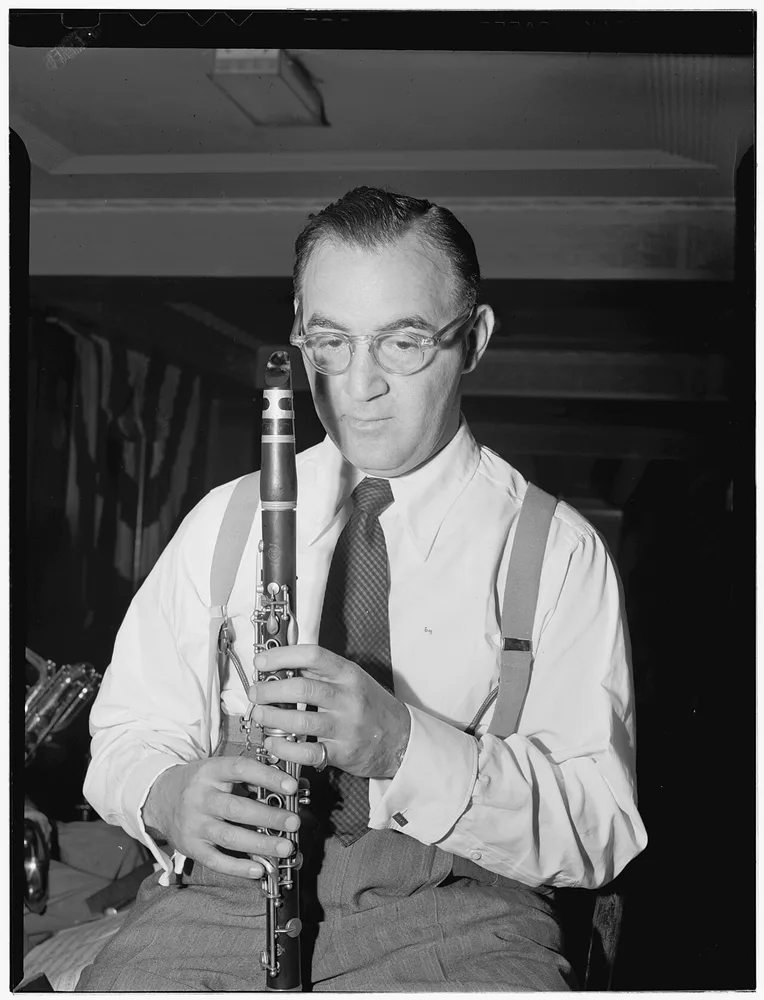
Benny Goodman playing the clarinet, 400 Restaurant, New York, about July 1946, photographed by William P. Gottlieb Public Domain (William P. Gottlieb collection, dedicated to the public domain by the photographer; Library of Congress: no known copyright restrictions) — Wikimedia Commons — https://commons.wikimedia.org/wiki/File:(Portrait_of_Benny_Goodman,_400_Restaurant,_New_York,_N.Y.,_ca._July_1946)_(LOC)_(4843744408).jpg

Benjamin David Goodman was born on May 30, 1909, in Chicago, the ninth of twelve children of Jewish immigrants from the Russian Empire. His father, David, a tailor, had come from Warsaw in 1892, and his mother, Dora Grisinsky, from Kaunas; the family lived in the crowded Maxwell Street neighborhood. In 1919 his father enrolled ten-year-old Benny and two of his brothers in free classes at the Kehelah Jacob Synagogue, where the youngest was handed a clarinet. He took two years of lessons from Franz Schoepp, a clarinetist in the Chicago Symphony Orchestra, played in the boys' band at Hull House under James Sylvester, and at 13 earned his union card and worked on Lake Michigan excursion boats. His first models were the New Orleans clarinetists then working in Chicago, Jimmie Noone, Johnny Dodds and Leon Roppolo, and in the summer of 1923 he met the cornetist Bix Beiderbecke. In 1926 he joined Ben Pollack's orchestra and made his first records; his first disc to be pressed, "When I First Met Mary" for Victor, was cut in Chicago on December 9, 1926.
Settling in New York, Goodman became a busy session player for radio, Broadway pits and record dates, sometimes on alto and baritone saxophone as well as clarinet, with the bands of Red Nichols, Ben Selvin, Ted Lewis and Isham Jones among others. He recorded for Brunswick under the name Benny Goodman's Boys, and in 1928 he and Glenn Miller wrote "Room 1411," Miller's first known composition. His Columbia records of 1933 and 1934 produced top-ten hits with Jack Teagarden on "Ain't Cha Glad?" and "I Ain't Lazy, I'm Just Dreamin'," with Mildred Bailey on "Ol' Pappy," and with Billie Holiday on "Riffin' the Scotch," cut at her first recording session, arranged by John Hammond on November 27, 1933. A four-month engagement at Billy Rose's Music Hall led him to form an orchestra, and NBC then hired the band for the late-night dance program Let's Dance. Hammond, who would become Goodman's brother-in-law, brought in Fletcher Henderson as an arranger after Henderson's own band folded, and Goodman hired members of Henderson's former band to teach his musicians the charts. Let's Dance ran about six months before a strike at its sponsor, Nabisco, ended it in May 1935.
Goodman's rise to national fame came in 1935. On July 1 the band recorded Henderson's arrangements of "King Porter Stomp" and "Sometimes I'm Happy," and on a cross-country tour the music finally landed with young dancers at McFadden's Ballroom in Oakland on August 19. Two nights later, on August 21, 1935, the band opened a three-week engagement at the Palomar Ballroom in Los Angeles, with trumpeter Bunny Berigan, drummer Gene Krupa and singer Helen Ward in the lineup. After an indifferent response to a first set of stock arrangements, Goodman opened the second with the Henderson and Spud Murphy charts, at Krupa's urging to play their own music, and the crowd erupted; the Palomar run is often described as the start of the swing era. From November 1935 he spent six months at the Congress Hotel in Chicago, where he took part in the Rhythm Club concerts organized by Helen Oakley, sitting in with Henderson's band and playing as a trio with Krupa and pianist Teddy Wilson, who had jammed with Goodman at a house party at Mildred Bailey's home earlier that year and whom Hammond had already put in the studio with him. Shortly after the band left Chicago in May 1936 to film The Big Broadcast of 1937 in Hollywood, the press began calling Goodman the "King of Swing," and on June 30, 1936, the band began the CBS radio series Camel Caravan.
The trio became a quartet in August 1936 when vibraphonist Lionel Hampton joined, and at a time when most bands, clubs and concert halls were segregated, Goodman's small groups were among the first integrated jazz ensembles to play for paying audiences. On the evening of January 16, 1938, his orchestra, trio and quartet played a sold-out concert at Carnegie Hall in New York. The program surveyed jazz history, brought on members of the Count Basie Orchestra and Duke Ellington's band for a jam on "Honeysuckle Rose," and closed with a long "Sing, Sing, Sing," in which Goodman handed an unscripted solo to pianist Jess Stacy. The concert was preserved on acetates that surfaced years later and were issued by Columbia in 1950 as The Famous 1938 Carnegie Hall Jazz Concert, which sold over a million copies. Krupa left to form his own band shortly after the concert, and trumpeter Harry James, who joined at the start of 1937, left after 1938 to launch his own band in January 1939 with Goodman's financial backing.
In 1939 the guitarist Charlie Christian, recommended to Hammond by Mary Lou Williams, was brought on stage at the Victor Hugo Restaurant in Beverly Hills on August 16 and played "Rose Room" for more than three quarters of an hour, by Hammond's account, and Goodman hired him. Christian played in the Goodman Sextet, formed that month, and in the orchestra until June 1941, and his electric guitar became a lead voice in small-group jazz; in the fall of 1940 the sextet also included Count Basie, the trumpeter Cootie Williams and the tenor saxophonist Georgie Auld. Henderson joined the organization as pianist and staff arranger, and Eddie Sauter supplied some of the band's most adventurous 1940s charts, including "Benny Rides Again" and "Clarinet a la King." Goodman's vocalists were Martha Tilton (1937 to 1939), Helen Forrest (December 1939 to August 1941) and Peggy Lee (August 1941 to 1943); Lee's 1942 hit "Why Don't You Do Right?" came from his orchestra. In March 1942 he married Alice Hammond Duckworth, John Hammond's sister. A licensing dispute between ASCAP and the publishers in 1941 and the musicians' union recording strikes of 1942 to 1944 and 1948 helped end the big-band boom, and singers took over the popularity bands had enjoyed.
In 1948 Goodman tried bebop. His bebop band drew on Wardell Gray, Stan Hasselgård, Buddy Greco and Zoot Sims; he sought advice from Mary Lou Williams and, in 1945, Mel Powell, and the Capitol recordings were praised by critics. After a little more than a year he returned to swing, saying it was what he knew best. In 1949 he took lessons from the classical clarinetist Reginald Kell, which meant changing his embouchure and fingering, and thereafter he performed and recorded the classical repertoire alongside jazz. He commissioned and premiered works including Béla Bartók's Contrasts (first recorded in 1940 with violinist Joseph Szigeti), Copland's Clarinet Concerto, Poulenc's Clarinet Sonata, Malcolm Arnold's Second Clarinet Concerto, Morton Gould's Derivations and Leonard Bernstein's Prelude, Fugue and Riffs. He recorded Mozart's Clarinet Quintet with the Budapest Quartet in 1938, and in July 1956 at the Berkshire Festival he recorded the Quintet with the Boston Symphony String Quartet and the Clarinet Concerto with the Boston Symphony Orchestra under Charles Munch. His band appeared in films from The Big Broadcast of 1937 to A Song Is Born (1948), and the 1956 film The Benny Goodman Story, with Steve Allen in the title role, dramatized his career.
In 1953 his reunited band and Louis Armstrong's group joined forces for a tour that ended in a quarrel between the two leaders. Through the 1950s and 1960s he assembled bands for tours and festival dates, among them a 1956 State Department tour of Japan, Burma, Cambodia, Malaya, Hong Kong and Thailand and the 1958 residency at the Brussels World's Fair issued as Benny in Brussels. In 1962 his orchestra made a State Department tour of the Soviet Union, with trombonist Jimmy Knepper, Jerry Dodgion and Turk Van Lake in its ranks, documented on Benny Goodman in Moscow. In 1975, after he and George Benson met during the taping of a PBS tribute to Hammond, the two recorded together, and Benson appears on Goodman's album Seven Come Eleven, issued in 1982. He kept performing, including a 40th-anniversary Carnegie Hall concert in 1978, and gave his last concert six days before his death. Goodman passed away of a heart attack on June 13, 1986, at his apartment in Manhattan House in New York City, at 77. He had been named to the DownBeat Jazz Hall of Fame in 1957, was among the 1982 Kennedy Center honorees, and received the Grammy Lifetime Achievement Award in 1986, and he held honorary doctorates from institutions including Harvard, Yale and Columbia; his papers are at Yale University.
Goodman's technique was secure enough that he moved between hot swing solos and Mozart, and the official Goodman website says he very rarely made mistakes in recording sessions; his early models were the New Orleans clarinetists Jimmie Noone, Johnny Dodds and Leon Roppolo. As a leader he was a demanding perfectionist, known among musicians for the disapproving stare they called "The Ray," and the discipline showed in the precision of his ensembles. His bands, which relied on arrangements by Fletcher Henderson, Jimmy Mundy and Spud Murphy and later on charts by Eddie Sauter, put hot jazz in front of a mass dance audience, and they launched or advanced the careers of many players, among them Gene Krupa, Harry James, Teddy Wilson, Lionel Hampton and Charlie Christian. Hiring Wilson and Hampton for his trio and quartet, and Christian for his sextet, made him a leading figure in the early integration of American jazz, a decade before Jackie Robinson entered major league baseball. The critic Bruce Eder has called the Carnegie Hall concert of 1938 the most important jazz or popular music concert in history, the moment jazz was accepted by a "respectable" concert audience. In the sextet, Christian's electric guitar carried a lead voice beside Goodman's clarinet. After the swing boom faded he made a brief detour into bebop and, from 1949, rebuilt his embouchure under Reginald Kell to play classical repertoire, which he commissioned and premiered from composers including Béla Bartók and Aaron Copland. Younger players took him as a model: Lee Konitz received his first clarinet at eleven because of Goodman, and Jim Hall called hearing Christian on a Goodman record at thirteen his awakening to jazz. His great rival for the title of leading swing clarinetist was Artie Shaw, whose fans called him the "King of the Clarinet."
- King Porter Stomp / Sometimes I'm Happy (1935, Victor) - Two arrangements by Fletcher Henderson recorded on July 1, 1935 and released on July 31, the kind of charts that turned a lukewarm cross-country tour into a sensation once the band reached California.
- Trio and quartet sides (1935-1938, Victor) - Goodman with Teddy Wilson and Gene Krupa, joined by Lionel Hampton from 1936; the trio's first coupling, "Body and Soul" and "After You've Gone," came out on Victor 25115 in 1935, and the sessions are collected in The Complete RCA Victor Small Group Recordings (RCA Victor, 1997).
- Sing, Sing, Sing (With a Swing) (1938, Victor 36205) - The Jimmy Mundy arrangement of Louis Prima's song, recorded on July 6, 1937 and running 8 minutes 43 seconds across both sides of a 12-inch disc, with Krupa's tom-tom drive at its center; it entered the Grammy Hall of Fame in 1982. Spotify - Sing, Sing, Sing Listen
- The Famous 1938 Carnegie Hall Jazz Concert (1950, Columbia Masterworks) - The two-LP set from the sold-out concert of January 16, 1938, with the Basie and Ellington guests, Martha Tilton's "Loch Lomond" and the long "Sing, Sing, Sing" with Jess Stacy's piano solo.
- Sextet sides with Charlie Christian (1939-1941, Columbia) - Small-group records such as "Flying Home" and "Rose Room" (October 2, 1939) and "A Smo-o-o-oth One" (March 13, 1941), which helped make the electric guitar a jazz solo instrument; collected on The Benny Goodman Sextet Featuring Charlie Christian: 1939-1941 (Columbia/Legacy, 1989).
- Contrasts (1940, Columbia Masterworks X-178) - Béla Bartók's trio for violin, clarinet and piano, written for Goodman and first recorded with the violinist Joseph Szigeti and the composer at the piano.
- "Why Don't You Do Right?" (1942, Columbia 36652) - Peggy Lee's breakout vocal with the Goodman orchestra, recorded on July 27, 1942, which sold over a million copies.
- Benny Goodman in Moscow (1962, RCA Victor) - Live recordings from the Moscow stops of the 1962 State Department tour, billed on the sleeve as the first performances in the Soviet Union by an American jazz band, with Zoot Sims, Phil Woods and other members of the touring band; the album reached No. 80 on Billboard's album chart.
Benny Goodman: Full Discography
Discogs artist ID 254768 ("Benny Goodman," real name Benjamin David Goodman, born May 30, 1909, in Chicago, died June 13, 1986, in New York City) lists about 8,300 entries, most of them compilations, reissues and appearances on other artists' records. Discogs also files his band and small-group work under separate entities, which were checked: Benny Goodman And His Orchestra (artist ID 374400, about 3,100 entries), The Benny Goodman Sextet (311730, about 640), The Benny Goodman Quartet (270025, about 540), The Benny Goodman Trio (311733, about 420), The Benny Goodman Quintet (314166, about 200) and The Benny Goodman Septet (374832, about 70). Because his catalog is among the largest in jazz, the leader table is a curated selection of 25 landmark releases rather than an exhaustive list: the trio, quartet and sextet sides, the big-band hits, the Carnegie Hall concert, the Capitol and Columbia albums, the classical recordings and the late live albums. Catalog numbers are those of the first or best-documented US pressing found; recording dates come from Discogs release notes and Wikipedia, and where a date is not documented the cell says so.
As Leader / Co-Leader
| Album Title | Recording Date(s) | Release Date | Label | Catalog Number | Format(s) | Personnel | Role | Reissue History | Spotify | Buy | Notes |
|---|---|---|---|---|---|---|---|---|---|---|---|
| Body and Soul / After You've Gone (Benny Goodman Trio) | 1935 | 1935 | Victor | 25115 | 10-inch 78 rpm single | Benny Goodman (clarinet), Teddy Wilson (piano), Gene Krupa (drums) | Leader (trio) | Reissued by Victor in 1943; the trio's 1935 sides are collected in the 1997 RCA Victor set listed below | — | — | The trio's first coupling; Discogs files the trio under a separate entity (artist ID 311733). |
| Don't Be That Way / One O'Clock Jump | Not specified in Discogs data | 1938 | Victor | 25792 | 10-inch 78 rpm single | Benny Goodman and His Orchestra (lineup not itemized on the release) | Leader | Reissued on Victor in 1939 and 1943 | — | — | Two band staples; "Don't Be That Way" opened the Carnegie Hall concert. |
| Sing, Sing, Sing (With a Swing) | July 6, 1937, Hollywood | 1938 | Victor | 36205 | 12-inch 78 rpm single | Benny Goodman (clarinet), Gene Krupa (drums), Harry James, Ziggy Elman, Chris Griffin (trumpets), Red Ballard, Murray McEachern (trombones), Hymie Schertzer, George Koenig (alto saxophones), Art Rollini, Vido Musso (tenor saxophones), Jess Stacy (piano), Allan Reuss (guitar), Harry Goodman (bass) | Leader | Reissued on Victor 78s through the 1940s; Grammy Hall of Fame, 1982 | — | — | Jimmy Mundy arrangement; 8 minutes 43 seconds across both sides of the disc. |
| Contrasts for Violin, Clarinet and Piano | 1940 | 1940 | Columbia Masterworks | X-178 | 12-inch 78 rpm album set | Joseph Szigeti (violin), Benny Goodman (clarinet), Béla Bartók (piano) | Soloist (billed with Szigeti and Bartók) | Later collected on CBS Masterworks M 42227, Collector's Edition: Compositions and Collaborations (1986) | — | — | First recording of the Bartók trio, which was written for Goodman. |
| Cabin in the Sky / Taking a Chance on Love | November 29, 1940, New York | December 27, 1940; reissued 1943 | Columbia | 35869 | 10-inch 78 rpm single | Benny Goodman and His Orchestra with Helen Forrest (vocals) | Leader | Reissued by Columbia in 1943, when "Taking a Chance on Love" reached No. 1 | — | — | Vernon Duke songs from the show Cabin in the Sky. |
| Six Flats Unfurnished / Why Don't You Do Right? | July 27, 1942, New York | 1942 | Columbia | 36652 | 10-inch 78 rpm single | Benny Goodman and His Orchestra with Peggy Lee (vocals) | Leader | Reissued on Columbia in 1945 | — | — | Lee's best-known Goodman record; it reached No. 4 on the US pop chart. |
| Benny Goodman Sextet (Set C-102) | October 2, 1939 to 1941, New York | July 17, 1944 | Columbia | C-102 | Four 10-inch 78 rpm records (album set) | Benny Goodman (clarinet), Charlie Christian (guitar), Lionel Hampton (vibraphone), Fletcher Henderson, Count Basie, Johnny Guarnieri (piano on various sides), Cootie Williams (trumpet), Georgie Auld (saxophone), Artie Bernstein (bass), Nick Fatool, Dave Tough (drums) | Leader (sextet) | The Charlie Christian sextet sides were later issued on LP and on the 1989 Columbia/Legacy CD The Benny Goodman Sextet Featuring Charlie Christian: 1939-1941 | — | — | A 1944 album set of sextet sides recorded between 1939 and 1941. |
| Session for Six | April 17, 1947 to April 14, 1949 | 1950 | Capitol | H-202 | 10-inch LP | Benny Goodman Sextet (individual credits not itemized on the release) | Leader (sextet) | The Capitol small-group sides were later collected in The Complete Capitol Small Group Recordings of Benny Goodman 1944-1955 (1993) | — | — | Capitol small-group sides from the late 1940s; recording dates from Discogs track notes. |
| The Famous 1938 Carnegie Hall Jazz Concert | January 16, 1938, Carnegie Hall, New York | December 1950 | Columbia Masterworks | SL-160 | 2xLP, mono | Benny Goodman (clarinet, leader); orchestra: Harry James, Ziggy Elman, Chris Griffin (trumpets), Red Ballard, Vernon Brown (trombones), Hymie Schertzer, George Koenig (altos), Art Rollini, Babe Russin (tenors), Jess Stacy (piano), Allan Reuss (guitar), Harry Goodman (bass), Gene Krupa (drums), Martha Tilton (vocal); trio and quartet: Teddy Wilson (piano), Lionel Hampton (vibraphone); guests: Bobby Hackett (cornet), Cootie Williams, Buck Clayton (trumpets), Johnny Hodges (alto and soprano saxophones), Harry Carney (baritone saxophone), Lester Young (tenor saxophone), Count Basie (piano), Freddie Green (guitar), Walter Page (bass) | Leader | CD reissues from the original metal masters in 1998, 2002 and 2006 | — | — | Issued from preserved acetates; among the first live jazz double albums and a million-seller. |
| Benny Goodman Combos | Not specified in Discogs data | September 7, 1951 | Columbia | GL 500 | LP, mono | Benny Goodman Sextet and related small groups (lineups not itemized on the release) | Leader | Reissued as Columbia CL 500 in 1955 | — | — | Twelve small-group sides including "After You've Gone" and "A Smo-o-o-oth One"; the labels read Benny Goodman Sextet. |
| Easy Does It! | Not specified in Discogs data | 1952 | Capitol | H-295 | 10-inch LP | Benny Goodman small groups: trio, quintet, sextet and septet (individual credits not itemized on the release) | Leader | The Capitol small-group sides were later collected in The Complete Capitol Small Group Recordings of Benny Goodman 1944-1955 (1993) | — | — | Eight small-group tracks, including "Sweet Georgia Brown" and "I Can't Get Started." |
| 1937-38 Jazz Concert No. 2 | March 3, 1937 to 1938 (radio broadcasts and concerts in Los Angeles, New York and Pittsburgh) | 1952 | Columbia Masterworks | SL-180 | 2xLP | Benny Goodman and His Orchestra (Gene Krupa, Harry James, Ziggy Elman, Jess Stacy, Babe Russin and others); trio and quartet with Teddy Wilson and Lionel Hampton | Leader | Reissued on CD by Legacy as Benny Goodman on the Air 1937-38 | — | — | Broadcast recordings; the album spent several weeks at No. 1 on Billboard's 33 1/3 rpm album chart in late 1952 and early 1953. |
| Benny Goodman Presents Arrangements by Eddie Sauter | Early 1940s (not specified in Discogs data) | 1953 | Columbia | GL 523 | LP | Benny Goodman and His Orchestra; arrangements by Eddie Sauter | Leader | Reissued on CD as Plays Eddie Sauter (Hep CD 1053, 1996) | — | — | Charts by Sauter written for Goodman's orchestra, including "Benny Rides Again" and "Clarinet a la King." |
| B.G. in Hi-Fi | November 1954, Riverside Studios, New York | 1955 | Capitol | W 565 | LP, mono | Benny Goodman (clarinet), Ruby Braff, Bernie Privin, Carl Poole, Chris Griffin (trumpets), Cutty Cutshall, Vernon Brown, Will Bradley (trombones), Hymie Schertzer, Al Klink, Boomie Richman, Paul Ricci, Sol Schlinger (saxophones), Mel Powell (piano), Steve Jordan (guitar), George Duvivier (bass), Bobby Donaldson (drums) | Leader | First issued in 1954 as multi-part sets; reissued on CD as Capitol Jazz CDP 7 92864 2 (1989) | — | — | Billed on the label as Benny Goodman, His Orchestra and His Combos; per the sleeve, recorded in high fidelity with a single condenser microphone pickup. |
| The Benny Goodman Story, Vols. 1 and 2 | 1955 (film soundtrack sessions) | February 1956 (Vol. 1); 1956 (Vol. 2) | Decca | DL 8252 (Vol. 1); DL 8253 (Vol. 2) | LP, mono | Benny Goodman (clarinet), Teddy Wilson (piano), Gene Krupa (drums), Lionel Hampton (vibraphone, Vol. 2), Harry James (trumpet, Vol. 2), Stan Getz, Babe Russin (tenor saxophones), Urbie Green, Murray McEachern, Jimmy Priddy (trombones), Hymie Schertzer (alto saxophone), Allan Reuss (guitar), George Duvivier (bass) | Leader | Reissued on CD as The Benny Goodman Story in 1995 | — | — | Soundtrack recordings for the Universal-International film starring Steve Allen. |
| Mozart: Clarinet Concerto; Clarinet Quintet | July 1956, Berkshire Festival | March 1957 | RCA Victor Red Seal | LM-2073 | LP, mono | Benny Goodman (clarinet); Boston Symphony Orchestra, Charles Munch (conductor); Boston Symphony String Quartet: Richard Burgin, Alfred Krips (violins), Joseph De Pasquale (viola), Samuel Mayes (cello) | Soloist | Reissued on CD in 1986 as Clarinet Concerto and Quintet | — | — | The concerto with the orchestra and the quintet with the string quartet, both recorded at the Berkshire Festival. |
| Benny in Brussels, Vols. 1 and 2 | 1958, Brussels World's Fair | 1958 | Columbia | CL 1247 (Vol. 1); CL 1248 (Vol. 2; stereo CS 8076) | LP, mono and stereo | Benny Goodman (clarinet), Zoot Sims, Seldon Powell (tenor saxophones), Al Block, Ernie Mauro (alto saxophones), Gene Allen (baritone saxophone), Taft Jordan, John Frosk, Billy Hodges, Ermet Perry (trumpets), Willie Dennis, Rex Peer, Vernon Brown (trombones), Roland Hanna (piano), Billy Bauer (guitar), Arvell Shaw (bass), Roy Burns (drums); Jimmy Rushing (vocals, Vol. 1) | Leader | Issued on CD as Benny in Brussels in 1989 | — | — | Recorded during the band's residency at the Brussels World's Fair. |
| Benny Goodman in Moscow | 1962, Moscow (live) | December 1962 | RCA Victor | LSO 6008 | 2xLP, stereo | Benny Goodman (clarinet), Zoot Sims, Tommy Newsom (tenor saxophones), Jerry Dodgion, Phil Woods (alto saxophones), Gene Allen (baritone saxophone), Jimmy Maxwell, Joe Newman, Joe Wilder, John Frosk (trumpets), Jimmy Knepper, Wayne Andre, Willie Dennis (trombones), John Bunch (piano), Teddy Wilson (piano, one track), Victor Feldman (vibraphone), Turk Van Lake (guitar), Bill Crow (bass), Mel Lewis (drums) | Leader | Issued on CD as In Moscow 1962 (Giants of Jazz, 1995) and reissued by Giants of Jazz in 2007 | — | — | Reached No. 80 on Billboard's album chart; recorded on the 1962 State Department tour. |
| Hello Benny! | Not specified in Discogs data | 1964 | Capitol | ST-2157 | LP, stereo | Benny Goodman (clarinet), Pete Jolly (piano), Monty Budwig (bass), Colin Bailey (drums), Benny Garcia Jr. (guitar), Teddy Edwards, Robert Hardaway (tenor saxophones), Herb Steward, Skeets Herfurt (alto saxophones), Ray Triscari, Tony Terran, James Zito (trumpets), Bob Edmondson, Vern Friley (trombones) | Leader | No reissue confirmed | — | — | Goodman's band on 1960s pop material including "Hello, Dolly!" and "The Girl from Ipanema." |
| Weber: Clarinet Concertos Nos. 1 and 2 | 1968 | October 21, 1968 | RCA Red Seal | LSC-3052 | LP, stereo | Benny Goodman (clarinet); Chicago Symphony Orchestra, Jean Martinon (conductor) | Soloist | Reissued on CD in 1986 as Clarinet Concertos | — | — | Classical repertoire; produced by Howard H. Scott and Joseph Habig. |
| Benny Goodman Today | 1970, Stockholm (live) | 1970 | London (US); Decca (Europe) | SPB 21 (London); DDS 3 (Decca) | 2xLP | Benny Goodman (clarinet) with a British big band: Bill McGuffie (piano), Lennie Bush (bass), Bobby Orr (drums), Louis Stewart, Bucky Pizzarelli (guitars), plus saxophones, trombones and trumpets | Leader | Issued under other titles in the early 1970s | — | — | Taken from a Stockholm concert; the release did not list its personnel. |
| Live at Carnegie Hall: 40th Anniversary Concert | 1978, Carnegie Hall, New York (live) | 1978 | London | 2PS 918/19 | 2xLP | Benny Goodman and guests (individual credits not itemized on the release) | Leader | Further selections issued on CD as Live at Carnegie Hall II: 40th Anniversary Concert (2001) | — | — | Marks the 40th anniversary of the 1938 Carnegie Hall concert. |
| Seven Come Eleven | 1975 | 1982 | Columbia | FC 38265 | LP, stereo | Benny Goodman (clarinet), George Benson, Bucky Pizzarelli (guitars), John Bunch (piano); produced by Teo Macero | Leader | No reissue confirmed | — | — | Studio recordings from 1975 issued in 1982, including Goodman's only studio meeting with Benson. |
| Let's Dance | 1985, Marriott Marquis, New York (live) | 1986 | Musicmasters | MM 20112Z | LP, stereo | Benny Goodman and His Orchestra (individual credits not itemized on the release) | Leader | Issued on CD as Live! Let's Dance (Musicmasters MM 60112X, 1986) | — | — | Live concert recorded for a public television fund-raising program in March 1986; one of Goodman's last recordings. |
| The Complete RCA Victor Small Group Recordings | 1935 to 1939 | 1997 | RCA Victor / BMG Classics | 09026-68764-2 | 3xCD, compilation | Benny Goodman (clarinet), Teddy Wilson (piano), Gene Krupa (drums, through 1938), Lionel Hampton (vibraphone, from 1936), with Dave Tough, Buddy Schutz (drums), John Kirby (bass) and Jess Stacy (piano) on the later sessions | Leader (trio, quartet and small groups) | A compilation of the Victor trio, quartet and sextet sides | — | — | Reissue produced by Orrin Keepnews; liner notes by Loren Schoenberg. |
As Sideman (selected major credits)
Goodman became a leader in the mid-1930s, so his sideman credits are concentrated in the late 1920s and early 1930s, with a few later guest appearances. This is a representative selection.
| Year | Project (Leader) | Title | Label | Catalog | Role | Notes |
|---|---|---|---|---|---|---|
| 1926-1929 | Ben Pollack and His Orchestra | "When I First Met Mary" and other Victor sides | Victor | 20394 | Clarinet | Goodman's first record pressed to disc, cut in Chicago on December 9, 1926, with Glenn Miller, Harry Goodman and Pollack on the date. |
| 1928 | Nathaniel Shilkret's All-Star Orchestra | Victor session of March 21, 1928 | Victor | Not specified | Clarinet | Played alongside Glenn Miller, Tommy Dorsey and Joe Venuti. |
| 1930-1933 | Ethel Waters | "My Kind of a Man" (1930), "When Your Lover Has Gone" (1931), "Heat Wave" (1933) | Columbia | 2222-D; 2409-D; 2826-D | Clarinet | Credited in the Classics reissue listings, per her profile; her November 27, 1933 session ("I Just Couldn't Take It, Baby" and "A Hundred Years from Today," Columbia 2853-D) was billed with Goodman's orchestra. |
| 1933 | Red Norvo | Marimba session for Columbia | Columbia | Not specified | Bass clarinet | A rare appearance on bass clarinet, with Dick McDonough (guitar) and Artie Bernstein (bass). |
| 1933 | Bessie Smith | "Gimme a Pigfoot" and "Take Me for a Buggy Ride" | Okeh | 8949 | Clarinet (guest) | Smith's final session, November 24, 1933, produced by John Hammond; Goodman, recording with Ethel Waters in the adjoining studio, dropped in and is barely audible on one selection. |
| 1955-1956 | Rosemary Clooney | "Memories of You" (1955 single) and A Date with the King (1956) | Columbia | Not specified | Clarinet (with trio and sextet) | Per her profile, Clooney recorded with Goodman's trio and sextet; the album is billed as a Clooney and Goodman collaboration. |
- Teddy Wilson - pianist, who joined Goodman's trio in 1935 after the two jammed at a house party at Mildred Bailey's home, and stayed through the Carnegie Hall concert; he rejoined the sextet in 1944 and worked with Goodman on and off until 1962.
- Gene Krupa - drummer who joined in December 1934, played in the trio and quartet, and drove "Sing, Sing, Sing"; he left to form his own band shortly after the January 1938 Carnegie Hall concert and later returned to the Goodman band for a few months.
- Lionel Hampton - vibraphonist who joined the trio in 1936, making it the quartet, and left in 1940 on friendly terms to start his own big band.
- Charlie Christian - electric guitarist in the Benny Goodman Sextet and Orchestra from August 1939 until June 1941; his "Rose Room" jam at the Victor Hugo Restaurant on August 16, 1939, won him the job.
- Fletcher Henderson - arranger whose charts, bought from 1934 at John Hammond's urging, powered the 1935 breakthrough; he joined Goodman's organization in 1939 as pianist and then staff arranger.
- Harry James - trumpeter from the start of 1937 through 1938; he left to form his own band in January 1939 with financial backing from Goodman.
- Bunny Berigan, Ziggy Elman, Chris Griffin - trumpeters in the 1935 to 1938 bands; Berigan was on the 1935 tour that reached the Palomar, and Elman joined in 1936 and composed the tune that became "And the Angels Sing."
- Jess Stacy - pianist with the orchestra from 1935 to 1939, whose unscripted solo on "Sing, Sing, Sing" at Carnegie Hall is among the best-known piano choruses of the era.
- Helen Ward, Martha Tilton - the band's first star vocalists; Ward sang with the band on its 1935 tour, and Tilton (August 1937 to the end of 1939) sang "Loch Lomond" at Carnegie Hall and "And the Angels Sing."
- Helen Forrest - vocalist from December 1939 to August 1941, with 55 studio recordings including "The Man I Love" and "Taking a Chance on Love."
- Peggy Lee - vocalist from August 1941, for about two years; her 1942 record "Why Don't You Do Right?" came out of the Goodman orchestra.
- Mildred Bailey - guest singer on Goodman's Camel Caravan radio program and on several Columbia records of 1939 and 1940, including the number-one "Darn That Dream," and on an all-star Columbia session in 1934.
- Billie Holiday - sang on her first record session, November 27, 1933, under Goodman's name, arranged by John Hammond; "Riffin' the Scotch" became a hit.
- Anita O'Day - auditioned for Goodman's orchestra in 1939 and lost the job to Forrest; she toured Europe with his orchestra in late 1959.
- Coleman Hawkins - featured on a Goodman session for Columbia on February 2, 1934, with Mildred Bailey as guest vocalist.
- Eddie Sauter - principal arranger of the early 1940s, with "Benny Rides Again," "Clarinet a la King" and "Moonlight on the Ganges."
- Count Basie Orchestra - at the 1938 Carnegie Hall concert, members of the Basie band (Basie himself, Buck Clayton, Freddie Green and Walter Page) and of Duke Ellington's band (Johnny Hodges, Harry Carney and Cootie Williams) joined the "Honeysuckle Rose" jam; Basie later played in the fall 1940 sextet with Christian and Williams.
- Lester Young - tenor saxophonist from the Basie band who was among the guests in the Carnegie Hall jam.
- Louis Armstrong - in 1953 Goodman's reunited band and Armstrong's group joined forces for a tour that ended in a quarrel between the two leaders and, by one account, their friendship.
- Stan Getz - passed through Goodman's band in the mid-1940s, per his profile, and is credited on the soundtrack albums of The Benny Goodman Story (Decca, 1956).
- Zoot Sims, Phil Woods, Jimmy Knepper, Mel Lewis - members of the 1962 State Department tour of the Soviet Union, documented on Benny Goodman in Moscow; Sims first worked for Goodman in 1943 and returned many times.
- Roland Hanna - pianist on the 1958 European tour, including the Brussels World's Fair residency, per his profile.
- Jimmy Rowles - pianist who appeared with Goodman's small groups repeatedly between 1948 and 1956, per his profile.
- Bucky Pizzarelli - guitarist who toured with Goodman until Goodman's death in 1986 and played with him at the White House.
- Ken Peplowski - tenor saxophonist in Goodman's last working band from 1984 until Goodman's death, per his profile.
- George Benson - guitarist who recorded with Goodman in 1975, recreating some of his duets with Charlie Christian, and appears on Seven Come Eleven.
- Rosemary Clooney - recorded "Memories of You" with Goodman's trio in 1955 and the 1956 album A Date with the King, per her profile.
- Ethel Waters, Bessie Smith - Goodman's orchestra accompanied Waters on two Columbia sides in late 1933, per her profile, and he dropped in from the neighboring studio on one of Smith's last sessions, where he can barely be heard on one selection.
- Wardell Gray, Stan Hasselgård, Buddy Greco, Mary Lou Williams, Mel Powell - bebop-era players and advisers around the 1948 small band.
- Ben Pollack, Glenn Miller, Joe Venuti, John Hammond - Pollack's orchestra gave him his first recordings, Miller co-wrote "Room 1411" with him, Venuti worked beside him on late-1920s sessions, and Hammond was the producer who shaped his Columbia years and later his brother-in-law.
- Joseph Szigeti, Béla Bartók, Reginald Kell - the violinist and composer of Contrasts, which Goodman premiered and recorded, and the clarinetist who retrained his embouchure in 1949.
More Swing Artists
See all 179 Swing artists →More American Jazz Artists
See all 646 American artists →- Wikipedia: Benny Goodman
- Wikipedia: The Famous 1938 Carnegie Hall Jazz Concert
- Wikipedia: Sing, Sing, Sing (With a Swing)
- Wikipedia: Contrasts (Bartók)
- Wikipedia: The Complete RCA Victor Small Group Recordings
- Wikipedia: 1937/38 Jazz Concert No. 2
- Wikipedia: Benny Goodman in Moscow
- Wikipedia: Benny Goodman Today
- Wikipedia: Charlie Christian
- Wikipedia: Teddy Wilson
- Wikipedia: Harry James
- Wikipedia: Fletcher Henderson
- Wikipedia: Helen Forrest
- Wikipedia: Peggy Lee
- Wikipedia: Anita O'Day
- Wikipedia: Bessie Smith
- Wikipedia: Wardell Gray
- Wikipedia: Stan Hasselgård
- Wikipedia: Lionel Hampton
- Official Benny Goodman website: Biography
- Official Benny Goodman website: Timeline
- Discogs: Benny Goodman (artist 254768)
- MusicBrainz: Benny Goodman
- JazzProfiles.com: Ken Peplowski
- JazzProfiles.com: Roland Hanna
- JazzProfiles.com: Jimmy Rowles
- JazzProfiles.com: Rosemary Clooney
- JazzProfiles.com: Ethel Waters
- JazzProfiles.com: Zoot Sims