 JAZZPROFILES lives in the music 2,059 Jazz Artists fully Profiled!
Dinah Washington
Last updated October 29, 2026
Listen on Spotify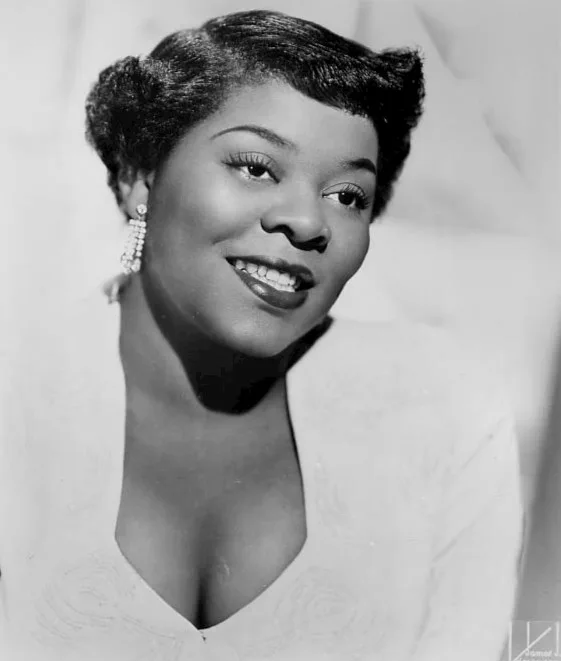
Dinah Washington in a publicity photograph by James Kriegsmann, as reproduced in a Mercury Records advertisement in Billboard, August 30, 1952 Public Domain (published in 1952 without a copyright notice; Wikimedia Commons tags it PD-US-no notice ad) — Wikimedia Commons — https://commons.wikimedia.org/wiki/File:Dinah_Washington_1952.jpg

Dinah Washington was born Ruth Lee Jones on August 29, 1924, in Tuscaloosa, Alabama, and was taken to Chicago as a small child; the Encyclopedia of Alabama puts the move at around her fourth year. Church music shaped her first: she played piano for the choir at St. Luke's Baptist Church while still in elementary school, directed a church choir in her teens, and sang with the Sallie Martin Gospel Singers. After winning an amateur contest at the Regal Theater at fifteen she moved into nightclub work, and by 1941-42 she was singing at Chicago rooms including Dave's Café and the Downbeat Room of the Sherman Hotel, where she shared a bill with Fats Waller. A friend took her to hear Billie Holiday at the Garrick Stage Bar, and the club's owner, Joe Sherman, was so taken with her version of "I Understand" that he hired her for the room upstairs. She picked up the name Dinah Washington during that engagement, though accounts differ on who suggested it: Sherman, the agent Joe Glaser, and Lionel Hampton himself have each been credited.
Hampton came to hear her at the Garrick and offered her a place as the female vocalist of his orchestra, and she sang with the band from 1943 to 1946. Her first records were made for Keynote in New York on December 29, 1943, a blues session organized by the critic Leonard Feather with a sextet drawn from Hampton's band, including trumpeter Joe Morris, tenor saxophonist Arnett Cobb and pianist Milt Buckner. "Evil Gal Blues," written by Feather, and its follow-up "Salty Papa Blues" both reached Billboard's Harlem Hit Parade. In December 1945, in Los Angeles, she recorded a set of blues sides for the Apollo label with a group led by tenor saxophonist Lucky Thompson that also included vibraphonist Milt Jackson and bassist Charles Mingus.
She left Hampton in 1946 and signed with Mercury as a solo artist; her first Mercury record was a version of Fats Waller's "Ain't Misbehavin'." Between 1948 and 1955 she placed 27 records in the R&B top ten. "Am I Asking Too Much" (1948) and "Baby Get Lost" (1949) both reached number one on the R&B chart, "I Wanna Be Loved" (1950) crossed over to number 22 on the pop chart, and "Teach Me Tonight" (1954) later entered the Grammy Hall of Fame. Alongside the hits she kept recording with jazz players. On August 14, 1954, in Los Angeles, she sang before a studio audience with the newly formed Clifford Brown-Max Roach quintet, joined by trumpeters Clark Terry and Maynard Ferguson, altoist Herb Geller and tenor saxophonist Harold Land. The results came out in early 1955 as Dinah Jams on EmArcy, Mercury's jazz imprint, and a companion instrumental album from the same session, Jam Session, includes her on one track.
EmArcy followed with a run of jazz-oriented albums. After Hours with Miss D (1954) paired her with Clark Terry and tenor saxophonist Eddie "Lockjaw" Davis, and For Those in Love, recorded in March 1955 with arrangements by Quincy Jones, used an eight-piece band that included Wynton Kelly and Jimmy Cobb; Dan Morgenstern's liner notes compared her to Billie Holiday. In the Land of Hi-Fi (1956) featured Cannonball Adderley, and The Swingin' Miss "D" (1957) put her in front of a Quincy Jones orchestra recorded over several days in December 1956. Songbook albums devoted to Fats Waller (with her then husband, tenor saxophonist Eddie Chamblee, as duet partner) and Bessie Smith (1958) followed. She appeared at the Newport Jazz Festival every year from 1955 through 1959, and her July 6, 1958 set, with arrangements by trombonist Melba Liston and a band that included Max Roach, vibraphonist Terry Gibbs and Wynton Kelly, was issued as Newport '58; she is also heard singing "All of Me" in the film Jazz on a Summer's Day. She was a regular at Birdland in 1958 and in 1961-62, performed with Count Basie and Duke Ellington in 1963, and in 1960 Leonard Feather included her among the "Giants of Jazz" in his Encyclopedia of Jazz.
In 1959 she had her first top-ten pop hit with "What a Diff'rence a Day Makes," from the album What a Diff'rence a Day Makes!, arranged and conducted by Belford Hendricks with a rhythm section of Kenny Burrell, Joe Zawinul, bassist Milt Hinton and drummer Panama Francis; the single reached number 4 on the pop chart and won the Grammy Award for Best Rhythm & Blues Performance at the second annual Grammy Awards. "Unforgettable" followed, then two duets with Brook Benton in 1960, "Baby (You've Got What It Takes)" and "A Rockin' Good Way (to Mess Around and Fall in Love)," both number one on the R&B chart. Her last big hit was "September in the Rain" (1961). In 1962 she moved to Roulette, where Henry Glover produced much of her remaining output, among it Back to the Blues (1963) and We Three (1963), a shared-billing LP with Sarah Vaughan and Joe Williams.
Washington died in Detroit on December 14, 1963, at the age of 39. Her husband at the time, the football player Dick "Night Train" Lane, found her unresponsive; an autopsy attributed the death to a combination of the sedatives secobarbital and amobarbital, prescribed for insomnia and dieting, and it was ruled accidental. She is buried at Burr Oak Cemetery in Alsip, Illinois. The number of her marriages is uncertain, with sources giving anywhere from six to nine. She was inducted into the Big Band and Jazz Hall of Fame in 1984, the Alabama Jazz Hall of Fame in 1986 and the Rock and Roll Hall of Fame in 1993, and three of her recordings, "What a Diff'rence a Day Makes," "Teach Me Tonight" and "Unforgettable," are in the Grammy Hall of Fame. Aretha Franklin recorded the tribute album Unforgettable: A Tribute to Dinah Washington in 1964.
Washington was billed as the Queen of the Blues, a title she herself attributed to Bessie Smith, and her catalog crosses blues, rhythm and blues, traditional pop and jazz, which is why writers disagree about how far to call her a jazz singer: one jazz reference notes she was never strictly one, while her Wikipedia entry calls her primarily a jazz vocalist, and her EmArcy sessions, her Hampton years and her place in the jazz halls of fame make the jazz case. The AllMusic biographer Richard S. Ginell described a gritty, high-pitched voice with absolute clarity of diction and clipped, bluesy phrasing, and noted that critics who accused her of trading art for commerce were reacting to the same adaptability that her fans loved. Quincy Jones said she could take a melody apart and rebuild it while every syllable stayed clear. Her sources were gospel, Bessie Smith's blues repertoire and the example of Billie Holiday, whom she heard at the Garrick as a teenager; her influence runs through the soul and pop singers who followed, most visibly Aretha Franklin in her 1964 tribute album, and Tony Bennett has recalled that performers from the other Las Vegas Strip shows would come out the night she was in town. Her jazz recordings are at their strongest when a small band leaves her room to phrase freely, as on Dinah Jams and For Those in Love, while the later Mercury and Roulette albums lean toward string and chorus arrangements that critics have long argued over.
- Evil Gal Blues (1943, Keynote) - Her first record, cut on December 29, 1943 with a sextet from the Lionel Hampton band; the Feather blues that introduced her. Spotify - The Fabulous Miss D! (Keynote, Decca and Mercury singles 1943-1953)
- Dinah Jams (1955, EmArcy) - Recorded live in a Los Angeles studio on August 14, 1954 with Clifford Brown, Max Roach, Clark Terry, Maynard Ferguson, Herb Geller and Harold Land; the most celebrated jazz date of her career. Spotify - Dinah Jams Listen
- After Hours with Miss D (1954, EmArcy) - A late-night small-group set recorded in New York on June 15, 1954 with Eddie "Lockjaw" Davis on tenor. Spotify - After Hours with Miss D Listen
- For Those in Love (1955, EmArcy) - Ballads and medium tempos arranged by Quincy Jones for an eight-piece band with Wynton Kelly and Jimmy Cobb. Spotify - For Those in Love Listen
- The Swingin' Miss "D" (1957, EmArcy) - Quincy Jones conducts a large band of New York studio and jazz players through standards, "Caravan" and "Perdido" among them.
- Dinah Sings Bessie Smith (1958, EmArcy) - A songbook of Bessie Smith material with arrangements by Ernie Wilkins and Robare Edmondson and a band that includes Blue Mitchell, Melba Liston and Max Roach.
- Newport '58 (1958, EmArcy) - Her Newport Jazz Festival set of July 6, 1958, with Melba Liston arrangements and Terry Gibbs on vibraphone.
- What a Diff'rence a Day Makes! (1959, Mercury) - The album behind her biggest pop success and the Grammy-winning title track. Spotify - What a Diff'rence a Day Makes! (Expanded Edition) Listen
Dinah Washington: Full Discography
Identity confirmed via the live Discogs API: artist ID 33587 ("Dinah Washington," real name Ruth Lee Jones, born August 29, 1924, in Tuscaloosa, Alabama, died December 14, 1963, in Detroit). Discogs credits this ID with more than 4,600 entries, most of them singles, compilations, reissues and track appearances on anthologies. Releases billed to her backing groups sit under separate Discogs entries ("Dinah Washington And Her Orchestra" 446663, "Dinah Washington And Her Trio" 4148784, "Dinah Washington & The All-Stars" 8107588 and "Dinah Washington And An All Star Sextet" 6783252) and were reconciled by hand; "Dinah Washington (2)" (9967429) is a separate, unrelated entry for a 2016 release. Much of her work first appeared as singles, so the tables below curate the principal albums and the most important guest credits rather than every release. Several entries note the source of a detail where Discogs and other references differ.
As Leader / Co-Leader
| Album Title | Recording Date(s) | Release Date | Label | Catalog Number | Format(s) | Personnel | Role | Reissue History | Spotify | Buy | Notes |
|---|---|---|---|---|---|---|---|---|---|---|---|
| Mellow Mama (1945 Apollo sessions) | December 10, 12 and 13, 1945, Los Angeles | 1992 (compilation of the 1945 sides) | Delmark Records | DL-451 | Vinyl, LP, compilation | Dinah Washington (vocals), Lucky Thompson (tenor saxophone), Karl George (trumpet), Milt Jackson (vibraphone), Wilbert Baranco (piano), Charles Mingus (bass), Lee Young (drums), Jewell Grant (alto saxophone), Gene Porter (clarinet, alto and baritone saxophones) | Leader (vocalist) | Original Apollo 78 releases; sides also collected in a 1988 compilation of her 1943-1945 recordings (Official, 83004) | — | — | Twelve blues sides cut for Apollo with Lucky Thompson's group; the LP is a later collection of those sessions |
| After Hours with Miss "D" | June 15, 1954, New York City | December 1954 | EmArcy | MG 26032 | Vinyl, 10-inch LP, mono | Dinah Washington (vocals), Clark Terry (trumpet), Gus Chappell (trombone), Rick Henderson (alto saxophone), Eddie "Lockjaw" Davis (tenor saxophone), Junior Mance (piano), Keter Betts (bass), Ed Thigpen (drums), Candido (bongos) | Leader | Later 12-inch and CD editions add tracks and players | Spotify - After Hours with Miss D | — | Credits shown are those of the 10-inch edition; Wikipedia's personnel for the longer program also names Eddie Chamblee, Paul Quinichette, Clarence "Sleepy" Anderson and Jackie Davis |
| Dinah Jams | August 14, 1954, Hollywood, California (live in the studio before an audience) | February 1955 | EmArcy | MG 36000 | Vinyl, LP, album, mono | Dinah Washington (vocals), Clifford Brown, Clark Terry and Maynard Ferguson (trumpets), Herb Geller (alto saxophone), Harold Land (tenor saxophone), Junior Mance and Richie Powell (piano), Keter Betts and George Morrow (bass), Max Roach (drums) | Featured vocalist | Reissued in later CD and compilation editions, not itemized | Spotify - Dinah Jams | — | First long-playing number in EmArcy's catalog; companion album Jam Session (MG 36002) comes from the same date and includes her on one track; Discogs credits William Claxton for the cover photography |
| For Those in Love | March 1955 | June 1955 | EmArcy | MG 36011 | Vinyl, LP, album, mono | Dinah Washington (vocals), Quincy Jones (arranger), Clark Terry (trumpet), Paul Quinichette (tenor saxophone), Cecil Payne (baritone saxophone), Jimmy Cleveland (trombone), Wynton Kelly (piano), Barry Galbraith (guitar), Keter Betts (bass), Jimmy Cobb (drums) | Leader | CD reissue on EmArcy in 1991 | Spotify - For Those in Love | — | Dan Morgenstern's liner notes compare her to Billie Holiday |
| Dinah! | January 12, 1955 (New York) and November 10-12, 1955 (Los Angeles), per Wikipedia | 1956 | EmArcy | MG 36065 | Vinyl, LP, album, mono | Dinah Washington (vocals), Hal Mooney (arranger, conductor), Herb Geller (alto saxophone), Georgie Auld (tenor saxophone), Wynton Kelly (piano), Keter Betts (bass), Jimmy Cobb (drums) | Leader | Reissued on CD by PolyGram in 1991 | — | — | Credits are for the album as a whole and are not assigned to individual tracks |
| In the Land of Hi-Fi | Not listed | November 1956 | EmArcy | MG 36073 | Vinyl, LP, album, mono | Dinah Washington (vocals), Hal Mooney and His Orchestra; Wikipedia also names Cannonball Adderley (alto saxophone) and Junior Mance (piano) | Leader | Not itemized | — | — | Twelve standards, including "On the Sunny Side of the Street" and "If I Were a Bell" |
| The Swingin' Miss "D" | November 21, 1956 and December 4-6, 1956, New York (per Wikipedia) | August 1957 | EmArcy | MG 36104 | Vinyl, LP, album, mono | Dinah Washington (vocals); Quincy Jones and His Orchestra: Quincy Jones (conductor, arranger), Clark Terry, Charlie Shavers, Joe Wilder, Ernie Royal, Nick Travis, Bernie Glow and Don Elliott (trumpets), Jimmy Cleveland, Quentin Jackson, Urbie Green and Tommy Mitchell (trombones), Hal McKusick, Anthony Ortega, Jerome Richardson, Lucky Thompson and Danny Bank (reeds), Clarence "Sleepy" Anderson (piano), Barry Galbraith (guitar), Milt Hinton (bass), Osie Johnson and Jimmy Crawford (drums) | Leader | Expanded CD reissue (1998) | — | — | Ernie Wilkins arranged two tracks and Benny Golson one, per Wikipedia; Discogs assigns drummers by track side |
| Dinah Washington Sings Fats Waller | Not listed | 1958 (Discogs; Wikipedia gives 1957) | EmArcy | MG-36119 | Vinyl, LP, album, mono | Dinah Washington (vocals), Eddie Chamblee (tenor saxophone, duet vocals); Wikipedia's personnel list also names Benny Golson, Frank Wess, Jerome Richardson, Melba Liston, Patti Bown and Jack Wilson | Leader | Reissued by Verve in 1990 as The Fats Waller Songbook | — | — | Chamblee, her husband at the time, is her partner on "Honeysuckle Rose" and "Everybody Loves My Baby" |
| Dinah Sings Bessie Smith | Not listed | 1958 | EmArcy | MG 36130 | Vinyl, LP, album, mono | Dinah Washington (vocals), Blue Mitchell, Fip Ricard and Clark Terry (trumpets), Quentin Jackson, Melba Liston and Julian Priester (trombones), Eddie Chamblee (tenor saxophone), baritone saxophonists Charles Davis, McKinley Easton, Harold Ousley and Sahib Shihab, pianists James Craig, Wynton Kelly and Jack Wilson, bassists Robare Edmondson, Paul West and Robert Lee Wilson, Max Roach and James Slaughter (drums); arrangements by Ernie Wilkins and Robare Edmondson | Leader | Reissued by Verve in 1999 as The Bessie Smith Songbook | — | — | Personnel is Wikipedia's album-wide list; Discogs carries no credit block for the original LP |
| Newport '58 | July 6, 1958, Newport Jazz Festival, Rhode Island | November 1958 | EmArcy | MG-36141 | Vinyl, LP, album, mono | Dinah Washington (vocals, vibraphone), Blue Mitchell (trumpet), Melba Liston (trombone, arranger), Urbie Green (trombone), Sahib Shihab (baritone saxophone), Harold Ousley (tenor saxophone), Terry Gibbs and Don Elliott (vibraphone), Wynton Kelly (piano), Paul West (bass), Max Roach (drums) | Leader | Two further tracks from the set appear on the 1991 Mercury compilation The Complete Dinah Washington on Mercury Vol. 5 (1956-1958) | — | — | The side-two instrumentals are "Backstage Blues" and "Julie and Jake"; she is also seen singing "All of Me" in the film Jazz on a Summer's Day |
| What a Diff'rence a Day Makes! | Fine Recording Studios, New York City (per Wikipedia) | 1959 | Mercury | SR-60158 (stereo) | Vinyl, LP, album, stereo | Dinah Washington (vocals), Belford Hendricks (arranger, conductor), Kenny Burrell (guitar), Joe Zawinul (piano), Milt Hinton (bass), Panama Francis (drums), Charles Davis (baritone saxophone), Jerome Richardson (flute) | Leader | Expanded CD reissue on Verve (2000) with three bonus tracks | Spotify - What a Diff'rence a Day Makes! (Expanded Edition) | — | Title track won the Grammy Award for Best Rhythm & Blues Performance and was inducted into the Grammy Hall of Fame in 1998 |
| The Two of Us (with Brook Benton) | Fine Recording Studios, New York City | 1960 | Mercury | SR 60244 | Vinyl, LP, album, stereo | Dinah Washington and Brook Benton (vocals); Clyde Otis directed the recording | Co-leader | Not itemized | Spotify - The Two of Us | — | Includes the duet hits "Baby (You've Got What It Takes)" and "A Rockin' Good Way (to Mess Around and Fall in Love)" |
| Unforgettable | Not listed | 1960-61 (Discogs dates its first issue April 1960; other sources give 1961) | Mercury | SR 60232 | Vinyl, LP, album, stereo | Dinah Washington (vocals), Belford Hendricks (arranger, conductor) | Leader | Compilation reissue in 1991 | Spotify - Unforgettable (Expanded Edition) | — | The single "Unforgettable" entered the Grammy Hall of Fame in 2001 |
| For Lonely Lovers | Not listed | June 15, 1961 | Mercury | SR 60614 | Vinyl, LP, album, stereo | Dinah Washington (vocals); no personnel listed | Leader | Not itemized | — | — | No credits beyond the vocalist are listed |
| September in the Rain | Not listed | September 4, 1961 | Mercury | MG 20638 | Vinyl, LP, album, mono | Dinah Washington (vocals); no personnel listed | Leader | Not itemized | — | — | Title track reached number 23 on the pop chart and number 5 on the R&B chart |
| Dinah '62 | March 1962, Bell Studios, New York City | May 1962 | Roulette | SR 25170 | Vinyl, LP, album, stereo | Dinah Washington (vocals), Fred Norman (conductor), Henry Glover (producer) | Leader | Not itemized | — | — | Early Roulette-era album |
| Drinking Again | Not listed | September 1962 | Roulette | R 25183 | Vinyl, LP, album, mono | Dinah Washington (vocals), Don Costa (arranger, conductor), Henry Glover (producer) | Leader | Not itemized | — | — | Torch-song program |
| Back to the Blues | 1962 | 1963 | Roulette | SR 25189 | Vinyl, LP, album, stereo | Dinah Washington (vocals), Fred Norman (arranger, conductor), Henry Glover (producer) | Leader | Not itemized | Spotify - Back to the Blues | — | Recording year per Wikipedia; Discogs gives the release year only |
| Dinah '63 | Not listed | 1963 | Roulette | SR-25220 | Vinyl, LP, album, stereo | Dinah Washington (vocals), Fred Norman (arranger, conductor), Henry Glover (producer) | Leader | Not itemized | — | — | Pop-standards program |
| A Stranger on Earth | Not listed | 1964 | Roulette | SR 25253 | Vinyl, LP, stereo | Dinah Washington (vocals), Fred Norman (arranger), Henry Glover (producer) | Leader | Not itemized | — | — | Issued after her death in December 1963 |
| Queen & Quincy | Not listed | 1964 | Mercury | MG 20928 | Vinyl, LP, mono | Dinah Washington (vocals); Quincy Jones and His Orchestra, with arrangements by Quincy Jones, Ernie Wilkins and Benny Golson; Discogs lists the same orchestra personnel as The Swingin' Miss "D" | Leader | Not itemized | — | — | Leonard Feather wrote the liner notes; recording dates are not listed |
As Sideman and Guest (selected major credits)
| Year | Project (Leader) | Title | Label | Catalog | Role | Notes |
|---|---|---|---|---|---|---|
| 1943 | Lionel Hampton and His Sextet | Evil Gal Blues / Homeward Bound (78 rpm) | Keynote | 605 | Vocals | Recorded December 29, 1943 in New York with Joe Morris (trumpet), Rudy Rutherford (clarinet), Arnett Cobb (tenor saxophone), Milt Buckner (piano), Vernon King (bass) and Fred Radcliffe (drums); Lionel Hampton led the group. Her recording debut |
| 1943 | Lionel Hampton and His Sextet | Salty Papa Blues / I Know How to Do It (78 rpm) | Keynote | 606 | Vocals | Same session as Keynote 605; reissued on Mercury 8044 in 1947 |
| 1954 | Clifford Brown, Clark Terry and Maynard Ferguson | Jam Session | EmArcy | MG 36002 | Vocals (one track) | Companion to Dinah Jams from the August 14, 1954 Los Angeles date; she sings "Darn That Dream," the second track on side one. Clifford Brown, Clark Terry and Max Roach are on the date |
| 1963 | Dinah Washington, Joe Williams and Sarah Vaughan | We Three | Roulette | R 52108 | Vocals | Three-artist billing; Discogs lists no personnel for the LP |
Her 1943-1945 Keynote and Apollo sides are collected on a 1988 compilation (Official, 83004), and the 2018 anthology The Fabulous Miss D! The Keynote, Decca and Mercury Singles 1943-1953 gathers her early singles; her many later singles and the large number of compilation and reissue titles are not itemized.
- Lionel Hampton - bandleader who hired her for his orchestra in 1943; she sang with the band until 1946 and made her first records with a Hampton sextet for Keynote.
- Clifford Brown and Max Roach - co-leaders of the quintet she sang with on Dinah Jams (August 14, 1954); Roach also drummed on Dinah Sings Bessie Smith and Newport '58.
- Clark Terry - trumpeter on Dinah Jams, After Hours with Miss D, For Those in Love, The Swingin' Miss "D" and Dinah Sings Bessie Smith.
- Quincy Jones - arranger and conductor of For Those in Love (1955) and The Swingin' Miss "D" (recorded 1956); the 1964 LP Queen & Quincy is also credited to his orchestra.
- Wynton Kelly and Jimmy Cobb - pianist and drummer on For Those in Love and Dinah!; Kelly is also on Dinah Sings Bessie Smith and Newport '58.
- Cannonball Adderley - alto saxophonist on In the Land of Hi-Fi (1956); biographical accounts also name him, with Clark Terry and Ben Webster, among her jazz collaborators.
- Junior Mance - pianist on Dinah Jams and After Hours with Miss D.
- Cecil Payne - baritone saxophonist on For Those in Love.
- Kenny Burrell and Joe Zawinul - guitarist and pianist in the band for What a Diff'rence a Day Makes! (1959).
- Charles Mingus and Milt Jackson - bassist and vibraphonist on her December 1945 Apollo blues sides led by Lucky Thompson.
- Sarah Vaughan - shared billing with Joe Williams on the Roulette LP We Three (1963).
- Eddie Chamblee - tenor saxophonist, her husband from 1957 (the end date is given as 1958 or 1959), and duet partner on Dinah Washington Sings Fats Waller; also on the Bessie Smith songbook.
- Melba Liston - trombonist and arranger of the Newport '58 set.
- Leonard Feather - critic who organized and wrote for her first Keynote session in 1943 and later wrote liner notes for her albums.
- Brook Benton - duet partner on the 1960 hits "Baby (You've Got What It Takes)" and "A Rockin' Good Way" and on the album The Two of Us.
More Vocal Jazz Artists
See all 220 Vocal Jazz artists →More American Jazz Artists
See all 646 American artists →- Wikipedia: Dinah Washington
- Encyclopedia of Alabama: Dinah Washington
- Rock & Roll Hall of Fame: Dinah Washington
- All About Jazz: Dinah Washington
- Grammy.com: Dinah Washington
- Discogs: Dinah Washington (artist 33587)
- AllMusic: Dinah Washington (Richard S. Ginell's characterization is quoted in the Wikipedia article above)
- Wikipedia articles on the albums Dinah Jams, For Those in Love, Dinah!, In the Land of Hi-Fi, The Swingin' Miss "D", Dinah Washington Sings Fats Waller, Dinah Sings Bessie Smith, Newport '58, What a Diff'rence a Day Makes! and After Hours with Miss "D"