 JAZZPROFILES lives in the music 1,002 Jazz Artists fully Profiled!
 Kenny Barron
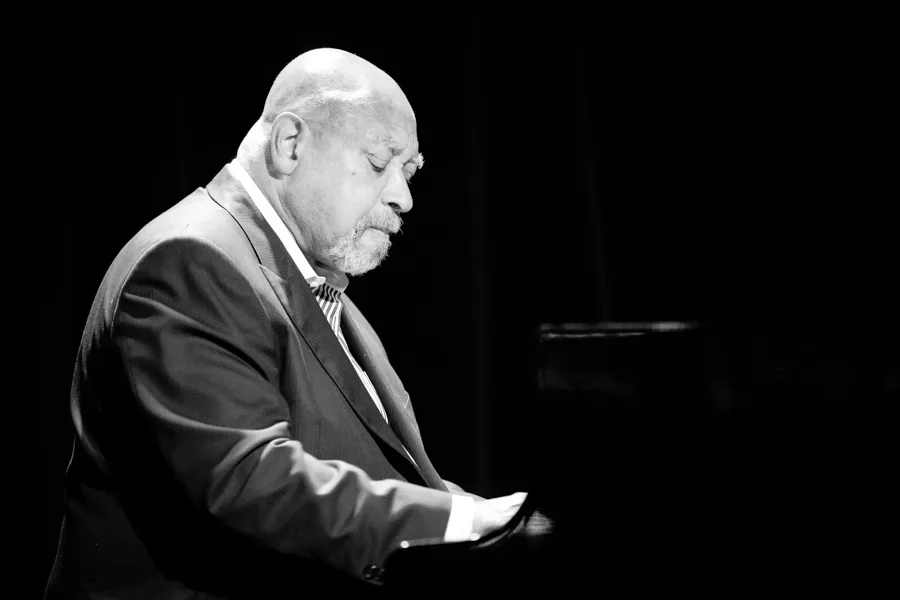
Kenny Barron at the piano at the Victoria Teater, Oslo, on August 13, 2018, during the Oslo Jazzfestival, with Kiyoshi Kitagawa on double bass and Johnathan Blake on drums CC BY-SA 4.0 (Creative Commons Attribution-ShareAlike 4.0 International) — Wikimedia Commons — https://commons.wikimedia.org/wiki/File:Kenny_Barron_Oslo_Jazzfestival_2018_(221007).jpg (photographer Tore Sætre, own work)
.jpg)
Kenneth Barron is born June 9, 1943, in Philadelphia, the youngest of five children in a household where his mother requires every child to take piano. He starts at six and dislikes it at first. His eldest brother, the tenor saxophonist Bill Barron, is seventeen years older and already working professionally, and it is Bill who begins asking him questions about music once he discovers his younger brother sitting at the piano playing blues chords by ear. Barron studies with Vera Bryant, a sister of the pianist Ray Bryant and the mother of guitarist Kevin Eubanks, trombonist Robin Eubanks and trumpeter Duane Eubanks. At fifteen he plays briefly in Mel Melvin's Philadelphia orchestra, a band that also carries his brother on tenor. In 1959, still in high school, he takes local gigs with Jimmy Heath, and two months before graduating he plays a night with Yusef Lateef; a few days after the ceremony he is on the road with Lateef for a week. His first recording comes at seventeen, on his brother's The Tenor Stylings of Bill Barron, cut at Medallion Studios in Newark on February 21, 1961, with Ted Curson on trumpet, Jimmy Garrison on bass and Frankie Dunlop on drums.
Barron moves to New York in 1961. James Moody hears him at the Five Spot and hires him on the spot, and in the same year he works briefly with Lou Donaldson, Roy Haynes and Lee Morgan. In 1962 he joins Dizzy Gillespie's quintet at nineteen and stays through 1966, touring internationally and recording Something Old, Something New (Philips, 1963), the score to Shirley Clarke's film The Cool World (Philips, 1964), Jambo Caribe (Limelight, recorded in Chicago on November 4 to 6, 1964, with Moody, Chris White and Rudy Collins) and The Melody Lingers On (Limelight, 1966). Gillespie's book gives him a working command of Latin and Caribbean rhythm that never leaves his playing. He is also briefly a member of the Jazztet around 1962, though the group never records with him.
After Gillespie he works with Stanley Turrentine and then spends three years with Freddie Hubbard, whose High Blues Pressure (Atlantic) he cuts across sessions on November 13, 1967, and January 10, 1968, playing on five of its six pieces. He records The Kicker and Tetragon with Joe Henderson for Milestone in 1967, and takes engagements with Milt Jackson and Buddy Rich, appearing on the drummer's Very Live at Buddy's Place (Groove Merchant, 1974) on five of its six tracks. In 1970 he works as accompanist and arranger for the singer Esther Marrow, and the following year he rejoins Yusef Lateef for close to five years, a stretch he credits with opening up his improvising: The Gentle Giant (Atlantic, 1972), Part of the Search (1974) and the live double album 10 Years Hence, taped at San Francisco's Keystone Korner on July 5 and 6, 1974. His own first leader date, Sunset to Dawn, is recorded at RCA Studio in New York on April 2, 1973, and issued by Muse.
Two long institutional commitments begin in this period. Barron joins the music faculty at Rutgers University in 1974 and teaches there until 2000, mentoring David Sanchez, Terence Blanchard and the guitarist Peter Bernstein among many others, and he takes a B.A. in arts from Empire State College in 1978. In 1977 he co-founds Sphere with bassist Buster Williams, drummer Ben Riley and saxophonist Charlie Rouse, the last two veterans of Thelonious Monk's own bands; the group's first album, Four in One, is recorded on February 17, 1982, the day Monk dies. Sphere runs through Bird Songs (Verve, 1988), disbands after Rouse's death that year, and reunites a decade later with Gary Bartz in the saxophone chair. Overlapping it is the association that reaches the widest audience: from 1986 Barron is Stan Getz's pianist, recording Voyage (BlackHawk, March 9, 1986), the Copenhagen concert that yields both Anniversary! and Serenity (July 6, 1987), the 1989 A&M sessions later issued as Bossas & Ballads: The Lost Sessions, and the four nights at the Café Montmartre in March 1991 that become People Time, Getz's last recording. Getz calls him his favorite pianist of all time.
The leader catalogue grows steadily across small independent labels through the 1970s and 1980s (Muse, Xanadu, Enja, Criss Cross Jazz, Reservoir, Uptown, Baystate) before Verve signs him in 1992 and releases Sambao, Other Places, Wanton Spirit, Things Unseen, Night and the City, Spirit Song and Freefall over the following decade. Sunnyside issues Canta Brasil (2002), Images (2004) and The Traveler (2008); Impulse! releases the duo record The Art of Conversation with Dave Holland in 2014 and Book of Intuition in 2016; Blue Note releases Concentric Circles in 2018. Since 2015 his working trio has been bassist Kiyoshi Kitagawa and drummer Johnathan Blake. He has composed more than fifty pieces, the best known of them "Voyage," which other musicians have recorded upwards of seventy-five times, and he has contributed to the scores of Spike Lee's Do the Right Thing (1989) and Malcolm X (1992).
Barron is named an NEA Jazz Master in 2010, having been inducted into the American Jazz Hall of Fame in 2005 and elected a Fellow of the American Academy of Arts and Sciences in 2009. Berklee College of Music gives him an honorary doctorate in 2010, and DownBeat's readers elect him to its Jazz Hall of Fame in 2022. His fourteenth Grammy nomination arrives in 2024 for Beyond This Place, an Artwork Records date with Immanuel Wilkins on alto saxophone and Steve Nelson on vibraphone. He now teaches at the Juilliard School, continues to tour solo and with the trio, and keeps recording: the solo Paris concert The Source (2023), the vocal project Songbook (2025), and Stars (2026, Newvelle Records), a vinyl-only trio session led by bassist Martin Wind with clarinetist Anat Cohen and drummer Matt Wilson.
Barron names Hank Jones and Tommy Flanagan as his principal models, and what he took from them was touch and phrasing rather than vocabulary: he describes their lines as elastic, "like a rubber band," never rigid, an ebb and flow he has spent a career refining. He also cites Wynton Kelly, his fellow Philadelphian McCoy Tyner and Herbie Hancock. The result is a mainstream post-bop language of unusual balance: dense two-handed voicings that never crowd a soloist, a legato right hand that carries a melody the way a horn player would, and a rhythmic elasticity in ballads that made him the accompanist of choice for singers including Abbey Lincoln, Helen Merrill, Dianne Reeves and Ann Hampton Callaway. The five years in Gillespie's band left him fluent in Latin and Brazilian rhythm, which he pursues on his own terms across Sambao, Canta Brasil and Kenny Barron & the Brazilian Knights, and eleven years in Sphere made him one of the most idiomatic non-alumni interpreters of Monk. The Los Angeles Times has called him "one of the top jazz pianists in the world," and Jazz Weekly the "most lyrical piano player of our time." Through twenty-six years at Rutgers and his current post at Juilliard he has taught Aaron Parks, Peter Bernstein, David Sanchez, Harry Pickens, Jon Regen and Earl MacDonald, among a long list of working professionals.
- People Time (1992, Gitanes Jazz/Verve) - The four Copenhagen nights of March 1991 that close Stan Getz's career, a saxophone and piano duo recorded while Getz was dying of liver cancer. Spotify - People Time Listen
- Wanton Spirit (1994, Gitanes Jazz/Verve) - A trio summit with Roy Haynes and Charlie Haden, recorded at Systems Two in Brooklyn in February 1994 and among the most-cited records of his Verve decade. Spotify - Wanton Spirit Listen
- Sunset to Dawn (1973, Muse) - His first album as a leader, cut in a single New York session with Bob Cranshaw, Freddie Waits, Warren Smith and Richard Landrum.
- Four in One (1982, Elektra Musician) - Sphere's debut, a program of Monk tunes recorded on the day Monk died, with Charlie Rouse, Buster Williams and Ben Riley.
- Green Chimneys (1984, Criss Cross Jazz) - A live trio date from July 1983 with Buster Williams and Ben Riley, the Sphere rhythm section working through the Monk book in a piano trio.
- The Art of Conversation (2014, Impulse!) - A piano and bass duo with Dave Holland, recorded and mixed over two days at Avatar Studios. Spotify - The Art Of Conversation Listen
- Book of Intuition (2016, Impulse!) - The first studio record by his long-running trio with Kiyoshi Kitagawa and Johnathan Blake, split between originals and Monk. Spotify - Book Of Intuition Listen
- Beyond This Place (2024, Artwork Records) - A quintet date with Immanuel Wilkins and Steve Nelson that brought his fourteenth Grammy nomination. Spotify - Beyond This Place Listen
Kenny Barron: Full Discography
Identity confirmed via the live Discogs API: artist ID 65746 ("Kenny Barron," realname Kenneth Barron, born June 9, 1943, Philadelphia, Pennsylvania, and described there as the younger brother of the tenor saxophonist Bill Barron, which matches Wikipedia and the National Endowment for the Arts biography exactly). That artist ID carries 1,166 release credits, of which only 117 are tagged as leader credits by Discogs, a count that is unreliable in both directions: several of Barron's own trio and quintet albums, among them Green Chimneys, Invitation, Quickstep, Images, Minor Blues, Book of Intuition and Concentric Circles, are filed under the generic "Appearance" tag, so each entry below was resolved from its master to its main release and checked by title and billing before a row was written.
Barron is one of the most recorded pianists in jazz, as a leader and far more often as a sideman, and no attempt at exhaustive coverage is made here. The first table curates 31 of his most significant leader and co-leader albums from 1973 to 2024; the second is a representative set of sideman credits covering the associations that shaped his career, with Dizzy Gillespie, Freddie Hubbard, Yusef Lateef, Ron Carter, Sphere and Stan Getz. Reissue histories were not enumerated at pressing level except where a specific reissue is named. The Buy column is — throughout, as no affiliate program is set up.
As Leader / Co-Leader
| Album Title | Recording Date(s) | Release Date | Label | Catalog Number | Format(s) | Personnel | Role | Reissue History | Spotify | Buy | Notes |
|---|---|---|---|---|---|---|---|---|---|---|---|
| Sunset to Dawn | Recorded April 2, 1973, RCA Studio, New York | 1973 | Muse Records | MR 5018 | Vinyl, LP, Album | Kenny Barron (piano, electric piano), Bob Cranshaw (electric bass), Freddie Waits (drums), Warren Smith (vibraphone, percussion), Richard Landrum (congas, percussion) | Leader | Paired with Golden Lotus on the 32 Jazz two-disc set Soft Spoken Here (1997) | — | — | His first album as a leader, produced by Don Schlitten with liner notes by Gary Giddins |
| Peruvian Blue | Recorded March 14, 1974 | 1974 | Muse Records | MR 5044 | Vinyl, LP, Album, Stereo | Kenny Barron (piano, clavinet, electric piano), Ted Dunbar (guitar), David Williams (bass), Albert Heath (drums), Richard Landrum and Sonny Morgan (percussion) | Leader | Not surveyed | Spotify - Peruvian Blue | — | Includes his own "Dolores Street SF," a tune he returns to fifty years later on The Source |
| Lucifer | Recorded April 28, 1975, Bell Sound Studios, New York | 1976 | Muse Records | MR 5070 | Vinyl, LP, Album | Kenny Barron (piano, electric piano, clavinet, synthesizer, cowbell), Bill Barron (soprano saxophone), James Spaulding (alto saxophone, bass flute), Charles Sullivan (trumpet), Carlos Alomar (electric and acoustic guitar), Chris White (electric bass), Billy Hart (drums) | Leader | Not surveyed | — | — | The one album under his own name featuring his brother Bill Barron; produced by Michael Cuscuna |
| Together | Recorded December 6, 1978, Sound Ideas Studios, New York | 1979 | Denon | YX-7544-ND | Vinyl, LP, Album | Kenny Barron and Tommy Flanagan (pianos) | Co-leader (two-piano duo) | Not surveyed | — | — | Japanese release; a duo with the pianist Barron names as one of his two principal models |
| Golden Lotus | Recorded April 4, 1980 (Downtown Sound, New York) and April 18, 1980 (Sound Heights, Brooklyn) | 1982 | Muse Records | MR 5220 | Vinyl, LP, Album | Kenny Barron (piano), John Stubblefield (tenor and soprano saxophone), Steve Nelson (vibraphone), Buster Williams (bass), Ben Riley (drums) | Leader | Paired with Sunset to Dawn on 32 Jazz's Soft Spoken Here (1997) | — | — | Steve Nelson's first recording with Barron, a partnership resumed on Beyond This Place forty-three years later |
| At the Piano | Recording date not stated on the release | 1982 | Xanadu Records | Xanadu 188 | Vinyl, LP, Album | Kenny Barron (solo piano) | Leader | Not surveyed | — | — | His first solo piano album, produced with liner notes by Don Schlitten |
| Spiral | Recorded 1982 | 1982 (Baybridge, Japan); the pressing resolved on Discogs is a 1984 UK issue | Eastwind | EWIND 709 | Vinyl, LP, Album | Kenny Barron (solo piano) | Leader | Not surveyed | Spotify - Spiral | — | A solo piano album first issued in Japan by Baybridge; the Discogs master resolves to the later Eastwind pressing, whose credit block lists no musicians beyond Barron himself |
| Green Chimneys | Recorded July 9, 1983 | 1984 | Criss Cross Jazz | Criss 1008 | Vinyl, LP, Album | Kenny Barron (piano), Buster Williams (bass), Ben Riley (drums) | Leader (billed "Kenny Barron Trio with Buster Williams and Ben Riley") | A 1988 CD reissue adds six tracks recorded in 1987 | — | — | The Sphere rhythm section playing Monk in a piano trio; engineered by Max Bolleman |
| 1+1+1 | Recorded April 23 and 24, 1984 | 1986 | Blackhawk Records | BKH 50601 | Vinyl, LP, Album | Kenny Barron (piano), Ron Carter and Michael Moore (basses) | Co-leader | Not surveyed | — | — | Recorded by Rudy Van Gelder; liner notes by Ira Gitler |
| Autumn in New York | Recorded December 14, 1984, Van Gelder Studio, Englewood Cliffs | 1985 | Uptown Records | UP27.26 | Vinyl, LP, Album, Stereo | Kenny Barron (piano), Rufus Reid (bass), Freddie Waits (drums) | Leader | Reissued on CD in 1996 as New York Attitude with three additional tracks | — | — | Recorded, mastered and lacquer-cut by Rudy Van Gelder |
| Landscape | Recorded October 5, 1984, Vanguard Studio, New York | 1985 | Baystate | RJL-8103 | Vinyl, LP, Album, Stereo | Kenny Barron (piano), Cecil McBee (bass), Al Foster (drums) | Leader | Not surveyed | — | — | Japanese release for RVC with Japanese liner notes |
| Scratch | Recorded 1985 | 1985 | Enja Records | ENJ-4092 2 | CD, Album | Kenny Barron (piano), Dave Holland (bass), Daniel Humair (drums) | Leader | Not surveyed | — | — | His first record with Dave Holland, a partnership that resumes as a duo three decades later |
| What If? | Recorded February 1986 | 1986 | Enja Records | 5013 | Vinyl, LP, Album, Stereo | Kenny Barron (piano), Wallace Roney (trumpet, tracks A1, A2, B2, B3), John Stubblefield (tenor saxophone, same tracks), Cecil McBee (bass, all but B1), Victor Lewis (drums) | Leader | Not surveyed | — | — | Recorded digitally by Rudy Van Gelder; the title track becomes one of his signature compositions |
| Live at Fat Tuesdays | Recorded live January 15 and 16, 1988, Fat Tuesdays, New York | 1988 | Enja Records | ENJA CD 5071-49 | CD, Album | Kenny Barron (piano), Eddie Henderson (trumpet), John Stubblefield (tenor saxophone), Cecil McBee (bass), Victor Lewis (drums) | Leader | Two of the seven tracks appear only on the CD issue | — | — | His working quintet of the late 1980s, caught over two nights |
| The Only One | Recorded 1990 | 1990 | Reservoir | RSR CD 115 | CD, Album | Kenny Barron (piano), Ray Drummond (bass), Ben Riley (drums) | Leader | Not surveyed | — | — | Engineered by Rudy Van Gelder; the title track becomes a standard of his own book |
| Live at Maybeck Recital Hall, Volume Ten | Recorded live December 3, 1990, Maybeck Recital Hall, Berkeley | 1991 | Concord Jazz | CCD-4466 | CD, Album | Kenny Barron (solo piano) | Leader | Not surveyed | — | — | Part of Concord's solo piano series; liner notes by Fred Bouchard |
| People Time | Recorded live March 3 to 6, 1991, Café Montmartre, Copenhagen | 1992 | Gitanes Jazz / Verve Records | P2-10823 | 2xCD, Album | Stan Getz (tenor saxophone), Kenny Barron (piano) | Co-leader (duo) | Expanded to a seven-disc set, People Time: The Complete Recordings, in 2010 | Spotify - People Time | — | Getz's final recording, made while he was terminally ill; liner notes by Alain Gerber and Charlie Haden |
| Sambao | Recorded May 1 to 13, 1992, BMG Studio, New York | 1993 | Verve Records / Gitanes Jazz Productions | 314 514 472-2 | CD, Album | Kenny Barron (piano), Toninho Horta (guitar), Nico Assumpção (bass), Victor Lewis (drums), Mino Cinelu (percussion) | Leader | Not surveyed | — | — | His first Verve album, and the first of three explicitly Brazilian projects; he writes six of the eight pieces |
| Other Places | Recorded February 1 and 2, 1993, New York | 1994 | Verve Records | 314 519 669-2 | CD, Album | Kenny Barron (piano), Bobby Hutcherson (vibraphone, seven of nine tracks), Ralph Moore (tenor and soprano saxophone), Rufus Reid (bass), Victor Lewis (drums), Mino Cinelu (percussion, four tracks) | Leader | Not surveyed | — | — | Mastered by Allan Tucker; the rhythm section rotates by track rather than playing throughout |
| Wanton Spirit | Recorded February 22 and 23, 1994, Systems Two, Brooklyn | 1994 | Gitanes Jazz Productions / Verve Records | 522 364-2 | CD, Album | Kenny Barron (piano), Charlie Haden (bass), Roy Haynes (drums) | Leader | Not surveyed | Spotify - Wanton Spirit | — | Grammy-nominated; one of two records with the Haden and Haynes trio |
| Things Unseen | Recorded 1995 | 1997 | Gitanes Jazz Productions / Verve Records | 314 537 315-2 | CD, Album | Kenny Barron (piano), Eddie Henderson (trumpet), John Stubblefield (saxophone), John Scofield (guitar), David Williams (bass), Victor Lewis (drums), Mino Cinelu (percussion), Naoko Terai (violin) | Leader | Not surveyed | — | — | Held back two years between session and release; liner notes by Josef Woodard |
| Night and the City | Recorded live September 20 to 22, 1996, The Iridium, New York | 1998 | Verve Records | 539 961-2 | CD, Album | Charlie Haden (bass), Kenny Barron (piano) | Co-leader (duo) | Reissued in 2022 in the Charlie Haden Quintessence of Duo series | — | — | Produced by Haden and Ruth Cameron; three nights of duo standards |
| Spirit Song | Recorded May 16 and 17, 1999 | 2000 | Verve Records | 543 180-2 | CD, Album | Kenny Barron (piano), David Sanchez (tenor saxophone), Eddie Henderson (trumpet), Russell Malone (guitar, three tracks), Regina Carter (violin, two tracks), Rufus Reid (bass), Billy Hart (drums), Michael Wall Grigsby (percussion, one track) | Leader | Not surveyed | Spotify - Spirit Song | — | Grammy-nominated; Barron writes eight of the ten pieces |
| Freefall | Recorded December 19 and 20, 2000, Systems Two, Brooklyn | 2001 | Verve Records | 549 706-2 | CD, Album | Kenny Barron (piano), Regina Carter (violin) | Co-leader (duo) | Not surveyed | — | — | A piano and violin duo; both players contribute liner notes |
| Canta Brasil | Recorded February 13 and 14, 2002, Systems Two, Brooklyn | 2002 | EmArcy | 017 993-2 | CD, Album | Kenny Barron (piano, arranger), Romero Lubambo (acoustic guitar), Nilson Matta (bass), Duduka Da Fonseca (drums), Anne Drummond (flute), Valtinho Anastacio (percussion) | Leader | Also issued on Sunnyside | Spotify - Canta Brasil | — | Trio da Paz serve as his rhythm section; he writes five of the eight pieces |
| The Traveler | Recorded December 12 and 13, 2007 | 2008 | EmArcy / Universal Music Jazz France | 5307530 | CD, Album | Kenny Barron (piano), Kiyoshi Kitagawa (bass), Francisco Mela (drums), Steve Wilson (soprano saxophone, three tracks), Lionel Loueke (guitar, three tracks), Ann Hampton Callaway, Grady Tate and Gretchen Parlato (vocals, one track each) | Leader | Not surveyed | Spotify - The Traveler | — | Three of his instrumental themes are given lyrics by Janice Jarrett and sung |
| The Art of Conversation | Recorded March 5, 2014, Avatar Studios, New York | 2014 | Impulse! | 379 466-1 | CD, Album | Kenny Barron (piano), Dave Holland (double bass) | Co-leader (duo) | Not surveyed | Spotify - The Art Of Conversation | — | Recorded and mixed over two days; includes "Waltz for Wheeler," dedicated to Kenny Wheeler |
| Book of Intuition | Recorded July 3 and 4, 2015, Avatar Studios, New York | 2016 | Impulse! / Universal Music France | 477 780-2 | CD, Album | Kenny Barron (piano), Kiyoshi Kitagawa (double bass), Johnathan Blake (drums) | Leader (billed "Kenny Barron Trio") | Not surveyed | Spotify - Book Of Intuition | — | Seven Barron originals, two Monk tunes and one by Charlie Haden |
| Concentric Circles | Recorded March 19 and 20, 2017, Brooklyn | 2018 | Blue Note | B002832502 | CD, Album | Kenny Barron (piano), Michael Rodriguez (trumpet, flugelhorn), Dayna Stephens (saxophone), Kiyoshi Kitagawa (bass), Johnathan Blake (drums) | Leader (billed "Kenny Barron Quintet") | Not surveyed | Spotify - Concentric Circles | — | His Blue Note debut as a leader, at seventy-four |
| Without Deception | Recorded 2019 | 2020 | Dare2 Records | DR2-011 | Vinyl, 2xLP, Album | Kenny Barron (piano), Dave Holland (bass), Johnathan Blake (drums) | Co-leader (trio with Dave Holland) | Not surveyed | — | — | Expands the Barron and Holland duo of 2014 into a trio |
| The Source | Recorded July 13, 2022, Théâtre de l'Athénée Louis Jouvet, Paris | January 20, 2023 | Artwork Records | ARTR2202CD | CD, Album | Kenny Barron (solo piano) | Leader | Not surveyed | Spotify - The Source | — | His first solo album in decades, recorded in a Paris theatre; booklet in French and English |
| Beyond This Place | Recorded February 25 and 26, 2023, Midi Live Studio | May 10, 2024 | Artwork Records / [PIAS] | ARTR007LP | Vinyl, 2xLP, Album, Limited Edition | Kenny Barron (Steinway piano), Immanuel Wilkins (alto saxophone), Steve Nelson (vibraphone), Kiyoshi Kitagawa (double bass), Johnathan Blake (drums) | Leader | Not surveyed | Spotify - Beyond This Place | — | Mastered at Abbey Road; his fourteenth Grammy nomination. The catalogue data above is from the gatefold double LP pressing |
Leader and co-leader titles not detailed above include Innocence (Wolf, 1978), In Tandem with Ted Dunbar (Muse, 1980), Imo Live (Whynot, 1983), Two as One with Buster Williams (Red, 1987), The Red Barron Duo with Red Mitchell (Storyville, 1988), Rhythm-a-Ning with John Hicks (Candid, 1990), Invitation (Criss Cross Jazz, 1991), Lemuria-Seascape (Candid, 1991), Quickstep (Enja, 1991), But Beautiful with Joe Locke (SteepleChase, 1991), The Moment (Reservoir, 1992), Confirmation with Barry Harris (Candid, 1992), Swamp Sally with Mino Cinelu (Verve, 1996), Live at Bradley's and Live at Bradley's II (1996 sessions, issued 2001 and 2005), Peace with George Robert (DIW, 2003), Images (Sunnyside, 2004), Super Standard (2004), Minor Blues (Venus, 2009), Kenny Barron & the Brazilian Knights (Sunnyside, 2013), Interplay with Mark Sherman (Chesky, 2015) and Songbook (Artwork, 2025).
As Sideman (selected major credits)
The table below covers the six associations that define Barron's sideman career. It is a representative selection: Discogs credits him on more than a thousand releases in total, spanning Chet Baker, Sathima Bea Benjamin, Nick Brignola, Joshua Breakstone, Ron Carter, Booker Ervin, Jon Faddis, Sonny Fortune, Chico Freeman, Bobby Hutcherson, Elvin Jones, Sheila Jordan, Abbey Lincoln, Jane Monheit, James Moody, Jimmy Owens, Buddy Rich, Bud Shank, Buster Williams and many more, not itemized exhaustively.
| Year | Project (Leader) | Title | Label | Catalog | Role | Notes |
|---|---|---|---|---|---|---|
| 1961 | Bill Barron | The Tenor Stylings of Bill Barron | Savoy Records | MG 12160 | Piano | Recorded February 21, 1961, at Medallion Studios, Newark. Barron's first recording, at seventeen, on his brother's date, with Ted Curson (trumpet), Jimmy Garrison (bass) and Frankie Dunlop (drums) |
| 1963 | Dizzy Gillespie | Something Old, Something New | Philips | PHS 600-091 | Piano | The pressing resolved on Discogs carries no credit block at all; the personnel is taken from Wikipedia's Gillespie and Barron discographies rather than release data |
| 1964 | Dizzy Gillespie | The Cool World (Original Score) | Philips | PHM 200-138 | Piano | Score to Shirley Clarke's film, composed and arranged by Mal Waldron, played by the Gillespie quintet with James Moody, Chris White and Rudy Collins |
| 1964 | Dizzy Gillespie | Jambo Caribe | Limelight | LS 86007 | Piano, bass | Recorded at Universal Studios, Chicago, November 4 to 6, 1964. Barron is credited with bass as well as piano on the release |
| 1966 | Dizzy Gillespie | The Melody Lingers On | Limelight | LM 82042 | Piano | With Moody, Candido, Billy Butler and Panama Francis; also issued in stereo as LS 86042 |
| 1968 | Joe Henderson | The Kicker | Milestone | MSP 9008 | Piano | Recorded 1967 with Ron Carter, Louis Hayes, Grachan Moncur III and Mike Lawrence. The sleeve notes that Barron appears courtesy of Atlantic Records |
| 1968 | Freddie Hubbard | High Blues Pressure | Atlantic | SC1501 | Piano (tracks A2 to B3) | Sessions of November 13, 1967, and January 10, 1968. Weldon Irvine plays piano on A1, so this is five of six pieces rather than album-wide |
| 1972 | Yusef Lateef | The Gentle Giant | Atlantic | SD 1602 | Piano, electric piano (tracks A1, B1, B3, B5) | Ray Bryant is credited on piano and electric piano on the same four tracks; the remaining pieces use a separate studio band with Eric Gale and Chuck Rainey |
| 1974 | Buddy Rich | Very Live at Buddy's Place | Groove Merchant | GM 3301 | Piano (tracks A1, A3 to B3) | Michael Abene plays piano on A2. With Sonny Fortune, Sal Nistico, Jack Wilkins and Anthony Jackson |
| 1974 | Yusef Lateef | Part of the Search | Atlantic | SD 1650 | Piano | The pressing resolved on Discogs carries no credit block; personnel per Wikipedia's Barron discography |
| 1975 | Yusef Lateef | 10 Years Hence | Atlantic | SD 2-1001 | Piano, cowbell | Recorded live at the Keystone Korner, San Francisco, July 5 and 6, 1974. Gatefold double LP with Bob Cunningham and Albert Heath |
| 1977 | Ron Carter | Pastels | Milestone | M-9073 | Piano (tracks A1, B1 to B3) | Recorded October 18 and 19, 1976, at Fantasy Studios, Berkeley, with a Don Sebesky string orchestration. Barron is on four of the five pieces |
| 1977 | Ron Carter | Piccolo | Milestone | M-55004 | Piano | Recorded live at Sweet Basil, New York, March 25 and 26, 1977, with Buster Williams and Ben Riley. Double LP |
| 1978 | Ron Carter | A Song for You | Milestone | M-9086 | Piano (tracks A2 to B3) | Recorded June 1978 at Van Gelder Studio. Leon Pendarvis plays piano on A1 |
| 1980 | Ron Carter | New York Slick | Milestone | M-9096 | Piano | Recorded December 1979 at Van Gelder Studio, with Art Farmer, Hubert Laws, J.J. Johnson and Billy Cobham |
| 1982 | Sphere | Four in One | Elektra Musician | 96-01661 | Piano | Recorded February 17, 1982, the day Thelonious Monk died. Charlie Rouse (tenor saxophone), Buster Williams (bass), Ben Riley (drums) |
| 1983 | Sphere | Flight Path | Elektra Musician | 60313-1 | Piano | Engineered by Rudy Van Gelder; all four members contribute liner notes |
| 1986 | Stan Getz | Voyage | BlackHawk Records | BKH 51101 | Piano | Recorded March 9, 1986, at Music Annex, Menlo Park, California, with George Mraz, Victor Lewis and Babatunde Olatunji. The title track is Barron's own composition |
| 1987 | Sphere | Four for All | Verve Digital | 831 674-1 | Piano | Recorded direct to two-track digital on March 2, 1987, at Van Gelder Studio |
| 1988 | Sphere | Bird Songs | Verve | 837 032-1 | Piano | The group's last album before Charlie Rouse's death that year; the pressing resolved carries no credit block |
| 1989 | Stan Getz | Anniversary! | EmArcy Digital | 838 769-2 | Piano | Recorded live at the Montmartre, Copenhagen, July 6, 1987, with Rufus Reid and Victor Lewis. Originally taped for Denmark's Radio |
| 1991 | Stan Getz | Serenity | EmArcy | 838 770-2 | Piano | The second album drawn from the same July 6, 1987, Copenhagen concert |
| 2003 | Stan Getz | Bossas & Ballads: The Lost Sessions | Verve Records / A&M Records | 0602498010983 | Piano | 1989 sessions produced by Herb Alpert and recorded by Al Schmitt, unissued for fourteen years, with George Mraz and Victor Lewis |
- Dizzy Gillespie - the bandleader who hired Barron at nineteen; he holds the piano chair from 1962 to 1966 and records five albums with the group.
- Yusef Lateef - two separate tenures, a single gig and a week-long tour in 1959 and then a five-year stretch beginning in 1971 that produced The Gentle Giant, Part of the Search and 10 Years Hence.
- Stan Getz - pianist in the saxophonist's final working quartet and duo partner, 1986 to 1991, across Voyage, Anniversary!, Serenity, Bossas & Ballads and People Time.
- Buster Williams, Ben Riley and Charlie Rouse - his partners in Sphere from 1977 until Rouse's death in 1988; Williams and Riley are also the trio on Golden Lotus, Imo Live and Green Chimneys.
- Ron Carter - a recurring piano chair on the bassist's Milestone albums of the late 1970s, including Pastels, Piccolo, A Song for You and New York Slick, and later a co-billed trio on 1+1+1.
- Freddie Hubbard - three years in the trumpeter's band from the late 1960s, documented on High Blues Pressure, A Soul Experiment and The Black Angel.
- Dave Holland - bassist on Scratch (1985) and later his duo and trio partner on The Art of Conversation (2014) and Without Deception (2020).
- Kiyoshi Kitagawa and Johnathan Blake - his working trio since 2015, on Book of Intuition, Concentric Circles, Without Deception, Beyond This Place and Songbook.
- Charlie Haden - bassist on Wanton Spirit (1994) and his partner on the live duo album Night and the City, recorded at the Iridium in September 1996.
- Tommy Flanagan, Barry Harris and John Hicks - fellow pianists with whom he recorded two-piano and co-led dates: Together (Denon, 1979), Confirmation (Candid, 1992) and Rhythm-a-Ning (Candid, 1990).
- Romero Lubambo, Nilson Matta and Duduka Da Fonseca - Trio da Paz, his backing group on Canta Brasil (2002).
- Victor Lewis - drummer in his own quintet and on the Getz quartet dates, appearing on What If?, Live at Fat Tuesdays, Sambao and Things Unseen.
- Red Mitchell - duo and trio partner on The Red Barron Duo (1988) and Talking (1991).
- Harvie S - bassist and duo partner on Now Was the Time (2008) and Witchcraft (2013), and a bandmate in Sheila Jordan's quartet.
- Wikipedia: Kenny Barron
- Wikipedia: Kenny Barron discography
- Wikipedia: Sphere (American band)
- National Endowment for the Arts: Kenny Barron, 2010 NEA Jazz Master
- Discogs: Kenny Barron (artist 65746)
- DownBeat: Readers Poll / Hall of Fame, The Quiet Elegance of Kenny Barron
- Kenny Barron official website