 JAZZPROFILES lives in the music 1,572 Jazz Artists fully Profiled!
 Charlie Haden
Last updated September 26, 2026
Listen on Spotify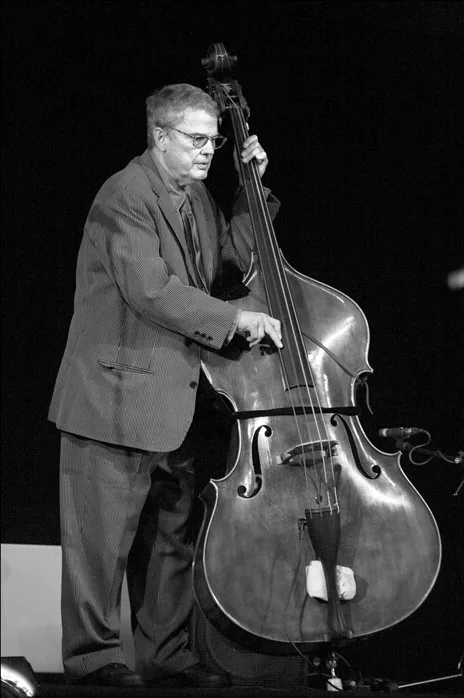
Charlie Haden, American jazz bassist, September 17, 2007. CC BY-SA 2.0 — Wikimedia Commons — https://commons.wikimedia.org/wiki/File:Charlie_Haden.jpg (photo by Geert Vandepoele)

Charles Edward Haden was born August 6, 1937, in Shenandoah, Iowa, into a family already on the radio: the Haden Family Band broadcast country and folk music over station KMA, and Charlie made his professional debut as a singer on the family's show at age two. He stayed a working singer in the group into his teens — yodeling, harmonizing, learning songs by ear — until bulbar polio struck at fifteen, paralyzing part of his throat and permanently weakening his voice. Unable to keep singing, he turned fully to the upright bass he'd already been fooling with, effectively rebuilding his musical identity around an instrument rather than a voice.
He moved to Los Angeles in 1957 to study composition, and instead found the city's underground jazz scene, then in ferment around pianist Paul Bley's group at the Hillcrest Club. Playing in Bley's band, Haden crossed paths with trumpeter Don Cherry and, decisively, with alto saxophonist Ornette Coleman, whose harmonically unmoored compositions were too radical for most working bassists of the era to follow. Haden could follow them, and more: rather than simply outlining Coleman's chord-less tunes, he began improvising counter-lines that moved independently of the horns, sometimes abandoning fixed harmony entirely to shadow the emotional shape of a solo instead. It was a fundamental break from the accompanist's role bass had played in jazz up to that point, and it became the technical foundation for everything Haden did afterward.
Haden, Cherry, Coleman, and drummer Billy Higgins recorded The Shape of Jazz to Come in Los Angeles in May 1959; the group then moved to New York and opened at the Five Spot Café that November, a residency that split the jazz world into believers and detractors and made the quartet's abandonment of fixed chord changes the decade's most argued-over development in the music. Change of the Century, cut the same year and released in 1960, extended the same language. Haden's tenure with Coleman was repeatedly interrupted — a heroin addiction that dated to his California years sent him in and out of the band and, at one low point, into Synanon, the Santa Monica addiction-recovery community, for treatment — but the association, and the vocabulary it gave him, defined the rest of his career even as he moved through dozens of other settings.
In 1969, with the Vietnam War and the era's liberation movements as an explicit backdrop, Haden formed the Liberation Music Orchestra, a large ensemble built around Spanish Civil War songs, orchestrated by pianist Carla Bley into a sound that fused free-jazz blowing with brass-band weight and folk melody. The self-titled debut, recorded that April with Cherry, Bley, Dewey Redman, Gato Barbieri, Roswell Rudd, and Paul Motian among others, doubled as a political statement: Haden dedicated it, in the sleeve notes, to a world without war, racism, and exploitation. He kept making the point on record — The Ballad of the Fallen (1983) drew on songs from the Spanish Civil War and revolutionary movements in El Salvador and Nicaragua — and once directly to a government: performing his composition "Song for Che" in Portugal in 1971 with Coleman's band and dedicating it onstage to independence movements in Portugal's African colonies, Haden was arrested and interrogated by agents of Portugal's fascist regime, and released only after an American cultural attaché intervened. The Liberation Music Orchestra reconvened only intermittently — roughly once a decade, around events serious enough to warrant it — through Not in Our Name (2005), an Iraq War-era Bley-arranged protest record, and Time/Life (Song for the Whales and Other Beings) (2016), an environmentally themed set finished shortly before Haden's death and released posthumously.
The 1970s and early '80s also brought Haden's deepest immersion in the ECM sound: Closeness (1976), a duo-album series pairing him one-on-one with Coleman, Keith Jarrett, Alice Coltrane, and Motian; membership in Old and New Dreams, the cooperative quartet of Coleman alumni (Cherry, Redman, Ed Blackwell) that kept playing Coleman's book without Coleman himself; and, starting with 1980's Magico, a trio with saxophonist Jan Garbarek and guitarist Egberto Gismonti that extended into Folk Songs (1981) and later reunions, exploring a spacious, folk-inflected group improvisation far from Ornette-quartet fire. That same year, on 80/81, Haden anchored a quartet led by a guitarist sixteen years his junior, Pat Metheny, alongside Jack DeJohnette, Redman, and Michael Brecker — a session guided as much by the two Missouri- and Midwest-rooted musicians' shared folk sensibility as by Coleman's harmonic freedom, and the start of a Haden-Metheny creative partnership that ran for two more decades. It resurfaced on Song X (1986), reuniting Haden with Coleman himself under Metheny's leadership for a ferocious, uncompromising free-jazz session, and again on the hushed, intimate duo record Beyond the Missouri Sky (Short Stories) (1997), which won the Grammy Award for Best Jazz Instrumental Performance and became one of the best-selling records either musician made.
Haden formed his second enduring band, Quartet West, in Los Angeles in the mid-1980s, with saxophonist Ernie Watts, pianist Alan Broadbent, and drummer Billy Higgins reuniting from the Coleman years. Where the Liberation Music Orchestra looked outward at politics, Quartet West looked backward at Los Angeles itself: a moody, film-noir-inflected book built from ballads, original compositions, and — on later records like Haunted Heart (1991) and American Dreams (2002) — vintage vocal samples and string arrangements evoking the city's postwar jazz and movie culture. Across the same decades Haden became one of the most widely deployed bassists in jazz, turning up as a sideman on John Scofield's Time on My Hands (1990) and Grace Under Pressure (1992), and building a substantial parallel catalog of Latin-inflected duo and small-group recordings with Cuban pianist Gonzalo Rubalcaba, including Nocturne (2001), which won the Grammy for Best Latin Jazz Album, and Land of the Sun (2004), which won a second.
Late in his career Haden closed a circle back to where he'd started: Rambling Boy (2008), credited to Charlie Haden Family & Friends, reunited him with his wife, singer Ruth Cameron, and all four of his children — including triplets Petra, Tanya, and Rachel Haden — for an album of country, bluegrass, and gospel material drawn from the Haden Family Band repertoire he'd grown up singing, with guests including Elvis Costello, Vince Gill, Rosanne Cash, and Metheny. Haden received a Recording Academy Lifetime Achievement Award in 2013 and was named a 2012 NEA Jazz Master, the United States' highest honor in the music. He had lived with post-polio syndrome — a late-onset return of muscle weakness in survivors of childhood polio — for decades, and its worsening in late 2010 ended his public performing, though he continued playing at home for friends and family. Charlie Haden died in Los Angeles on July 11, 2014, at age 76.
Haden's playing was built on a paradox: a bassist trained by ear on country and folk radio became the instrumentalist who most fully liberated jazz bass from strict harmonic duty, developing lines that moved with a soloist's freedom rather than a rhythm section's obligation during his years in Ornette Coleman's quartet. That same ear for plain, singable folk melody — inherited straight from the Haden Family Band — never left his playing; it surfaced as the emotional backbone of the Liberation Music Orchestra's political arrangements, the spacious folk-jazz of his ECM trio with Garbarek and Gismonti, and the deliberately unhurried, deep-toned ballad style that made him as recognizable a stylist as any saxophonist or pianist he worked with. Few bassists have moved as convincingly between free-jazz abstraction, protest music, film-noir mood pieces, and Latin balladry while sounding, in every setting, unmistakably like themselves.
- The Shape of Jazz to Come (1959, Atlantic, Ornette Coleman Quartet) - Recorded May 1959 with Coleman, Don Cherry, and Billy Higgins; the foundational free-jazz statement that established Haden's harmonically independent bass style. Spotify - The Shape Of Jazz To Come
- Liberation Music Orchestra (1969/1970, Impulse!) - His politically charged debut as a leader, arranged by Carla Bley around Spanish Civil War songs, recorded April 1969. Spotify - Liberation Music Orchestra Listen
- Magico (1980, ECM) - The first record from his trio with Jan Garbarek and Egberto Gismonti, a spacious, folk-rooted departure from the Coleman-quartet fire. Spotify - Magico Listen
- 80/81 (1980, ECM, Pat Metheny) - Anchored Metheny's Ornette-inflected quartet alongside Jack DeJohnette, Dewey Redman, and Michael Brecker; the start of Haden's long Metheny partnership. Spotify - 80/81 Listen
- The Ballad of the Fallen (1983, ECM) - Second Liberation Music Orchestra album, drawing on songs of the Spanish Civil War and Central American revolutionary movements. Spotify - The Ballad Of The Fallen Listen
- Song X (1986, Geffen, with Ornette Coleman & Pat Metheny) - Reunited Haden with Coleman under Metheny's leadership for an uncompromising free-jazz session. Spotify - Song X Listen
- Quartet West (1987, Verve) - Debut of his Los Angeles-set second band, with Ernie Watts, Alan Broadbent, and fellow Coleman-quartet alumnus Billy Higgins. Spotify - Quartet West Listen
- Beyond the Missouri Sky (Short Stories) (1997, Verve, with Pat Metheny) - Hushed duo record of standards and folk-rooted originals; won the Grammy for Best Jazz Instrumental Performance. Spotify - Beyond The Missouri Sky Listen
- Nocturne (2001, Verve, with Gonzalo Rubalcaba) - Cuban and Mexican boleros with Rubalcaba, Joe Lovano, David Sánchez, and Pat Metheny guesting; won the Grammy for Best Latin Jazz Album. Spotify - Nocturne Listen
- Not in Our Name (2005, Verve, Liberation Music Orchestra) - Carla Bley-arranged Iraq War-era protest record, recorded in Rome with guitarist Steve Cardenas. Spotify - Not In Our Name Listen
- Rambling Boy (2008, Decca, Charlie Haden Family & Friends) - A late-career return to his country and bluegrass roots, reuniting him with his wife Ruth Cameron and all four of his children. Spotify - Rambling Boy Listen
Charlie Haden: Full Discography (Landmark Leader / Co-Leader Recordings)
Identity confirmed via live Discogs API call: artist ID 253592 ("Charlie Haden"), distinct from the "Charlie Haden Quartet West" group entry (Discogs id 328283) and from his daughter Petra Haden's separate artist page (Discogs id 283376). Haden's total logged catalog as leader and sideman runs to more than 1,100 Discogs credits across a 55-year recording career (1958–2016); this table itemizes landmark albums as leader, co-leader, or Liberation Music Orchestra bandleader only. His extensive sideman work — including with Ornette Coleman, Keith Jarrett, John Scofield, and dozens of others — is covered in Personnel & Collaborations in final-profile.md, not duplicated here.
| Album Title | Recording Date(s) | Release Date | Label | Catalog Number | Format(s) | Personnel | Role | Reissue History | Spotify | Buy | Notes |
|---|---|---|---|---|---|---|---|---|---|---|---|
| Liberation Music Orchestra | April 27-29, 1969, Judson Hall, NYC | 1970 | Impulse! / ABC Records | AS-9183 | Vinyl, LP, Album, Stereo | Charlie Haden (double bass, sleeve notes), Carla Bley (piano, tambourine, arranged by), Don Cherry (cornet, flute), Dewey Redman (tenor/alto sax), Gato Barbieri (tenor sax, clarinet), Roswell Rudd (trombone), Michael Mantler (trumpet), Paul Motian (percussion), Andrew Cyrille (percussion), Perry Robinson (clarinet), Howard Johnson (tuba), Robert Northern (french horn), Sam Brown (guitar) | Leader | None found in this pass | Spotify - Liberation Music Orchestra | — | Conceived around Spanish Civil War songs; sleeve notes dedicate the album to a world without war, racism, and exploitation. Discogs master shows 1970; recording took place April 1969, hence the 1969/1970 date widely cited elsewhere |
| Magico | June 1979, Talent Studio, Oslo | 1980 | ECM Records | ECM 1151 | Vinyl, LP, Album, Stereo | Charlie Haden (bass), Egberto Gismonti (guitars, piano), Jan Garbarek (saxophones) | Co-leader (trio) | None found in this pass | Spotify - Magico | — | First of the Haden/Garbarek/Gismonti trio records; distinct from the trio's 2012 live reunion album Mágico: Carta de Amor |
| 80/81 | May 26-29, 1980, Talent Studios, Oslo | 1980 | ECM Records | ECM 1180/81 | Vinyl, 2xLP, Album, Stereo | Pat Metheny (guitar), Charlie Haden (bass), Jack DeJohnette (drums), Dewey Redman (tenor sax), Michael Brecker (tenor sax) | Sideman (co-billed) | Won the Deutsche Schallplattenkritik annual prize, 1981 | Spotify - 80/81 | — | Billed to Pat Metheny; Haden co-billed alongside DeJohnette, Redman, and Brecker |
| Folk Songs | November 1979, Talent Studios, Oslo | 1981 | ECM Records | ECM 1170 | Vinyl, LP, Album, Stereo | Charlie Haden (bass), Egberto Gismonti (8-string guitar, piano), Jan Garbarek (tenor/soprano sax) | Co-leader (trio) | None found in this pass | Not confirmed available as a standalone album on Spotify in this pass — only individual tracks and a fan playlist found; flagged unconfirmed rather than guessed | — | Second Haden/Garbarek/Gismonti trio record |
| The Ballad Of The Fallen | November 1982, Tonstudio Bauer, Ludwigsburg, Germany | 1983 | ECM Records | ECM 1248 | Vinyl, LP, Album, Stereo | Charlie Haden (bass), Carla Bley (piano, glockenspiel, arranged by), Don Cherry (pocket trumpet), Dewey Redman (tenor sax), Steve Slagle (clarinet, flute, alto/soprano sax), Jim Pepper (flute, tenor/soprano sax), Mick Goodrick (guitar), Paul Motian (drums, percussion), Sharon Freeman (french horn), Gary Valente (trombone), Michael Mantler (trumpet), Jack Jeffers (tuba) | Leader (Liberation Music Orchestra) | None found in this pass | Spotify - The Ballad Of The Fallen | — | Second Liberation Music Orchestra album; drew on songs of the Spanish Civil War and revolutionary movements in El Salvador and Nicaragua |
| Song X | December 12-14, 1985, The Power Station, NYC | 1986-04 | Geffen Records / Metheny Group Productions | GHS 24096 | Vinyl, LP, Album | Ornette Coleman (alto sax, violin), Charlie Haden (bass), Jack DeJohnette (drums), Denardo Coleman (drums, percussion), Pat Metheny (guitar, guitar synth) | Sideman (co-billed) | Reissued/expanded as Song X: The Complete Sessions (2005, Nonesuch) | Spotify - Song X | — | Billed to Pat Metheny and Ornette Coleman; reunited Haden with his original Coleman-quartet bandleader |
| Quartet West | December 22-23, 1986, Producers 1 & 2, Los Angeles | 1987 | Verve Records | 831 673-1 | Vinyl, LP, Album, Stereo | Charlie Haden (bass), Ernie Watts (alto/soprano/tenor sax), Alan Broadbent (piano), Billy Higgins (drums) | Leader | None found in this pass | Spotify - Quartet West | — | Debut of Haden's Los Angeles-set band, reuniting him with Ornette Coleman Quartet drummer Billy Higgins |
| In The Year Of The Dragon | March 1989, Sound Ideas, NYC | 1989 | JMT | 834 428-2 | CD, Album, Stereo | Geri Allen (piano), Charlie Haden (bass), Paul Motian (drums) | Co-leader (trio) | None found in this pass | Not confirmed as a standalone Spotify album in this pass — appears bundled within The Montreal Tapes collection rather than as its own release; flagged unconfirmed rather than guessed | — | Billed jointly to Allen, Haden, and Motian |
| Beyond The Missouri Sky (Short Stories) | 1996, Right Track Studio / Clinton Recording Studios, NYC | 1997 | Verve Records | 537 130-2 | CD, Album | Charlie Haden (bass), Pat Metheny (acoustic guitars and other instruments, on Linda Manzer-built guitars) | Co-leader (duo) | None found in this pass | Spotify - Beyond The Missouri Sky | — | Won the Grammy for Best Jazz Instrumental Performance; link cross-verified against the Pat Metheny profile's discography |
| Nocturne | August 27-31, 2000, Criteria/The Hit Factory, Miami | 2001-04-17 | Verve / Gitanes Jazz Productions | 013 611-2 | CD, Album | Charlie Haden (bass), Gonzalo Rubalcaba (piano), Ignacio Berroa (drums, percussion), David Sánchez (tenor sax), Joe Lovano (tenor sax), Pat Metheny (acoustic guitar), Federico Britos (violin) | Leader | None found in this pass | Spotify - Nocturne | — | Won the Grammy Award for Best Latin Jazz Album, 2002 |
| Not In Our Name | July 19-22, 2004, Studio Forum Music Village, Rome | 2005 | Verve Records | B0004949-02 | CD, Album | Charlie Haden (bass), Carla Bley (piano, arranged by), Miguel Zenón (alto sax), Chris Cheek (tenor sax), Tony Malaby (tenor sax), Michael Rodriguez (trumpet), Seneca Black (trumpet), Curtis Fowlkes (trombone), Steve Cardenas (guitar), Matt Wilson (drums), Sharon Freeman (french horn), Joe Daley (tuba) | Leader (Liberation Music Orchestra) | None found in this pass | Spotify - Not In Our Name | — | Third Liberation Music Orchestra studio album, an Iraq War-era protest record; personnel and Spotify link cross-verified against the Steve Cardenas profile |
| Rambling Boy | Jan-Apr 2008, Nashville / NYC / Burbank | 2008 | Decca | B0011639-02 | CD, Album | Charlie Haden (bass), Ruth Cameron (vocals, co-producer), Josh Haden (vocals), Rachel Haden (vocals), Tanya Haden (vocals, cello), Petra Haden (vocals), Jack Black (vocals), Pat Metheny (guitar), Elvis Costello (vocals), Vince Gill (vocals), Rosanne Cash (vocals), Ricky Skaggs (vocals, guitar, mandolin, banjo), Bruce Hornsby (vocals, piano), Béla Fleck (banjo), Sam Bush (mandolin), Stuart Duncan (fiddle), Jerry Douglas (dobro) | Leader (billed to Charlie Haden Family & Friends) | None found in this pass | Spotify - Rambling Boy | — | Return to the Haden Family Band's country/bluegrass/gospel repertoire; "Is That America (Katrina 2005)" earned a Best Country Instrumental Performance Grammy nomination |
Additional titles confirmed in Discogs's "Main" artist-credit list but not itemized above (scope note)
The following albums also carry Haden's "Main" (co-billed) artist credit on Discogs and represent real, additional landmark recordings, but were not itemized with full personnel in this pass given time constraints: The Golden Number (1977, A&M/Horizon), Closeness (1976, A&M/Horizon, duo series with Ornette Coleman, Keith Jarrett, Alice Coltrane, and Paul Motian), Old and New Dreams (1979, ECM, cooperative quartet of Coleman alumni), Dream Keeper (1990, Blue Note, Liberation Music Orchestra), Steal Away (1994, Verve, duo with Hank Jones), Land of the Sun (2004, Verve, second Grammy-winning Rubalcaba collaboration), and Time/Life (Song for the Whales and Other Beings) (2016, Impulse!, final Liberation Music Orchestra album, personnel confirmed via Discogs: Haden, Carla Bley, Steve Cardenas, Matt Wilson, Chris Cheek, Tony Malaby, and others — Haden's last studio recording, finished before his 2014 death and released posthumously).
Sideman highlights (selected, not exhaustive)
| Year | Project (Leader) | Title | Label | Role | Notes |
|---|---|---|---|---|---|
| 1959 | Ornette Coleman Quartet | The Shape of Jazz to Come | Atlantic | Bass | Recorded May 1959; foundational free-jazz album |
| 1959 | Ornette Coleman Quartet | Change of the Century | Atlantic | Bass | Released 1960 |
| 1990 | John Scofield | Time on My Hands | Blue Note | Bass | With Joe Lovano, Jack DeJohnette; confirmed via John Scofield profile |
| 1992 | John Scofield | Grace Under Pressure | Blue Note | Bass | With Bill Frisell; confirmed via John Scofield profile |
| 1992 | Pat Metheny | Secret Story | Geffen | Acoustic bass, tracks 1 & 8 | Confirmed via WebSearch cross-check; Steve Rodby and Will Lee cover bass on remaining tracks |
| 2002 | Charlie Haden's Liberation Music Orchestra | Live in Montreal (DVD) | Image Entertainment | Bass, conductor, arranged by | Confirmed via Discogs release data: personnel includes Ryan Kisor (trumpet), Joe Lovano and Javon Jackson (tenor sax), Bill Stewart (drums) |
| 2006 | Antonio Forcione | Heartplay | Naim Label | Double bass, composer | Duo album, not a sideman date in the usual sense but Haden's only own-name duo recording with an Italian guitarist; confirmed via Discogs release 2415069 (extraartists: Charlie Haden, double bass; Antonio Forcione, guitar) |
- Ornette Coleman - original quartet member from the late 1950s (The Shape of Jazz to Come, Change of the Century) through Song X (1986) and beyond; the formative relationship of Haden's career.
- Don Cherry and Billy Higgins - fellow Ornette Coleman Quartet members; Cherry also a Liberation Music Orchestra founding participant and Old and New Dreams bandmate, Higgins later a Quartet West co-founder.
- Carla Bley - arranger, conductor, and pianist for every Liberation Music Orchestra album from 1969's debut through Time/Life (2016).
- Pat Metheny - 80/81 (1980), Song X (1986), Secret Story (1992, tracks 1 and 8), Beyond the Missouri Sky (1997), and Rambling Boy (2008); profiled separately on JazzProfiles.com.
- Jan Garbarek and Egberto Gismonti - trio partners on Magico (1980) and Folk Songs (1981).
- Gonzalo Rubalcaba - extensive duo/small-group Latin jazz partnership, including Nocturne (2001, Grammy winner) and Land of the Sun (2004, Grammy winner).
- Ernie Watts, Alan Broadbent, Billy Higgins - Quartet West, formed mid-1980s, running through American Dreams (2002) and beyond.
- John Scofield - sideman credit on Time on My Hands (1990) and Grace Under Pressure (1992); profiled separately on JazzProfiles.com.
- Ryan Kisor - trumpeter on the Liberation Music Orchestra's Live in Montreal DVD (2002); profiled separately on JazzProfiles.com.
- Steve Cardenas - guitarist on the Liberation Music Orchestra's Not in Our Name (2005) and Time/Life (2016); profiled separately on JazzProfiles.com.
- Ruth Cameron and the Haden children (Josh, and triplets Petra, Tanya, and Rachel) - Rambling Boy (2008), a return to the Haden Family Band's country repertoire.
- Antonio Forcione (guitar) - duo partner on Heartplay (2006, Naim Label), an album of originals by both musicians plus Fred Hersch's "Child's Song"; profiled on JazzProfiles.com.
- Giancarlo Barigozzi (recording engineer) - credited as recording engineer on First Song (Soul Note 121222-2, 1992), per Discogs.
More Free Jazz Artists
See all 269 Free Jazz artists →More American Jazz Artists
See all 567 American artists →- Wikipedia: Charlie Haden
- Discogs: Charlie Haden - artist ID 253592, verified via live API call with no naming collisions against "Charlie Haden Quartet West" (328283) or Petra Haden (283376).
- The Washington Post: Charlie Haden, jazz bassist with Ornette Coleman and his own groups, dies at 76
- The Stranger: Ornette Coleman Bassist, Free-Jazz Catalyst Charlie Haden, 1937-2014
- Iowa Public Radio: Fresh Air's summer music interviews — Jazz great Charlie Haden
- National Endowment for the Arts: Charlie Haden
- Wikipedia: Rambling Boy (Charlie Haden album)
- Wikipedia: Nocturne (Charlie Haden album)
- Wikipedia: The Shape of Jazz to Come
- Spotify Web API / open.spotify.com - all album links above verified by direct page fetch (title, artist, and release-year match) before inclusion.